1609: Vicente Turixi, King of the Moriscos

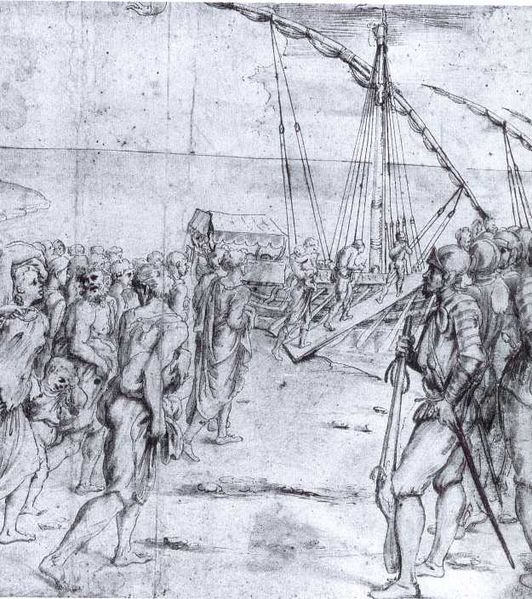
La Expulsión de los Moriscos, by Vincenzo Carducci (Vicente Carducho).

Having taken the trouble over the preceding century to eliminate (or force underground) its substantial Muslim population by forcibly converting it to Christianity, Spain in the early 1600s bethought itself to complete the operation upon its recently minted fellow-Christians by ejecting these Moriscos from Spain altogether.

When the edict for this radical act of expulsion first came down in the heavily Morisco area of Valencia, some of its victims reportedly embraced the prospect of deportation to a land where their dress, language, and religion were no longer forbidden.

Others were less sanguine.

Armed resistance broke out in two wilderness fastnesses, the mountainous Vall de Laguar (Spanish link) and — as narrated by Henry Charles Lea in his freely available The Moriscos of Spain; their conversion and expulsion —

the Muela de Cortes (Spanish link), an almost inexpugnable spot, being a deep valley surrounded by precipitous heights, of which the passes were easily defensible. The Moriscoes of that region … were in a state of excitement and were readily persuaded to rise by an outlaw named Pablillo Ubcar. They elected as king Vicente Turixi, who sent a proclamation through the sierra for all to join him under pain of treason. From their strongholds they made raids on the surrounding country, gathering cattle and provisions, burning villages, and desecrating churches.

[Ethnic cleansing coordinator Don Agustin] Mexia, absorbed in the work of embarkation and fearing to interrupt it, for awhile paid no attention to these movements … who could readily be reduced when the time came.

His provisions were justified … those of the Muela de Cortes … lost heart when they heard of the defeat of those of Aguar, and were disappointed as to the appearance of the Moor Alfatami on his green horse, whom tradition reported to be concealed under the mountain since the days of King Jayme … It was agreed that they [the rebels, surrendering] should be safe in person and property, provided they would go to embark within three days.

The rapacious soldiery, who had promised themselves abundant plunder, in their disappointment threw off all discipline; they sacked the village of Royaya, outraged the women and seized numbers of children as slaves. Only three thousand Moriscoes were brought to the port of embarkation, the rest having scattered and taken to the mountains to escape the fury of the soldiers.

These, estimated at two thousand in number, for several years gave infinite trouble, killing all the Christians they met and committing constant depredations. At one time the Governor of Jativa induced many of them to come down, but finding that they were to be enslaved they fled back to the mountains.

A reward was offered for King Turixi, dead or alive; he was tracked to a cave, captured, and brought to the city, when he was sentenced to have hands and ears cut off, to be drawn, torn with pincers, hanged and quartered; but at the execution, December 18th, the cutting of hands and ears was omitted. He had been confessed twice and reconciled twice, and died as a good Christian, making a most edifying end, for we are told that he had been a liberal almsgiver and devoted to the Virgin and the religious Orders.

The miserable remnants were hunted down gradually, the viceroy paying twenty ducats a head for them as galley-slaves.

The armed resistance in Valencia — where Moriscos were most numerous, and the expulsion was first decreed — was actually much less than had been feared, which gave the Spanish authorities all the encouragement they would need to enforce it elsewhere, too.

“Seeing that the whole body of our nation is tainted and corrupt, he applies to it the cautery that burns rather than the salve that soothes; and thus, by prudence, sagacity, care and the fear he inspires, he has borne on his mighty shoulders the weight of this great policy and carried it into effect, all our schemes and plots, importunities and wiles, being ineffectual to blind his Argus eyes, ever on the watch lest one of us should remain behind in concealment, and like a hidden root come in course of time to sprout and bear poisonous fruit in Spain, now cleansed, and relieved of the fear in which our vast numbers kept it.”

-Cervantes, Don Quixote

On this day..

1818: Abdullah ibn Saud, last ruler of the first Saudi state

On this date in 1818, the last ruler of the first state established by the Al Saud who rule the modern state of Saudi Arabia lost his head to the Ottoman Sultan.

The Ottoman state and its (largely independent) vassal Egypt begged to dispute the Wahhabi tribe’s authority in the Arabian peninsula (and its proclivity for raiding Ottoman caravans) and made war on the House of Saud throughout the 1810’s.

The Battle of ad-Dir’iyah in 1818 settled the matter, with our day’s principal Abdullah I surrendering to the Egyptian general Ibrahim Pasha.

We pick up the action from the third-hand, well-after-the-fact reports of the London Times. This, printed on Jan. 16 1819 under the “German Papers” heading:

FROM THE TURKISH FRONTIERS, DEC. 16.

The last victory over the Wechabites puts an end to the war at once. Ibrahim Pacha, who commanded the Turkish army, sends the captive Abdallah to Constantinople, but he first had his head shaved, and all his teeth pulled out.

On Feb. 6, the Times channeled the Dutch and Flanders mail:

Intelligence from Constantinople, dated the 24th December, states, that the Chief of the Wechabites, Abdallah, and his Iman, were brought prisoners into that capital on the 16th of the same month. After being led, in chains, through the principal streets, they were taken to prison and put to the torture. On the following morning, they were brought before the Sultan and beheaded. Their naked bodies were exposed during three days, and then delivered to the populace.

In addition to Abdullah himself, this affair finished off the city of Diriyah as a Saudi capital.

But of course, the Saud and their state were just getting started.

On this day..

1520: Hemming Gadh

On this date in 1520, Hemming Gadh was beheaded at Raseborg Castle, Finland for his support of Swedish independence from Denmark.

Gadh (English Wikipedia entry | Swedish | free Swedish biography), around 70 by this time, had had a colorful, opportunistic career in Swedish politics. And religion: he was once temporarily Bishop of Linkoping, but could not win papal approval for the post and got excommunicated a few years later.

A Gadh-fly to the Danish-run Kalmar Union, he was a longtime supporter of Swedish independence agitator Sten Sture the Elder — so much so that when Sten kicked the bucket in 1503, it was Gadh who spiked the story and sent a squire disguised as the late statesman running off to Stockholm to rally his successors before the opposition could capitalize on the situation. (Sweden: The Nation’s History, by Franklin D. Scott)

Gadh was a key figure holding the Swedish party together in a decade-long interregnum until Sten Sture the Younger was up to the task.

And young Sten’s arrival was just in time, because around 1518, Gadh got captured, went over to the Unionist party, and helped it capture Stockholm … precipitating an infamous bloodbath.

Danish King Christian II evidently didn’t trust this turncoat any further than he could throw him, however, which was quite a bit further when he was cut in two. The opportunism that had served Gadh so well for so long this time cost him his head. (Swedish link.)

When in Finland, you can still see the dramatic former island keep where it all went down:


Raseborg Castle (Finnish: Raaseporin linna, Swedish: Raseborgs slott) in Ekenas.

(More information here)

On this day..

1983: John Eldon Smith, mafioso Willy Loman

On this date in 1983, Georgia’s electric chair* got its first use in 19 years.

The Headsman is not a theologian, but does believe John Eldon Smith’s quotable last words —

Well, the Lord is going to get another one.

— would be conditioned on the Lord’s policy on crimes like this:

Joseph [Ronald] Akins’ former wife, appellant Rebecca Akins Smith Machetti, together with her husband, appellant John Eldon Smith, a/k/a Anthony Isalldo Machetti, a/k/a Tony Machetti** … plotted the death of Joseph Akins with the intent of redeeming the proceeds of Akins’ insurance policies, and other benefits, the beneficiaries of which were Mrs. Machetti and her three daughters by her marriage to Akins … appellant Tony Machetti drove to Macon, Georgia … contacted Ronald Akins and lured him into the area of the crime, ostensibly to install a television antenna … when he and his wife arrived at the appointed time the appellant Tony Machetti killed both of them with a shotgun.

Trial testimony against Smith said that the insurance salesman was hoping with his shotgun-slaying prowess to become a made man.

And the supposed last words, it should be noted, are not apparent on the secret audio recording of the execution, available here, although the religious theme presents itself in the form of a Catholic benediction. The rest is all clinical efficiency, a far cry from the next year’s dreadful botch.

The Dec. 16, 1983 New York Times report — executions were still oddities that drew national coverage at this time — quoted a witness remarking on the “antiseptic and sterile” process, which the Times writer described thus:

A square of material was draped over Mr. Smith’s face and a leather-strapped cap containing an electrode was placed over his head.

So tightly was he strapped to the chair, witnesses said, it was difficult to tell when the three unidentified executioners pressed three small buttons, one of which sent 2,000 volts of electricity through the condemned man’s body for two minutes. According to prison tradition, none of the executioners knew if his was the lethal button.

Far more noteworthy than either the day’s procedure or its subject was the context of a noticeably accelerating execution pace.

From resumption of executions in 1977 through 1982, there had been only six people put to death in the U.S.; Smith capped a year with five more, including back-to-back days (Robert Wayne Williams had been electrocuted in Louisiana on December 14).

Anti-death penalty lawyer and activist Henry Schwarzschild was quoted in the article bemoaning “a new period where executions are utterly likely” and prophesying 30 to 50 in the year ahead thanks to prisoners’ appeals expiring.

There were, in the event, 21 American executions during the ensuing twelvemonth, almost tripling the country’s total up to that time; the annual total has never since 1983 returned to single digits.

* One of several electric chairs named “Old Sparky”

** The non-wiseguy name’s similarity to a John McCain alias is presumably pure coincidence.

On this day..

10 executions that defined the 2000s

With the turn of the tide to the 2010s, we bid farewell to a decade that never did get a consensus moniker.

Like every decade known to the historian’s annals, however, the Aughties found plenty of work for the world’s hangmen.

As we prepare to flip over the calendar, Executed Today remembers ten executions that most palpably captured the decade’s Zeitgeist.

10. Dhananjoy Chatterjee, 2004

Although the world’s second-most populous country retains the death penalty and has dozens of death row denizens, an entire generation of Indians has come of age having never known an actual execution … never, except for the 2004 hanging of Dhananjoy Chatterjee (Update: Not any more). That made this otherwise ordinary criminal a worldwide controversy, and his archaic colonial-era hangman a temporary celebrity.

9. Aileen Wuornos, 2002

Two years after the magnetic prostitute/serial killer was given a lethal injection in Florida, Charlize Theron won an Oscar for portraying her in Monster.

8. Wang Binyu, 2005

This migrant laborer was just grist for the mill of China’s helter-skelter industrialization in the neoliberal economic machine … until, in a fury over wages stolen by his employer, he slew a foreman. Chinese media that picked up his story inadvertently made him an emblematic figure for the untold millions of his countrymen and -women who could sympathize with his sentiment: “I want to die. When I am dead, nobody can exploit me anymore. Right?” Internet buzz about Wang had to be forcibly squelched.

7. Timothy McVeigh, 2001

The Gulf War veteran was the face of terrorism in the U.S. from the time of his arrest for the 1995 bombing of Oklahoma City’s Murrah Federal Building, until three months after his June 11, 2001, execution.

6. Mahmoud Asgari and Ayaz Marhoni, 2005

Heart-rending photos of these teenagers hanging in Iran were a worldwide Internet sensation and made them an instant symbol of Iranian anti-gay persecution.

5. Mamoru Takuma, 2004

“I want others to know the unreasonableness that high-achieving children could be killed at any time,” said the author of perhaps the most infamous crime spree in modern Japanese history. The usually glacial Japanese capital system got the former janitor into a noose barely three years after he’d knifed eight children to death in the “Osaka school massacre”.

4. Cameron Todd Willingham, 2004

Something tells us that the ornery Texan — he took his leave of the world throwing an obscene gesture at his former wife from his execution gurney — would have been but pleasantly surprised to discover himself a major posthumous headache for Gov. Rick Perry (who signed his death warrant) and like-minded partisans of pseudoscience arson convictions. The sad part is that the evidence of Willingham’s potential innocence in the recent bombshell New Yorker article was basically all available at the time of his execution.

Rediscovery (with touching, or feigned, naivete) of the timeless problematic of executing innocents has characterized the 2000s not only in the U.S. but around the world.

3. The Bali Bombers, 2008

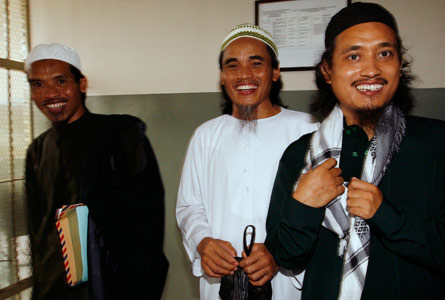
These grinning Islamic militants orchestrated the 2002 coordinated triple bombing on the Indonesian resort island of Bali that killed 202, most of them western tourists. (88 were Australians, the predominant nationality affected, as against only 38 Indonesians.) Then they spent six years gleefully milking their notoriety.

2. Zheng Xiaoyu, 2007

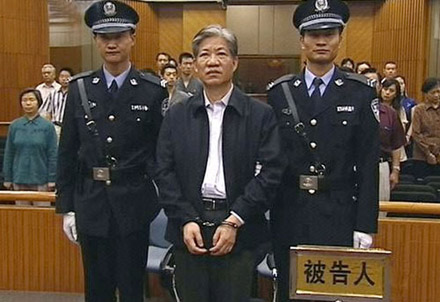
Zheng Xiaoyu hears his death sentence.

While proletarians like Wang Binyu died for pennies and many like Fu Xinrong died for their organs, the more privileged in China’s gangster capitalism played for higher stakes. For a decade the state’s Food and Drugs Minister, Zheng Xiaoyu took payola to rubber-stamp products that turned out to be dangerous to man and beast. His high-profile execution was Beijing’s response to a wave of concern about the safety of Chinese exports abroad … and a pledge, one year in advance of the 2008 Olympics, of China’s readiness for the world stage.

Zheng aside, elites behaving as gangsters (and vice versa) have been a recurring phenomenon on China’s execution grounds of late.

1. Saddam Hussein, 2006

Undoubtedly the decade’s signature execution, the 2006 hanging by America’s Iraqi puppet government of America’s longtime foreign policy bete noir was purchased for trillions that would have been better spent just buying the guy off … especially since cell phone video soon to circle the globe revealed the old rattlesnake taking command of a distinctly undignified scene.


Honorable Mentions

Some other notable executions to remember the 2000s by:

  • Creepy Malaysian pop singer Mona Fandey
  • Anti-abortion terrorist/martyr Paul Hill
  • Dmitry Chikunov, whose secret execution launched his mother on the crusade that would abolish Uzbekistan’s death penalty
  • Draconian anti-drug laws ensnaring foreign drug mules, like Australian national Nguyen Van Van and Nigerian footballer Iwuchukwu Amara Tochi in Singapore, and mentally ill Briton Akmal Shaikh in China
  • Vietnamese crime lord Nam Cam
  • Han Bok-nam, whose public shooting in North Korea was filmed and smuggled out of the country
  • The filmed stoning of Du’a Khalil Aswad in Iraq
  • Many people, such as Italian journalist Enzo Baldoni, taken hostage in Iraq and demonstratively “executed”

On this day..

1971: Martyred Intellectuals’ Day in Bangladesh

This date’s observance marks the systematic execution by (West) Pakistani forces of the intellectual class of East Pakistan at the end of the civil war which would detach the east as the independent nation Bangladesh — an unavenged war crime as cynical as it was brutal.


Executed intellectuals in the Dhaka Rayerbazar, 1971.

This was not a single discrete massacre, but a continuing policy during the March-December 1971 war. December 14, just two days before the Pakistani army surrendered, was the peak date of a dreadful endgame paroxysm that saw hundreds of scholars, teachers, lawyers, doctors, artists, writers, engineers, and the like rounded up and summarily executed in a bid to decapitate the new Bengali state’s intelligentsia.

Though the martyrs were subsequently venerated in Bangladesh, the higher-stakes regional geopolitics have always made effective redress a nonstarter.

On this day..

1777: Rev. Benjamin Russen, child rapist

On this date in 1777, crying out “Stand clear! Look to yourselves! I am the first hypocrite in Sion!”, a clerical schoolmaster was hanged at Tyburn for raping one of his charges.

Ann (or Anne) Mayne testified that the reverend had raped her when she was 9 and 10 years old (the girl was only 10 at the time of the trial). Russen ducked similar charges leveled by three other girls. Rachael Davis, for instance,

said, he lay upon her; but she did not declare, that he entered her body: I told the parties, that no one need be bound over, for it did not appear capital, as she did not say her body was entered.

Result: acquittal. (I’m sure you’ll feel good about entrusting your Bethnal-Green charity school child to Rev. Russen after that.)

Three acquittals out of four ain’t bad.

But it only took one conviction to hang him.

The Old Bailey Online record of Russen’s trial is full of dickering over penetration degrees, and of course, hymen breakage (or lack thereof).

According to this Treatise of the Pleas of the Crown,* the judge in the Mayne case

left it to the jury whether any penetration were proved; for if there were any, however small, the rape was complete in law. The jury found him guilty, and he received judgment of death. But before the time of execution, the matter being much discussed, the learned Judge reported the case to the other judges for their opinions, whether his direction were proper. And upon a conference it was unanimously agreed … that the direction of the Judge was perfectly right. They held, that in such cases the least degree of penetration is sufficient, though it may not be attended with the deprivation of the marks of virginity. It was therefore properly left to the jury by the Judge, and accordingly the prisoner was executed.

* Part of Edward Hyde East’s project in this Treatise is to argue against a standard still used in some jurisdictions that ejaculation was required to constitute a rape. See Passion and Power: Sexuality in History.

On this day..

1831: Gen. Jose Maria Torrijos y Uriarte and his liberal followers

On this date in 1831, one of the great Spanish liberal officers was shot along with dozens of comrades attempting to spark a revolution.

It was a dark time for Spanish liberals under the autocratic rule of Ferdinand VII.

Jose Maria Torrijos y Uriarte (Spanish Wikipedia page) was one of the heroes of that downtrodden cause from way back, a noble-born officer who had been made a captain at the precocious age of 13 and been around for all of Spanish liberalism’s greatest early 19th century tragedies.

He was in Madrid for the ill-fated uprising against its French occupiers in 1808, and was captured en route to aid Pedro Velarde‘s last stand.

Lucky for Torrijos, and luckier still: as a prisoner, he might have been in line for the ensuing mass execution, but an aide-de-camp of General Murat let him go in gratitude for chivalrously preserving a French officer from the Spanish mob.

A few years after the Peninsular War, with independent Spain yoked to a reactionary Bourbon-backed monarchy, Torrijos’ dangerous opinions made him a prisoner once more.

This time, he was liberated by the brief ascendancy of fellow-traveler Rafael del Riego. This effusion, too, was destined for grief upon the scaffold; once more, Torrijos escaped, this time to exile.


The execution of Rafael del Riego

Pushing forty and a bit emptyhanded for all his strivings, Torrijos’ restless soul was not satisfied knocking about the shores of England. He soon assembled a company of like-minded folk (such as Robert Boyd) to make another bid at liberating Iberia. But he was induced to put ashore under the misapprehension of support, and promptly rounded up.

The Malaga governor’s message to Madrid requesting instruction returned the simple order: shoot them all.* (Spanish link)


El fusilamiento de Torrijos y sus compañeros en la playa de Málaga, by Antonio Gisbert

“A la muerte de Torrijos y sus compañeros”
by José de Espronceda (from here (pdf))

Helos allí: junto a la mar bravía
cadáveres están ¡ay! los que fueron
honra del libre, y con su muerte dieron
almas al cielo, a España nombradía.

Ansia de patria y libertad henchía
sus nobles pechos que jamás temieron,
y las costas de Málaga los vieron
cual sol de gloria en desdichado día.

Españoles, llorad; mas vuestro llanto
lágrimas de dolor y sangre sean,
sangre que ahogue a siervos y opresores,

y los viles tiranos con espanto
siempre delante amenazando vean
alzarse sus espectros vengadores.


Monument to Torrijos at Malaga’s Plaza de la Merced.

* Around 50 or so were shot. The exact figure is differently accounted by various sources; I have been unable to determine if any among them are authoritative.

On this day..

1541: Thomas Culpeper and Francis Dereham, the Queen’s lovers

Indictment:

That Katharine, queen of England, formerly called Kath. Howerd, late of Lambyth, Surr., one of the daughters of lord Edmund Howard, before the marriage between the King and her, led an abominable, base, carnal, voluptuous, and vicious life, like a common harlot, with divers persons, as with Francis Derham of Lambeth and Hen. Manak [Manox] of Streteham, Surr., 20 and 24 May 32 Hen. VIII., and at other times, maintaining however the outward appearance of chastity and honesty. That she led the King by word and gesture to love her and (he believing her to be pure and chaste and free from other matrimonial yoke) arrogantly coupled herself with him in marriage. And the said Queen and Francis, being charged by divers of the King’s Council with their vicious life, could not deny it, but excused themselves by alleging that they were contracted to each other before the marriage with the King;* which contract at the time of the marriage they falsely and traitorously concealed** from the King, to the peril of the King and of his children to be begotten by her and the damage of the whole realm. And after the marriage, the said Queen and Francis, intending to renew their vicious life, 25 Aug. 33 Hen. VIII., at Pomfret, and at other times and places, practised that the said Francis should be retained in the Queen’s service; and the Queen, at Pomfret, 27 Aug. 33 Hen. VIII., did so retain the said Francis, and had him in notable favour above others, and, in her secret chamber and other suspect places, spoke with him and committed secret affairs to him both by word and writing, and for the fulfilling of their wicked and traitorous purpose, gave him divers gifts and sums of money on the 27 Aug. and at other times.

Also the said Queen, not satisfied with her vicious life aforesaid, on the 29 Aug. 33 Hen. VIII., at Pomfret, and at other times and places before and after, with Thos. Culpeper,† late of London, one of the gentlemen of the King’s privy chamber, falsely and traitorously held illicit meeting and conference to incite the said Culpeper to have carnal intercourse with her; and insinuated to him that she loved him above the King and all others. Similarly the said Culpeper incited the Queen. And the better and more secretly to pursue their carnal life they retained Jane lady Rochford, late wife of Sir Geo. Boleyn late lord Rochford, as a go-between to contrive meetings in the Queen’s stole chamber and other suspect places; and so the said Jane falsely and traitorously aided and abetted them.

On this date in 1541, Thomas Culpeper and Francis Dereham paid the penalty for their indiscretions; the former queen would see her lovers’ severed heads mounted on pikestaffs on London Bridge as she was rowed to the Tower.

The onetime court favorite Culpeper was beheaded for cuckolding the royal person, and that’s no more than one would expect. But the political pull-less Dereham — who had slept with (and possibly “pre-contracted” to wed) the willing young Kate before she meant anything to the king — enjoyed the full measure of the traitor’s torture: hanged, emasculated, eviscerated, and dismembered, all of it basically for having failed to anticipate that his little conquest would one day grow up to turn the monarch’s head.

What a time to be alive.

* Catherine Howard’s confessional letter to Henry VIII … desperately attempting to limit her indiscretions to the time before her marriage:

I, your Grace’s most sorrowful subject and most vile wretch in the world, not worthy to make any recommendation unto your most excellent Majesty, do only make my most humble submission and confession of my faults. And where no cause of mercy is given on my part, yet of your most accustomed mercy extended unto all other men undeserverd, most humbly on my hands and knees do desire one particle thereof to be extended unto me, although of all other creatures I am most unworthy either to be called your wife or subject.

My sorrow I can by no writing express, nevertheless I trust your most benign nature will have some respect unto my youth, my ignorance, my frailness, my humble confession of my faults, and plain declaration of the same, referring me wholly unto Your Grace’s pity and mercy. First, at the flattering and fair persuasions of Manox, being but a young girl, I suffered him a sundry times to handle and touch the secret parts of my body which neither became me with honesty to permit, nor him to require. Also, Francis Derehem by many persuasions procured me to his vicious purpose, and obtained first to lie upon my bed with his doublet and hose, and after within the bed, and finally he lay with me naked, and used me in such sort as a man doth his wife, many and sundry times, and our company ended almost a year before the King’s Magesty was married to my Lady Anne of Cleves and continued not past one quarter of a year, or a little above.

Now the whole truth being declared unto Your Majesty, I most humbly beseech you to consider the subtle persuasions of young men and the ignorance and frailness of young women. I was so desirous to be taken unto your Grace’s favor, and so blinded by with the desire of worldly glory that I could not, nor had grace to consider how great a fault it was to conceal my former faults from your Majesty, considering that I intended ever during my life to be faithful and true unto your Majesty ever after. Nevertheless, the sorrow of mine offenses was ever before mine eyes, considering the infinite goodness of your Majesty toward me from time to time ever increasing and not diminishing. Now, I refer the judgment of my offenses with my life and death wholly unto your most benign and merciful Grace, to be considered by no justice of your Majesty’s laws but only by your infinite goodness, pity, compassion and mercy, without which I acknowledge myself worthy of the most extreme punishment.

** Early the next year, parliament declared, “to avoid doubts in future” — read: “retroactively legislated” — that “an unchaste woman marrying the King shall be guilty of high treason.” This also made anyone who knew about said unchastity guilty of (at least) misprision of treason for failing to report it.

† Surviving letter from Howard to Culpeper:

Master Culpeper,

I heartily recommend me unto you, praying you to send me word how that you do. It was showed me that you was sick, the which thing troubled me very much till such time that I hear from you praying you to send me word how that you do, for I never longed so much for a thing as I do to see you and to speak with you, the which I trust shall be shortly now. That which doth comfortly me very much when I think of it, and when I think again that you shall depart from me again it makes my heart die to think what fortune I have that I cannot be always in your company. It my trust is always in you that you will be as you have promised me, and in that hope I trust upon still, praying you that you will come when my Lady Rochford is here for then I shall be best at leisure to be at your commandment, thanking you for that you have promised me to be so good unto that poor fellow my man which is one of the griefs that I do feel to depart from him for then I do know no one that I dare trust to send to you, and therefore I pray you take him to be with you that I may sometime hear from you one thing. I pray you to give me a horse for my man for I had much ado to get one and therefore I pray send me one by him and in so doing I am as I said afor, and thus I take my leave of you, trusting to see you shortly again and I would you was with me now that you might see what pain I take in writing to you.

Yours as long as life endures,
Katheryn.

One thing I had forgotten and that is to instruct my man to tarry here with me still for he says whatsomever you bid him he will do it.

Though this letter is far from conclusively inculpatory, Culpeper confessed that he “intended and meant to do ill with the queen and that in like wise the queen so minded to do with him.”

On this day..

2007: Seven Tuareg and Arab civilians

On this date two years ago, seven civilians were apparently summarily executed by Niger security forces in that country’s long-running internal conflict with its Tuareg population.

Extrajudicial executions have been a recurring event (among the other usual charms of warfare) in Niger’s fight against the Mouvement des Nigériens pour la Justice (MNJ).

Amnesty International charged that these were among 13 civilians executed in a four-week span, possibly in retaliation for MNJ armed attacks.

A close relative of one of the dead told Amnesty International: “We were waiting for our relatives in Agadez when we saw their vehicles arrive driven by soldiers. We asked them where our relatives were. They refused to answer and then, as we insisted, they agreed to drive us to the place where the seven were buried.”

The people who identified the bodies said that they saw numerous signs on the victims of cigarette burns and whipping as well as many bullet wounds to the face and chest.

The nomadic Tuareg people of Niger’s (and neighboring Mali’s) northern Sahara territories have a long-running history of rebellion against the southerly federal government stretching back into the colonial period. (There’s a very detailed pdf paper on the subject here.)

These executions, which also swept up Arab businessmen, were part of the most recent (as of this writing) incarnation, a 2007-2009 campaign that seems ostensibly to have simmered down for now.

But the lucrative, contentious, and damaging (to the Tuareg) uranium mining industry that fuels the conflict (and that put Niger in the American news for the Bush administration’s duplicitous attempt to impute nuclear ambitions to Iraq in order to justify invading) still remains … and that fact seems to promise more bloodshed yet to come.

On this day..