1947: Shigematsu Sakaibara, “I obey with pleasure”

In the evening of June 18, 1947,* six convicted Japanese war criminals were hanged** by the U.S. Navy War Crimes Commission on Guam.
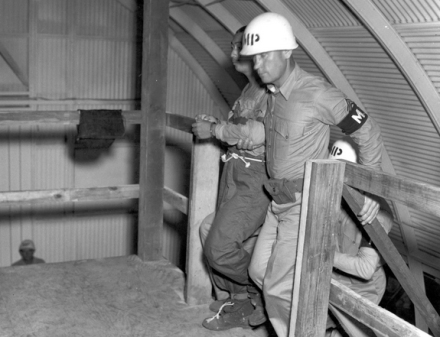

An unidentified Japanese prisoner ascends the gallows on Guam.

The most lastingly notable of the six was Rear Admiral Shigematsu Sakaibara, who was hanged for ordering (and perhaps in one instance, personally conducting) an infamous mass execution on Wake Island that has already appeared in these pages.

According to Judgment at Tokyo:

For some, the hanging of one of these six men had been a horrible tragedy and perhaps even a mistake. Rear Adm. Shigematsu Sakaibara had enjoyed the reputation of “gentleman soldier” and protector of the common man. Hailing from a wealthy family near Misawa in Tohokhu province, some 450 miles north of Tokyo, Sakaibara never forgot his roots. Forever poking fun at the fast-paced Tokyo lifestyle, the rear admiral touted the value of rural living, the integrity and honesty of those who lived in Japan’s rugged north country, and Tokyo’s need to recognize their great contributions to the war effort. Contemplating a postwar political future, he would be following in the footsteps of his politically influential family in northern Japan. That future was linked to championing the rights of returning veterans and other have-nots. Misawa had indeed had a heroic reputation as an important navy town and base for years. Sakaibara had assisted in the training exercises held there for the Pearl Harbor attack plan in late 1941. His future seemed golden no matter who won the war. But what some in his command called “The 1943 Incident” changed all that.
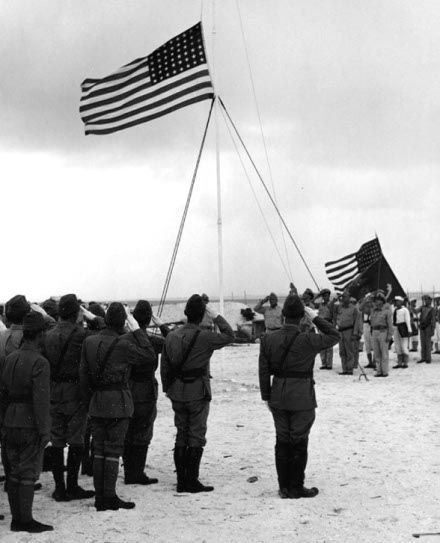

Shigematsu Sakaibara (right foreground) surrendering Wake Island on September 4, 1945.

These events, Sakaibara admitted in his trial, had taken place in an atmosphere of near starvation and impending doom. The defense counsel especially emphasized that point, asking the commission to understand and respect the pressures and strains on Sakaibara at the time of the incident. But the commission was not in a forgiving mood. In the chaos of retreat or not, innocent civilians had been murdered.

… Unfortunately for Sakaibara, several members of his former command expressed surprise on the witness stand when asked about the desperate situation on Wake in 1943. These men insisted that Sakaibara and his defense team’s description of a starving, chaotic Wake was an exaggerated one. There had been no unexpected miseries, confusion, or sense of peril, they said. Sakaibara’s fate was sealed.

True to form, defendant Sakaibara offered a very literate final statement to the commission. In contrast to so many of his colleagues on trial in Tokyo, on Guam, or elsewhere, Sakaibara, albeit with carefully picked words, admitted he was guilty of rash and unfortunate actions. He appeared especially convincing when he noted that he wished he had never heard of Wake Island. But his most memorable comments involved his own view of morality in war. A nation that drops atom bombs on major cities, the rear admiral explained, did not have the moral authority to try so many of his countrymen. With Hiroshima and Nagasaki in mind, Sakaibara claimed there was little difference between himself and the victors over Japan. With that statement a legend grew, particularly in his home town, of Sakaibara, the victim of American revenge.

… As late as the 1990s, some people there, not necessarily of the World War II generation, still bowed in reverence to Sakaibara family members out of respect for the “sacrificed” gentleman soldier.

His last words:

I think my trial was entirely unfair and the proceeding unfair, and the sentence too harsh, but I obey with pleasure.

* Some sources places the executions on June 19; the U.P. wire story, dated June 19th, referred to the hangings occurring “last night,” and the preponderance of evidence I have been able to locate appears to me to support the 18th rather than the 19th.

** An interesting bit of interservice-rivalry color on proceedings in Guam, courtesy of Prisoners of the Japanese:

The United States Navy had hanged fewer than a handful of men in more than a hundred years … Now on Guam they had all kinds of Japanese to try and sentence to death … They had to requisition an Army executioner to show them how to hang. He was a lieutenant with silver-rimmed glasses, a leading-man moustache, and a paunch. He used the traditional British drop formula, but he was an innovator as well: He invented a method of lowering the dead body to the stretcher without having to cut the rope.

On this day..

1795: The last Montagnards

On this date in 1795, the Mountain that had so recently dominated revolutionary France was destroyed by the blade.

This largely forgotten date is actually a significant milestone of those years’ imbroglio: the date on which the French bourgeoisie achieved its revolution by slaying the last sans-culottes-affiliated deputies in punishment for the last sans-culottes uprising.

In the year since the fall of Robespierre, a White Terror had purged his former adherents — or in class terms, had put Madame Guillotine to work pushing the Paris working class out of its former political authority.

The latter’s last hurrah of resistance was the Prairal Rebellion of May 20, 1795, when a mob stormed the Convention.

In the florid narration of Thomas Carlyle,

[I]t billows free through all Corridors; within and without, far as the eye reaches, nothing but Bedlam, and the great Deep broken loose! … Insurrection rages; rolls its drums; will read its Paper of Grievances, will have this decreed, will have that.

… National Representation, deluged with black Sansculottism, glides out; for help elsewhere, for safety elsewhere; here is no help.

About four in the afternoon, there remain hardly more than some Sixty Members: mere friends, or even secret leaders; a remnant of the Mountain-crest, held in silence by Thermidorian thraldom. Now is the time for them; now or never let them descend, and speak! They descend, these Sixty, invited by Sansculottism: Romme of the New Calendar, Ruhl of the Sacred Phial, Goujon, Duquesnoy, Soubrany, and the rest. Glad Sansculottism forms a ring for them; Romme takes the President’s chair; they begin resolving and decreeing. Fast enough now comes Decree after Decree, in alternate brief strains, or strophe and antistrophe, — what will cheapen bread, what will awaken the dormant lion. And at every new decree,* Sansculottism shouts “Decreed, decreed!” and rolls its drums.

Fast enough; the work of months in hours, — when see, a Figure enters … And then Gilt Youth, with levelled bayonets, countenances screwed to the sticking-place! Tramp, tramp, with bayonets gleaming in the lamp-light: what can one do, worn down with long riot, grown heartless, dark, hungry, but roll back, but rush back, and escape who can? The very windows need to be thrown up, that Sansculottism may escape fast enough. Money-changer Sections and Gilt Youth sweep them forth, with steel besom, far into the depths of Saint-Antoine. Triumph once more! The Decrees of that Sixty are not so much as rescinded; they are declared null and non-extant. Romme, Ruhl, Goujon and the ringleaders, some thirteen in all, are decreed Accused. Permanent-session ends at three in the morning. Sansculottism, once more flung resupine, lies sprawling; sprawling its last.

The so-called Cretois were hailed before a tribunal; six were condemned to death on this date.**

They dramatically attempted to cheat the headsman by stabbing themselves after the trial, somehow passing down the line without intervention a single knife smuggled by Goujon.

Three of them died of their self-inflicted injuries. The other three went immediately to the guillotine.

“They were,” Carlyle concludes, “the Ultimi Romanorum … Sansculottism sprawls no more. The dormant lion has become a dead one; and now, as we see, any hoof may smite him.”

* According to A Popular History of France from the First Revolution to the Present Time, one of the decrees was abolition of the death penalty “except in the case of emigrants and forgers of assignats.”

** Other less treasonably culpable former Montagnards who had not cast their lot squarely with the Thermidorians were proscribed or otherwise cut off from power in the aftermath of the Prairal rebellion.

On this day..

1944: Marc Bloch, French historian

On this date in 1944, the Gestapo shot French historian Marc Bloch among a batch of Resistance members.

When war broke out between France and Germany in 1939, the 52-year-old professor spurned advice to get out of the country. Driven by his love of France, he resigned his post at the Sorbonne to join the reserves.

I was born in France, I have drunk the waters of her culture. I have made her past my own. I breathe freely only in her climate, and I have done my best, with others, to defend her interests.

(Bloch had won the Legion of Honor for his brilliance and bravery in World War I, “always ready to March and give example.”)

High-profile intellectuals of Resistance proclivities and Jewish extraction, needless to say, had a problem in those terrible years.

The remarkable Bloch almost made it through the whole of the war in the French Resistance, but was arrested a few weeks before the Allied landing at Normandy, tortured, and shot. Comrades in arms remembered his death as an unusually sobering loss.

We couldn’t, no we couldn’t bear that image: Marc Bloch, our “Narbonne” of clandestine life, turned over to the Nazi beasts; this perfect exemplar of French dignity, of exquisite and profound humanism, this spirit become a prey of flesh in the vilest hands. We were there, a few of us, in Lyons, his friends, his comrades in the clandestine struggle, when we learned of the arrest, when we were immediately told that, “They tortured him.” A detainee had seen him in the offices of the Gestapo, bleeding from the mouth (that bloody trail in the place of the last malicious smile he had left me with on a street corner before being caught up in the horror). I remember: at those words, “He was bleeding,” we broke out in tears of rage. The most hardened lowered their heads despondently, as we do when things are just too unfair.

For months we waited, hoped. Deported? Still in Montluc? Transferred to another city? We didn’t know anything until the recent day when we were told, “There’s no more hope. He was executed at Trévoux on June 16, 1944. His clothes and papers were recognized.” They killed him, alongside a few others who he inspired with his courage.

For we know how he died. A kid of sixteen trembled not far from him. “This is going to hurt.” Marc Bloch affectionately took his hand and simply said, “No, my boy, it doesn’t hurt,” and fell first, crying out: “Vive La France!”

Marc Bloch, commemorated at this French site, bequeathed 20th century scholarship one of its great intellectual legacies. His The Historian’s Craft,* a composition halted short of completion by the Nazi firing squad, was posthumously published and remains one of the classic texts of historiography; the journal he co-founded in 1929 gave its name to a whole school of thought in the field. (Bloch’s own name also adorned a school in a more literal sense, the Marc Bloch University, now subsumed by the University of Strasbourg.)

Works By and About Marc Bloch

* The blog To The Roots is in the midst of a series of posts exploring The Historian’s Craft.

On this day..

1389: Saint Tsar Lazar, after the Battle of Kosovo

On this date (by the Julian calendar then in use) in 1389, Stefan Lazar Hrebeljanovic — that’s Tsar Lazar to you — led the armies of Moravian Serbia against the expanding Ottoman Empire at the Battle of Kosovo.

The Serbs were defeated — thereby plunging, in the national mythology, into a half-millennium of Turkish domination. Lazar was supposedly* captured and beheaded.

For a generation, Lazar had firmed up his authority as the most significant Serbian autocrat outside the Ottoman orbit. The gravity of that orbit, however, grew more powerful with each passing year; soon, it would devour Byzantium.

Here in the 14th century, the Turkish expansion took on vassals in southeastern Europe. For a prince in the marches, a reckoning had to come due.

Of course, some Serbian lords and other Christian rulers were prepared to owe fealty to the Turks.

In the national epic poem The Battle of Kosovo, our day’s hero receives divine visitation charging him to choose between the treasures of earth and those of eternity, perhaps the author’s critique of European nobles who joined the infidel.

‘Lazar! Lazar! Tsar of noble family,
Which kingdom is it that you long for most?
Will you choose a heavenly crown today?
Or will you choose an earthly crown?
If you choose the earth then saddle horses,
Tighten girths- have your knights put on
Their swords and make a dawn attack against
The Turks: your enemy will be destroyed.
But if you choose the skies then build a church-
O, not of stone but out of silk and velvet-
Gather up your forces take the bread and wine,
For all shall perish, perish utterly,
And you, O Tsar, shall perish with them.”

Lazar built the church.

This particular battle grew into one of mythic importance in the national memory of Serbia: the sacred apogee of national honor, even the bulwark of Christendom upon which the Islamic wave broke.**

Its site, “Kosovo Polje” or the “Field of Blackbirds” near Pristina, is a monument to the Serbian and Orthodox cause; that it is located, as its name suggests, in the province forcibly detached from Belgrade by NATO during the Kosovo War makes it a politically touchy bit of topography. Nationalist outfits like the Tsar Lazar Guard are violently displeased with Albanians having say-so about the place.

Not surprisingly, the record of the time suggests less a Balkan Thermopylae than that old historical standby — shifting relationships of collaboration, resistance, and negotiated boundaries amid Ottoman advances and (sometimes) reverses.

Lazar’s own son and heir Stefan Lazarevic became an Ottoman ally; when the Ottomans were themselves invaded, he shifted his alliance to a different regional power, Hungary. His successor, Durad Brankovic, became estranged from that alliance and eventually fought against the Hungarians in the Second Battle of Kosovo … as an Ottoman vassal.†

Be that as it may, St. Vitus’ Day — Vidovdan in Serbo-Croatian — which is now observed on its Gregorian calendar date of June 28th, remains one of the most sacred days on the Serbian calendar (it’s also the feast day of Lazar, a saint in the Orthodox tradition).

Vidovdan obtained another layer of meaning in 1914, for it was June 28 that Yugoslav nationalists then under the heel of a Christian empire assassinated Austro-Hungarian Archduke Ferdinand and ignited the First World War.

* It’s the predominant version of legend but not a settled historical fact that Lazar was actually beheaded as a prisoner. He may have simply died in battle, or of wounds taken sustained in the fight.

** Subject, like all good myths, to opposing interpretations.

† At the Second Battle of Kosovo, Serbian forces captured the fleeing Hungarian ruler, John Hunyadi, and his eldest son, Laszlo.

On this day..

2008: Anandrao Sainu Koram, Naxalite informer

Last year on this date, India’s Maoist “Naxalites” publicly beheaded a former comrade who had surrendered and collaborated with police.

Naxalites.

The incident that occurred in village Murgaon of Dhanora sub district has the entire Maoist-affected region in the grip of tension because of the manner in which the reprisal has been carried out.

A group of 40 to 50 Maoists went to the village Saturday night, called out Anandrao Sainu Koram from his house, tied him to a tree and beheaded him in full view of the villagers who had gathered at the spot, deputy superintendent of police Anant Rokde said Sunday.

“They also warned Anandrao’s colleague Shantaram Gawde, who too had surrendered to the police in April this year along with three others, that he would meet the same fate if he did not desist from acting as an informer,” Rokde told IANS on the basis of the complaint lodged by Anandrao’s wife.

The 23-year-old Koram was reportedly the fourth surrendered Naxalite slain by insurgents in as many months of the long-running and escalating conflict … which, needless to say, has been dire for civilians.

On this day..

Unspecified Year: Clever Tom Clinch, hung like a hero

This 1726 poem by Jonathan Swift toasts a charismatic client of the Tyburn tree — who is, alas, completely fictional.

Clever Tom Clinch going to be hanged

As clever Tom Clinch, while the Rabble was bawling,
Rode stately through Holbourn, to die in his Calling;
He stopt at the George for a Bottle of Sack,
And promis’d to pay for it when he’d come back.
His Waistcoat and Stockings, and Breeches were white,
His Cap had a new Cherry Ribbon to ty’t.
The Maids to the Doors and the Balconies ran,
And said, lack-a-day! he’s a proper young Man.
But, as from the Windows the Ladies he spy’d,
Like a Beau in the Box, he bow’d low on each Side;
And when his last Speech the loud Hawkers did cry,
He swore from his Cart, it was all a damn’d Lye.
The Hangman for Pardon fell down on his Knee;
Tom gave him a Kick in the Guts for his Fee.
Then said, I must speak to the People a little,
But I’ll see you all damn’d before I will whittle.
My honest Friend Wild, may he long hold his Place,
He lengthen’d my Life with a whole Year of Grace.
Take Courage, dear Comrades, and be not afraid,
Nor slip this Occasion to follow your Trade.
My Conscience is clear, and my Spirits are calm,
And thus I go off without Pray’r-Book or Psalm.
Then follow the Practice of clever Tom Clinch,
Who hung like a Hero, and never would flinch.

Any relationship between this literary gallows scene and any particular calendar date is purely coincidental, although the condemned man’s past-tense reference to executed thief-taker Jonathan Wild would theoretically place it subsequent to that man’s hanging on May 24, 1725.

On this day..

1987: Jimmy Glass, electrocution appellant

On this date in 1987, Jimmy L. Glass died in Louisiana’s electric chair — having come one vote short of having the device declared unconstitutional by the Supreme Court.

The 20-year-old Glass escaped from a parish jail with fellow inmate Jimmy Wingo on Christmas Eve, 1982, robbing and murdering an elderly couple in the process. Each blamed the other; both got the chair.*

But should they have?

Glass would lend his name to a landmark 1985 Supreme Court decision contesting Louisiana’s method of execution.

By a 5-4 decision, the high court held that electrocution, still at that point the country’s prevailing method of execution despite its medieval reputation for grisly botches, remained a constitutional method of inflicting death.

Liberal Justice William Brennan‘s vigorous dissent from that judgment is not for the squeamish. (For readability, I’ve added emphasis and removed the many citations in the original.)

[E]vidence suggests that death by electrical current is extremely violent and inflicts pain and indignities far beyond the “mere extinguishment of life.” Witnesses routinely report that, when the switch is thrown, the condemned prisoner “cringes,” “leaps,” and ” ‘fights the straps with amazing strength.’ ” “The hands turn red, then white, and the cords of the neck stand out like steel bands.” The prisoner’s limbs, fingers, toes, and face are severely contorted. The force of the electrical current is so powerful that the prisoner’s eyeballs sometimes pop out and “rest on [his] cheeks.” The prisoner often defecates, urinates, and vomits blood and drool.

“The body turns bright red as its temperature rises,” and the prisoner’s “flesh swells and his skin stretches to the point of breaking.” Sometimes the prisoner catches on fire, particularly “if [he] perspires excessively.” Witnesses hear a loud and sustained sound ” like bacon frying,” and “the sickly sweet smell of burning flesh” permeates the chamber. This “smell of frying human flesh in the immediate neighbourhood of the chair is sometimes bad enough to nauseate even the Press representatives who are present.” In the meantime, the prisoner almost literally boils: “the temperature in the brain itself approaches the boiling point of water,” and when the postelectrocution autopsy is performed “the liver is so hot that doctors have said that it cannot be touched by the human hand.” The body frequently is badly burned and disfigured.

The violence of killing prisoners through electrical current is frequently explained away by the assumption that death in these circumstances is instantaneous and painless. This assumption, however, in fact “is open to serious question” and is “a matter of sharp conflict of expert opinion.” Throughout the 20th century a number of distinguished electrical scientists and medical doctors have argued that the available evidence strongly suggests that electrocution causes unspeakable pain and suffering. Because ” ‘[t]he current flows along a restricted path into the body, and destroys all the tissue confronted in this path . . . [i]n the meantime the vital organs may be preserved; and pain, too great for us to imagine, is induced. . . . For the sufferer, time stands still; and this excruciating torture seems to last for an eternity.‘ ” L.G.V. Rota, a renowned French electrical scientist, concluded after extensive research that

“[i]n every case of electrocution, . . . death inevitably supervenes but it may be very long, and above all, excruciatingly painful . . . . [T]he space of time before death supervenes varies according to the subject. Some have a greater physiological resistance than others. I do not believe that anyone killed by electrocution dies instantly, no matter how weak the subject may be. In certain cases death will not have come about even though the point of contact of the electrode with the body shows distinct burns. Thus, in particular cases, the condemned person may be alive and even conscious for several minutes without it being possible for a doctor to say whether the victim is dead or not. . . . This method of execution is a form of torture.”

At least neither the juridical near miss nor Brennan’s graphic description of his impending manner of death dented Jimmy’s sense of humor. Asked for his last words, the “swaggering” inmate, already strapped in the chair, replied

Yeah, I think I’d rather be fishing.

Luckily for Carlisle United, he’s not the same guy as journeyman goaltender Jimmy Glass, who in 1999 improbably struck home one of the greatest goals in English football history.

* Wingo was put to death four days after Glass.

On this day..

1725: John Gow and his pirate crew

On this date in 1725, John Gow and seven comrade raiders hanged for piracy.

Having mutinied to commandeer a merchant vessel in November 1724, Gow managed merely a three-month career of seaboard outlawry* in European waters before an ill-fated landward raid in his native Scotland saw the ship run aground.

Captured, Gow and confederates were hailed to London to stand trial, the captain delaying matters by refusing to plead before the threat of being pressed forced his hand. The inevitable sentence came off a little … unevenly. During the hanging,

[Gow’s] friends, anxious to put him out of his pain, pulled his legs so forcibly that the rope broke and he dropped down; on which he was again taken up to the gibbet, and when he was dead was hanged in chains on the banks of the Thames.

Scottish scribbler Sir Walter Scott mined the local lore of “the Orkney pirate” heavily for his novel The Pirate.

* Exhaustingly catalogued in the Newgate calendar.

On this day..

1942: The village of Lidice, for the assassination of Reinhard Heydrich

On this date in 1942, the Germans visited upon the Czechoslovakian village of Lidice one of the most notorious butcheries of World War II: the physical destruction of the town, and the execution of most of the adult population, in revenge for the assassination of Reichsprotektor Reinhard Heydrich.

Heydrich had power of life and death in Nazi-occupied Bohemia and Moravia, and did not scruple to use it.

“The Hangman of Prague” was no mere functionary, but a Nazi grand wizard from way back, who’d had a hand in the Third Reich’s most terrifying greatest hits — the Night of the Long Knives, Kristallnacht. Just four months before this date, Heydrich had chaired the Wannsee Conference.* (Watch Kenneth Branagh as Heydrich ride herd over a gaggle of bureaucrats to get the Final Solution up and running in Conspiracy.) Hitler called him his “man with the iron heart.”

So he was a natural target for the Czechoslovakian army-in-exile and their British handlers, made more so by his lordly disdain for common-sense security safeguards.

Zipping along a predictable route in an open car, he was a sitting duck for a hit squad, who gave the Nazi bastard a mortal shrapnel wound from a grenade that had him lingering painfully at death’s door for several days before he finally died of blood poisoning.

The 1964 Czechoslovakian film Atentat (“Assassination”) chronicles the plot to kill Heydrich and its aftermath.

For this effrontery, Czechoslovakians would pay a dreadful price.

Naturally, the Nazis mercilessly hunted down and slaughtered those with any connection to the plot.

But the Reich also exacted collective reprisals to make plain that the entire “protectorate” could be considered hostage against such plots in the future.

Special transports of Jews marked “Attentat auf Heydrich” were shipped to the camps, and 152 were executed on the day Heydrich succumbed. But then, the Nazis were brutalizing Jews anyway. Something more headline-grabbing would be needed.

Enter Lidice.

After gaudy funerals for the slain Reichsprotektor, the Reich settled upon the small town of Lidice north of Prague — trumping up a few connections to resistance to “justify” collective punishment.

On this date, German troops stormed it, summarily executed all the men and boys** old enough to bear arms and a fair number of women, deported the others, and then physically destroyed and buried the town.

Lidice was intended as a demonstration — boldly published to the world as proof against a repeat,† it became the byword of Nazi cruelty towards subject nations. Though not by quantitative standards the greatest crime of the occupation, not even the greatest crime in reprisal for Heydrich, its three syllables distill all the evil of Hitler’s conquest for Czechoslovakia.

Lidice did live, and does yet, as an emblem par excellence those terrible years.

Less alive: Heydrich’s right-hand man Karl Hermann Frank, who was hanged in Prague after the war for engineering this monstrous crime. Those survivors of Lidice able to make the trip enjoyed priority seating.

* Heydrich’s aide at the Wannsee Conference, and taker of cleaned-up minutes, was Mr. Banality of Evil himself, Adolf Eichmann.

** Only three men of Lidice survived the destruction: two who were in England at that time, and one who was imprisoned in Prague for killing his son. The sentence for this crime, it turned out, was life.

† An effective proof — the calculated wholesale slaughter apparently did cool both the conquered populace and the enemies of Germany on enthusiasm for further assassinations.

On this day..

1864: Doctor Edmond-Désiré Couty de la Pommerais, poisoner

At dawn this morning before the walls of La Roquette, a homeopath convicted of poisoning his mistress was beheaded for one of Paris’s most sensational crime dramas of the 1860’s.

The ill-fated Madame de Pauw had fallen suddenly ill and expired in the doctor’s care; means and opportunity were obvious, and motive readily adduced from the handsome life insurance policies of the expired woman.

La Pommerais was convicted on this basis of killing his paramour in the midst of a farcical insurance scam, with noted forensic scientist Ambroise Tardieu establishing to the court’s satisfaction the presence of the poison digitalin.

(One can read a detailed 1865 critique of Tardieu’s conclusions and testimony, a reminder that the criminal justice system’s struggles with the uses and limitations of forensic science are a longstanding concern. This (if one takes it as such) murder, which reads in retrospection like a classic in the genre of comedic criminality, might have been the perfect crime absent an obvious pecuniary design: the death was put down to a routine cause and only scrutinized when an anonymous tip and/or the suspicious insurance adjusters led the authorities to exhume the body 13 days after burial.)

American newsman George Alfred Townsend chanced to be abroad in Paris on this occasion, and recorded the scene as “thousands of Parisians bent their steps the night before the execution” in Campaigns of a Non-combatant — excerpted at length here for its topicality to this blog.

The news had gone abroad that la Pommerais would not be pardoned. It was also generally credited that this would be the last execution ever held in Paris, since there is a general desire for the abolition of capital punishment in France, and a conviction that the Legislature, at its next session, will substitute life-imprisonment.* This, with the rarity of the event, and that terrible allurement of blood which distinguishes all populaces, brought out all the excitable folk of the town; and at dusk, on the night before the expiation, the whole neighborhood of La Roquette was crowded with men and women. All classes of Parisians were there, — the blouses, or workingmen, standing first in number; the students from the Latin Quartier being well represented, and idlers, and well-dressed nondescripts without enumeration, — distributing themselves among women, dogs, and babies.

Venders of galeaux, muscles, and fruit were out in force. The “Savage of Paris,” clothed in his war plumes, paint, greaves, armlets, and moccasins, was selling razors by gaslight; here and there ballad-mongers were singing the latest songs, and boys, with chairs to let, elbowed into the intricacies of the crowd, which amused itself all the night long by smoking, drinking, and hallooing. At last, the mass became formidable in numbers, covering every inch of ground within sight of the prison, and many soldiers and sergeants de ville, mounted and on foot, pushed through the dense mass to restore order.

At midnight, a body of cavalry forced back the people from the square of La Roquette. A number of workmen, issuing from the prison-gates, proceeded to set up the instrument of death by the light of blazing torches. The flame lit up the dark jail walls, and shone on the helmets and cuirasses of the sabre-men, and flared upon spots of the upturned faces, now bringing them into strong, ruddy relief, now plunging them into shadow. When the several pieces had been framed together, we had a real guillotine in view, — the same spectre at which thousands of good and bad men had shuddered; and the folks around it, peering up so eagerly, were descendants of those who stood on the Place de la Concorde to witness the head of a king roll into the common basket. Imagine two tall, straight timbers, a foot apart, rising fifteen feet from the ground. They are grooved, and spring from a wide platform, approached by a flight of steps. At the base, rests a spring-plank or bascule, to which leather thongs are attached to buckle down the victim, and a basket or pannier filled with sawdust to receive the severed head. Between these, at their summit, hangs the shining knife in its appointed grooves, and a cord, which may be disconnected by a jerk, holds it to its position. Two men will be required to work the instrument promptly, — the one to bind the condemned, the other to drop the axe. The bascule is so arranged that the whole weight and length of the trunk will rest upon it, leaving the head and neck free, and when prone it will reach to the grooves, leaving space for the knife to pass below it. The knife itself is short and wide, with a bright concave edge, and a rim of heavy steel ridges it at the top; it moves easily in the greased grooves, and may weigh forty pounds. It has a terrible fascination, hanging so high and so lightly in the blaze of the torches, which play and glitter upon it, and cast stains of red lights along its keen blade, as if by their brilliance all its past blood-marks had become visible again. A child may send it shimmering and crashing to the scaffold, but only God can fasten together the warm and throbbing parts which it shall soon dissever. And now that the terrible creature has been recreated, the workmen slink away, as if afraid of it, and a body of soldiers stand guard upon it, as if they fear that it might grow thirsty and insatiate as in the days of its youth. The multitude press up again, reinforced every hour, and at last the pale day climbs over the jail-walls, and waiting people see each other by its glimmer. The bells of Notre Dame peal out; a hundred towers fall into the march of the music; the early journals are shrieked by French newsboys, and folks begin to count the minutes on their watches. There are men on the ground who saw the first guillotine at work. They describe the click of the cleaver, the steady march of victims upon the scaffold-stairs, the rattle of the death-cart turning out of the rue Saint Honore, the painted executioners, with their dripping hands, wiping away the jets of blood from the hard, rough faces; nay! the step of the young queen, white-haired with care, but very beautiful, who bent her body as she had never bent her knee and paid the penalty of her pride with the neck which a king had fondled.

At four minutes to six o’clock on Thursday morning, the wicket in the prison-gate swung open; the condemned appeared, with his hands tied behind his back, and his knees bound together. He walked with difficulty, so fettered; but other than the artificial restraints, there was no hesitation nor terror in his movements. His hair, which had been long, dark, and wavy, was severed close to his scalp; his beard had likewise been clipped, and the fine moustache and goatee, which had set off his most interesting face, no longer appeared to enhance his romantic, expressive physiognomy. Yet his black eyes and cleanly cut mouth, nostrils, and eyebrows, demonstrated that Couty de la Pommerais was not a beauty dependent upon small accessories. There was a dignity even in his painful gait; the coarse prison-shirt, scissored low in the neck, exhibited the straight columnar throat and swelling chest; for the rest, he wore only a pair of black pantaloons and his own shapely boots. As he emerged from the wicket, the chill morning air, laden with the dew of the truck gardens near at hand, blew across the open spaces of the suburbs, and smote him with a cold chill. He was plainly seen to tremble; but in an instant, as if by the mere force of his will, he stood motionless, and cast a first and only glance at the guillotine straight before him. It was the glance of a man who meets an enemy’s eye, not shrinkingly, but half-defiant, as if even the bitter retribution could not abash his strong courage … he seemed to feel that forty thousand men and women, and young children were looking upon him to see how he dared to die, and that for a generation his bearing should go into fireside descriptions. Then he moved on between the files of soldiers at his shuffling pace, and before him went the aumonier or chaplain, swaying the crucifix, behind him the executioner of Versailles — a rough and bearded man — to assist in the final horror.

It was at this intense moment a most wonderful spectacle. As the prisoner had first appeared, a single great shout had shaken the multitude. It was the French word “Voila!” which means “Behold!” “See!” Then every spectator stood on tiptoe; the silence of death succeeded;** all the close street was undulant with human emotion; a few house roofs near by were dizzy with folks who gazed down from the tiles; all the way up the heights of Pere la Chaise, among the pale chapels and monuments of the dead, the thousands of stirred beings swung and shook like so many drowned corpses floating on the sea. Every eye and mind turned to the little structure raised among the trees, on the space before La Roquette, and there they saw a dark, shaven, disrobed young man, going quietly toward his grave.

He mounted the steps deliberately, looking towards his feet; the priest held up the crucifix, and he felt it was there, but did not see it; his lips one moment touched the image of Christ, but he did not look up nor speak; then, as he gained the last step, the bascule or swingboard sprang up before him; the executioner gave him a single push, and he fell prone upon the plank, with his face downward; it gave way before him, bearing him into the space between the upright beams, and he lay horizontally beneath the knife, presenting the back of his neck to it. Thus resting, he could look into the pannier or basket, into whose sawdust lining his head was to drop in a moment. And in that awful space, while all the people gazed with their fingers tingling, the legitimate Parisian executioner gave a jerk at the cord which held the fatal knife. With a quick, keen sound, the steel became detached; it fell hurtling through the grooves; it struck something with a dead, dumb thump; a jet of bright blood spurted into the light, and dyed the face of an attendant horribly read; and Couty de la Pommerais’s head lay in the sawdust of the pannier, while every vein in the lopped trunk trickled upon the scaffold-floor! They threw a cloth upon the carcass and carried away the pannier; the guillotine disappeared beneath the surrounding heads; loud exclamations and acclaims burst from the multitude; the venders of trash and edibles resumed their cheerful cries, and a hearse dashed through the mass, carrying the warm body of the guillotined to the cemetery of Mt. Parnasse. In thirty minutes, newsboys were hawking the scene of the execution upon all the quays and bridges. In every cafe of Paris some witness was telling the incidents of the show to breathless listeners, and the crowds which stopped to see the funeral procession of the great Marshal Pelissier divided their attention between the warrior and the poisoner, — the latter obtaining the preponderance of fame.

(This attention-getting execution attracted an apocryphal story† (pdf) that the severed head of La Pommerais was subject to a “wink test” to determine whether consciousness survived the fall of the blade.)

The doctor bequeathed the world a book on homeopathic medicine, which the discerning reader of French can peruse free.

* Actually, the last execution in France was still 113 years away.

** Rashomon-like, not all observers concurred as to the event’s quiet solemnity. The New York Times reported that

[t]he language of those non-official persons who assembled to witness this expiation of a great crime was brutal to the last decree. They hissed and hooted as the convict was about to mount the ladder, and were loudest in their brutal demonstrations when the crucifix was pressed to his lips. The blade had scarcely severed his head from his body, when a rush was made to do violence to the trunk. The troops were obliged to interfere, and had some difficulty in repelling the crowd, which was excited by the sight of a ‘gentleman criminal’ to a pitch of savage ferocity … The Pays, in noticing this expiation of a great crime, states that the crowd retired in silence. But I am in a position to affirm that the contrary was the cxase.

† Put about — as a hoax? — by Auguste Villiers de l’Isle-Adam.

On this day..