1719: Mary Hamilton, lady in waiting

On this date in 1719, Mary (Marie) Hamilton, lady-in-waiting upon the tsaritsa Catherine I, was beheaded in St. Petersburg for infanticide.

A frightened Mary Hamilton contemplates her imminent execution in this 1904 painting by Pavel Svedomsky.

Lady Hamilton — her Scottish family had emigrated generations earlier — did not like to wait on her libido.

She could tell you if Peter the Great deserved his nickname, and dish on any number of other courtiers, nobles, and hangers-on.

This pleasing sport, of course, assumes with it the risks imposed by an equally impatient biology. Hamilton’s gallantries two or three times quickened her womb.

Her decision to dispose of these unwanted descendants in the expedient way — once by abortion, and again by infanticide — was done on the sly (voluminous court gowns helped) but surely also with no expectation of such a severe sanction in the unlikely event of detection.

But according to Eve Levin,* Russia’s longtime slap-on-the-wrist policy for infanticide was changing, and beginning “to distinguish between a woman who killed her child to hide illicit sexual conduct, and a woman who killed her child because she was too poor to care for it. In the first instance, the killing of the child reflected selfish behavior and was considered to be murder.”

Mary Hamilton was obviously not too poor to raise children.

In 1717, an unrelated investigation of another of Hamilton’s lovers led him to accuse the libertine lady-in-waiting of practicing post-natal birth control, which Mary admitted to,** certainly expecting her mistress the queen and her paramour the king to look forward, not back.

Peter, the towering and intense “learned druzhina” with his eye fixed on the West and a modernity that Russia lagged behind, was a liberal man in many respects. But he remained eminently capable of ruthlessness in service of an idea. This affair played out, after all, in his brand-new capital St. Petersburg, built on the bones of thousands peasants who threw up the city over swampland at Peter’s command. In 1718, he’d had his own son knouted to death.

Apparently infanticide was one of those ideas.

After all, executing women for infanticide was happening where the Hamiltons had come from. And it would still be good enough for late 18th century Enlightenment philosophers.

On the day of the execution, the prisoner appeared on the scaffold in a white silk gown trimmed with black ribbons. Peter climbed the structure to stand beside her and spoke quietly into her ear. The condemned woman and most of the spectators assumed that this would be her last-minute reprieve. Instead, the Tsar gave her a kiss and said sadly, “I cannot violate the laws to save your life. Support your punishment with courage, and, in the hope that God may forgive you your sins, address your prayers to him with a heart full of faith and contrition.” Miss Hamilton knelt and prayed, the Tsar turned away and the headsman struck.

Then, the bystanding tsar picked up the severed head that had once shared his pillow and discoursed to the multitude on its anatomical features — another idea imported from the West. That strange tsar afterward had the disembodied dome preserved in a jar until Catherine the Great ran across it and (after remarking that the woman’s youthful beauty had been preserved this half-century) had it decently buried.

Something else of Mary Hamilton outlasted her pickled cranium, however.

In one of those unaccountable twists of history, Hamilton maybe became conflated with the “four Marys”, Ladies-in-Waiting of Mary, Queen of Scots — and the story seemingly became translated backwards into this altogether different time and place. This is a much-disputed hypothesis† but for purposes of a blog post is well worth the noticing, while resigning to wiser heads the literary forensics at stake.

There was no “Mary Hamilton” among the Queen of Scots’s attendants, but in at least some of the many different versions of this ballad that survive, a person of this name is held to have become the lover of the king (“the highest Stuart,” in this case) and been put to death for killing her illegitimate child.‡ It is, at the very least, rather difficult to miss the parallel.

O little did my mother ken,
The day she cradled me,
The lands I was to travel in,
Or the dog’s death I wad d’ee!

Variants of this ballad remain popular to this day.

* “Infanticide in Pre-Petrine Russia,” Jahrbücher für Geschichte Osteuropas, Neue Folge, Bd. 34, H. 2 (1986).

** She had also pilfered some effects from the Queen.

† Dissenting opinions on identifying the “Mary Hamilton” of the ballad with our Mary Hamilton can be read here and here.

Presumed basis for the conflation: an actual 1563 infanticide scandal featuring the illicit offspring of Mary’s apothecary and “a Frenchwoman that served in the Queen’s bedchamber.”

On this day..

1956: Jesus Maria de Galindez

(Thanks to Meaghan Good of the Charley Project for the guest post. -ed.)

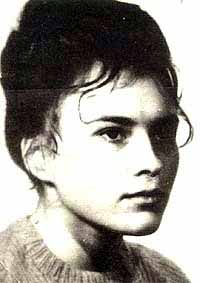
On this date in 1956 or very shortly thereafter, Jesus Maria de Galindez was probably executed in the Dominican Republic.

Jesus Maria de Galindez

The previous day, he had vanished without a trace from New York City. According to unconfirmed but highly credible accounts, he was killed on orders from — and in the presence of — Dominican dictator Rafael Leonidas Trujillo.

Galindez’s disappearance caused an international incident. It was covered in numerous newspapers and periodicals, including Time and Life, and was the subject of much speculation and many conspiracy theories. In spite of an extensive search, his body has never been found. The case has remained in memory into the 21st century, however, as this 2001 New York Press article demonstrates.

Who was Galindez?

Born in Spain in 1915, he was a political activist, a committed anti-fascist and Basque nationalist. As a result, he ran into trouble with Spain’s dictator, Francisco Franco, and had to run for his life.

In 1939, Galindez set up shop in the Dominican Republic, only to find fascism polluting this country as well. He had to run again in 1946, this time to New York City.

While working on his Ph.D in political science from Columbia University, Galindez found the time to teach college classes, write a newspaper column which was syndicated throughout Latin America, and represent the Basque government-in-exile. He was a busy man.

He was also very afraid, and with good reason. Like most despots, Rafael Trujillo held grudges for a long, long time, and his henchmen kidnapped and/or killed many of his enemies, even those outside the country. One of Galindez’s friends was killed by Trujillo’s agents in Manhattan in 1952.

Galindez then wrote a letter to be opened in the event of his death or disappearance, stating that if he should come to harm, Trujillo was surely behind it.

On March 12, 1956, Galindez taught a class at Columbia and a student gave him a lift to the subway. This was the last time he was seen alive. When he was reported missing five days later, all his belongings were found undisturbed in his apartment. The FBI and the New York Police Department searched for him without result.

According to an investigation by Life magazine, which published its conclusions in 1957, Trujillo’s agents forcibly abducted Galindez on March 12, drugged him and bundled him aboard a small private plane piloted by an American, Gerald Murphy.

Early in the morning on March 13, Murphy stopped in Miami for fuel, then continued southward, stopping at Monte Cristi in the Dominican Republic. From there another pilot, Octavio de la Maza, took over. De la Maza was a tough character who had already committed one murder, in England. He flew Galindez to Ciudad Trujillo. Galindez was then shot to death in Rafael Trujillo’s presence and buried.

The Dominican government tried to buy off Murphy with a plum job as a flight captain, but pretty soon he started blabbing about his mysterious plane trip and its passenger, whom he’d at first thought was a wealthy invalid.

Pilot Octavio de la Maza: mopped up.

Thus was a second assassination necessary to cover the first: in December 1956, Murphy vanished without a trace in the Dominican Republic, only days before he was due to fly home to America. His body was never found. Now, his co-pilot had to be silenced, and a very neat job it was too: Octavio de la Maza was arrested and charged with Murphy’s murder. He had just enough time to get his parents out of the country before the ax fell, but never came to trial because he was found hanged in his cell in January … conveniently leaving a full confession in writing: Murphy had hit on him, and De la Maza lost his temper and pushed him off a cliff.

The world smelled a rat. Trujillo, of course, denied everything and went so far as to hire an American lawyer, Morris Ernst, to conduct his own investigation into Galindez’s disappearance. After ten months, Ernst issued a report predictably exonerating his employer. He claimed Galindez had stolen money earmarked for the cause of Basque Nationalism and simply walked out of his life.

And there the matter rests.

No charges were brought against anyone in Galindez’s disappearance. Columbia awarded him his Ph.D in absentia and his thesis, published as The Era of Trujillo, became a bestseller throughout Latin America.

What goes around comes around: Trujillo was himself assassinated in 1961. One of the men who plotted his murder was Antonio de la Maza, Octavio’s brother.

On this day..

1975: Olga Hepnarova, tram spotter

On this date in 1975, 23-year-old Olga Hepnarova was hanged at Prague’s Pankrac Prison.

On July 19, 1973, a splenetic Hepnarova had lived out the road rager’s fantasy by barreling her three-ton Praga RN lorry into a tram stop* — killing eight elderly commuters.

Caught on the scene where her Truck of Death came to rest, Hepnarova’s authorship was not in question — only her culpability.

Three days after the bloodbath, she was telling police about her hatred of and alienation from her “brutal” fellow-beings, of beatings from her father and every form of humiliation and disrespect among her peers. This had been a lifelong theme with Hepnarova; the wounds of the world pierced her deeply, and she had spent time in a psychiatric institution after a teenage suicide attempt. In her short working life, she’d been unable to hold down any job for long. Truck-driving, tragically, was only her latest (and last) gig.

About the same time the tormented Hepnarova was owning her actions to the authorities, editors at two newspapers received nearly-identical letters she had posted before she made herself famous, touching much the same themes.

I am a loner. A destroyed person. A person destroyed by people… I therefore have a choice – to kill myself or to kill others. I choose – TO AVENGE MY PERSECUTORS. It would be too easy to leave this world as an unknown suicide. Society is too indifferent, rightly so. My verdict is: I, Olga Hepnarová, the victim of your bestiality, sentence you to the death penalty.

Doctors who examined her did not find her sufficiently off her rocker to have not known what she was doing, and the remorseless Hepnarova accepted the court’s verdict and sentence with equanimity. There are reports, however, that by the last day her placidity had crumbled and that she fought the execution team and had to be dragged, swooning, to the noose.

For this documentary, have your Czech handy. (And the same — or the online translator of your choice — for this Czech website about Olga Hepnarova’s life and legal case.)

Hepnarova was the last woman ever hanged in Czechoslovakia. (Or either of its death penalty-less successor states, if you want to count it that way.)

* The street where this shocking scene was enacted is today named for Milada Horakova, who preceded Hepnarova on Pankrac’s gallows.

On this day..

1997: The last execution in Ukraine

The last execution in Ukraine apparently took place on this date in 1997 — and bizarrely, nobody even seems sure of exactly who enjoyed this unwelcome distinction.

This was post-Soviet Ukraine under Leonid Kuchma, a man in no way renowned for his excessive regard for human dignity.

But Kuchma was keen on integrating with Europe, and that meant appeasing western Europe’s human rights sensibilities.

Ukraine joined the Council of Europe in 1995, a move that required it to abolish the death penalty. But executions — by means of the old Soviet method, a single gunshot to the back of the head — were ragingly popular during a decade of economic collapse and spiraling crime.

According to When the State No Longer Kills, which has an entire chapter devoted to the Ukrainian abolition experience, Ukraine’s annual count of reported murders shot up from 2,016 in 1988 to 4,896 by 1996, with 4,000-plus per annum every year from 1993 on.

“The country’s crime rate does not allow for cancelling the death penalty,” Ukraine’s Parliamentary chair told COE observers in November 1996.

He was in for a surprise.

To Europe’s chagrin, some 167 people were indeed put to death in 1996 alone. The Council Of Europe pointedly threatened sanctions against the Ukrainian delegation in January 1997 … and Kiev chickened out.

Its last executions were thirteen conducted in the first 70 days of 1997 — executions which were not announced publicly beforehand or even afterwards, and only wrung as admissions out of the government months afterward when the prisoners’ respective contacts realized they hadn’t heard from them in a suspiciously long period of time. Between this up-front secrecy and Ukraine’s practice of dumping its executed bodies in unmarked graves, nobody ever seems to have been able to document who exactly died when, and who really was last. (We assume the incriminating paper does exist somewhere in the bowels of the bureaucracy.)

By the same token, there was no public indication when the sun came up on March 12 that anything had changed. Ukraine kept information about its death row prisoners close to the vest; the Council of Europe continued to press it for a moratorium until very late in 1997, when Kiev announced that it had in fact been observing a de facto moratorium since March 11. I guess we have no choice but to take their word for it.

Just like that, this impossible dream had been accomplished.

Two years later, the country’s high court barred the death penalty, followed quickly by parliamentary action to remove it from the statutes full stop.

The nameless dead man or woman of this date is actually not only the last executed in Ukraine, but the last in the entire 47 countries of the Council of Europe — a zone that still excludes Ukraine’s neighbor Belarus, which as of writing is the last redoubt of capital punishment in Europe.

On this day..

1762: Jean Calas, intolerably

(Thanks to Mary O’Grady for the guest post. -ed.)

In the 1760s, Toulouse was no place for a Huguenot, not even for an affable, prosperous paterfamilias like Jean Calas. The whole southwestern region of France barely tolerated Protestants.

The Calas household included two adult sons, Louis, who had converted to Roman Catholicism, and Marc-Antoine, their sisters, as well as their parents, Jean Calas and his wife, and a longtime maid who was Catholic. Monsieur and Madame Calas and their daughters were Protestant, as was Marc-Antoine. Friends and associates described the ménage as placid, except for occasional outbursts of misbehavior by elder son Marc-Antoine.

Jean Calas was a textile dealer. On October 13, 1761, young Marc-Antoine Calas was found hanged in his father’s shop. Wishing to spare the family’s reputation from the stigma of suicide as well as his son’s corpse from the mutilation which was customary for suicides, Jean Calas at first claimed to the authorities that an intruder killed his son.

An ugly rumor swept Toulouse: Marc-Antoine was murdered by his own parents, because he planned to convert to Catholicism. (Never mind that Jean Calas kept his Catholic son Louis in the bosom of his family and employed a Catholic servant.) Jean Calas was arrested and subjected to a trial that was anything but fair; by this time, he had admitted, too late, that his son had hanged himself, probably over gambling debts.

No dice. The appellate court of Toulouse condemned Jean Calas to death on March 9, 1762. The execution was set for the following day.

Murder of a family member was held to be a particularly hideous crime, and hideous was the penalty: breaking on the wheel. Jean Calas was tied to a cartwheel in the main square of Toulouse. His limbs were broken with iron rods. He proclaimed his innocence until the executioner finally strangled him to death.

L’affaire Calas inspired Voltaire to new vigor in his fight for religious toleration. In 1763 he published A Treatise on Tolerance, a landmark document which remains well-read today.

O different worshippers of a peaceful God! if you have a cruel heart, if, while you adore he whose whole law consists of these few words, “Love God and your neighbor,” you have burdened that pure and holy law with false and unintelligible disputes, if you have lighted the flames of discord sometimes for a new word, and sometimes for a single letter of the alphabet; if you have attached eternal punishment to the omission of a few words, or of certain ceremonies which other people cannot comprehend, I must say to you with tears of compassion for mankind: “Transport yourselves with me to the day on which all men will be judged and on which God will do unto each according to his works.

“I see all the dead of past ages and of our own appearing in his presence. Are you very sure that our Creator and Father will say to the wise and virtuous Confucius, to the legislator Solon, to Pythagoras, Zaleucus, Socrates, Plato, the divine Antonins, the good Trajan, to Titus, the delights of mankind, to Epictetus, and to many others, models of men: Go, monsters, go and suffer torments that are infinite in intensity and duration. Let your punishment be eternal as I am. But you, my beloved ones, Jean Châtel, Ravaillac, Damiens, Cartouche, etc. who have died according to the prescribed rules, sit forever at my right hand and share my empire and my felicity.”

May all men remember that they are brothers! May they hold in horror tyranny exerted over souls, just as they do the violence which forcibly seizes the products of peaceful industry! And if the scourge of war is inevitable, let us not hate one another, let us not destroy one another in the midst of peace, and let us use the moment of our existence to bless, in a thousand different languages, from Siam to California, [God’s] goodness which has given us this moment.

-Voltaire, A Treatise on Tolerance

As a result of Voltaire’s efforts, 50 French judges were appointed to a panel to review Jean Calas’s case. Their charge was to decide whether anti-Huguenot prejudice had cost Jean Calas his life. They reversed Calas’s conviction on March 9, 1765, the third anniversary of the poor man’s condemnation.

A few French books about Jean Calas

On this day..

1784: Anton Joseph Suter, Appenzell politician

On this date in 1784, 64-year-old former Landammann of Appenzell,** was beheaded in a nasty bout of local politics.

The amiable and fair-minded Suter (wee German bio), a tavernkeeper, won election to his position at the head of a popular party — in the process defeating a local aristocrat who expected the gig as his birthright and nursed a terrible grudge against Suter for the defeat.


The cantonal form of direct democracy by which Suter was elected, the Landsgemeinde, is still practiced in Appenzell. This (cc) image from Götz A. Primke shows the 2009 assembly in Appenzell, at which crotchety, longsword-bearing residents voted a ban on nude hiking.

This aggrieved aristocrat, Geiger by name, had to bide his time all through the 1760s and into the 1770s, until the political stars aligned against Suter.

It seems a neighboring town had been able to take possession of a lush alpine slope in Appenzell’s environs by dint of an unpaid mortgage, a terrible wound to Appenzell’s pride and no small inconvenience to its residents.

Suter pushed an attempt to force repurchase of this land in a suit at the Swiss Diet, a sort of United Nations of otherwise-autonomous Swiss cantons. But he lost the suit, and the Diet demanded that Appenzell cough up the court costs as well.

Accustomed as we are today to the suits and countersuits that constitute the very cogs of late capitalism, it’s a little hard to understand how the trifling matter of a court fee could suffice to topple a government — but it did. Geiger’s people prevailed upon the canton’s executive council to drop the suit (Suter pursued it on his own), and now persuaded it to drop Suter.

Well, persuaded. It’s more like, it did several days frantic retail politicking from the pulpits and in the streets, then showed up when the council met to shout down Suter and drag him out by force, not neglecting to disenfranchise Suter’s many supporters who fought them on the point. As Suter fled into exile, Appenzell pronounced him a rebel on the strength of some super-secret documents.

That really could have been that, but Suter’s foes were so intent on his head that they contrived a ruse to lure him back into the canton’s territory on the pretext of a secret meeting with his daughter — then arrested him, tortured him with thumbscrews and the rack, and finally sentenced him to death.

On the day appointed the scaffold was closely surrounded by troops. Suter, maimed and pale, was assisted to his place. Standing there a moment he addressed the people, declaring himself robbed and murdered by his country. He then knelt down and in clear tones thrice pronounced the Ave Maria. With the last word of the last repetition of the prayer the sword descended and his head fell …

The sight of the blood of the ex-Landamman filled the people with rage. They had looked for a reprieve to the very last; and now that all hope was gone, they fell upon such of the victim’s enemies as were to be found lingering in the streets and fought and struggled with them in their desperation … The enemies of Suter were found to form no exception to the rule that retribution pursues the murderer. No sooner was the ex-Landamman in his grave than the Furies took up their task … Geiger, who formerly had gone about demanding Suter’s life, now — a pitiable victim to remorse — went about acknowledging that for seven long years he had pursued him without a cause. It is related concerning the member of the Blood Court that they all ever afterwards were harassed by terrors of conscience, one to such an extent that he even became insane. The guilt of Suter’s murder settled upon Inner-Rhoden irretrievably … like the very brand of Cain. Time went by and changes occurred, but that remained. Finally in 1829, forty-five years after the execution, the Great Council met and, with a solemnity befitting he occasion, unanimously revrsed the findings of the court by which Suer had been banished, as also of that by which he had been sent to the block.

Another summary of Suter’s career and sad end can be found here.

* Thanks to the same public-domain source, we’ve visited Appenzell before.

On this day..

1862: Martin Dumollard, l’assassin des bonnes

It’s the sesquicentennial of France’s beheading of Martin Dumollard, one of the earliest — some even venture the earliest — serial killers in the modern record.

From Madame Tussaud’s Chamber of Horrors, this is no mere death mask — but the actual skin of the killer. More pictures here, including Dumollard’s creepy house.

This dull peasant spent at least the latter half of the 1850s (and maybe the first half, too) visiting Lyon where he would lure impecunious girls with the promise of good wages in a domestic position.

We know very well that there was no job awaiting these young women, but the twist is that Dumollard wasn’t a sex-killer, either — he just wanted to throttle his marks, drink their blood, and steal their poor clothes and meager possessions to re-sell them.

So, a strange, scary man: here’s his French Wikipedia page; most of the resources about him are in French, but this little biography should suffice to orient the Anglophone.

And in Second Empire France, with its haunting specters of Communism and nationalism, the migration of country bumpkins like Dumollard into urban areas, and the existential threat posed the entire polity by the rise of neighboring Prussia … in that France, Dumollard’s shocking spree really agitated the id of the respectable French bourgeoisie.

Relentless and grim — Dumollard had actually seen his own father put to death when the family fled as refugees to Italy during his boyhood — the illiterate, middle-aged murderer as presented to the public heedlessly stuffed his face with food while maintaining a near-total disinterest in the criminal case that would claim his head. He’d also shown no interest in subterfuge, leading the courts to castigate police for not detecting him years earlier even though several girls had escaped from him. His wife abetted the whole thing, dutifully washing out the victims’ stained clothes before market days. (She got a sentence of hard labor.)

Dumollard must have looked to his betters like some vengeful golem arisen from the soil, a homicidal automaton not even impelled by any recognizable human avidity, and a frightening warning of what might befall them.

According to Albert Borowitz, the unveiling a few months later of Jean-Francois Millet’s unnerving painting The Man with the Hoe raised hackles in France (and it did raise hackles) partly because of the farmer’s perceived resemblance to Martin Dumollard.


L’homme à la houe (The Man with the Hoe), by Jean-Francois Millet. “A monster without brow, dim-eyed and with an idiotic rictus, planted in the middle of a field like a scarecrow,” wrote Paul de Saint-Victor of this painting. “No trace of intelligence humanizes this brute at rest. Has he just been working, or murdering? Does he dig the land or hollow out the grave?

“The public voice has found his name: it is Dumollard, gravedigger of the good.”

On this day..

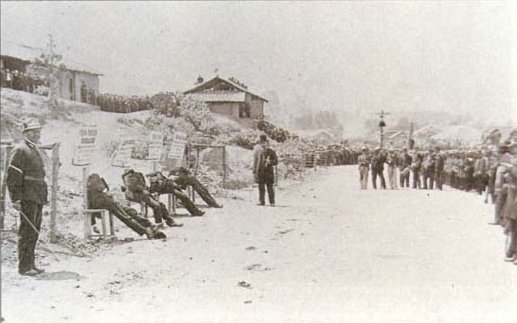
1905: Two murderers beheaded in French Indochina

On this date in 1905, this happened in French Indochina:

“Annamites” — a term that will not get you a warm welcome in Southeast Asia today — were residents of the French protectorate of Annam. It, along with Tonkin to its north and Cochinchina to its south, comprise present-day Vietnam: “Annamite” was also sometimes generalized as a colonialist synonym for all Vietnamese. (Here’s a 1947 Life magazine article by William Bullitt that does just that in its warning about the burgeoning war wherein “Annamites — half starved and weakened by malaria, gentle by nature but courageous” had started “kill[ing] every Frenchman they can.”)

Postcard pictures on this post via BeheadedArt.com, which delivers what it promises. (Clicker beware.)

On this day..

1906: The would-be assassins of General Rafael Reyes

BOGOTA, Colombia, Tuesday, March 6. — The three men who on Feb. 10 attempted to assassinate Gen. Reyes, the President of the Republic of Colombia, were shot to-day at the spot where the attack took place.

-New York Times, March 8

Reyes had parlayed a successful military career into politics (Spanish link), and was the elected-ish but also dictatorial president of Colombia.

He had the misfortune to ascend to this illustrious post on the heels of a bitter civil war that had seen its Panama department break clean away. To Reyes’ administration would fall a variety of civil society infrastructure projects (more Spanish): constitutional reform, military modernization, a central bank, reconciliation with the Liberal party.

Marco Salgar (left) and Roberto Gonzalez, two of the failed assassins.

He couldn’t make these omelets without breaking a few eggs and his authoritarian power was challenged with at least two coup attempts and multiple assassination plots, as well as a bid by other Colombian territories to break away and join up with Panama.

But the most notorious angry-with-Reyes event was the 10th of February 1906 — also the title (Spanish again) of a book of photographs documenting the incident — when three gunmen ambushed Reyes on the outskirts of Bogota and somehow all managed to miss both the president and his daughter.

Reyes’ vengeance was extrajudicially old-school: the executions he arranged were not permitted under Colombian law at all, and by having them publicly shot at the scene of the crime, he added a downright medieval twist of lese-majeste.


Images from here. These are the three shooters mentioned by the Times, as well as a fourth accomplice.

However rough his methods, Reyes did accomplish some important reforms for his country, and he did have the grace to resign his position in 1909 under fire for financial and diplomatic mismangement. (The man’s five-year administration has its own periodization in Colombian historiography: the quinquenio.) There have been worse entries in the annals of dictatorship.

On this day..

1945: Lena Baker

What I done, I did in self-defense, or I would have been killed myself. Where I was I could not overcome it.

-Lena Baker’s final statement

The state of Georgia has only ever electrocuted a single woman: African-American maid Lena Baker, put to death on this date in 1945 for murdering her abusive employer.

Baker was a sharecropper and a former sex worker hired to care for white mill owner Ernest Knight as he recuperated from a broken leg. This, as Baker’s biographer Lela Bond Phillips puts it, “developed into a sexual relationship.”

A twisted, sometimes-violent relationship.

Both Knight and Baker were alcoholics, and the Knight liked to keep his domestic in the gristmill for days on end.*

As an interracial liason, it was also entirely taboo; Knight’s son tried everything to separate his dad from this scandalous arrangement, including moving the family and beating up Baker.

Knight pere was even more committed to keeping her.

On the night of April 29-30, 1944, the elder Knight locked Baker up in the mill, after she’d attempted to flee him. Baker testified that after Knight got back from church — it was Sunday, after all — Baker tried to leave over Knight’s threats. The two fought over Knight’s pistol, and the fight ended when the pistol discharged through Knight’s head. As to how it went off or who pulled the trigger, Baker said she didn’t know.

Although the irascible, hard-drinking Knight wouldn’t have won any popularity contests among his white neighbors, this breach of the color line was prosecuted both vigorously and speedily: a one-day trial that August (the all-white, all-male jury goes without saying, right?) sufficed to send the maid to her death.**

She’s (obviously) the subject of the 2008 film Hope & Redemption: The Lena Baker Story.

* Virtual imprisonment of domestic labor: not a thing of the past.

** In 2005, the Georgia Board of Pardons and Paroles — which turned down Baker’s clemency application in early 1945 — issued a posthumous pardon suggesting that a non-death penalty manslaughter charge would have been the more appropriate conviction. Baker’s family and defenders read that as vindication; there’s a detailed NPR story about it here.

On this day..