1868: Three Italian bandits

On this date in 1868, a trio of notorious Italian brigands went under the French guillotine in Marseilles.

Joseph Coda-Zabetta, the leader, had escaped a hard labor sentence in Italy and fled to France where he founded a large band of robbers who terrorized France’s Mediterranean countryside from Nice to Marseilles for some months in 1867.

From raiding unoccupied country homes the gang soon progressed to bold invasions of occupied houses and waylaying travelers. “In one instance,” a press report of their trial reported,* “six of the band attacked a convoy of carriers, one of whom received a pistol-shot in the breast and a stab with a knife, from which injuries he afterwards died.”

Twelve of the band faced trial, and four of their number received death sentences. (Seven others had long prison sentences; a man named Muletto was acquitted.)

Coda, Antoine Quaranta, and Felix Mardi (Italian pdf) were all guillotined on this date in 1868. (They died, it was said, repentant (French).) The fourth condemned prisoner, Jacques Mulatere, had his death sentenced commuted to life at hard labor.

* London Times, Dec. 20, 1867

On this day..

1944: Max Sievers, freethinker

On this date in 1944, German freethinker Max Sievers was beheaded at Brandenburg Prison for “conspiracy to commit high treason along with favouring the enemy.”

A working-class Berliner, Sievers (English Wikipedia entry | German) became a prominent communist and atheist writer in the interwar years. He directed the Association of Freethinkers for Cremation from the early 1920s, and in 1927 became the chair of the German Freethinkers League.

This was not a demographic Adolph Hitler was courting. In the wake of the 1933 Reichstag Fire, the Nazis stamped out atheistic movements, even converting the Freethinkers’ building into a Protestant recruitment venue.

Briefly imprisoned, Sievers fled Germany upon his release later in 1933 and from exile in Belgium — and then, after Belgium was conquered, in hiding in France — he kept up a drumbeat of antifascist propaganda, notably the 1939 book Unser Kampf gegen das Dritte Reich: von der nazistischen Diktatur zur sozialistischen Demokratie.

He was finally arrested by the Gestapo on June 3, 1943, and condemned to death by Roland Freisler.

Sievers was posthumously exonerated in 1996, and is today — and on January 17th in particular — an honored martyr for German humanist, atheist, and freethinker groups.

On this day..

1909: The Pollet gang, breaking the French moratorium

Warning: Graphic severed head pictures await at the bottom of this post.

On this date in 1909, the guillotine returned France after an absence of more than three years.

The sitting president was a staunch death penalty opponent and had blocked all executions since his term began in 1906. That was about the same span of time that the Pollet gang had, in the words of a New York Times wire report,* “infested the Belgian-French frontier, robbing churches, houses, and inns, holding up stage coaches and belated travelers, and torturing and slaying their victims according to the old piratical adage that dead men tell no tales.”

Abel Pollet had been a smuggler who put his native gift for leadership to good use organizing his fellow traffickers into a more lucratively violent line of work. Thanks, presumably, to the syndicate’s pre-existing professional aptitude for evasion, it persisted for years and authored a quantity of robberies and murders that authorities could only guess at. (The official homicide estimation ran north of 50.) It was a spree so atrocious that it helped force the end of the whole death penalty moratorium since sentiment was so strong against the Hazebrouck gang .

Incited by the many depredations and perhaps starved from years without the bloody spectacle of public execution, a vast concourse of 30,000 mobbed the guillotine at Bethune.

“At midnight there were 2,000 watchers in the square,” one report ran. “The main street of the town was crowded as on the eve of a fete. Soon after midnight men brought ladders and benches to the square and mounted them to obtain an uninterrupted view. Others climbed into the branches of trees, where their presence was revealed by the glow of cigarettes and pipes in the dark among the branches.”

Undeterred by the steady winter’s drizzle, they would wait all the night through, their numbers continually augmented as road-trippers arrived by train.

At four in the morning the dread traveling executioner Anton Diebler, who had already plied this trade for a generation and more and would continue in the role for another 30 years, arrived with four assistants to set up the guillotine. It was only with difficulty that police restrained the pawing mob.

By half-past five the public prosecutor officially informed the condemned men what they surely already knew — that there would be no mercy. The crowd on the square would have its prey.

As the first robber, Theophile Deroo, emerged at 7:25 a.m., “there was a painful silence, and then an outbreak of hoots and curses from the crowd.” A wilting Deroo had to be hustled to the board amid the jeers. “A mort! A mort!” came the howls.

Three times in the next eight minutes the executioners furiously scrubbed the apparatus clean while guards (per the Times) “held the crowd back with main force.”

Canut Vromant followed coolly; Auguste Pollet was third, fighting and shouting. His brother, the leader Abel Pollet, went under a rain of curses that he answered with the words “Down with the priests! Long live the Republic!”

People are ghoulish. Far be it from us to deny them.


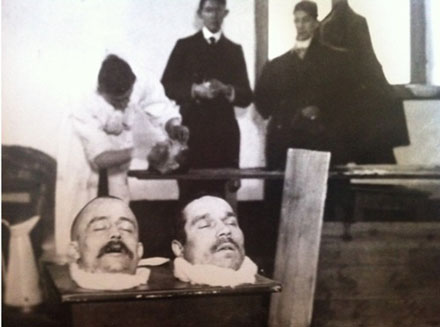
Top: the heads of the Pollet brothers. Middle: The heads of their two accomplices. Bottom: Canut Vromant’s headless trunk awaits autopsy. All images from the invaluable Bois de Justice, via this goregrish forum.


After the quadruple executions, the heads are cleaned up. (Source)

Perhaps, dear reader, you find the public exhibition of these severed heads objectionable. If so, you have an ally in the French state that did the severing.

For years, French elites had been fretting the indecorous behavior of the crowd at what was supposed to be a solemn occasion. The advent of photography only made matters worse, for now the discomfiting head-chopping exercise could be shared with those indisposed to sitting up all night smoking pipes in trees.

But as the moratorium gave way, the rising media form of cinema promised even more debased exhibitions. Enterprising cinematographers were already staging execution re-creations; now there was the prospect for film audiences to be incited to countless bloodlust frenzies by on-the-scene deathporn footage of hated criminals going under the blade. It was in response to just this fear that France a bit later in 1909 promulgated (French link) its first film censorship rules — forbidding in this case the public display of film liable to disturb the public tranquility.

* Jan. 16, 1909 … under the excited headline “THIRST FOR BLOOD AMONG THE FRENCH”,

On this day..

1794: Jean-Baptiste Carrier, of the Noyades de Nantes

On this date in 1794,* a revolutionary Montagnard who had overstayed his welcome made his departure through the guillotine’s window.

Carrier (English Wikipedia entry | French) was the Revolutionary Convention’s proxy in Nantes where he distinguished himself in bloodthirstiness while putting down a counterrevolutionary revolt.

He’s most particularly noted for the Noyades de Nantes, a series of mass drownings in the Loire that claimed two thousand or more victims — mostly priests and civilians viewed as refractory. Overall the casualties in the Vendee ran to six figures; there’s been latter-day debate over whether the Republican policy there rose to the level of genocide.


Les noyades de Nantes en 1793, by Joseph Aubert (1882).

He was “one of those inferior and violent spirits, who, in the excitement of civil wars, become monsters of cruelty and extravagance” Adolphe Thiers judged him. (Ironically, considering Thiers’ subsequent career.) “This frantic wretch imagined that he had no other mission than to slaughter.”

Now, one could author a bloodbath in the provinces and still stick around for posterity, but that play depended on a timely volte-face with the Thermidorean reaction.

Unlike Fouche and Tallien, Carrier couldn’t pull that off. He was left in an increasingly untenable position after Robespierre fell.

What would follow Robespierre? Carrier’s own person and the Noyades de Nantes were central to this question in the tumultuous latter half of 1794. His beheading would be the climax of a string of pivotal trials.

Ninety-four Bretons already under arrest by the revolutionary committee were put to trial in the weeks following Thermidor. En route to their spectacular acquittal, these accused

subpoenaed as witnesses the members of the Nantes revolutionary committee, who had also been arrested … [and] charged that they were guilty of summary executions and of mass drownings in the Loire; they acknowledged these acts but placed the responsibility for them on Carrier. This meant that there were three trials — that of the ninety-four, that of the Nantes revolutionary committee, and that of Carrier — each revealing ghastly atrocities, which were given wide coverage in the anti-Jacobin press throughout France. (Gilded Youth of Thermidor)

The atrocious stories from Nantes promulgated in Paris by these first trials soon had the city in an uproar and dealt the already-reeling Jacobins “a terrible blow in public opinion” according to one newspaper also quoted in Gilded Youth. The Nantes revelations would provide the impetus (or the pretext) for the riots that soon shuttered the Jacobin Club and placed the Parisian bourgeoisie firmly in control.

If Carrier was the casualty in all this, well, he wasn’t exactly in a position to complain about being sacrificed for someone’s ideology.

Gracchus Babeuf, later to drop his own head into the basket, campaigned against Carrier furiously during a robust pamphlet war.

Carrier: this horrible name strikes all ears, is issued from all mouths. Merely speaking it causes a shiver of horror. There is not a single Frenchman for whom this word does not suffice to tell the story of the man it designates. It reminds all of his contemporaries of the most irascible of carnivorous beings. Posterity will not be able to find in any tradition an exterminator who was his equal. The crimes of this master villain are recognized by, and proven to, all, and yet he has unofficial defenders in the National Convention, and it even appears that there exists a strong party that wants to save him. Even more, there are signs that announce that there are those who want to influence, even terrify the just tribunal that, with its usual wisdom, is investigating the affair of the infamous drowner who has far surpassed Nero and all the other great executioners. …

they’ll justify the mass killer of the west with the excuse that the terrorism he provided the earth an example of was necessary for the salvation of the Fatherland.

Exterminable system! It was necessary for the salvation of France to erase the entire population of its western parts! It was necessary for the salvation of the Fatherland to turn its most beautiful countryside into a horrible desert, to make it the lair of voracious animals both terrestrial and aquatic by covering the waters, fields, and woods with corpses! …

In order to save the Fatherland were the 23 noyades of Nantes, one of 600 children, needed? Were “republican marriages” necessary, where young boys and girls tied together naked were knocked unconscious with saber blows and then tossed into the Loire? (Deposition by Philippe Tronjoli and Bourier) Was it necessary (another deposition of 25 Vendémiaire) to cause to die in the prisons of Nantes through hunger, infection, and misery, 10,000 citizens, 30,000 if we include the executions and noyades? Were the sabrades necessary (deposition of Laéné) on the departmental square, which occupied 300 men for six weeks filling the mass graves with those who perished from this torture? Was it necessary for Carrier (deposition of Tronjoli of the 27) to sleep with three beautiful women and then drown them? Was it necessary to execute (deposition of Renaudot) infantry and cavalry detachments of the rebel army who had voluntarily surrendered? Was it necessary to drown or execute (deposition of Thomas) 500 children, the oldest of whom wasn’t fourteen and who Carrier called vipers that must be suppressed? Was it necessary (same deposition) to drown 30-40 women eight and eight and a half months pregnant and to offer horrified eyes the still palpitating corpses of the babies tossed into a tub filled with excrement? Was it necessary (deposition of Abraham and goodwife Puchotte) to kill in one night by suffocation (caused by infection and lack of air) 50-60 prisoners in a galleon whose side panels were shut expressly to cause suffocation?

Carrier’s likeness is preserved in wax at Madame Tussaud’s.

* A few sources give November 16; this is unambiguously mistaken. (See e.g. London Times, Jan. 15, 1795, reporting the December 16 execution.)

On this day..

1938: Martha Marek, Zeliopaster

On this date in 1938, Austrian Martha Marek was guillotined in Vienna for several murders by poison.

She first came to the attention of the discerning interwar crime audience in 1925 when she and her husband Emil were convicted of insurance fraud: Emil claimed to have “lost his leg while chopping wood” just after having taken out a policy, but examination showed that the lost leg had actually been chopped off methodically — and clumsily. They both served a short stint in prison but at least Martha still had four good limbs to go with her wits.

Martha before her marriage had been the lover of a department store magnate five decades her senior who lavished money on her and left her a tidy inheritance to the chagrin of his family. She made her way in the world hitting mother lodes and living comfortably on them, and the time would come that poison would suit her ends better than seduction.

In July 1932, Emil died of apparent tuberculosis. The next month, the couple’s infant daughter Ingeborg died too. Martha, who had lately been reduced to peddling vegetables in the street, pocketed insurance payments on both.

Shortly after, she moved in with an elderly aunt, and the aunt soon died too — leaving her home and assets to her “caregiver”.

As this nest egg dwindled, Martha opened the place to boarders, and one of these poor souls also died — not before mentioning to some people that he always seemed to get sick when he ate Martha’s food. Turned out, Martha had insured his life too.

Martha actually got away with all of this at first, despite the agitation of the dead boarder’s relative. But she pushed her luck a little bit too far when she tried to fraudulently report some insured paintings as stolen in 1937. Persnickety insurance adjusters investigated, and the whole murder spree came out in the process. She was convicted for killing husband, daughter, aunt, and lodger with the rat poison Zeliopaste (thallium).

Austria’s traditional execution method had been hanging, and its traditional executive behavior had been to commute women’s death sentences.

However, the March 1938 Anschluss annexing Austria to Hitler’s Germany brought an update to Germany’s capital punishment policies. Hitler rejected the mercy application (it didn’t help that Martha was half-Jewish) … and prolific Third Reich executioner Johann Reichhart overpowered a violently struggling Martha Marek to behead her on the fallbeil.

On this day..

1955: Elli Barczatis and Karl Laurenz, East Berlin spies

On this date in 1955, the East German Prime Minister’s own chief secretary was beheaded as a spy, along with her lover.

You’ll find this affair blurbed in the Historical Dictionary of Sexspionage, so you’d figure it’s got to be good — but it wasn’t quite James Bond. (They never really are.)


Elli Barczatis (top) and Karl Laurenz

Elli Barczatis hooked up in 1949 with Karl Laurenz when both worked in the DDR Ministry of Industry. (Both these links are in German, as are most that follow.)

Their careers went in opposite directions thereafter. Barczatis scored a plum appointment as Prime Minister Otto Grotewohl‘s administrative aide while Laurenz got booted out of the Communist party altogether for political unreliability: he’d been a mere social democrat before the communist takeover.

Laurenz started scratching out a living as a freelance journalist in both East and West Berlin, prior to Berlin Wall days, and was recruited by West Germany’s intelligence service to brief them on the goings-on in the East.

In December 1950, a former coworker saw Barczatis and Laurenz at a cafe rendezvous — and saw Barczatis pass the reporter a sheaf of papers. The coworker reported it to East Germany’s secret police, the Stasi.

Because of Barczatis’s proximity to the head of government, the Stasi had to investigate the tip with great delicacy. But no matter; the East German spooks could be patient as death when the occasion demanded. So over the course of four-plus years, they cautiously surveilled, and eventually entrapped, the lovers.

At last, on March 4, 1955, those grim security men arrested Barczatis at her apartment in the suburb of Kopenick. Laurenz, returning laster that day to the East from a West Berlin meeting with intelligence officers, was nabbed as well.

Laurenz confessed to espionage right away; it might have been a cathartic experience for him. “The accused became provocative, comparing the State Secretariat for State Security of the German Democratic Republic with the fascist Gestapo and the Nazi SD,” a Stasi officer reported after marathon interrogation sessions. “He remarked that the treatment of prisoners by the State Secretariat for State Security is worse than the treatment by the SD and the Gestapo.” But the doomed spy still stubbornly protected his contacts, sources — and Elli Barczatis. He insisted that she was more leaker than spy, and gave him information thinking only that it was background for his reporting.

According to John Koehler’s Stasi: The Untold Story of the German Secret Police, there might have been something to that.

What was the extent of Elli Barczatis’s espionage? What did she betray that justified her execution? Incredibly, the interrogation record reveals not a single instance in which she furnished Laurenz with material so sensitive that it could be interpreted as having endangered the security of the communist state. She betrayed no military or defense secrets. She merely told her friend about letters her office received from the populace complaining about food shortages; mismanagement that created problems in industry; government personnel changes; and Westerners who visited Prime Minister Grotewohl. The absurdity of all communist regimes was that such tidbits of information were considered state secrets.

Baczatis’s and Laurenz’s beheading on the fallbeil was the culmination of a mid-Fifties security crackdown by East Germany that also eliminated (although not by execution) at least two other highly-placed West German assets, Hermann Kastner and Walter Grosch. (Source.)

On this day..

1793: Jean-Jacques Ampère, father of a savant, for Joseph Chalier

(Thanks to Amelia Fedo, a graduate student in French literature, for the guest post.)

He didn’t know it yet, but on this date in 1793, a brilliant adolescent named André-Marie Ampère lost his father to the guillotine. If the name sounds familiar, it’s because it would eventually become the SI unit of electrical current.

Andre-Marie Ampere, one of the founding pioneers of electromagnetism (Ampere called the new field “electrodynamics”) lost his father to the French Revolution’s guillotines.

The father in question was Jean-Jacques Ampère, an intelligent and levelheaded man whose sense of duty outweighed his instincts of self-preservation.

He was determined to do every job he had to the best of his ability — whether the task was educating a son or discharging the office of justice of the peace — and this diligence cost him his life.

A bourgeois silk merchant (a quintessentially Lyonnais occupation), he lived with his wife and son in a tiny village outside of Lyon called Poleymieux-au-Mont-d’Or. It was there that he and his wife, who were one of only five bourgeois families in a primarily peasant population, raised the boy who would grow up to be the father of electrodynamics.

In 1782, he retired and devoted himself full-time to his children’s upbringing — particularly that of his son, whom he soon realized was not an ordinary child. Born partly of necessity (Poleymieux lacked a school) and partly of choice (Jean-Jacques had, after all, opted to move to Poleymieux, and some speculate that he wished to give his son an upbringing like the one advocated by Rousseau in Émile), André-Marie’s unorthodox education resembled what today’s DIY pedagogues might call “unschooling”: he was encouraged to take charge of his own learning, given access to his father’s library, and taught a variety of eclectic subjects according to what most held his interest at the moment.

For most children, this technique is questionable; but when your kid happens to be a genius and a polymath, it works just fine. André-Marie was an audodidact and proactive in his learning, which would be a force for good in his life: as we’ll see, it was what pulled him out of his depression after his father’s death.

When the Bastille fell in 1789, not much changed at first. Jean-Jacques embraced the ideals of the Revolution and even wrote a play called Artaxerxe ou le Roi constitutionnel [Artaxerxe or the constitutional king], which James Hofmann, author of André-Marie Ampère: Enlightenment and Electrodynamics, sees as a parable containing Revolutionary themes.

A month after the fall of the Bastille, he lost his job as local aristocrat Guillin Dumontet’s procureur fiscal (a “judicial and administrative position,” according to Hofmann). Then, in the fall of 1791, he took another bureaucratic job: justice of the peace and “presiding legal functionary for the police tribunal” in Lyon. He may have done it voluntarily, out of sincere political fervor; but he may also have done it to protect his family, since his former boss, Guillin Dumontet, had been beheaded and partially cannibalized by his peasants a few months prior. If he had indeed taken this post for the good of his family, his plan backfired horribly…

As has been detailed in the post on Joseph Chalier, 1793 was not a good year for the Lyonnais.

The Revolution ran counter to the grain of Lyonnais culture for a number of historical reasons (the strong Catholic tradition and the silk trade being two of them). More immediately, famine and taxes had not disposed the people of Lyon towards the local Revolutionary government — particularly the far-left Jacobin faction, which continuously struggled for control of the city.

When the Jacobins seized power in March 1793, they provoked opposition from Girondins and royalists alike, and on May 29 important members of the Jacobin leadership were arrested. Among those apprehended was Joseph Chalier, head of a major Jacobin club known as the “Central Club.” Someone had to open the case against Chalier, and that someone was Jean-Jacques Ampère.

In spite of the Convention’s attempts at negotiation (which quickly turned to threats), Chalier was sentenced to death on July 16 and guillotined the next day. It was not Jean-Jacques who condemned Chalier to death — that does not appear to have been part of his job — but it was he who sent out the warrant for his arrest, and this was more than enough to get him sentenced to death when the political tides turned. (If the judges who actually sentenced Chalier to death — Cozon, Pourret, Régnier, and Maret — were ever punished, I haven’t found any evidence for it.)

Paris responded by placing Lyon under siege on August 9, and two months later, the city surrendered to the Convention. Rather than flee, Jean-Jacques remained in the city, resolved to see his duty through to the bitter end. Throughout the siege, he instructed his wife not to tell their children of the danger he was in. When Lyon was taken, he was immediately arrested, and in the six weeks he spent in prison, he had little doubt about his fate.

Trial and execution

Much of his trial is preserved in court documents. They refer to Lyon as “Ville-Affranchie” — “Liberated City,” the name Bertrand Barère gave to the town before declaring, “Lyon has made war against liberty; Lyon is no more” — so you know they mean business.

During his interrogation, Ampère père was accused not only of having issued the warrant for Chalier’s arrest, but also of having sentenced male and female Jacobin club members to public humiliation and having their eyebrows shaved off, respectively — as well as just generally having been a jerk to Jacobin detainees during interrogations.

The responses he gives show a man resolved to keep both his pride and his honor in the face of certain death, a functionary convinced that he had committed no wrong. Ampère admits to having had Chalier arrested but vehemently denies the other charges. He was also asked if he had left his post and/or sent a revocation to Paris, and responded that he had kept his post and had “no revocation to make.” This probably sealed his fate.

Here’s the full text of his interrogation, from Histoire des tribunaux révolutionnaires de Lyon (take my translations of legalese with a grain of salt; I don’t speak it in any language):

Frimaire 2, Year 2 (November 22)

Interrogation of Jean-Jacques Ampère, 61 years of age, justice of the peace of the canton of Halle-aux-Blés, residing in Lyon, Quai Saint-Antoine, Number 44. — Responses he gave.

I was in Lyon during the siege.

I never had any correspondence with the so-called constituent authorities in Lyon.

Question: You are accused of having filed the whole procedure against the patriots, of having been president of the correctional police during the whole time of the counter-Revolution, and of having judged those who had committed no crime other than belonging to the [Jacobin] club, sentencing the men to be tied to the post [this refers to a punishment formally known as “exhibition,” which was sort of like the pillory] and the women to having their eyebrows cut off; of having condemned, among others, Cadet Rufard, member of the [Jacobin] club, to six months of imprisonment for having sought bread for his brother, put in chains on May 29. You are reproached with having said to all of those whom you interrogated, “You are scoundrels, you people with your clubs; you had agents all the way out in the country, and your plot was the destruction of honest people.” In a word, you are accused of the assassination of the virtuous Chalier, since it was you who filed the first procedure, and it’s thanks to your arrest warrant that he mounted the scaffold.

Response: I never had any part in the judgments against patriots, men or women, which pronounced the sentence of pillory against the men and shaved eyebrows against the women; I admit to having filed the procedure against Citizen Chalier, on the declaration that had been made to me on May 27 by the public prosecutor who had the right to provoke my ministry; I also made several investigations against certain municipal officers after May 29, and in ruling on these procedures, I followed the law in sending back the accused in the presence of the director of the jury, the indictment alone regulating the jurisdiction. I conformed to the investigation of the functions of police officers who are uniformly employed to gather the vestiges of crimes and send the judgment back to the courts who should be informed of them. The circumstances were such that prudence joined with my sense of duty in making me carry out the measure indicated by the law. Before ruling on the procedure against the municipal officers, I had also ruled on the fate of a municipal named Sautemouche. I let him out under an oath to return, and soon after his release, the unfortunate Sautemouche succumbed to the blows of malicious persons. He was murdered, and most of the sections shouted for my arrest, because I had obeyed my conscience and my opinion by delivering an innocent man.

Question: Did you leave Lyon and did you send your revocation to the Committee of Public Safety, according to the law?

Response: I have no revocation to make.

Question: Did you continue your functions during the siege in a city in revolt?

Response: Yes, from May 27 until the beginning of August.

Question: Did you issue the warrant for Chalier’s arrest?

Response: Yes, on June 7.

On November 22, the same day as his trial (other sources give the date as November 23, 24 or 25, but I’m going by the date of execution given in legal documents), he was guillotined in Place Bellecour along with three men who appear not to have been involved in the affair: Étienne Chazottier, a lawyer and the president and secretary of the “permanent section” (a local political office), for “offenses against patriots”; Pierre-Elisabeth Chaponnay, an aristocrat, for “giving considerable sums to, and favoring the plans of, counterrevolutionaries”; and Jean Freidière, a geometer and secretary of the “surveillance committee” — no crime given. Ampère was 61 years old.

Shortly before his execution, he was allowed to write a final letter to his wife. Here’s the most complete version I can find, taken from Portraits Littéraires by Charles-Augustin Sainte-Beuve:

My dear angel, I have received your comforting letter; it was a life-giving balm to the emotional wounds that had been inflicted on my soul by my regret at being misunderstood by my fellow-citizens, who have denied me, through the most cruel separation, a homeland that I have cherished so much and whose prosperity is so close to my heart. I wish for my death to be the seal of a general reconciliation between our fellow-men. I pardon those who rejoice in it, those who caused it, and those who ordered it. I have reason to believe that the national vengeance, of which I am one of the most innocent victims, will not extend to the few possessions that have been sustaining us, thanks to your wise money-saving and our frugality, which was your favorite virtue … After my trust in the Eternal, to whose breast I hope will be taken that which remains of me, my sweetest consolation is that you will cherish my memory as much as I cherished you. That much is owed me. If from my home in Eternity, where our dear daughter has preceded me, I am able to attend to things on earth, you and my dear children will be the object of my care and concern. May they enjoy a better fate than their father and always have before their eyes the fear of God, that salutary fear that makes innocence and justice act on our hearts in spite of the fragility of our nature! … Do not speak to Josephine [André-Marie’s younger sister, then about eight years old] of her father’s misfortune — make sure she does not know about it; as for my son, there is nothing I do not expect of him. As long as you have them, and they have you, embrace each other in my memory: I leave you all my heart.

The author then explains that “There follow a few pieces of advice concerning the household economy, notes about paying off debts, and meticulous scruples regarding antique probity, signed with these words: J.-J. Ampère, husband, father, friend, and forever-faithful citizen.”

He continues with a sentiment shared by most nineteenth-century commentators on this affair: “Thus died, with resignation, with grandeur, and expressing himself almost as Jean-Jacques [Rousseau] would have been able to, this simple man, this reclusive merchant, this justice of the peace from Lyon. He died like so many members of the National Assembly, like so many Girondins, sons of [the spirit of] ’89 and ’91, children of the Revolution, devoured by it, but pious to the end, and not cursing it!”

We are also treated to some of Ampère’s actual notes (it would have been nice if Sainte-Beuve had just reprinted them in their entirety instead of only snatches): “It is impossible, my dear friend, for me to leave you rich, or even moderately comfortable; you cannot attribute this to my bad conduct nor to any spendthrift behavior. My greatest expense was the purchase of books and geometrical instruments which our son could not do without; but that expense was itself a bargain, because he never had any tutor except for himself.”

The Jacobins greatly spun the proceedings against Ampère; in a November 25 letter to the Convention, Collot d’Herbois and Fouché claimed that: “It was liberty that they wanted to assassinate in killing Chalier; his executioners have confessed it; before coming under the blade of justice, they were heard to say that they were dying for the king, that they had wanted to give him a successor.” It goes without saying that there is no reason to believe that Ampère said any such thing on the scaffold—he lived and died a Republican.

Aftermath

To say the execution was a shock to the eighteen-year-old André-Marie would be an understatement.

He never truly recovered from the death of his father, which was neither the first nor the last personal tragedy that would befall him; his older sister Antoinette had died a year earlier, and he would also lose his first wife after only four years of marriage. James Hofmann points out in Enlightenment and Electrodynamics that Jean-Jacques was André-Marie’s only link to the world outside Poleymieux, where he was socially isolated in addition to being intellectually stimulated (his undersocialization did indeed have a permanent effect; he was extremely awkward all his life).

Although André-Marie made a “return to normalcy” through study, he was scarred for life; Hofmann asserts that the event “contributed to the permanently melancholy cast of his adult temperament.”

After hearing the news, André-Marie became catatonic for a year; according to his friend and fellow-scientist François Arago, “The blow was too hard; it was beyond the strength of a young man of eighteen: Ampère was shattered. His intellectual faculties, so active, so intense, so developed, suddenly gave way to a veritable idiocy. He spent his days mechanically contemplating the earth and sky, or making little heaps of sand.”

Yikes. Arago claims that André-Marie was able to snap out of it with the help of Rousseau’s writings on, of all things, botany: “This lethargy of all moral and intellectual feeling had lasted for more than a year, when the letters of J.-J. Rousseau, on botany, came into Ampère’s hands. The limpid and harmonious language of this work entered the soul of the sick young man and partially gave him his nerves back, as the rays of the rising sun pierce the thick fogs of morning and bring life to the heart of plants stiff from the night’s chill.” With that, Ampère’s intellectual life reawakened; he began to study, and eventually became more or less functional — although, according to Hofmann, direct discussion of the event remained a taboo subject.

Indirect references are another matter; he named his son Jean-Jacques, in memory of his father and also, some speculate, as an homage to Jean-Jacques Rousseau.

On this day..

1940: Hans Vollenweider, the last guillotined in Switzerland

On this date in 1940, Hans Vollenweider became the last person executed in Switzerland.

The Swiss had long experience with executions by beheading and, of course, with mechanical refinements, so adoption of the guillotine was a natural fit … especially after Napoleon overran Switzerland.

Actually, Switzerland had experimented with guillotine-like machines centuries before the French introduced the device, but in the 19th century its Jacobin associations led to a running tug-of-war that saw some cantons abolish the guillotine (German link) in favor of a return to public beheading with a sword. At the same time, the pan-European move away from capital punishment saw a precipitous decline in actual executions, culminating with outright abolition in Switzerland’s 1874 constitution.

Although the death penalty was narrowly reinstated by referendum* (more German) in 1879, its use thereafter was sparing and often contested. In 1938, Switzerland adopted by referendum a new, federal criminal code abolishing the death penalty.

But that code did not take legal effect until January 1, 1942 … and in the intervening years, two people would be controversially guillotined under the outgoing statutes.

Hans Vollenweider (German link) “enjoys” the distinction of being the last of these.

He was a triple murderer, although formally condemned only for one of these homicides — and condemned by an Obwalden court not even a month before, on September 19. Vollenweider’s last legal appeal and his application mercy were disposed of in the week before he lost his head.

There’s a 2004 German-language documentary film about this milestone execution, Vollenweider – Die Geschichte eines Mörders (Vollenweider – The Story of a Murderer).

Vollenweider was the last person executed in Switzerland for an “ordinary” crime, but the death penalty did remain on the books for treason until 1992. Seventeen additional people were executed for that crime during World War II — executed by shooting, not beheading.

Switzerland today has abolished the death penalty at the constitutional level for all crimes. It does retain one single guillotine left in a warehouse somewhere as its last keepsake from an increasingly distant era.

* More precisely, the individual cantons were granted the right to introduce the death penalty in their own territories.

On this day..

1909: Les Chauffeurs de la Drome

At daybreak this date in 1909, three French rural bandits dubbed “Les Chauffeurs de la Drôme” were publicly guillotined in Valence to the hurrahs of a great crowd.

Most of the (plentiful) information online about these charmers is in French; in their day about 1905 to 1908 they enjoyed quite a lot of notoriety in southern France for their bloody crime spree, comprising at least 11 murders amid numerous home invasion burglaries. They were a throwback gang whose niche the 20th century would eradicate as surely as they themselves. In the time before ubiquitous mass communication and high-speed transport, a sufficiently bold band of robbers could have their way with a rural residence miles from any possible aid: this was one of the great terrors of Europe, and early crime broadsheets from centuries previous dwell often on the terrors of an isolated farmer or miller made prey in his own home by a band of cutthroats.*

The root of the word chauffeur is the French verb “to heat” — think stoking an engine, for the word’s familiar meaning of professional driver — and the specialty of the Chauffeurs de la Drome was torturing their hostages by scorching their feet with hot irons until the sufferers yielded up the hidey-holes of whatever treasure they had on premises. Their trial was a fin-de-siecle circus, and their executions likewise to a discomfiting degree. Though nothing specifically scandalous occurred as the chauffeurs were snuffed out on a public street, there are a number of pictures of this event, some of them made into postcards and circulated.

This was a trend not very much appreciated by the French government, but of course such images make arresting historical artifacts.

We’re here featuring select images of Octave David. When David walked the few steps through a sea of early-rising spectators to the portable guillotine erected on the streetcar tracks directly in front of the prison gates, his companion Pierre Berruyer had already been beheaded. (The chauffeurs were nos. 126 through 128 in the prolific Anatole Deibler’s career.)

He would have glimpsed Berruyer’s headless trunk already rolled into the large box that would soon receive his body as well. (The box had accommodations for four.) And while the execution team washed down the blade between uses, the grotesque bloody puddles and remains of fresh gore were a constant source of complaint. All three executions were completed in a six-minute span; it’s safe to assume that the smell and the feel of Pierre Berruyer’s violent death surrounded David as he walked to the used chopper. As the events here transpired, the third robber Urbain Liottard still awaited his own turn just inside the prison walls — in a few moments, Liottard would see two steaming neckless corpses stacked up in the rude bin gaping to receive him.


Looking alarmingly Christlike, the half-naked form of the condemned murderer emerges from the prison’s maw amid a throng of indistinct, black-clad voyeurs.


David reaches the guillotine; the assistant executioners are about to tip him onto the board that will carry him into place. The identification on these photos is from Bois de Justice, an invaluable site on the history of the guillotine; I’m unsure from my own observation whether to equate the figure in these pictures with the one in the first, above.


One of the beheadings (I’m not certain that it’s David’s) has been completed; the body and head are being transferred to their receptacles. Again, Bois de Justice has details on this scene.


Following one of the beheadings, the visibly stained blade is raised for cleaning before the third criminal is brought out.

* For some examples, see Joel Harrington’s The Faithful Executioner, a book we’ve previously profiled.

On this day..

1812: Hölzerlips, Blood Court prey

On this date in 1812, the German bandit Hölzerlips — that’s just “Philip of the Woods”, despite what your dirty mind was thinking — was beheaded with three compatriots at Heidelberg.

They were part of a gang of six vagrant souls (the other two were spared on account of youth) who, finding everything displaced in the time of the Napoleonic wars, made their daily bread robbing around the Spessart in southern Germany.

In this capacity they racked up at least 15 known incidents of highway robbery, going so far as to kill a Swiss merchant on the road in 1811.

Captured shortly thereafter, Heidelberg grandees considered them (in)famous enough to merit a staged Blutgericht (“Blood Court”) followed by beheading this date, a spectacle that drew 30,000 gawking spectators in its day.


Friedrich Rottmann: Blutgericht über Hölzerlips Bande, 1812

On this day..