1725: Leendert Hasenbosch cast away

On this date, in 1725, Leendert Hasenbosch was sent ashore in punishment for sodomy; six months later, he sipped his last bit of turtle’s blood.

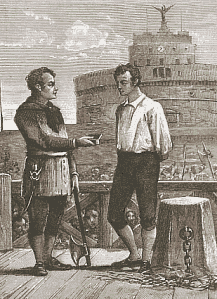
He’d made a living first as a Corporal and then a Military Bookkeeper aboard a VOC ship in the Dutch East Indies. After being convicted of sodomy, Hasenbosch’s captain left him a castaway on Ascension Island.

The rest of the story, riddled in castaway lore, acts as a blip on the screen of cultural relativism for execution, religion and homosexuality. Being the diligent bookkeeper, Hasenborsch kept a diary during his six-month prelude to a different sort of Ascension. In January of the following year, British sailors discovered the castaway’s tent and things, including the diary (though no sign of his body was ever found).*

A diary entry of Leendert Hasenbosch.

Much has been written about what happened in those six months between sentence and death, including three published versions with varying degrees of poetic license. The diary’s surviving passages reveal a deeply religious man tormented by his actions, begging for forgiveness while facing imminent death.

Leendert Hasenbosch’s final diary entry.

And so the diary ends. Not a hint of irony on the horizon as the sun sets on Ascension Island.

* Excerpts, claimed as the correct English transcription of the diary, taken from “An Authentick Relation” in The Harleian Miscellany

On this day..

1808: The Executions of the Third of May

Two centuries ago today, Napoleon’s troops executed hundreds of prisoners taken during a quashed uprising against them in Madrid.

The carnage gives posterity an 1814 Goya masterpiece. (And this blog’s frontispiece.)

More reading: Napoleon’s Cursed War, by Ronald Fraser.

On this day..

1478: Pazzi Conspiracy attempted … and suppressed

On this date in 1478, a coup d’etat against the Medici family in Florence was attempted during Easter mass — and by day’s end, its leading perpetrators had been hanged.

The Pazzi conspiracy implicates, even more than the municipal political rivalries of the Pazzi and Medici families, the peninsular geopolitics pitting Florence against the Pope, each side with its own constellations of allied lords and city-states.

The arrangement of players and their assorted interests is amply covered elsewhere; we shall suffice for this space to say that the Pazzi were a family of wealth and lineage (another death-sentenced Florentine, Dante, had dropped a couple of their ancestors into his infernal tableau), and proceed to the aftermath.

When one strikes a king, one must strike to kill. In this case, the co-ruling Medici brothers, Giuliano and Lorenzo were both attacked — but Lorenzo survived, and visited a terrible vengeance upon the assailants.

An enraged mob — the Pazzi had misjudged the city’s mood to begin with, and committing murder in church was ill-calculated to win sympathy — and a star chamber of Medici loyalists immediately began rounding up the numerous conspirators, many of whom were summarily hanged from the windows of the Palazzo Vecchio.

Along with a number of obscure foot soldiers and family retainers who suffered such indignities as being thrown from high windows onto cobblestones and torn apart by the mob, the most prominent victims this day were Francesco de Pazzi (the link is to his Italian wikipedia page) and Archbishop Francesco Salviati, a papal loyalist whose grievance against Florence for delaying his seat as archbishop of Pisa had done much to instigate the conspiracy.

They were far from the only victims: fugitives who had escaped the city were hunted for weeks and months thereafter, although Lorenzo “the Great” — who cuts the very model of the enlightened prince to posterity, rightly or not — was disposed in several cases to grant mercy to innocents against the dictates of political expediency.

However, the culpable after this day had every reason to fear. Perhaps the most affecting story is that of elderly Pazzi patriarch Jacopo de Pazzi (Italian again), caught in flight by Tuscan villagers whom he tried desperately (and unavailingly) to bribe for the privilege of suicide rather than a return to the fate of his kinsmen. Florentine communal pride celebrated popular participation in vengeance against the papal plot. Botticelli was commissioned to paint the executed conspirators hanging in their death throes on the very facade of the palace where they had in fact been put to death.

The Pazzi family wasn’t quite blotted out literally — later, it would even be restored to the city — but a comprehensive sentence of civic damnatio memoriae followed in the weeks after the immediate danger was checked. The family property was confiscated, its name and coat of arms banished, even the public festival its Crusader forebear had inspired was (unsuccessfully) renamed. For a time, merely to marry a Pazzi was to exclude oneself from public office.

Niccolo Machiavelli was a boy of eight at the time the Pazzi conspiracy was attempted. As a political theorist in later years, the event would liberally illustrate his writings. In Machiavelli’s Discourses (available free from Project Gutenberg), for instance, the Pazzi conspiracy is a lesson in the danger of conspiring against two princes at once, the risk inherent in having any great number of people aware of the plot, and the unpredictable small turns of fortune and minor slips in execution upon which a great matter may succeed or fail.

[I]n these grave undertakings, no one who is without such experience, however bold and resolute, is to be trusted.

The confusion of which I speak may either cause you to drop your weapon from your hand, or to use words which will have the same results. Quintianus being commanded by Lucilla, sister of Commodus, to slay him, lay in wait for him at the entrance of the amphitheatre, and rushing upon him with a drawn dagger, cried out, “The senate sends you this;” which words caused him to be seized before his blow descended. In like manner Messer Antonio of Volterra, who as we have elsewhere seen was told off to kill Lorenzo de’ Medici, exclaimed as he approached him, “Ah traitor!” and this exclamation proved the salvation of Lorenzo and the ruin of that conspiracy.

Machiavelli also renders his account of this day’s affair in his History of Florence, another Gutenberg freebie.

A detailed exploration of the event is available here.

On this day..

1944: Ardeatine Massacre

On this date in 1944, Nazi troops occupying Italy avenged a partisan attack by executing 335 Italian hostages in the Ardeatine caves outside Rome.

Part of the cave complex where the massacres took place, barred by a decorative gate.

It was six months since Germany had invaded her onetime ally, eliminating those fascists who had deposed Mussolini. Now an occupied country — an increasingly tenuous occupation as the Allied war effort bore down on Germany — Italy’s partisans multiplied.

On March 23, some of them bombed a German army column, killing 33.

The Germans ordered an immediate reprisal, although there were administrative debates over how many hostages to shoot for each casualty. Hitler initially ordered a staggering 100:1 ratio, the sort of boundary-pushing command that makes 10:1 look like the choice of moderate, reasonable mass-murderers.

A motley collection was hastily assembled to fill the quota: regular prisoners, captured partisans, men from the neighborhood and from the Jewish community rounded up randomly,* even a young Italian diplomat (the link is in Italian) being held as a political suspect. So hastily was it done, the killers miscounted the harvest — as one later explained in a deposition:

Q. It was discovered that the number of people killed was more than intended, five extra. Can you explain that to us?

A. [At the Ardeatine,] Priebke was there with the copy of the list. He got the people down [off the trucks] and canceled out their names. At a certain point, one of the prisoners was not on Priebke’s list. At the end, in fact, there were five extra men. That was when Kappler said, “What do I do with these five? They’ve seen it all.”

For much of this day, in groups of five in these manmade caves that form part of the ancient catacomb network, German soldiers went about their sanguinary business. The bodies were stacked; some of the caves dynamited — as surely many Germans realized it would not be many months before the less that was known of such crimes, the better.

But publicity is the point of reprisals, after all, and the five extra men were far from the only ones who had seen the awful business. The butchery was known from the very next morning.

Intended to alienate leftist partisans from the general populace, the massacre instead united Italians of every stripe in disgust. Even the Italian fascists were horrified; according to Richard Lamb’s War in Italy 1943-1945, Mussolini ordered all political prisoners released to safeguard them from a repeat performance.

Like many wounds of the Second World War, this infamous war crime is far from healed over.

For one thing, the Pope was notably — outrageously — silent about a crime in his own back yard and directed largely against his own flock, feeding charges of Vatican collaboration.

For another thing, there was far from a complete accounting for its authors after Italy’s liberation. An American investigative series famously caught one of the massacre’s perpetrators, onetime Gestapo officer (and little apologetic about it) Erich Priebke, living in Argentina — in 1990.

The relevant parts two and three are below (part one is here).

Part 2:

Part 3:

And finally, the affair, or more particularly the partisan bombing that precipitated the massacre, has been the subject of postwar critique and revisionism, especially given the years of terrorist tit-for-tat between far-right and far-left factions that followed the war. Just last year, an Italian court intervened in the historical dispute, ruling against a Berlusconi newspaper’s campaign to smear the resistance with responsibility for this day’s executions.

* Notorious informer Celeste di Porto, “the black panther,” reputedly helped fill up the rolls by fingering Jews. A childhood friend of hers, Lazzaro Anticoli, scribbled before his execution, “If I never see my family again, it is the fault of that sellout Celeste di Porto. Avenge me.” According to Susan Zuccotti, the informer had had Anticoli’s name added at the last minute to bump her own brother off the list; di Porto’s Italian Wikipedia page charges her with responsibility for 26 of the Ardeatine victims. She was almost lynched at one point after the war for collaborating; she spent seven years in jail.

On this day..

1796: Mastro Titta’s first execution of many

A Catholic man with the name Giovanni Battiste (“John the Baptist”) Bugatti could hardly have had a more ironic role in church history than the man who, on this date in 1796, dispatched his first victim as official executioner of the Papal State. Nicholas Gentilucci was hanged for killing a clergyman and his coachman, then robbing two friars while on the lam; Gentilucci’s corpse was subsequently quartered.

Little is known about Gentilucci, but much is known of his then-17-year-old executioner, for Bugatti, who would become known simply as Mastro Titta, turned out to be the most individually prolific taker of life in turn-of-the-19th century Rome.

Bugatti was born in Rome in 1779 and, even while putting criminals of the state to death, lived and worked on the west side of the Tiber River as an umbrella painter. Executions were a side job, and these ghastly deeds were recognized as such by the church, which compensated him a paltry three cents of a Roman lira for each body.

“Minister of Justice”

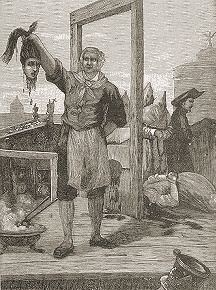
Mastro Titta brandishes an executed woman’s head.

The original Mastro Titta — the titular corruption of the “Minister of Justice” — took responsibility for each of his “patients” (as he called them, and as they were notoriously referred to by others), dutifully noting each of the 516 in his memoir. He stood for 69 years as the primary administrator of the death penalty in papal Rome, killing variously by beheading, hanging, and use of the mallet. Some were charged with murder, others with conspiracy, others with more petty crimes, but all were found guilty by the court of judges chosen by the Church’s bishops and cardinals.

The Minister’s performances were not without an (increasingly practiced) flair, heavy on the religious symbolism. Bugatti’s residence on the west side of the river meant that, when he was to carry out a punishment, he had first to cross the river.

Initially, the executions were carried out in the Piazza del Popolo, but that location was retired in the 1820’s; it’s not clear how consistent the location was after this, but at least one later execution occurred near San Giovanni decollato, home to the group of monks dedicated to comforting the condemned even when the final blow didn’t occur at its doorstep. Regardless of the locale, a spectacle soon arose surrounding that crossing and the parade which followed, as documented by Italian dialect poet G.G. Belli in 1835 (presumably for the execution of Giovanni Orioli di Lugo on July 11 of that year):

The Dilettante at the Bridge

They approach: Attention: the ceremony is brief.
Behold the condemned, neck bare and stretched.
He is the first man of the opera, the Patient,
The Ace of Spades, lord of the fesitval.

And behold the professor that will soon be
The surgeon acting for the people
For three pence, the community,
He will cure the ills of their pained head!

But not the man on the left: the other, to the right.
He in the second place is the Assistant.
The proceedings wait for Mastro Titta.

Do you want the usual from me, who takes the head?
I who never miss it: I am consistent;
And I know him as well as I know the Pope.

The translation is largely mine, with help on some difficult sections from a well-written and complete description of Mastro Titta’s life and work here and here.

Just a Job

A pinch of snuff before I snuff you?

Bugatti was known for playing the role of executioner in a manner which left no doubt as to his feelings towards the act: it was his job, his service to the Church itself, undisturbed by any personal animus towards the condemned — particularly early in his career.

He often offered snuff to his victims and spoke briefly and quietly with them prior to the execution, likely ploys to ease the victim into his role in the spectacle. Dickens viewed one of Mastro Titta’s beheadings on 8 March 1845*, and, in his Pictures From Italy, he remarked on the callousness of the event.

In keeping with this attitude, most of the entries in Mastro Titta’s memoir are fewer than 20 words. They reflect a man who seeks to distance himself from the crowd’s bloodlust. A selection:

  • Tommaso Tintori, guilty of homicide, 28 February 1810″ (The first using the “new edifice for beheading from the French government” — that is, the guillotine)
  • “Pecorari Angel, of Poli, aged 29. Peasant guilty of premeditated homicide of one woman, condemned to «death as an example» in Poland on 21 January 1847.” (There were a number of prisoners sentenced in other Catholic parts of Europe sent to Rome for Titta’s ministrations.)
  • “Sabbatino Proietti, aged 25, «decapitated» in Rieti for petty theft and highway robbery and murder on 20 August 1853, died converted, executed through administration of justice at the public square at the Bridge.”
  • “Angelo Lisi di Alatri, found guilty of premeditated highway robbery and murder in Frosinone, «dead» on 30 April 1862.”

An Anomalous Man

Bugatti was born just seven years prior to the Grand Duchy of Tuscany becoming the first of the Italian states to abolish the death penalty. There, Leopold II barred torture and punishment of death, a decision heavily influenced by Cesare Beccaria’s On Crimes and Punishments and a desire to distance his nation from Rome.

In the neighboring Papal State, however, the practice continued, the embodiment of the church’s power over its people in matters earthly and spiritual. Executions of the time performed for various reasons, but with a handful of exceptions, they were almost exclusively performed on persons in the lower class. Many relied on the use of torture or testimony from confessionals. Papal executions were carried out until the 1870s and only declared unnecessary (though not banned by the Church) by Pope John Paul II in the 1990s.

A complete discussion of the role of executions in the Catholic Church is too much for this space,** but a man like Bugatti serves usefully to exemplify the absurdity endowed in these killings by the Catholic Church. Where the half-dozen popes who served over Bugatti thought such executions to be necessary for the control of the masses, they had no such ideas about nobles who committed crimes.

The execution itself consisted of a parade with masked priests, banners, scriptural readings, and sermonizing, culminating in the death of the condemned. John L Allen of the National Catholic Reporter described the treatment of these executions in that day as “a liturgy”, and descriptions from writers such as Lord Byron show a scene which could only be described as a mix of Catholic Mass and town festival.

Such ritualized killing came to contrast starkly with the Italian celebration of an anti-death penalty position, and the two stood at odds for over a century. In 1909, the topic was hot enough that a plaque glorifying two Italians executed by Bugatti in 1825 was erected; a dozen years later, its contents were concealed out of deference to Rome until after the Second Vatican Council. The commemorated, Angiolo Targhini and Leonida Montanari (here’s their Italian Wikipedia page), were convicted essentially of riling the people, and they were summarily beheaded; their story was the inspiration for Luigi Magni’s 1969 classic Nell’anno del Signore:

“So ends the long list of Bugatti.”

Mastro Titta was given an official residence, and at the end of his term, he was handsomely rewarded with a pension for his service — 30 scudi per year. His final executions were carried out on 17 August 1864, wearing his traditional red cloak (now on display at the Criminology Museum of Rome): Antonio Olietti of Rome and Domenico Antonio Demartini were beheaded for homicide.

The Minister of Justice was 85, four and some years from the end of his life, and the final line in his memoir reads, “So ends the long list of Bugatti. May that of his successor be shorter.”

Indeed it was.

The final executions in Rome occurred on 24 November 1868 at the hands of Antonio Balducci, Bugatti’s long-time apprentice; the event was marked by Pope Pius IX famously intoning in response to calls for a stay, “I can’t, and I don’t want to.” The last execution in the Papal State was of Agatino Bellomo on 9 July 1870, in Palestrina, shortly before the nascent unified Italy absorbed Rome.

Mastro Titta is still known in Italy,† but, adrift amid a particularly violent period of revolution, his legacy as papal executioner is largely lost to the rest of the world.

* The day’s guillotinee was Giovanni Vagnarelli, 26, from Augustine; he killed Bavarian Anna Cotten and robbed her, and her wife’s statement at confessional was used to convict Vagnarelli. Such confessional convictions were not uncommon, as Bugatti’s own memoir confirms.

** There’s surprisingly little reading out there about this topic, though it would seem ripe for a book or two. Here’s what I can find:

  • “Fear and Loathing in Bologna and Rome: The Papal Police in Perspective”, Steven Hughes, Journal of Social History, 1987.
  • “Capital Punishment: The Curious History of its Privileged Place in Christendom”, James J. Megivern, Proceedings of the American Philosophical Society, 2003.
  • For a discussion of current discourse in Catholic teachings, this is rather interesting: “To Kill or Not to Kill: The Catholic Church and the Problem of the Death Penalty”, lecture by E. Christian Brugger, Asst. Prof. of Ethics, Dept. of Religious Studies, Loyola University, 2001.

† A half dozen kilometers from the bridge that Mastro Titta crossed on his way to carry out Papal justice now stands the Mastro Titta Pub. It is reportedly “tastefully done” and serves mostly Belgian beers.

On this day..

1845: An Italian highwayman, as witnessed by Dickens

On this date in 1845, Charles Dickens witnessed a man beheaded in Rome for robbery and murder.

At 33, Dickens was well-established in his field; he already had to his credit The Pickwick Papers, Oliver Twist, Nicholas Nickleby and others.

Dickens spent a good part of the mid-1840’s abroad, with extended stays in North America, Italy and Switzerland, although without much abating his prodigious output. He intended the travelogue Pictures From Italy to help finance his journeys; it met an unenthusiastic reception and rates distinctly among Dickens’ minor works.

This day’s events took place during the latter stages of Dickens’ stay in Italy and — as the distinctly proscriptive last paragraphs of this excerpt indicate — touch a social theme very pressing to the author, one to which he would soon return again. Years later, the utterly unedifying scene of the public guillotine would be fodder for Dickens’ A Tale of Two Cities, whose tragic protagonist has already appeared in these pages.

Of note also is Dickens’ implication — though he doesn’t quite state it outright — that the criminal was uncovered by a secret revealed under the seal of confession, a touchy point for the priesthood as any viewer of television crime dramas will certainly be aware. We have to allow a considerable latitude for a misapprehension on the traveler’s part here, especially given that Pictures as a whole caught considerable heat from the moment of its publication for its relentless anti-Catholicism. (Update: More on the use of confessionals in Papal Rome in this post about the Vatican’s headsman.)

Here’s the scene in its entirety:

On one Saturday morning (the eighth of March), a man was beheaded here. Nine or ten months before, he had waylaid a Bavarian countess, travelling as a pilgrim to Rome – alone and on foot, of course – and performing, it is said, that act of piety for the fourth time. He saw her change a piece of gold at Viterbo, where he lived; followed her; bore her company on her journey for some forty miles or more, on the treacherous pretext of protecting her; attacked her, in the fulfilment of his unrelenting purpose, on the Campagna, within a very short distance of Rome, near to what is called (but what is not) the Tomb of Nero; robbed her; and beat her to death with her own pilgrim’s staff. He was newly married, and gave some of her apparel to his wife: saying that he had bought it at a fair. She, however, who had seen the pilgrim-countess passing through their town, recognised some trifle as having belonged to her. Her husband then told her what he had done. She, in confession, told a priest; and the man was taken, within four days after the commission of the murder.

There are no fixed times for the administration of justice, or its execution, in this unaccountable country; and he had been in prison ever since. On the Friday, as he was dining with the other prisoners, they came and told him he was to be beheaded next morning, and took him away. It is very unusual to execute in Lent; but his crime being a very bad one, it was deemed advisable to make an example of him at that time, when great numbers of pilgrims were coming towards Rome, from all parts, for the Holy Week. I heard of this on the Friday evening, and saw the bills up at the churches, calling on the people to pray for the criminal’s soul. So, I determined to go, and see him executed.

The beheading was appointed for fourteen and a-half o’clock, Roman time: or a quarter before nine in the forenoon. I had two friends with me; and as we did not know but that the crowd might be very great, we were on the spot by half-past seven. The place of execution was near the church of San Giovanni decolláto (a doubtful compliment to Saint John the Baptist) in one of the impassable back streets without any footway, of which a great part of Rome is composed – a street of rotten houses, which do not seem to belong to anybody, and do not seem to have ever been inhabited, and certainly were never built on any plan, or for any particular purpose, and have no window-sashes, and are a little like deserted breweries, and might be warehouses but for having nothing in them. Opposite to one of these, a white house, the scaffold was built. An untidy, unpainted, uncouth, crazy-looking thing of course: some seven feet high, perhaps: with a tall, gallows-shaped frame rising above it, in which was the knife, charged with a ponderous mass of iron, all ready to descend, and glittering brightly in the morning sun, whenever it looked out, now and then, from behind a cloud.

There were not many people lingering about; and these were kept at a considerable distance from the scaffold, by parties of the Pope’s dragoons. Two or three hundred foot-soldiers were under arms, standing at ease in clusters here and there; and the officers were walking up and down in twos and threes, chatting together, and smoking cigars.

At the end of the street, was an open space, where there would be a dust-heap, and piles of broken crockery, and mounds of vegetable refuse, but for such things being thrown anywhere and everywhere in Rome, and favouring no particular sort of locality. We got into a kind of wash-house, belonging to a dwelling-house on this spot; and standing there in an old cart, and on a heap of cartwheels piled against the wall, looked, through a large grated window, at the scaffold, and straight down the street beyond it until, in consequence of its turning off abruptly to the left, our perspective was brought to a sudden termination, and had a corpulent officer, in a cocked hat, for its crowning feature.

Nine o’clock struck, and ten o’clock struck, and nothing happened. All the bells of all the churches rang as usual. A little parliament of dogs assembled in the open space, and chased each other, in and out among the soldiers. Fierce-looking Romans of the lowest class, in blue cloaks, russet cloaks, and rags uncloaked, came and went, and talked together. Women and children fluttered, on the skirts of the scanty crowd. One large muddy spot was left quite bare, like a bald place on a man’s head. A cigar-merchant, with an earthen pot of charcoal ashes in one hand, went up and down, crying his wares. A pastry-merchant divided his attention between the scaffold and his customers. Boys tried to climb up walls, and tumbled down again. Priests and monks elbowed a passage for themselves among the people, and stood on tiptoe for a sight of the knife: then went away. Artists, in inconceivable hats of the middle-ages, and beards (thank Heaven!) of no age at all, flashed picturesque scowls about them from their stations in the throng. One gentleman (connected with the fine arts, I presume) went up and down in a pair of Hessian-boots, with a red beard hanging down on his breast, and his long and bright red hair, plaited into two tails, one on either side of his head, which fell over his shoulders in front of him, very nearly to his waist, and were carefully entwined and braided!

Eleven o’clock struck and still nothing happened. A rumour got about, among the crowd, that the criminal would not confess; in which case, the priests would keep him until the Ave Maria (sunset); for it is their merciful custom never finally to turn the crucifix away from a man at that pass, as one refusing to be shriven, and consequently a sinner abandoned of the Saviour, until then. People began to drop off. The officers shrugged their shoulders and looked doubtful. The dragoons, who came riding up below our window, every now and then, to order an unlucky hackney-coach or cart away, as soon as it had comfortably established itself, and was covered with exulting people (but never before), became imperious, and quick-tempered. The bald place hadn’t a straggling hair upon it; and the corpulent officer, crowning the perspective, took a world of snuff.

Suddenly, there was a noise of trumpets. ‘Attention!’ was among the foot-soldiers instantly. They were marched up to the scaffold and formed round it. The dragoons galloped to their nearer stations too. The guillotine became the centre of a wood of bristling bayonets and shining sabres. The people closed round nearer, on the flank of the soldiery. A long straggling stream of men and boys, who had accompanied the procession from the prison, came pouring into the open space. The bald spot was scarcely distinguishable from the rest. The cigar and pastry-merchants resigned all thoughts of business, for the moment, and abandoning themselves wholly to pleasure, got good situations in the crowd. The perspective ended, now, in a troop of dragoons. And the corpulent officer, sword in hand, looked hard at a church close to him, which he could see, but we, the crowd, could not.

After a short delay, some monks were seen approaching to the scaffold from this church; and above their heads, coming on slowly and gloomily, the effigy of Christ upon the cross, canopied with black. This was carried round the foot of the scaffold, to the front, and turned towards the criminal, that he might see it to the last. It was hardly in its place, when he appeared on the platform, bare-footed; his hands bound; and with the collar and neck of his shirt cut away, almost to the shoulder. A young man — six-and-twenty — vigorously made, and well-shaped. Face pale; small dark moustache; and dark brown hair.

He had refused to confess, it seemed, without first having his wife brought to see him; and they had sent an escort for her, which had occasioned the delay.

He immediately kneeled down, below the knife. His neck fitting into a hole, made for the purpose, in a cross plank, was shut down, by another plank above; exactly like the pillory. Immediately below him was a leathern bag. And into it his head rolled instantly.

The executioner was holding it by the hair, and walking with it round the scaffold, showing it to the people, before one quite knew that the knife had fallen heavily, and with a rattling sound.

When it had travelled round the four sides of the scaffold, it was set upon a pole in front — a little patch of black and white, for the long street to stare at, and the flies to settle on. The eyes were turned upward, as if he had avoided the sight of the leathern bag, and looked to the crucifix. Every tinge and hue of life had left it in that instant. It was dull, cold, livid, wax. The body also.

There was a great deal of blood. When we left the window, and went close up to the scaffold, it was very dirty; one of the two men who were throwing water over it, turning to help the other lift the body into a shell, picked his way as through mire. A strange appearance was the apparent annihilation of the neck. The head was taken off so close, that it seemed as if the knife had narrowly escaped crushing the jaw, or shaving off the ear; and the body looked as if there were nothing left above the shoulder.

Nobody cared, or was at all affected. There was no manifestation of disgust, or pity, or indignation, or sorrow. My empty pockets were tried, several times, in the crowd immediately below the scaffold, as the corpse was being put into its coffin. It was an ugly, filthy, careless, sickening spectacle; meaning nothing but butchery beyond the momentary interest, to the one wretched actor. Yes! Such a sight has one meaning and one warning. Let me not forget it. The speculators in the lottery, station themselves at favourable points for counting the gouts of blood that spirt out, here or there; and buy that number. It is pretty sure to have a run upon it.

The body was carted away in due time, the knife cleansed, the scaffold taken down, and all the hideous apparatus removed. The executioner: an outlaw ex officio (what a satire on the Punishment!) who dare not, for his life, cross the Bridge of St. Angelo but to do his work: retreated to his lair, and the show was over.

Pictures from Italy is available free online from Project Gutenberg.

The date and description would indicate that Dickens witnessed the death of 26-year-old Giovanni Vagnarelli. (See this list of the Holy See’s executions.)

Part of the Themed Set: The Written Word.

On this day..

2007: 23 Shia hostages

On this date in 2007, during Iraq’s sectarian civil war, Sunni gunmen avenged the execution of Saddam Hussein by hanging 23 Shia hostages in Baghdad’s Haifa Street.

It was but one instance of retaliatory violence ensuing upon the former dictator’s hanging Dec. 30, with scores killed around the country — many in a similar fashion.

London’s Telegraph reports:

The residents of the city’s Haifa Street will long remember the events of Sunday morning. As shop owners raised their shutters and stall holders set out their stock, three minibuses roared to a halt.

Gunmen jumped out and pulled blindfolded prisoners on to the street. Ropes were tied to lampposts and electricity poles. Those hostages who resisted were shot. Others who were still alive had nooses tied around their necks and were then suspended in mid air to choke to death.

All were left hanging, and the victims received little sympathy from those who witnessed the events.

“We watched as all these blindfolded men were hung up and some were shot in the head,” Imad Atwan, a supermarket worker said.

“Altogether there were 23 bodies. We are all Sunni people here so we supported the gunmen. Some of them are the guards of our neighbourhood.”

The discoveries were not limited to Haifa Street. People murdered in the same way had been found in Al Doura district and Amriya, in western Baghdad.

The interior ministry estimates that 200 Iraqis were taken hostage after Saddam was sentenced to death.

On this day..

1944: An unknown Allied airman

On this date in 1944, in the midst of a worldwide conflagration that would claim 70 million lives, one unknown crew member of an Allied bomber was shot by Nazi SS/SD troops in the woods around Enschede, Netherlands.

From late 1942, the Allies’ massive industrial capacity had sapped the vaunted Luftwaffe, bleeding down the German air force in desperate airborne combat in the Mediterranean and the Eastern front. Crippling losses in July and August 1943 lay Germany’s industrial heart open to devastating bombing and would within a year spell the end of the Luftwaffe as an effective fighting force.

The contest’s stakes were high. This hour-long compilation of contemporaneous U.S. propaganda footage celebrates the decisive effect of air supremacy in western Europe:

With hostile planes darkening Europe’s skies, the Germans called upon ruthlessness to stand in for materiel. Nazi SS chief Heinrich Himmler issued, according to Robin O’Neil, an August 1943 order to show no quarter to captured enemy pilots.

The young man shot this day suffered its effects:

The airman (estimated age 26 years), who was apparently unhurt, was taken by the SS to the cellar of the villa [serving as SS headquarters], where he was kept under guard while arrangements were made for his disposal. These arrangements consisted of the removal of his flying kit, and the substitution of a civilian light-coloured shirt, a pair of dark trousers, and a pair of socks.

In this dress he was put into a security vehicle, his hands handcuffed behind his back, and taken some distance in the grounds of the SS HQ to a spot within the compound where a grave had already been prepared. The airman was marched from the car by an escort of two SS men, one of whom dropped back and shot the airman in the back of the neck. He was buried and the grave was carefully camouflaged.

To this day, the airman’s identity has not been established. It was assumed that he was British or American, most probably American, as the trousers he was wearing were of a dark shade of khaki, and the fact that when he was informed in the car, in English, that he was to be executed, he made an indistinct reply in which the word “America” was uttered.

Countless such executions undoubtedly took place and were lost, forgotten or concealed in the charnel house of war. Thanks to the witness of Dutch prisoners who survived the war, this single act of routine brutality endured not only historically but juridically: little more than a year later, its author, Dr. Karl Eberhard Schongarth — an SS officer who participated in the Wannsee Conference and slaughtered thousands in occupied Poland and Holland — faced a war crimes prosecution for the execution of the anonymous airman.

His actions this date may have been small by the gauge of a bloodthirsty career, but since pre-war treaties explicitly regulated treatment of war prisoners, they also constituted a conveniently plain transgression of the far-from-bright line demarcating “war crimes.” For this one killing, Schongarth was himself hanged as a war criminal in Hamelin, Germany on May 16, 1946.

On this day..

1577: Soulmother of Kussnacht

On an uncertain date in November of 1577, a popular medium whose given name is lost to history was burned to death in a lakeside town for claiming to speak with the dead.

The Soulmother of Kussnacht ran a successful enterprise channeling spirits for those who survived them. Though her persecution by a Church ill-disposed to “wise women” seems a given in retrospect, she evidently ran this business openly for well over a decade, and was at least once before brought to the attention of authorities who found her harmless.


Kussnacht as seen in an old postcard. Image reproduced with permission.

Historian Carlo Ginzburg locates Die Seelenmutter within the cosmos of pre-Christian “shamanism” that persisted in Christendom under varying degrees of toleration. In Ginzburg’s Night Battles: Witchcraft and Agrarian Cults in the Sixteenth and Seventeenth Century, which chronicles the Inquisition’s crackdown on a sect of northern Italian occultists, the contemporaneous execution of the Soulmother is both barometer and precedent for Rome’s rising intolerance of heresy.

On this day..

1002: St. Brice’s Day Massacre

On this date over a millennium past, according to the chronicle of John of Wallingford, King Ethelred the Unready of England conducted a massacre of Danes living in the realm.

The character of this sanguinary event — named after a fourth-century French bishop whose feast day Nov. 13 happens to be — lies half-buried in history’s shifting sands. Surely the slaughter of every Dane in a Britain then very much in the Scandinavian orbit would have been not only morally reprehensible but logistically unimaginable.

The accepted, albeit sketchy, story has it that to consolidate his own authority — or to check an actual or suspected plot against him — Ethelred ordered the surprise apprehension and summary execution of some sizable number of Danish lords and mercenaries. British historian Thomas Hodgkin characterizes it as a sort of coup d’etat.

On this date, it was the Danes who were unready for Ethelred.

But whatever its true extent or immediate object, it occurred within the context of intensifying conflict between the English crown and Scandinavian aspirants. Ethelred was to spend the better part of his life struggling — both militarily and through the ruinous tribute of Danegeld — to hold back the incursions of the Viking king Sweyn I.

The St. Brice’s Day Massacre exacerbated those tensions. Sweyn’s sister was apparently among those massacred, and — whether driven by vengeance or simply availing a pretext — Sweyn resumed harrying the English kingdom in the following years.

By 1013, Sweyn had driven Ethelred to Normandy and ruled all of England, welding together a Norse empire fringing the whole north of Europe.

But the empire — and England’s place in it — proved an historical cul-de-sac. Authority in England would be contested for another half-century, gradually sapping the crown’s strength until the Norman Conquest in 1066 swept aside Viking power and set England on a course that would redefine its history.

Update: The story of Ethelred, Normandy, and the Vikings told in Episode 3 of Lars Brownworth’s Norman Centuries podcast:

[audio:http://c4.libsyn.com/editions/58550/17915/03-richard-the-good.mp3]

The British History Podcast covers the St. Brice’s Day Massacre in episode 328.

On this day..