1552: Edward Seymour, deposed Lord Protector

The set of any given Tudor-era costume drama is a walking Who’s Who of scaffold superstars, most notably, of course, the wives of Henry VIII. That king’s bed did not cease exuding power and danger with Henry’s death.

With Henry’s demise, the crown fell to the only legitimate son the old man had produced in a lifetime of trying, the sickly 9-year-old Edward VI, son of Henry’s beloved* third wife Jane Seymour.

Jane’s brothers had leveraged their late sister’s favor into political muscle, and Edward Seymour smoothly outmaneuvered rival factions late in Henry’s life to set himself up as the true ruler of England during the boy king’s regency.

Created Duke of Somerset and Lord Protector,** Edward ran the country for going on three years, executing the other Seymour sibling as a rival along the way.

But the power of the king’s office without the attendant legitimacy turned out to be a double-edged blade.

Edward inherited a campaign against Scotland (and France) to secure the betrothal of the king to the young Mary Queen of Scots, then just beginning her own lifetime as a political and matrimonial football.

That wearisome (and costly) military scenario could only exacerbate the enmities a somewhat tin-eared Somerset generated in the course of everyday politics at the treacherous Tudor court. Catholics resented his liberal religious policy (Thomas Cranmer produced the first Book of Common Prayer on Edward Seymour’s watch); noble rivals wheedled and flattered the youthful king in his charge; and Edward Seymour’s populist political style rubbed stodgier nobles the wrong way without quite satisfying discontent among commoners† who rebelled widely in 1549, a year of terrible harvests and economic breakdown. By October of 1549, he had been politically isolated and was supplanted by John Dudley. (Guess what happened to him.)

Interestingly, that transition initially looked to be as bloodless a coup d’etat as 16th century England could enjoy: Seymour did a couple months in the Tower of London but accepted his place and not only rejoined the Privy Council but dynastically married his daughter to Dudley’s heir.

All it took, however, was an ounce of paranoia on Dudley’s part to suspect the former Lord Protector of plotting against him. The peers of the realm wouldn’t convict him of a trumped-up treason charge, but “compromised” with a felony conviction that had, for old man Somerset, the exact same result.

We have an account of the Duke’s oddly portentous end from diarist Henry Machyn, whose record of the scene in the original text of Early Modern English we present here beside its “translation” — courtesy of Machyn diaries here and here.

[The xxij of January, soon after eight of the clock in the morning, the duke of Somerset was beheaded on Tower hill. There was as] grett compeny as have bene syne . . the kynges gard behynge there with ther ha[lbards, and a] M1. [i.e., a thousand] mo with halbards of the prevelege of the Towre, [Ratcliffe,] Lymhowsse, Whyt-chapell, Sant Kateryn, and Strettford [Bow], as Hogston, Sordyche; and ther the ij shreyfs behyng th[ere present] seyng the execusyon of my lord, and ys hed to be [smitten] of, and after shortely ys body was putt in to a coffin, [and carried] in to the Towre, and ther bered in the chyrche, of [the north] syd of the qwyre of sant Peters, the wyche I beseeche [God] have mercy on ys sowlle, amen! And ther was [a sudden] rumbelyng a lytyll a-for he ded, as yt had byn [guns] shuttyng [i.e., shooting] and grett horsys commyng, that a M1. [i.e., a thousand] fell [to the] grond for fere, for thay that wher at the on syd [thought] no nodur butt that one was kyllyng odur, that [they fell] down to the grond on apon anodur with ther halb[ards], they thought no nodur butt that thay shuld . . . . . sum fell in to [the] dyche of the Towre and odur plasys, . . . and a C. [i.e., 100] in to the Towre-dyche, and sum ran a way for [fear.] He [the Duke of Somerset] was beheaded soon after eight o’clock in the morning, being brought to his execution the sooner to prevent the concourse of the people, who would be forward to see the last end of one so well beloved by them. It was the greatest company as have been seen. The King’s guard being there with their arms, there were a thousand more with halberds of the privilege of the Tower, from Ratcliff, Limehouse, Whitechapel, St. Katherine, and Stratford Bow, as Hoxton, Shoreditch.

And there the two sheriffs being there present seeing the execution of my lord. And his head to be off. And after shortly his body was put into a coffin and carried into the Tower and there buried in the church of the north side of the choir of St. Peter. The which I beseech God have mercy on his soul. Amen.

And there was a sudden rumbling a little before he died as it had been guns shooting and great horses coming, that a thousand fell to the ground for fear. For they that were at the one side thought no other but that one was killing other. That they fell down to the ground, one upon another with their halberds. They thought no other but that they should flee. Some fell into the ditch of the Tower and other places, and a hundred into the Tower ditch, and some ran away.

* Henry was buried next to Jane, a meek spouse who had stayed out of politics, given him an heir, and died from the birth.

** Not the realm’s most famous Lord Protector, of course, but the last to exercise the office as it had been traditionally understood, for the protection of an underage sovereign.

† Notably, Somerset ordered a commission to look into nobles enclosing common land, a burning issue throughout the century. Some think this raised hopes in the hoi polloi for a resolution to the great class conflict that the Duke didn’t have the juice to implement.

On this day..

1758: Francois Macandal, forgotten black messiah

(Thanks to Mark Davis of macandal.org for the guest post on a remarkable historical parallel to today’s inauguration of Barack Obama. -ed.)

The world was astounded when Barack Obama was elected to the Presidency in 2008 knowing the cultural barriers minorities have faced for hundreds of years. The date of inauguration, January 20, also happens to be the anniversary of the burning at the stake of a virtually unknown man, Francois Macandal,* whose epic war against cultural barriers has been buried for centuries.

Read some of his story and judge if the historic election of Barack Obama could have occurred without the man they called “Macandal.”

The parallels with Barack Obama’s journey are numerous, but the life of Macandal was perhaps even more remarkable, reaching great heights and falling into the darkest chasms of despair, yet succeeding in spite of staggering odds. Macandal’s travails may be about finding one’s purpose and dreaming of victory even when condemned by a majority, as he was relentlessly pursued by soldiers and hounded by countless naysayers.

251 years ago on January 20, 1758, Macandal was chained to a post on a platform before thousands of slaves brought together to witness his brutal torture and execution. Because of his importance, the French gathered slaves from hundreds of plantations throughout the colony of St. Domingue (now Haiti and the Dominican Republic). They believed such a horrific spectacle would quash Macandal’s Revolution, which he began to end French rule and abolish slavery, 12 years before.

Around 1746 Macandal escaped his plantation, united thousands of escaped slaves along with many still enslaved, and proclaimed that he would lead them all to independence and freedom. This declaration, from someone who had only six years before been taken from his home in the Congo, was unprecedented, since no slave colony had ever defeated a European nation. Then Macandal mobilized tens of thousands and may have inspired millions to end slavery and defeat colonial hegemony in the Haitian Revolution consummated decades after his death.

But ironically even the famous, black Marxist writer C.L.R. James, attributed one of the greatest revolutions in history to something akin to ‘spontaneous rioting’ by 500,000 black slaves in 1791. Since 1791 almost every historian has reduced the “Haitian Revolution,” the only successful overthrow of a colonial power by black slaves, to a ‘collective rage,’ inspired by the whites of the “French Revolution.” Yet it may have been Macandal’s Revolution, not the starving peasants of France, that inspired their uprising in 1789.

The true story of Macandal represents obscure but recorded testimonies about his life and explains why the slave revolt of 1791 was in fact, “Macandal’s Revolution,” almost 50 years in the making. Macandal foretold the end of slavery, then planned it, plotted it and began it. His story shatters a myth that has gone unchallenged for over 200 years: that the Haitian Revolution of 1791 was a spontaneous slave uprising inspired by the French peasants who had charged the Bastille Prison in Paris two years earlier.

The Haitian Revolution ultimately ousted the French, defeating Napoleon and numerous French generals. It also succeeded against the vaunted British army and established a new government run by former slaves. It was the first domino in a series of colonial defeats and changes in law that led to the end of institutional slavery; and Macandal started it all.

Correcting the Historical Record

Macandal is rarely the focus of historians and when mentioned only his insignificance is noted. But the popular version of his story was immortalized by the original French writers themselves, in the interest of bolstering a self-image of innate superiority as a nation and a race. To have recognized Macandal’s brilliance would have acknowledged slavery’s illegitimacy, so Macandal’s real story had to be trivialized and buried.

This telling of Macandal’s journey from a free child in Africa to slavery and then revolution, relies less on popular writings and more on a review of all of the records in context. For example French writers claimed Macandal broke free because he was tied with ropes and the post was made of rotted wood that fell apart when he was set ablaze. Historians have repeated this without scrutiny. The French on St. Domingue regularly burned slaves to death at the town square of the capital, “Cap Francais.” At Macandal’s execution they gathered thousands of slaves as witnesses, to insure a humiliating defeat and halt his widely supported rebellion. Yet, despite this grandiose staging, we are supposed to believe Macandal was insignificant. And we must accept that the French military was so inept they forgot how to execute and did not know that ropes burn and untreated, rotted wood is flammable. Many such dubious “facts,” are still repeated blithely about Macandal and few Westerners grant him his bravery, genius or impact.

Interestingly, the U.S. Bill of Rights guaranteeing equality for all was also adopted in 1791, but it would be more than seven decades before slavery was outlawed in the U.S. and almost two centuries before equal opportunity laws were passed and enforced. For one tiny nation, Macandal enabled this to occur over 200 years ago.

Background

I began researching the life of Macandal 20 years ago, startled and inspired by one chapter in Wade Davis’ popular book The Serpent and the Rainbow, which focused on secret societies, Voodoo and Zombification. His version of Macandal’s story was dictated to him by Rachel Bouvoir-Dominique, a Haitian Anthropologist I interviewed in 1997, at her office in Cap Haitien. Working under the tutelage of well-known author and expert on Haitian history Michel Laguerre, a professor at U.C. Berkeley, I received grants for a field study and documentary on the subject of Macandal.

Anthropologists often allocate greater weight to oral history, informal observer accounts, burial remains, maps and gravures, re-evaluating more accepted published works historians rely on, and so this account reflects my perspective and research as an Anthropologist. I examined European gravures (illustrations) and colonial records cited commonly more skeptically, because they were clearly burdened by religious, sexist and racial paradigms of the day. For example illustrations portrayed slaves with happy smiles and sanguine facades, enjoying their lives in idyllic settings on the plantations. Yet slaves faced torture, rape, separation of family and death from over-work, every day. Blacks were often drawn with monkey features (toes, ears etc.) and other demeaning caricatures.

Western writers were fiercely loyal to provincial rhetoric, including the gender and racial bias then considered crucial foundations of Christian theology. Western scholars dehumanized natives and women to rationalize slavery, prejudice and justify the infamous “hierarchy of being,” which granted “white men” a closeness to God that no one else could approach. This endowed them with the right to use others as they saw fit.

There were many reasons colonial authorities destroyed or buried the noteworthy exploits of slaves. Few accounts of courageous acts from among the ranks of millions of Africans during 400 years of slavery were recorded and preserved, primarily to maintain the perception that slavery was justified, necessary and Nubian Africans were not truly human but beasts of burden. There are literally thousands of articles, books and films about individuals among the six million Jews who died during the holocaust but only a scant few from among the 100-200 million indigenous peoples killed during the colonial expansion; all the more reason to re-evaluate slaves like Macandal.

A Brief History of Macandal

During the early 18th century, around the age of 12, Macandal was taken from the west coast of Africa, probably the Loango Kingdom in the Congo. I claim the date of his birth was 1728 primarily because oral historians in Haiti I interviewed believed him to be 30 when he was fastened to a post before thousands and set on fire in 1758.

The French called him Macandal which may derive from a city in the Congo called “Makanda.” The town of Makanda no longer exists due to civil war but could have ancient roots and slaves were often named after the places they came from. His name may have been taken from the term makanda (plural form of “kanda”) referring to African societal groups. Some written accounts report that Macandal claimed to be descended from a ranking societal group and the son of a Chief or King.

Amazingly, Macandal could speak, read and write Arabic fluently. Some believe this is because he was raised Muslim, yet the Congo was Christianized long before Macandal was born. Portuguese mercenaries, missionaries and armies had combed every square inch of the Congo beginning in the late 1400’s, searching for gold, diamonds and slaves, forcing conversion to Christianity. However Macandal’s words and actions reveal a unique knowledge of both Christianity and Islam. His ancestors may have emigrated from the east coast where Muslims and Asians had allied with Swahilis to build beautiful cities and schools before the Portuguese invasion. His family may have then hidden themselves for centuries.

Conversion to Christianity was also a requirement for slaves on colony plantations but Macandal defied the French by learning the underpinnings of Christianity, to understand the roots of slavery and challenge newly acquired doctrines. Despite many influences the adult Macandal claimed no affiliation with Christianity, Islam, Voodoo or Animism.

As a child Macandal was educated and known to be accomplished in both music and art, including painting and sculpture. His dedication to learning was apparent throughout his life. He displayed a vast knowledge of plants, became a doctor on the plantation he was taken to and was sought by even the French themselves for treatment of diseases and ailments. Yet the vegetation on St. Domingue was completely different from that of the Congo; therefore, Macandal had to study his new environment and learn the properties of perhaps hundreds of plants. He secretly taught himself French and became so eloquent that the French aristocrats remarked that he could speak it better than they themselves, though education was strictly forbidden for slaves.

Based on historical records and interviews, it appears that Macandal was first sentenced to death on his plantation, around 1746 at the age of 18, for falling in love with the plantation owner’s favorite lover, a young and beautiful house slave. He underwent a scene of heinous torture intended to culminate in his death in front of many witnesses, but escaped mysteriously and fled into the hills. The French replaced this account with a tale about Macandal becoming handicapped from losing a hand in a sugar mill and then being left unguarded. His escapes were always attributed to poor guard oversight.

Though Macandal probably began his new life of freedom with the intention of bringing vengeance to his former owner Lenormand de Mezy and rescuing his true love, for some reason his objective evolved. Perhaps because of the totality of his traumatic experiences or because of the influence of Maroons (ex-slaves already living in the distant mountains) Macandal met after escaping, he began working for a new goal of freedom for all.

Macandal led a sweeping and unwavering revolution during the 12 years after his escape from the plantation. Unlike other escaped slaves, Macandal actually made the end of slavery his stated mission. He became the first to unite thousands of disparate Maroons who were living free but divided by tribal affiliation and known to be ardently dedicated to the destruction of each other. His uniting of these groups was an extraordinary accomplishment and he is the first known black leader and ex-slave to do so.

He began calling himself the “Black Messiah” and gave rousing speeches in secret locations to recruit slaves. He made dangerous and daring appearances on plantations during the night to urge loyalty and inspire hope. The name “Black Messiah” had great meaning to Macandal as evidenced by one of his famous speeches at a secret recruitment meeting. The words exposed Macandal’s understanding of Islam and Christianity and their link to institutional slavery. The term was a powerful catalyst he used to preempt religious and ethical indoctrination of blacks and free them from the ideological bonds of slavery. He had to usurp the authority of the Church and French government to convince slaves they deserved equality, freedom, family sanctity, education and self-government.

Macandal became a brilliant strategist and had a large, organized camp with lieutenants, captains and other ranks. He led countless attacks and escaped capture mysteriously many times. His tactics were unique and devastating. They were known to be carried on after his disappearance despite the brutal efforts of the French to extinguish illegal grassroots activity. During his reign as a Maroon leader he may have recruited half or more of the 100,000 slaves living on the plantations as secret agents of his revolution.

Maroons and slaves apparently employed his tactics for decades after his disappearance in 1758. During the decade before the final thrust for overthrow in 1791, and despite harsh measures to thwart rebellion, Maroon activity greatly increased. This activity was so secret that virtually nothing is known about this period and is one reason historians assume the war for independence was unplanned, even though the first massive attack was led by Boukman Dutty, formerly a cruel black overseer who was a contemporary of Macandal. His gathering, which launched the war, was convened at a hidden location where Macandal formerly gave his speeches, the symbolism of which cannot be denied.

Generals that followed Boukman used ingenuity and unique strategies to win the 13-year war and Toussaint L’Ouverture is given most of the credit for the victory. But Toussaint refused to support the war until after it had begun; its inevitability certain. He was 13 when Macandal was sentenced to death in 1758. A voracious reader and student of warfare he was well aware of Macandal but content as a slave under a liberal planter.

It is my thesis the “Macandal Revolution” continued through the three decades preceding the Haitian Revolution. No other slave is known to have prophesied and promised the end of slavery yet Macandal predicted that blacks would defeat the French, become free and independent of colonial rule and control the colony of St. Domingue. His rally cry and pronouncement repeatedly rang throughout the colony despite opposition and betrayal from many slaves who greatly feared the French and did not believe victory was possible.

The Haitian Revolution remains the only successful movement by black slaves to defeat a colonial power and achieve complete independence. It stands alone as a towering victory against incalculable odds. Though it is characterized as a ‘riot’ that generated its own momentum, 500,000 slaves and free blacks mysteriously rose up in unison, using sticks and stones, against over 50,000 heavily armed soldiers, landowners and henchmen.

The Fall of Colonialism

As Macandal’s victories mounted I propose that word of his revolution spread to Europe and bolstered many anti-colonial movements. For example one of his closest secret allies was a French Jesuit priest and the Jesuits along with other religious leaders in Europe began fomenting rebellion during this period. Before news of Macandal’s revolt spread, many in Europe believed the slave trade was not only profitable but philanthropic. It had long been heard in the churches that slaves were heathens being brought to Christ and treated well in the process. His uprising no doubt made many Europeans aware that slaves were not being treated well and were desperate. Macandal’s shocking victories may have provoked Europeans to finally condemn colonialism and slavery. His fearless attacks and disregard for colonial might may have also seeded the French Revolution.

What really happened on January 20, 1758? Macandal endured great agony during an intense and excruciating punishment. He did this so that slaves everywhere might become free. The French claim Macandal was burned alive at the town square in Cap Francais.** Admitting he broke free and leaped out of the fire, they wrote that soldiers reclaimed Macandal and threw him back in. However some observers claimed Macandal broke his chains and fled, never to be seen again. How he broke free during any of his escapes despite being surrounded by guards and soldiers, is not known. It is interesting to note that his remains were never found and there is no burial site. Given the French proclivity for making examples of slaves to increase fear and enforce discipline, a successful execution should have been commemorated by another French monument.

For most historians, January 20, 1758, came and went with barely a mention in official memorandums. Yet a detailed search of documents reveals a massive cover-up, confusion and consternation. Macandal’s Revolution was not quashed or even slowed; instead it was impelled and sent wildly rumbling down a path of manifest destiny. Plantation owners later discovered their most trusted slaves were working for the revolution. New restrictions were put on all blacks throughout the colony and 4-5 rebels were burned at the town square every month to strike fear into the rest. Intense interrogation and torture revealed ever more depth to the conspiracy. Macandal’s execution day inflamed slaves and intensified their commitment to him and they became more united and fervently bent on winning freedom. Jesuits were banned from St. Domingue five years later.

As the first U.S. President with African roots is inaugurated on January 20, no one will speak of Macandal or Macandal’s Revolution, which led to equal rights in 1804 for one small nation. January 20, 1758, the day the French sought to secure colonialism and slavery in perpetuity, became a day of victory for Macandal and a watershed event which brought colonialism down. Though Macandal has been denied his place, his actions may have ended slavery and paved the way for people like Barack Obama to make history.

Mark Davis received his Bachelor of Arts degree in Anthropology from U.C. Berkeley and a Master’s in Anthropology from the University of Hawaii. He is the foremost authority on Macandal and his one hour documentary The Black Messiah was broadcast on PBS in 1997. He publishes information through his website at www.macandal.org.

* The man’s true name is lost to us; the one he was given by the French can be alternately spelled “Mackandal” or “Makandal” or “Mackendal”.

** Renamed Cap Haitien after Haiti won its independence.

On this day..

1961: Patrice Lumumba

No brutality, no torture has ever made me plead for mercy, because I prefer to die with my head up, with unshakable faith and deep confidence in the destiny of my country, rather than live in submission and spurning of scared principles.

-Patrice Lumumba’s last letter to his wife

One person’s “murdered under controversial circumstances” is another person’s “executed.” By most unbiased accounts, Patrice Lumumba was both.

A strident anti-colonialist caught in the most inflammatory of Cold War power struggles, Lumumba remains a controversial figure.

In 1956, Patrice Lumumba was a mail clerk in Belgian Congo recently out of prison for embezzlement of post office funds. Though previously involved with the Liberal Party of Belgium, a colonialist political party, after prison, he helped found the Mouvement National Congolais, a pro-independence national party (an important distinction at the time, as most pro-independence parties were at least partially tribal in nature).

Convicted in 1959 of inciting an anti-colonial riot and sentenced to 6 months in prison, Lumumba was released early as Congo won its independence and the MNC became an important political force. Just how important became apparent the following June, when the 35-year-old Lumumba was ratified as the newly independent Congo’s first prime minister.

From criminal to high statesman in just over a year, Lumumba took his new power in stride, and watched in disgust as the deposed King Baudouin of Belgium attended the new nation’s first Independence Day celebration, and before a fawning international media condescendingly congratulated Belgium’s colonial beneficence to its former slave plantation.

Struck from the day’s official celebrations in favor of the the lukewarm exhortations of the new President Kasa-Vubu, Lumumba found time on the day’s unofficial program. Strident, emotional, and unabashed in its anticolonialist, nationalist, and pan-Africanist bent, Lumumba’s famous speech was roundly criticized by the domestic and foreign press, but well-received by the crowd and ultimately delivered directly to history.

Lumumba’s tenure as prime minister was short-lived, however.

Mere weeks after independence, a mutiny on army bases broke out in reaction to Lumumba’s ill-fated decision to leave the military out of a government pay raise. The resulting anarchy quickly spread throughout the country, and the province of Katanga, with the support of King Baudouin and powerful mining companies, declared independence. As United Nations troops failed to quell the situation, Lumumba appealed to the Soviets, whose intervention succeeded only in causing Lumumba’s political support to crumble.

Kasa-Vuba dismissed Lumumba in September; in response, Lumumba declared Kasa-Vuba deposed — quite illegally, as it happens — and appealed to the Senate, from whom he managed to win a vote of confidence.

At this point, in the heat of the Cold War, things got interesting.

Deposed again, this time in a CIA-endorsed coup, Lumumba found himself under house arrest and under the protection of UN troops. Not certain whether to trust the rule of the various laws surrounding him, Lumumba slipped out under the cover of night and escaped to nearby Stanleyville (now Kisangani), where he believed he had enough supporters to set up his own government — and army, whom one supposes he had by then resolved to pay rather better.

Pursued by forces loyal to the new government, Lumumba was captured and arrested in early December 1960 and charged with “inciting the army to rebellion.” Devoid of his former UN protection, the man who would be the leader of a newly free nation watched as he became a pawn in a much larger struggle. UN Secretary General Dag Hammarskjöld appealed to the process of law –- whatever that was –- while the USSR jumped a step ahead, demanding that Lumumba be immediately released and reinstated as prime minister and all UN forces withdrawn.

So much for that. The UN Security Council convened, and, a week later, the USSR’s resolution was defeated. Another, Western-backed resolution that would have given the UN power to act as impartial arbitrator was vetoed by the USSR.

At this point, caught between hostility of Cold War politics and the ever-hazy idea of “international law,” Lumumba languished in the military barracks of an even more hostile government. Hearing of plans for his transfer to barracks at the now-subdued Katanga province, Lumumba was wild on the plane trip and was forcibly restrained after appealing to other passengers to intervene on his behalf. Late at night after his arrival at his new prison, Lumumba was driven to an isolated spot and executed by firing squad. News of his death was not released until three weeks later, when it sparked protests in several European cities over the role of the Belgian government, which denied any involvement.

The extent of US and Belgian involvement in Lumumba’s death remains the subject of ongoing speculation. So does the question of what might have been.

On this day..

1980: Four Iraqi Turkmen

On this date in 1980, a professor, a soldier, a bureaucrat and a businessman were hanged by Saddam Hussein in his campaign to cow Iraq’s Turkic ethnic minority.

The ethnic and religious quiltwork of Iraq is much more nuanced than Sunni vs. Shia — and this blog has noticed its deadly potential before.

This day’s hangings belong to an earlier era, of the Ba’athist secular pan-Arab aspiration that had Hussein quashing minority national aspirations. (Though the anti-minority stance was hardly unique to him.)

Nejdet Kochak, Abdullah Abdurrahman, Riza Demirji and Adil Sherif were ethnic Turkmen (or Turkomen), ethnically and linguistically distinct Moslem descendants of those far-flung peoples of the Eurasian steppes.

More to the point, they were relatively prominent voices for Turkoman civil rights in the face of harsh state suppression.

This being Saddam Hussein’s Iraq, the problem had an easy solution. The four were made examples of, convicted of spying for their brother Turks in Turkey, and hanged — but not forgotten.

On this day..

1895: Charles Stokes, in the heart of darkness

On January 15, 1895, a Belgian colonial official in the Congo Free State hanged Charles Stokes for trading illicitly.

A British subject who’d abandoned his humdrum Liverpool desk job to become an missionary in Africa, Stokes eventually became a merchant in the mysterious continent noted for his favorable relationships with the locals. (He had two African wives.)

In 1895, operating out of German East Africa,* his caravan was detained trading into the Congo Free StateKing Leopold’s hellish personal reserve — with “Arab” slavers who colonial authorities considered rebels. That “rebel Arab slavers” bit formed the charge against him, but trading outside the royal monopoly was probably at least as egregious in Belgian eyes.

An 1895 Review of Public Events at Home and Abroad sums up the scenario.

It was alleged that [Stokes] had large quantities of arms, ammunition, and ivory, and that he had bought the ivory at a low price from Kibonge, the assassin of Emin Pasha. Captain Lothaire, an official, an official of the Congo State, with a strong force, was then advancing from Stanley Falls to attack this Arab chief Kibonge, in revolt against the Congo State.** On Lothaire’s arrival at Kilunga, Kibonge was already a prisoner in the hands of his own native subordinates, who refused to join him in fighting the State. Stokes applied to Lothaire for protection of his ivory and goods, which he desired to carry towards the East Coast. Lothaire claimed that letters were found among Kibonge’s effects which went to prove that Stokes had sold large quantities of arms and ammunition to this chief, to be used in war against the Congo State. Mr. Stokes was arrested by Captain Lothaire’s orders, brought before a court-martial composed of two non-commissioned officers and Lothaire, and sentenced to be hanged. The execution took place the following morning.

Though not surprising that the summary hanging of a European would provoke an international incident, one would hardly call it equitable given the unnumbered, unmourned multitudes of Africans whose lives were wrung dry and discarded for Belgium’s treasury. Still, the “Stokes Affair” made the headlines in both England and Germany, and for activist types struggling to gain any kind of traction for their tales of colonial horrors, it was something to work with.

Leopold paid off both countries. The trial of Lohaire for naughtily conducting the execution ended in an acquittal. Belgium set up a blue-ribbon commission of missionaries solemnly vowing to investigate abuses, which was never heard from again.

(Look for Charles Stokes’ appearance in this tale of the Belgian Congo’s woe, beginning at about 1:01:25.)

If the Stokes incident didn’t catch fire itself, it became a stick in the accumulating dry tinder that Sir Roger Casement set a spark to in the early 20th century.

And maybe a bit more than that, too.

The horror! The horror!

Stokes’s singular story is often thought to inform (pdf) Joseph Conrad’s great literary critique of colonialism, Heart of Darkness.

The Stokes hanging would be only one data point among many for those who had ears to listen to the horrors emerging from the Congo, to be sure. Still, Molly Mahood and Ian Watt have included Stokes — the gone-native ivory trader — as one of several possible inspirations for the novel and especially the Kurtz character. Lothaire himself probably offered fodder for the petty, tyrannous impunity of colonial officers who the narrator encounters on his way to meet Kurtz.

I gathered in snatches that this was some man supposed to be in Kurtz’s district, and of whom the manager did not approve. ‘We will not be free from unfair competition till one of these fellows is hanged for an example,’ he said. ‘Certainly,’ grunted the other; ‘get him hanged! Why not? Anything — anything can be done in this country.’

* Present-day Rwanda, Burundi and Tanzania.

** Lothaire had spent the early part of the decade wresting Belgian commercial dominance in the eastern Congo from the incumbent Arabo-Swahili elites. (The link is French.) “Arabs” in the context of the Belgian Free State meant these Moslem bantus, not (by and large) ethnic Arabs as we would think of them today.

Neither were “Arab slavers” a distinct enemy class for the Free State; those prepared to play ball with white authorities raided native settlements to obtain slaves for rubber plantations and other Belgian-authorized ventures.

On this day..

1759: The Tavora family

Two and a half centuries ago today, Portugal’s noble Tavora family was extirpated in Belem.

[A] scaffold eighteen feet in height was erected in the market-place of Lisbon, during the night of the 13th, round which was drawn up a cordon of military. Precisely at 7 o’clock in the morning, the old Marchioness of Tavora, as the most guilty, was brought upon the scene, her hands bound, and a rope round her neck. She was placed on a chair, and her eyes being bound, the executioner struck her head off without the previous utterance by her of any complaint. After her came the twenty-one-year-old son, Joseph Maria de Tavora. They bound him on a cross raised aloft, broke his arms and legs with iron clubs, and then strangled him with a rope. The same fate befell [Tavora son-in-law] Jeronimo de Ataide, Count of Atouguia, the young Marquis Luiz Bernard de Tavora, colonel of cavalry, his servant Blasius Joseph Romeiro, Corporal Emanuel Alvarez Fereira, valet of the Duke of Aveira, and the body-page, John Michael. Their corpses were all flattened upon wheels, which were placed on poles, and this proceeding took up so much time that fully half an hour elapsed before another execution could be proceeded with.


Other outstandingly gory images of this day’s business are here.

After the page Miguel or Michael, the executioner took the old Francis d’Assis de Tavora, bound him on a St. Andrew’s cross, gave him three blows on the chest with an iron rod that resounded to a distance, shattered his arms and legs, and then gave him his coup de grace through the heart. The executioner’s men then, amidst wild shrieks, shattered the arms, legs, and thighs of the ninth victim, the old Duke of Aveiro, while still alive, then killed him by a blow on the chest, and threw him into the blazing fire. Finally, the tenth delinquent, the valet Anton Alvarez Fereira, brother of the above-mentioned Emanuel, was conducted before the corpses of the nine who had been previously executed, each one being shown to him; he was then bound to a stake, round which was placed a heap of wood, and this being set fire to, was raked together until he was completely consumed* … When the execution was over, the scaffold, together with all the dead bodies, was set on fire and burnt to ashes, which were thrown into the Tagus.

Oh, and one last thing:

[T]he palaces of the high nobility who had been executed were pulled to pieces and levelled to the ground, and salt strewed on the places where they had stood, as a sign that they should never be built up again.

Yikes.


This stone marker was placed on the site of the razed palace of Jose Mascarenhas, the Duke of Aveiro. “On this infamous land,” it announces, “nothing may be built for all time.” Copyrighted image courtesy of Ludgero Paninho.

Seems someone got the idea that the Tavoras tried to kill (and more problematically, failed to kill) Portuguese king Joseph I.

Circumstantial, torture-adduced evidence put the scheming Marchioness Eleonora de Tavora and clan behind an apparent assassination attempt, wherein a couple of assailants had shot at the king’s unmarked carriage as it returned on a little-used road from a rendezvous with his mistress. (One of the circumstances was that the mistress was a Tavora, which put the accused in a position to know the king’s secret travel plans. Others argue the gunmen might have just been common highwaymen who had no idea they were setting upon the royal person.)

Whatever the facts of the matter, obscure behind a quarter-millennium, its attribution to the Tavoras and the spectacular revenge thereupon visited was effected by the king’s competent and ruthless minister, Sebastião José de Carvalho e Melo, the future Marquis de Pombal.


A monumental plinth surmounted by Pombal dominates the present-day Lisbon plaza named for him.

His able handling of the recent Lisbon earthquake had cemented his position as the throne’s right-hand man in a trend of centralizing absolutism not much appreciated by the old aristocracy (nor by the hidebound clerical orders, which explains why the aforesaid gory account of the execution ground comes from a German anti-Jesuit polemic).

And he would not miss the opportunity an attack on the king’s person gave him to sweep away his opponents.

The peers of the realm were summoned to witness their fellow blue-bloods so nauseatingly dispatched, and the Jesuits — “reported to have inflamed the Tavora family to their [the Jesuits’] desired pitch … in revenge for what had justly been done to them in South America”** — were forthwith suppressed.

(Functionally a progressive secular dictator — or an enlightened despot, to use a more 18th-century description — Pombal would eventually push political conflict with Rome so near the brink of outright schism that the Catholic Encyclopedia’s entry on Melo characterizes it as “a sort of disguised Anglicanism,” adding that “many of the evils from which the Church now suffers are a legacy from him.” His ascendancy is the “Pombaline Terror” in Catholic annals.)

Melo/Pombal exercised the power of the state for the rest of Joseph’s life, but the king’s daughter and successor Maria I dismissed him — though she did not take punitive action against Pombal for his persecutions, as his enemies demanded.

* Also doomed to burning alive was one Joseph Policarpo, who was able to escape the mass arrest a few weeks before and fled the kingdom. He was executed by effigy.

** This comment is from the letters of Christopher Hervey, an Englishman abroad in Portugal at the time of the execution whose 100+ pages’ worth of correspondence include live-at-the-scene reporting and English translations of the public pronouncements against the supposed culprits. As to the South American roots of Pombal’s conflict with the Jesuits, the order had resisted Pombal’s early schemes to reorganize and rationalize Portugal’s New World holdings in order to make the country a more competitive colonial power. Jesuit resistance to giving up the order’s control of education, and its humanitarian efforts to protect Indians, had been seen as contributing to an Indian rebellion that broke out in Jesuit-controlled territory — even to the point that Jesuits themselves were suspected of arming Indians in an effort to carve out church-controlled states. Hervey’s version has the Jesuits behind the plot in order to eliminate Pombal’s threat to their power. Others share this opinion … and Pombal, obviously, was keen to have his rivals inculpated for lese majeste in the public mind.

On this day..

1934: Marinus van der Lubbe, for the Reichstag fire

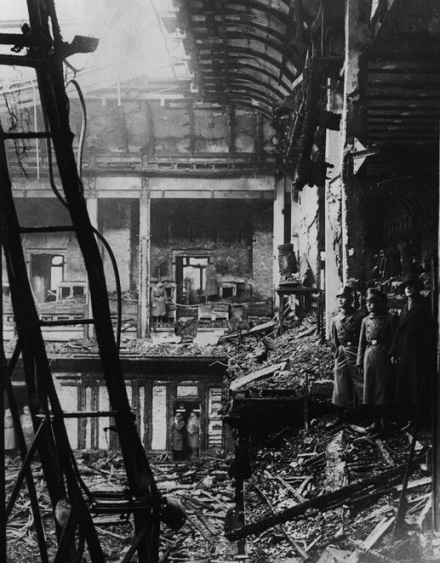
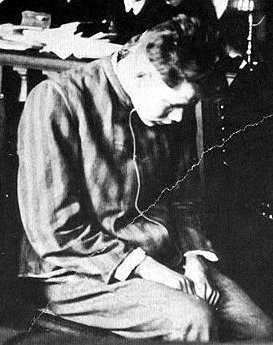
On this date in 1934, Dutch bricklayer Marinus van der Lubbe was beheaded by guillotine in Leipzig for setting the Reichstag Fire.

A watershed event* in the formation of the Nazi dictatorship, the Reichstag fire days before a parliamentary election enabled Hitler to stampede voters, suspend civil liberties, suppress left-wing parties on grounds of a suspected Communist plot, and seize “emergency” powers he would never relinquish.

Heil Hitler.

This clip from an American miniseries on Hitler with the characters chattering in unaccented English portrays the fascists’ opportunistic use of the attack on a national symbol … something not exactly unknown to later generations.

Van der Lubbe, who was arrested on the scene, suffered the predictable fate. Four other Communists charged as accomplices were acquitted, in a trial with the gratifying spectacle of Hermann Goering personally testifying, and being undressed on cross-examination by one of the reds. One is reminded here that Hitler did not yet have everything in the state apparatus at his beck and call … although he did have a great deal already, inasmuch as the arson law under which van der Lubbe died was passed after the Reichstag fire and made retroactive.

If the big-picture outcome of the Reichstag fire is pretty clear-cut, its real origin and the corresponding rightness of the judicial verdicts have remained murky ever since. The fact that the scene of the crime became Nazi ground zero for the next decade sort of obscures the evidence.

Van der Lubbe confessed, so his participation is generally taken as a given.

Whether he was really able to start the blaze acting alone, as he insisted, and the Nazis “only” exploited this fortuitous calamity; whether he was part of a larger leftist plot, as his prosecutors claimed; or whether, as Shirer and many others since have viewed him, he was a patsy in a false flag operation set up by the Nazis with an eye towards creating a politically advantageous national emergency — these possibilities remain very much up for debate.

For what it’s worth, postwar West German courts reversed and un-reversed the sentence before officially rehabilitating van der Lubbe last year on the non-specifically indisputable grounds that the legal machinery brought to bear on the Reichstag fire “enabled breaches of basic conceptions of justice.”

* From Defying Hitler: A Memoir by a writer who would soon emigrate:

I do not see that one can blame the majority of Germans who, in 1933, believed that the Reichstag fire was the work of the Communists. What one can blame them for, and what shows their terrible collective weakness of character … is that this settled the matter. With sheepish submissiveness, the German people accepted that, as a result of the fire, each one of them lost what little personal freedom and dignity was guaranteed by the constitution, as though it followed as a necessary consequence. If the Communists had burned down the Reichstag, it was perfectly in order that the government took “decisive measures”!

Next morning I discussed these matters with a few other Referendars. All of them were very interested in the question of who had committed the crime, and more than one of them hinted that they had doubts about the official version; but none of them saw anything out of the ordinary in the fact that, from now on, one’s telephone would be tapped, one’s letters opened, and one’s desk might be broken into. “I consider it a personal insult,” I said, “that I should be prevented from reading whichever newspaper I wish, because allegedly a Communist set light to the Reichstag. Don’t you?” One of them cheerfully and harmlessly said, “No. Why should I? Did you read Forwards and The Red Flag up to now?”

On this day..

1900: En Hai, the murderer of von Ketteler

On the last day of the 19th century, a Chinese officer was beheaded on the public street where he had precipitated western* military intervention in the Boxer Rebellion by killing a German diplomat.

Foreign commercial penetration — and domination — was generating domestic turmoil in China. As liberal reforms foundered in the late 1890’s, a more radical anti-foreigner movement blending spiritualism and martial arts launched the Boxer Rebellion (or Yihetuan Qiyi, in the local coinage).

In addition to massacring hated missionaries, the Boxers besieged foreign diplomatic missions in Peking … and veteran German ambassador Klemens von Ketteler was killed in a firefight on a crowded street. (The particular circumstances of the killing seem highly confused, and were immediately colored by the various interested parties’ axe-grinding; it’s sometimes called an “assassination,” but there’s no proof von Ketteler was specifically targeted, and the ambassador himself managed to get a shot off in the fray.)

Given the financial interests at stake, it would be far too much to say that von Ketteler’s death caused the military intervention that ensued, but it certainly catalyzed the conflict. The next day, China’s Dowager Empress declared war against the Eight-Nation Alliance. Within two months, Peking (Beijing) was under foreign occupation.

The man detained as von Ketteler’s murderer — En Hai, or Enhai, or Su-Hai — was proud to claim the act himself, and intimations of the Chinese government’s official blessing for anti-foreigner activities were carefully massaged since the Eight-Nation powers would have need of the Qing dynasty to keep order locally.


On the afternoon of this day in 1900, En Hai was brought out from German custody to the street where von Ketteler had met his end and handed over to the Chinese for beheading. Notice the substantial foreign attendance in both the photograph and the drawing. A German officer’s diary entry cited in The Origins of the Boxer War: A Multinational Study recounted the scene.

Ketteler’s murderer was executed at last — for months past the unfortunate wretch has been begging for his execution. It took place in one of the busiest thoroughfares but there were only a few curious onlookers. Scarcely fifty yards away the usual business was being quietly transacted in the streets, people who were eating did not suffer themselves to be interrupted, and a teller of fairy-tales who was recounting his absurd stories had interested his numerous audience much more than the execution.

And to see that the lesson would not be lost on future generations of Chinese, the humiliating peace imposed upon China that December (and formally signed the following year) required China to expiate its guilt by

erect[ing] on the spot of the assassination of his Excellency the late Baron von Ketteler, commemorative monument worthy of the rank of the deceased, and bearing an inscription in the Latin, German, and Chinese languages which shall express the regrets of His Majesty the Emperor of China for the murder committed

Having been made an offer it couldn’t refuse, China honored the intersection (German link) where both the victim and his killer had died in their turns with a massive pailou archway, inscribed

This monument has been erected by order of His Majesty the Emperor of China for the Imperial German Minister Baron von Ketteler, who fell on this spot by heinous murder on the 20th of June, 1900, in everlasting commemoration of his name, as an eternal token of the Emperor’s wrath about this crime, as a warning to all.


A historical postcard of Ketteler monument.

“Everlasting commemoration,” in this case, lasted 15 years.

The national aspirations that had fired the Boxers reared up again in 1911-12 to topple the Qing. Days after Germany’s surrender in World War I, the Chinese Republic began removing the von Ketteler monument.

Visitors will need to look sharp to catch it now, in Zhongshan Park (aka Sun Yat-Sen Park or Central Park), where it has been rededicated to abstractions that age a little better than our German civil servant.

But this was still not quite the last the name von Ketteler was heard in the consular world. A relative (German link) of the man slain in Peking was a conservative diplomat of the Weimar and early Nazi period who opposed the national socialist government. Wilhelm Emmanuel von Ketteler was abducted by the Gestapo in 1938 and murdered thereafter in unclear circumstances, possibly for involvement in a very early plot to kill Hitler.

* “Western” in this case includes Japan, the regional industrial power that also flanked the Russian Empire to the east — very much a player on the European balance-of-power chessboard. Germany (obviously), France, Italy, Russia, the U.K., and the U.S.A. were the other nations involved in the intervention, along with the Austro-Hungarian Empire, whose naval deployment to China included future Sound of Music character Georg Ritter von Trapp.

A fair amount of detail on China’s foreign relations during this period is available free in the (dry, and sometimes dated) public-domain 1918 work The International Relations of the Chinese Empire.

On this day..

1979: Hafizullah Amin

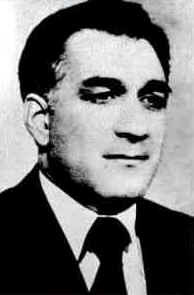
On this date in 1979, the 104-day term of Afghan president Hafizullah Amin met a violent end as a Soviet-engineered coup raised the curtain on a war destined to bring misery to both Cold War combatants.

The Soviet Union’s ongoing intervention in Afghan politics had through the 1970’s steadily mired it deeper into an unstable political situation.

Now, it was running out of patience with the country’s president, Hafizullah Amin.
He’d got the best of rival Nur Mohammad Taraki in a power struggle that September, but to the political chaos and the blossoming Islamic insurgency roiling his country, Amin added a level of brutality that was all his own, and a streak of diplomatic independence that was distinctly unwelcome in Moscow.

Amin was a Communist himself, and both he and the predecessor he’d murdered had wanted ever-increasing Soviet aid to keep the country stable.

But that proved to be a Faustian bargain.

Though Kabul radio would announce that Amin had been tried and summarily executed for “crimes against the state,” the short-lived dictator’s fate had been decided two weeks before when the Soviet Politburo passed a secret resolution for his ouster — having lost whatever confidence it had once held in him as a dependable satellite governor.

“The Soviet Union,” said the New York Times in a more innocent time,

has seemed deeply troubled by the inability of either the Taraki or Amin governments to put down the rebellions in Afghanistan, which have been largely tribal but also militantly anti-Communist.

Amin survived a KGB poisoning, so the Red Army dispensed with subtlety by raiding the palace, plucking their preferred satrap out of exile in eastern Europe to take Amin’s place.

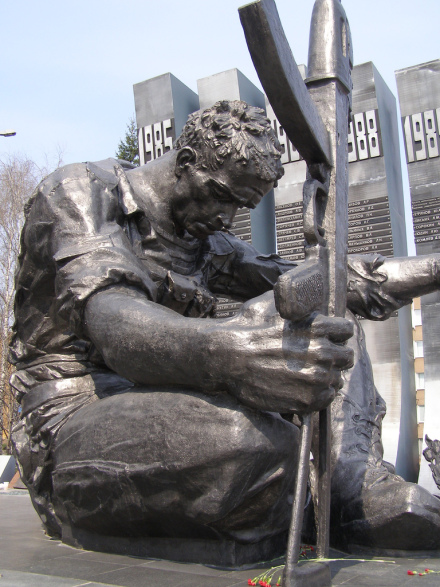
It would not see the last of Afghanistan until 10 years, 15,000 Soviet dead, and hundreds of thousands of Afghan casualties later.


A memorial in Ekaterinburg, Russia, to the Soviet dead in the Afghan war. Image courtesy of beatdrifter (Andy Holmes).

On this day..

1948: Hideki Tojo and six other Japanese war criminals

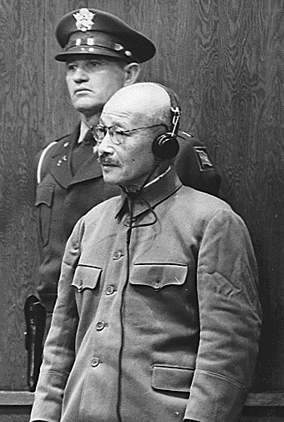
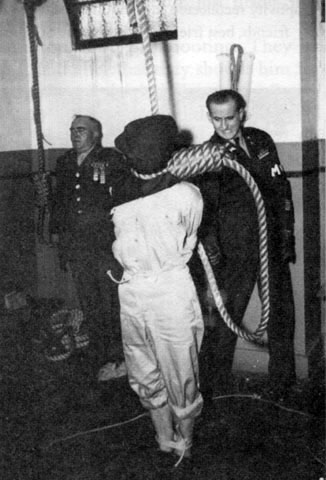
On this date in 1948, seven “Class A” war criminals, including Japan’s wartime Prime Minister Hideki Tojo, were hanged at Sugamo Prison by the American occupation authorities.

Like other Axis heads of state, Tojo was in for a bad end: he shot himself in the chest before American troops could arrest him, but missed his heart even though a doctor had helpfully marked the spot on his chest for him.


Fail.

However inevitable Tojo’s postwar fate, however, he was not exactly of a kind with the likes of Hitler and Mussolini. Indeed, he’d been cashiered from his Prime Ministerial gig in 1944 by the real power behind the throne — the Japanese military.
Unlike the “Fuhrer” and “Il Duce,” Tojo was a reflector, not a creator, of national thought. His word was not law. It was not his command or dictate. He was one among many and not even the first among equals. He was a militarist — misguided, naive, and narrow in outlook; he regarded war as a legitimate instrument of national policy; he apparently believed what he told the court, and failed to recognize the patent contradictions between his contentions and the facts. This had been his undoing.

That’s Robert Butow in Tojo and the Coming of War. Butow argues that the titular authority in Japan (he became Prime Minister shortly before the bombing of Pearl Harbor), a dedicated, patriotic officer of adequate talents but limited vision, came much too late and controlled much too little to be seen as the equal of the European theater’s villains.

The Japan of which General Hideki Tojo became premier was operated by remote control. It was a country in which puppet politics had reached a high state of development, to the detriment of the national welfare. The ranking members of the military services were the robots of their subordinates — the so-called chuken shoko, the nucleus group, which was active “at the center” and which was composed largely of field-grade officers. They, in turn, were influenced by younger elements within the services at large and by ultranationalists outside military ranks. The civilian members of the cabinet were the robots of the military — especially of the nucleus group, working through the service ministers and the chiefs of the army and navy general staffs. The Emperor himself, through no fault of his own, was the robot of the government — of the cabinet and the supreme command, a prisoner of the circumstances into which he was born … Finally, the nation — the one hundred million dedicated souls, the sum and substance of Japan, from whom the blood and toil and tears and sweat of Churchill’s phrase were wrung — the nation was the robot of the throne.

He was the man for his time and place. He fit right in.

Even when being fitted for a noose.

Once Tojo had recovered from his errant self-inflicted wound,* and even though he had been among those opposing surrender even after the atomic bombings, he played ball with the International Military Tribunal for the Far East (whose trial transcripts run to 50,000 pages).

The former premier embraced responsibility, diligently shielding the Emperor from any intimation of guilt (some argue this was the procedure’s entire raison d’etre, from the perspective of both the prosecution and the defense), and walked a dignified and honorable last mile in the courtrooms of the victor’s justice, presenting his perspective as he knew it in the context of a wish for peace between the late antagonists.

1. I deny that Japan “declared war on civilization.”

2. To advocate a New Order was to seek freedom and respect for peoples without prejudice, and to seek a stable basis for the existence all peoples, equally, and free of threats. Thus, it was to seek true civilization and true justice for all the peoples of the world, and to view this as the destruction of personal freedom and respect is to be assailed by the hatred and emotion of war, and to make hasty judgments.

3. I would like to point out their [my accusers’] inhumane and uncivilized actions in East Asia ever since the Middle Ages.

4. In the shadow of the prosperity of Europe and America, the colored peoples of East Asia and Africa have been sacrificed and forced into a state of semi-colonization. I would point out that the cultural advance of these people has been suppressed in the past and continues to be suppressed in the present by policies designed to keep them in ignorance.

5. I would point out that Japan’s proposal at the Versailles Peace Conference on the principle of racial equality was rejected by delegates such as those from Britain and the United States.

6. Of two through five above, which is civilization? Which is international justice? Justice has nothing to do with victor nations and vanquished nations, but must be a moral standard that all the world’s peoples can agree to. To seek this and to achieve it — that is true civilization.

7. In order to understand this, all nations must hate war, forsake emotion, reflect upon their pasts, and think calmly.

The “Class A” convicts not executed along with Tojo were freed afterwards.

Tojo has enjoyed a bit of a latter-day resurgence in the public regard, product of the nationalist right’s resurgence in Japan. The hanged man’s granddaughter Yuko Tojo has waged a tireless campaign to clear him.

Further to that end, his ashes — and those of the other Class A convicts — were covertly added to the controversial Yasukuni Shrine, and remain there to this day. That public tribute to principals of Japan’s bloody foreign occupations has become a hot political football between Japan and other nations, especially China.

But after all, Tojo the man was never a leper, but part and parcel of his times. Small wonder that we moderns hear an echo of the general’s postwar justification for the War in the Pacific from the country that hanged him.

Japan … faced considerable military threats as well.

Japan attempted to circumvent these dangerous circumstances by diplomatic negotiation, and though Japan heaped concession upon concession, in the hope of finding a solution through mutual compromise, there was no progress because the United States would not retreat from its original position. …

Since events had progressed as they had, it became clear that to continue in this manner was to lead the nation to disaster. With options thus foreclosed, in order to protect and defend the nation and clear the obstacles that stood in its path, a decisive appeal to arms was made.

The problematic nature of the war crimes proceedings in postwar Japan (especially vis-a-vis those in Germany) is examined in Yuma Totani’s The Tokyo War Crimes Trial: The Pursuit of Justice in the Wake of World War II. The author discussed her research on the New Books In History podcast.

[audio:http://newbooksinhistory.com/podpress_trac/web/720/0/Totani%20Interview.mp3]

* According to John Dower’s Embracing Defeat, the suicide scenario angered some nationalists because Tojo only “belatedly summoned the will to die,” and “chose the foreigner’s way of the bullet rather than the samurai’s way of the sword, and then botched even this.”

On this day..