1864: Two Dodds, as two spies, in two states, and twice botched

On January 8, 1864, young David Owen Dodd was hanged in Little Rock for spying on federal troops … and cavalryman Ephraim Dodd (no known relation) suffered the same fate for the same crime in Knoxville.

Just one of those strange coincidences.

Ephraim Dodd

Ephraim Shelby Dodd is the subject of an outstanding HistoryNet profile whose contents this blog can not so much improve upon as summarize.

A member of Terry’s Texas Rangers (“men who ride like Arabs and fight like devils”) Dodd was captured in December 1863 and convicted by his diary — a particularly harsh reading of his diary in which a reference to having passed himself off as a Yankee was interpreted as evidence of espionage. (The diary is available online and as part of a book on Terry’s Rangers.)

Knoxville worthies rallied to save him and Ephraim Dodd insisted upon his innocence, but not so vociferously that he displayed any terror of his fate.

Do not grieve for me, my dear parents, for I am leaving a world full of crime and sin for one of perfect bliss.

The hanging itself wasn’t bliss, exactly, despite a well-planned soundtrack.

From the “Death March” the music gradually slid into “Mary’s Dream,” and then we were carried back by the magic of the plaintive notes to juvenile days; to visions of “Sandy far at Sea,” and to the sad cadence of that fading refrain,

“When, soft and low, a voice she heard
Saying, Mary, weep no more for me.”

The solemn march, the wailing notes of the fife, and perhaps above all the calm, unmoved, manly bearing of the prisoner — so we thought — produced a mournful impression upon the spectators.

Points earned on artistic merit, however, were deducted for technique.

At a signal the bolt was now withdrawn, the culprit fell, but the cotton rope broke by the sudden tension, and the man lay stretched and stunned upon the frozen ground below. A mummer of horror, mingled with expressions of pity, ran through the assembled crowd. Recovering for an instant from the shock — for his neck was not broken — he said — perhaps incoherently: “Release me quick, if you please.” For some ten minutes the unfortunate man lay thus upon his back, without moving a muscle. Meantime the officers and men, whose painful duty it was to see to the execution of the law, adjusted this time two parts of the same rope instead of one, and the half-conscious man was borne up the fatal steps a second time, being partly supported upon the drop until the double noose had been adjusted. Not a word or sign of suffering all this time escaped his lips. In another moment the drop fell, and prisoner’s form now hung by the neck — the knot behind the head. Death finally ensued by strangulation. In ten minutes, Dr. Cogswell, the officiating surgeon, pronounced life extinct, and the body was taken down and buried.

David Owen Dodd

A few hours later and 500 miles down the way, the entirely unrelated hanging of David Owen Dodd proceeded in Little Rock, Ark.

David Dodd’s final resting place at Mount Holly cemetery. Image courtesy of Richard Theilig.

Only 17 at his hanging and not physically robust enough to get his brains blown out at Gettysburg, Dodd was sent by his father on a business trip across Union lines — everything legit, and carrying a pass — but got busted with morse code notations of Union troop strength in the city.

Unlike Ephraim, who was basically a normal soldier thrust into incriminating-looking circumstances by the chance of war, young David Dodd was rightly accused.

He didn’t bother protesting his innocence, but he also kept mum about his contacts. (Suggestively, a teenage girl and her father were whisked out of town and kept under guard in Vermont for the rest of the war.) That proud silence has won him quite a reputation in Arkansas as the Boy Hero of the Confederacy.

But similarities between the condemned men extended beyond their names. David’s parting filial reassurance could pass for a paraphrase of Ephraim’s.

[D]o not weep for me for I will be better off in heaven. I will soon be out of this world of sorrow and trouble.

And the hanging itself, conducted in a tense atmosphere, was likewise a botched job. In this case, the slight young man didn’t fall hard enough to break his neck, but did fall far enough to get his tiptoes on the ground, initiating an agonizingly protracted strangulation which the soldiers on detail expedited by (accounts differ) pulling on David Dodd’s legs and/or pulling up on the rope.

On this day..

1898: Theodore Durrant, the Demon of the Belfry

The annals of crime will attest that malefaction, like any other history, repeats itself — as tragedy and then as farce and then simply with numbingly grisly monotony.

Which brings us to San Francisco, for another forgotten crime of the century — a theater of the time actually produced a play called Criminal of the Century — that sent the Nancy Graces of the Gilded Age aswoon.

Theodore Durrant‘s basic profile — normal-seeming medical student and Sunday school superintendent with a secret pervy side — might not seem so remarkable with a century’s worth of serial killer profiles in the books, but ponder what programming hours Court TV would fill with mutilated, violated female parishioners found stuffed in the cupboard and belfry at any of the nation’s Emanuel Baptist Churches.

That Durrant was the last person seen with either of them anchored what the Associated Press would call (only a week after the bodies were discovered) a “chain of circumstantial evidence that has been welded link by link … so strong that it seems hardly possible that it can be rent asunder.”

Why,

information poured in … proving that the prisoner was a degenerate of the most depraved class. For obvious reasons, names cannot be given of young ladies to whom he made the most disgusting propositions, and the wonder of it is that he was not killed, or at least exposed before. But in most instances the nature of his insults were such that the young ladies offended feared to inform their relatives, lest they would take the law in their own hands. One young lady told her mother that some time previous to these murders, Durrant had inveigled her into this same library and excusing himself for a moment, returned stark naked and she ran screaming from the church.

The particulars were nationwide news copy from the outset in 1895 to hanging in 1898, and the city had a difficulty scraping together a jury qualified to give the man a fair trial (deliberation time: five minutes).

Durrant, for his part, protested his innocence to the gallows. Few believed him, but he did pick up a married groupie the press nicknamed “Sweet Pea Girl” for the flowers she kept bringing him.*

The more things change …

Even the legal route to hanging was (by 19th century standards) characteristically-for-California tortuous. The “fight for delay,” reported the Los Angeles Times (Jan. 8, 1898), was “vigorously maintained for almost twenty months, not even ceasing with the execution of the death sentence.”

Durrant came within two days of execution twice in 1897; the full narrative of legal maneuvers will be amply suggested by the Times‘ account of those made in the last week alone.

On December 31, an appeal for a writ of supersedeas was made to the State Supreme Court, but was refused. The Federal courts were then vainly appealed to for a writ of habeas corpus. On January 3 a petition was presented to Gov. Budd, praying for executive interference in the case. The petition stated that Durrant was a vital witness in the slander suit brought by his mother against [trial juror Horace] Smyth.**

On January 5 Durrant’s attorneys made another application to the United States court for a writ of habeas corpus. This was denied; also permission to appeal to the United States Supreme Court. On January 6, Attorney Boardman arrived in Washington, and endeavored to persuade Justice Brewer of the Supreme Court to grant permission to an appeal. Justice Brewer declined, and Boardman announced that he would appear before the entire court on Friday and demand to be heard.

In San Francisco on January 6, Attorneys Dickinson and Deuprey asked the United States Circuit Court for leave to file a bill of exceptions. … On the same afternoon, Gov. Budd formally announced that he would not interfere.

Durrant’s beloved sister would change her name to Maud Allan and emerge as a popular dancer in Europe in the early years of the 20th century. Renowned for her sensual portrayal of Salome, Maud strikes an immediate reminder of another character from these grim pages … and like Mata Hari, Durrant’s sister was accused (non-fatally, in Maud’s case) of consorting with German operatives during World War I.

* A paroled murderess also had Durrant’s back.

** According to the story, Smyth publicly called Durrant a “moral monster” and suggested that the condemned had had relations with his mother and sister.

On this day..

1994: Mansour Kikhia?

Fifteen years ago, a Libyan-born dissident of American nationality was abducted from a human rights conference in Cairo.

The fate or current whereabouts of Mansour Kikhia remain unknown to this day — although one widely-suspected scenario (and the conclusion of a CIA report on the incident) is that he was spirited to Libya and secretly executed early in 1994.

While other speculation has had Kikhia being held alive, the insulin-dependent diabetic would have been in a bad way absent the sort of painstaking medical attention he would not likely have been receiving from his captors.

The former Libyan foreign minister and United Nations ambassador, who had broken with dictator Muammar al-Gaddafi in 1980, was in Egypt to participate in an Arab Organization of Human Rights conference. The date he vanished from his hotel, last seen in the company of unknown Egyptian men driving vehicles with Mukhabarat markings, was December 10, 1993 — the 45th anniversary of the seminal modern human rights document, the Universal Declaration of Human Rights.

Several distinguished Middle Eastern scholars wrote an open letter shortly after Kikhia’s disappearance imploring

Arabs, Americans with an interest in the Arab world and human rights organizations not to rest until he regains his freedom. Nothing could be worse than to let the governments concerned think he will be forgotten.

If not “forgotten” in the strictest sense — see some links of the bulletins issued over the years to keep alive his memory — the governments concerned sure seem to have paid no price for having disappeared Mansour Kikhia.

On this day..

1892: Sylvester Henry Bell

The state of Vermont has long since dispensed with the death penalty; it hasn’t had a death penalty law on the books since 1964, and its last execution was a decade before that. (Source)

But back when the traps were dropping on Green Mountain State scaffolds, no consideration of sentiment (or holiday pay) barred hanging a man on New Year’s Day, as occurred in 1892.

You could call Sylvester Bell a ladykiller.

According to family genealogists familiar with the case, the Canadian-born farmer used two of his wife’s relatives as character witnesses in his naturalization proceedings … and eight months later, shot said wife, the mother of his five children. Not only did Sylvester win acquittal for this non-fatal attack, Marcia Farnsworth Bell actually had to fight to get a divorce on the grounds of “intolerable severity”.

Marcia and her unmarried children moved to Randolph, Vt., where the kids opened a major department store.

Nothing daunted, a then-54-year-old Sylvester remarried the decades-younger Emma Lock (or Locke) in 1887.


‘Til death do us part: Sylvester and Emma’s marriage certificate.

We may imagine an ensuing union not altogether free of discord,* as we rejoin the public record of their lives with the Jan. 2, 1890 Burlington Clipper.

It appears that Mrs. Bell had left her husband and applied for a divorce. Thursday she, in company with Deputy Sheriff Hall, went to the house to remove her things. Bell met them very pleasantly and permitted her to pick up her goods. As she was about ready to leave she went up stairs and he followed her. Soon afterward a pistol shot was heard and Officer Hall rushed up, and Bell met him at the door of the room into which Mrs. Bell had gone and handed him the pistol, saying, “Take this. I have done the deed.” The ball entered the head of the unfortunate woman, just back of the ear, and she lived about thirty minutes, unconscious.

Bell was put under arrest and for a time the excitement, and sympathy was so strong for the murdered woman that it looked as if Bell would be lynched, but the law will now be allowed to take its course.

The article understatedly observed, “Bell’s reputation with his wives is bad.”

The course of the law will not hold much suspense for readers of this blog.

The novelty of the eventual New Year’s execution attracted the New York Times which (botching the hanged man’s name and the date of his crime) reported the scene from the scaffold, where “Stephen” Bell bought himself an extra 34 minutes in this vale of tears with the verbosity of his last statement.

WINDSOR, Vt., Jan. 1. — Stephen H. Bell was hanged here this afternoon for the murder of his wife, in the town of Fairfax, Dec. 26, 1880. At 1:40 the door of the west wing of the prison was closed and at 1:44 the prisoner was taken from his cell, where he was holding an earnest conversation with Chaplain Wassall.

The prisoner was somewhat pale from long confinement. He boldly ascended the steps and, although assisted, appeared to be nerved up for the occasion. Chaplain Wassall offered a fervent prayer, during which Bell bowed and covered his face with his hand. Sheriff Lovell, as soon as the Chaplain had finished, stepped forward and said: “Stephen H. Bell, have you anything to say why the penalty of the law should not be executed on you?”

Bell, rather pale and tremulous, stood erect, and after addressing the Sheriff and officers in charge, asking for all the time he wanted in which to speak, began a talk which lasted thirty-four minutes. It was a rambling statement, in which he declared his innocence. When he had finished, Bell stepped back to his chair.

Sheriff Lovell took him by the arm, and the condemned man stood up bravely. When Deputies How and Randall had pinioned his wrists, arms, and legs Bell stepped on the drop and said: “Gentlemen, I am a dying man; good-bye.” Instantly the Sheriff touched the spring and the drop fell. In fourteen minutes he was pronounced dead. The body was buried in Windsor Cemetery.

Interestingly, Bell was the only person executed in his state during a 22-year period from 1883 to 1905. That span is bookended in Vermont’s death penalty annals by the first woman hanged in Vermont and the last woman hanged in Vermont.

Bell’s descendants continue to seek information on Sylvester; anyone who may know more can get in contact via this author.

* Another report of the murder describes Emma fleeing to live with her parents on account of Sylvester’s repeatedly menacing her with a butcher knife and a gun, until the “overseer of the poor, after a time succeeded in getting them together again, he giving up his pistol and agreeing to behave himself.” Clearly, it was a different time for domestic violence victims.

On this day..

1894: Chief Two Sticks, Ghost Dancer

On this date in 1894, Sioux Chief Cha Nopa Uhah (“Two Sticks”) was hanged in Deadwood, S.D., for instigating the murder of white ranchers on the Pine Ridge Reservation.

The story begins little more than two years after one of the most tragic and emblematic events in the white conquest of North America — Wounded Knee:

By early 1893, the “Ghost Dance” religious movement that had animated the Lakota people had not disappeared … nor had the futile dream of armed resistance to white domination.

A band under Chief Two Sticks, a leader described as resistant to settled white civilization and inclined towards retaining the traditional nomadic life, raided a white cattle ranch. The raid was not deadly, but its consequences were.

Indian police dispatched to arrest the raiders were killed in a shootout, after which the raiders again attacked the ranch — looking this time for men, not cattle. Four white cowboys were killed.

A number of additional Indians died when tribal authorities deployed in force to stop Two Sticks’ followers, perhaps narrowly averting much worse — as it’s a given that federal authorities would not have countenanced Two Sticks’ continued liberty.

The chief himself was severely wounded in the process, and only after a lengthy recovery was he well enough to stand trial in the white men’s courts in Deadwood.

His last words, according to an impressive HistoryNet retelling of Chief Two Sticks’ tale with a great deal of detail about his last hours (including an attempted suicide, so that he could die by Indian hands), denied responsibility for the violence.

My heart is not bad. I did not kill the cowboys; the Indian boys [meaning White Faced Horse, Fights With, Two Two and First Eagle] killed them. I have killed many Indians, but never killed a white man; I never pulled a gun on a white man. The great father* and the men under him should talk to me and I would show them I am innocent. The white men are going to kill me for something I haven’t done. I am a great chief myself. I have always been a friend of the white man. The white men will find out sometime that I am innocent and then they will be sorry they killed me. The great father will be sorry, too, and he will be ashamed. My people will be ashamed, too. My heart is straight and I like everybody. God made all hearts the same. My heart is the same as the white man’s. If I had not been innocent I would not have come up here so good when they wanted me. They know I am innocent or they would not let me go around here. My heart knows I am not guilty and I am happy. I am not afraid to die. I was taught that if I raised my hands to God and told a lie that God would kill me that day. I never told a lie in my life.

The killing and execution are related (from the white settlers’ point of view) in The Black Hills trails : a history of the struggles of the pioneers in the winning of the Black Hills by Jesse Brown and A.M. Willard.

* Earlier that day, Two Sticks had received word that President (and former hangman) Grover Cleveland had denied him clemency.

On this day..

1862: Asa Lewis, Confederate deserter

On this date in 1862, a 19-year-old Confederate infantryman became the tragic victim at Murfreesboro, Tenn., of his army’s need to shore up military discipline.

Kentuckian Asa Lewis was shot for desertion, for having returned home after his enlistment expired in order to help his family plant the season’s crops.

“French leave”,* it’s sometimes called — an illicit but temporary and often unpunished absence from the unit.

According to Mark Weitz’s More Damning Than Slaughter: Desertion in the Confederate Army, it was a pervasive phenomenon — as were more permanent desertions which menaced the small Confederate army, fighting amid the soldiers’ own farms, whose languishing from the conscription of able-bodied men presented a constant temptation to depart.**

[The South’s] white population combined with its preferred form of agriculture to create a potential pool of men who could hardly be called disposable … To find the Southern soldier one must go down the food chain into that vast sea of men referred to as yeomen and poor whites. These men and their sons would form the backbone of the Southern army, an army of farmers, men whose lives were as governed by the seasons as the lives of their fathers and grandfathers before them. These men could not be spared in the same way as their Northern counterparts without affecting the quality of their families’ lives — and often those families’ very survival.

Under less urgent circumstances, Lewis would be the poster child for the guy who would sort of deserve to slide for the odd spell of French leave.

He’d fought with distinction, earning decorations and promotions, and his mother and sisters were reportedly starving without his help. He was only being kept in the army after his term of engagement by the 19th-century equivalent of a stop-loss policy.

But Lewis had the bad fortune to go AWOL — it seems he did intend to return — right when the urgency of the army-wide desertion situation was becoming apparent to Confederate brass … and while serving under the general who Weitz says took it most seriously.

Gen. Braxton Bragg had issued an amnesty earlier that fall to clear the decks, and then declared pitiless treatment of desertion going forward.

Bragg understood something that his superiors, peers, and colleagues did not: the Confederacy had an army of farmers … Bragg knew that these men were fighting at home, that they would [sic] were being drawn back there, and that he had to take immediate steps to close off the avenues of departure.

Bragg tightened the screws on soldiers who straggled on the march (a common strategy to slink away), on grunts seeking medical furloughs (already establishing themselves as a halfway house towards a discharge), and on Confederate prisoners obtained by exchange for Union POWs (who were no longer paroled back home, but kept with the army).

Asa Lewis was hardly the only man shot under the policy. But construing mere French leave as capitally punishable “desertion” gave the general a chance to put the fear of a Confederate firing squad into other potential stragglers and malingerers — and the Kentuckian campaign to obtain clemency for the poor kid probably only helped Bragg’s purpose.

The next day’s Rebel Banner (cited in this free Google books offering) ran this item:

[A]midst a drenching rain-storm, Asa Lewis, member of Captain Page’s company, Sixth Kentucky regiment, was shot by a file of men. He was executed upon a charge of desertion, which was fully proven against him. The scene was one of great impressiveness and solemnity. The several regiments of Hanson’s brigade were drawn up in a hollow square, while Generals Breckinridge and Hanson, with their staffs, were present to witness the execution. The prisoner was conveyed from jail to the brigade drill-ground on an open wagon, under the escort of a file of ten men, commanded by Major Morse and Lieut. George B. Brumley. Lewis’s hands were tied behind him, a few words were said to him by Generals Brekinridge and Hanson, and word fire was given, and all was over. The unfortunate man conducted himself with great coolness and composure. He was said to have been a brave soldier, and distinguished himself at the battle of Shiloh.

Official journos may have been approving — Weitz says a contemporary newspaper report approvingly claimed that “when Bragg saw his army melting away from desertion he began shooting every man convicted by a court-martial, and that as a result his army had become ‘well disciplined'” — but less charitable interpretations of Bragg would hew more to the line that the man was simply being a petty, vindictive tyrant.

The aforementioned execution witness Breckinridge, for instance, was a Kentuckian himself and hated Bragg’s guts. (A week later, Bragg would waste 10,000 Confederate lives at the Battle of Stones River, and the rift became irreparable.)

* The French call it “English leave”.

** Other able-bodied farm laborers in the South, of course, were better inclined to back the Union.

On this day..

1948: Hideki Tojo and six other Japanese war criminals

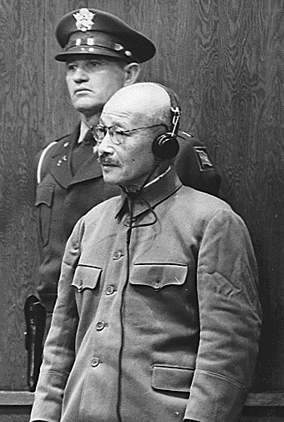
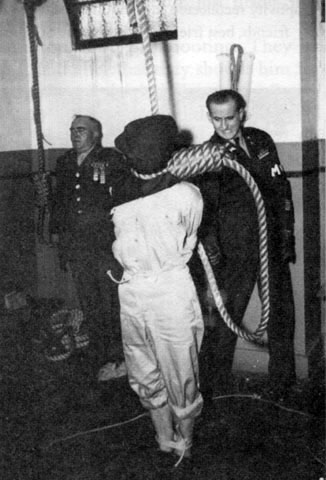
On this date in 1948, seven “Class A” war criminals, including Japan’s wartime Prime Minister Hideki Tojo, were hanged at Sugamo Prison by the American occupation authorities.

Like other Axis heads of state, Tojo was in for a bad end: he shot himself in the chest before American troops could arrest him, but missed his heart even though a doctor had helpfully marked the spot on his chest for him.


Fail.

However inevitable Tojo’s postwar fate, however, he was not exactly of a kind with the likes of Hitler and Mussolini. Indeed, he’d been cashiered from his Prime Ministerial gig in 1944 by the real power behind the throne — the Japanese military.
Unlike the “Fuhrer” and “Il Duce,” Tojo was a reflector, not a creator, of national thought. His word was not law. It was not his command or dictate. He was one among many and not even the first among equals. He was a militarist — misguided, naive, and narrow in outlook; he regarded war as a legitimate instrument of national policy; he apparently believed what he told the court, and failed to recognize the patent contradictions between his contentions and the facts. This had been his undoing.

That’s Robert Butow in Tojo and the Coming of War. Butow argues that the titular authority in Japan (he became Prime Minister shortly before the bombing of Pearl Harbor), a dedicated, patriotic officer of adequate talents but limited vision, came much too late and controlled much too little to be seen as the equal of the European theater’s villains.

The Japan of which General Hideki Tojo became premier was operated by remote control. It was a country in which puppet politics had reached a high state of development, to the detriment of the national welfare. The ranking members of the military services were the robots of their subordinates — the so-called chuken shoko, the nucleus group, which was active “at the center” and which was composed largely of field-grade officers. They, in turn, were influenced by younger elements within the services at large and by ultranationalists outside military ranks. The civilian members of the cabinet were the robots of the military — especially of the nucleus group, working through the service ministers and the chiefs of the army and navy general staffs. The Emperor himself, through no fault of his own, was the robot of the government — of the cabinet and the supreme command, a prisoner of the circumstances into which he was born … Finally, the nation — the one hundred million dedicated souls, the sum and substance of Japan, from whom the blood and toil and tears and sweat of Churchill’s phrase were wrung — the nation was the robot of the throne.

He was the man for his time and place. He fit right in.

Even when being fitted for a noose.

Once Tojo had recovered from his errant self-inflicted wound,* and even though he had been among those opposing surrender even after the atomic bombings, he played ball with the International Military Tribunal for the Far East (whose trial transcripts run to 50,000 pages).

The former premier embraced responsibility, diligently shielding the Emperor from any intimation of guilt (some argue this was the procedure’s entire raison d’etre, from the perspective of both the prosecution and the defense), and walked a dignified and honorable last mile in the courtrooms of the victor’s justice, presenting his perspective as he knew it in the context of a wish for peace between the late antagonists.

1. I deny that Japan “declared war on civilization.”

2. To advocate a New Order was to seek freedom and respect for peoples without prejudice, and to seek a stable basis for the existence all peoples, equally, and free of threats. Thus, it was to seek true civilization and true justice for all the peoples of the world, and to view this as the destruction of personal freedom and respect is to be assailed by the hatred and emotion of war, and to make hasty judgments.

3. I would like to point out their [my accusers’] inhumane and uncivilized actions in East Asia ever since the Middle Ages.

4. In the shadow of the prosperity of Europe and America, the colored peoples of East Asia and Africa have been sacrificed and forced into a state of semi-colonization. I would point out that the cultural advance of these people has been suppressed in the past and continues to be suppressed in the present by policies designed to keep them in ignorance.

5. I would point out that Japan’s proposal at the Versailles Peace Conference on the principle of racial equality was rejected by delegates such as those from Britain and the United States.

6. Of two through five above, which is civilization? Which is international justice? Justice has nothing to do with victor nations and vanquished nations, but must be a moral standard that all the world’s peoples can agree to. To seek this and to achieve it — that is true civilization.

7. In order to understand this, all nations must hate war, forsake emotion, reflect upon their pasts, and think calmly.

The “Class A” convicts not executed along with Tojo were freed afterwards.

Tojo has enjoyed a bit of a latter-day resurgence in the public regard, product of the nationalist right’s resurgence in Japan. The hanged man’s granddaughter Yuko Tojo has waged a tireless campaign to clear him.

Further to that end, his ashes — and those of the other Class A convicts — were covertly added to the controversial Yasukuni Shrine, and remain there to this day. That public tribute to principals of Japan’s bloody foreign occupations has become a hot political football between Japan and other nations, especially China.

But after all, Tojo the man was never a leper, but part and parcel of his times. Small wonder that we moderns hear an echo of the general’s postwar justification for the War in the Pacific from the country that hanged him.

Japan … faced considerable military threats as well.

Japan attempted to circumvent these dangerous circumstances by diplomatic negotiation, and though Japan heaped concession upon concession, in the hope of finding a solution through mutual compromise, there was no progress because the United States would not retreat from its original position. …

Since events had progressed as they had, it became clear that to continue in this manner was to lead the nation to disaster. With options thus foreclosed, in order to protect and defend the nation and clear the obstacles that stood in its path, a decisive appeal to arms was made.

The problematic nature of the war crimes proceedings in postwar Japan (especially vis-a-vis those in Germany) is examined in Yuma Totani’s The Tokyo War Crimes Trial: The Pursuit of Justice in the Wake of World War II. The author discussed her research on the New Books In History podcast.

[audio:http://newbooksinhistory.com/podpress_trac/web/720/0/Totani%20Interview.mp3]

* According to John Dower’s Embracing Defeat, the suicide scenario angered some nationalists because Tojo only “belatedly summoned the will to die,” and “chose the foreigner’s way of the bullet rather than the samurai’s way of the sword, and then botched even this.”

On this day..

1855: The slave Celia, who had no right to resist

(Thanks to Caitlin at Vast Public Indifference for the guest post -ed.)

In 1850, 60-year-old Robert Newsom, a prosperous farmer, traveled forty miles from his home in Callaway County, Missouri to neighboring Audrain County to buy a slave. Newsom was the head of a large and complex household that included several of his grown children, grandchildren, and five enslaved boys and men. His wife had died a few years earlier, a consideration that may have influenced his decision to purchase a female slave, a fourteen-year-old girl named Celia.

From the first day, Newsom treated Celia as his concubine. Testimony given before the Missouri Supreme Court in 1855 indicates that Newsom raped Celia for the first time on the journey home from the slave market. He installed her in a small cabin behind his house, where he continued to rape her on a regular basis over the next five years. During that time, she gave birth to two children.

In the spring of 1855, Celia began a relationship with George, another slave on the farm, and soon discovered that she was pregnant again. At George’s urging, Celia approached Newsom’s daughters and pled with them to protect her from their father during her pregnancy. The oldest daughter, Mary, later testified that Celia had threatened to hurt Newsom if he came to her cabin again, but there is no evidence that either she or her sister intervened.

On the night of June 23, 1855, Robert Newsom went to Celia’s cabin, no doubt intent on raping her yet again. He never returned to his own home.

Although Celia was never allowed to testify in her own defense, investigators reconstructed the events of the night through a combination of physical evidence and Celia’s confession. Fearful of Newsom, Celia had hidden a hefty stick in a corner of her cabin. When Newsom attacked her that night, Celia retrieved her weapon and beat him to death with it. She then dismembered the body and burned it to ashes in her fireplace. The next morning, Celia offered Newsom’s eleven-year-old grandson two dozen walnuts in exchange for his help cleaning out the fireplace and spreading the ashes in the yard.

The jury that convicted Celia of murder accepted her confession as fact, but some elements of her tale do not ring true. As Melton McLaurin observes in his book, Celia, A Slave, the task of cutting enough wood and tending the roaring fire necessary to consume a human corpse in a single night “would have taxed the strength of a healthy woman, and Celia was pregnant and sick” (McLaurin, 49). McLaurin implies that George either helped Celia or was primarily responsible for Newsom’s demise and that Celia may have lied to protect him. George disappeared shortly after the murder and was never arrested or charged.

Celia stood trial for Newsom’s murder in October of 1855 (State of Missouri v. Celia, a Slave). Her lawyer, John Jameson, argued that Celia was legally entitled to defend herself from a would-be rapist under an 1845 law that made any attempt “to take any woman unlawfully against her will and by force, menace or duress, compel her to be defiled” a felony. He requested that the jury be instructed that

The words “any woman” in the first clause of the 29th section, of second article of laws of Missouri for 1845, concerning crimes & punishments, embrace slave women, as well as free white women.

The judge, William Augustus Hall, refused to honor the defense’s motion. Instead, he instructed the jury that a slave had no right to resist her master, even in the case of sexual assault. The jury found Celia guilty and sentenced her to death. (Celia’s child was delivered stillborn in prison.) The Missouri Supreme Court denied her appeal, and she was hanged on December 21, 1855.

Celia’s story is currently part of the interactive Slavery and the Making of America exhibit at PBS.org.

For more information, please see the following books:

McLaurin, Melton A. Celia, a Slave: A True Story. (University of Georgia Press, 1991). Google Books preview

Gordon-Reed, Annette, ed. Race on Trial: Law and Justice in American History. (Oxford University Press, 2002). Google Books preview.

On this day..

1786: Hannah Ocuish, age 12

(Thanks to Caitlin at Vast Public Indifference for the guest post -ed.)

On December 20, 1786, the Sheriff of New London, Conn., led a distraught 12-year-old girl to the gallows, placed a rope around her neck, and hanged her in front of a crowd of spectators. The girl was Hannah Ocuish, a young member of the Pequot nation. She was charged with the murder of six-year-old Eunice Bolles, a white girl with whom Hannah had quarreled the previous summer.

While it is difficult to get a clear picture of Hannah’s life from the available sources, it is clear that hers was not a comfortable existence. An appendix to Rev. Henry Channing’s execution sermon notes that Hannah’s mother was “an abandoned creature, much addicted to the vice of drunkenness,” who sent Hannah to work as a servant in a white family’s home. At the age of six, Hannah was accused of beating a white child while trying to steal her necklace. The anonymous author describes Hannah’s character thus:

Her conduct, as appeared in evidence before the honorable Superior Court was marked with almost every thing bad. Theft and lying were her common vices. To these were added a maliciousness of disposition which made the children in the neighborhood much afraid of her. She had a degree of artful cunning and sagacity beyond many of her years.

This description, expressed in terms designed to emphasize the importance of training children in obedience, may or may not be accurate. Regardless, all evidence suggests that Hannah was alone in a hostile world.

On July 21, 1786, someone found Eunice Bolles’ body at the side of the road outside Norwich, Conn. The corpse displayed signs of extreme trauma: “the head and body were mangled in a shocking manner, the back and one arm broken, and a number of heavy stones placed on the body, arms and legs.” Investigators questioned Hannah, who initially denied any involvement, but mentioned that she had seen a group of boys on the road earlier. The town officials did not believe her. On July 22, “she was closely questioned, but repeatedly denied that she was guilty.” Still unconvinced, the investigators “carried [Hannah] to the house where the body lay, and being charged with the crime, burst into tears and confessed that she killed her, saying if she could be forgiven she would never do so again.”

Hannah’s confession, which was accepted as truth by the court, indicated that she had sought revenge on Eunice because the younger girl had “complained of her in strawberry time … for taking away her strawberries.” When Hannah saw Eunice walking to school alone, she beat and choked her, covering the body with rocks “to make people think that the wall fell upon her and killed her.”

Rev. Henry Channing, a talented local minister, visited Hannah in prison many times, urging her to repent so that her soul might be spared. On the day of her execution, he delivered a thundering sermon entitled, God Admonishing His People of Their Duty as Parents and Masters, which held Hannah up as an example of what could happen if parents did not raise their children to be “dutiful and obedient.”

Her crimes, he argued, were the “natural consequences of too great parental indulgence,” and warned that “appetites and passions unrestrained in childhood become furious in youth; and ensure dishonour, disease and an untimely death.” In the portion of the sermon directed at Hannah herself, Channing did his best to scare her into repentance:

HANNAH! — prisoner at the bar– agreeably to the laws of the land you have arraigned, tried and convicted of the crime of murder … The good and safety of society requires, that no one, of such a malignant character, shall be suffered to live, and the punishment of death is but the just demerit of your crime: and the sparing you on account of your age, would, as the law says, be of dangerous consequence to the publick, by holding up an idea, that children might commit such atrocious crimes with impunity … And you must consider that after death you must undergo another trial, infinitely more solemn and awful than what you have here passed through, before that God against whom you offended; at whose bar the deceased child will appear as a swift witness against you — And you will be condemned and consigned to an everlasting punishment, unless you now obtain a pardon, by confessing and sincerely repenting of your sins, and applying to his sovereign grace, through the merits of his Son, Jesus Christ, for mercy, who is able and willing to save the greatest offenders, who repent and believe in him.

At her trial in October, Hannah “appeared entirely unconcerned,” but as the date of her execution approached, she began to show fear. In early December, visitors began to ask her how long she had to live, and Hannah “would tell the Number of her Days with manifest Agitation.” On December 19th, she “appeared in great Distress . . . and continued in Tears most of the Day, and until her Execution.” Witnesses to her execution reported that Hannah “seemed greatly afraid when at the Gallows.” With her last words, she “thanked the Sheriff for his kindness, and launched into the eternal World.”

In the United States, the youngest children put to death by the government have all be children of color. James Arcene, a Cherokee boy, was only 10 or 11 years old when he was hanged for committed a robbery and murder that resulted in his 1885 hanging in Arkansas.* At 12, Hannah Ocuish was the youngest female offender executed by any state. In the 20th century, the youngest children executed were both African-American: 13-year-old Fortune Ferguson of Florida (1927) and 14-year-old George Stinney of South Carolina (1944).

In 2005, the United States Supreme Court abolished the death penalty for criminals who committed their crimes as juveniles (Roper v. Simmons). The court split 5-4, with Jutices Scalia, O’Connor, Thomas, and Chief Justice Rehnquist dissenting. In his dissent, Justice Scalia excoriated the majority for considering international consensus (along with the laws of 30 of the 50 U.S. states) on the cruelty of executing children under the age of 18 when determining the standard for “cruel and unusual.” Justice Scalia, an avowed proponent of Constitutional originalism, proclaimed, “I do not believe that the meaning of our Eighth Amendment, any more than the meaning of other provisions of our Constitution, should be determined by the subjective views of five Members of this Court and like-minded foreigners.”

* This post originally asserted that Arcene was a juvenile when hanged. In fact, he was (or claimed to have been) 10 years old or so at the time he committed the crime, but was not tried and hanged until over a decade later. (This is corrected in the Arcene post.) -ed.

On this day..

1878: John Kehoe, king and last of the Molly Maguires

On this date in 1878, John “Black Jack” Kehoe was hanged in Pottsville — as Pennsylvania’s anthracite trusts took a victory lap around the corpses of the Molly Maguires.

Even to say what the Mollies were is to take a side in their life-and-death struggle. Irish immigrants fleeing the potato famine had poured into Pennsylvania’s coal mining country in the mid-19th century, where life in the mines was nasty, brutish and short, and the pay wasn’t anything to write home about either.

In a time when capital ruthlessly hunted any intimation of labor organizing and the Irish were a distinctly second-class people, the (apparent, or at least alleged) response of the Mollies was natural: form a secret society, and wring by threat of bodily harm the concessions it could not pursue by collective bargaining. For the recent Irish transplants, the tableau of a Catholic underclass working for a Protestant landlord who owned (and gouged on) everything in sight had a certain familiar feel.

Terrorists? They certainly used violence to achieve political objectives, at least if the testimony of their foes is credited. But they weren’t the only ones.

Mine owners turned public and private violence on Irish radicals pushing for things like the eight-hour day. The notorious strike-breaking Pinkerton Detective Agency was detailed to infiltrate the Mollies.

The main blow against the Mollies was struck over a period of (extrajudicial) vigilante justice in the mid-1870’s, culminating in “Pennsylvania’s Day of the Rope” in 1877, when ten supposed members were (judicially) hanged around the Keystone State.

Kehoe, a power broker in mining country with some sway at the capital who was reputed to call the shots among the Maguires, faced the hangman singly a year later for an 1862 cold-case murder so doubtfully ascribed to Kehoe that the governor hesitated to sign the death warrant.

He signed it just the same, marking a sort of ceremonial “end to Molly-ism.” The New York Times exulted two days hence “that the widely-extended and long-continued tyranny and terror of this association is at an end,” and all because the resolute executive had gone and sent a hempen message to “the savage and benighted population of the coal region.”

The lesson taught by the punishment of the Molly Maguires would have been shorn of much of its terror and impressiveness if the energetic and persistent efforts made in behalf of KEHOE, the reputed king of that organization, had resulted in rescuing him from the gallows. If they had even so far succeeded as to have caused his punishment to be commuted to imprisonment for life, the admonitory influence of his fate upon the murderous clain of whom he was the last surviving chief would have been greatly lessened, and the snake of Molly Maguire-ism, of which he was the forked tongue and fangs, might haply have been only scotched, not killed. … The law has shown that it has subtlety enough to hunt [the Molly Maguires] through every possible labyrinth of refuge and strip from them every artifice of disguise, and power enough to wring them out of the desperate grasp of sympathizing constituencies and crush them.

Florid.

Like we said, violence wasn’t the exclusive resort of one side. But the monopoly of violence … that was held, as always, by the same hands that held the monopolies. Sean Connery as Kehoe reflects on the uneven contest while awaiting his fate in a (fictional) exchange with the Pinkerton mole who condemned him from the 1970 film The Molly Maguires.*

Pennsylvania Gov. John Hartranft left office a few weeks later, and reflected in his outgoing address on the lessons “the manufacturers and operators” ought to draw from the late unpleasantness.

The Mollie Maguire murders, like the agrarian murders in Ireland, and the trades-union outrages, arsons, and machine-breakings in England, were not the work of the so-called criminal classes. They were essentially class murders … If some of the leading spirits of the class had been members of a board of arbitration as representatives of labor, with some of the employers or their agents as representatives of capital, it is not unreasonable to suppose that most of the disagreements that have kept the coal regions in a state of turmoil might have been amicably adjusted, and many of those who were assassinated and of those who have been hanged living to-day.

101 years later, Kehoe received what was thought to be the first and only posthumous pardon in the state’s history. The Mollies’ true extent, purpose and actual actions — even their very existence as anything but a stalking-horse for the more thorough conquest of surplus labor — remain hotly debated to this day, since the public record of this tight-lipped society consists of little beyond the courtroom testimony of a handful of parties thoroughly prejudiced to hostility by class interest or payoffs.

* Written by Walter Bernstein, who had only recently emerged from the Hollywood blacklist for his Communist proclivities.

On this day..