1460: Tiburzio di Maso, Roman brigand

The Roman outlaw-slash-rebel Tiburzio di Maso was executed on this date in 1460, with seven other members of his band.

Tiburzio’s father had been put to death seven years before for joining in the anti-papal intrigues of his kinsman (by marriage) Stefano Porcaro. Theirs was the old populist dream of Cola di Rienzi, to throw off the depraved overlordship of Rome’s patricians and resume the tribune of the people.

Their enemy in this endeavor, to speak a bit more specifically, must be the pope himself — for as Gibbon observed, “the policy of the Caesars has been repeated by the popes; and the bishop of Rome affected to maintain the form of a republic, while he reigned with the absolute powers of a temporal, as well as a spiritual, monarch.” It was this throne that had destroyed Tiburzio’s father, and upon which he proposed to revenge himself.

White breast, sweet tongue, kind eyes and ready wit! You marble limbs, full of vigour, when shall I see you again? When again shall I bite those coral lips, or feel again that tremulous tongue murmuring in my mouth, or ever handle those breasts.

Why, Achates, you have scarcely seen this woman. Where she is most feminine, there she is most lovely. I wish you could be me! Not the beautiful wife of Candaules, King of Lydia, was more beautiful than she. I cannot wonder that he wished to show his wife naked to his friend, to give him the greater pleasure. I would do the same myself. If it were possible, I’d show you Lucretia naked, for otherwise I cannot describe to you how beautiful she is, nor can you imagine how full and substantial was my pleasure. But rejoice with me, because my delight was greater than words can tell.

-[the man who would become] Pope Pius II, The Tale of Two Lovers

By the time the son Tiburzio came to avenge his father,* the pope in question was Pius II, once so much the gentleman-humanist that he is the only pontiff to byline an epistolary erotic novel. Come election to the seat of St. Peter, however, he had predictably discovered a newly illiberal affinity for the overweening prerogatives customarily asserted by his office

Among the lesser of these prerogatives was the option to make his residence in the less miasmatic confines of his native Siena, and his extended absence from Rome surely gave some air by which the brash youth could kindle a rebellion. Tiburzio attracted a gang who alternately caroused together and sallied together as highwaymen on the famously dangerous roads. “If in Porcaro the democratic movement had already generated to the level of Catiline, in Tiburzio and Valeriano, the heroes of 1460, it had sunk to that of mere brigandage,” wrote the German historian Ferdinand Gregorovius. (Via)

“Mere” brigandae posed a real danger to papacy’s safety, however, enough so that the governor’s running skirmishes with this most dangerous gang eventually required the returned of Pope Pius to steady the situation: a captured informant gave information that Tiburzio’s band was in league with Ghibelline nobles and had even arranged with the condottiero Jacopo Piccinino to throw open the city gates for his army.

But our man, well into the history-repeating-as-farce cycle, squandered his opportunity and his life by recklessly sallying into the city from refuge in nearby Palombara once one of his party was arrested. The Roman masses turned deaf ears on his calls to arms, and papal gendarmes captured Tiburzio and several misadventuring comrades. Without the inducements of torture, he too admitted the conspiracy with Piccinino — and the whole bunch hanged together on Capitoline Hill.

* Dad’s foe was Pope Nicholas V, who died in 1455.

On this day..

1936: Ramiro Ledesma Ramos, Falangist

Falangist politician Ramiro Ledesma Ramos was executed on this date in 1936, during the Spanish Civil War.

Ledesma (English Wikipedia entry | Spanish) launched the first fascist publication in Spain as a perspicacious 25-year-old admirer of Mussolini and Hitler.*

La Conquista del Estado — the expressive title was cloned from Curzio Malaparte‘s Italian fascist magazine — positioned Ramos as one of the leading apostles of the right in early 1930s Spain. Despite his youth, he’s been credited by later observers as one of the clearest, earliest intellectual exponents of fascism in Spain. Ledesma affiliated from the start with the Falangist movement Jose Primo de Rivera, and personally signed off on the party’s yoke-and-arrows logo and its motto “¡Arriba España!”

Spain’s Republican government had him detained in Madrid with the outbreak of the Spanish Civil War in July 1936. With the fascist armies closing in on Madrid in late October, Ledesma was among dozens of political prisoners taken out and shot without trial at the cemetery of Aravaca.

* His philo-Hitlerism allegedly led Ledesma to imitate the Fuhrer’s flopover coiffure.

On this day..

1939: Operation Tannenberg public mass executions begin

This photo (from the German Bundesarchiv) captures an SS execution of Poles in Kornik just weeks into the German occupation of Poland in 1939, fruit of a pre-planned Nazi project to secure the new territory as lebensraum.

Operation Tannenberg (English Wikipedia entry | German | Polish) could be seen as a vanguard for the mind-boggling exterminations to come in subsequent years, cementing the army’s commitment to a campaign that extended well beyond territorial conquest. Alexander Rossino examines this understudied segment of World War II in Hitler Strikes Poland: Blitzkrieg, Ideology, and Atrocity and contends that “the unlimited, almost nihilistic violence of the Wehrmacht” emerges first in these initial weeks of the Polish campaign, which proved a “transitional conflict” pivoting towards the more notorious atrocities to come. “The invasion of Poland thus occupies a crucial place in the history of Nazi Germany’s descent into mass murder and genocide.”

Drawn up by Hitler, Himmler, and Heydrich and officially authorized on August 25, a week before Germany invaded Poland, Tannenberg intended to destroy Poland’s elites — from intelligentsia and nobility down to community priests and teachers, and the politically active across the spectrum from Communist to monarchist. The hope was to leave the subject nation supine, incapable of challenging Berlin’s designs on her future. Estimates I have seen vary widely but tens of thousands of Poles (with a liberal portion of Polish Jews) were shot by SS Einsatzgruppen units under Tannenberg even by the end of 1939, and kilings continued apace thereafter. Though not the literal first Operation Tannenberg Killings, the October 20-23 period marked the first public mass executions; a Polish-language list of the incidents and victims involved is available here.

The very name Tannenberg is a nationalist allusion to Germany’s time-immemorial rivalry with Poland; the original Battle of Tannenberg saw the rising Polish-Lithuanian empire defeat the Teutonic Knights, essentially breaking the latter as a European power. This defeat resonated in 20th century German national mythology not unlike the Battle of Kosovo for Serbia; in 1914, Field Marshal Paul von Hindenburg made himself a household name by smashing the Russians in a battle vaguely in the vicinity, and cannily christened it, too, the Battle of Tannenberg. (The Germans put up a monument to it which they felt obliged to tear down later in the war as they were being driven out of Poland.)

On this day..

1862: Ten Confederate hostages in the Palmyra Massacre

On this date in 1862, Union Gen. John McNeil had ten Confederate soldiers shot in what history has recorded as the Palmyra Massacre.

The Slave Power’s northern salient, Missouri was surrounded to the east, north, and west by free soil — which made it an antebellum flashpoint since the days of the Missouri Compromise.*

In the 1850s, the Missouri conflict spilled into neighboring Kansas as the enemy sides of the slavery question fought to determine whether Kansas would enter the Union as slave state or free. The Missouri borderlands of Bleeding Kansas was where the radical abolitionist martyr John Brown made his name, commanding free state militia in a guerrilla war that presaged the coming clash of North and South.

By the time we lay our scene in 1862, John Brown has exited courtesy of Virginia’s gallows, and the dragon’s teeth sown in Missouri and Kansas and everywhere else had sprung to horrible life. Missouri’s own civil war pitted neighbor against neighbor throughout the state in a bushwhacking conflict that extended locally for many years after Appomattox.**

The nastiness of the years to come is aptly suggested by this date’s events.

Like neighboring Kentucky, Missouri was a border state with a Union government, albeit one contested by a rival Confederate government. From the standpoint of the North, all Confederate activity there was behind its lines and the perpetrators therefore potentially subject to treatment (up to and including execution) as spies, saboteurs, and the like.†

Joseph Chrisman Porter, a Confederate officer, was one such possible client of this here site, tapped as he was for recruiting and raiding operations in northeast Missouri. His Union adversary Gen. John McNeil saw Porter as basically a terrorist. In August of 1862, Porter’s aide Frisby McCullough fell into McNeil’s hands: the Union general had McCullough shot.

On September 12, Porter raided the town of Palmyra, where McNeil held a number of Confederate prisoners. In the course of the raid, he kidnapped Andrew Allsman, a 60-year-old Palmyra resident. “It was said of him that he was able to inform the military authorities of certain movements of the enemy, and that he gave definitive information as to the homes and whereabouts of many men of Confederate leanings,” in the words of this pro-Confederate 1902 pamphlet on the incident. “Naturally, this placed him in disfavor with the Southern sympathizers and those who were fighting in that cause.”

What happened next — though it was not known to the Union at the time — was that Allsman was shot. The pamphlet just cited attempts to obfuscate this event into the fog of war and not really Porter’s fault. The bare fact is that his raiders had gone out of their way to seize an aged non-combatant and then summarily executed him.

Not knowing Allsman’s fate, McNeil responded with an ultimatum to his opposite number.

Palmyra, Mo., Oct. 8, 1862.

To Joseph C. Porter.

Sir: — Andrew Allsman, an aged citizen of Palmyra and a non-combatant, having been carried away from his home by a band of persons unlawfully arraigned against the peace and good order of the State of Missouri, and which band was under your control, this is to notify you that, unless Andrew Allsman is returned unharmed to his family within ten days from date, ten men, who have belonged to your band, and unlawfully sworn by you to carry arms against the government of the United States, and who are now in custody, will be shot as a meet reward for their crimes, amongst which is the illegal restraining of said Allsman of his liberty, and if not returned, of presumptively aiding in his murder. Your prompt attention to this will save much suffering.

Yours, etc.,

W.R. Strachan
Provost Marshal General Northeast District of Missouri
By order of Brigadier General commanding McNeil’s column

The Confederates, of course, could not produce Allsman.

So, on the evening of Oct. 17, five rebel prisoners in the Palmyra stockade plus five more held in Hannibal were informed that they would be shot the next afternoon, in ruthless enforcement of the threat.

The men who died this date in 1862 by a volley of musketry at the Palmyra fairgrounds were:

  • Captain Thomas Sidenor
  • William T. Baker
  • Thomas Humston
  • Morgan Bixler
  • John McPheeters
  • Hiram Smith
  • Herbert Hudson
  • John Wade
  • Marion Lair
  • Eleazer Lake

Their names adorn the base of a monument erected in Palmyra in 1907 commemorating the so-called “Palmyra Massacre”. The state of Missouri as a digital archive of original documents relating to the affair available here.

* Missouri was where the slave Dred Scott lived; his owner taking him to the neighboring free state of Illinois and thence points north occasioned the notorious Supreme Court case that bears his name.

** Frank and Jesse James were Confederate partisans for William Quantrill in the Missouri war; they segued directly into their more celebrated career in outlawry right after the war ended — robbing banks whilst settling scores with pro-Union men for the rest of the 1860s, before branching out to other points on the frontier.

† The Union might obviously have chosen to treat the entire Confederacy as a treasonable enterprise rather than a legitimate enemy belligerent. As a historical matter, it did not take this perspective.

On this day..

1946: The Neuengamme camp war criminals

On this date in 1946, eleven men convicted by a British war crimes court of war crimes at the Neuengamme concentration camp hanged at Hamelin prison.

Neuengamme held about 106,000 prisoners from 1938 until the British overran it on May 3, 1945. (In a tragic coda, many of the last prisoners died when the ships to which they had been transferred were mistakenly strafed by the Royal Air Force that same day.)

Though its primary purpose was slave labor — Neuengamme inmates cranked out bricks and armaments — rather than extermination, close on half of its residents died of the maltreatment. Anne Frank’s elderly roommate-in-hiding “Albert Dussel” (his real name was Fritz Pfeffer) died there of enterocolitis in 1944; Suriname national hero Anton de Kom succumbed to tuberculosis at Neuengamme days before it was liberated.

Nor was Neuengamme above more direct methods — of course it wasn’t. As the Third Reich collapsed, Neuengamme was used to dispose of 71 leftists for no better reason than the Nazis begrudged their potential postwar life; meanwhile, Jewish children who had been subjected to medical experiments were hanged by their stonehearted SS doctor.

That gentleman, Alfred Trzebinski, was one of the men in the dock for Neuengamme, and ultimately, one of the men on the scaffold.*

Camp commandant Max Pauly and SS Schutzhaftlagerführer Anton Thumann were among the 10 others executed for Neuengamme, all together on October 8, 1946.

* Sigmund Freud’s grandson Walter worked for the War Crimes Investigation Unit on (among other cases) Trzebinski’s Bullenhuser Damm school hangings.

On this day..

1546: The Fourteen of Meaux

If the execution of the “Fourteen of Meaux” falls far short of the massacre of the Vaudois as regards the number of its victims, its strictly judicial character makes it more instructive as an example of the treatment of heretics.

In the year 1546 the Reformers of Meaux organised themselves into a Church after the pattern of that set up by the French refugees at Strassburg eight years before. They chose as their first pastor, a wool-carder, named Pierre Leclerc, a brother of the man who was burnt at Metz.

Their number increased under his ministry, and the matter soon came to the ear of the authorities. On September 8 a sudden descent was made on the congregation, and sixty persons were arrested and sent to Paris to be tried by the Parliament. Their greatest crime was that they had celebrated the Holy Communion.

On October 4 sentence was pronounced. Fourteen were sentenced to be tortured and burned, five to be flogged and banished; ten, all women, were set free, while the remainder were to undergo graduated forms of penance. The sentences were carried out at Meaux on October 7.*

Etienne Mangin, in whose house the services had always been held, and Leclerc, were carried to the stake on hurdles, the rest on tumbrils. They had all previously undergone what was known as “extraordinary” torture, and all had refused to reveal the names of other Reformers at Meaux. At the stake six yielded so far as to confess to a priest, thereby escaping the penalty of having their tongues cut out; the others who remained firm suffered this additional barbarity, which it was the custom to inflict on those who died impenitent. The congregation at Meaux was thus broken up, but the survivors carried the evangelical seeds to other towns in France.

The “Fourteen of Meaux” were not the only victims of the year 1546. Five others had already been burned at Paris, including the scholar and printer Etienne Dolet. Others were burned in the provinces. The next year, 1547, opened with fresh executions; and on January 14 the mutilation of a statue of the Virgin was expiated by a solemn procession at Paris.

Such was the policy which Francis I began definitely to adopt towards Protestantism after the affair of the placards, and which he put into active execution during the last seven years of his life. How far was it successful? As we have seen, it drove a large number of persons into exile; and these consisted chiefly of the better-born and better-educated among the Reformers.

It intimidated many into outward conformity with the Church. It prevented all public exercise of the Reformed religion, and all open propaganda. Religious meetings were held by night or in cellars; doctrines were spread by secret house-to-house teaching, or by treatises concealed amongst the wares of pretended pedlars.

On the other hand the frequent executions helped to spread the evil they were meant to repress. The firm courage with which the victims faced death did as much as the purity of their lives to convert others to their faith. Moreover, the influence of the exiles reacted on their old homes. From Geneva to the other Swiss centres of Protestantism missionaries came to evangelise France.

The Cambridge Modern History, vol. 2

* There are some sources that aver Oct. 6, and it appears that the primary documents are not explicit on the exact date of execution. This Proceedings of the Huguenot Society collects a great deal of information about the Fourteen of Meaux and settles on Thursday, Oct. 7 (see fn 54, page 101 and fn 64, page 103) — in part because the Parlement also demanded that the heretical house be razed, with Catholic services to be held there every Thursday.

On this day..

1750: James Maclaine

Gentleman highwayman James MacLaine hanged at Tyburn on this date in 1750.

The debauched son of a Presbyterian minister, MacLaine wasted first an inheritance and later a dowry on expensive clothes, gambling, and ladies of easy virtue; want, however, was his ticket to the immortality of the gallows when he joined fellow penniless gentleman William Plunkett to seek his revenue on the roads. (Inspiring the 1999 film Plunkett & Macleane — which uses one of several alternate spellings available for our man’s surname.)

For several months in 1749-1750 they prowled the environs of a lawless London, and notably Hyde Park, with the exaggerated courtesy demanded by romance of their profession. They found noteworthy prey: once, they stole a blunderbuss from the Earl of Eglington, though Eglington survived to suffer a noteworthy murder years later; in November 1749, they robbed M.P. Horace Walpole, even skimming his face with a pistol-ball that was inches wide from depriving posterity of the gothic novel.*
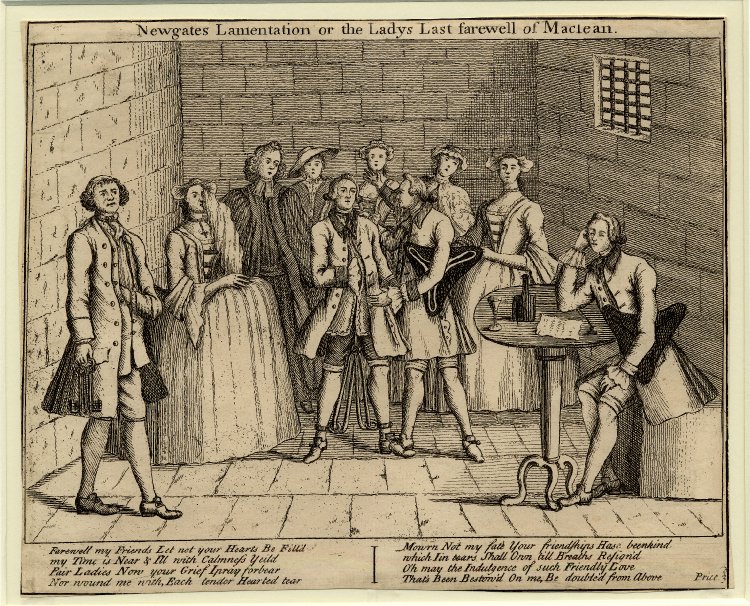
When caught** by mischance, the mannered† Maclaine became the object of public celebration, much to the bemusement of Walpole — who professed no ill will for his assailant but wondered that “there are as many prints and pamphlets about him as about the earthquake.”

Three thousand people are reported to have turned up on a sweltering summer Sunday to pay their admiration to the rogue, not excluding the very cream of society. Walpole teased his friends, court beauty Lady Caroline Fitzroy (wife of the Earl of Harrington) and her sidekick Miss Elizabeth Ashe, for presenting themselves among these masses to starfuck this latter-day Duval. “I call them Polly and Lucy,” he wrote, alluding to female conquests of the outlaw Macheath in The Beggar’s Opera, “and asked them if he did not sing,”

Thus I stand like the Turk with his doxies around.

Maclaine did not have to borrow Macheath’s ballads, for he was celebrated with verse dedicated all to him — like this “Jemmie Maclaine”, to the tune of Derry Down:

Ye Smarts and ye Jemmies, ye Ramillie Beaux,
With golden cocked hats, and with silver laced clothes,
Who by wit and invention your pockets maintain,
Come pity the fate of poor Jemmy Maclaine,

Derry down derry, etc.

He robb’d folks genteely, he robb’d with an air,
He robb’d them so well that he always took care
My lord was not hurt and my Lady not frighted,
And instead of being hanged he deserved to be knighted!

Derry down derry, etc.

William Hogarth‘s 1751 print cycle The Four Stages of Cruelty, one skeleton overseeing the operating theater where a hanged criminal is dissected is subtly labeled — Macleane.

* Walpole once remarked of the ubiquity of violent crime in London that “one is forced to travel, even at noon, as if one was going to battle.”

** Plunkett was never apprehended; it’s alleged that he ultimately escaped to North America.

† Although our man “has been called the gentleman highwayman,” the player-hating Ordinary of Newgate wrote, “and his dress and equipage very much affected the fine gentleman, yet to a man acquainted with good breeding, that can distinguish it from impudence and affectation, there was little in his address or behaviour, that could entitle him to that character.”

On this day..

1567: The Michelade of Nimes

On this date in 1567, Huguenots in revolt in Nimes put to death dozens of Catholics in a courtyard butchery to climax a massacre remembered as La Michelade (English Wikipedia entry | the much more detailed French)

This name of sinister memory derives from one of the church calendar’s great autumnal feast, Michaelmas — and the sword-arm of its titular archangel would have been required to keep the peace between the rival religionists in the Languedoc.

Nimes went heavily for the Protestants, with the region’s royal governors unable to restrain the conquest of Catholic neighborhoods and churches by the predominant Huguenots through the 1560s: “the very wind which blew upon Nimes breathed heresy,” in the words of Dumas.

The years running up to our events of 1567 feature one of the numerous rancorous truces pocking France’s intractable Wars of Religion: this one is known as the “Armed Peace”, which gives you an idea where everyone’s heads were at. And in Nimes, the heresy in the wind was not such as to prevent the restoration of Catholic authorities to control of the civic institutions — to the undoubted irritation of the Huguenot grandees who endured the indignity of displacement alongside the sure knowledge of the popular weight that supported them.

This ripening conflict appropriately came to fruition via a vegetable market at a city fair on Michaelmas — September 29, 1567 — where an altercation turned into a sectarian riot and soon transformed into a municipal Protestant insurrection.

Huguenots still maintaining the preponderance of force in Nimes, they perpetrated the expected outrages during the excitement: sacking the cathedral, murdering some particularly hated Catholics. But the overall organization of the Huguenots and the organized participation of the city’s Huguenot elites suggests a good deal of advance orchestration, and perhaps coordination with the Huguenot attempt to kidnap the king just days before.

In the disturbance, Nimes’s first consul Guy Rochette — Catholic, naturally — sought refuge in the palace of Bishop Bernard d’Elbene; a Huguenot captain forced the door and arrested them, confiscating from Rochette the keys to the city. Though the bishop managed to escape, other prominent Catholics were systematically detained, too. According to Allan Tulchin’s That Men Would Praise the Lord: The Triumph of Protestantism in Nimes, 1530-1570, “[i]t seems clear that the Protestant leadership intended to conduct a general roundup of Catholic lay and clerical leadership. Protestant forces targeted at least half of the sixteen men who had served as consul between 1564 and 1567 … of the nine Catholic members of the presidial, only two did not appear among the victims.”

Captive Catholics were detained in several buildings around the city, notably in the city hall. It is not known to what extent the kill lists to cull from these unfortunates were preordained and to what extent they were improvised in the moment, but on the night of September 30, summons for specific victims went out, and Protestant squads complied by dragging them out of the city hall basement or wherever else they were held to the courtyard of the bishop’s palace. This would be the makeshift abattoir.

In the narration of Dumas,

when night came the large number of prisoners so imprudently taken began to be felt as an encumbrance by the insurgent chiefs, who therefore resolved to take advantage of the darkness to get rid of them without causing too much excitement in the city. They were therefore gathered together from the various houses in which they had been confined, and were brought to a large hall in the Hotel de Ville, capable of containing from four to five hundred persons, and which was soon full. An irregular tribunal arrogating to itself powers of life and death was formed, and a clerk was appointed to register its decrees. A list of all the prisoners was given him, a cross placed before a name indicating that its bearer was condemned to death, and, list in hand, he went from group to group calling out the names distinguished by the fatal sign. Those thus sorted out were then conducted to a spot which had been chosen beforehand as the place of execution.

This was the palace courtyard in the middle of which yawned a well twenty-four feet in circumference and fifty deep. The fanatics thus found a grave ready-digged as it were to their hand, and to save time, made use of it.

The unfortunate Catholics, led thither in groups, were either stabbed with daggers or mutilated with axes, and the bodies thrown down the well. Guy-Rochette was one of the first to be dragged up. For himself he asked neither mercy nor favour, but he begged that the life of his young brother might be spared, whose only crime was the bond of blood which united them; but the assassins, paying no heed to his prayers, struck down both man and boy and flung them into the well. The corpse of the vicar-general, who had been killed the day before, was in its turn dragged thither by a rope and added to the others. All night the massacre went on, the crimsoned water rising in the well as corpse after corpse was thrown in, till, at break of day, it overflowed, one hundred and twenty bodies being then hidden in its depths.

Dumas is indulging poetic exaggeration of the scene, and later estimations of the number of victims range well below 120 — but Tulchin quotes a leather worker who saw the courtyard on the following day and described it as “all covered with blood and the water of the well all red.” Even “merely” twenty or thirty victims slashed to death would have been a gory work.

In the days following, Huguenots would cement their control of Nimes with the systematic pillage of churches and (after a six-week siege) the capture of the city’s royal garrison. There was no general massacre after the Michelade; in the main, Catholics were forced into submission or exile instead of the grave.

But the effusion, combined with Huguenot attacks further north, helped to trigger the (very brief) “Second War” within the Wars of Religion which gave way after a short truce to the much bloodier “Third War” of 1568-1570 … whose peace would be broken by a Catholic sectarian massacre much better remembered to history than the Michelade.

On this day..

1943: Michal Kruk, Przemysl Pole who aided the Jews

In the German-occupied city of Przemysl, Poland on September 6, 1943, Michal Kruk and several other non-Jewish Poles were publicly executed for their roles sheltering Jews being rounded up for the local ghetto — bound, naurally, for worse fates thereafter.

Przemysl’s Jewish community was almost completely annihilated during the Holocaust.

On this day..

1914: Eugene Odent, the mayor of Senlis

On the second of September in 1914, the mayor of Senlis, France, was shot by the occupying Germans in the opening weeks of World War I.


Detail view (click for the full image) of a map of the British Expeditionary Force’s retreat in northern France during the first days of World War I.

The beautiful ancient town, where the Carolingian dynasty met its end (King Louis V was killed in a hunting accident there in 987, enabling Hugh Capet to take the throne), unhappily found right in the path of the German army smashing its way towards Paris as France and her allies gave way.

German troops reached Senlis by the first of September, and overwhelmed the city in a minor battle.

On guard from the experience of being picked off by franc-tireur snipers during the Franco-Prussian War many years before, the Germans entered this urban skirmish with far more concern for the safety of their troops than for that of noncombatants. A number of civilians were seized for use as human shields by the Germans as they moved through the streets, and some others reportedly executed summarily. Numerous buildings were torched.

In doing all this, the occupying army considered itself entitled not to suffer the resistance of its new (if ever so temporary) subjects — indeed it insisted upon the point with lead. On September 2, the German firing squads shot several French civilians accused of firing at German soldiers. The French Wikipedia page on the affair gives these names:

  • Romuald-Emile Aubert, 52
  • Jean-Stanislas Barber, 66
  • Cottereau Arthur-Lucien, 17
  • Pierre Dewert, 45
  • Mégret Gabriel, 52
  • Jean-Baptiste Pommier, 67
  • Rigault Arthur, 61
  • Louis Simon, 36

Hours later, the town’s mayor Eugène Odent heroically shared their fate. He had been accused by the Germans of orchestrating “terrorist” civilian resistance — shuttering buildings for the convenience of snipers, failing to demand orderly submission from his neighbors, and generally inconveniencing the new boss. (Most of Senlis’s 7,000 residents had fled town ahead of the approaching attack, presumably shuttering up in the process.)

The stunning German attack seemed on the brink of capturing Paris at this point, but just days later the disordered French “miraculously” — it’s literally known as the Miracle of the Marne — threw the invaders back at the Battle of the Marne.

This battle crushed Berlin’s dream of a knockout victory and allowed the combatants to settle in for four bloody years of miserable trench warfare. It also enabled the French to recapture Senlis, whose horrors — Eugene Odent and all — were collected for early entry into the war’s annals of barbaric-Hun propaganda.

On this day..