c. 560 B.C.E.: Aesop, fabulist

On an unknown date around the 560s B.C.E., the storyteller Aesop is supposed to have been executed in Delphi by being hurled from the Hyampeia rock.

The semi-legendary fable-fashioner is not quite so irretrievable to history as, say, Homer, although assuredly many or all of the tales that have accrued under the heading “Aesop’s Fables” trace to origins other than this man.

Supposed to have lived from the late 7th to mid 6th centuries B.C.E., Aesop is first referenced by history’s first historian, Herodotus.

But by way of summation, we cannot improve upon Plutarch‘s succinct description of Aesop’s fate in his essay, “On God’s Slowness to Punish Evil”. (Available here; a different translation is free online here.)

I’m sure you know the story of how Aesop came here bringing gold from Croesus. He meant to make a magnificent offering to the god,* and also to give every inhabitant of Delphi four minas, but apparently he got angry and fell out with the locals; so he made the ritual offering, but sent the money back to Sardis, because he didn’t think that the people deserved a windfall. They then engineered a charge against him of temple robbery and executed him by pushing him from the famous cliff called Hyampeia.** Subsequently, the story goes on, divine wrath afflicted them with failed harvests and with all kinds of strange diseases, and as a result they used to visit all the festivals where Greeks were assembled and make an announcement inviting anyone who so wished to claim compensation from them for Aesop. Two generations later Idmon of Samos arrived at Delphi; not only was he not a relative of Aesop, but he was in fact a descendant of the people who had bought Aesop as a slave in Samos.† It was only when the Delphians had compensated him that their troubles ceased.‡ (We are also told that this incident was the reason for moving the place of punishment for temple robbers from Hyampeia to Aulia.)

There are many books and media under the Aesop’s Fables branding available for purchase, but you can also find the same content in the public domain at Gutenberg.org and elsewhere.

In any format, they’re timeless. “The Mischievous Dog”, for instance, could have been written especially for bloggers.

[audio:http://www.gutenberg.org/files/19616/mp3/19616-04.mp3]

* Referring to the sacred shrine occupied by the Oracle of Delphi, of course.

** When visiting Delphi, look for Hyampeia marked on your tourist map as “Phleboukos”, one of the Phaedriades surrounding the sacred site. Hyampeia/Phleboukos towers above the Castalian spring. It’s high.

† Besides being a slave, Aesop (at least, the Aesop as legend accumulated) was afflicted with other disadvantages suitable to elevate his mythological wisdom. According to The Life of Aesop:

AESOP (according to Planudes, Cameraius and others) was by Birth, of Ammorius, a Town in the greater Phrygia; (though some will have him to be a Thracian, others a Samian) of a mean Condition, and his Person deformed, to the highest degree: Flat-nos’d, hunch-back’d, blobber-lipp’d; a long mishapen Head; his Body crooked all over, big-belly’d, badger-legg’d, and his Complexion so swarthy, that he took his very Name from’t; for Aesop is the same with Aethiop. And he was not only unhappy in the most scandalous Figure of a Man, that ever was heard of; but he was in a manner Tongue-ty’d too, by such an Impediment in his Speech, that People could very hardly understand what he said.

Be sure to check The Life‘s account of Aesop’s demise, with the undiplomatic Aesop having enraged his hosts with his poor opinion of their digs … and the fables he tells in his defense falling very flat: “He was speaking on, but they pushed him off headlong from the Rock, and he was dashed to pieces with the Fall.”

‡ The Delphians’ search for compensation is directly described by Herodotus’ Histories, written little more than a century after Aesop’s death. Though the execution story itself could be apocryphal, its presence in Herodotus at least makes Greeks’ belief in the event as a real one of their recent past about as credibly documented as anything from 2500+ years ago.

That Aesop belonged to Iadmon is proved by many facts — among others, by this. When the Delphians, in obedience to the command of the oracle, made proclamation that if any one claimed compensation for the murder of Aesop he should receive it, the person who at last came forward was Iadmon, grandson of the former Iadmon, and he received the compensation. Aesop therefore must certainly have been the former Iadmon’s slave.

Evidently, Aesop’s reputation for sagacious wit was well-established in the 5th century B.C. Aristophanes makes respectful references to Aesop in his plays The Wasps, Peace and The Birds — in the latter, the birds’ ignorance is underscored because they haven’t read their Aesop.

On this day..

Feast Day of St. Stephen

The day after Christmas — or the second day of the twelve days of Christmas, in a more traditional coinage — is the feast of St. Stephen.*

St. Stephen is well-known as the “protomartyr”, the first Christian to die for his faith. (Jesus doesn’t count.) There’s a St. Stephen’s Gate in Jerusalem so named for its supposed proximity to the site of the protomartyrdom.

We get the Stephen story from the New Testament Acts of the Apostles, as given in this from the Tyndale-derived King James Version (Acts 6:8 – 8:3)

And Stephen, full of faith and power, did great wonders and miracles among the people. Then there arose certain of the synagogue, which is called the synagogue of the Libertines, and Cyrenians, and Alexandrians, and of them of Cilicia and of Asia, disputing with Stephen. And they were not able to resist the wisdom and the spirit by which he spake.

Then they suborned men, which said, We have heard him speak blasphemous words against Moses, and against God. And they stirred up the people, and the elders, and the scribes, and came upon him, and caught him, and brought him to the council, and set up false witnesses, which said, This man ceaseth not to speak blasphemous words against this holy place, and the law: For we have heard him say, that this Jesus of Nazareth shall destroy this place, and shall change the customs which Moses delivered us. And all that sat in the council, looking stedfastly on him, saw his face as it had been the face of an angel.

Then said the high priest, Are these things so? … [elided; Stephen preaches on at great length before he comes to the point]

Howbeit the most High dwelleth not in temples made with hands; as saith the prophet, Heaven is my throne, and earth is my footstool: what house will ye build me? saith the Lord: or what is the place of my rest? Hath not my hand made all these things?

Ye stiffnecked and uncircumcised in heart and ears, ye do always resist the Holy Ghost: as your fathers did, so do ye. Which of the prophets have not your fathers persecuted? and they have slain them which shewed before of the coming of the Just One; of whom ye have been now the betrayers and murderers: Who have received the law by the disposition of angels, and have not kept it.

When they heard these things, they were cut to the heart, and they gnashed on him with their teeth.

But he, being full of the Holy Ghost, looked up stedfastly into heaven, and saw the glory of God, and Jesus standing on the right hand of God, and said, Behold, I see the heavens opened, and the Son of man standing on the right hand of God.

Then they cried out with a loud voice, and stopped their ears, and ran upon him with one accord, and cast him out of the city, and stoned him: and the witnesses laid down their clothes at a young man’s feet, whose name was Saul.

And they stoned Stephen, calling upon God, and saying, Lord Jesus, receive my spirit. And he kneeled down, and cried with a loud voice, Lord, lay not this sin to their charge. And when he had said this, he fell asleep.

And Saul was consenting unto his death. And at that time there was a great persecution against the church which was at Jerusalem; and they were all scattered abroad throughout the regions of Judaea and Samaria, except the apostles. And devout men carried Stephen to his burial, and made great lamentation over him.

As for Saul, he made havock of the church, entering into every house, and haling men and women committed them to prison.

The persecuting “Saul” at the end of this text is, of course, Saul of Tarsus, the future St. Paul.

Here’s a set of Catholic devotionals for the day, and here’s a more secular vibe on the day’s various quirky Anglo traditions.

As for that song …

Good King Wencesla(u)s, a tenth-century Bohemian ruler, is himself a saint — the patron saint of the Czechs, as a matter of fact.

Wenceslas was murdered in a palace coup, supposedly leading his servant Podevin to avenge that death, for which said Podevin was in turn executed. The lyrics of the song “Good King Wenceslas” celebrate the king and his loyal page undertaking together the charitable works they were famous for.

“Mark my footsteps, my good page
Tread thou in them boldly
Thou shalt find the winter’s rage
Freeze thy blood less coldly.”

In his master’s steps he trod
Where the snow lay dinted
Heat was in the very sod
Which the Saint had printed
Therefore, Christian men, be sure
Wealth or rank possessing
Ye who now will bless the poor
Shall yourselves find blessing.

* At least, it’s the Feast of St. Stephen in the Latin rite. The occasion is observed on Dec. 27 in the Orthodox tradition.

On this day..

1624: Marco Antonio de Dominis, posthumously

On this date in 1624, the recently-deceased body of unscrupulous Croatian prelate Marco Antonio de Dominis was burned at Rome’s Campo dei Fiori, along with all his manuscripts.

Hypothesizing

As a precocious young man Dominis taught mathematics, rhetoric and philosophy; in 1611, he produced a scientific treatise on the formation of rainbows through light refraction, De radiis visus et lucis. A century later, Isaac Newton would write* in Opticks that

it is now agreed upon, that this Bow is made by Refraction of the Sun’s Light in drops of falling rain. This was understood by some of the Antients, and of late more fully discover’d and explain’d by the famous ANTONIUS DE DOMINIS Archbishop of Spalato.**

More opportune was his advocacy of a moon-induced tide, which idea his contemporary Galileo erroneously scorned.†

Though he makes a “great men of Croatian science” list, the scientific dabblings are not what the man was chiefly known for.

Apostatizing

A caricature of Dominis made an appearance, around the time of the man’s bodily demise, in Thomas Middleton’s play A Game at Chess, as the “fat bishop” who switches sides from black to white and back.

And that’s the man’s legacy, in a nutshell.

Elevated to Bishop of Senj, and then Spalato, he got the Inquisition after him and raised dust for England and the Anglican church in 1616.

They called you great-bellied-Doctour, made fat under Antichrist; and some there were also that sayd, that before you ranne away from the Pope, you got your owne Neece with child, and that feare to be punished for it, made you trudge away with your great load of flesh in such hast.

–John Floyd

In Albion the absconded archbishop settled into a fine tenured appointment on the king’s dole to denounce the papists like only a convert can do. As A Game at Chess would indicate, he also earned fame for his avarice and gluttony, and who knows how many other deadly sins.

The rep for opportunism grew when Dominis defected back to Holy Mother Church upon the election of an old intimate as Pope Gregory XV. His well-worn welcome in England as anti-papal vituperator had, too, become complicated by the progress of the proposed Spanish Match to wed Prince Charles to Europe’s leading Catholic monarchy — an ultimately abortive project, but nearing the acme of its fortunes at the time Dominis returned to Italy.

(The Spanish Match is the protracted political and diplomatic dance whose progress A Game at Chess allegorically tells. Dominis arranged his return to the Catholic fold through the Spanish ambassador in England, making the former a fit character for the playwright to project the double-dealing and skullduggery of the rivals’ negotiations.)

Theosophizing

Unfortunately for our unprincipled Renaissance man, Gregory himself yielded up the ghost almost immediately and left the Church in the hands of the aggressive Urban VIII. (Urban is the guy who forced Dominis’s old tidal rival Galileo to retract heliocentrism.)

Dominis — who seems to have been an ecumenical guy, maybe just a fancy way of saying he could accommodate any doctrine amenable to his ambition‡ — was evidently still trafficking with the unorthodox even after he returned, recanted, and renounced. (Renunciation in English | Latin).§

One contemporary reportedly said of Dominis

he was a malecontent knave when he fled from us, a railing knave while he lived with you, and a motley parti-coloured knave now he is come back.

The Inquisition imprisoned Dominis, and his death in Castel Sant’Angelo was not sufficient to end heresy proceedings against such as he left behind.

[H]is body was put into a well-pitched coffin, and that into another greater than it … until such time as the cause of the said Archbishop, still depending, should be determined by the Sacred Congregation; that according to their sentence, whatever justice did require, might be done upon him.

The sentence being framed and ready to be put in execution, the said body was … taken the twentieth of this present month of December, forth from the convent where it was left, and carried to the church of Minerva, and there laid upon a table in an eminent place, together with his picture and a little sack of books which he had printed; and where it stood all the night.

The next morning … the most illustrious and most reverend lods cardinals, supreme inquisitors, with many others … proceeded unto a definitive sentence, which was, to declare him unworthy of the favour of the Holy See apostolic, to deprive him of all his honour, benefit, or dignity, confiscate his goods, and give him over to the secular powers, as de facto they then gave him over, that he and his picture, together with the books he had written, should be burned …

INSCRIPTIO

MARCUS ANTONIUS DE DOMINIS,

LATE ARCHBISHOP OF SPALATRO,

Most impiously bent his style against the Church of God, which had extraordinarily well deserved of him; having wounded her and stabbed her through, he so left her without cure, and wretchedly betook himself to the English altars, that thence the swine might the more securely gruntle against the Pope and Catholics. Returning home again, but no convert, his apostatic spirit he forsook not. He died (and the voice of a penitent man would he had not uttered) impenitent. (Source)

* Dominis is still today sometimes credited as the first to explain both primary and secondary rainbows, in preference to Descartes, who nailed them 20 years later. According to The Rainbow Bridge: Rainbows in Art, Myth, and Science, that gave far too much credit to Dominis for either originality or accuracy, and may have been written intentionally to undercut Descartes. (R.E. Ockenden made the same claim about Newton’s exaggeration in “Marco Antonio de Dominis and His Explanation of the Rainbow” in the not-exactly-current Dec. 1936 Isis).

Maybe Newton explicator and Executed Today guest blogger Thomas Levenson of the Inverse Square blog could refract some light on this.

** Spalato, i.e., Split, the scenic Dalmatian city where the great Roman Emperor Diocletian famously retired to tend his cabbages.

† “Lately,” Galileo sniffed, “a certain prelate has published a little tract wherein he says that the Moon, wandering through the sky, attracts and draws up toward itself a heap of water which goes along following it.” As cited in Understanding the Heavens: Thirty Centuries of Astronomical Ideas from Ancient Thinking to Modern Cosmology.

There’s an interesting treatment of Galileo’s stubborn adherence to a wrong idea about the tides in a history-of-ideas context in “Galileo’s Claim to Fame: The Proof That the Earth Moves from the Evidence of the Tides,” by W. R. J. Shea in The British Journal for the History of Science, Vol. 5, No. 2 (Dec., 1970)

‡ Though he’s frequently read as a mere trimmer, it’s possible to give Dominis a much more sympathetic take. King James VI and I and the Reunion of Christendom argues that

it is difficult to explain his movements on this basis alone. Both in his journey to England and in his journey to Rome he took great risks, and in both cases gave up a reasonably secure position for one much less certain. Hacket, in the late seventeenth century, saw him not only as a place-seeker but as a man obsessed with an idea: “He lived and died with General Councils in his Pate, with Wind-Mills of Union to concord Rome and England, England and Rome, Germany with them both, and all other Sister-Churches with the rest, without asking leave of the Tridentine Council.” … [he] died for an ecumenical ideal which is only now, perhaps, beginning to be understood and appreciated … [and his] move [back to Rome] was the desperate attempt of a lonely, egotistical, and gifted man to find personal and spiritual fulfillment and, at the same time, to help to restore unity and coherence to a Europe being torn apart by religious conflict and war.

§ The Catholic Encyclopedia has Dominis re-relapsing when his pension expired along with Pope Gregory.

On this day..

1609: Vicente Turixi, King of the Moriscos

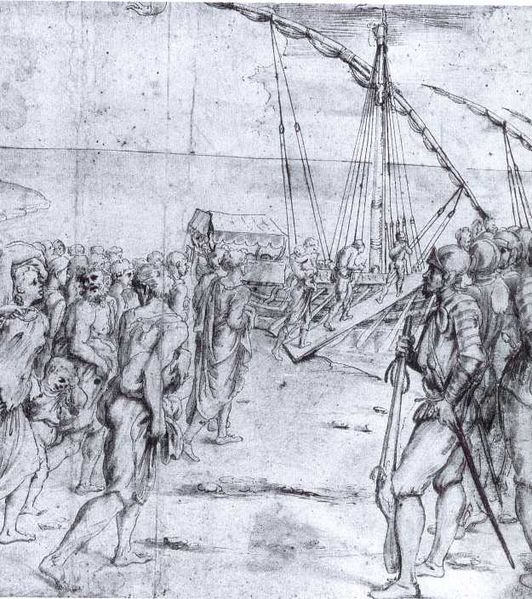
La Expulsión de los Moriscos, by Vincenzo Carducci (Vicente Carducho).

Having taken the trouble over the preceding century to eliminate (or force underground) its substantial Muslim population by forcibly converting it to Christianity, Spain in the early 1600s bethought itself to complete the operation upon its recently minted fellow-Christians by ejecting these Moriscos from Spain altogether.

When the edict for this radical act of expulsion first came down in the heavily Morisco area of Valencia, some of its victims reportedly embraced the prospect of deportation to a land where their dress, language, and religion were no longer forbidden.

Others were less sanguine.

Armed resistance broke out in two wilderness fastnesses, the mountainous Vall de Laguar (Spanish link) and — as narrated by Henry Charles Lea in his freely available The Moriscos of Spain; their conversion and expulsion —

the Muela de Cortes (Spanish link), an almost inexpugnable spot, being a deep valley surrounded by precipitous heights, of which the passes were easily defensible. The Moriscoes of that region … were in a state of excitement and were readily persuaded to rise by an outlaw named Pablillo Ubcar. They elected as king Vicente Turixi, who sent a proclamation through the sierra for all to join him under pain of treason. From their strongholds they made raids on the surrounding country, gathering cattle and provisions, burning villages, and desecrating churches.

[Ethnic cleansing coordinator Don Agustin] Mexia, absorbed in the work of embarkation and fearing to interrupt it, for awhile paid no attention to these movements … who could readily be reduced when the time came.

His provisions were justified … those of the Muela de Cortes … lost heart when they heard of the defeat of those of Aguar, and were disappointed as to the appearance of the Moor Alfatami on his green horse, whom tradition reported to be concealed under the mountain since the days of King Jayme … It was agreed that they [the rebels, surrendering] should be safe in person and property, provided they would go to embark within three days.

The rapacious soldiery, who had promised themselves abundant plunder, in their disappointment threw off all discipline; they sacked the village of Royaya, outraged the women and seized numbers of children as slaves. Only three thousand Moriscoes were brought to the port of embarkation, the rest having scattered and taken to the mountains to escape the fury of the soldiers.

These, estimated at two thousand in number, for several years gave infinite trouble, killing all the Christians they met and committing constant depredations. At one time the Governor of Jativa induced many of them to come down, but finding that they were to be enslaved they fled back to the mountains.

A reward was offered for King Turixi, dead or alive; he was tracked to a cave, captured, and brought to the city, when he was sentenced to have hands and ears cut off, to be drawn, torn with pincers, hanged and quartered; but at the execution, December 18th, the cutting of hands and ears was omitted. He had been confessed twice and reconciled twice, and died as a good Christian, making a most edifying end, for we are told that he had been a liberal almsgiver and devoted to the Virgin and the religious Orders.

The miserable remnants were hunted down gradually, the viceroy paying twenty ducats a head for them as galley-slaves.

The armed resistance in Valencia — where Moriscos were most numerous, and the expulsion was first decreed — was actually much less than had been feared, which gave the Spanish authorities all the encouragement they would need to enforce it elsewhere, too.

“Seeing that the whole body of our nation is tainted and corrupt, he applies to it the cautery that burns rather than the salve that soothes; and thus, by prudence, sagacity, care and the fear he inspires, he has borne on his mighty shoulders the weight of this great policy and carried it into effect, all our schemes and plots, importunities and wiles, being ineffectual to blind his Argus eyes, ever on the watch lest one of us should remain behind in concealment, and like a hidden root come in course of time to sprout and bear poisonous fruit in Spain, now cleansed, and relieved of the fear in which our vast numbers kept it.”

-Cervantes, Don Quixote

On this day..

1532: Solomon Molcho

(Thanks to Jonathan Shipley of A Writer’s Desk for the guest post. -ed.)

Solomon Molcho, a Portuguese mystic, burned at the stake on this date in 1532 for apostasy.

Solomon Molcho’s Shel Silverstein-esque stylized signature. You can see his robe in Prague, or here.

He was in Regensberg, Germany with Jewish messianic adventurer David Reubeni meeting with Emperor Charles V hoping to persuade the ruler of the Holy Roman Empire to arm Marranos (Sephardic Jews forced to adopt Christianity) against the Turkish onslaught.

Charles imprisoned them both, turning them over to the Inquisition in Mantau, Italy. Reubeni died in prison, possibly poisoned. Molcho, who chose at the stake not to return to Christianity, burned.

Molcho’s life ended in flame but started in the warm bosom of the high echelons of Portuguese society. Born Christian to Marrano parents around 1500, Molcho held the post of royal secretary in the high court of Portuguese justice.

That is, until Reubeni visited Portugal on a political mission.

Enamored with Reubeni, who claimed to be a prince descended from the tribe of Reuben, and who had gained favor with Pope Clement VII, Molcho wanted to join Reubeni in the adventurer’s travels. Reubeni refused. Molcho circumcised himself in hopes of gaining Reubeni’s favor. It was all for naught, and so Reubeni emigrated to Turkey.

Soon Molcho was wandering through the Land of Israel, a preacher who predicted the Messianic Kingdom would come in 1540. He, too, gained favor with Pope Clement VII and, after studying the Kabbalah, predicted natural disasters like a flood in Rome in 1530 and an earthquake in Portugal in 1531. After those predictions, and dabbling in strange experiments, Molcho claimed himself to be a precursor to the coming Messiah, if not the Messiah himself.

This troubled many. Now traveling with Reubeni — one a Kabbalist mystical messianic preacher, the other a peripatetic Jewish dwarf — they sermonized, and allied themselves, where they could.

But not with the emperor.

Molcho, in the provincial capital of Mantua, south of Lake Garda in the Po plain, was given one last opportunity to convert back to Catholicism. Asking instead for a martyr’s death, Molcho got it.

On this day..

1777: Rev. Benjamin Russen, child rapist

On this date in 1777, crying out “Stand clear! Look to yourselves! I am the first hypocrite in Sion!”, a clerical schoolmaster was hanged at Tyburn for raping one of his charges.

Ann (or Anne) Mayne testified that the reverend had raped her when she was 9 and 10 years old (the girl was only 10 at the time of the trial). Russen ducked similar charges leveled by three other girls. Rachael Davis, for instance,

said, he lay upon her; but she did not declare, that he entered her body: I told the parties, that no one need be bound over, for it did not appear capital, as she did not say her body was entered.

Result: acquittal. (I’m sure you’ll feel good about entrusting your Bethnal-Green charity school child to Rev. Russen after that.)

Three acquittals out of four ain’t bad.

But it only took one conviction to hang him.

The Old Bailey Online record of Russen’s trial is full of dickering over penetration degrees, and of course, hymen breakage (or lack thereof).

According to this Treatise of the Pleas of the Crown,* the judge in the Mayne case

left it to the jury whether any penetration were proved; for if there were any, however small, the rape was complete in law. The jury found him guilty, and he received judgment of death. But before the time of execution, the matter being much discussed, the learned Judge reported the case to the other judges for their opinions, whether his direction were proper. And upon a conference it was unanimously agreed … that the direction of the Judge was perfectly right. They held, that in such cases the least degree of penetration is sufficient, though it may not be attended with the deprivation of the marks of virginity. It was therefore properly left to the jury by the Judge, and accordingly the prisoner was executed.

* Part of Edward Hyde East’s project in this Treatise is to argue against a standard still used in some jurisdictions that ejaculation was required to constitute a rape. See Passion and Power: Sexuality in History.

On this day..

1541: Thomas Culpeper and Francis Dereham, the Queen’s lovers

Indictment:

That Katharine, queen of England, formerly called Kath. Howerd, late of Lambyth, Surr., one of the daughters of lord Edmund Howard, before the marriage between the King and her, led an abominable, base, carnal, voluptuous, and vicious life, like a common harlot, with divers persons, as with Francis Derham of Lambeth and Hen. Manak [Manox] of Streteham, Surr., 20 and 24 May 32 Hen. VIII., and at other times, maintaining however the outward appearance of chastity and honesty. That she led the King by word and gesture to love her and (he believing her to be pure and chaste and free from other matrimonial yoke) arrogantly coupled herself with him in marriage. And the said Queen and Francis, being charged by divers of the King’s Council with their vicious life, could not deny it, but excused themselves by alleging that they were contracted to each other before the marriage with the King;* which contract at the time of the marriage they falsely and traitorously concealed** from the King, to the peril of the King and of his children to be begotten by her and the damage of the whole realm. And after the marriage, the said Queen and Francis, intending to renew their vicious life, 25 Aug. 33 Hen. VIII., at Pomfret, and at other times and places, practised that the said Francis should be retained in the Queen’s service; and the Queen, at Pomfret, 27 Aug. 33 Hen. VIII., did so retain the said Francis, and had him in notable favour above others, and, in her secret chamber and other suspect places, spoke with him and committed secret affairs to him both by word and writing, and for the fulfilling of their wicked and traitorous purpose, gave him divers gifts and sums of money on the 27 Aug. and at other times.

Also the said Queen, not satisfied with her vicious life aforesaid, on the 29 Aug. 33 Hen. VIII., at Pomfret, and at other times and places before and after, with Thos. Culpeper,† late of London, one of the gentlemen of the King’s privy chamber, falsely and traitorously held illicit meeting and conference to incite the said Culpeper to have carnal intercourse with her; and insinuated to him that she loved him above the King and all others. Similarly the said Culpeper incited the Queen. And the better and more secretly to pursue their carnal life they retained Jane lady Rochford, late wife of Sir Geo. Boleyn late lord Rochford, as a go-between to contrive meetings in the Queen’s stole chamber and other suspect places; and so the said Jane falsely and traitorously aided and abetted them.

On this date in 1541, Thomas Culpeper and Francis Dereham paid the penalty for their indiscretions; the former queen would see her lovers’ severed heads mounted on pikestaffs on London Bridge as she was rowed to the Tower.

The onetime court favorite Culpeper was beheaded for cuckolding the royal person, and that’s no more than one would expect. But the political pull-less Dereham — who had slept with (and possibly “pre-contracted” to wed) the willing young Kate before she meant anything to the king — enjoyed the full measure of the traitor’s torture: hanged, emasculated, eviscerated, and dismembered, all of it basically for having failed to anticipate that his little conquest would one day grow up to turn the monarch’s head.

What a time to be alive.

* Catherine Howard’s confessional letter to Henry VIII … desperately attempting to limit her indiscretions to the time before her marriage:

I, your Grace’s most sorrowful subject and most vile wretch in the world, not worthy to make any recommendation unto your most excellent Majesty, do only make my most humble submission and confession of my faults. And where no cause of mercy is given on my part, yet of your most accustomed mercy extended unto all other men undeserverd, most humbly on my hands and knees do desire one particle thereof to be extended unto me, although of all other creatures I am most unworthy either to be called your wife or subject.

My sorrow I can by no writing express, nevertheless I trust your most benign nature will have some respect unto my youth, my ignorance, my frailness, my humble confession of my faults, and plain declaration of the same, referring me wholly unto Your Grace’s pity and mercy. First, at the flattering and fair persuasions of Manox, being but a young girl, I suffered him a sundry times to handle and touch the secret parts of my body which neither became me with honesty to permit, nor him to require. Also, Francis Derehem by many persuasions procured me to his vicious purpose, and obtained first to lie upon my bed with his doublet and hose, and after within the bed, and finally he lay with me naked, and used me in such sort as a man doth his wife, many and sundry times, and our company ended almost a year before the King’s Magesty was married to my Lady Anne of Cleves and continued not past one quarter of a year, or a little above.

Now the whole truth being declared unto Your Majesty, I most humbly beseech you to consider the subtle persuasions of young men and the ignorance and frailness of young women. I was so desirous to be taken unto your Grace’s favor, and so blinded by with the desire of worldly glory that I could not, nor had grace to consider how great a fault it was to conceal my former faults from your Majesty, considering that I intended ever during my life to be faithful and true unto your Majesty ever after. Nevertheless, the sorrow of mine offenses was ever before mine eyes, considering the infinite goodness of your Majesty toward me from time to time ever increasing and not diminishing. Now, I refer the judgment of my offenses with my life and death wholly unto your most benign and merciful Grace, to be considered by no justice of your Majesty’s laws but only by your infinite goodness, pity, compassion and mercy, without which I acknowledge myself worthy of the most extreme punishment.

** Early the next year, parliament declared, “to avoid doubts in future” — read: “retroactively legislated” — that “an unchaste woman marrying the King shall be guilty of high treason.” This also made anyone who knew about said unchastity guilty of (at least) misprision of treason for failing to report it.

† Surviving letter from Howard to Culpeper:

Master Culpeper,

I heartily recommend me unto you, praying you to send me word how that you do. It was showed me that you was sick, the which thing troubled me very much till such time that I hear from you praying you to send me word how that you do, for I never longed so much for a thing as I do to see you and to speak with you, the which I trust shall be shortly now. That which doth comfortly me very much when I think of it, and when I think again that you shall depart from me again it makes my heart die to think what fortune I have that I cannot be always in your company. It my trust is always in you that you will be as you have promised me, and in that hope I trust upon still, praying you that you will come when my Lady Rochford is here for then I shall be best at leisure to be at your commandment, thanking you for that you have promised me to be so good unto that poor fellow my man which is one of the griefs that I do feel to depart from him for then I do know no one that I dare trust to send to you, and therefore I pray you take him to be with you that I may sometime hear from you one thing. I pray you to give me a horse for my man for I had much ado to get one and therefore I pray send me one by him and in so doing I am as I said afor, and thus I take my leave of you, trusting to see you shortly again and I would you was with me now that you might see what pain I take in writing to you.

Yours as long as life endures,
Katheryn.

One thing I had forgotten and that is to instruct my man to tarry here with me still for he says whatsomever you bid him he will do it.

Though this letter is far from conclusively inculpatory, Culpeper confessed that he “intended and meant to do ill with the queen and that in like wise the queen so minded to do with him.”

On this day..

1549: Robert Kett, rebelling against enclosures

On this date in 1549, Robert Kett (sometimes “Ket” or “Kette”) was hanged over the side of Norwich Castle for an eponymous rebellion.

Reviews here and here.

Possibly England’s last medieval peasant rising, and possibly its first modern revolt, Kett’s Rebellion pitted the agrarian feudal commons against the proto-capitalist world taking shape.

A 15th century of relative prosperity for the English peasant had given way to a decades-long process (centuries-long, really) of enclosure.

Impelled by the profitable wool export business, landlords began “enclosing” formerly open arable land for pasture, thereby destroying the communal and quasi-communal agricultural models of the middle ages.

Karl Marx

For Marx, among many others, this revolution in agricultural production — and the attendant proletarianization of the former peasantry — marks the dawn of the capitalist epoch, when

great masses of men are suddenly and forcibly torn from their means of subsistence, and hurled as free and “unattached” proletarians on the labour-market. The expropriation of the agricultural producer, of the peasant, from the soil, is the basis of the whole process …

Although, therefore, the English land, after the Norman Conquest, was distributed in gigantic baronies, one of which often included some 900 of the old Anglo-Saxon lordships, it was bestrewn with small peasant properties, only here and there interspersed with great seignorial domains. Such conditions, together with the prosperity of the towns so characteristic of the 15th century, allowed of that wealth of the people which Chancellor Fortescue so eloquently paints in his “Laudes legum Angliae;” but it excluded the possibility of capitalistic wealth.

The prelude of the revolution that laid the foundation of the capitalist mode of production, was played in the last third of the 15th, and the first decade of the 16th century. A mass of free proletarians was hurled on the labour-market by the breaking-up of the bands of feudal retainers, who, as Sir James Steuart well says, “everywhere uselessly filled house and castle.” … In insolent conflict with king and parliament, the great feudal lords created an incomparably larger proletariat by the forcible driving of the peasantry from the land, to which the latter had the same feudal right as the lord himself, and by the usurpation of the common lands. The rapid rise of the Flemish wool manufactures, and the corresponding rise in the price of wool in England, gave the direct impulse to these evictions. The old nobility had been devoured by the great feudal wars. The new nobility was the child of its time, for which money was the power of all powers. Transformation of arable land into sheep-walks was, therefore, its cry … As Thornton rightly has it, the English working-class was precipitated without any transition from its golden into its iron age. (Capital, volume I, chapters 26–27)

It did not suffer its precipitation quietly.

Thomas More

Enclosures were a predominant social problem in England throughout the century, and if contemporaries could hardly descry the shape of the economic revolution taking shape, they worriedly noticed the poverty, the vagabondage, and the depopulated villages.

In Utopia, Thomas More upbraids a country where

your sheep, which are naturally mild, and easily kept in order, may be said now to devour men and unpeople, not only villages, but towns; for wherever it is found that the sheep of any soil yield a softer and richer wool than ordinary, there the nobility and gentry, and even those holy men, the abbots! not contented with the old rents which their farms yielded, nor thinking it enough that they, living at their ease, do no good to the public, resolve to do it hurt instead of good. They stop the course of agriculture, destroying houses and towns, reserving only the churches, and enclose grounds that they may lodge their sheep in them. As if forests and parks had swallowed up too little of the land, those worthy countrymen turn the best inhabited places into solitudes; for when an insatiable wretch, who is a plague to his country, resolves to enclose many thousand acres of ground, the owners, as well as tenants, are turned out of their possessions by trick or by main force, or, being wearied out by ill usage, they are forced to sell them; by which means those miserable people, both men and women, married and unmarried, old and young, with their poor but numerous families (since country business requires many hands), are all forced to change their seats, not knowing whither to go; and they must sell, almost for nothing, their household stuff

Commissions studied enclosure; edicts forbade and reversed them; commentators denounced them — all to no effect.

Robert Kett

Robert Kett, from a larger painting (click to see it) by Samuel Wale.

Henrician England had plenty of violent social transformation on its plate, of course, and plenty of violent tools to manage it. When the philandering tyrant kicked the bucket in 1547, he left the unfolding social catastrophe to the weakened protectorate government of his sickly nine-year-old heir.

In East Anglia in the summer of 1549, a peasant riot against an enclosure caught a spark. Unexpectedly, when the mob moved to throw down the enclosures put up by Robert Kett (another small landowner), he committed himself to the peasant cause and ably steered the rebellion for six heady weeks.

Kett was the man for his time and place: proving a natural leader, he marshaled the inchoate rage of his countrymen into an orderly, disciplined force.

Kett’s peasant army marched on Norwich, and stunningly captured England’s second city, thereupon petitioning the crown upon a variety of economic grievances (the petition is available on Wikipedia).

And Kett meant business, as this fiery (perhaps slightly fatalistic) oration suggests; he well knew that he had committed his own person to glory or destruction.

Now are ye overtopped and trodden down by gentlemen, and put out of possibility ever to recover foot. Rivers of riches ran into the coffers of your landlords, while you are pair’d to the quick, and fed upon pease and oats like beasts. You are fleeced by these landlords for their private benefit, and as well kept under by the public burdens of State wherein while the richer sort favour themselves, ye are gnawn to the very bones. You tyrannous masters often implead, arrest, and cast you into prison, so that they may the more terrify and torture you in your minds, and wind our necks more surely under their arms. And then they palliate these pillories with the fair pretence of law and authority! Fine workmen, I warrant you, are this law and authority, who can do their dealings so closely that men can only discover them for your undoing. Harmless counsels are fit for tame fools; for you who have already stirred there is no hope but in adventuring boldly.

Alas, like the enclosures themselves, the matter was to be resolved against the peasantry by main force. [bits and bobs on the daily progress of skirmishes and battles in this pdf] Though the rebels actually defeated the first force sent against them, they were decisively beaten at Dussindale on Aug. 27.

“We were promised ynoughe and more then ynoughe. But the more was an hawlter.”*

Promises of clemency induced the survivors to surrender peacably; though wholesale punitive bloodletting seems not to have been imposed, the leaders, of course, had to be made an example of.

Robert Kett and his brother, William, were convicted of treason and hanged.

Smoothly leveraging his dispatch in handling the rebellion, John Dudley, Duke of Northumberland, overturned the national political leadership of the Lord Protector the Duke of Somerset, who was accused of having triggered the rising with an excess of sympathy for the dispossessed peasant class. (Both Somerset and Northumberland would end up on the chopping block themselves.)

* Quote from a survivor of the rebellion, cited by Diarmaid MacCulloch in “Kett’s Rebellion in Context,” Past & Present, No. 84 (Aug., 1979).

On this day..

1823: Dr. Edme Castaing, the first to kill with morphine

On this date in 1823, French physician Edme Castaing expiated upon the scaffold history’s first conviction for murder with morphine.

The good doc used the drug, a new twist on an ancient remedy only recently brought to market, apparently to poison off one of two wealthy brothers with the connivance of the other wealthy brother, the latter of whom stood in danger of being disinherited.

And then, the beneficiary of that crime wrote a will of his own to the profit of the poisoner.

Do not try this at home.

Castaing, naturally, poisoned off the other brother, too, and relieved some considerable financial distress along with, one must think, the burdensome company of a complete dullard.

“The science of toxicology,” however, “was not greatly advanced at this time, and … the above conclusion was based on presumption rather than fact.”

While today, such a case might be ripped from CSI, in 1823 it entailed an uncertain trial with varying (and wrong) medical testimony and a circumstantial trail of witnesses drawing flailing rebuttals from the accused that ran towards the unconvincing and the contradictory. (Follow the twists and turns from a contemporary chronicle here.)

Quite convicted in the public eye (a verdict history has had little cause to revisit), Castaing was judicially acquitted of the murder of Hippolyte Ballet, and doomed by the barest 7-5 majority verdict for the second Ballet boy. The London Times complained in its report of the execution (printed Dec. 9, 1823), that

[t]he faculty speak in very harsh and unmeasured terms of Dr. Pellatan, who neither described with care and accuracy, what he himself observed on opening of the body of Ballet, nor gave them the means of forming an opinion themselves, by bringing to Paris the intestines of the deceased. The physicians join the rest of the world in ascribing Ballet’s death to substances administered by Castaing, but they regret that criminal justice could not, owing to the neglicence or ignorance of Pellatan, obtain more satisfactory proofs of the crime. Beyond his own confessions, contradictions, and admissions, there was confessedly no ground to convict him.

A few years later, Victor Hugo (we keep meeting him here) had the title character in “The Last Day of a Condemned Man” occupying Castaing’s former cell, and evidently thought the matter possessed sufficient notoriety to name-check the headless poisoner decades afterwards in Les Miserables.

On this day..

1689: Karposh, Macedonian rebel

On an uncertain date in early December (or possibly late November), the Macedonian* rebel Karposh was executed at Skopje.

The Great Turkish War had seen the Ottomans advance to the gates of Vienna, but an alliance of European powers pushed the Mohammedan back.

Their crisscrossing armies roiled the Balkans, creating the opportunity for a bit of ill-fated separatism.

Arambasha [a title, not a name] Karposh raised a native Macedonian rebellion (detailed account of it here) that waxed and waned with the fortunes of the Austrian army. In his brief heyday, he was acclaimed “Prince of Kumanovo“.

But a November 1689 counteroffensive seriously harshed that vibe; the Turks overran his force and drug Karposh back to Skopje where he and a couple hundred fellow Macedonian captives are said to have been put to death by impalement on the lovely Stone Bridge over the Vardar. (Other versions of this story cite, less picturesquely, hanging.)

You can still see this landmark today in Skopje … capital of the now-independent Macedonia.

* Lest I wade carelessly into the Balkan ethnic crossfire, I hasten to declaim that “Macedonian” here refers to the geographic environs roughly coincident with the present-day Republic of Macedonia. No representation as to the man’s ethnicity or his project is intended, or attempted.

On this day..