1977: Princess Misha’al bint Fahd al Saud and her lover

On this date in 1977, a 19-year-old royal adulteress and her paramour were executed in a Jeddah parking lot by the order of the girl’s powerful grandfather.

Princess Misha’al‘s fate has been obscured by secrecy and the Rashomon-like interpretations imposed upon it by observers.

In its outline (and the first stock interpretation we’re imposing) it’s that timeless human tragedy, the love story, in which headstrong royal daughter and suffocating traditional family square off over the seditious power of the feminine libido.

The princess, in a youthful arranged marriage by most accounts, took up with a Saudi boy while both were studying abroad in cosmopolitan Beirut, and dangerously attempted to maintain the affair back in the royal kingdom to the point of a quixotic (and obviously foiled) escape attempt. Whether under color of a judicial proceeding — the story says Misha’al refused to walk away by simply renouncing her lover and defiantly brought down the death sentence by confessing adultery — or simply on his own authority, the girl’s staunchly conservative* grandfather exercised his right as tribal patriarch to inflict an honor killing for the disgrace they had brought on the family.

The execution in Jeddah — she by gunshot,** he by a very clumsy beheading — that is supposed to have occurred on this date was public, but quiet; news of it got abroad only slowly and incompletely. Small wonder that, once it did, the blended motifs of Romeo and Juliet, harem titillation and oil politics made dynamite material for high-, middle- or lowbrow exploitation.

In 1980, the affair became the subject of one of the most notorious television programs ever aired, the docudrama Death of a Princess. This film’s airing in Britain in 1980 led Riyadh to expel the British ambassador, and cost £200 million of lost revenue for the UK from canceled orders and product boycotts by the Saudis.†

It was aired on in the United States on PBS in 1980 to similar controversy, as oil companies rushed to distance themselves from it.

Rebroadcast in 2005, Death of a Princess is available online for your judgment (as is this partial script): is this a muckraking expose of a shameful crime? orientalist heavy petting? “a sensitive and thoughtful exploration of the Arab dilemma,” as per its own advance publicity? and what did the official apologies (and in only a few countries, censorship) say about the political weight of the petroleum industry?

These, meanwhile, are the western reactions, already removed from events by a further layer of mediation, a forest of axes seeking grinding. If the writer who composed this piece is to be believed, the executed girl has posthumously achieved a sort of universal symbolic gravity in the Arab world, standing for the plight of any hopeless cause of justice dashed against authoritarian power.

* For the House of Saud, it must be recalled, the personal was political in the problematic confrontation between tradition and modernity athwart the desert kingdom’s sea of oil.

** “Princess Misha’al” was executed fully veiled, which permits the rumor that the slain woman was actually a surrogate and the onetime royal favorite lives on incognito somewhere.

† According to the July 4, 1980 London Times.

Part of the Themed Set: The Feminine Mystique.

Editor’s note: References to “Princess Misha” corrected; thanks to hannah for the clarification.

On this day..

1537: Robert Aske, for the Pilgrimage of Grace

On this date in 1537, Robert Aske was hanged for leading the Pilgrimage of Grace.

The year preceding had been among the most wrenching in British history, and when Henry VIII began shuttering Catholic monasteries, many an egg that would comprise the English Reformation‘s omelette would be shattered.

In the conservative and Catholic-leaning north, Thomas Cromwell‘s reforms (combined with various political and economic grievances) triggered an uprising that soon controlled York.

This fraught situation ended much easier for the English crown than it might have, with a royal negotiating strategy of nominally accepting the Pilgrimage’s terms inducing the massive rebel force to disband, allowing its leaders to be seized thereafter on the first pretext of renewed trouble.

[flv:https://www.executedtoday.com/video/Pilgrimage_of_Grace.flv 440 330]

Robert Aske, the barrister who had come to the fore of the Pilgrimage movement and had personally negotiated terms with Henry, was among about 200 to suffer death for their part in the affair. In Aske’s case, it was against the will of Jane Seymour, Henry’s demure third queen and also a Catholic-inclined traditionalist; she made an uncharacteristic foray into state policy by ask(e)ing for Aske’s life, summarily vetoed by the king’s reminding her the fate of her politically-minded predecessor.*

Here’s Aske hanged at York Castle in The Tudors:

And here’s an inscription on a Yorkshire church reminding one of Aske’s surviving brothers of the events of those pivotal months.

* In other wives-of-the-king developments, Henry’s future (sixth, and final) wife Katherine Parr was taken a hostage by the rebels during the Pilgrimage.

On this day..

1836: Louis Alibaud, failed regicide

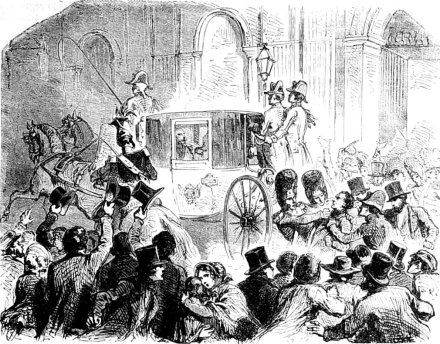
Early this Monday morning in 1836, Louis Alibaud — having been condemned to death by the Chamber of Peers at trial the preceding Friday and Saturday — lost his head for taking a shot at oft–shot–at French King Louis-Philippe.

As related by the London Times (July 6, 1836),

at half-past 6 in the afternoon of the 25th of June, 1836; the windows of the carriage were lowered, and it was passing through the gate [of the Tuileries palace] leading to the Pont Royale, when a man, who had been standing by a post in the court, raise [sic] a cane gun and discharged it against the King. By a miraculous chance the King was lowering his head to salute the National Guard under arms, and the ball passed just four lines above his head, and entered one of the angles of the carriage, settling about an inch deep in an oak beam.

The assassin was immediately arrested; he was a young man, of about 25 years of age, dressed in a dark coat, cloth pantaloons, and black hat, and wearing under his chin a thick brown beard.

The disabled former infantryman, “inspired by political fanaticism and a morbid satiety of life,” mounted no defense of himself save for a defense of tyrannicide — “I had the same right to his life that Brutus had to the life of Julius Caesar!” (Source)

Naturally, this line had neither the intent nor the effect of securing clemency, and he was repeatedly cautioned by the court against pursuing it; all concerned knew precisely where matters were headed, of course, and the state had no interest in providing a public forum for sedition.

On this day..

1294: Rane Jonsen, Marsk Stig conspirator

On an unknown date in 1294, the former page of the late Danish King Eric V was put to death for regicide outside Roskilde.

Rane Jonsen or Jonsson (here’s his short Danish Wikipedia page) had been present at the hunt during which the former monarch, more popularly known as “Erik Glipping”, was murdered by unknown assailants in 1286.

The convention — and the official verdict of state — have it that Jonsen contrived to admit marsk Stig Andersen Hvide and fellow conspirators to the vulnerable king’s presence for the purpose of murdering him, possibly revenging the king’s rape of Andersen’s wife. “Marsk Stig” and Rane both fled, and were condemned along with seven other men by the Danish Assembly in the spring of 1287.

Although there is little remaining primary documentation, it does seem that the guilt of these people was decided above all by political expedience. It was Stig Anderson’s opponents who got control of the government (and the regency of 12-year-old Erik Menved), conveniently declaring the guilty parties to be their own rivals, who had formerly been close to Erik Glipping.*

Our page, himself a noble, got the short end of the stick in all this; he energetically denied the story that he had stood aside to permit the murder of his liege, claiming that he fought back albeit unarmed and outnumbered.

But as an emblem of the perfidy of the king’s inner circle, you couldn’t do much better than Rane theatrically planting his sword into a table and standing aside to signify the king’s vulnerability. You can just picture that story being retold with a meaningful ahem to the boy-king Eric VI.

In fact, it was retold: wrongful conviction or no, this episode (in its official version, with Rane and Stig as evildoers) was the basis for a number of entries in the rich Danish ballad genre.

Though popularly cited as medieval ballads, disputed dating places different verses anywhere from Rane Jonsen’s own time to three centuries later.** In any era, they offer some lovely exemplars of the art.

This book reproduces several; topical for this entry is an imagining of the fugitive regicide’s plight, both sad (for his hopelessness) and menacing (for his violent seizure of a bride) — disconcertingly delivered in a repetitious lullaby singsong.

Ranild bade saddle his charger gray,
‘Twas told me oft before,
“I’ll be the Algrave’s guest today,
“Tho’ friends I have no more.”

Ranild rode up to his castle gate
‘Twas told him oft before
Where ermine-clad the Algrave sate,
Tho’ friends he had no more.

“Hail noble Algrave, here I come,
‘Twas told thee oft before
“To fetch my trothplight Kirstin home,
“Tho’ friends I have no more.”

Then up and spake her mother dear,
“‘Twas told thee oft before,
“For thee is bride no longer here,
“For friends thou hast no more.”

“I’ll either with the maid return,
“‘Twas told you oft before
“Or else your house and chattels burn,
“Tho’ friends I have no more.”

“Nay set not thou the house on flame,
“‘Twas told thee oft before,
“E’en take the bride thou ‘rt come to claim,
“Tho’ friends thou hast no more.”

In mantle wrapt the gentle maid,
‘Twas told her oft before,
On Ranild’s good gray horse was laid,
Tho’ friends he had no more.

No other bridal bed had they,
‘Twas told her oft before,
Than bush, and field, and new made hay,
For friends he had no more.

“The wood has ears, the mead can see,
“‘Twas told thee oft before,
“A wretched outlaw’d pair are we,
“For friends I have no more.”

“And had you not King Erick slain,
“‘Twas told you oft before,
“We still might in the land remain,
“But friends we have no more.”

“Stay, Kirstin, stay, such words forbear,
“‘Twas told thee oft before,
“Where strangers are, take greater care,
“For friends we have no ore.”

With that he slapp’d her cheek so red,
“‘Twas told thee oft before,
“It was not I, smote Erick dead,
“Tho’ friends I have no more.”

From the same source, our day’s principal meets his end:

Report is rife in all the land
Ranild at last is caught;
He surely had never gone from Hielm,
His doom had he bethought;
A death of torture he must die,
As he has long been taught.

Ranild he stepp’d within the door,
‘Good evening’ bade the king,
And all the guard of gentlemen,
Who round him stood in ring;
“Christ! may no son of loyal Dane
“Such trouble on him bring!

“But, O King Erick, noble liege,
“Remember you no more;
“The best was I of all the swains
“Your father’s livery wore;
“And you through wood and flowery mead
“In arms so often bore?”

“Full well I know thou servedst here
“For clothes and food and pay;
“And, like a vile and treacherous knave,
“My father didst betray;
“For which the stake thy carcase bears,
“If I but reign a day.”

“My hands and feet hack from my limbs,
“Tear from my head these eyes;
“With racking tortures martyr me,
“The worst you can devise;
“So much the wrong I’ve done your house
“For vengeance on me cries.”

“Thine eyes put out, that will we not,
“Nor lop thy hands or feet;
“But with a traitor’s hardest death
“The worst of traitors treat;
“And on our father’s murderer take
“Such vengeance as is meet.”

As forth from Roskilde he was led,
He wrung his hands anew,
And tears to see him go to die
Wept ladies not a few;
He turn’d him round, and bade them all
A thousand times Adieu.

They led him forth to where the rack
Stood ghastly on the plain;
“O Christ, from such a martyring death
“Protect each honest Dane!
“Had I but stay’d at Hielm this year,
“And there in safety lain!

“Now were there here one faithful friend,
“Who home for me would go,
“And would my sorrowing wife Christine,
“Her path of duty show!
“O Christ, look on my children dear!
“O comfort thou their woe!

“And you, I pray, good Christian folk,
“Who here are standing round,
“A pater noster read for me,
“That grace for me be found;
“And that this night I reach the land,
“Where heavenly joys abound.”

Marsk Stig, however, is the primary focus of these dramas; he raided shipping from his island base on Hielm (Hjelm), dying of natural causes in 1293. Some additional translated ballads about this character are available here.

But since this is poetry, take a moment to dig the original Danish,† which should be at least partially comprehensible to any English- or German-speaker.

Marsti ind aff dorren tren
med suerd i hoyre hend:
kongen sidder hannem op igien,
saa giorlig han hannem kende

…

>>Hor du, Ranil Ienssen!
oc vilt du verie mit liff:
jeg giffuer dig min soster
oc halff min rige in min tid.<< Det vor Ranil Iensson, han hug i borde oc balck; det vil ieg for sanden sige: hand veriet sin herre som en skalck De stack ham ind at skulder-bende, oc det stod ud aff halss; det vil ieg for sandingen sige: det vaar alt giort med falsk. De stack hannem ind at skulder oc ud aff venster side: >>Nu haffuer wi giort den gierning i dag,
all Danmarck baer for stor quide<<.

Stig burst through the door,
his sword in his right hand;
the king sat upright
and recognized him.

…

“Hear me, Rane Jonson!
If you defend my life
I will give you my sister
and half of my kingdom.”

Rane Jonson swung his sword
and stuck it in the table and in the wall;
in truth,
he betrayed his lord shamefully.

They stabbed him in the shoulderbone
and out through the neck;
in truth,
they did it all deceitfully.

They stabbed him in the shoulder
and out through the left side.
“Now we have done the deed today,
all Denmark bears too heavy a load”

* Discussed at length in “Killing Erik Glipping. On the Early Days of a Danish Historical Ballad” by William Layher in Song and Popular Culture, 45, 2000. Layher reports that the Norwegian government (which received the fugitives) and the Danish were still trading nastygrams over the propriety of the convictions in the early 1300s. On the instigation of the Archbishop of Lund, who supported the exiles, the Church interdicted sacraments to Denmark for several years around the turn of the century.

** See Layher again. At least one contemporaneous bard, minnesinger Meister Rumelant, is known to have composed on the famous murder.

† Extract and translation from Layher, once again.

Part of the Themed Set: The Ballad.

On this day..

1839: William John Marchant

On this date in 1839, a spooked 18-year-old servant was hanged at Newgate Prison for murdering fellow-servant Elizabeth Paynton.

A good Chelsea lad with no rap sheet, Marchant slashed Paynton’s throat with a razor when they were left alone, fled, but was so pursued by guilt that he gave himself up and pleaded guilty. Awaiting death, he lamely told his distraught parents

the upper house-maid and the cook went out, leaving [Marchant] with the deceased in the house by themselves. The cook, as she was leaving the house, dared him to get possession of a riband or pair of garters which the deceased had displayed before the servants in the kitchen in jest, and threatened to inflict some ludicrous punishment upon him if he did not … [Marchant] improperly endeavoured to obtain possession of the garters, but she resisted him, and at length slapped his face, called him some ill names, and said she would get him out of his situation for his rudeness. He then ran to fetch a razor to cut the garters and get them into his own possession, and he then had not the least intention of killing her or perpetrating any other offense … but when he did return with the razor in his hand he was seized, as he says, with a sudden and unaccountable impulse, which he could not define, and in a paroxysm of insanity in a moment, and without premeditation, he cut her throat.

(In a later telling, he dropped the garter cover story and copped to a more distinctly identifiable attempted rape, with the murder precipitated by its object’s threat to have him sacked.)

As the London Times remarked on the hanging,

It is difficult, perhaps, to hold him out as an example to other erring youth; for, as he neither appears to have been a drunkard, nor given up to licentious courses, his crime is of so extraordinary a character, that it is hardly possible any other, by following the same course, should terminate his career by the same shameful death … there [may] be no occasion to read a lesson to those who in ordinary cases might be seduced to commit a similar offence.

The dearth of instructional opportunity (and the fact that “the crowd was not great”) did not obstruct London’s enterprising gallows-foot entrepreneurs from cranking out multiple broadsides,* complete with cookie-cutter didactic poem. This sort of thing was standard fare for the day’s forgettable petty villains, not merely its crimes of the decade.

All ye who pity my sad fate,
With sorrow most sincere,
Unto the truth which I will state,
I pray you lend an ear.
Condemned in scorn and shame to die
My doom is most severe,
‘Tis but a few short days since I
Just reached my eighteenth year.

My face is all beset with woe,
My cheeks are worn with care,
My eyes are parch’d and sunk with Grief,
That once so sparkling were.
Strange horrors chill my every vein,
A voice most wild and true,
Whispers to this distracted brain,
Thy hand Elizabeth slew.

At this my very heart doth bleed
With grief, remorse, and guilt
To think upopn the ruthless deed,
The blood which I have spilt;
For never since that hour have I
One moment’s comfort knew,
And poor Elizabeth’s murdered corpse
Is ever to my view.

Behold my days are like a flower,
That blooms at break of day,
Cut down and withered in an hour,
And vanished away.
Lament, lament, to see me die
All ye who do me view,
A poor, heartbroken, wretched lad,
Must bid this world adieu.

Vain, are my lamentations, vain
These unavailing sighs,
Girm [sic] death is hastening apace,
I must prepare to die.
Heaven grant none may hereafter be
Like luckless me undone,
But always strive with humble mind,
The tempters snare to shun.

* From Harvard University’s collection.

Update: The Times Archive Blog flags another interesting bit of this story: the newspaper’s hectoring the doomed footman’s chaplain for excessive “enthusiasm.”

Part of the Themed Set: The Ballad.

On this day..

1840: Francois Benjamin Courvoisier, for the murder of Lord Russell

On this date in 1840, a valet was hanged at Newgate Prison for the murder of his aristocratic employer, Lord William Russell.

This celebrity murder of a former Member of Parliament, septuagenarian patriarch of one of England’s august noble houses, by a member of his household activated all the crime-panic circuits still familiar a couple centuries later.

That of class, of course: the perpetual frisson of animosity between the respectable and those they held in economic servitude, bursting bloodily onto the front pages.

That of foreignness, since Courvoisier was Swiss.

And that ever-popular fear of youth amok, when the 23-year-old claimed inspiration from William Harrison Ainsworth‘s then-popular potboiler about the beloved underclass robber Jack Sheppard.*

Speedy Trial

The valet was quickly on trial for his life; the total time elapsed from Russell’s death to Courvoisier’s own was two months to the day.

But a less hasty schedule might have permitted better investigation, as Courvoisier was well on his way to acquittal with his lawyer’s deft rebuttal of the crown’s entirely circumstantial case.

When police discovered the decisively damning evidence of Russell’s stolen effects midway through the trial, the Swiss man made himself an milepost in the evolution of professional ethics at the bar. Summoning his lawyers, Courvoisier informed them that he was indeed guilty but that he had no intention of pleading guilty to a hanging crime and expected his defense to continue.

Attorney Charles Phillips reluctantly complied, implicating fellow-servant Sarah Mancer as the potentially guilty party. When it became publicly known after the trial that Phillips had become aware of his client’s guilt, he was publicly vilified for the vigor of his representation, e.g., contesting “with violent language the witnesses for the prosecution, whose evidence he [knew to be] true,” and a lively debate among legal types on professional propriety in such an instance ensued.**

Read All About It

None of this availed Benjamin Courvoisier aught. His celebrity was brief, but intense — he even signed an autograph for the sheriff, dating it “the day of my execution,” as he was being pinioned for hanging. Broadsides like these below (links to selections from Harvard Library’s extensive publication of execution broadsides) sold a reported 1.65 million copies. (Source)

Broadside 1

Broadside 2

Broadside 3

Broadside 4

Among the published broadsides are several popular ballads relating to the case — one written to lament the murder, before the apprehension of a suspect; others for the condemned’s execution. One certainly wouldn’t call these great literature, but they’re representative examples of broadside balladry, nearly de rigueuer for scandal-mongering Victorian crime coverage and therefore very relevant for these pages.

COURVOISIER’S LAMENT
(Written by Himself.)

You Christians all of every nation,
A warning take by my sad fate–
For the dreadful crimes that I’ve committed,
I, alas! repent too late.
Only think what I must suffer,
And the death which I must undergo–
I cannot rest by day or night,
My heart’s so full of grief and woe.

My parents they were poor — but honest —
And brought me up in virtuous ways;
And never, ’till this sad occurrence,
Did I embitter their fond days.
But now, alas! quite broken-hearted,
My friends and family must be,
To think that I soon must quit
This world for a long Eternity.

My Master was a Nobleman–
Lord William Russell was his name;
Beloved he was by all who knew him,
And well he did deserve the same.
Oh! how could I so basely murder
One that was so good and kind?
I hope the Lord above will pardon
Me, that I may mercy find.

Alas! my days they are all numbered.
When I must give up my last breath;
For the horrid crimes that I’ve committed,
Die an ignominious death.
Oh! while I’ve life, let me entreat you
All, take warning by my fate!
Shew the ways of evil-doers,
Or you’ll repent when ’tis too late.

Attend unto my true confession–
A lesson it may be to you;
Give not your mind too much to pleasure,
Act upright — be just and true.
Let not the sight of gold e’er tempt you
To act dishonest to your friend:
For that alone caused me to murder,
And brought me to this untimely end.

Let not the world blame those two Females
Who, fellow-servants were with me;
For of the murder and the robbery,
None whatever knew but me.
No other crimes have I committed,
Save one single robbery;
Tho’ it was said that Etiza Grimwood
Basely murdered was by me.

Charles Dickens attended this hanging, mining the scene for Barnaby Rudge.

William Thackeray came too — he was becoming publicly engaged as a man troubled by capital punishment, and it was the first execution he had witnessed. (Actually, he turned away at the decisive moment.) Thackeray published an article about the experience in Fraser’s magazine, reflecting doubt at the salutary value of public executions and empathy with the young man’s scrambled mental state as he was raced from condemnation to the gallows in a mere fortnight.

At first, his statements are false, contradictory, lying. He has not repented then. His last declaration seems to be honest, as far as the relation of the crime goes. But, read the rest of his statement — the account of his personal history, and the crimes which he committed in his young days; them “how the evil thought came to him to put his hand to the work.” It is evidently the writing of a mad, distracted man. The horrid gallows is perpetually before him; he is wild with dread and remorse. Clergymen are with him ceaselessly; religious tracts are forced into his hands: night and day they ply him with the heinousness of his crime, and exhortations to repentance. Read through that last paper of his. By heaven, it is pitiful to read it. See the Scripture phrases brought in now and anon; the peculiar terms of tract-phraseology (I do not wish to speak of these often meritorious publications with disrespect). One knows too well how such language is learned-imitated from the priest at the bedside, eagerly seized and appropriated, and confounded by the poor prisoner.”

* Courvoisier’s Jack Sheppard reference triggered thunderous indictments of this text in the popular press — “a publication calculated to familiarise the mind with cruelties,” howled the London Examiner “and to serve as the cut-throat’s manual” and caused the stage adaptation to be censored (pdf).

Though Ainsworth had decades of writing ahead of him, it’s been argued that his reputation never fully recovered from this case, and that’s why he’s not in the canon. What he lacks in posthumous celebration he garnered in contemporary buzz; Ainsworth’s “Newgate novels” valorizing highwaymen helped to feed an enduring popular craze for hanging broadsides and “penny dreadfuls” and to mainstream a (commercialized) version of thieves’ cant. See The Hanging Tree: Execution and the English People 1770-1868.

** See The Bar & The Old Bailey, 1750-1850. In a more unctuous vein, the bishop of London submitted a petition to the House of Lords demanding repeal of the right of defendants’ lawyers to make closing statements.

Part of the Themed Set: The Ballad.

On this day..

1600: Jean Livingston, Lady Waristoun

At 4 o’clock in the morning this day — as a favor to her powerful father to limit the public spectacle — Jean Livingston lost her head for arranging the murder of her husband just three days before.

Provoked by one beating too many, Lady Waristoun (or Lady Warriston) got a servant to murder him in his bed on the night of July 1.

Robert Weir blew town — he wouldn’t be apprehended until 1604, whereupon he suffered one of the very few instances of execution on the breaking-wheel to occur in the British Isles — but the Lady and her nurse Janet Murdo were “caught red-handed”, an actual juridical concept in Scottish law which means what it says on the tin.

They were condemned to death by burning, which dad’s pull was able to mitigate for his daughter (but not the nurse), so

scho wes tare to the Girth Crosse upon the 5 day of Julii, and her heid struk fra her bodie at the Cannagait fit; quha diet verie patiently. Her nurische wes brunt at the same tyme, at 4 houres in the morneing, the 5 of Julii.

In the exceedingly brief time — about a day and a half — between sentence and execution, Lady Waristoun was reported to have undergone a wonderous transformation. The not-uninterested report* of her confessor offers these mournful final words, a stark contrast to her defiant state just after condemnation.

The occasion of my coming here is to show that I am, and have been, a great sinner, and hath offended the Lord’s Majesty; especially, of the cruel murdering of mine own husband, which, albeit I did not with mine own hands, for I never laid mine hands upon him all the time that he was murdering, yet I was the deviser of it, and so the committer. But my God hath been always merciful to me, and hath given me repentance for my sins; and I hope for mercy and grace at his Majesty’s hands, for his dear son Jesus Christ’s sake. And the Lord hath brought me hither to be an example to you, that you may not fall into the like sin as I have done. And I pray God, for his mercy, to keep all his faithful people from falling into the like inconvenient as I have done! And therefore I desire you all to pray to God for me, that he would be merciful to me!

Then, she had her head lopped off by the maiden while at the same hour Janet Murdo, much less wept for, was burnt alive at Castlehill.

This sudden and sensational fall of an elite, and allegedly beautiful, woman obviously made quite a splash, with printed accounts feeding almost inevitably into the Scots ballad tradition.

My mother was an ill woman,
In fifteen years she married me ;
I hadna wit to guide a man,
Alas! ill counsel guided me.

O Warriston, O Warriston,
I wish that ye may sink for sin;
I was but bare fifteen years auld,
When first I enter’d your yates within.

I hadna been a month married,
Till my gude Lord went to the sea;
I bare a bairn ere he came hame,
And set it on the nourice knee.

But it fell ance upon a day,
That my gude lord return’d from sea;
Then I did dress in the best array,
As blythe as ony bird on tree.

I took my young son in my arms,
Likewise my nourice me forebye;
And I went down to yon shore side,
My gude lord’s vessel I might spy.

My lord he stood upon the deck,
I wyte he hail’d me courteouslie;
“Ye are thrice welcome, my lady gay,
Wha’se aught that bairn on your knee?”

She turn’d her right and round about,
Says, “Why take ye sic dreads o’ me?
Alas! I was too young married,
To love another man but thee.”

“Now hold your tongue, my lady gay,
Nae mair falsehoods ye’ll tell to me;
This bonny bairn is not mine,
You’ve loved another while I was on sea.”

In discontent then hame she went,
And aye the tear did blin’ her e’e;
Says, “Of this wretch I’ll be revenged,
For these harsh words he’s said to me.”

She’s counsell’d wi’ her father’s steward,
What way she cou’d revenged be;
Bad was the counsel then he gave, —
It was to gar her gude lord dee.

The nourice took the deed in hand,
I wat she was well paid her fee;
She kiest the knot, and the loop she ran,
Which soon did gar this young lord dee.

His brother lay in a room hard by,
Alas! that night he slept too soun’;
But then he waken’d wi’ a cry,
I fear my brother’s putten down.

O get me coal and candle-light,
And get me some gude companie;
But before the light was brought,
Warriston he was gart dee.

They’ve ta’en the lady and fause nouriee,
In prison strang they hae them boun’;
The nouriee she was hard o’ heart,
But the bonny lady fell in swoon.

In it came her brother dear,
And aye a sorry man was he;
“I wou’d gie a’ the lands I heir,
O bonny Jean, .to borrow thee.”

“O borrow me, brother, borrow me–
O borrow’d shall I never be;
For I gart kill my ain gude lord,
And life is nae pleasure to me.”

In it came her mother dear,
I wyte a sorry woman was she;
“I wou’d gie my white monie and gowd,
O bonny Jean, to borrow thee.”

“Borrow me, mother, borrow me,–
O borrow’d shall I never be;
For I gart kill my ain gude lord,
And life’s now nae pleasure to me.”

Then in it came her father dear,
I wyte a sorry man was he;
Says, “Ohon! alas! my bonny Jean,
If I had you at hame wi’ me.

“Seven daughters I ha’e left at hame,
As fair women as fair can be;
But I would gie them ane by ane,
O bonny Jean, to borrow thee.”

“O borrow me, father, borrow me,–
O borrow’d shall I never be;
I that is worthy o’ the death,
It is but right that I shou’d dee.”

Than out it speaks the king himsell,
And aye as he steps in the fleer,
Says, “I grant you your life, lady,
Because you are of tender year.”

“A boon, a boon, my liege the king,
The boon I ask, ye’ll grant to me.”
“Ask on, ask on, my bonny Jean,
Whate’er ye ask, it’s granted be.”

Cause take me out at night, at night,
Lat not the sun upon me shine;
And take me to yon heading hill,
Strike aff this dowie head o’ mine.

Ye’ll take me out at night, at night,
When there are nane to gaze and see;
And ha’e me to yon heading hill,
And ye’ll gar head me speedilie.

They’ve ta’en her out at nine at night,
Loot not the sun upon her shine;
And had her to yon heading hill,
And headed her baith neat and fine.

Then out it speaks the king himsell,
I wyte a sorry man was he;
“I’ve travell’d east, I’ve travell’d west,
And sailed far beyond the sea,
But I never saw a woman’s face
I was sae sorry to see dee.

“But Warriston was sair to blame,
For slighting o’ his lady so;
He had the wyte o’ his ain death,
And his bonny lady’s overthrow.”

* Snappily titled, “A Worthy and Notable Memorial of the Great Work of Mercy which God wrought in the Conversion of Jean Livingstone Lady Warristoun, who was apprehended for the Vile and Horrible Murder of her own Husband, John Kincaid, committed on Tuesday, July 1, 1600, for which she was execute on Saturday following; Containing an Account of her Obstinacy, Earnest Repentance, and her Turning to God; of the Odd Speeches she used during her Imprisonment; of her Great and Marvellous Constancy; and of her Behaviour and Manner of Death: Observed by One who was both a Seer and Hearer of what was spoken.”

Part of the Themed Set: The Ballad.

On this day..

1706: Dona Beatriz Kimpa Vita, the Kongolese Saint Anthony

On July 2, 1706, Kimpa Vita, a Congolese noblewoman also known by her baptismal name Dona Beatriz, was burned as a witch in Evululu.

This remarkable woman claimed to be a medium for the spirit of Saint Anthony of Padua, a popular saint in the Catholicized Kingdom of Kongo, and attracted a mass movement in the midst of civil war and social breakdown in the proud Kongo state.

Executed Today is pleased to mark this occasion with an interview with Boston University Prof. John K. Thornton, author of The Kongolese Saint Anthony: Dona Beatriz Kimpa Vita and the Antonian Movement, 1684-1706.


This is a very unfamiliar story to most, as you point out in The Kongolese Saint Anthony. So let’s begin with some orientation — the Kingdom of Kongo is in the midst of a ruinous civil war. Why?

The civil war in Kongo was basically a dynastic affair, that is, a battle between branches of the royal family for control over the throne. Kongo had a very highly centralized political structure, the king and his council had a lot of power not only over who held high office, but also who got what income, because a lot of income derived from holding office. So controlling the kingship and its related patronage was very important.

This story is very complicated, I try to lay it out as simply as possible in Chapter II of my book. To make matters short, by D Beatiz’ day it had two branches duking it out — the Kimpanzu and the Kinlaza, with Pedro IV, conveniently descended from both these families, as a sort of conciliatory figure.

And it’s a highly Catholic country. How did that come to be?

Pretty remarkable story.

Actually I think it’s the only real missionary victory that the Catholic church had in the early modern period. By that I mean that they spread the faith to a completely independent country and not just by conquest.

Officially, it was a series of miracles that both Catholic priests and Kongo elites witnessed in 1491 that led Nzinga a Nkuwu, the king of Kongo to become a Christian and be baptized on May 3, 1491 (my birthday is May 3, 1949 which I have taken to be a sort of sign that I should be studying Kongo).

However, it was Nzinga a Nkuwu’s son Afonso (ruled 1509-1542) that really established the church. Afonso provided for the funding of the church, created schools for teaching literacy and Christian religion for the nobility, had children educated in Portugal and returned to the country, and working with his own educated people and Portuguese priests also figured out how to blend the two traditions into a religion that was acceptable in the country. It’s no wonder the Church called him the “Apostle of Congo”.

The kings who followed elaborated and extended what Afonso started, especially by creating a network of schools all over the country. By and large Rome and Portugal collaborated and blessed the project, so the Pope allowed Afonso’s son Henrique to be the first Sub-Saharan African bishop in 1518, and assigned him to extend the church in Kongo (Henrique died in 1531). In 1596 the Pope made Kongo’s capital city the seat of the Bishop of Congo and Angola.

The Church grew again in the late sixteenth century when a series of kings named Alvaro (I and II, father and son, in particular) went a lot farther than Afonso had in Europeanizing Kongo. They gave the nobles titles of nobility in European fashion (Counts, Dukes and Marquis), the brought in relics from Europe (bones of martyrs, for example), established an embassy in Rome, renamed the capital city as Sao Salvador, and so on. The Kongolese ambassador to Rome, Antonio Manuel, who died in 1608 and is honored in a wing in the church of Santa Maria Maggiore in Rome, left personal papers when he died now found in the Vatican archives. They show the sort of culture a person educated entirely in Kongo could show, in addition to a fascinating array of Kongolese administrative documents — the only ones we have. He also studied Carmelite mysticism, and had correspondence from many different people all over Europe. He was clearly at home among elite Europeans and was regarded by those who met him as a cultured individual in a period when extra-Europeans were not always seen that way.

The Jesuits established a college in Kongo in 1624 and it provided advanced education along European lines until it was close just about the time that Beatriz was active. Kongo had a library, in fact, though no trace of it exists any more, found on the second floor of the Jesuit college.

So in short, the answer is that the political elite of the country decided in the sixteenth century to make their country a Catholic one, and they took vigorous steps to make it happen.

They put teachers out all through the country, visiting priests from Europe constantly met these teachers in the rural areas, they were usually literate and possessed a good deal of knowledge of European culture, some had even lived in Europe. These schoolmasters were the soul of the church; they instructed the people (using a catechism in their own language after 1624), prepared them for the sacraments and led weekly prayers at places of worship, usually large wooden crosses erected at key points all around the country.

So there’s a religious penetration that on the face of it might seem to be a religion of colonization, of foreign domination. But that’s clearly not the way most Kongolese thought about it.

It was never a religion of conquest, and for that reason, the Kongos managed to make it their own without feeling they were abandoning or being forced to give up something. In the sixteenth and seventeenth centuries foreign visitors often commented on how proud the Kongos were, of their country, their language, their food and the like, thinking that they were the best people in the world. “Congo arrogance” was a common epithet that the Portuguese who built the colony of Angola on Kongo’s southern border used to describe them.

And it’s still very true today. I go to Angola quite a bit and have been to Mbanza Kongo twice. You can feel and hear that pride even now. During the colonial period (roughly 1885 to 1975 in that area) the Portuguese tried very hard to replace indigenous languages with Portuguese and to erase African culture in a systematic way, especially after 1926. But the Kongos simply refused to be erased: they continued their language secretly, kept their special foods and taught their children that they were still the best. It worked.

Today in Angola, you see in so many places that Portuguese is the language of daily life — even street kids shout at each other in Portuguese in Luanda and the land east all the way to Malange. But in Mbanza Kongo and elsewhere in the north, the language of daily life is Kikongo, the ancient language of the country. Their pride has been a problem for Kongo, too. In 1992 a lot of them were massacred in Luanda, partially for political reasons that are very complicated, but also I think because other Angolans resent this pride. But enough on that.

Anyway, the Kongolese were proud to be not just Christians but Catholics. The Portuguese tried to invade Kongo from Angola several times, first in 1622, then again in 1657, and finally in 1670. Each time they were decisively defeated. On the other hand, the Kongos were also unable to invade Angola, as they were repelled there also, first in 1580 and again in 1665 (when the famous Battle of Mbwila was fought on the border between the two domains of Angola and Kongo).

This led to great hostility between Kongo and Portugal and especially its governors of Angola. Portuguese were massacred in the wake of the 1622 invasion and after the Battle of Mbwila in 1665, and by the 1670s they had been effectively forced to leave the country, trading their only with Africa servants called pombeiros who represented their interests. (Priests were an exception).

Yet this history didn’t impact on the way Kongos saw themselves as Catholics. King Garcia II (1641-1661) famously wrote a letter in which he proudly stated that they obeyed the Pope, vicar of Christ on earth, even though the Portuguese, whom they hated, had introduced them to the religion. Indeed, the only thing that we see in the correspondence of Kongolese kings that they do say good about Portugal was that it introduced them to the religion.

The idea of a Catholic Kongo was reinforced when Kongo made an alliance with the Dutch. This took place in 1622 in the aftermath of the failed Portuguese invasion. Pedro II, the king, sent a letter to the Dutch States General proposing an alliance in which the Dutch would send a fleet to attack Angola by sea, and Kongo would send an army by land. The first attempt to do this in 1624 failed, in part because the Portuguese went out of their way to conciliate Kongo, but the second attempt, in 1641, succeeded and for a time the Kongo-Dutch alliance (joined by the formidable Queen Njinga of Ndongo-Matamba who was also at war with Portugal) nearly drove the Portuguese out of Angola.

The Dutch hoped to use this opportunity to also convert Kongo to the Calvinism of the Dutch Reformed Church and they even had special literature designed to convert Catholics who spoke Portuguese to Calvinism. But Garcia II would have none of it, and had the books burned (it was the seventeenth century after all), and forced the ministers to leave. He wrote a letter to the Dutch Estates General protesting the attempt and in it he made the statement I summarized in the paragraph above.

Kongo tried to make contact with Dutch speaking Catholic countries in the aftermath of the third failed Portuguese invasion in 1670. It seemed like a good compromise though the Dutch never did come back to Angola to fight, and the Catholic parts weren’t part of the Dutch program.

So, that’s background — now, who is Dona Beatriz Kimpa Vita?

She was the daughter of a noble Kongo family from the region right around Kibangu, a flat-topped mountain that lays some distance east of the capital of Mbanza Kongo (on a clear day you can see that mountain from Mbanza Kongo).

She seems to have had spiritual gifts even as a youth, and had dreams of playing with angels and visions and the like. Not surprisingly, she turned to religious pursuits, becoming a nganga Marinda, a spiritual person whose role the Catholic missionaries did not like, but was widely accepted in the Kongo as legitimate. She was probably too spiritual and independent to be married, since she had two failed marriages by the time she began her prophecy.

Her movement combines both a religious renewal and a national restoration. Should one think of her as a religious person whose cause happened to have political implications, or someone who’s very intentionally trying to alter the balance of power? Is it even right to separate the secular and the religious dimensions?

I think Beatriz was trying to end war as much as anything else. This was at the height of the slave trade: thousands of people were being exported annually to Brazil, to the Spanish Indies, to Suriname, and some even to South Carolina.

The slave trade was one of the byproducts of war (along with death and destruction), and because slavery was lucrative, it helped to continue the wars in a vicious cycle. As Beatriz understood it, the solution was to end the civil war and restore the kingdom. None of the pretenders to the throne seemed able to do that.

She thought that he had sent Saint Anthony do to that, and he had come to earth and chose to be incarnate in her. It harmonized with Kongos’ belief that they were God’s chosen people (he had created Kongo himself, sending his angels to create the rest of the world), and he would intervene to set things right.

And who exactly are her followers?

Beatriz had followers from all ranks and walks of life. Pedro IV had her burned, but his own wife Hipolyta became a devotee. Pedro was intrigued by her message himself. A number of the top contenders also were either tempted or became her followers. The most notable of her followers was Pedro Constantinho da Silva, one of Pedro’s generals who saw allying with her as a chance to become king. Along with the political guys was a great mass of peasants, who really hoped for a better time and thought that Beatriz’ movement could restore the kingdom.

It was the politics of her movement that got her in trouble. Once Beatriz threw herself in with Pedro Constantinho she was doomed because the other contenders became her enemies. It was Pedro IV who managed to capture her, and he had her burned as a heretic and witch. Before she went over to Pedro Constantinho, Pedro IV had been very interested in her mission and protected her.

Dona Beatriz? Kimpa Vita?
What’s In A Name?

Kongos in those days usually had at least two names.

The first one was a zina dia santu (Saint’s name), given as a Portuguese name though often pronounced as in Kikongo and always incorporating “Dom” or “Dona” as part of the name. So someone named Joao would be called Ndozau, and someone named Miguel would be Ndomigel.

Their second name was a Kikongo name, like Mpanzu, Nkuwu, Vita, Nzinga and so on. As far as I can tell people got both names from their parents when they were born, and they probably started using the zina dia santu even before baptism. If people had two Kikongo second names, the second one was the father’s first name, sort of like the Scandanavian system where a Johan’s child is named Johansson.

Beatiz’ second names mean “scheme” or “plan” (Kimpa), and “war” (Vita). It might be because she was born in a war and this was added, or it might just be her father’s first Kikongo name. King Antonio I had Vita as an element in his name; some people use this as evidence she was descended from this king who was killed in the Battle of Mbwila in 1665. I think such a fact would have been noted at the time and I doubt it.

Nowadays, people in Angola and DRC tend to look down on the zina dia santu, which they view (wrongly, I believe) as a remnant of the colonial past. Many Angolans believe that somehow the Portuguese organized all that Christian stuff in Kongo and the local people resisted or rejected it.

I think the reason for this is twofold: first, because that’s what the Portuguese claimed during the colonial period, that they really more or less created the Kingdom of Kongo, which is totally untrue. A second reason is because most Angolans with any nationalist feeling don’t like to be identified with Portugal and so look to a non-Portuguese past. Hence, D Beatriz is rather militantly known as “Kimpa Vita” in Angola and one does not often hear her Christian name, though of course people know it.

-J.K.T.

Dona Beatriz rejects or alters a number of religious practices we might think of as essentially Catholic, like the iconography of the cross, but she’s not doing it in the name of rejecting Catholicism — she’s doing it in the name of Saint Anthony of Padua. Was there simply a pent-up need for renegotiating the way the faith worked for Kongolese? If so, did it happen in some other way after she was executed?

I think she was concerned that Christianity was too European, and one of the things she chided the missionaries about was that they did not represent any black saints.

She had direct revelation from God on her side, she died every Friday and spent each weekend in Heaven conferring with the Heavenly Father about the affairs of Kongo and so what she got there was pretty much undeniable. From these sessions in Heaven she learned the stories about Jesus being born in Nsundi, baptized in Sao Salvador and Mary being a slave of a Kongo marquis. There was probably a lot more richness to these stories that our accounts tell us.

Kongos were pretty sure, I think, that God was an African and their pride also gradually placed stories in Africa, so in this way Beatriz was confirming what people believed or wanted to believe. After her death, we find a lot of art objects, particularly crucifixes, in which Jesus is shown as an African (his features are African) and is wearing a cloth with a specifically Kongo design. Cecile Froment has recently competed a wonderful Ph.D. thesis at Harvard on this art which I think will really demonstrate how much the Church in Kongo incorporated Kongo concepts. I don’t know if Beatriz’ movement inspired this art directly, but her movement and the art together represent what many people were thinking.

An aside here. From Afonso’s time onward, there was a desire to make an independent Kongo church under its own bishop and with its own clergy. They had the educational resources to support this, so they felt they should. Alvaro II entertained ideas that he could control such a church, that the king was “vicar of his kingdom” and could appoint clergy at will. This wasn’t canonical and the church didn’t support it, even going to far as to try some of those who advised him on this through the Inquisition. But even when Kongo got its own bishop in 1596, the kings of Portugal managed to get control of appointment and put Portuguese in there.

This was the cause of endless conflicts between the kings and the bishops, particularly because of the hostility between Portugal and Kongo over Angola. Finally, a compromise was worked out. While the bishop ended up residing in Angola, and he refused to ordain many Kongolese, the priestly needs of Kongo were to be met by missionaries, who weren’t really there to spread the faith (it had already spread) but to perform the sacraments that an ordained priest could. Because Portugal didn’t want Kongolese clergy, and Kongo didn’t want Portuguese clergy, the compromise was to chose Italian clergy who were from neutral states (mostly Florence, but others as well). These priests came from the Capuchin order, a strongly Counter-Reformationist order that wanted to purge Kongo’s Catholicism of its local elements in the name of purifying the faith. That didn’t go so well, and the struggle over just how Kongo the church could be was waged along these lines.

Beatriz came into this struggle on the Kongo side. While not denying the Capuchins their place as priests, she contended with them over the theological questions. She lost this round, mostly for political reasons and not theological ones. Maybe the African Jesus of Froment’s thesis was the theological victory of Beatriz or at least her followers.

She occupies the ruined former capital. What’s the significance here? Had she remained unmolested, what trajectory might her movement have been on?

I think that messianic religious leaders like her in a politically charged environment don’t have much chance unless they are very astute or their supporters are strong. Of course occupying the capital was vital. It had been abandoned in 1678 and was in ruins, yet it was the very symbol of Kongo. The kings were all buried there, the cathedral was there. Holding the city was in effect restoring the kingdom and presumably ending the civil war.

She could only have remained in power if she had stayed with Pedro Constantinho and if his forces had been enough to protect her and to fend off the inevitable attacks that the other two primary contenders, Joao II of Bula and Pedro IV of Kibangu, would mount. Pedro ended up beating both of these two, first Pedro Constantinho in 1709 and then Joao. So with Pedro Constantinho as patron she could not have survived.

She also made the political mistake, which we can only put down to overconfidence or naivete, of going back home to her parents who lived in Pedro IV’s domain to have her baby. Having the baby also upset her, and made her feel guilty since as a saint she should not have done this.

But let’s be a bit speculative and say that Pedro IV didn’t capture her, or he decided to follow her and put distance between himself and the Catholic clergy who were obviously opposed to her. What might have happened? Perhaps he would have re-founded the church in Kongo with a new relationship to Rome, and decided to have Kimpa Vita and some sort of apostolic succession from her ordain priests and bishops. These would clearly have been drawn from the schoolmasters who ran the church in Kongo anyway. A good number of them did become Antonioans and they would have created a new church. It would have had some of its own new traditions, like the stories that Beatriz told about Jesus’ birth in Nsundi and baptism in Mbanza Kongo, or the descent of kings and the like. These might have been written since the chruch was literate and perhaps formed a new scripture. And perhaps they might have found, in time a way to reconcile this with Rome, but maybe not. It would have been an independent church as we see all over Africa now.

What exactly leads to her execution? Cui bono?

Her execution was done following her capture as described above. She was tried in a civil not an ecclesiastic court under Kongo and not church law. Kongo law prescribed punishment for witchcraft and heresy and those were the charges against her.

We don’t know what happened in her trial since the record has not survived (my dream is to find it, since there probably was one once, and who knows, it might have been sent to the Inquisition in Portugal or Angola). But all we know is what the Italian priests, Bernardo da Gallo and Lorenzo da Lucca told us, and they were not invited to the trial (fine by them; they didn’t want to be too closely associated with the results). They questioned her about her beliefs, and da Gallo’s account of that inquiry is our basis for knowing what she believed. But they could do no more on that end than hear the result. They were happy for it since that’s what they wanted too.

Her movement isn’t destroyed by her execution. What happens over the next 2 1/2 years before the Battle of Sao Salvador? And what happens after that battle: What was Dona Beatriz’ immediate legacy? Was she remembered, was her name invoked? What became of her followers?

We know the movement remained very strong in Mbanza Kongo after her death, and that Antonian prayers were shouted out by the defenders of the city in 1709. But there is not documentary mention of them further after that. But don’t read too much into this, since the documentary record becomes very, very quiet after 1710 or so — we just don’t have any details about it from any source. In fact, until I discovered a kinglist written in 1758 (I think by a Kongo) we weren’t sure how long the reigns of the kings were for the next fifty years or even what order they ruled in. It is possible that the movement survived even there.

We also know that the movement had very strong bases in the southwest part of Kongo, in lands belonging the the Kimpanzu faction that had been headed by Suzanna de Nobrega. This faction was not involved in the war in 1709 and thus would not have suffered the inevitable persecution that took place in Mbanza Kongo.

But Manuel II, the king who followed Pedro IV after his death in 1718, came from that faction and region. He had abandoned the Antonians to join Pedro, and perhaps he also suppressed the movement back home. We have a couple of letter from him, written early in his reign and dealing with ecclesiastical matters, but the question of Antonians doesn’t come up in them.

After my book was published, Simon Bockie, a librarian at Berkeley and an excellent ethnographer of Kongo (he’s a Kongo himself) wrote a critical review. He claimed that I had not made use of abundant oral traditions that he had heard in his youth about Kimpa Vita in writing my book and thus I had written an account based on only the testimony of her enemies.*

I had searched published sources in French, Portuguese and Kikongo for traditions that I could relate to Beatriz when I did my research, and I did make as much use of these as I could when I wrote. But at the time I had not been able to do research in Mbanza Kongo and so had to let that aspect go. When my wife, Linda Heywood and I went to Mbanza Kongo in 2002, we specifically asked about traditions concerning Kimpa Vita (as she is usually called today) and were taken to a man who claimed to be the local expert on her. He asked us if we wanted to hear the tradition in French, Portuguese or Kikongo (Mbanza Kongo is very near the border of the Democratic Republic of the Congo and probably half the population is trilingual). We said Kikongo, which he proclaimed to be the right answer. He then went into a half-hour or maybe forty-five-minute discourse on the question. He had some interesting things to say. First, I noticed that he gave dates in his account, but he stated them in French. Likewise, he mentioned the names of the missionaries and the Christian names of Kongo kings in French also. I thought this was strange and concluded that he had received a “fed back” tradition, meaning that he had combined what he might have known from oral sources, such as his parents or elders, with written sources that drew on the movement which was described in French at least as early as 1953.

I might have easily concluded that both his traditions and those Bockie heard as a youth were simply feed back stories made to surround an event known only from modern historical reconstruction. You can hear such a tradition and have no idea that it is of modern creation, since you might not know its sources and even the one telling you might have heard rather than read it. Personal elaboration around a few set facts is a common point of oral tradition, and thus explaining things one receives from tradition or even from books can be expanded this way.

But having said that I was very intrigued by other elements in the story which were purely Kikongo. The most important was the very significant role played in the story I heard in Mbanza Kongo by Beatriz’s mother (ngudi andi Kimpa Vita), to the point where much of the inspiration of the movement was in fact from the mother, and moreoever, the mother continued the movement after her daugher’s death.

The traditionalist went on to link modern religious movements through the descent of this mother. Was it possible that the movement did live on? I can’t say. I do know that several independent churches claim Kimpa Vita as their founder, or claim to be heirs to her message, most notably some branches of the Kimbanguist church (founded in the 1920s by a prophet named Simon Kibangu) and the Bundu dia Kongo, a rapidly growing church founded by Mwanda Nsemi in the 1960s. It could be true, or it could be simply propaganda of these movements, also fed back into tradition.

Was it unusual that this movement was led/instigated by a woman? Or would that not have been consequential to her followers and opponents?

The movement was led by Saint Anthony; D Beatriz was only his earthly form. Why he chose a woman is harder to say.

Did it make a difference that he did? Probably. Beatriz realized that the woman/man thing was a problem. When Pedro’s soldiers arrested her they challenged her, asking how Saint Anthony, who was a man, could have a baby. Her only answer was that she didn’t know, only that it had come from Heaven. She certainly was attentive to women; for example, she could make the barren bear children, and women were among her close followers.

I don’t think, though, that we should read too much into the sex issue. There were also a number of very powerful women in Kongo at her time: Queen Ana Afonso de Leao all but ruled the southeast, and Queen Suzanna de Nobrega ruled the southwest. Although Joao II ruled Lemba, everyone knew that his sister, Elena was the real ruler of that territory. There were provisions in Kongo law allowing women who reached a certain political level to have male concubines and treat them more or less as men treated female concubines.

Finally I confess that I didn’t do as much as I wanted to or could about the question of women and females in Kongo life when I wrote the book, and sacrificed some analytical asides in the interests of narrative. I tried to remedy this ever so slightly in an dense and technical article I published in the Journal of African History, called “Elite women in the Kingdom of Kongo”, not for the faint-hearted, that addressed the question of female power. I had also addressed female power in the life of Queen Njinga, who ruled in the Kimbundu speaking area south of Kongo, in another article some twenty years ago, and I hope to write more about women in the future.

Has there been a reclamation or rediscovery of her in the postcolonial period? How does Dona Beatriz/Kimpa Vita read in Angola now?

As long ago as 1996 there was an official decision to erect a statue to her somewhere in the country. There is an image of her, drawn by Bernardo da Gallo from life, on the cover of my book, so it wouldn’t be hard to do. This would be the “book” D Beatriz Kimpa Vita, with the full apparatus of scholarship, as opposed to the “tradition” Kimpa Vita, supported by the oral traditions and independent churches. It will be interesting to see how these two versions, my book, and Kongo pride run into each other.

* Canadian Journal of African Studies, Vol. 32, No. 3 (1998), pp. 645-647, in which Bockie writes,

As a child growing up in the Lower Congo listening to tales from our oral history, I heard many times about the exploits of Kimpa Vita, who was still remembered after 250 years as a major cultural heroine … It was something of a shock to find that Thornton has chosen to present his account almost exclusively through the eyes of her enemies and killers … there remains no convincing Kongo voice or presence in this book.

On this day..

1947: The avatar of Doctor Wonder

On this date in 1947, according to the modern mystical sect of Daheshism, the eponymous founder Dahesh was shot as a spy at the Iran-Azerbaijan frontier — only to reappear perfectly alive in his native Lebanon.

Not that Dr. Wonder.

This Dr. Wonder:

Now, every theology looks like mummery to an outsider practically by definition, and far be it from Executed Today to impugn anyone’s spiritual truth. But: you might want to strap yourself in for Dahesh.

Born Salim Moussa Achi, “le docteur Dahesh” — “a Franco-Arabic amalgam that translates as ‘Dr. Wonder'” — made his unusual name in Beirut in the 1930’s and 1940’s “for his mesmeric gaze, the sway he held over some highly placed Lebanese (especially women), and his propensity for performing Houdini-like ‘wonders’ — including transmuting strips of paper into banknotes, appearing and disappearing at will, removing his head before retiring, and summoning spirits.”

Expelled from Lebanon, he is supposed to have walked across Syria and Turkey to Azerbaijan,* been caught without papers in that dangerous neighborhood, and shortly thereafter executed as a suspected spy.

Next thing you know, he’s back in Beirut, ready to fulfill his destiny of dying in New York in 1984 as a collector of forgettable 19th century art. And also performing “thousands” of miracles revealing him to be the reincarnation of Jesus Christ, which we know for a fact because he never claimed to be Jesus.

Something like that. Finer points elided.

Daheshism today evidently claims a few thousand followers — including the wealthy Zahid family — and no centralized church-like entity. Its most prominent public billboard is New York’s Dahesh Museum, which houses the late Doc Wonder’s collection of the official French Academy art overthrown by impressionism.

And the miracle on this date in 1947?

Sure, you (o ye of little faith!) might think that he slipped back into Beirut and seized on the shooting of some poor undocumented schmo who happened to resemble him.

But actually, the trick was to swap places with one of your six celestial avatars, a race of real good sports about suffering martyrdom since that’s also what the “crucified” Jesus did.**


* The sourcing is mixed on whether “Azerbaijan” here should be considered the Azerbaijan Soviet Socialist Republic then a constituent of the USSR, or its neighboring Iranian region, also called Azerbaijan.

** In this, Daheshism echoes very longstanding mystical approaches to spirit/body dualism; some early Gnostic Christians seem to have believed that Christ was not flesh in the literal human sense, and therefore his apparent death was otherwise. The Koran also supports the notion that Christ did not die bodily.

On this day..

Feast Day of Saint Peter and Saint Paul

June 29 is the shared feast day (in both the Latin and Greek rites) of the two biggest wheels in first century Christianity, Saint Peter and Saint Paul.

Tradition holds that both men were martyred in Rome during the persecutions of Emperor Nero after Rome burned: Paul beheaded, Peter crucified upside-down at his own request not to die in the manner of his lord.* Some traditions have both being put to death on the same day; others do not.

Concrete dates** are going to be hard to come by, of course, and the purported historical doings of New Testament Christians are inextricably conjoined to theological ox-goring.

But it is their lives and not their deaths that make them memorable, and to judge by the conquest of the faith they propounded, their feast day honors are richly deserved. Some scholars with no fear for their soul will tell you that Paul in particular can be rated a more consequential historical person than the Nazarene himself, having formulated the doctrine and conducted the ministry needed to turn a dead-end Jewish sect or inchoate reform movement into a surging universal religion that would play to Praetorians.

[flv:http://www-tc.pbs.org/wgbh/pages/frontline/video/flv/1610/jc7.flv 440 330]

More from this program — and other resources on early Christianity — at this Frontline page.

While linked on this day, Peter and Paul appear in the Bible as sometime rivals. One might well speculate at the dynamics between them: Peter, after all, got his commission straight from the Savior himself; the upstart Saul of Tarsus, late of the Jewish establishment, arrived fired with the zeal of the converted and went from persecuting Christians to appropriating their doctrine, even calling Peter out publicly.

However they sublimated that awkwardness, their respective offices as Apostle to the Jews (Peter) and Apostle to the Gentiles (Paul) allude to an oft-explored problem whose resolution would prove decisive for the nascent faith: did Christianity require adherence to the strict Mosaic law?

The stakes: would anyone outside of already-existing Jews actually want to convert?

Paul looks like the firebrand, boldly and tirelessly enacting his revolutionary faith-alone revelation (so central to the Protestant Reformation 15 centuries later) on the pacified highways and sea lanes of the Pax Romana; Peter seems the compromiser (or a vacillator), instinctively granting precedence to the Jewish tradition but being carried along by events towards Paul.

Peter is seen in the Bible acceding to Paul’s opposition to making Greeks eat kosher and circumcise, and even persuading the most august Judaizer and leader of the Jewish Christians at Jerusalem, Saint James.

Amongst these illustrious names, we may perceive or imagine — “through a glass darkly”, as it were — what must have been a blossoming multitude of contending beliefs and practices.

Paul made Christian doctrine amenable† to the practices that would make it a phenomenal evangelical success (and separate it from the faith of Abraham), but on that same winners-write-history basis one is entitled to wonder whether the authority of Peter and James have been appropriated ex post facto by the Biblical writers of the Pauline party. If so, you wouldn’t say his reputation has suffered for it: the pope still claims to speak as “the unworthy heir of St. Peter” … and in St. Peter’s Basilica.

Whatever the faithful and the merely interested may speculate about their historicity, their names are on the founding charter of Christianity.

I have fought the good fight, I have finished the race, I have kept the faith. Now there is in store for me the crown of righteousness, which the Lord, the righteous Judge, will award to me on that day … (St. Paul, 2 Timothy 4:7-8)

A very few of the very many books about Peter and Paul and their times

* See the apocryphal Acts of Peter.

** Italian archaeologist Margherita Guarducci, however, argued that Peter’s death could be assigned to a precise date: October 13, 64. We can pose against this skepticism that Peter ever went to Rome at all, a sometime Protestant hobby-horse supposed to undermine the primacy of the Holy See.

† But not so decisively that he wasn’t soon at loggerheads with the Jerusalem Jewish Christians again.


Update: Just as this post was getting set to publish, the Vatican announced the discovery of what it claims may be the oldest image of St. Paul, a 4th century fresco uncovered in a Roman catacomb.

On this day..