1648: Margaret Jones, the first witch executed in Boston

We expediently cadge today’s entry from the public-domain Memorial History of Boston, in a section penned by Chicago public librarian William F. Poole.

(The illustrations, their captions, and the footnotes are interpositions from ExecutedToday.com.)


In Boston, the earliest execution for witchcraft was that of Margaret Jones, of Charlestown, on June 15, 1648.* There seems to be no evidence that any earlier case of witchcraft was under investigation in the colony.

Her husband, Thomas Jones, was arrested at the same time on the same charge, but he was not convicted. The little we know of Margaret Jones we find in Governor Winthrop’s Journal. She was evidently a strong-minded woman, and a skilful practitioner of medicine … There was no charge that she had bewitched any one, and the usual phenomena of spectres, fits, spasms, etc. were wanting. The main evidence on which she was convicted was her imps, which were detected by “watching” her …

The Court Records and the Deputies’ Records … for May 18, give an order concerning Margaret Jones and her husband, without the mention of their names, as follows: —

This court, desirous that the same course which hath been taken in England for the discovery of witches, by watching [them a certain time] may also be taken here with the witch now in question: [It is ordered that the best and surest way may forthwith be put in practice, to begin tis night, if it may be, being the 18th of the 3d month] that a strict watch be set about her every night, and that her husband be confined to a private room and watched also” (Deputies’ Records, with the words in brackets inserted from the Court records).

The theory of the English law books was that every witch had familiars or imps, which were sent out by the witch to work deeds of darkness, and that they returned to the witch once a day, at least, for sustenance, and usually in the night. By watching the witch these imps might be detected, and thus furnish certain proof of guilt in the accused.


1647 frontispiece of English witch hunter Matthew Hopkins‘s tract The Discovery of Witches shows witches and their various named familiars.

Michael Dalton’s Country Justice, containing the Practice, Duty, and Power of Justices of the Peace, was a common book in the colonies, and was quoted in the witch trials at Salem. In the chapter on “Witchcraft” it has the following directions: —

Now against these witches, being the most cruel, revengeful, and bloody of all the rest, the justices of the Peace may not always expect direct evidence, seeing all their works are the works of darkness, and no witnesses present with them to accuse them; and, therefore, for the better discovery, I thought good here to insert certain observations, partly out of the ‘Book of Discovery of the Witches that were arraigned at Lancaster, Anno 1612, before Sir James Altham and Sir Edward Bromley, Judges of Assize there,’ and partly out of Mr. [Richard] Bernard’s ‘Guide to Grand Jurymen.’

These witches have ordinarily a familiar, or spirit, which appeareth to them, sometimes in one shape and sometimes in another; as in the shape of a man, woman, boy, dog, cat, foal, hare, rat, toad etc.


A 1579 English image of a witch feeding her familiars. (But not from secret teats.)

And to these their spirits they give names, and they meet together to christen them (as they speak). Their said familiar hath some big or little teat upon their body, and in some secret place, where he sucketh them. And besides their sucking the Devil leaveth other marks upon their body, sometimes like a blue or red spot, like a flea-biting, sometimes the flesh sunk in and hollow (all which for a time may be covered, yea, taken away, but will come out again in their old form). And these Devil’s marks be insensible, and being pricked will not bleed, and be often in their secretest parts, and therefore require diligent and careful search. These first two are main points to discover and convict those witches; for they fully prove that those witches have a familiar, and made a league with the Devil. So, likewise, if the suspected be proved to have been heard to call upon their spirits, or to talk to them, or of them, or have offered them to others. So if they have been seen with their spirit, or to feed something secretly; these are proofs that they have a familiar. They have often pictures [images] of clay or wax, like a man, etc., made of such as they would bewitch, found in their house, or which they may roast or bury in the earth, that as the picture consumes, so may the parties bewitched consume (Edition of 1727, p. 514.)

Mr. John Gaule, in his Select Cases of Conscience touching Witches and Witchcraft, 1646, p. 77, condemning the barbarous methods of discovering witches, thus describes the mode of “watching a witch” in use at the time: —

Having taken the suspected witch, she is placed in the middle of a room upon a stool or table, cross-legged, or in some uneasy posture, to which if she submits not, she is bound with cords. She is there watched, and kept without meat or sleep for the space of four-and-twenty hours. — for they say within that time they shall see her imp come and suck. A little hole is likewise made in the door for the imps to come in at.

Margaret Jones was “searched” and “watched;” the fatal witch-marks were discovered, and her imp was seen in “the clear day-light,” as appears in the record of the case which Governor Winthrop made in his Journal at the time: —

[June 15, 1648].** At this court, one Margaret Jones, of Chalrestown, was indicted and found guilty of witchcraft, and hanged for it. The evidence against her was —

  1. That she was found to have such a malignant touch, as many persons, men, women, and children,, whom she stroked or touched with any affection or displeasure, or etc. [sic], were taken with deafness, or vomiting, or other violent pains or sickness.
  2. She practising physic, and her medicines being such things as, by her own confession, were harmless, — as anise-seed, liquors, etc., — yet had extraordinary violent effects.
  3. She would use to tell such as would not make use of her physic, that they would never be healed; and accordingly their diseases and hurts continued, with relapse against the ordinary course, and beyond he apprehension of all physicians and surgeons.
  4. Some things which she foretold came to pass accordingly; other things she would tell of, as secret speeches, etc., which she had no ordinary means to come to the knowledge of.
  5. She had, upon search, an apparent teat … as fresh as if it had been newly sucked; and after it had been scanned, upon a forced search, that was withered, and another began on the opposite side.
  6. In the prison, in the clear day-light, there was seen in her arms, she sitting on the floor, and her clothes up, etc., a little child, which ran from her into another room, and the officer following it, it was vanished. the like child was seen in two other places to which she had relation; and one maid that saw it, fell sick upon it, and was cured by the said Margaret who used means to be employed to that end. Her behavior at her trial was very intemperate, lying notoriously, and railing upon the jury and witnesses, etc., and in the like distemper she died. The same day and hour she was executed, there was a very great tempest at Connecticut, which blew down many trees, etc. (ii. 397, ed. of 1853).

Mr. John Hale,† in his Modest Inquiry, p. 17, mentions the case, but none of the incidents recorded by Winthrop. He was born in Charlestown, was twelve years old at the time, and with some neighbors visited the condemned woman in prison the day she was executed. He says: —

… She was suspected, partly because that, after some angry words passing between her and her neighbors, some msichief befell such neighbors in their creatures [cattle] or the like; partly because some things supposed to be bewitched, or have a charm upon them, being burned, she came to the fire and seemed concerned.

The day of her execution I went, in company of some neighbors, who took great pains to bring her to confession and repentance; but she constantly professed herself innocent of that crime. Then one prayed her to consider if God did not bring this punishment upon her for some other crime; and asked if she had not been guilty of stealing many years ago. She answered, she had stolen something; but it was long since, and she had repented of it, and there was grace enough in Christ to pardno that long ago; but as for witchcraft she was wholly free from it, — and so she said unto her death.

There is no other contemporary mention of the case. It is a horrible record; and if downright, stolid superstition and inhumanity was not surpassed, if, indeed, it was equalled, at Salem forty-four years later. That it was an incident characteristic of the time, and that similar atrocities were being committed in every nation in Europe without shocking the sensibilities of the most refined and cultivated men of that day, are the only mitigating circumstances which can be suggested.

Thomas Jones, the husband of the woman executed, found, on his release from prison, that his troubles had only begun. He resolved to leave the country, and took passage in the Boston ship “Welcome,” riding at anchor before Charlestown … The weather was calm, yet the ship fell to rolling, and so deep it was feared she would founder … hearing that te husband of the executed witch was on board, between whom and the captain a dispute had arisen as to his passage-money, [the County Court of Boston] sent officers to arrest him, one of them saying “the ship would stand still as soon as he was in prison.” No sooner was the warrant shown, tan the rolling of the ship began to stop, and after the man was in prison it moved no more.‡

* Not to be confused with the first witchcraft execution in all of New England, witchwhich distinction belongs, so far as can be documented, to Alse Young in Connecticut the previous year.

** Winthrop does not date this entry himself. The author of this piece observes in a footnote here that “the date next preceding is June 4, 1648. The true date of the execution was doubtless June 15, as appears in Danforth‘s Almanac for that year.

† John Hale is of particular interest as one of the ministers later involved in the Salem witch trialsproceedings he initially supported, but turned against as they unfolded. He appears in that capacity as a character in Arthur Miller’s The Crucible; there’s a short YouTube video series exploring his character in that play: Part 1 | Part 2

The work cited here, A Modest Enquiry into the Nature of Witchcraft, was Hale’s post-Salem critique of witchcraft theology and jurisprudence.

‡ Suggestive evidence indeed. Montague Summers might encourage us to consider the possibility that the Joneses really were witches.

On this day..

1673: Thomas Cornell, on spectral evidence

(Thanks to Meaghan Good of the Charley Project for the guest post. -ed.)

On this day in 1673, alleged mother-slayer and arsonist Thomas Cornell was hanged in Portsmouth in the colony of Rhode Island.

The death of his elderly mother, Rebecca, and the subsequent homicide investigation have got to be one of the strangest murder stories in American colonial history.

The Cornells were a respectable and prosperous Quaker family, the ancestors of the man who founded Cornell University. (Their descendants also included Lizzie Borden of the “forty whacks” fame, but that’s another story.)

Rebecca, a 73-year-old widow, was the legal owner of the family’s hundred-acre spread by Narragansett Bay. Her oldest son, Thomas, and his wife and six children lived there with her, along with one lodger and one male servant, a Narragansett Indian named Wickopash.

Crowded as the house was, Rebecca had the master bedroom all to herself. It was well known that Rebecca and Thomas didn’t get along. For some time, both parties had been complaining bitterly about each other to anyone who would listen. Thomas resented the fact that, at 46, he was still financially dependent on his mother, who had made generous gifts from her late husband’s estate to her other children but not to him. Rebecca, for her part, said Thomas was “a Terror to her” and that she was neglected and had to fetch her own firewood.

None of her complaints were taken seriously until after her mysterious death, which is chronicled in Elaine Forman Crane’s 2002 book Killed Strangely: The Death of Rebecca Cornell.

Rebecca died on the evening of February 8, 1673.

That night, she refused to join the family for dinner because she didn’t like what was being served. After the meal was over, her grandson came to her room to check on her and found her charred body lying on the floor by the fireplace, burnt “to a cole.” She was recognizable only by her shoes.

Her death was originally ruled “an unhappie accident.”

It could have been spontaneous human combustion, but a more likely explanation is that embers from the fireplace or from the pipe Rebecca smoked landed on her dress.


An alleged victim of spontaneous human combustion.

No one heard her scream, no one smelled smoke, and somehow the fire didn’t spread to the rest of the house. No one seems to have suspected foul play at that time.

Two nights later, however, Rebecca’s younger brother, John Briggs, received a spiritual visitation from his sister as she slept. “See how I was burned with fire,” she said. He inferred that someone had intentionally burned her.

Briggs didn’t report his experience for a week, but when he did his account was taken seriously by the superstitious colonials. Rebecca’s body was exhumed and given a thorough inspection, and this time a wound was found on her upper abdomen. The authorities decided she had been stabbed by something like “the iron spyndell of a spinning whelle.” No murder weapon was ever produced, however.

Thomas quickly became the prime suspect: he was the last person to see Rebecca alive, and the whole town knew of the enmity between them. After Rebecca’s death, Thomas and his wife Sarah reportedly made some incredibly crass remarks; Sarah said her mother-in-law’s demise was “a wonderfull thing,” and Thomas said that his mother had always liked a good fire, and “God had answered her ends, for now shee had it.”

This hearsay was presented as evidence at Thomas’s trial, along with John Briggs’s dream.

Thomas was convicted and, although many of the townspeople had doubts about the verdict and death sentence, he chose not to appeal. He was hung before a crowd of over one thousand people.

Did Thomas Cornell murder his mother?

Certainly he wasn’t the only one who had the opportunity to do so; the house was full of people that night. In fact, a year after Thomas’s death, the servant Wickopash was tried as an accomplice to the murder. Nothing is known about the case against him, but he was acquitted.

In 1675, Rebecca’s son William tried to make a case against Thomas’s wife for the murder, but he failed to produce any witnesses or evidence against her.

Was this even a murder at all?

The fire, as noted above, could have been accidental; as for the “suspicious wound” the authorities found after they dug up the body, Rebecca could have stabbed herself in her struggles after her dress caught fire, or perhaps those who performed the exhumation saw only what they expected to see.

And there is yet a third possibility: prior to her death, Rebecca told her daughter she had contemplated suicide on several occasions, but her religious beliefs prohibited such action.

One final note: Thomas’s wife, Sarah, was pregnant at the time of his execution and later gave birth to a daughter.

She named the baby Innocent.

On this day..

1647: Domenica Gratiadei and her coven of witches

This date in 1647 marked the execution of five supposed witches in Trentino.

Secular and modernist as this grim site‘s curators confessedly stand, we have perhaps given too little credence to those devout officers of the law who labored in those years to uphold the throne of heaven besieged by Satan’s varied earthly minions.

Montague Summers

In an effort to balance the record, we present this date’s account as rendered by a guy who took the supernatural a bit more seriously: Montague Summers.

Summers is a weird figure, but if he wasn’t really a throwback believer in Rome’s phantasmagoric early modern theology, he was the century’s most sublime performance artist.

Converting to Catholicism as an Anglican deacon, he went about in spooky clerical robes although his ordination status remains unclear to this day, immersed his capacious mind in supernatural arcana, and penned voluptuously eloquent books credulously treating the spectral evidence another era had given against sorcerers, vampires, lycanthropes, and suchlike habitues of the Monster Manual.*

I have endeavoured to show the witch as she really was -– an evil liver: a social pest and parasite: the devotee of a loathly and obscene creed: an adept at poisoning, blackmail, and other creeping crimes: a member of a powerful secret organization inimical to Church and State: a blasphemer in word and deed, swaying the villagers by terror and superstition: a charlatan and a quack sometimes: a bawd: an abortionist: the dark counselor of lewd court ladies and adulterous gallants: a minister to vice and inconceivable corruption, battening upon the filth and foulest passions of the age.

Summers projected (perhaps intentionally) a mysterious and vaguely sinister persona and did not disdain to cultivate a friendship with nefarious occultist Aleister Crowley, his contemporary. There were even rumors of an unwholesome interest in pederasty.

We’re confident that none of this has done his sales a bit of harm. So who are we social pests and parasites of the blogosphere not to batten upon it ourselves?

The below is drawn from Summers’ The Geography of Witchcraft — and as the reader will perceive, Geography at least purports to treat the flying-off-to-infernal-orgy stock in trade of those bygone witch hunters as legitimate evidence of the lead crone’s “attendance at the Sabbat, sometimes, no doubt, an experience on the psychic plane, for she was undoubtedly a medium of unusual powers, and sometimes in actual fact.”

A typical case of Witchcraft, and one which owing to its prominence and the meticulous investigations of the authorities has luckily been reported in full, attracted considerable attention in the winter of 1646 and the following spring. It will, moreover, be found to present so many factors and features, which occur again and again in the contemporary trials of wellnigh every European country, that it may profitably be dealt with in some detail.

A certain old woman of Castelnovo, Maria Salvatori, nicknamed “la Mercuria,” who had long been suspected of sorcery, was arrested on 26 October, 1646, and formally examined. At first the two principal charges, sufficiently damning in themselves, seem to have been that at her communions she did not swallow the Sacred Host, but kept It in her mouth to spit It out secretly and reserve It for some abominable purpose, and also that by her ecbolic spells she had caused the young Marchesa Bevilacqua to miscarry in childbirth. She was again interrogated on 8 November and put to the torture of the cord when she accused Domenica, the widow of a certain Tomaso Camelli, and Domenica’s daughter, Lucia, the wife of Antonio Caveden, both of whom dwelt at the hamlet of Villa, of being rank witches. She also avowed she had taken a Host from her mouth to give to Lucia Caveden, who thereby confected a charm which caused the abortion of the Marcioness. She added that she had also bewitched Cristoforo Sparamani, the son of Cecilia Sparamani, and that a certain Delaito Cavaleri was a necromancer and a worshipper of Satan. A further interrogation followed on 15 November, as a result of which the court, consisting of Paride Madernino, delegate in all criminal and civil cases in the districts of Castelnovo and Castellano, and his assessor Giovanni Ropele, doctor utriusque iuris, promptly gave orders to GiuseppeCoriziano, “bargello di questa turia,” to arrest Domenica and Lucia. This was done, and on Saturday, 24 November, 1646, at Nogaredo, the proceedings against the witches were formally opened. “Processus Criminalis pro destructione lamiarum.” On 27 November Domenica Carnelli was questioned by the judges, but they got little enough out of her. Two days following Lucia Caveden was brought before the tribunal. She vehemently declared that the charges were all malice; the hag Salvatori was her enemy; and with many cries she called Heaven to witness her innocence, repeatedly exclaiming “per grazia del Signor Iddio no son una stria” But the next day she proved less firm and implicated yet another woman, Domenica Gratiadei, who was immediately thrown into prison, a number of suspicious objects being found in her house when it was closely searched by the officers. Certain pots of a dark unguent and a mysterious powder being produced in court, Lucia Caveden confessed that these were for the destruction of human life and cattle. Seeing that the game was up Domenica Gratiadei, upon being put to the torture, soon laid bare all the secrets of the infernal sisterhood. She had made this unguent with which she annointed herself to attend the Sabbat “trasformata in gatto,” she had cast the evil eye on Cristofero Sparamani, she had renounced her baptism, defiled the Blessed Sacrament, adored Satan with divine honours. The judges were filled with horror, and trembled at the hideous tale of diabolism these women poured forth. Cecilia Sparamani, a plain honest woman, was next summoned as a witness and told how her son fell into fits of no ordinary kind. The doctors had acknowledged their skill baffled, and in spite of the prayers of two Capuchin fathers and the exorcisms of Monsignore the Bishop of Brondolo, this preternatural sickness still persisted. She informed the court that as soon as summer came and the roads were passable she intended to take the boy to the shrine of S. Antony at Padua, to whom she had a special devotion.

On 18 December, 1646, Benvenuta, the daughter of Domenica Gratiadei, made a startling confession. She declared that she had been taken by her mother “as if in a dream” to a place where there was dancing and singing, where she had been welcomed by a large number of revellers, and especially by a young man, who having kissed and fondled her awhile afterwards had connexion with her. This was, her mother averred, Satan himself. When closely questioned as to these proceedings the girl could only reply: “Tutto mi sembra, come ho detto, un sogno: e parevami che sempre vi fosse il diavolo in forma di quel giovene.” It would seem from these very striking and significant words that the girl was a hypnotic subject, entirely under her mother’s control, and that on these occasions she passed into a semi-trance state. The case dragged on throughout the months of January and February, 1647. There were interminable interrogations, and a large number of persons were gradually implicated.

On 2 January 1647, Domenica Gratiadei gave a detailed description of the Sabbats she had attended. She and an old warlock named Santo Peterlino always led the coven. “The rest followed in the shape of cats; but the Devil went first of all.” They enjoyed banquets, dances, plays, music, songs, and afterwards all worshipped Satan, presenting him with Hosts which they kept from their last communion. Before attending the Sabbat she anointed herself with an unguent made of “the Blessed Sacrament, the blood of certain small animals, Holy Water, the fat of dead babies” which was mixed with horrible imprecations and blasphemies to confect the charm.

On 10 January, a strange figure, Maddalena Andrei, nicknamed “La Filosofa,” first appears in the case. She confessed that she had assisted in the making of the ointment and had also adored the Devil who frequently appeared to her, “brave, like a gallant captain, dressed all in red.” On 9 March, when Giuseppe Goriziano entered the cell of La Filosofa to summon her to court he found her lying dead upon the floor. The common people believed that she had been carried off by Satan, especially as the Archpriest of Villa, Don Giovanni Bragliardi, shrewdly suspecting that the unhappy woman had committed suicide, refused her sepulture in consecrated ground.

This long and complicated Witchcraft-trial at length came to an end in April 1647. The court was throned with an excited yet hushed crowd, when the judge Paride Madernino and his assessors the Counts of Lodrone and Castel-Romano delivered the sentences. Domenica Camelli, Lucia Caveden, Domenica Gratiadei, Catterina Baroni, Zinevra Chemola, Isabella and Plonia Gratiadei, and Valentina Andrei were condemned to death. Maria Salvatori, “la Mercuria,” and Maddalena Andrei, “la Filosofa” had expired in prison. The condemned were beheaded and their bodies burned. It would seem, however, that Isabella and Polonia Gratiadei and Valentina Andrei managed to escape and could not be traced. The execution of the rest took place on 14 April, 1647, when Leonard Oberrdorfer the common hangman carried out the judicial sentence.

The chief witches here naturally fall into four groups each constituted of one old and one young woman, Domenica Camelli and Lucia her daughter; Domenica Gratiadei and Benvenuta her daughter; Isabella Gratiadei and Plonia her daughter; Maddalena Andrei and her daughter Valentina. The chief of the coven was undoubtedly Domenica Gratiadei, whose vile confessions, a mixture of most horrid blasphemies and lewdest obscenity, convince her of being a wretch wholly devoted to evil, and an active propagandist of the Satanic cult. It was she who had debauched her own daughter to “the Devil,” that young man whose name and individuality do not appear, but who may be guessed to have been a noble of the district, using the witches for his own ends and, presumably, supplying them with money to carry out his dark designs. That the whole gang frequently attended the Sabbat, at which he was not unseldom present, there can, I think, be no question.

This case is recounted in much greater detail in Italian in this Google book; this page has another summary, also in Italian.

* “[I]n every way a ‘character,’ and in some sort a throwback to the Middle Ages,” the London Times blurbed Summers at his death (obituary in the Aug. 11, 1948 issue). But his “preoccupations with the supernatural, however, represented only one side of his nature. His solid services to learning lie rather in his copious editorial and critical work on the English Restoration drama — a field in which he possessed the most comprehensive and expert knowledge.”

Summers’ edited compendium of 17th century playwright Aphra Behn‘s works is available free at gutenberg.org.

For exemplars of the stuff more topical to this post, one can also peruse free online his The Vampire: His Kith and Kin and his translation of the notorious witch-persecution manual Malleus Maleficarum.

On this day..

1244: Two hundred-plus Cathars at Montsegur

On this date in 1244, over two hundred Cathar heretics submitted themselves to the stake rather than submit to the Catholic church.

Though not literally the last of the Cathars, that outlawed dualistic sect in the south of France whose extirpation occupied the papacy for much of the 13th century, this date was the last great stand and the signature massacre of the Albigensian Crusade. Afterwards, only minor outposts and isolated individuals would remain available for mop-up duty.

Heretical holdouts, fleeing a malevolent Inquisition established in the Languedoc by victorious Catholic armies, holed up at a few Cathar strongholds of which the most impressive was the mountain citadel of Montsegur.


The spectacular attraction of Montsegur tourists see today is not the legendary Cathar castle — which was razed by its conquerors — but a subsequent rebuild. (cc) image from SarahLouiseHathaway

Finally in 1243-1244, a massive Catholic army invested Montsegur; one can’t help but compare this hopeless confederation of fearless zealouts ranged against the mighty temporal powers to the Jews at Masada — and as with Masada, it were death to succumb to the besiegers.

When Montsegur finally surrendered, two hundred-some — the reported counts differ slightly — were burned at the stake for refusing to renounce their faith; many of them had actually taken sacred vows in the days before Montsegur fell.

They were Nazis, Dude?

The National Socialists’ weird quest to outrace Indiana Jones for mystical artifacts also brought the swastika to Montsegur, under the direction of the occult medievalist Otto Rahn.

Rahn thought the Holy Grail may have been secreted at Montsegur under Cathar protection, a half-literal, half-metaphorical secret goblet carrying the heretics’ forbidden gnostic wisdom from the day of Mani.

(Other Nazis, allegedly including Heinrich Himmler himself, favored the similar-sounding Spanish fortress of Montserrat. Dan Brown prefers the Knights Templar, who could have laid their gauntlets on the cup of Christ when a few Cathars allegedly slipped through Montsegur’s encirclement carrying some unidentified mysterious secret.)

On this day..

1688: Philip Standsfield

Oh Gentlemen, see, see dead Henrys wounds,
Open their congeal’d mouthes, and bleed afresh.
Blush, blush, thou lumpe of fowle Deformitie:
For ’tis thy presence that exhales this blood
From cold and empty Veines where no blood dwels.
Thy Deeds inhumane and unnaturall,
Provokes this Deluge most unnaturall.

Lady Anne Neville in Shakespeare’s Richard III

There long persisted superstition* of ancient vintage that the wounds of a murder victim will bleed in the presence of the murderer.**

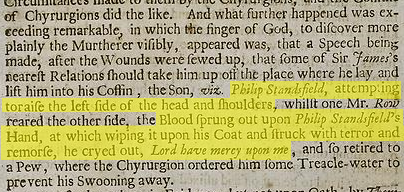
This date in 1688 saw the execution in Edinburgh of one Philip Standsfield (sometimes Stansfield or even Standfield) for parricide, his conviction being secured in part by the supposed accusation of his father’s corpse.

The prodigal firstborn of James Standsfield was an incorrigible scoundrel, and the state had a considerable circumstantial case to the effect that said scoundrel finally popped the old man to prevent disinheritance. (It also appeared that he’d tried to do it other times over the years.)

Circumstantial evidence is nice.

But how about some forensic evidence to really cinch a conviction? No DNA evidence here in the 17th century, so maybe something a little more … supernatural?


From A True Relation of a Barbarous Bloody Murther etc., available here.

The King’s Advocate insisted — over the objections of a defense attorney that “it was a superstitious observation, founded neither upon law nor reason” — that the corpse’s having bled on Philip Standsfield but none of the others in his party simultaneously attempting to move it “he must ascribe … to the wonderful Providence of God, who in this manner discovers murder.”

Divine forensics. That’s even better than the arson evidence Texas used to kill Cameron Willingham.

And it had the same result, to wit,

the said Philip Standsfield to be taken upon Wednesday next, being the 15th of February instant, to the Market-cross of Edinbrugh, and there, betwixt two and four o’clock in the afternoon, to be hanged on a gibbet till he be dead, and his tongue to be cut out and burnt upon a scaffold, and his right hand to be cut off and affixed to the east port of Haddingtoun, and his body to be carried to the Gallowlie betwixt Leith and Edinburgh, and there to be hanged up in chains; and ordains his name, fame, memory, and honours to be extinct, his arms to be riven forth and delete out of the books of arms …†

Well, you get the idea. Executed Today would like to apologize to the dempster of Edinburgh for keeping Philip Standsfield’s name, fame, and memory alive.

In our defense, we are hardly the only ones: this is thought to be the last time that Scottish law employed the bleeding-corpse “test”.

* Some other instances of purported “bleeding at the touch” may be perused here.

** In a 1927 piece in the Journal of the American Institute of Criminal Law and Criminology, Canadian jurist William Renwick Riddell says this folk belief “was wide spread and is not dead yet” and offers in a footnote (perhaps by way of explaining his interest) that “when at the Bar, I was once offered such evidence by my client; but I declined to use it.”

† The execution was botched, and the gibbeted body illicitly pulled down and tossed in a ditch — which is where the elder Standsfield’s had been discovered.

On this day..

1786: Elizabeth Wilson, her reprieve too late

On this date in 1786, Elizabeth Wilson was hanged in Chester, Pennsylvania for the murder of her infant twins.

“One of the melodramas of the early American republic,” our Elizabeth (sometimes called “Harriot Wilson” in the accounts) was a farmer’s daughter of Chester County who got knocked up by a passing sailor. When this gentleman declined to make an honest woman of her after she had borne the bastards, the kids disappeared — later to be discovered dead in the woods by a hunter.

The fallen woman denied having killed them directly, but “acknowledged having placed the children by the road-side, in order that any person passing that way, and who had humanity enough, might take them up.”

She would eventually, after condemnation, accuse her lover of having slain the children.

Elizabeth’s brother William Wilson vigorously undertook on this basis to secure her a pardon at the hands of the Commonwealth’s executive authority, the Supreme Executive Council — then under the leadership of no less august a character than Benjamin Franklin.

And he found a sympathetic audience. Council Vice-President Charles Biddle* “firmly believed her innocent, for to me it appeared highly improbable that a mother, after suckling her children for six weeks, could murder them … there was a large majority would have been for pardoning her.”

Instead of an outright commutation, it granted a stay of execution for William Wilson to investigate further, which he did to no successful effect.

“But here we must drop a tear!” exclaims the Faithful Narrative of Elizabeth Wilson, a popular pamphlet (pdf) sensationalizing the case. “What heart so hard, as not to melt at human woe!”

For William Wilson’s suit on behalf of his sister had succeeded in earning, on the eve of the Jan. 3 hanging, a second respite on Biddle’s certain anticipation that clemency would be forthcoming. Ill himself, William took the stay of execution from Biddle’s own hands and raced through a fearful storm on the 15-mile ride from Philadelphia to Chester … but

did not arrive until twenty-three minutes after the solemn scene was closed. When he came with the respite in his hand, and saw his sister irrecoverably gone, beheld her motionless, and sunk in death, who can paint the mournful scene?

Let imagination if she can!

Imagination can do quite a lot with this sort of material, and so the tale of Elizabeth Wilson — the intrinsic pathos of the condemned, her widely-suspected innocence, her evangelical-friendly repentance, the cliffhanger conclusion — became widely re-circulated, and undoubtedly embroidered.

Quaker colonial diarist Elizabeth Drinker (who had firsthand experience of official injustice, when suspicious-of-Quakers revolutionaries had banished her husband from Philadelphia) was still seeing these publications over a decade after Wilson’s death.

May 16 [1797]. Unsettled. Wind variable. Read a narrative of Elizabeth Wilson, who was executed at Chester, Jany ’86, charged with the murder of her twin infants. A reprieve arrived 20 minutes after her execution, by her brother from Philadelphia. She persisted to the last in her account of the murder being committed by the father of the children, which was generally believed to be the truth. I recollect having heard the sad tale at the time of the transaction.

The Wilson story actually persisted (and persists) for centuries yet. Her shaken brother, William, withdrew himself from society and lived out his last years in a cave: he entered folklore as the Pennsylvania Hermit, affixed with his tragic sister to all manner of spook stories, like a spectral horseman galloping to Chester, or a ghostly woman rummaging the leaves where the bodies were found. You’ll hear all about the Pennsylvania Hermit when touring his former stomping grounds, now open to the public (for a fee, my friend) as Indian Echo Caverns.

* Biddle was a future U.S. Senator, but he’s probably best known through his son. Born just five days after Elizabeth Wilson’s execution, Nicholas Biddle was a bitterly controversial character as one of antebellum America’s original banksters.

Charles Biddle’s notes on the case veer into the era’s philosophical concern with the timeless problem of making a just response to infanticide.

“Perhaps,” he muses “the punishment of death is too great for an unmarried woman who destroys her child. They are generally led to it from a fear of being exposed … [and] while death is the punishment, a jury will seldom find a verdict against them.”

On this day..

1640: Bishop John Atherton, buggerer

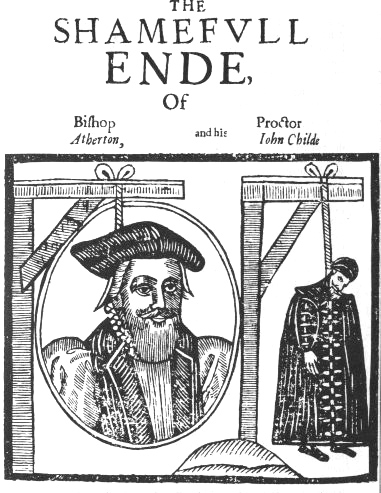
On this date in 1640, John Atherton achieved the unenviable distinction of being the only Anglican bishop hanged for buggery.* (His proctor, and alleged lover, John Childe, got the same treatment a few months later.)


Suppose a Devill from th’infernall Pit,
More Monsterlike, then ere was Devill yet,
Contrary to course, taking a male fiend
To Sodomize with him, such was the mind
Of this Lord Bishop, he did take a Childe
By name, not years, acting a sinne so vilde
-From the text of the pamphlet this image decorates

The Oxford-educated Englishman was appointed Lord Bishop of Waterford and Lismore by King Charles‘s hated governor Thomas Wentworth.

It may well have been the internecine politics of the day that claimed Atherton’s life, just as the civil wars they engendered in the ensuing decades claimed the original trial records.

While posterity is left to speculation, Atherton was defended in print in those years as well. (Defended as no homo, that is — not defended on principle against ubiquitous anti-gay laws.) If it wasn’t really a voracious sexual appetite (not exclusively same-sex**), goes this argument, it was intra-Protestant infighting, with Atherton’s successful clawback of land for the weak Irish Anglican church stepping on the toes of the local land barons who had recently expropriated it.

This politics outside the boudoir argument gets compelling treatment in Mother Leakey and the Bishop, a historical investigative thriller that links Atherton to a weird ghost story† in his native Somerset — that of “Old Mother Leakey,” the Minehead ghost.

Mother Leakey was Atherton’s mother-in-law, and Somerset family members claimed she haunted them — including with a message for the bishop that one of his sisters-in-law actually went to deliver in Ireland. The message isn’t known; in legend, this was a warning from beyond against the prelate’s ungodly behavior; in reality, it was more probably a family shakedown.‡

Despite the skepticism of the Leakey family’s own contemporaries, the facts, allegations, suppositions, and pure flights of fancy somehow managed to blend and recombine into a lasting tale of the paranormal that Minehead still retails to this day.

And it goes right back to the public opprobrium Bishop Atherton endured — as described in that 1641 hanging pamphlet:

“demonstrates the link between the stories of Mother Leakey and Bishop John Atherton … in a highly readable and often entertaining fashion”

… through pride, high fare, and lustfull life,
Incest committed with the Sister of his wife,
For which he sued his pardon, and then fled
To Ireland, where a worser life he led

He surely warned was to mend his life,
By his own Sister Master Leakies wife,
Which Master Leakies Mother being dead,
And in her life-time conscious how he led
His lustfull life, her Ghoast in gastful wise
Did oft appeare before her Sisters Eyes,
But she feare-strucken durst not speak unto it,
Till oft appearing forced her to doe it:
Then thus she spake, Mother in Law what cause
You from your rest, to my unrest thus drawes?
Who answered, daughter tis the wicked life
Your Brother leads, warne him to mend his life;
If not, then plainely tell him tis decreed,
He shall be hangd, bid him repent with speede:
Then shall my restless spirit be at rest,
And not till then; Thus vanisht. She addrest
Herselfe for travaile, Into Ireland went
With this sad message unto him was sent:
Which how he tooke to heart may plaine appeare
By the slight answer he returned her,
What must be, shalbe: If I must, I must dye,
Mariage, and hanging, come by destiny.
Thus scoft her counsell, sent her back, and when
Shee was returnd, he grew farre viler then
He was before, if Viler man may be,
For one bad Act before, committed three.

* According to Who’s Who in Gay and Lesbian History, Atherton and Childe were the second pair of alleged homosexual lovers executed in the British Isles. The first was the Earl of Castlehaven in 1631, along with his manservants.

** “[O]ne should note the compound sexual nature of the ‘sodomy’ charge in this context, a portmanteau omnibus of non-procreative sex, which is what ’sodomy’ was widely held to be.”

† Walter Scott footnotes this legend in Rokeby: “Mrs Leakey … dispatched her [daughter-in-law] to an Irish prelate, famous for his crimes and misfortunes, to exhort him to repentance, and to apprize him that otherwise he would be hanged; and how the bishop was satisfied with replying, that if he was born to be hanged, he should not be drowned.”

‡ Archbishop William Laud dispatched a team of ghost-whisperers to investigate the Leakey story well before the ectoplasm hit the fan for Atherton, and they weren’t buying: “certainly it is a fiction and a practice … it may be some money business.” Bishop Atherton had left home under a cloud with the suspicion that he’d had an affair with his wife’s sister, and this was part of the eventual Irish complaint against the horny goat.

On this day..

1492: Sir Nicholas de Mimsy-Porpington, Nearly Headless Nick

(Thanks to Elizabeth M. Hull for the guest post. -ed.)

Post-mortem resident of Gryffindor House, Hogwarts School of Witchcraft and Wizardry, Hogsmeade, U.K.

A minor character in J.K. Rowling’s Harry Potter saga, Nearly Headless Nick remains one of the most memorable. Executed — badly — on Halloween of 1492, Sir Nicholas de Mimsy-Porpington became the ghost of Gryffindor House. The school has about 20 resident ghosts: the Grey Lady (Helena Ravenclaw) and the Bloody Baron of Slytherin House died violently as well, in a murder-suicide.

Rowling says that her editor suggested that she cut a ballad Mimsy-Porpington wrote about himself from The Chamber of Secrets. In the song, the ghost claimed to have been executed for “a mistake any wizard could make,” a “piffling error,” a case of wizardry gone wrong. Asked by Lady Grieve (otherwise unknown) to straighten her teeth, Mimsy-Porpington seems to have given her a tusk. “They” imprisoned the piffler immediately, though he cried all night that he could fix his mistake, and his beheading followed the next morning.

Unfortunately for Mimsy-Porpington, his was not the only incompetence: “they’d mislaid the rock/Where they usually sharpened the axe”! The “cack-handed twit” of a headsman said “this may sting a bit” to the gibbering wizard, and swung the axe in the air. Alas, unable to sharpen the blade, the executioner was reduced to bestowing numerous blows: “But oh the blunt blade! No difference it made,” the ghost sang,

My head was still definitely there.
The axeman he hacked and he whacked and he thwacked,
“Won’t be too long,” he assured me,
But quick it was not, and the bone-headed clot
Took forty-five goes ’til he floored me.

(The full ballad is here and here; the original handwritten version can be seen here.)

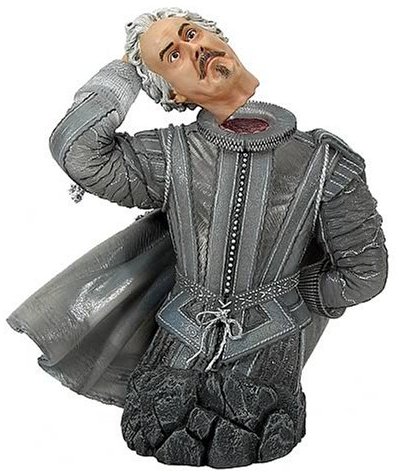
After repeated strokes of the edgeless axe, Mimsy-Porpington finally expired. On festival occasions, he re-enacts his near-beheading, a show quite popular with the Hogwarts student body (Prisoner of Azkaban, p. 159).

However, the bone-headed, cloddish headsman was unable to completely behead the wizard. As Ron Weasly notes, the ghost is merely nearly headless.


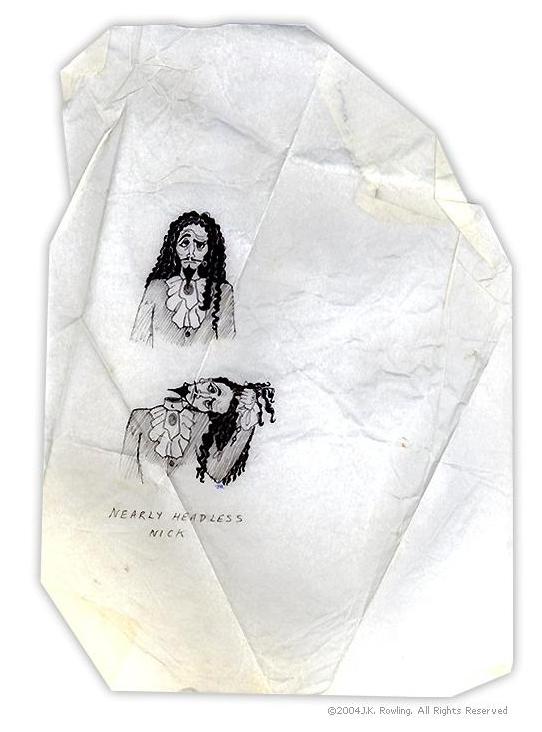
Nick, as played in the Harry Potter films by John Cleese. Rowling’s own original sketch of Nearly Headless Nick is here.

While he gets a great deal of pleasure from entertaining Hogwarts residents by swinging “his whole head . . . off his neck and . . . onto his shoulder as if it was on a hinge” (Sorceror’s Stone, p. 124), his condition limits his access to the dizziest heights of post-mortem society. Beheading was an aristocratic execution, meant to bring a swift death to the privileged, those able to hunt legally in their lifetime. In the afterlife, the beheaded aristocrats have established a “Headless Hunt” Club, and have blackballed Mimsy-Porpington, who misses their entrance requirements by that much: “‘half an inch of skin and sinew holding my neck on.'” Unable to participate in Club sports like “Horseback Head-Juggling and Head Polo,” Mimsy-Porpington is denied admission into the elite society (Chamber of Secrets, p. 124).

Sadly, their scorn for his crippling condition is not limited to exclusion from their company.

Mimsy-Porpington’s five hundredth Deathday anniversary party, held on Halloween 1992, welcomes hundreds of ghosts from as far away as Kent to a feast of rotten fish, putrid, “maggoty haggis,” and a tombstone cake with grey icing, while an orchestra of 30 musical saws plays waltzes. The Deathday Boy’s speech is interrupted by the members of the Headless Hunt: “Sir Properly Decapitated-Podmore” begins a game of Head Hockey, sending his own head sailing past the humiliated Mimsy-Porpington as he tries to address his guests (Chamber of Secrets, p. 132-7).

Somehow the courageous Gryffindor ghost overcomes this diabolical heads-up-manship and several months as a petrified cloud to live a useful afterlife, helping Harry many times. Most significantly, in the final pages of The Order of the Phoenix, a traumatized and grieving Harry turns to Mimsy-Porpington, hoping to discover a way to keep his dead friend and guardian Sirius Black alive. “‘You’re dead,'” Harry says, “‘But you’re still here, aren’t you? … People can come back, right? As ghosts. They don’t have to disappear completely.'” Mimsy-Porpington gently tells Harry that he can only “‘walk palely'” where his living self once trod, “‘neither here nor there,'” hovering between life and death for fear of the unknown. However, Black risked his life joyously and died laughing; he will not linger between death and life. Harry must live on without him.

There may be historical precedent for Mimsy-Porpington’s death in the botched execution of James Scott, Duke of Monmouth (1685), when the notorious Jack Ketch took five blows to kill the rebel, and finally had to use a knife to sever the last “skin and sinew” connecting the head to the corpse. Monmouth’s hairstyle in portraits from the late 1600s resembles that drawn by Rowling in her sketch of Nearly Headless Nick, although that sketch shows a beard style from the early 1600s, nearly 70 years earlier. Moreover, the ghost enters Harry Potter’s life wearing an Elizabethan neck ruff and says that he has not eaten in nearly 400 years, implying a death in the late 1500s.

In spite of this wibbly-wobbly timeline, Mimsy-Porpington’s deathdate establishes the firm chronology of Rowling’s series: the five hundredth anniversary of his death in 1492 would fall in 1992; therefore the events of Chamber of Secrets (published in 1997) must occur in 1992. The dating of the series is confirmed five books later by the tombstones of Harry’s parents, who died on Halloween Day, 1981 (Deathly Hallows, p. 328). For J.K. Rowling, death, the last enemy — not life — marks the measure of this world’s time.

On this day..

1769: Nicolas de Lafreniere and four others for the Louisiana Rebellion

On this date in 1769, five French Creoles were shot in New Orleans for a revolt the previous year against a Spanish takeover.

This date’s story begins with the French King Louis XV getting his French clock cleaned in the French and Indian War. This conflict blew an ill wind all over Francophone North America, much of which was taken by the British. Result: a quarter-millennium later, this blog is in English.

Even what France kept, she did not keep. In a secret pact, France ceded to wartime ally Spain “the country known as Louisiana, as well as New Orleans and the island in which the city is situated.”

This projection onto New World colonists of Old World diplomatic horse-trading was rife with potential hostility among the traded horses. In this instance, Louisianans were widely dismayed when they were finally informed that they’d become Spaniards.

When they did get the memo — and Louis XV declined to reconsider — they launched the Louisiana Rebellion of 1768, expelling the new Spanish govenror Antonio de Ulloa.*

These weren’t mere rabble who showed Ulloa “insubordination … a sense of liberty and independence,” but elites of French New Orleans. Nicolas de Lafreniere was the attorney general.

“The name of Lafreniere deserves rank with those of foremost American patriots,” Americans later reckoned. O’Reilly’s reputation did not fare as well in the patriotic literature, but he perhaps had the best of the law.

Between a rock and a hard place, the leftover French adjutant Charles-Philippe Aubry refused to support the rebels, but also refused to fire on fellow Frenchmen. Meanwhile, Ulloa refused to provide his credentials to the uppity colonists. Louis XV refused to receive the delegations sent to implore him to keep Louisiana.

All these refuseniks found the matter adjudicated by immigrant Irish officer Alejandro O’Reilly, plucked out of Cuba to replace Ulloa and lay down the law. He spoke softly when he landed, but the amnesty he offered was followed a few months later by the surprise arrest of the chief rebels.

Lafreniere, Joseph Milhet, Jean-Baptiste Noyan, Pierre Caresse, and Pierre Marquis were ordered hanged on this date. Noyan, nephew of the city’s founder and a young man just married, was offered his pardon, but melodramatically refused.

It was found that there was no hangman in the colony, so the condemned prisoners were ordered to be shot. When the day of execution came, hundreds of people left the city. Those who could not leave went into their houses, closed the doors and windows and waited in an agony of sickening dread to hear the fatal shots. Only the tramping of soldiers broke the deathlike stillness which brooded over the crushed and helpless city. At three o’clock on a perfect October afternoon in 1769, the condemned men were led to the Spanish barracks. Lafreniere, it is said, gave the order to fire. A volley of muskets broke out on the still air, and five patriots went to their death, — the first Louisianians to give their blood for the cause of freedom.

A History of Louisiana

The details and historiography of this event are the subject of this 146-page master’s thesis. (pdf)

Whether or not all that stuff about Louisiana planters as freedom-loving patriots trod down by the barbarous Spanish has any real merit to it, that’s the way they’ve been memorialized.

Lafreniere Park in Metairie, La. — home of anti-death penalty VIP Sister Helen Prejean — is named for Nick Lafreniere.

When next visiting the Louisiana State House, keep an eye out for this day’s victims on the frieze to the right of the main entrance. And when next visiting New Orleans, keep an ear out for the ghost of the priest that buried them.

* Ulloa was also a scientist and gave his name to the Ulloa Halo, a “physical illusion consisting of a white luminous ring or arch that can sometimes be seen in mountainous regions, typically in foggy weather, while facing an area opposite the Sun.”

On this day..

1913: Ernest Austin, the last hanged in Queensland

On this date in 1913, Ernest Austin was hanged at Brisbane’s Boggo Road Gaol — the last person to suffer that fate in Queensland.

Austin stalked an 11-year-old girl down a dirt road — one that inconveniently recorded the distinctive prints of his heel-less boot — and raped and murdered her.

This “mental deficient” (“The State Slays Its Own Creation,” headlined an anti-death penalty newspaper, alluding to Austin’s institutionalized upbringing) was resigned to his fate even prior to conviction. Resigned enough to hurry it along.

Witness opened the cell door, and found accused standing with an upturned cell bucket by his side. O’Callaghan shook out all the blankets, and found a rope plaited of three strips torn off a blanket. Witness said to accused:—”You should not do anything rash.” Accused replied:—”I will be hanged anyhow.” Witness then said:—”You are not found guilty yet.” Accused said:—”I admit I murdered the girl.”

Little wonder the government wasn’t interested in clemency.

Nine years later, Queensland became the first Australian state to abolish the death penalty.

Austin’s ghost is supposed to haunt Boggo Road Gaol to this day, even though the section of the prison where he died has long since been demolished. The haunting story seemingly rests on an urban legend that Austin was some outsizedly diabolical creature and not the run-of-the-mill pathetic malefactor that a century’s perspective might suggest.

On this day..