1615: Kate McNiven, the Witch of Monzie

(It’s Samhain — the ancient, pagan wellspring of Halloween. Thanks to Royelen for this timely remembrance of a completely undated witch-burning from Scottish folklore.)

A gurgling fountain at the property border announces a gentle place. The fountain has a small pond filled with friendly goldfish which swim your way. They are hoping for morsel of food but it feels like an appropriate welcome to a local herb shop.

The mission is to find a remedy for leg pain. For a few moments the pain can wait while the lemon thyme gets rubbed by fingers gathering up the smell for a delightful inhalation. And then there is the basil, the chocolate mint, the rosemary — and so it goes with rows and rows of little pots of tiny green plants, each fragrant in a unique way. Each creating its own sensation.

When sated with nasal stimulation, it’s time to enter the house. It causes no surprise when cheery sounding chimes ring as the door opens. Inside the walls are lined with shelves. Each shelf is filled with glass jars. Each jar has a different dried leaf. There are many jars. An herb shop employee is happy to help.

“Pain, long-standing muscle pain? In your leg. Uh-huh. It’s possibly a nutritional deficiency, you want to take calcium, two pills twice-a-day. You’ll know in two weeks if this is the cause.”

This knowledge, long forgotten and now denied by Western medicine, may have been the kind of knowledge that got Kate McNiven killed.

Scottish lore has it that Kate McNiven’s community of Monzie in Scotland first sought her out for her wisdom, maybe for her herb cures and curse-ending charms. Then, in the era of witch burnings, her community pulled her from her service and burned her to death. After killing her, Kate McNiven’s community made her a local legend.

Today we might assess Kate McNiven as a real witch based on the power of the curse she left behind — a curse which the generations passed down and which now comes to us across the Internet; a curse which leaves us the tale of a talisman known as the Inchbrakie Moonstone.

Though there are no official records, the curse is said to begin in 1615* when Kate was accused of witchcraft. Having been found guilty, word spread of her immediate execution by fire. A landowner of a nearby estate, having come upon the fire preparations, asked the gathered crowd to stop their execution plan. While he had no success, he did win favor from the named witch.

As the fires around her grew, Kate McNiven began her curse. The landowner of execution site was cursed, then the area known as Monzie was cursed, and finally she honored the unsuccessful estate owner who attempted to stop her execution. She threw from the fires a charm — a blue stone that had been around her neck — and told him that if he kept it close, he would always be blessed with sons and they would always be blessed with lands.

The legend goes that the cursing was successful. The landlord on whose land she died was not able to pass the property on. Monzie withered.

Of course, the land owner who pleaded her case kept the stone near as directed. As the legend goes it always was put on the fingers of the daughter-in-laws and heirs were always produced. Centuries of fecundity were enjoyed until one descendant made the mistake of allowing the stone to be moved outside of the estate. That was the end of the good run and proof of Kate’s powers as a witch.

Is the legend of the Witch of Monzie a romantic retelling of a woman’s death or is it a community reassuring itself that the executed woman was guilty of her crimes? Maybe both. Maybe more.

Swiss psychotherapy pioneer Carl Jung’s theory of the shadow tells us that Kate McNiven’s peers attributed to her what they could not accept in themselves. They found her untrustworthy and capable of doing strange things. For some reason, she of all people was chosen as the one to be the scapegoat. It may have been for no other reason than she didn’t point the finger at someone else. The people of Monzie did not fight for her release, and they likely felt relieved that the pressure was off of them. Their untrustworthiness and strange behaviors were not under scrutiny. For the moment, they were safe.

It’s easy to imagine Kate McNiven as Tessie in Shirley Jackson’s short story, “The Lottery”:,

The children had stones already. And someone gave little Davy Hutchinson a few pebbles.

Tessie Hutchinson was in the center of a cleared space by now, and she held her hands out desperately as the villagers moved in on her. “It isn’t fair,” she said. A stone hit her on the side of the head. Old Man Warner was saying, “Come on, come on, everyone.” Steve Adams was in the front of the crowd of villagers, with Mrs. Graves beside him.

“It isn’t fair, it isn’t right,” Mrs. Hutchinson screamed, and then they were upon her.

* Not only the year but the century of Kate McNiven’s — or M’Niven, McNieven or Nicniven — execution is disputed. Sources report both 1615 (in the midst of King James’ witch-sniffing reign), and 1715 (which would make her one of the last witchcraft executions in Scotland).

But there is no original documentation — a University of Dundee archivist has confirmed this for Executed Today — and McNiven is not listed in Scotland’s witch executions database. She was promulgated in a 19th-century text, The Holocaust, or, the Witch of Monzie and could be entirely fictional. (Update: The myth dissected in comments.)

On this day..

1618: Walter Raleigh, age of exploration adventurer

On this date in 1618, schemer, explorer, and lover Walter Raleigh fell permanently out of favor.

One of the biggest wheels of Elizabethan England, Raleigh (who also rendered his name Rawleigh, Rawley, and most commonly, Ralegh) charmed his way into the Queen’s inner circle, and possibly her pants, and was even thought to be a contender for her hand.

In between gorging on royal monopolies, scribbling poetry, popularizing tobacco, and introducing the potato to Ireland [allegedly], Raleigh got his New World on by attempting to colonize Virginia,* helping fund it with privateering operations against England’s rivals in the land-grab game. The city of Raleigh, North Carolina — present-day North Carolina was part of the Virginia Colony back in the day — is named for him.

Proud, powerful, and the queenie’s pet. Just the sort of courtier other noble suckups loved to hate.

When the palace fave secretly dallied with one of the Queen’s ladies-in-waiting, he went on the royal outs and got real familiar with the Tower of London. Though he managed to patch up with Elizabeth, things were never quite the same for Sir Walter. Elizabeth’s successor James I put him back in prison (suspending a death sentence) for supposedly participating in the Main Plot.

Raleigh passed the time under lock and key burnishing his Renaissance man rep by writing various poetry and treatises, including an account of his voyage to Guyana. Convinced the legendary city of El Dorado was in the vicinity, Raleigh eventually prevailed upon James to release him to make another run at it.

But a dust-up with a Spanish outpost in South America left his son dead, and the Spanish ambassador hopping mad. Raleigh was arrested upon his return, and the death sentence reinstated.

At 66 years of age or so, Walter Raleigh had had a pretty good run.

He took his punishment with equanimity, writing tenderly to his wife, and examining the blade that would take off his head on the scaffold with the observation,

“This is a sharp Medicine, but it is a Physician for all Diseases.”

His wife creepily kept the severed head for the remaining 29 years of her life.

There’s a more detailed tour of Raleigh’s life here, and a site linking many works by and about Raleigh here.

* As Governor of Virginia, Raleigh forbade injuring Indians on pain of death, according to Giles Milton’s Big Chief Elizabeth. Raleigh’s “imperialism with a human face” policy had exchange programs of Indians visiting England, most notably Pocahontas.

On this day..

31: Sejanus, captain of the Praetorian Guard

Over the course of this day in 31, Lucius Aelius Seianus went from virtual master of the Roman Empire to strangulation at the order of the Senate.

Patrick Stewart as Sejanus in I, Claudius.

Known simply as Sejanus, he was of equestrian stock who rose to prefect the Praetorian Guard when Tiberius succeeded Augustus as Rome’s first citizen.

It was not yet the “infamous Praetorian Guard”. Sejanus would make it so: his were the institutional aggrandizement — long outliving Sejanus — that would position the Guard to arbitrate imperial succession; his the persecutorial internal policing that made it a swords-and-sandals Gestapo.

Sejanus maneuvered skillfully towards supreme power in Rome — and ruthlessly enough that he is suspected of having murdered Tiberius’s son and heir Drusus. Though the Emperor refused a dynastic marriage with Drusus’s widow that would have set Sejanus up for official succession, the Praetorian had the purple in all but name in the late 20’s when Tiberius decamped for the dissolution of Capri.

The usual sort of thing ensued: spies, informers, purges and political murders.

The Republic had been down this road before. After the peace of Augustus, it was a chilling preview of Imperial Rome’s coming attractions.

Unlike most of those, the Sejanus issue was ultimately resolved without civil war. Finally wise to his captain’s game, Tiberius snuffed out the threat in a single blow without bestirring himself from his island retreat by sending word to convoke Sejanus and the Senate to elevate the soldier to the tribunate … and having a letter there read which demanded the soldier’s arrest.

That august old body — “men fit to be slaves,” in Tiberius’s estimation — took it from there. Sejanus was summarily executed this very evening, his body torn apart by the mob, and a witch hunt for his lieutenants and supporters immediately began.

Nice coverage of Sejanus and Tiberius on the History of Rome podcast.

[audio:http://c1.libsyn.com/media/17332/58-_Partner_of_my_Labors.mp3]

On this day..

1793: Marie Antoinette

This afternoon in Paris, 1793, the French Revolution devoured the Queen.

Thirteen-year-old Madame Antoine — a year before marriage, and rebranding as Marie Antoinette. A vast gallery of her portraiture awaits here.

Among the most emblematic death penalty victims in history, Marie Antoinette — the “widow Capet,” as she was styled in egalite, after the guillotine shortened her husband — had the bad luck to personify the decadence of the ancien regime under the hegemony of the sans-culotte.

(And, of course, the good luck to be born heir to all the perks of absolutism she enjoyed for the first thirty-plus years of life. So, you know: a mixed bag.)

Those infamous excesses — and her infamous alleged bon mot, “let them eat cake” — are said to have been greatly exaggerated, nothing that everyone wasn’t doing, nothing that wasn’t understandable under the circumstances.

She had a gift, it seems, for accumulating to her personal reputation the outrage incurred by every gross and petty indulgence of the old order. And she had a popular press, the libelles, ready to embroider them salaciously.

Poor Marie.

Jacques-Louis David sketched this portrait of a haggard Marie Antoinette en route to the guillotine.

Cruel, wanton, senseless … her death was all of these, but then many others in the Terror suffered the same, as many others had under the Bourbons.

As royal dynastic pairings go, she’d been dealt a bad hand.

Her mere presence in France was fruit of the controversial policy of alliance with the Austrian Habsburgs from the Seven Years’ War, and she was trundled off with her dowry and her teenage wiles to the foreign snakepit of Versailles just as the minister advancing that policy fell. Distrusted by the French as an Austrian catspaw, castigated by her family for her inadequacies thereto, socially expected to display conspicuous regal largesse during a budget crisis not of her making, and unable for the longest time to get a successful coition from her indifferent and/or impotent husband, it must have seemed to her some days like every play was a losing one.

She struggled to gain traction at court. But she would lose much more than influence.

I was a queen, and you took away my crown; a wife, and you killed my husband; a mother, and you deprived me of my children. My blood alone remains: take it, but do not make me suffer long. (WikiQuote)

Her bearing she kept forever: in a kangaroo court with a foreordained outcome where her imperious dignity still managed to turn aside an accusation of sexual abuse her son had been cajoled into supplying; on the scaffold, when she did not neglect courtesy to the executioner whose foot she trod:

“Monsieur, je vous demande pardon. Je ne l’ai pas fait exprès.”

For much more queenliness, Marie-Antoinette.org delivers what the url promises, in quantity. If this figure or this period appeals, be sure to browse its forums.

Naturally, the doomed queen has had plenty of attention from printed word as well:

A few books about Marie Antoinette

As well as less, er, traditional media.

Part of the Themed Set: Belles Epoque.

On this day..

1660: Major-General Thomas Harrison, the first of the regicides

On this date in 1660, the restored House of Stuart began a week of bloody justice against Charles I‘s regicides by hanging, drawing and quartering Thomas Harrison at Charing Cross.

Stuart Little

Charles’ son and heir Charles II had been stuck on the continent during the 1650’s, until the Commonwealth came apart from its own internal contradictions after the death of Oliver Cromwell.

With anarchy looming, suddenly monarchy didn’t look so bad — and Charles II had a way back into the saddle.

Beheads I Win …

The first thing on everyone’s mind was what to do about the little matter of having lopped off his dad’s head.

Political reality drove the settlement: nearly everyone in the English gentry had in some manner acquiesced to the Commonwealth during its decade-plus turn steering the ship of state; an expansive line on treason would be a nonstarter. At the same time, His Soon-To-Be-Royal-Again Majesty expected a few examples made to do right by the old man and keep king-killing well off his future subjects’ agenda.

Result: the Indemnity and Oblivion Act, granting a free pardon to all supporters of the Commonwealth save a handful of those most directly implicated in Charles I’s execution.

Weeks of frantic negotiating between the parties and private settlements of borderline cases with the royalist camp preceded the action. But Thomas Harrison wasn’t part of any of it.

… Entrails you Lose.

The rigid Puritan, one of 59 who signed the last king’s death warrant and at one time the commander of England’s armies, had been on the outs with everyone since Cromwell set up the Protectorate in 1653. Godly Tom was a “Fifth Monarchist,” anticipating the imminent return of Christ perhaps in conjunction with the imminent year 1666 … and no government felt safe about these millenarians. He’d been imprisoned several times by the Protectorate, too.

Though many attainted regicides fled for Europe or America, Harrison (possibly motivated by age and infirmity) hung out, waited for arrest, and took his punishment stolidly.

God hath covered my head many times in the day of Battle. By God I have leaped over a wall, by God I have runned through a Troop, and by my God I will go through this death.

Specifically meaning, drawn on a hurdle from Newgate to Charing Cross (with a fine vantage for the doomed on Whitehall, where Charles I had met his end), hanged but revived, his genitalia cut off and bowels carved out and burned while still conscious, and finally beheaded and his body divided into quarters for gruesome public display around town.

You have selected regicide.

Harrison died on a Saturday, and his was the opening act of a busy week in the bowel-burning business; nine other fellow regicides condemned with him would share that fate during the week ahead:

  • John Carew, on Monday the 15th;
  • John Cook and Hugh Peters, on Tuesday the 16th;
  • Thomas Scot, Gregory Clemen, Adrian Scroop and John Jones, on Wednesday the 17th;
  • Francis Hacker and Daniel Axtel, on Friday the 19th.

Harrison was chosen as the first partly, perhaps, because the Fifth Monarchists were (justifiably) considered a still-extant menace, and partly because, as one account had it,

[h]e was a fierce and bloody enthusiast. And it was believed, that, while the army was in doubt, whether it was fitter to kill the king privately, or to bring him to an open trial, that he offered, if a private way was settled on, to be the man that should do it. So he was begun with. But, however reasonable this might be in itself, it had a very ill effect: for he was a man of great heat and resolution, fixed in his principles, and so persuaded of them, that he never looked after any interests of his own, but had opposed Cromwell when he set up for himself. He went through all the indignities and severities of his execution, in which the letter of the law in cases of treason was punctually observed, with a calmness or rather a cheerfulness that astonished the spectators.

“As cheerful as any man could do in that condition”

And this coda is attested by the age’s famous diarist, Samuel Pepys, whose neat and oft-quoted summation of Harrison’s fate runs thus:

I went out to Charing Cross, to see Major-General Harrison hanged, drawn, and quartered; which was done there, he looking as cheerful as any man could do in that condition … Thus it was my chance to see the King beheaded at White Hall, and to see the first blood shed in revenge for the blood of the King at Charing Cross.

Who overcomes by force hath overcome but half his foe

As might be expected, vindicated royalists sought more blood than the handful of exemplars could furnish. What compromise could expiate the sin of regicide?

Poet and polemicist John Milton, having been propagandist-in-chief for the now-abortive revolution, endured the jeers of his enemies for the conspicuously apolitical stuff (a grammar book!) by which he would set his table in the years ahead.

Upon John Milton’s not suffering for his traiterous Book when the Tryers were executed, 1660.

That thou escaped’st that vengeance, which o’ertook,
Milton, thy regicides, and thy own book,
Was clemency in Charles beyond compare:
And yet thy doom doth prove more grievous far.
Old, sickly, poor, stark blind, thou writest for bread:
So for to live thoud’st call Salmasius from the dead.

(Claudius Salmasius was a French intellectual whose defense of the Stuart royal rights had been savaged by Milton during the Protectorate.)

It’s thanks to the Indemnity and Oblivion Act’s not sending Milton the way of General Harrison that we have Paradise Lost.

On this day..

1979: Francisco Macías Nguema, President for Life

In the early afternoon this date, Equatorial Guinea’s former President for Life was sentenced to death with six aides at the end of a four-day trial for murder, treason, embezzlement, and genocide.

That evening, the seven were shot at Malabo’s Blabich Prison.

Nguema Biyoto Masie, nee Francisco Macías Nguema, rose from the Spanish colonial bureaucracy to win the first post-independence presidency of the minuscule African state.

He quickly created a one-party state and increasingly nutty cult of personality, answering to such horror-comic nicknames as “Unique Miracle”.

Nguema’s Unique Miracle for Equatorial Guinea was a Pol Pot-style catastrophe, killing or driving out most of the population (including Nguema’s own wife), eviscerating the economy, and getting into military brinksmanship with neighboring Nigeria.*

His nephew, Teodoro Obiang Nguema Mbasogo, overthrew him a few weeks before this date. Despite the speedy resolution of the case, international observers on the scene considered it a fair enough trial and the dictator’s guilt duly established; procedurally, the execution happened immediately because he was tried by the highest court in the land and there was nowhere to appeal.


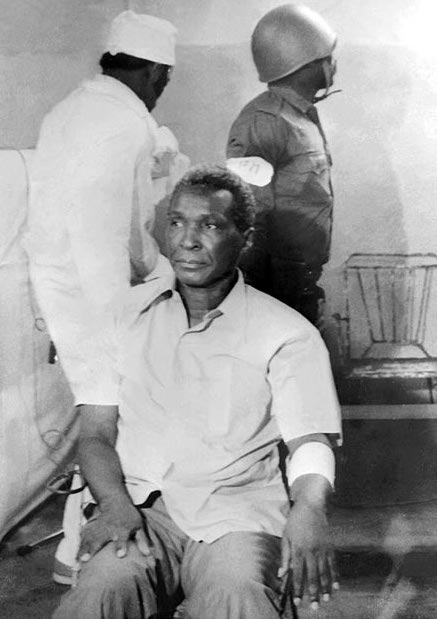
Francisco Macias Nguema during his trial.

Still, the shooting itself was handled by hired Moroccan troops, rather than citizens of Equatorial Guinea: Nguema had convinced quite a lot of people that he had magic powers, and the locals weren’t eager to be the ones to test the proposition.

Bloody but necessary first step to parliamentary democracy?

Not quite. Teodoro Obiang Nguema Mbasogo, one of the worst dictators you’ve never heard of, still runs Equatorial Guinea in much the manner of his predecessor to this day.


Did we mention that Equatorial Guinea has oil?

* Francisco Macias Nguema’s daughter, “Empress Bella Syttam Macias”, lives in Utah and defends her dad. She seems to have been too young to have been personally involved in anything unsavory in the 70’s.

On this day..

1589: Dietrich Flade, for leniency towards evildoers

On Sept 18, 1589, a magistrate and deputy governor in Trier, a city embroiled in a witch-burning campaign, was himself delivered that fate.

The winds of the Reformation swirled mercilessly at that time, and Dietrich Flade sat on the bench charged with maintaining order in Trier. Flade held a Doctorate of Civil and of the Canon Law, and he was well-connected in the magisterial Germany of the day. He just happened to be alive at the wrong time. George Lincoln Burr provides an extensive account of Flade’s ill-fated time on the bench, including this foreboding look:

But the storm that was to rob him of fortune, fame, and life was already brewing all along the horizon. The witch-trials, which, during the earlier part of the century, had appeared only sporadically, were settling here and there into organized persecutions. In the neighboring Lorraine, the terrible Nicolas Remy was already exercising that judgeship, as the fruit of whose activity he could boast a decade later of the condemnation of nine hundred witches within fifteen years; and just across the nearer frontier of Luxemburg, now in Spanish hands, the fires were also blazing. Nay, the persection had already, in 1572, invaded the Electorate itself.

In six years, the diocese of Trier oversaw the execution of 368 witches, many of whom confessed only under torture. The anti-witchcraft campaign was so expansive that some towns were left with few if any women. The hysteria was widely reviled by the academics of the time, including both Flade and Cornelius Loos.

Loos was so disturbed by the events occurring around him that he wrote a book in objection; before it could gain distribution, however, Loos was arrested and jailed. It was four years before he was released, only after recanting his entire treatise and acknowledging the authority of the Pope.

Flade (German Wikipedia link) was not as lucky.

As judge, he was too light with suspected witches and allowed many to go free or get off with light sentences. Worst of all, he let the unsettled Reformation continue without his intervention on behalf of the church. His “trial” was brutal*, with an extracted confession from five heinous torture sessions serving as evidence against him. As high-ranking as Flade was, though, he was executed rather mutedly in Treves.

Not without reason, Burr suspects the motive was entirely political on the part of Archbishop Johann von Schöneburg. Von Schöneburg immediately stepped up his campaign to ensure his dominion, moving to larger mass executions and damning the populace to a generation of loss — except the executioner, of course, who was paid handsomely for the deed.

The persecutions were spurred on by both similar events elsewhere in the world and the writings of those directly involved. France, and, of course, Spain both featured notable witchcraft courts. One bishop under Von Schoeneburg, Peter Binsfield, was tasked with scribing works to defend the practice, which he dutifully discharged in 1589 and 1591; these were followed shortly by Jesuit Peter Thyraeus** (1594) and the aforementioned Nicholas Remy (1595). By that time, however, the furor in Trier had, in more ways than one, burned itself out: by 1593, with too few people to tend the land and sustain the towns, the area around Trier had become an economic crater, and the persecutors put a reluctant end to the madness.

Badly damaged page from Flade’s original trial transcription, courtesy of the Cornell University Library’s Witchcraft Collection.

* One of the founders of Cornell University, A.D. White, joined forces with Burr to acquire the one known copy for that university’s library in 1883. Burr intended to transcribe the text but apparently never completed the job, instead delivering several talks and writing an tract on the subject that includes extensive footnotes.

** Thyraeus also wrote one of the age’s definitive considerations of lycanthropy, shapeshifting and werewolfism — another demonic manifestation simultaneously afoot in Germany.

On this day..

1946: Amon Göth, Schindler’s List villain

On this date in 1946, Plaszow concentration camp commandante Amon Göth was hanged near the camp site by Poland’s postwar Communist government.

Göth is most widely recognizable as Ralph Fiennes’ fiendish character in Schindler’s List, one of the American Film Institute’s top movie villains of all time. (And, naturally, a first-class bastard in real life, too.)

A short-drop strangulation is not the way you’d want to go. It turns out, though, that Steven Spielberg (ever the sentimentalist) seriously tidied up the proceedings.

As you watch the video of the real Amon Goeth’s exit below — and it’s a snuff film, so proceed advisedly — consider the following:

  • Amon Goeth does bear a passing fair resemblance to Ralph Fiennes.

  • To judge by their getup — dig the masks! — the executioners might have been Batman and Robin.
  • To judge by the discharge of their duties, the executioners might have been Larry, Moe and Curly. Goeth survived two drops (notice the executioner on the right gesticulating in frustration as the second try fails) before they finally got it right:

On this day..

1538: Cratwell, a hangman

This yere, the first daye of September, beinge Sondaye, at Clerkenwell, where the wrestlinge is kept, after the wrestlinge was done, there was hanged on a payre of gallowes, newe made, in the same place, the hangman of London and two more for robbinge a bouth in Bartlemewe fayre, which sayd hangman had done execution in London since the Holy Mayde of Kent was hanged, and was a conninge butcher in quarteringe of men.

A Chronicle of England During the Reigns of the Tudors, from A.D. 1485 to 1559

On this day..

1794: Maximilien Robespierre, Saint-Just and the Jacobin leadership

On this date in 1794, the curtain — and the blade — fell on the Terror.

Maximilien Robespierre, who had breakfasted the previous day as master of France, was guillotined this evening with his chief lieutenants and partisans.

His fall came as sudden and inevitable as his rise had been unpredictable.

Five years before, Robespierre was an unprosperous Arras attorney of fashionably liberal philosophies, and you wouldn’t have given a sou for the prospects of his being remembered five minutes after he died. Yet it would come that his inseparable lieutenant Saint-Just would remark with understatement, “The words we have spoken will never be forgotten on earth.”

The historic convocation of the Estates-General thrust him onto the political stage where he would make the dread name that follows him, starting off in the Revolution’s inception as a far-left deputy. He took a notable early stand against the death penalty, with several arguments that are quite familiar by our day:

The first obligation of a legislator is to form and preserve public morals, the source of all freedom, source of all social happiness. When in running to a particular goal he turns away from this general and essential goal he commits the most vulgar and dire of errors. The king must thus present to the people the purest model of justice and reason. If in place of this powerful, calm and moderate severity that should characterize it they place anger and vengeance; if they spill human blood that they could spare and that they have no right to spread; if they spread out before the people cruel scenes and cadavers wounded by torture, it then alters in the hearts of citizens the ideas of the just and the unjust; they plant the seed in the midst of society of ferocious prejudices that will produce others in their turn. Man is no longer for man so sacred an object: we have a less grand idea of his dignity when public authority puts his life at risk. The idea of murder inspires less fear when the law itself gives the example and the spectacle. The horror of crime is diminished when it is punished by another crime. Do not confuse the effectiveness of a penalty with the excess of severity: the one is absolutely opposed to the other. Everything seconds moderate laws; everything conspires against cruel laws.

For Robespierre, it was an abomination for the nation to deal out death within its community, but his Rousseauan elevation of the collective and abstract People made extirpating existential threats to the community itself an altogether different matter.

The future tyrant’s anti-death penalty case for executing the deposed Louis XVI, flowing directly from those principles, makes interesting reading and is excerpted at length (all emphases added) here for its topicality:

When a nation has been forced to resort to the right of insurrection it returns to a state of nature as regards its tyrant. How can the latter invoke the social compact? He has annihilated it. The nation can preserve it still, if it thinks fit, in whatever concerns the interrelations of its citizens: but the effect of tyranny and insurrection is to break it entirely as regards the tyrant; it is to throw them into mutual war; the tribunals, the judiciary procedures, are made for the members of the city. … The right to punish the tyrant and that to dethrone him are the same thing. The one does not admit of different forms from the other. The tyrant’s trial is insurrection; his judgment is the fall of his power; his penalty, whatever the liberty of the people demands.

Peoples do not judge like judiciary courts. They pass no sentences; they hurl the thunderbolt. They do not condemn kings: they thrust them back into oblivion; and this justice is not inferior to that of courts. If they arm themselves against their oppressors for their own safety, why should they be bound to adopt a mode of punishing them which would be a new danger to themselves?

As for me, I abhor the penalty of death so lavish in your laws, and I have neither love nor hatred for Louis. Crimes only I hate. I have asked the Assembly, which you still call Constituent, for the abolition of the death penalty, and it is not my fault if the first principles of reason seem to it moral and political heresies. But if you never bethought yourselves to invoke them in favor of so many unfortunates whose offenses are less their own than those of the government, by what fatality do you remember them only to plead the cause of the greatest of all criminals? You ask an exception to the death penalty for him alone against whom it can be legitimate! Yes, the penalty of death generally is a crime, and for that reason alone, according to the indestructible principles of nature, it can be justified only in cases when it is necessary for the safety of individuals or the social body. Public safety never demands it against ordinary offenses, because society can always guard against them by other means and make the offender powerless to harm it. But a dethroned king in the bosom of a revolution which is anything but cemented by laws, a king whose name suffices to draw the scourge of war on the agitated nation, neither prison nor exile can render his existence immaterial to the public welfare: and this cruel exception to ordinary laws which justice approves can be imputed only to the nature of his crimes.

It is with regret that I utter this fatal truth. But Louis must die, because the country must live.

“Pity is treason.”

Months later, as head of the Committee of Public Safety — the Orwellian name harkens to the body’s power to judge who lay inside the community and who, lying outside, made war upon it — he would find an inexhaustible fifth column of kindred threats to the Revolution.

But Revolutionary France really was in a war for its survival, against external and internal foes alike. The monarchist for whom crime multiplied upon crime every day after the Tennis Court Oath has the easiest time of this period, for every step brings a new monstrosity. And it is well enough to call Robespierre illiberal, to shudder at his prim and icy persona.

But if the French Revolution’s liberte, egalite, fraternite is a legacy for celebration — as it is to much of the west, and much of the world — one must grapple with the place of this man and his methods.

Merely because they are the paths not taken, one hardly seems entitled to assume that at that tumultuous moment the rule of a constitutional monarchy heir to all the monstrosity of the ancien regime, the government of the Girondins who had launched the nearly fatal war against Austria, or that of Danton‘s haute bourgeoisie would necessarily have delivered France to a better place, or even a different one.

For a Dickens, Robespierre’s Terror is simply the appalling wrong turn of a high-minded movement. For Trotsky, “the Incorruptible”* is the admirable sword of France’s bourgeois revolution who effects the needful task of annihilating the feudal nobility, who presses fearlessly forward seeing that the only alternative is the slide into Bonaparte. Between the two lie many readings of the man.

Whether an aberration, a visionary, or a necessity, he waded a sea of blood for his frightening twins Virtue and Terror.

The fall of 9 Thermidor preceded Robespierre’s execution by a full — and very eventful — day. Arrested by the Convention, he was promptly liberated by his base in the Paris Commune which came within a whisker of overthrowing the Convention at that very moment. Instead, a frantic few hours of marshaling the armed power of the Revolution’s rival claimants to leadership ensued ending in a fray which saw the Robespierrists overpowered.

Robespierre was shot through the jaw in the process of signing an appeal to arms — some say a botched suicide, but a wound from the invading national guard is more generally believed; at any rate, the bloodied document with his signature begun “R-o-” is one of the age’s most arresting historical artifacts.

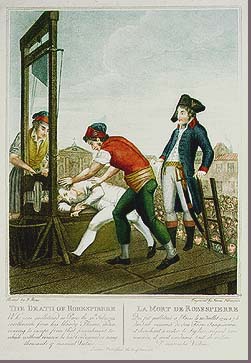
Horrifically injured, he lay most of the following day exposed for public derision before he was hauled with his party to the guillotine, re-erected in the Place de la Revolution for this most memorable execution. In Carlyle’s florid (and free) narration:

Robespierre lay in an anteroom of the Convention hall, while his Prison-escort was getting ready; the mangled jaw bound up rudely with bloody linen: a spectacle to men. He lies stretched on a table, a deal box his pillow; the sheath of the pistol is still clenched convulsively in his hand. Men bully him, insult him: his eyes still indicate intelligence; he speaks no word. … -O reader, can thy hard heart hold out against that? His trousers were nankeen; the stockings had fallen down over the ankles. He spake no more word in this world.

Fouquier had but to identify; his Prisoners being already Out of Law.** At four in the afternoon, never before were the streets of Paris seen so crowded. From the Palais de Justice to the Place de la Revolution … it is one dense stirring mass; all windows crammed; the very roofs and ridge-tiles budding forth human Curiosity, in strange gladness. … All eyes are on Robespierre’s Tumbril, where he, his jaw bound in dirty linen, with his half-dead Brother, and half-dead Henriot, lie shattered; their “seventeen hours” of agony about to end. The Gendarmes point their swords at him, to show the people which is he. A woman springs on the Tumbril; clutching the side of it with one hand; waving the other Sibyl-like; and exclaims: “The death of thee gladdens my very heart, m’enivre de joie;” Robespierre opened his eyes; “Scelerat, go down to Hell, with the curses of all wives and mothers!” — At the foot of the scaffold, they stretched him on the ground till his turn came. Lifted aloft, his eyes again opened; caught the bloody axe. Samson wrenched the coat off him; wrenched the dirty linen from his jaw: the jaw fell powerless, there burst from him a cry; — hideous to hear and see. Samson, thou canst not be too quick!

Samson’s work done, there bursts forth shout on shout of applause. Shout, which prolongs itself not only over Paris, but over France, but over Europe, and down to this generation. Deservedly, and also undeservedly. O unhappiest Advocate of Arras, wert thou worse than other Advocates? Stricter man, according to his Formula, to his Credo and his Cant, of probities, benevolences, pleasures-of-virtue, and such like, lived not in that age. A man fitted, in some luckier settled age, to have become one of those incorruptible barren Pattern-Figures, and have had marble-tablets and funeral-sermons. His poor landlord, the Cabinet-maker in the Rue Saint-Honore, loved him; his Brother died for him. May God be merciful to him, and to us!

Part of the Themed Set: Thermidor.

* Even his enemies agreed — sometimes adding it to the bill of particulars against him — that Robespierre lived a life of personal moderation; he lived as a boarder with a working-class family, and disdained to avail the politician’s typical harvest of political graft.

** The Convention had decreed Robespierre’s outlawry when he escaped custody; his immediate execution was, of course, akin to the logic he had once turned against the king.

On this day..