1794: Not Thomas Paine

An avidity to punish is always dangerous to liberty. It leads men to stretch, to misinterpret, and to misapply even the best of laws. He that would make his own liberty secure must guard even his enemy from oppression; for if he violates this duty he establishes a precedent that will reach to himself. -Thomas Paine

On this date in 1794, revolutionary firebrand Thomas Paine got a date with the guillotine when the public prosecutor Antoine-Quentin Fouquier-Tinville put his name on the list for the next batch of heads.

Paine — “Mad Tom” to foes of his fire-eating opposition to despotic church and crown — is best-known for his part in the American Revolution; his pamphlet “Common Sense” made an incendiary and influential case for revolution.

More so than any other high-profile compatriot in the cause of American independence, Paine took to heart the age’s revolutionary spirit, the fine principles of solidarity, the zeal to put life and fortune at liberty’s service.

Not content to retire to the estate granted him for his services to the fledgling United States of America — Paine coined that name, by the way — the hellraiser sailed for the Old World to help overthrow the sclerotic Bourbon despotism whose geopolitically-minded aid* had had such material effect for American liberty.

Paine served in France’s National Convention, one of the highest-profile and least-impeachable members of that body as well as one of only two foreigners. These distinctions offered him some safety in the Revolution’s internecine tempests — some, but not quite enough. He drew the ire of the Montagnards by opposing the execution of Louis XVI.

The terrible gears of mass fratricide which apparently doomed Paine as the Terror unfolded turned out to be his refuge, and that of three fortunate fellows with him. Had he gone to the scaffold as a single high-profile traitor, there would have been no mistake about it; now, at the height of the Terror, jailers marked dozens for death by the fallible expedient of chalking their cell doors. If the guillotine made mass execution feasible, the bureaucratic apparatus to manage it was still catching up.

Here’s the version of a Paine’s preservation that he himself later related — albeit second-hand, since he was suffering this day “a violent fever which had nearly terminated my existence” and “was not in a condition to be removed, or to know of what was passing, or of what had passed, for more than a month. It makes a blank in my remembrance of life. The first thing I was informed of was the fall of Robespierre.”

[T]he manner in which I escaped that fate is curious, and has all the appearance of accident.

The room in which I was lodged was on the ground floor, and one of a long range of rooms under a gallery, and the door of it opened outward and flat against the wall; so that when it was open the inside of the door appeared outward, and the contrary when it was shut. I had three comrades, fellow-prisoners with me, Joseph Vanhuile, of Bruges, since president of the municipality of that town, Michael Robins, and Bastini, of Louvain.

When persons by scores and hundreds were to be taken out of prison for the guillotine, it was always done in the night, and those who performed that office had a private mark or signal by which they, knew what rooms to go to, and what number to take. We, as I have said, were four, and the door of our room was marked unobserved by us with that number in chalk; but it happened, if happening is a proper word, that the mark was put on when the door was open and flat against the wall, and thereby came on the inside when we shut it at night, and the destroying angel passed by it. A few days after this Robespierre fell, and the American ambassador arrived and reclaimed me and invited me to his house.

During the whole of my imprisonment, prior to the fall of Robespierre, there was no time when I could think my life worth twenty-four hours, and my mind was made up to meet its fate.

Presumably this would have been a short reprieve, had not Jacobin rule (and rulers) promptly expired.

We noticed two days ago the U.S. mission’s willingness to exert itself for Lafayette’s wife, who surely had not done better service for the American Revolution than had Paine himself.

Paine waited in vain for American intervention, and was incandescent with rage at George Washington and his envoy Gouverneur Morris for abandoning him (Morris was replaced by the more Paine-friendly James Monroe a few weeks later). In a wide-ranging 1796 denunciation of Washington’s conduct and American political tilt towards Britain and away from France, Paine accused his country** of giving the Jacobins the green light to cut off a gadfly’s head.

Could I have known to what degree of corruption and perfidy the administrative part of the Government of America had descended, I could have been at no loss to have understood the reservedness of Mr. Washington toward me, during my imprisonment in the Luxembourg. There are cases in which silence is a loud language.

Soon after I was put into arrestation and imprisonment in the Luxembourg, the Americans who were then in Paris went in a body to the bar of the Convention to reclaim me. They were answered … that I was born in England, and … their reclamation of me was only the act of individuals, without any authority from the American Government.

A few days after this, all communication from persons imprisoned to any person without the prison was cut off by an order of the police. I neither saw, nor heard from, anybody for six months; and the only hope that remained to me was that a new Minister would arrive from America to supersede Morris …

One hundred and sixty-nine were taken out of the Luxembourg one night, in the month of July, and one hundred and sixty of them guillotined. A list of two hundred more, according to the report in the prison, was preparing a few days before Robespierre fell. In this last list I have good reason to believe I was included. A memorandum in the hand-writing of Robespierre was afterwards produced in the Convention, by the committee to whom the papers of Robespierre were referred, in these words:

Demander que Thomas Payne soit de decrete d’accusation pour les interets de l’Amerique, autant que de la France.

I had then been imprisoned seven months, and the silence of the Executive part of the Government of America (Mr. Washington) upon the case, and upon everything respecting me, was explanation enough to Robespierre that he might proceed to extremities.

This venomous open letter and the deistic tract The Age of Reason he was banging out during the Revolution, combined with the frightening turn of the French Revolution itself, helped send Paine’s public regard into decline. “Atheist,” they tutted, and he’s been the most untouchable Founding Father ever since.

Next year is the bicentennial of his death in obscurity and pauperhood; his homelessness, so to say, in the annals of political thought and national pantheons testifies in some ways to the defeat his principles suffered in his very lifetime. The American Revolution turned conservative; France’s fell to despotism; England’s was strangled in its crib.

Even so, he fired the imaginations of many troublemakers still to come. A man of no wealth or position who etched in fire the spirit of his times, Paine saw further and spoke plainer than most of his contemporaries. If a prophet is not welcome in his own country, it scarcely diminishes the power of the prophecy.

And/or, enjoy this free biography at Google Books.

* Given by the French crown in opposition to France’s great rival Britain, of course.

** Paine certainly considered himself American, though he wouldn’t have made that inconsistent with being French, too. The matter of his citizenship between England (where his pamphlets had him attainted in absentia on a capital charge), France and the United States was a contested one at a time when the very notion was being reforged in the heat of revolution; at any rate, as diplomatic pretext for failing to ask for his life, citizenship makes a feeble excuse.

Republican radicals in England didn’t mind claiming him as their own, developing this alternate lyric sheet to the national anthem:

[audio:God_Save_the_Queen.mp3]

God save great Thomas Paine
His ‘Rights of Man’ explain
To every soul.
He makes the blind to see
What dupes and slaves they be,
And points out liberty,
From pole to pole.

Thousands cry ‘Church and King’
That well deserve to swing,
All must allow:
Birmingham blush for shame,
Manchester do the same,
Infamous is your name,
Patriots vow.

Part of the Themed Set: Thermidor.

On this day..

1944: Col. Claus Schenk Graf von Stauffenberg, for the plot to kill Hitler

Minutes after midnight this date in 1944, four senior Wehrmacht officers who had come within an ace of murdering Adolf Hitler less than 12 hours earlier were summarily shot in Berlin — the first of thousands executed for the most famous assassination attempt on the Fuhrer.

One of those rare moments where historical epochs (arguably) turn on the minutest exigencies of chance, the so-called July 20 plot had seen Col. Claus Schenk Graf von Stauffenberg insinuate a bomb into Hitler’s conference room in modern-day eastern Poland, then fly back to Berlin to mount a coup d’etat.

Blam

Stauffenberg had every reason as he left Wolfsschanze to believe the devastating blast at 12:42 p.m. must have killed the Nazi dictator. Little did he know that another officer at the table where the high command was plotting strategy for the eastern front had, in the name of legroom, shifted the deadly satchel to the other side of a heavy oak table support — shielding Hitler from the brunt of the explosion.

Four men died. Hitler had hearing loss, an injury to his right arm, and one hell of a grudge.

Stauffenberg weaseled out of the confused bunker and flew back to Berlin, expecting that his confederates were even then launching Operation Valkyrie — a contingency plan for martial law in the case of civic disturbance that the conspirators intended to use to mount a coup.

Failure to Communicate

Control and distribution of information was not the least of the many threads in the tapestry of July 20, 1944. Hitler had risen to power on his artful grasp of propaganda; today, his headquarters’ mastery of communications would overpower the putschists’ rank amateurism.

While en route, Stauffenberg had no ability to communicate to the wider world. Landing in Berlin three hours after the not-quite-deadly-enough blast at Wolfsschanze, he must have been stunned to find that Valkyrie had not been launched. Apparently, fragmentary reports from the east were unclear as to whether Hitler had survived; everyone was reluctant about committing himself.

Frantically, Stauffenberg — already deeply committed — rallied his comrades and set the treasonable gears into motion. But by this time, communications with Hitler’s headquarters had been re-established and contradictory reports of the assassination attempt’s success were flying in Berlin. Stauffenberg’s sincere but incorrect eyewitness testimony of Hitler’s death became increasingly untenable. Compounded by the sluggish and ill-coordinated action of the conspirators, officers of a more opportunist bent soon began lining up with the bad guys.

Joseph Goebbels, the senior Nazi in Berlin and Hitler’s wizard of public relations, was inexplicably left unmolested for hours — long enough to phone the radio station (also never seized) an announcement of Hitler’s survival. “To think that these revolutionaries weren’t even smart enough to cut the telephone wires! My little daughter would have thought of that.”

Conspirators’ orders to military units around Berlin went out late, piecemeal, and far too often fell on ears already deaf to the appeals. In some cases, the proclamations that should have been queued up for inundating the airwaves instantaneously were with some other officer not on the scene, and consequently were haphazardly redrafted on the fly — for telex operators who had caught the day’s drift themselves and intentionally delayed or ignored them.

From the perspective of a radio editor it was tragic. Tragic because the way in which details were handled made it obvious that this revolt had had very lithe chance of succeeding. (Source)

The coup fell apart almost as soon as it began.

Fromm Here to Eternity

Most decisively of all, timely information had prevented any participation by Gen. Friedrich Fromm, Stauffenberg’s commanding officer and the head of the Reserve Army — it was that position that allowed his aide access to Hitler’s person, and it was under his authority that the putschists were issuing their Valkyrie orders.

Fromm fell in the “opportunist” camp, and would have been ready to strike had the Fuhrer been demonstrably killed. But a telephone connection straight from the scene of the crime assured him that Hitler had survived … and that his adjutant was a wanted man.

Fromm the potential collaborator quickly turned the tables on Stauffenberg and company late on the night of the 20th.

The Schwein Abides

Before advancing to our heroes’ foreordained fate, take a moment to appreciate this newsreel rushed into production to assure the German public that everything was under control. It’s an impressive advance on statist slick-talking from Germany’s World War I clunkers (like this):

Notice Hitler greeting Mussolini — the two had been scheduled to meet that day; it would be their last encounter in this world. His maimed right arm hanging concealed beneath a greatcoat, Hitler shakes left-handed.

Shoot First, Ask Questions Later

Now that Fromm saw which way the wind was blowing, he acted with alacrity: many executions in the days to come were the product of Hitler’s vengeance, but this night, Claus von Stauffenberg, Albrecht Mertz von Quirnheim, Friedrich Olbricht, and Werner von Haeften were shot on Fromm’s orders for Fromm’s benefit. Here’s Shirer’s description of the fatal scene:

Fromm … had quickly made up his mind to eliminate these men and not only to cover up the traces — for though he had refused to engage actively in the plot, he had known of it for months, sheltering the assassins and not reporting their plans — but to curry favor with Hitler as the man who put down the revolt. In the world of the Nazi gangsters it was much too late for this, but Fromm did not realize it.

He … announce[d] that “in the name of the Fuehrer” he had called a session of a “court-martial” (there is no evidence that he had) and that it had pronounced death sentences on four officers: “Colonel of the Genera Staff Mertz, General Olbricht, this colonel whose name I no longer know [Stauffenberg, his aide], and this lieutenant [Haeften].”

In the courtyard below in the dim rays of the blackout-hooded headlights of an Army car the four officers were quickly dispatched by a firing squad. Eyewitnesses say there was much tumult and shouting, mostly by the guards, who were in a hurry because of the danger of a bombing attack — British planes had been over Berlin almost every night that summer. Stauffenberg died crying, “Long live our sacred Germany!”

The courtyard of the Bendlerblock on modern-day Stauffenbergstrasse in Berlin, where Col. Stauffenberg and three compatriots were shot. Photo by Daniel Ullrich, licensed by CC-by-sa.

Minutes after they died, the SS arrived on the scene and forbade any further executions of potential witnesses.

Fromm’s gambit didn’t work any better than Stauffenberg’s had: he was arrested right away, and was himself later shot.

What If?

While the afternoon’s theatrics may have been doomed from the moment Hitler arose unkilled from the bomb’s debris, his miraculous escape from death — “confirmation of the task imposed upon me by Providence,” he told the nation in a radio address an hour after Stauffenberg’s execution — is an inexhaustible mine for historical hypothesizing.

That the bomb could have, and would have with the least change in the principle variables, slain the dictator is widely accepted; a 2005 reconstruction of the blast scene by the Discovery Channel supports that belief in the context of the cable-documentary-friendly format* of Adolf Hitler plus slow-mo explosives. (Parts 1, 2 and 3 of this series set up the episodes excerpted here with the plot’s historical background and the crew’s investigation into the precise dimensions of the blast space — a combination of file footage, modern recreation shots, talking heads, and tromping about the forest in the modern remains of Wolfsschanze.)

But that’s the easy what-if.

More problematic — and well into the realm of bar-stool dickering — are the questions of what would have happened if the explosive had hit its target.

Stauffenberg enjoys latter-day popularity in Germany — the street where he was shot bears his name — in no small measure because of the confessedly quixotic nature of the attempted murder. Indeed, he probably died at the height of his potential popularity for history.

But it’s not for nothing that this attempt (though it did have many botched antecedents) took place in the weeks when Germany’s military position went from desperate to disastrous. Over the preceding two months, Soviet offenses had pushed the front back to the prewar Polish border, and the Normandy landing had opened a rapidly expanding western front. The assassination had a healthy dose of self-interest … and therefore was at least potentially antithetical to other interests at play in the great conflagration.

The motivation of sparing the Fatherland the ravages of war on its own soil is not ignoble of itself, of course. But given this opposition circle’s years-long failure to take effective action against Hitler while he went from successful crime to successful crime, one might ask a little more than a late-breaking suicidal gambit for unreserved historical vindication.

The German military’s deal with the devil had seen Europe’s greatest armed forces squandered by its dumbest commander. The end result would bleed the Nazi state white at unspeakable human cost … but also, arguably, towards one of the better postwar outcomes imaginable.

And would the coup even have achieved the goal of leaving Germany unoccupied? It seems impossible to think that any outcome would have been worse than Hitler, and the last year of the war was also its bloodiest … but among the spectrum of counterfactual alternatives, the appealing possibilities mostly seem to work out in spite of the plotters, rather than because of them.

1. Civil War?

Countercoups, or even outright civil war, might very likely have erupted between rivals for succession. This might have worked out as the best-case situation — fragmenting German resistance and hastening the inevitable — but it might also have given Germany a leaner, meaner fascism with a path to enduring long-term. Predicting any particular arrangement of players to emerge from this black box is a just-so story, and any of them probably leads to one of the other three alternatives; certainly the plotters weren’t banking on their own subsequent overthrow.

2. Status Quo Ante?

The coup might have utterly failed to obtain peace. German was close to defeat; the Allies were demanding unconditional surrender, and the entire point of the plot was to surrender on better terms than that. Had no quarter been offered, the putschist government might then have fought on (either by choice, or by the compulsion of internal politics) to much the same end, although quite plausibly with much less gratuitous bloodletting in the camps. Accidentally abating the Holocaust would be a very significant plus, of course, but probably not what posterity has in mind when it goes naming streets for the man.

3. World War Against Russia?

The new government might have successfully made peace with the western Allies, which was its fervent hope. Under the circumstances of the summer of 1944, that practically implied the continuation of the global war with the capitalist and fascist powers aligning against the USSR. The horrors of the eastern front up to the summer of 1944 then would likely pale in comparison to what followed. You could tell the story so that it all works out in the end, but replacing the long Cold War with an immediate hot war, especially with the United States less than a year away from its first successful A-bomb test, isn’t exactly a presumptive improvement.

4. 1918 Redux?

In the all but unimaginable case that the post-Hitler government successfully sued for peace on both its fronts (or accepted unconditional surrender), it would have had to give up to a Soviet buffer zone much of what the Soviets ultimately conquered. Millions who died fighting for it, and millions more who died in concentration camps while the fighting played out, and millions of women raped by the conquering Red Army, would have considered that arrangement an improvement; still, the peace itself could have ensconced a less crazy and therefore more durable military dictatorship in central Europe, which wouldn’t necessarily seem like an altogether positive outcome vis-a-vis the actual postwar history. More worryingly, this might have horribly recapitulated the post-World War I scenario in which the liberal politicians who accepted defeat, and not the crazed reactionaries who caused it, were blamed for the loss, fueling the subsequent rise of some unattractive revanchist successor state. Precisely because that example would have been uppermost in the officers’ own minds, it’s hard to believe this least-bloodthirsty path would have been the actual consequence of the coup.

And so on …

Second-order effects from any of these possibilities generate a novelist’s trove of alternative histories. What would the map of eastern Europe have looked like? Whither European Jewry … and therefore the postwar state of Israel … and therefore the political chessboard in the Middle East? What would an early resolution in Europe have meant for the Pacific theater, or for the Chinese revolution? How would decolonization movements have been affected had the war concluded earlier, or had it transformed into a worldwide anti-Communist war?

Postscript

Somewhere in those alternate realities, staff at the re-education camp are bantering over happy hour about what would have happened if Stauffenberg had failed.

Who knows if “internally peacable European social democracies” are a bullet point for the pie-eyed optimists, or the incorrigible pessimists?

A few of the books about Stauffenberg and Operation Valkyrie

Poor Col. Stauffenberg is due to be played by a smirking Tom Cruise in the biopic Valkyrie, a role that has drawn some slightly overheated controversy in Germany over Cruise’s adherence to Scientology.

* And, let’s face it, blog-friendly, too.

On this day..

1918: Tsar Nicholas II and his family

In the small hours after midnight on the night of July 16-17 90 years ago, the former Tsar Nicholas II, his wife, children, and four family retainers, were shot in a Yekaterinburg basement by their Bolshevik jailers.

Doting family man, vacillating dictator, as weak and rich as Croesus … the doomed Emperor and Autocrat of All the Russias was a man small of stature. His reign emerged under a bad star when 1,300 Muscovites were trampled to death in the crush for his coronation largesse; 18 years later, Nicholas‘s support for Serbia against Austria-Hungary was instrumental in pitching Europe into World War I, a blunder for which he reaped a whirlwind long in the making.

When an anti-Bolshevik force approached Yekaterinburg (or Ekaterinburg), where the deposed royals had been stashed in a commandeered private residence,* Yakov Sverdlov (for whom the city was subsequently renamed) ordered the prisoners shot — not only the tsar, but his beloved wife, their hemophiliac heir, and those four daughters who had to be bayoneted because the state jewels secreted in their corsets shielded them from the gunfire.

The executioners (here’s the account of their leader; here’s another guard’s version) did their best to destroy and conceal the remains, helping fuel subsequent rumors that one of the children had survived and escaped.

Those rumors are only now, with post-Soviet investigation and DNA forensics, being debunked, and not yet to the satisfaction of all comers. This very week, Moscow affirmed (though the Orthodox church has not accepted) that the last of Nicholas’s family had been accounted for:

Modern nostalgia for this unimpressive sovereign is making a minor comeback, with Nicholas absurdly contending in a current poll for the title of “greatest Russian” … supported not only by the miseries of the state that succeeded his, but by the family’s decent and accessible private life.

Even a monarchist — especially a monarchist! — shouldn’t reason that the greatest monarch is the one who drove the bus over the cliff. But much is forgiven a martyr. Indeed, like Charles I of England, the last Romanov monarch has been posthumously saddled with divine sanction; he and all the family are certified “passion bearers”. (Update: And possible future relics!)

A handful of the many books about the Romanovs and their fall

* The Ipatiev House where the tsar was held (and shot) no longer stands. On its spot is a church consecrated five years ago yesterday to the Romanov canonization.

Update: The Romanovs were officially rehabilitated by the Russian Supreme Court on October 1, 2008.

On this day..

1535: Thomas More, the king’s good servant but God’s first

On this date in 1535, Sir — later Saint — Thomas More kept his conscience at the expense of his head on Tower Hill.

For all More‘s greatness — as intellectual, polemicist, lawyer, statesman, father — none of his many gifts at the end could avail him beside his commitment to Catholicism at the dawn of the English Reformation.

Yet it is for those gifts that he cut such a commanding presence in his times, for those very reasons that his sovereign hounded his first citizen to assent to the divorce and remarriage he was fixed upon.

A devotee and friend of Erasmus from years before, More was in Henry’s more orthodox youth the king’s very scourge of Protestantism. His scatological invective against Martin Luther in Responsio ad Lutherum — much in the impolite tenor of Catholic-Protestant rhetoric continent-wide, it should be noted — is of the sort to crimson the cheeks of the milquetoast modern:

Since he has written that he already has a prior right to bespatter and besmirch the royal crown with shit, will we not have the posterior right to proclaim the beshitted tongue of this practitioner of posterioristics most fit to lick with his anterior the very posterior of a pissing she-mule until he shall have learned more correctly to infer posterior conclusions from prior premises?

Over that hairshirt, he wore the robes of state. But his engagement with the world had a selective bent that must have exasperated his colleague and predecessor as Lord Chancellor, Cardinal Wolsey. Orson Welles and Paul Scofield spar here in the definitive More hagiography A Man for All Seasons over the intellectual’s delicate refusal to dirty his gloves with the great matter of state before them — the annulment the king demanded of his marriage to the Queen (and More’s friend) Catherine of Aragon:

Peas in a pod, these two: Wolsey, the cleric grounded in realpolitik; More, the barrister who trusts to God. (More considered holy orders as a young man.)

Our man’s reputation for honesty in a den of hypocrites has certainly outrun Wolsey’s. Still, all More’s disdain for the deal-making that invests the sovereign majesty and all his foreboding for the relationship he had with his dangerous king were not quite enough to stop him accepting the Chancellorship and the opportunity to stamp out Lutheranism … knowing perfectly well the simultaneous thrust of Henry’s boudoir policy.

It all cuts quite a contrast to More’s (barely) pre-Reformation text, Utopia (available free from Project Gutenberg), which named a literary genre and described an imagined society of tolerant primitive communism that surely would have blanched at its inventor’s coming role in the state’s machinations:

I can have no other notion of all the other governments that I see or know, than that they are a conspiracy of the rich, who, on pretence of managing the public, only pursue their private ends, and devise all the ways and arts they can find out; first, that they may, without danger, preserve all that they have so ill-acquired, and then, that they may engage the poor to toil and labour for them at as low rates as possible, and oppress them as much as they please

[E]very man might be of what religion he pleased, and might endeavour to draw others to it by the force of argument and by amicable and modest ways, but without bitterness against those of other opinions; but that he ought to use no other force but that of persuasion, and was neither to mix with it reproaches nor violence* …

It’s not a given that More himself agrees with every (or even any) sentiment expressed in Utopia, but his most famous work’s criticism of the death penalty too liberally applied makes interesting reading.

[E]xtreme justice is an extreme injury: for we ought not to approve of those terrible laws that make the smallest offences capital … God has commanded us not to kill, and shall we kill so easily for a little money [i.e., execute petty thieves]? But if one shall say, that by that law we are only forbid to kill any except when the laws of the land allow of it, upon the same grounds, laws may be made, in some cases, to allow of adultery and perjury: for God having taken from us the right of disposing either of our own or of other people’s lives, if it is pretended that the mutual consent of men in making laws can authorise man-slaughter in cases in which God has given us no example, that it frees people from the obligation of the divine law, and so makes murder a lawful action, what is this, but to give a preference to human laws before the divine? and, if this is once admitted, by the same rule men may, in all other things, put what restrictions they please upon the laws of God.

This insistence on the supremacy of divine law over human institutions forms the basis of his objection to parliament’s overthrowing the papacy — which he expressed openly only after he was convicted by obviously perjured “jailhouse snitch” testimony

[Y]ou have no authority, without the common consent of all Christians, to make a law or Act of Parliament or Council against the union of Christendom.

Paul Scofield bears enjoying in the role in A Man for All Seasons:

More is sometimes suspected of desiring martyrdom since he marched so unerringly into it, but he also made every attempt to survive Henry’s demand the he affirm the royal remarriage and the king’s ecclesiastical supremacy by withdrawing silently from the public sphere rather than openly opposing it. More had by every account an enviable, downright happy life at his own hearth, and a tender and intellectual relationship with his favorite daughter Meg. (Meg corresponded with her father in prison, collected his works, and retrieved his head from London Bridge.)

But by his way of thinking — Meg tried to talk him out of it — he couldn’t swear to the Act of Succession acknowledging the king’s right to divorce Queen Catherine and disinherit her daughter Mary if Henry decided to force the choice. And in the king’s eyes, there was no middle ground for someone of the ex-Chancellor’s stature.

Henry could see to it, though, to cut his old friend a break and commute the sentence from drawing and quartering to “mere” beheading, here depicted in the past season of the Showtime series The Tudors.

More’s last moments as rendered here — the ironic remark at the foot of the scaffold, “See me safe up: for my coming down, I can shift for myself”;** his generous answer to the headsman’s plea for forgiveness — are well-documented. Undoubtedly, his sturdy martyr’s bearing, the extension of a life of joyful piety, helped cement for posterity the fame he held in life.

And that dying address — “I die the King’s good servant, but God’s first” — gathers in one sentiment free of bombast or self-pity the irreconcilable demands of conscience that would lead many thousands besides More to Henry VIII’s scaffolds, and rings equally true to less lethal challenges to the conscience in every land and time since.

Anne Boleyn, who caused More’s fate, shared it less than a year afterwards.

Thomas More was canonized by the Catholic Church in 1935 — the patron saint of politicians. Rather bizarrely, July 6 is also his feast day on the Anglican calendar, a tribute to the nearly universal regard his memory enjoys.

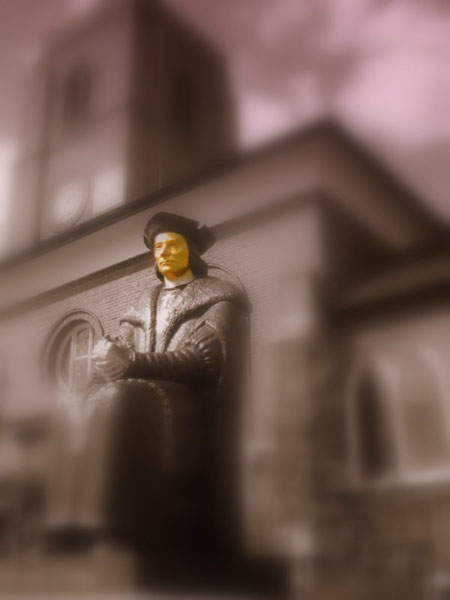
Thomas More's statue at the Chelsea Old Church

Chelsea resident Thomas More’s statue at the (Anglican) Chelsea Old Church.

* Despite its religious tolerance, More’s Utopia — anticipating Dostoyevsky — maintains:

a solemn and severe law against such as should so far degenerate from the dignity of human nature, as to think that our souls died with our bodies, or that the world was governed by chance, without a wise overruling Providence … since a man of such principles must needs, as oft as he dares do it, despise all their laws and customs: for there is no doubt to be made, that a man who is afraid of nothing but the law, and apprehends nothing after death, will not scruple to break through all the laws of his country, either by fraud or force, when by this means he may satisfy his appetites.

** According to the biography published by More’s son-in-law — who married More’s favorite, Margaret — the jest was occasioned by the rickety look of the scaffold. The Mirrour of Vertue in Worldly Greatness; Or, The Life of Sir Thomas More is available free on Google Books.

On this day..

1962: Adolf Eichmann

On this date in 1962, the architect of the Final Solution received such justice as could be meted to him on earth at Israel’s Ramla Prison.

Adolf Eichmann, the vacuum cleaner salesman turned SS Obersturnbannfuhrer, remains the only person judicially executed in the history of modern Israel, whose intelligence services kidnapped him from Argentina where he had settled after the war.

Other Nazis had used the “only following orders” defense with little success in the Nuremberg Trials shortly after World War II. On trial years later (and at the hands a Jewish state) Eichmann — a bookish, unmenacing man who invoked Kant — posed the questions of individual responsibility and human psychology in starker terms.

To be sure, he was no anonymous functionary. Neither, however, had he dirtied his nails at the stomach-churning business end of the Holocaust: rather, he had engineered the stupendous logistical project of deporting Eastern Europe’s Jews for extermination, an (impressive) accomplishment worth exponentially more lives than any Einsatzgruppe could ever account for, yet simultaneously abstract from the upshot.

Eichmann said he did it without ill-will towards its subjects — simply to obey and to achieve.

The Banality of Evil

[I]f it was of small legal relevance, it was of great political interest to know how long it takes for an average person to overcome his innate repugnance of crime, and what exactly happens to him once he has reached that point. To this question, the case of Adolf Eichmann supplied an answer that could not have been clearer or more precise.
-Hannah Arendt

Hannah Arendt took him at his word* and saw in Eichmann the abyss gazing back into us, into his judges — not a monster but a man unsettling in his normalcy, whose job was not TPS reports or quarterly sales results but turning humans into ash.

The company man. The career man. Every man, standing in for countless thousands more who pushed the papers that drove the trains to Auschwitz.

What for Eichmann was a job, with its daily routine, its ups and downs, was for the Jews quite literally the end of the world.

Not everyone accepts her conclusions, but Arendt’s characterization of “the banality of evil” has become the man’s epigraph. And Eichmann disturbs us precisely because we seem to be able to meet him on his terms, even sympathize with him when the horror of his crimes begs for a monster like Streicher or Goebbels we could safely consign to the Other.

Arendt’s turn of phrase has a certain breezy (hackneyed, even) life in the public discourse, but her analysis of Eichmann’s careerism remains a challenging and deeply relevant one for we heirs of the world that hanged him.

The complete transcript of Eichmann’s trial is available online here. Video of his trial has been posted online here (in English) and here (original languages).

* Albeit with some reservations; others have argued that Eichmann was considerably more personally invested in his mass-murder project than his demeanor at trial admitted. Certainly he had an interest in showing the mellower Eichmann when he was on trial for his life.

On this day..

1718: John “Jack Ketch” Price, former hangman

On this date in 1718, the former common hangman got a taste of his own medicine.

As the 18th and especially 19th centuries unfolded and executions became more private, orderly and “humane,” the executioner’s office became more subtle and bourgeois. In the early 1700’s, however, it was commonly filled by a character who might just as easily have been on the other end of the rope. And once in a while … they were.

One disreputable character who performed the office for twenty years and more following the Stuart Restoration, Jack Ketch, lent his very name to the position (and its accoutrement — e.g., “Jack Ketch’s knot,” the hangman’s noose).

Our day’s victim, by the Christian name of John Price, was “Jack Ketch” in 1714-1715 until his debts caught up with him, and if the Newgate chronicle be believed wasn’t half-bad at the gig. Alas that he lost the position: his life in every other respect is reported by our sanctimonious interlocutors as one of drunken savagery.*

In such a state a couple of years later, he beat a woman to death during an attempted (or actual) rape at Bunhill Fields, at which location the law compelled him, in the parlance of the times, to “dance with Jack Ketch.” The prospect of hanging concentrated old Ketch’s mind wonderfully on the task of not missing one precious moment that might be spent drinking.

[H]e was no sooner confined in the condemned hold, than laying aside all thoughts of preparing himself for his latter end, he appeared quite void of all grace; and instead of repenting for his manifold sins and transgressions, he would daily go up to chapel intoxicated with cursed Geneva [i.e., gin] … As he was riding in the cart he several times pulled a bottle of Geneva out of his pocket to drink before he came to the place of execution

One would imagine that the dreadful scenes of calamity to which this man had been witness, if they had not taught him humanity, would at least have given him wisdom enough not to have perpetrated a crime that must necessarily bring him to a similarly fatal end to what he had so often seen of others: but perhaps his profession tended rather to harden his mind than otherwise.

Price/Ketch was not the only public executioner to find himself on the receiving end of his former trade, but he does seem to have the distinction of being the only one who was also gibbeted — his carcass hung up in an iron cage in the London district of Holloway.

Update: John Price’s career narrated by Lucy Inglis of Georgian London in a podcast interview with Early American Crime.

On this day..

1498: Girolamo Savonarola, as he had once burned vanities

On this date in 1498, the Dominican friar who had once bent Florence to his austere will was hung in chains and burned.

Girolamo Savonarola preached standing-room-only, millenial sermons against worldly immorality, in the early 1490’s. By 1494, when peninsular politics chased a weak Medici scion from Florence, he had become its master.

He makes a complex character, with a streak of flawed greatness even his contemporary enemies recognized; his anti-Renaissance theology was severe but not dour, fired as it was by a genuine spiritual passion that spoke to real needs of his audience and a real crisis growing in the Church. And he did not disdain the revolutionary real-world implications of his faith.

Savonarola instituted Republican government with a touch of the Taliban — a vice squad of young hooligans to rough up rouged ladies and card-players;* a famous Bonfire of the Vanities in which Botticelli incinerated some of his own work — but also a populist economic touch.

For reasons both internal (the killjoy factor of busting up dice games wore out its welcome) and external (his French ally Charles VIII was driven from Italy, and Savonarola made a dire enemy of the corrupt Borgia pontiff Alexander VI), the priest’s grip on Florence weakened. In April 1498, he was arrested with two other clerics; all three were tortured into signing confessions, then hanged in the Piazza della Signoria by an insolent executioner.

The doomed Savonarola anguished that he had not been strong enough to resist the tortures of the rack, and penned in contrition the Latin meditation Infelix ego:

Alas wretch that I am, destitute of all help, who have offended heaven and earth — where shall I go? Whither shall I turn myself? To whom shall I fly? Who will take pity on me? To heaven I dare not lift up my eyes, for I have deeply sinned against it; on earth I find no refuge, for I have been an offence to it…

Like Savonarola’s memory and teachings, it spread — often illicitly — in a Europe ready for religious reform. Infelix ego has been frequently set to devotional music, like this version by Orlande de Lassus:

[audio:Infelix_Ego_Lassus.mp3]

Savonarola might have been in himself a dead end, an unsuccessful prophet quickly rolled back, but he nonetheless possesses a recognizable essence that distills both the Zeitgeist of his time and the immemorial hunger for simplicity and virtue that coexists with the equally human celebration of pleasure and beauty. He left complex legacies to both the Church and the city his reforms sought (and ultimately failed) to scourge.

In religion, his castigation of the vice and sin of the Church (a position of which he was an outstanding but hardly a lonely advocate) prefigured the coming Reformation. But Savonarola also never left off the most devout affiliation to Catholicism, nor sought institutional schism even when he had been excommunicated.** What to make of such a man? He is both depicted (at the base of a Martin Luther statue) at the Worms Reformation Monument, and proposed for present-day Catholic canonization.

So too his secular legacy — the theocrat who burned books and expelled the Medici and was reduced to ashes for his reactionary principles — merits a respectful recollection in Florence, even if few would actually want to live in his republic. He repelled Machiavelli, a libertine counselor of the post-Savonarola Florentine Republic, but perhaps fascinated him as well, as a prince with a precisely backward grasp of his own power.

This stone marking the site of the execution stands at a crossroads of tourist traffic in a thicket of statuary, mostly nude and/or classically inspired, outside the entrance to one of Europe’s principle collections of Renaissance art.

One wonders what the old Dominican would have made of it.

Books about Savonarola’s Florence

* Savonarola also made sodomy punishable by death.

** Alexander VI tried first to get him (in Lyndon Johnson’s fragrant phrase) inside the tent pissing out by making him a cardinal, which Savonarola spurned.

On this day..

1315: Enguerrand de Marigny, on Montfaucon

On this date in 1315, an obscure petty noble who had become the king’s right-hand man was hanged by his rivals a few months after his royal sponsor expired.

Late in the epoch-making reign of King Philip the Fair — under whose rule the papacy was hijacked to Avignon and the Templars were crushedEnguerrand de Marigny was the man loyally keeping the books.

Since Philip was a stubbornly spendthrift fellow, that meant Marigny’s chief pursuit was the creative extraction of new revenues, through fresh taxes and the debasement of coinage. His public esteem suffered commensurately, little aided by the fact that his duties made him fabulously wealthy and the most powerful man in the country, give or take a king.

Said monarch was vigorous in that age-old pastime of the feudal monarchy, centralization of the power scattered among the nobility, further to which end he was happy to promote a competent administrator of scanty lineage and dependable loyalty.

Aggrieved lords, like the grasping Charles de Valois, were ready with their grudges against the unpopular minister when Philip shuffled off in November 1314. When charges of financial impropriety didn’t stick, they cooked up an allegation of sorcery — just then coming into vogue as a trump card in the game of judicial homicide.

Enguerrand hung two years upon the monumentally terrifying Montfaucon Gibbet (the link is to the structure’s French Wikipedia page), but everyone felt just terrible about it later. (the link is French, again) An actual inquiry — they skipped that step when they strung him up — exonerated the luckless minister, allowing his heirs to retrieve his body and a chunk of his fortune from the sympathetic king; Charles was so pursued by guilt that on his deathbed, he sent out a fat dispensation of alms with the request that recipients pray for both Enguerrand de Marigny and himself.

It worked … at least for Marigny’s reputation.

None can tell, after this lapse of time, whether this remorse proceeded from weakness of mind or sincerity of heart, and which of the two personages was really guilty; but, ages afterwards, such is the effect of blind, popular clamor and unrighteous judicial proceedings, that the condemned lives in history as a victim and all but a guileless being. (Source)

It was no hard feelings from Enguerrand’s little brother, Jean. The family influence had landed him a bishopric, and he held the job until his death in 1350, even repelling an English siege of Beauvais during the Hundred Years’ War.

A European Haman?

Enguerrand de Marigny comes in for a passing notice as T.H. White affectionately surveys the Middle Ages in The Once and Future King:

What an amazing time the age of chivalry was! Everybody was essentially himself — was riotously busy fulfilling the vagaries of human nature … [a] coruscating mixture of oddities who reckoned that they possessed the things called souls as well as bodies, and who fulfilled them in the most surprising ways.

[Y]ou might have seen Enguerrand de Marigny, who built the enormous gallows at Mountfalcon, [sic] himself rotting and clanking on the same gallows, because he had been found guilty of Black Magic.*

That Marigny erected the gallows on which he hung is an oft-repeated claim, an instance of a whole subgenre of moralistic folklore in which death-dealing inventors are hoisted on their own petard. These stories are not always dependablecontra rumor, for instance, Dr. Guillotin was not guillotined — and today’s protagonist may not have a firm hold on this small consolation, either.

Here is Victor Hugo’s rendering of the structure’s history in The Hunchback of Notre Dame.

Montfauçon was, as Sauval says, “the most ancient and the most superb gibbet in the kingdom.” …

Let the reader picture to himself, crowning a limestone hillock, an oblong mass of masonry fifteen feet in height, thirty wide, forty long, with a gate, an external railing and a platform; on this platform sixteen enormous pillars of rough hewn stone, thirty feet in height, arranged in a colonnade round three of the four sides of the mass which support them, bound together at their summits by heavy beams, whence hung chains at intervals; on all these chains, skeletons; in the vicinity, on the plain, a stone cross and two gibbets of secondary importance, which seemed to have sprung up as shoots around the central gallows; above all this, in the sky, a perpetual flock of crows; that was Montfauçon.

At the end of the fifteenth century, the formidable gibbet which dated from 1328, was already very much dilapidated; the beams were wormeaten, the chains rusted, the pillars green with mould; the layers of hewn stone were all cracked at their joints, and grass was growing on that platform which no feet touched. The monument made a horrible profile against the sky; especially at night when there was a little moonlight on those white skulls, or when the breeze of evening brushed the chains and the skeletons, and swayed all these in the darkness. The presence of this gibbet sufficed to render gloomy all the surrounding places.

The mass of masonry which served as foundation to the odious edifice was hollow. A huge cellar had been constructed there, closed by an old iron grating, which was out of order, into which were cast not only the human remains, which were taken from the chains of Montfauçon, but also the bodies of all the unfortunates executed on the other permanent gibbets of Paris. To that deep charnel-house, where so many human remains and so many crimes have rotted in company, many great ones of this world, many innocent people, have contributed their bones, from Enguerrand de Marigni, the first victim, and a just man, to Admiral de Coligni, who was its last, and who was also a just man.

Hugo — who, let us admit, is not to be depended upon for history — has elevated Marigny to the very first victim of the Montfaucon gallows, but the reader will also notice that the same passage dates the edifice’s construction thirteen years after Marigny’s own execution.

Helpless Historiography

Montfaucon the execution site had a rich history. There seem to have been at least two separate gallows sites (the link is French) on the hill, and its vintage as an execution space dates back to the 13th century. (more French)

About this point, this blog runs against the limits of its writer’s access to primary documentation and werewithal to pursue it. Sources seem mightily confused on the embryonic era of Montfaucon; at least two other ministers — Pierre de La Brosse, a confidante of the previous king, and Pierre Remy, another royal treasurer hanged a generation after Marigny — also have their own claim to have been hanged on the structure they erected.

It may be that this was actually true of Remy, a less dramatically captivating figure with an official portfolio similar to Marigny’s, and the two simply became conflated in legend. Something certainly seems to have been built during his time, and it may have been the stone replacement for the original gallows.

The suggestion of someone who researched it more thoroughly than I have (another French page, but worth the visit if only for the pictorial schematics) is that the landmark structure may have predated all these men.** Brosse and Marigny, in this conception, may simply have worked various repairs upon it that became magnified in the retelling, while the gallows Remy set up might have been those on the secondary location, erected as a stopgap during a more thorough reconstruction of the permanent site, and/or reserved for more vulgar elements than ministers of the crown.

* Readers may appreciate an annotation of other references White makes in his fantasy classic.

** We find repeated claims that the alleged “sorceror” Marigny engaged for his capital crime was hanged below him, which would support that notion; I have been unable to identify the provenance of this detail, however.

On this day..

1945: Benito Mussolini, his mistress, and his aides

On this date in 1945, Communist partisans shot Benito Mussolini and his mistress, Clara Petacci near Lake Como, along with fifteen or so additional fascist aides and officials.

It was an inglorious end for the flamboyant onetime socialist turned violent rightist, the man who had founded (and named) fascism; whose had inspired Hitler when the latter was still a streetcorner rabble-rouser, and then wandered suicidally into Germany’s orbit.

The next day, the victims’ bodies were hung up in Milan — the heart of Mussolini’s own power and still a stronghold of neo-fascist parties today — at Piazza Loreto for public abuse. The deposed Duce still had it in his power to stir the imagination of his Teutonic partner: news of the Italian dictator’s fate made it to the Fuhrer’s bunker and was said to have steeled Hitler’s resolve to take his own life with the dread vision of what should befall him if he were taken alive.

On this day..

1670: Major Thomas Weir, a Puritan with a double life

On this date in 1670, a 70-year-old upstanding Edinburgher went to the stake for confessing — unbidden — to witchcraft.

The “Wizard of West Bow” had had a distinguished military career and an exactingly pious public life among Edinburgh’s strictest Presbyterians. So it came as something of a surprise when, after being struck by an illness, he up and copped to a lifelong sexual relationship with his sister Jean … and a lifetime of hitherto unknown black arts, powered by a Satanic walking-staff. He was so far from being suspect that town elders at first thought him daft.

Only when Jean backed his story with the sort of details to give vapors to the “Bowhead Saints” neighborhood did things get serious. She especially warned about that staff.

So on this day, the dumbfounded city worthies had to tote one of their own to the area around Edinburgh’s modern Pilrig Street and have him strangled and burnt at the stake. Whatever moved Weir to issue his damning (literally!) admission, he was plainly quite in earnest: when asked to pray at the stake, he shot back, “Let me alone, I will not. I have lived as a beast, and I must die as a beast.” The staff was thrown onto the pyre with him; it was said to burn abnormally slowly.

His sister was hanged shortly thereafter for the same offenses, scandalizing her upstanding neighbors by tearing her clothes off on the way to the scaffold.

For a century, nobody dared live in Weir’s house, which the cremated major — and/or that staff, floating about looking for its owner — supposedly haunted. The house is long torn down, but the tale is natural fodder for any “haunted Edinburgh” tour.

One is struck in such a story by its modernity — perhaps the reason it could speak to a Victorian novelist like Robert Louis Stevenson.

The interpretive framework we begin with for witch hunts is — well, a “witch hunt.” Our own sense of what unjust social persecution is shapes the way we read these long-gone cases, the confessions forced from the victims’ lips. We identify with the “witches”; it is the alien world that ferrets them out and burns them that wants explaining.

Major Weir unnervingly turns the tables on such voyeurs as your correspondent. He steps without warning out of a forgotten mass of long-gone peoples, his confession not merely voluntary but insistent against skepticism — and suddenly we grapple for our bearings not in sociology but in abnormal psychology: here is a man very much of his society who has unexpectedly rejected it, boasts of rejecting it all along, and does so not craving after reconciliation to his people but in order to die (as does his sister) obstinate in that rejection. We can perhaps identify less readily with this individual than with his crestfallen friends.

Whether or not the Weirs really did anything that would count as a crime today — although one is practically forced to agree that at a minimum, the siblings violated a sexual taboo still enforced now — we have a template for this man not in the McCarthy hearings but straight from the evening news: the unassuming neighbor revealed to be a serial killer; the trusted rector who turns out to have been a pedophile.

On this day..