Top to bottom: Proskurov, Rychagov, Shtern, and Smushkevich.
“Quantity has a quality all its own.”
-Stalin
The aphoristic Uncle Joe doomed Soviet officers in both quantity and quality on this date in 1941, shooting 20 Soviet officers at the very moment when Mother Russia could have used them most.
This wouldn’t seem like the ideal time for a purge, but old habits are hard to break.
As the Wehrmacht closed in on Moscow, these prisoners had been evacuated to the Volga city of Kuybyshev (today, Samara). In this, they were already treated more courteously than some.
But any semblance of consideration for these fallen brass — to say nothing of bourgeois indulgences like due process — went out the window when an order arrived from Lavrenty Beria:
“Investigation to be stopped, all to be executed by firing squad without delay.”
They were.
Those “all” included:
Fighter ace Lt. Gen. Pavel Rychagov, who had sealed his fate by undiplomatically characterizing Soviet planes as “coffins.” (His wife was shot, too.)
Lithuanian pilot Yakov Smushkevich, a veteran of the Spanish Civil War and the Battle of Khalkhin Gol. Smushkevich’s daughter talks about him in this interview.
Gen. Grigori Shtern, who commanded the Battle of Khalkhin Gol.
Baltic commander Aleksandr Loktionov
Ivan Proskurov, an air force officer who’d forewarned of the impending German invasion, without effect. (He had good company.)
Many of this day’s victims were rehabilitated after Stalin fell.
Cold comfort, perhaps, but for their survivors there was bloodier satisfaction: the personal order Beria gave to execute them was in turn used against Beria when he was purged.
It’s a bit tangential, but here‘s an interesting interview with one of their contemporaries in Soviet combat aviation, who managed to survive those terrible years (despite being “taken out to be shot on three occasions” while a POW in Spain). There are some pictures of the planes these men would have used in this thread of a Spanish-language military forum.
On this date in 1943, Australian World War II commando Leonard Siffleet was beheaded on Aitape Beach in Papua New Guinea, along with two Ambonese, H. Pattiwal and M. Reharing
A photograph of the Japanese soldier Yasuno Chikao an instant before he strikes off Siffleet’s head was taken from the body of a Japanese casualty later in the war. Published in Life magazine, it became one of the war’s most iconic photos.
Later in the war, American advances in the Pacific would enable the Yankee to do this regularly. In 1942, it was all but a suicide mission.
The plan involved launching 16 B-25s from an aircraft carrier — an unprecedented feat in itself — to fly light with arms and heavy with fuel to just make it 400 miles to Honshu, and with any luck on to China before the tanks ran dry.
Considering that the bombers had to launch in a panic when the carrier group was spotted a couple hundred miles too early, the raid’s success was downright miraculous: all 16 bombers made it on to (or near enough) the mainland without being shot down, where the crews bailed out and, for the most part, escaped to allied forces. Jimmy Doolittle would title his autobiography I Could Never Be So Lucky Again.
But not all were quite as lucky as Lt. Col. (later, General) Doolittle.
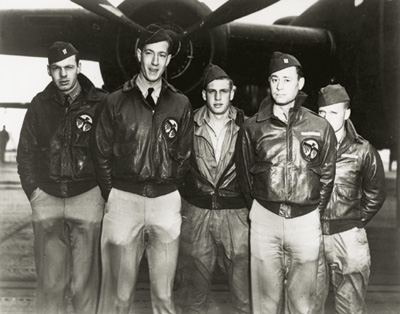
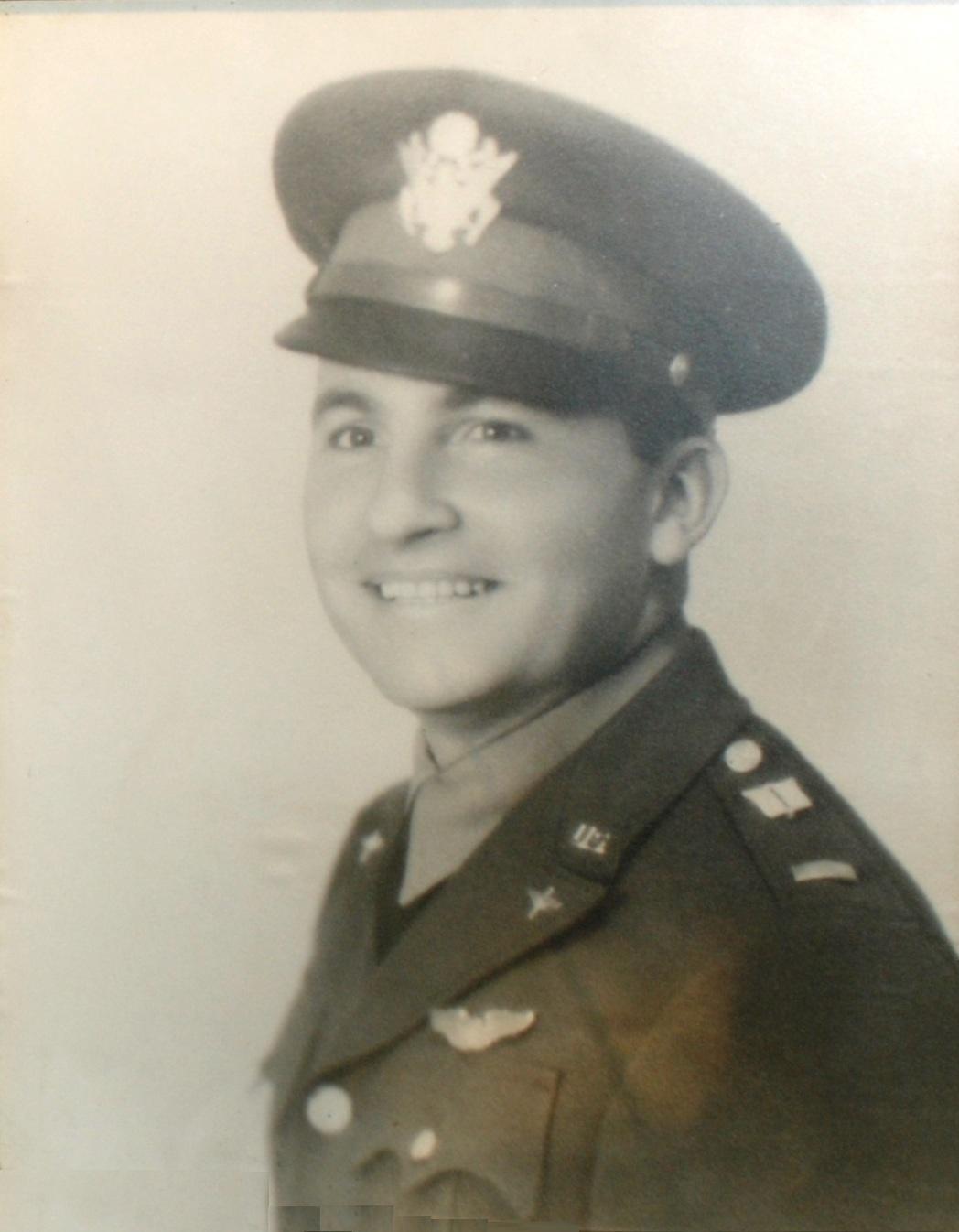
Farrow (left) and Hallmark. Spatz was a member of Farrow’s crew, and is pictured center in that plane’s crew shot here.
Two (out of eighty) drowned when their ride was ditched in the drink. Eight others were captured by the Japanese.
Four of those eight captives would survive the war to tell the tale. A fifth died in captivity. And the other three — pilots William Farrow and Dean Edward Hallmark, and (for somewhat unclear reasons) gunner Harold Spatz — were shot this day in a Shanghai cemetery following a sketchy military trial which condemned them for hitting civilian targets.
Designed largely for its psychological effect, the morale-boosting Doolittle raid has attracted interest from countless other sources who treat it in greater depth. DoolittleRaid.com and DoolittleRaider.com both provide detailed online information about the raid.
For more traditional media, one could do worse than bomber pilot Ted Lawson’s book, and its subsequent propaganda film adaptation, Thirty Seconds Over Tokyo.
“Seldom is a poet burned alive, no matter how critics may roast his work!”
-Robert Beale
On this date in 1689, German poet and mystic Quirinus Kuhlmann was roasted in Moscow for heresy.
This Silesian millenarian (English Wikipedia entry | German) experienced a mystical conversion and spent his law school hours instead scribbling visionary poetry and devouring visionary texts.
Inflamed with Bohmian fire, I read Bohme with fiery eagerness and capacity. I did not know the Bohmian texts and I knew them the same day. What an admiration (o Jesus!) overcame me when I heard Bohme tell his revelations which I had learned from the universe of nature, with God as my teacher, it were the revelations the first outlines of which I just had begun to delineate in my own works.
Quirinus’s particular vibe was an end-times kingdom of Jesus thing with the Catholic Church as the Antichrist. He cast about Europe vainly imploring princes to ally — Protestants with Orthodox with Mussulmen — to destroy the papal whore of Babylon. This
Prince of Fanatics … wrote a book, entitled Prodromus Quinquennii Mirabilis, and published at Leyden in 1674, in which he set forth his peculiar views. He stated that in that same year the Fifth Monarchy or the Christian Kingdom was about to commence, that he himself would bring forth a son from his own wife, that this son by many miracles would found the kingdom, and that he himself was the Son of God. On account of these mad ravings he was exiled by the Chief of the United Provinces of the Netherlands, and expelled with infamy from the University of Leyden. But his strange mission did not cease. He wandered for some time in France and England … He then proceeded to Turkey on his mission, and presented himself to the Sultan. Although ignorant of the language of the country, he persuaded himself that he could speak in any tongue; but when they led him into the presence of the Sultan he waited in vain for the burning words of eloquence to flow. The Turks dealt with him according to his folly, and bestowed on him a sound thrashing. Thence he proceeded to Russia …
Kuhlmann could have picked a better time to evangelize Russia than the reign of Peter the Great. This progressive despot did indeed look west for Russia’s future: in industry, in law, in war, even in fashion. But certainly not in holy alliances.
It was a fellow-German in Moscow, a Lutheran pastor, who denounced Kuhlmann as a dangerous heretic. He and a follower were duly burned as such.
On this date in 1987,* Iranian cleric and revolutionary official Mehdi Hashemi was secretly executed … seemingly, for leaking the Iran-Contra scandal.
Hashemi was an O.G. of the Iranian Revolution, imprisoned by the notorious secret police SAVAK** and freed when the Shah’s government collapsed in 1979.
Hashemi had a series of posts in the revolutionary state generally relating to exporting the revolution, and under the aegis of Ayatollah Montazeri, who in the late 1980s was the heir apparent of Ayatollah Khomeini for leadership in the Islamic Republic.
Montazeri was a rival of parliamentarian Akbar Hashemi Rafsanjani,† and further to that rivalry the Montazeri faction leaked embarrassing information about Rafsanjani’s dealings with the United States.
The Great Satan’s disreputable Middle East policy entailed playing both sides of the destructive Iran-Iraq War — arming Saddam Hussein‘s Iraq, while also making secret weapons sales through Israel to Iran despite a supposed arms embargo, thereby obtaining the release of American hostages in Lebanon.
This is the “Iran” half of the Iran-Contra scandal … which became the Iran-Contra scandal when Hashemi publicly exposed the existence of secret Iranian-American contacts to the Lebanese magazine Ash-Shiraa.
The immediate motivations appear murky even to specialists, of whom this writer is not one … but whatever they were, the leak backfired — as so often is the case — on the whistleblower himself.
While the authors of the covert policy in each country emerged stronger, Hashemi was arrested just before the story broke publicly and “persuaded” (with 75 lashes!) into one of those Soviet-style auto-denunciations, which was broadcast on Iranian TV.
Hashemi’s self-flagellation, as characterized here, runs thus:
Deviation is my ultimate sin. This is why I now stand before you. I began my career with minor infractions, gradually strayed from the correct path, continued with larger mistakes, then to major sins, and ultimately to the worst sin possible — that of heresy, apostasy, and treason against the Imam, the Community, Islam, and the Islamic Revolution. I have to ask myself what was the root cause of my downfall? …
(His answer: “carnal instincts”.)
I now realize that despicable sinners like myself had no business inside the heir-designate’s office. I thank God that I have been removed from that office …
I would like to plead with my former colleagues and friends who shared my deviant ideas to return to the correct path, relinquish their false notions, reform themselves, unite against imperialism, and overcome the carnal instincts that can lead them toward having relations with Satan and his representatives.
He was tried on a basket of nasty charges including “corruption on earth,” murder, kidnapping, plotting against the government … and, because state authority is not immune to irony, arms struggling.
Hashemi’s patron Ayatollah Montazeri worked unavailingly behind the scenes to save his man; Hashemi’s judge noted in his memoirs that the execution was carried out before the sentence went public, specifically to prevent Montazeri throwing his weight around to stop it.
But that weight would dwindle near to nothing in the months ahead, as the case opened a schism between Montazeri and the Iranian leadership.
After publicly calling for greater political openness, and criticizing a horrifying 1988 mass execution, Montazeri was officially demoted from the designated successor position in favor of Ayatollah Khamenei — who did indeed succeed to the Supreme Leader job, and holds it to this day.
Montazeri remained a frequent internal critic (and, for a time, political prisoner) of the Iranian government during the 1990s and 2000s; by the time of his December 2009 funeral, he was an emblem for the embattled Iranian reform movement.
* The execution was reported by Iranian radio as having taken place at dawn that same day, but opposition organizations immediately charged that it had actually been carried out some days before. (See New York Times, Sep. 29, 1987) If the matter has been definitively resolved, I have not been able to document it.
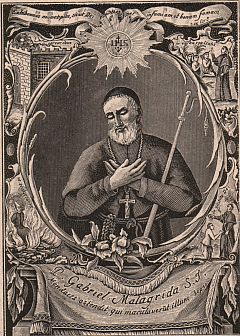
On this date in 1761,* the Jesuit Gabriel Malagrida became a late casualty of the Tavora Affair and the Lisbon earthquake when he was garroted for heresy.
Malagrida (English Wikipedia entry | Portuguese) was a 72-year-old Italian with decades of missionary service to the Portuguese New World colonies under his belt.
He had, in his time, been a prominent exponent of the Jesuits missions’ policy in the Amazon, which amounted to asserting their own jurisdiction against the secular government’s attempt to order its overseas territories. (There’s more on that conflict here.)
And this only exacerbated his principal sin of being a Jesuit — an order whose diminution was eagerly sought by the rising statesman of Enlightenment Portugal, the Marquis of Pombal.
The shock of the 1755 Lisbon earthquake would deal Pombal the trump hand he needed to start reshaping both city and society to his liking.
Malagrida, meanwhile, carped that the earthquake’s causes
“are not comets, are not stars, are not vapors or exhalations,** are not phenomena, they are not natural contingencies or causes; but they are solely our intolerable sins … I do not know how a Catholic subject dares to attribute the present calamity of this tragic earthquake to causes and natural contingencies. Do not these Catholics understand this world is not a house without an owner?”
This published pamphlet merely echoed what many of the order were saying in the pulpits, and Pombal was not about to let the backwards, superstitious crowd** own the catastrophe.
Malagrida was banished from Lisbon: and, when the Tavora family was implicated in an attempt to assassinate the Portuguese king, Malagrida, their confessor, found himself clapped in prison.
Though the now-septuagenarian priest did not share the Tavoras’ grisly public butchery, he was left to molder. A couple years in a dungeon saw him go a bit strange, and supposedly he published treatises with such eccentric features as God’s personal instructions to Malagrida, and Malagrida’s fascination with St. Anne’s uterus. Catholic sources, which consider Malagrida a martyr, doubt that he ever published any such thing; if he did, it seems apparent that it was dementia rather than heresy that afflicted the old man.
But Pombal had installed his own brother as judge of the tribunal, so the matter was prearranged. The execution itself was
staged in a dramatic way, even to the point of Malagrida’s appearing on the scaffold in Jesuit habit, to impress upon the Portuguese and the world at large that an old order had come to an end and a new one was to be established … one might say that … symbolism at the cost of one human life was a relatively humane procedure in comparison with the symbolic elimination of whole classes of society in the twentieth century.
Detail view (click for the full image) of Malagrida executed at a Lisbon auto de fe. CC image from Ricardo Mealha, original provenance unknown.
Pitying the superstitious Jesuit at the stake, Enlightenment secularist Voltaire inveighed against Enlightenment secularist Pombal for conducting the execution … just part of Voltaire’s queer ideas about not killing people over their religious beliefs.
“It is all pity and horror,” Voltaire wrote in a private correspondence. “The Inquisition has found the secret to inspire compassion for the Jesuits.”
Voltaire’s appraisal in Candide (already published by this time) of a country in the grip of religious superstition unjustly stands as one of the lasting literary monuments to an event that actually rolled back clerical influence: “the sages of [Portugal] could think of no means more effectual to prevent utter ruin than to give the people a beautiful auto-da-fé; for … the burning of a few people alive by a slow fire, and with great ceremony, is an infallible secret to hinder the earth from quaking.” That the philosophe who penned those words waxed so immoderately outraged at the demonstrative chastisement of a man who preached precisely all that hocus-pocus — that Voltaire ascribed his execution to “the Inquisition” — plants the cherry on the irony sundae.‡
But Pombal’s expedient use of the Inquisition’s medieval machinery to make an example of Father Malagrida would not be the start of a pattern; the Pombaline reforms of the years to come brought the Inquisition sharply to heel, and it was Malagrida himself who was its last victim (pdf) in Portugal in its classical ecclesiastic form.
** The “God is pissed” hypothesis was posited against theories of earth’s vapors promulgated by the Pombal-sponsored scientist Ribeiro Sanches.
† Anti-Jesuit sentiment was widely abroad in Europe at this time; increasingly resented as political manipulators, the Society would be suppressed by papal order in 1773, only to revive during the post-Napoleonic reaction.
‡ Malagrida was well-known to contemporaries in Europe, but that does not mean sympathy for him was universal. The British pol Lord Shelburne was satirized as “Malagrida” for his putative duplicity.
While we know the schism from the comfort of retrospection, those present for its 16th century inception (and long afterward) had the task of sorting out winners and losers on blood-soaked scaffolds.
So we pause this date to note the extirpation September 20 and 21 of the Babington Plot, a half-baked scheme to re-establish the Old Faith that turned into one of history’s signature achievements of espionage.
Its namesake, young Sir Anthony Babington, was a secret Catholic with more money than sense; like many a Catholic of this time, he bristled under the rule of Elizabeth I, the daughter of the very woman who started all this English Reformation trouble.
Besotted with fellow-Catholic Mary Queen of Scots after having served as her page in his youth, Babington was easy prey for the fellow invariably described as Elizabeth’s “spymaster” — Francis Walsingham.
Not one for scruples where his own security or his sovereign’s was concerned, Walsingham had long considered Mary Queen of Scots too dangerous to be left alive: every Catholic plot against Elizabeth intended to replace her on the throne with this Catholic cousin.
Trying to overcome Elizabeth’s reluctance to off fellow royalty — dangerous precedent, in these dangerous times — Walsingham entrapped Babington and a coterie of other Catholics into designing and documenting a scheme to assassinate Elizabeth and support a Spanish invasion.
And most importantly to Walsingham, they got Mary to sign off on it.
Though the design was grandiose, the real danger was pretty much nil — since Walsingham, a Renaissance reconnaissance man famous for his continent-spanning intelligence network, had penetrated the circle months before.* Walsingham let the conspiracy ripen long after he had the goods on the likes of Babington, intending to make it the instrument of Mary’s destruction. He succeeded.
Coded correspondence that Mary thought she was smuggling in and out of her cell was in fact being intercepted and decrypted.
When Babington wrote to her, alluding to his intent with “six noble gentlemen” to murder Queen Elizabeth, Mary doomed herself with a favorable reply:
The affair being thus prepared, and forces in readiness both within and without the realm, then shall it be time to set the six gentlemen to work; taking order upon the accomplishment of their design, I may be suddenly transported out of this place.
Within days, all — Mary, Babington, six gentlemen, and more — were in chains, and the commoners were being tortured into confessions and implications.**
The reckoning for Mary Queen of Scots would not arrive for some months yet.
But those of lesser breeding were dispatched with dispatch. Tried in two bunches, there were 14 in all condemned; on this date, Babington, was hanged, drawn and quartered for treason, along with accomplices John Ballard, Thomas Salisbury, Robert Barnewell, John Savage, Henry Donn and Chidiock Tichborne — the last of these leaving behind this doleful poetic adieu:
My prime of youth is but a frost of cares,
My feast of joy is but a dish of pain,
My crop of corn is but a field of tares,
And all my good is but vain hope of gain;
The day is past, and yet I saw no sun,
And now I live, and now my life is done.
The spring is past, and yet it hath not sprung;
The fruit is dead, and yet the leaves be green,
My youth is gone and yet I am but young,
I saw the world and yet I was not seen;
My thread is cut and yet it is not spun,
And now I live, and now my life is done.
I sought my death and found it in my womb,
I looked for life and saw it was a shade,
I trod the earth and knew it was my tomb,
And now I die, and now I am but made;
My glass is full, and now my glass is run,
And now I live, and now my life is done.
-Chidiock Tichborne
(Hear this bummer of a verse read aloud here and here.)
The torture these first seven unfortunates endured as their entrails were ripped from their still-living bodies was so horrible that Elizabeth ordered the seven others awaiting execution the next day simply to be hanged to death before all the disemboweling business.†
A few books about spymaster Francis Walsingham
* Walsingham had plenty of plots to contend with, but did Elizabeth even greater service keeping tabs on the buildup of the Spanish Armada through a spy network in Italy — even using it to delay the invasion by a crucial extra year by drying up Spain’s credit line with Italian bankers. (Source, via (pdf))
Incidentally, and completely off topic: the subversive, forward-thinking philosopher Giordano Bruno — an Italian who was eventually executed by the Inquisition — has been alleged to be one in Walsingham’s employ.
** Luckily for Elizabeth, the treasonous Protestants who supported her back when she was at the mercy of her Catholic half-sister Mary Tudor were better able to hold their tongues under duress.
† One of those executed on September 21, Charles Tilney, has an oblique Shakespeare connection: he’s one possible author of the play Locrine, which Shakespeare might have revised and/or staged; Locrine is in the Shakespeare Apocrypha.
On this date on 2000, Lu Cheng was shot for murder in the Republic of China (Taiwan).
The executed man’s photograph, held by his sister Lu Jing. (Chinese source)
Lu Cheng was condemned in June 2000 for kidnapping and murdering a onetime high school classmate and the sentence executed with dispatch on the eve of the Mid-Autumn Festival.
That was notwithstanding appeals by Lu’s camp against the highly circumstantial case — and a potentially compelling alibi that had been ignored in favor of a potentially torture-induced confession. (More in Chinese here)
Cases like Lu’s have helped drive a growing anti-death penalty sentiment in Taiwan, where executions declined throughout the 2000s, eventually settling into a five-year moratorium that has only recently been undone.
On the 20th of August, 1672, the city of the Hague, always so lively, so neat, and so trim that one might believe every day to be Sunday, with its shady park, with its tall trees, spreading over its Gothic houses, with its canals like large mirrors, in which its steeples and its almost Eastern cupolas are reflected,–the city of the Hague, the capital of the Seven United Provinces, was swelling in all its arteries with a black and red stream of hurried, panting, and restless citizens, who, with their knives in their girdles, muskets on their shoulders, or sticks in their hands, were pushing on to the Buytenhof, a terrible prison, the grated windows of which are still shown, where, on the charge of attempted murder preferred against him by the surgeon Tyckelaer, Cornelius de Witt, the brother of the Grand Pensionary of Holland was confined.
…
the whole town was crowding towards the Buytenhof, to witness the departure of Cornelius de Witt from prison, as he was going to exile; and to see what traces the torture of the rack had left on the noble frame of the man who knew his Horace so well.
Yet all this multitude was not crowding to the Buytenhof with the innocent view of merely feasting their eyes with the spectacle; there were many who went there to play an active part in it, and to take upon themselves an office which they conceived had been badly filled,–that of the executioner.
There were, indeed, others with less hostile intentions. All that they cared for was the spectacle, always so attractive to the mob, whose instinctive pride is flattered by it,–the sight of greatness hurled down into the dust.
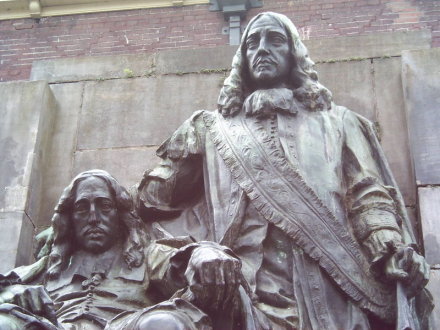
That ominous mob got its spectacle this date in 1672, lynching the Dutch Republic’s longtime de facto head of state, Johan de Witt along with his brother Cornelis/Cornelius.
A statue of Johan (standing) and Cornelis de Witt in their native Dordrecht.
The mercantile powerhouse that was the 17th century Dutch Republic was the stage for a long-running conflict between the Orange monarchists (hence the soccer uniforms) and the Republican merchant class.
With the sudden death of the young William II, Prince of Orange in 1650, leaving the (non-hereditary) executive office of stadtholder vacant, the Republicans became ascendant.
And the outstanding figure of the First Stadtholderless Period was Johan de Witt, scion of a Dordrecht merchant family powerful enough that William II had imprisoned de Witt’s own father during a power struggle.
While all these guys were landing themselves in their respective canons, Johan de Witt was trying to keep the age Golden.
Having only relatively recently broken free of Spain, the small country was an up-and-comer on the horns of a serious security dilemma: its leading commercial position put it into maritime competition with England, while its continental location made it vulnerable to the enormous army of the neighboring continental hegemon, France. Ultimately, even with its trade wealth, it did not have the resources to keep up with both of western Europe’s leading powers.
For a generation, de Witt’s statecraft kept the men of the Low Countries out of that predicament, while his brother Cornelis chipped in with a couple of timely naval victories. (Actually authored by Michiel de Ruyter, but Cornelis rode shotgun.)
In 1654, Johan brought the First Anglo-Dutch War to a close, making with Oliver Cromwell a secret pact he was only too happy to enforce never to allow William II’s son, the eventual William III, to be named stadtholder. Reason being: William III was the grandson of the Stuart king Cromwell beheaded, Charles I, and thus a potential claimant to the English throne. Both Protestant Republics had a distinct interest in keeping this monarchist well away from power. (Both would be sorely disappointed.)
A decade and a Stuart Restoration later, de Witt maintained (mostly) Dutch dominance of the seas in the Second Anglo-Dutch War, then held off France (with the help of a timely alliance with the recent adversary, England) in the War of Devolution.
In each case, he kept at least one of England or France on the sideline, or in his own camp.
But the Third Anglo-Dutch War was the charm — as it was also the Franco-Dutch War, and therefore 1672 was Rampjaar: disaster year. While the Dutch were aces on the waves, a massive French invasion easily overwhelmed them on terra firma.
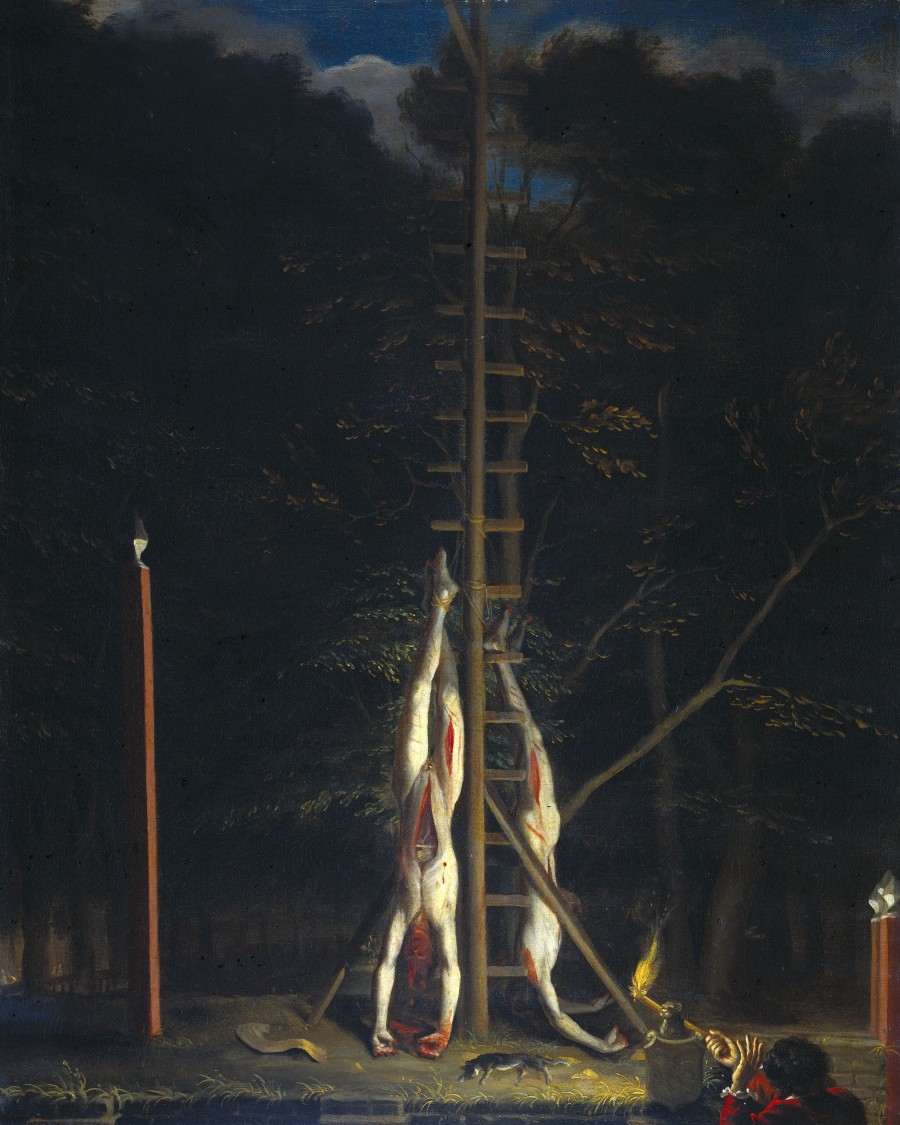
Detail view (click for the full image) of a grisly painting of the mutilated de Witt brothers strung up at The Hague. It’s attributed to Jan de Baen, who in better times took Johan de Witt’s portrait.
De Witt’s never-beloved mercantile oligarchy speedily collapsed with the military reverses, and the now all-grown-up William III was there to pick up the pieces to popular acclaim. Arrested for treason, Cornelis sustained torture without confessing, but when Johan visited him in prison — and William III incriminatingly withdrew the cavalry protecting the brothers — the mob quenched its fury with the de Witts’ blood.
every one of the miscreants, emboldened by his [Johan’s] fall, wanted to fire his gun at him, or strike him with blows of the sledge-hammer, or stab him with a knife or swords, every one wanted to draw a drop of blood from the fallen hero, and tear off a shred from his garments.
And after having mangled, and torn, and completely stripped the two brothers, the mob dragged their naked and bloody bodies to an extemporised gibbet, where amateur executioners hung them up by the feet.
Then came the most dastardly scoundrels of all, who not having dared to strike the living flesh, cut the dead in pieces, and then went about the town selling small slices of the bodies of John and Cornelius at ten sous a piece.
-Dumas
The word “ungrateful” comes to mind.
De Witt stood altogether on a lower plane than Cromwell. We regard him rather as a man of rare and singular talent, than as one of the chosen great ones of the earth, which Cromwell was. He stands far above the common run of men; and he was head and shoulders above nearly all the notable men of his time. He would have been greater if the movement of his limbs had been less burdened with the Dutch governing apparatus … He is not one whom the world can ever greatly admire or love.
(Here’s another, and here’s a 17th century volume de Witt himself coauthored.)
The rise of William III came with the decline of that Dutch Golden Age: the country fended off the immediate military threat, but it increasingly slipped behind its larger neighbors. Costly as was the Franco-Dutch War, it is a step on the path towards the present-day Europe, and this gives us enough excuse to notice that the Eurovision lead-in tune is actually from a Te Deum composed to mark its end.
But William’s own ascent to this wealthy sovereignty was just the beginning for him. Sixteen years later, the House of Orange’s champion vindicated Cromwell’s trepidation about him and gained a far more satisfactory position from which to do battle with his Gallic rival Louis XIV by stunningly overthrowing the Stuart dynasty and becoming King of England in the Glorious Revolution.**
* The Dutch remained the sole western contact of closed Japan until 1854, which is why Japan’s eventual period of scientific advancement became known as ‘Dutch Learning’.
** Albion did not forget the de Witts, either: according to this 1785 cant dictionary, the term “dewitted” had a 17th-18th century run in English to denote — well, exactly what happened to Cornelis and Johan.
On this day in 1775, Thomas Jeremiah, a free black man in the then-colony of South Carolina, was hung after being convicted of attempting to a slave insurrection.
The case against him was extremely weak, but he was tried/framed under the Negro Act of 1740 (in a slave court, although he was not a slave), wherein the defendant was considered guilty until proven innocent. South Carolina’s own royal governor, William Campbell, called it a case of “judicial murder.”
Very little is known about Jeremiah. He left no diary or letters behind, and most of his trial records have been lost. We know he was married but we know nothing about his wife, whether she was a slave or a free black like himself, or whether they had any children. We don’t know how he became free or how he learned his trade. He is, in fact, so obscure that he doesn’t even have his own Wikipedia entry.
What little we do know, however, suggests that he was a most extraordinary man: a fisherman and ship’s pilot, one of less than 500 free blacks in the city of Charles Town (now called Charleston), Jeremiah had somehow managed to claw his way up and amassed a net worth of £1,000, or about $200,000 in today’s money. He was one of the wealthiest free black men in North America, and certainly the wealthiest self-made one.
Jeremiah was basically a victim of his own success. He had risen too high; he made the local white elites uncomfortable. As Harris noted, Jeremiah “did not need to gather arms or preach revolution to undermine slavery, because his whole life was a refutation of whites’ basic justification for slavery.”
Henry Laurens, a wealthy businessman, future Continental Congressman, slaveowner, and contemporary of Jeremiah’s, stated he was “a forward fellow, puffed up by prosperity, ruined by Luxury & debauchery & grown to amazing pitch of vanity & ambition.” He needed to be smacked down and he was, most severely.
In the spring and summer of 1775, revolution was fomenting everywhere. White “Patriots” wanted an opportunity to get out from under England, but they feared their slaves would use the conflict to try and get out from under them.
Nat Turner and Charleston’s own Denmark Vesey — these immortal rebels lay years into the future, but their very prospect made slave rebellions an omnipresent fear among the white populace. It was jumpy. And when two slaves accused Jeremiah of trying to persuade them to rebel, it jumped.
Only a few months passed between Jeremiah’s arrest and his execution. By that time he was a broken man, welcoming death. After he was hung, his body was cut down and burned to ashes.




 Malagrida (