1942: Mykhailo and Olena Teliha, Ukrainian artists

On this date in 1942, poet Olena Teliha and her husband Mykhailo were shot by the Nazis at Babi Yar for their Ukrainian nationalist activism.


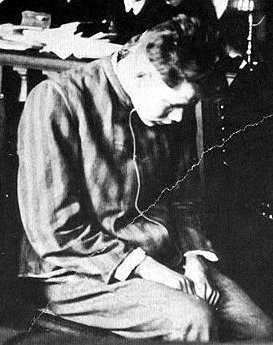
Olena Teliha (top) and her husband, Mykhailo Teliha.

Having lived in Czechoslovakia (where they met and married) and then Poland during the interwar period, the Telihas weren’t present for the worst of Soviet depredations in Ukraine. Mykhailo, a bandurist, might have been in an especially bad way, since his musical genre of choice harkened to subversive themes of Cossack insurrection, and was therefore heavily persecuted.

Instead, they moved to Kiev as the German invasion opened the prospect of returning to their ancestral homeland. There they found their affiliation with the Organization of Ukrainian Nationalists quite unwelcome to the new occupiers.

Olena kept writing for a prohibited nationalist paper, and Mykhailo gamely stuck by her.

Without a Name

Neither love, nor caprice nor adventure–
Not everything must be named.
As not always in abysmal waters
Can one find a motionless floor.

And when Your reawakened soul
Again rushes to a luminous path,
Do not question whose inspired oars
Were able to cast aside the dark shore.

Neither love, nor tenderness, nor passion,
Only heart — tumultuous eagle!
Drink then splashes, fresh, effervescent,
Of nameless, joyful sources.

(Executed Today friend Sonechka’s original translation from the Ukrainian text, found among this collection of Olena Teliha’s work)

Their execution this date is not to be confused with the mass execution of thirty thousand-plus Jews in September 1941, the atrocity with which Babi Yar is most frequently associated. This ravine continued to be used for Nazi executioners throughout the occupation of Kiev, including for more than 600 Ukrainian nationalists — who are today honored at the site with this monument:

On this day..

1944: Twenty-two or more Poles

The demonstrative public hanging this day in 1944 of Poles in the remains of the Warsaw Ghetto* was little more than an everyday atrocity in Nazi-occupied Poland — although, ten days after the gauleiter responsible for previous mass executions had himself been assassinated by the Polish Home Army, it presumably had an extra bit of meaning for the city’s denizens.

According to Gregor Dallas’s 1945: The War That Never Ended,

Nazi terror reached new heights for the non-Jewish population of Warsaw in the winter of 1943-4. People were seized at random in the streets and executed on the spot; between October and February some 270 to 300 men and women were publicly hanged or shot each week — the kind of atrocities the French commemorate in Tulle and Oradour were, in Warsaw, a part of daily life. ‘On my way to Leszno Church today,’ Julian Kulski, a young soldier of the Home Army, recorded on 11 February 1944, ‘I saw a crowd of people standing in front of the Wall. They were gazing at something above the Wall, on the Ghetto side of it. As I got closer, I could see for myself — hanged from the upper-storey balconies of what had been an apartment house were the bodies of twenty-two of our Freedom Fighters.’ Kulski, at any rate, took them for Freedom Fighters.


This blurry photo dated to the same day and location was taken from a moving tram.

This mass execution may also be one alluded to by Jewish resistance fighter Yizhak “Antek” Zuckerman,** who survived the war in Warsaw with false papers identifying him as a Pole. His A Surplus of Memory: Chronicle of the Warsaw Ghetto Uprising remembers such an execution occurring while they lived on Leszno Street after the ghetto’s destruction — and that it greatly upset his wife, Zivia Lubetkin, because Zuckerman was so late arriving home that day.

One day the Germans hanged fifty Poles on street lamps, something they often did. This time it was on Leszno Street, in retaliation for harassing Germans. In such a case, they would take fifty Poles from their “stock” in Pawiak, publish their names, add the crime for which they were being murdered, and hang them in the city on electric poles. In this case, they also strung people up on the outside walls of the ghetto, where there was still a wall, even though there was no longer a ghetto.

* Warsaw’s Jewish ghetto had been liquidated the previous spring; at this point, it was rubble behind the still-standing wall.

** Zuckerman also appeared as a witness in the Israeli trial of Adolf Eichmann.

On this day..

1895: Charles Stokes, in the heart of darkness

On January 15, 1895, a Belgian colonial official in the Congo Free State hanged Charles Stokes for trading illicitly.

A British subject who’d abandoned his humdrum Liverpool desk job to become an missionary in Africa, Stokes eventually became a merchant in the mysterious continent noted for his favorable relationships with the locals. (He had two African wives.)

In 1895, operating out of German East Africa,* his caravan was detained trading into the Congo Free StateKing Leopold’s hellish personal reserve — with “Arab” slavers who colonial authorities considered rebels. That “rebel Arab slavers” bit formed the charge against him, but trading outside the royal monopoly was probably at least as egregious in Belgian eyes.

An 1895 Review of Public Events at Home and Abroad sums up the scenario.

It was alleged that [Stokes] had large quantities of arms, ammunition, and ivory, and that he had bought the ivory at a low price from Kibonge, the assassin of Emin Pasha. Captain Lothaire, an official, an official of the Congo State, with a strong force, was then advancing from Stanley Falls to attack this Arab chief Kibonge, in revolt against the Congo State.** On Lothaire’s arrival at Kilunga, Kibonge was already a prisoner in the hands of his own native subordinates, who refused to join him in fighting the State. Stokes applied to Lothaire for protection of his ivory and goods, which he desired to carry towards the East Coast. Lothaire claimed that letters were found among Kibonge’s effects which went to prove that Stokes had sold large quantities of arms and ammunition to this chief, to be used in war against the Congo State. Mr. Stokes was arrested by Captain Lothaire’s orders, brought before a court-martial composed of two non-commissioned officers and Lothaire, and sentenced to be hanged. The execution took place the following morning.

Though not surprising that the summary hanging of a European would provoke an international incident, one would hardly call it equitable given the unnumbered, unmourned multitudes of Africans whose lives were wrung dry and discarded for Belgium’s treasury. Still, the “Stokes Affair” made the headlines in both England and Germany, and for activist types struggling to gain any kind of traction for their tales of colonial horrors, it was something to work with.

Leopold paid off both countries. The trial of Lohaire for naughtily conducting the execution ended in an acquittal. Belgium set up a blue-ribbon commission of missionaries solemnly vowing to investigate abuses, which was never heard from again.

(Look for Charles Stokes’ appearance in this tale of the Belgian Congo’s woe, beginning at about 1:01:25.)

If the Stokes incident didn’t catch fire itself, it became a stick in the accumulating dry tinder that Sir Roger Casement set a spark to in the early 20th century.

And maybe a bit more than that, too.

The horror! The horror!

Stokes’s singular story is often thought to inform (pdf) Joseph Conrad’s great literary critique of colonialism, Heart of Darkness.

The Stokes hanging would be only one data point among many for those who had ears to listen to the horrors emerging from the Congo, to be sure. Still, Molly Mahood and Ian Watt have included Stokes — the gone-native ivory trader — as one of several possible inspirations for the novel and especially the Kurtz character. Lothaire himself probably offered fodder for the petty, tyrannous impunity of colonial officers who the narrator encounters on his way to meet Kurtz.

I gathered in snatches that this was some man supposed to be in Kurtz’s district, and of whom the manager did not approve. ‘We will not be free from unfair competition till one of these fellows is hanged for an example,’ he said. ‘Certainly,’ grunted the other; ‘get him hanged! Why not? Anything — anything can be done in this country.’

* Present-day Rwanda, Burundi and Tanzania.

** Lothaire had spent the early part of the decade wresting Belgian commercial dominance in the eastern Congo from the incumbent Arabo-Swahili elites. (The link is French.) “Arabs” in the context of the Belgian Free State meant these Moslem bantus, not (by and large) ethnic Arabs as we would think of them today.

Neither were “Arab slavers” a distinct enemy class for the Free State; those prepared to play ball with white authorities raided native settlements to obtain slaves for rubber plantations and other Belgian-authorized ventures.

On this day..

1934: Marinus van der Lubbe, for the Reichstag fire

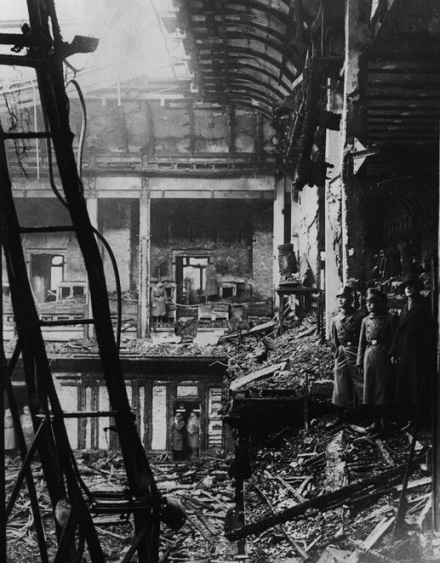
On this date in 1934, Dutch bricklayer Marinus van der Lubbe was beheaded by guillotine in Leipzig for setting the Reichstag Fire.

A watershed event* in the formation of the Nazi dictatorship, the Reichstag fire days before a parliamentary election enabled Hitler to stampede voters, suspend civil liberties, suppress left-wing parties on grounds of a suspected Communist plot, and seize “emergency” powers he would never relinquish.

Heil Hitler.

This clip from an American miniseries on Hitler with the characters chattering in unaccented English portrays the fascists’ opportunistic use of the attack on a national symbol … something not exactly unknown to later generations.

Van der Lubbe, who was arrested on the scene, suffered the predictable fate. Four other Communists charged as accomplices were acquitted, in a trial with the gratifying spectacle of Hermann Goering personally testifying, and being undressed on cross-examination by one of the reds. One is reminded here that Hitler did not yet have everything in the state apparatus at his beck and call … although he did have a great deal already, inasmuch as the arson law under which van der Lubbe died was passed after the Reichstag fire and made retroactive.

If the big-picture outcome of the Reichstag fire is pretty clear-cut, its real origin and the corresponding rightness of the judicial verdicts have remained murky ever since. The fact that the scene of the crime became Nazi ground zero for the next decade sort of obscures the evidence.

Van der Lubbe confessed, so his participation is generally taken as a given.

Whether he was really able to start the blaze acting alone, as he insisted, and the Nazis “only” exploited this fortuitous calamity; whether he was part of a larger leftist plot, as his prosecutors claimed; or whether, as Shirer and many others since have viewed him, he was a patsy in a false flag operation set up by the Nazis with an eye towards creating a politically advantageous national emergency — these possibilities remain very much up for debate.

For what it’s worth, postwar West German courts reversed and un-reversed the sentence before officially rehabilitating van der Lubbe last year on the non-specifically indisputable grounds that the legal machinery brought to bear on the Reichstag fire “enabled breaches of basic conceptions of justice.”

* From Defying Hitler: A Memoir by a writer who would soon emigrate:

I do not see that one can blame the majority of Germans who, in 1933, believed that the Reichstag fire was the work of the Communists. What one can blame them for, and what shows their terrible collective weakness of character … is that this settled the matter. With sheepish submissiveness, the German people accepted that, as a result of the fire, each one of them lost what little personal freedom and dignity was guaranteed by the constitution, as though it followed as a necessary consequence. If the Communists had burned down the Reichstag, it was perfectly in order that the government took “decisive measures”!

Next morning I discussed these matters with a few other Referendars. All of them were very interested in the question of who had committed the crime, and more than one of them hinted that they had doubts about the official version; but none of them saw anything out of the ordinary in the fact that, from now on, one’s telephone would be tapped, one’s letters opened, and one’s desk might be broken into. “I consider it a personal insult,” I said, “that I should be prevented from reading whichever newspaper I wish, because allegedly a Communist set light to the Reichstag. Don’t you?” One of them cheerfully and harmlessly said, “No. Why should I? Did you read Forwards and The Red Flag up to now?”

On this day..

1946: The treacherous Theodore Schurch

One day after William Joyce became the last Briton put to death for treason, 27-year-old Theodore Schurch hanged for treachery at London’s Pentonville Prison.

Like Joyce, Schurch had enrolled in the British Union of Fascists as a teenager in the 1930’s, and it was reputedly at the party’s direction that he joined the army as a driver.

During World War II, Schurch crossed and recrossed enemy lines, delivering operational intelligence to the Italians and Germans by helping to interrogate prisoners of war, or posing as a P.O.W. himself to gain the confidences of other captured Allied soldiers.

Scurch’s army buddies seemed to think he was alright, and there was probably more than a shred of truth to the defense’s contention, paraphrased by the London Times (September 18, 1945), that the lad

was a poor, uneducated fool who was caught young [by fascist ideology] when he knew no better and jockeyed into a position from which he could not recover.

But obviously, one makes this argument when one is in no position to contest factually the capital charges against oneself, and indeed has admitted much of it. Schurch was convicted on all nine counts of treachery, plus one of desertion. Not a big fish, maybe — but just the right size to become the last man hanged in Britain for a crime other than murder.

He’s actually listed as a war casualty, which in a way he was, on the Commonwealth War Graves Commission’s Brookwood Memorial outside of London.

On this day..

1946: William Joyce, Lord Haw-Haw

On this date in 1946, fascist William Joyce, famous by the nickname “Lord Haw-Haw” for his English-language Nazi propaganda broadcasts, was hanged at Wandsworth Prison for treason.

As a pugilistic young anti-Semite with the unusual credential of being a Unionist Irish Catholic, Joyce had been a moving spirit in the interwar British fascist party. (Since audio broadcasts would define Joyce’s life, it seems appropriate to refer the reader for a fuller biography to this recent Oxford biography podcast.)

But because time loves a good laugh, it had the guy haranguing his countrymen for insufficient patriotism marked out for the last treason execution in British history, and unrepentant about it by the time he got there.

The Brooklyn-born Joyce (he never lost his American citizenship) who naturalized as a German in 1940 had a rather tenuous claim on the patriotic high horse to begin with, and after the war, that meant the treason charge proceeded on legally doubtful grounds: speaking the King’s English didn’t mean he owed allegiance to the king. Prosecutors ultimately hung him with a British passport he’d obtained fraudulently, and the legal principle has never since sat well with jurists.

It was just the tool at hand. The British government really hated the guy.*

However limited the resources at his disposal — sparse intelligence, paltry staff, and of course, after 1942, a disastrously collapsing war effort — he had fashioned them into broadcast spin to twist the British lion’s tail in countless British homes throughout the war.

Here’s one episode, with Joyce savaging Winston Churchill, selected from archive.org’s library of Joyce broadcasts (1-7, 8-16, 17-23).

[audio:William_Joyce_Churchill.mp3]

Joyce’s star shone brightest and his invective cut deepest early in the war. Once everything at the front stopped coming up Teutons, he descended into irrelevance and self-parody, albeit without professing the slightest doubt in his fascist convictions.

This last broadcast, prepared just a few days before Germany capitulated, has our day’s principal ramblingly drunkenly from the besieged Nazi capital.

[audio:William_Joyce_final_broadcast.mp3]

Content-wise, not much had changed eight months later, but at least he managed to make his gallows statement coherently.

In death as in life, I defy the Jews who caused this last war, and I defy the power of darkness which they represent. I warn the British people against the crushing imperialism of the Soviet Union. May Britain be great once again and the hour of the greatest danger in the West may the standard be raised from the dust, crowned with the words — you have conquered nevertheless. I am proud to die for my ideals and I am sorry for the sons of Britain who have died without knowing why.

There’s a thorough, and lavishly illustrated, history of Joyce here.

* Authorities passed on prosecuting his wife Margaret, who’d also appeared on some Lord Haw-Haw broadcasts. Under the circumstances, Joyce’s daughter (by his first marriage) Heather Iandolo turned out pretty balanced.

On this day..

1900: En Hai, the murderer of von Ketteler

On the last day of the 19th century, a Chinese officer was beheaded on the public street where he had precipitated western* military intervention in the Boxer Rebellion by killing a German diplomat.

Foreign commercial penetration — and domination — was generating domestic turmoil in China. As liberal reforms foundered in the late 1890’s, a more radical anti-foreigner movement blending spiritualism and martial arts launched the Boxer Rebellion (or Yihetuan Qiyi, in the local coinage).

In addition to massacring hated missionaries, the Boxers besieged foreign diplomatic missions in Peking … and veteran German ambassador Klemens von Ketteler was killed in a firefight on a crowded street. (The particular circumstances of the killing seem highly confused, and were immediately colored by the various interested parties’ axe-grinding; it’s sometimes called an “assassination,” but there’s no proof von Ketteler was specifically targeted, and the ambassador himself managed to get a shot off in the fray.)

Given the financial interests at stake, it would be far too much to say that von Ketteler’s death caused the military intervention that ensued, but it certainly catalyzed the conflict. The next day, China’s Dowager Empress declared war against the Eight-Nation Alliance. Within two months, Peking (Beijing) was under foreign occupation.

The man detained as von Ketteler’s murderer — En Hai, or Enhai, or Su-Hai — was proud to claim the act himself, and intimations of the Chinese government’s official blessing for anti-foreigner activities were carefully massaged since the Eight-Nation powers would have need of the Qing dynasty to keep order locally.


On the afternoon of this day in 1900, En Hai was brought out from German custody to the street where von Ketteler had met his end and handed over to the Chinese for beheading. Notice the substantial foreign attendance in both the photograph and the drawing. A German officer’s diary entry cited in The Origins of the Boxer War: A Multinational Study recounted the scene.

Ketteler’s murderer was executed at last — for months past the unfortunate wretch has been begging for his execution. It took place in one of the busiest thoroughfares but there were only a few curious onlookers. Scarcely fifty yards away the usual business was being quietly transacted in the streets, people who were eating did not suffer themselves to be interrupted, and a teller of fairy-tales who was recounting his absurd stories had interested his numerous audience much more than the execution.

And to see that the lesson would not be lost on future generations of Chinese, the humiliating peace imposed upon China that December (and formally signed the following year) required China to expiate its guilt by

erect[ing] on the spot of the assassination of his Excellency the late Baron von Ketteler, commemorative monument worthy of the rank of the deceased, and bearing an inscription in the Latin, German, and Chinese languages which shall express the regrets of His Majesty the Emperor of China for the murder committed

Having been made an offer it couldn’t refuse, China honored the intersection (German link) where both the victim and his killer had died in their turns with a massive pailou archway, inscribed

This monument has been erected by order of His Majesty the Emperor of China for the Imperial German Minister Baron von Ketteler, who fell on this spot by heinous murder on the 20th of June, 1900, in everlasting commemoration of his name, as an eternal token of the Emperor’s wrath about this crime, as a warning to all.


A historical postcard of Ketteler monument.

“Everlasting commemoration,” in this case, lasted 15 years.

The national aspirations that had fired the Boxers reared up again in 1911-12 to topple the Qing. Days after Germany’s surrender in World War I, the Chinese Republic began removing the von Ketteler monument.

Visitors will need to look sharp to catch it now, in Zhongshan Park (aka Sun Yat-Sen Park or Central Park), where it has been rededicated to abstractions that age a little better than our German civil servant.

But this was still not quite the last the name von Ketteler was heard in the consular world. A relative (German link) of the man slain in Peking was a conservative diplomat of the Weimar and early Nazi period who opposed the national socialist government. Wilhelm Emmanuel von Ketteler was abducted by the Gestapo in 1938 and murdered thereafter in unclear circumstances, possibly for involvement in a very early plot to kill Hitler.

* “Western” in this case includes Japan, the regional industrial power that also flanked the Russian Empire to the east — very much a player on the European balance-of-power chessboard. Germany (obviously), France, Italy, Russia, the U.K., and the U.S.A. were the other nations involved in the intervention, along with the Austro-Hungarian Empire, whose naval deployment to China included future Sound of Music character Georg Ritter von Trapp.

A fair amount of detail on China’s foreign relations during this period is available free in the (dry, and sometimes dated) public-domain 1918 work The International Relations of the Chinese Empire.

On this day..

1943: Elfriede Scholz, Erich Maria Remarque’s sister

On this date in 1943, pacifist novelist Erich Maria Remarque lost his youngest sister to the Nazi regime — beheaded because her “brother is beyond our reach.”

Actually, Elfriede Scholz was convicted (upon the denunciation of her landlady a few weeks before) by the kangaroo People’s Court for undermining the war effort. (“Wehrkraftzersetzung” — German has a word for everything.)

Like her brother, Elfriede was a staunch opponent of the Nazi government, and in 1943 that could certainly have sufficed to get her a one-way trip to Plotzensee Prison.

But Roland Freisler‘s verdict explicitly referenced (German link) her more famous brother — upon whom the Nazis would have poured out an interwar era’s worth of fury had they been able to get to him in America.

Ihr Bruder ist uns entwischt, aber Sie werden uns nicht entwischen! (Your brother is beyond our reach, but you will not escape us!

Though Erich Maria Remarque and Adolf Hitler had served together at the Third Battle of Ypres, they didn’t quite see eye to eye after the Great War.

Remarque’s immortal anti-war novel All Quiet on the Western Front was banned and burned by war-glorifying Nazis (they also said Remarque was of Jewish descent, apparently without any factual basis).

Erna, Elfriede and Erich Remark — the author later restored an ancestral spelling of his name that had been Germanized in the 19th century — in happier times.

Remarque left Germany, an intellectual celebrity and man-about-town who rubbed shoulders with the likes of Marlene Dietrich (with whom he had a passionate affair) and Ernest Hemingway (with whom he did not).

The Nazis stripped his citizenship, and fumed that they couldn’t get their jackboots on him. (At one point, Goebbels invited Remarque to return. Sly.)

But Elfriede, they could get. She had stayed in her native Germany with her husband and family.

Not content with taking her head off, Berlin added a particularly vicious twist by billing the expatriate author 90 marks for the executioner’s trouble.

The author never said or wrote much about Elfriede, even his diaries. But years later, Erich Remarque dedicated his novel about life in a concentration camp, Spark of Life, to his late sister. Today, there’s a street named for Elfriede in the Remarques’ native Osnabruck.

More about Remarque at the German (but the site is multilingual) Erich Maria Remarque-Friedenszentrum and this online exhibit from New York University.

Better still, here’s the 1930 film version of All Quiet on the Western Front — that year’s Academy Award winner as Best Picture.

On this day..

1945: The Belsen war criminals

On this date in 1945, British hangman Albert Pierrepoint executed eleven guards of the Bergen-Belsen concentration camp and two other Nazis in occupied Hameln.

Liberated only eight months before these hangings, Belsen provided the to-us-familiar store of Nazi atrocity stories. Forty-five sat in the dock at the Belsen trial under British military authority, including the notorious camp commandante Josef Kramer — better known as the Beast of Belsen — and the “Angel of Death” Irma Grese.

Those two, and nine others less distinctively nicknamed, faced the gallows. (They were hanged together with two other war criminal convicts not connected to the Belsen trial, Georg Otto Sandrock and Ludwig Schweinberger, for a total of 13.)

On December 13, 1945, Pierrepoint hanged Grese; then, Elisabeth Volkenrath; and then, Juana Bormann, each individually. Finally, the men were then dispatched in pairs.

(Other than Kramer, the most notable was Nazi doctor Fritz Klein, who gave this reading of medical ethics when queried while the camps were still operating: “My Hippocratic oath tells me to cut a gangrenous appendix out of the human body. The Jews are the gangrenous appendix of mankind. That’s why I cut them out.”)


Of all this batch, Irma Grese, the “beautiful beast”, enjoys the liveliest afterlife.

If one finds her pretty, then she was a pretty young thing — only 16 when she hitched herself to the SS; turning 22 during her fatal postwar trial.

Stalking the camp with her whip, and (rather conveniently) cited with the ravenous sexual appetite a B-movie screenwriter would give such a character, part of her siren song is plainly the fetishistic magnetism of Nazi women.

But in the numerous discussion threads about Irma Grese, any number of her advocates will emerge.

Can we leave it at the fascination that female war criminals inspire? Certainly few 22-year-old Einsatzgruppen men have the mitigatory evidence of a coming-of-age in farming and retail so lovingly emphasized, the precise measure of complicity in genocide analyzed in such detail (pdf).

Grese, perhaps, strikes as impressionable, in the youthful sense of absorbing one’s place from the world one inhabits. Her hangman wrote that “[s]he seemed as bonny a girl as one could ever wish to meet.” As a camp guard, she wins promotions; to her interrogators, she accepts responsibility equal to Himmler’s; among those condemned at the Belsen trial, she alone is defiant.

In that guise — and whether or not it is rightly attributed to her — she presents back to her interlocutor those timeless questions of personal identity and moral responsibility: where does abnormal psychology leave off into perfectly conventional psychology that just happens to occupy an abnormal world?

On this day..

1942: Partisans by the Sonderbataillon Dirlewanger

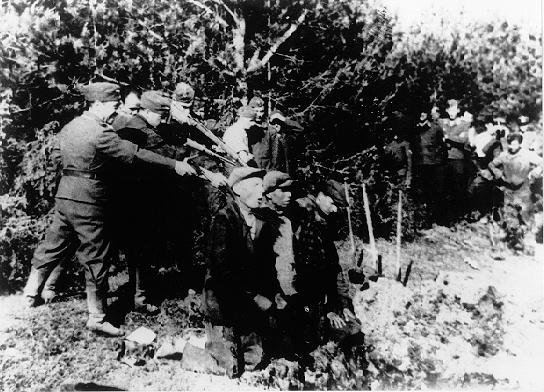
On an uncertain date in November 1942, this photograph of an SS unit executing anti-Nazi partisans in Belarus was taken.

Behind this striking but all too typical image of brutal field executions on the eastern front lies the sordid story of one of the strangest military formations in the Nazi service.

The Dirlewanger brigade was formed under a man whose fortuitous early enrollment in the NSDAP had enabled him to pull strings to get himself out of Dachau, where he had been sent after his second molestation conviction, and where unfolding events could have easily seen him on the other end of the firing squad.

Instead, Oskar Dirlewanger formed a unit of criminals and reprobates: poachers at first, and eventually, as it grew into the SS-Sonderbatallion Dirlewanger, men culled from the camps or soldiers condemned by the army, some literally trading the likelihood of execution themselves for service under one of the most disreputable commanders in the field.

Oh, and, just incidentally — it stuck them into a lawless environment where they could probably practice and refine their pathologies unchecked. Some “rehabilitation.”

As of this relatively early date, the convict floodgates weren’t yet entirely open, and the existing German volunteers were supplemented by a goodly portion of Soviet citizens recruited in the occupied territories. From 1942 to 1944, they hung around Belarus hunting guerrillas and doing to them — well, you know. (The original notion of using poachers was to exploit their ranger-like woodsman talents for anti-partisan warfare.)

Oh, and civilians. Tens of thousands of civilians. That almost goes without saying.

Sadly for Dr. Dirlewanger, events further south were undoing all his bloody work, for it was also in the November 1942 that the Red Army decisively turned the tide of the war with its counterattack at Stalingrad — in fact, it was this very date in 1942 that it completed its encirclement, stranding a quarter-million freezing Wehrmacht regulars on the banks of the Volga, only a handful ever to see Germany again.

The Dirlewanger brigade would have its own turn being minced by the Soviet war machine, though not before it had a notorious hand in drowning the Warsaw Uprising in blood.

Dirlewanger himself was tortured to death by Polish guards a few weeks after the war ended.

Part of the Themed Set: The “Ex” Stands For “Extrajudicial”.

On this day..