This site is occasionally prepared to stray outside its execution-anniversary beat to cover especially fascinating manifestations of the death penalty in history.
So for this date, we observe the anniversary not of a punishment, but of the crime itself: a capital homicide in the capital of the world that changed art forever.
NNDB summarizes Caravaggio as a “temperamental painter,” but a less generous interlocutor might prefer a descriptor like “lowlife.”
Painter, he certainly was.
Caravaggio’s pioneering realism and flair for the dramatic …
Caravaggio’s Judith Beheading Holofernes, 1598-1599. Though the young painter on the make would hardly want for models of public decapitation in 16th century Rome, the gendered intimacy with the act invites consideration of Caravaggio’s likely attendance at the execution of Beatrice Cenci.
… made him a rock star on the canvas.
Though the papacy in its dogmatic counter-reformation aspect may have viewed Caravaggio’s eye-catching chiaroscuro with suspicion, there were scudi enough to burst the coinpurse of a talent who could grace a chapel with awe-inspiring stuff like this:
However many souls his stark brushwork won for the Church, Caravaggio’s reverential fare belied the creator’s own distinctly profane pastimes: gambling, boozing, brawling, and whoring around. He needed the intervention of well-placed patrons to duck prosecution on several occasions.
May 29, 1606 finds our “temperamental” antihero encountering a wealthy scoundrel by the handle of Ranuccio Tomassoni and a problem that would outstrip any political pull the artist could muster.
Allegedly, the two met to settle a paltry tennis wager, although this may have been a cover story for a rivalry over a courtesan.*
On whatever pretext, the young hotheads fell into a melee. Caravaggio won … and Tomassoni bled to death from the gash his foe dealt to his femoral artery.**
Caravaggio now had mortal blood on his hands. Homicides were treated very harshly by the authorities. Caravaggio was about to have a price put on his head, and if he were caught, that head would be summarily removed from his body and hung on a public street. Allies of Ranuccio bent on revenge were likely to be after him as well. … Caravaggio, the celebrated Italian painter, was now a notorious wanted killer. (Source)
Condemned an outlaw by Pope Paul V — himself fruit of Rome’s Borghese family, great patrons of art in their own right — Caravaggio fled the Eternal City. His brilliance went with him, perhaps even amplified by the exile.
“The fall from grace was huge,” a curator of late Caravaggio works argued. “It had a profound impact. He started expressing the psychological essence of the stories he is telling.”
The painter and killer had four years left to him — an exile spent sleeping clothed and armed, forever looking over his shoulder. But what his jangled nerves could still spare for the canvas would helplaunch the baroque artistic epoch and still influences us today.
Flight, fancy, and fortune took Caravaggio to Malta and to Sicily, but the year or so he spent as Naples’ visiting genius would make his artistic legacy: that city’s succeeding generations of painters took enthusiastic inspiration from Caravaggio’s Neapolitan offerings — like a Seven Works of Mercy that must have carried a very personal meaning for the hunted man.
He was reportedly as arrogant and hot-tempered on the run as he had been in Rome, but Caravaggio’s art in exile also traces his desperate attempts to undo the consequences of his bad behavior.
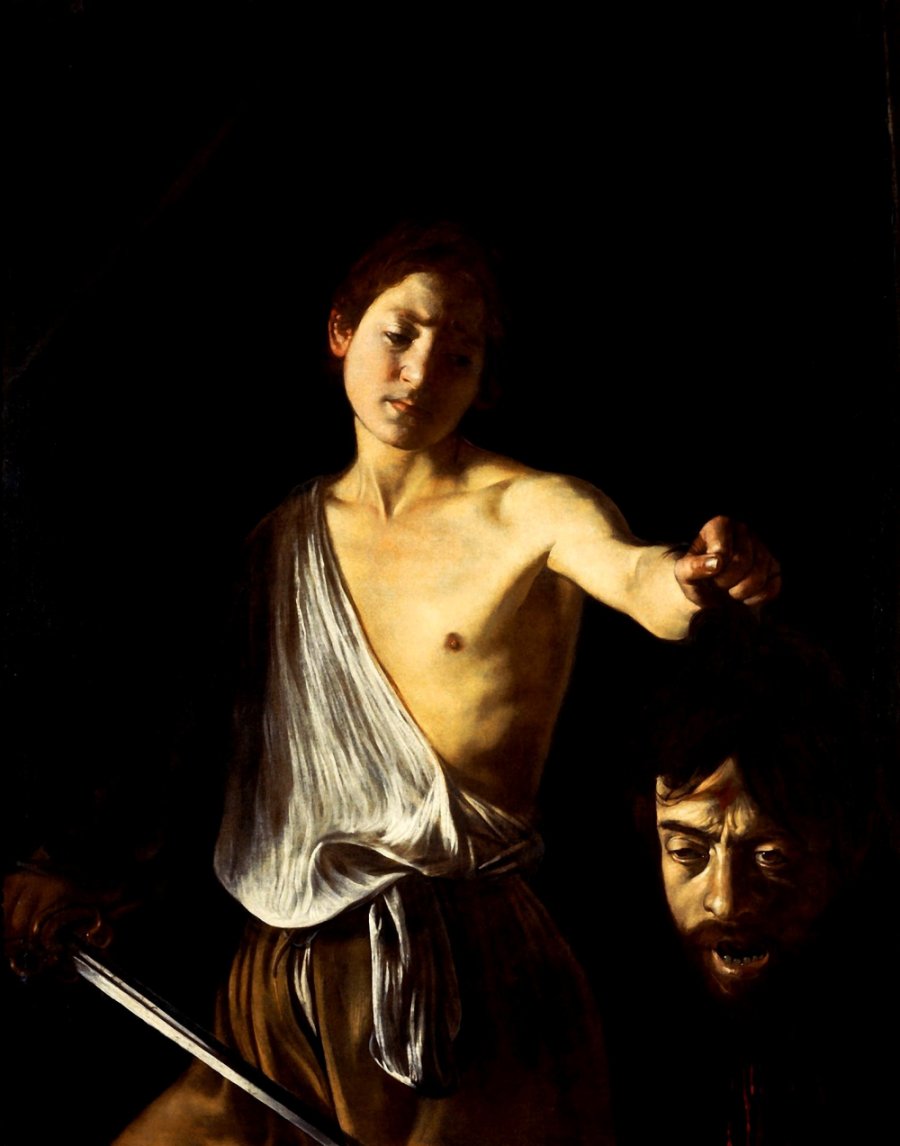
Exploiting his apparent affinity for the sawing off of heads, Caravaggio rendered his own head in a severed state in at least two apparently penitential paintings during this vulnerable period.
While David with the Head of Goliath seems to have been created shortly before Caravaggio’s own death for the pope’s art-hounding “Cardinal Nephew” Scipione Borghese, in a bid to earn a pardon. Caravaggio’s self-portrait as the dead man, and Latin inscription “humility kills pride” on the Israelite hero’s sword, suggest an attempt to effect through his creative virtuosity his own execution in effigy.
That would be, at any rate, the only execution Caravaggio ultimately had to endure. He died in the summer of 1610 under unclear — and inevitably suspicious — circumstances while attempting to return to Rome.
A few biographical books about Caravaggio …
… and some Caravaggio art books
* Ranuccio Tomassoni was the pimp and lover of a prostitute named Fillide whom Caravaggio had painted years before, and become enamored of. This Fillide was also Caravaggio’s model for Judith in the arresting painting of the Biblical heroine in mid-decapitation above.
** Possibly, if you like the love triangle angle, in a botched attempt to castrate his rival.
On this date in 1655, Catholic forces under the Duke of Savoy carried out a notorious massacre of Waldensians* in the Piedmont.
This interesting, excommunicate sect had persisted for centuries in those hard-to-reach places in Alpine foothills, intermittently ignored and hunted. After Martin Luther, many Protestants inclined to see them as a proto-Reformation movement, or even a counter-papal apostolic succession reaching back to ancient Christianity.
At any rate, they sure weren’t Catholic.
And our friend the Duke decided — perhaps piqued by the murder of a missionary Catholic priest, or for whatever other reason — to mount one of those heresy-extirpating sorties and make them Catholic in 1655.
On April 17, the Marquis of Pianezza appeared with an overwhelming force of mixed Piedmontese, French, and Irish** troops. They conducted a few skirmishes, then made nice with the Waldensian civic leaders and induced them to quartering their troops temporarily further to some expedient pretext.
Alas! alas! these poor people were undone. They had received under their roof the executioners of themselves and their families. The first two days, the 22d and 23d of April, passed in peace, the soldiers sitting at the same table, sleeping under the same roof, and conversing freely with their destined victims …
At last the blow fell like a thunderbolt. At four of the clock on the morning of the 24th April the signal was given from the Castle of La Torre. But who shall describe the scenes that followed? On the instant a thousand assassins began the work of death …
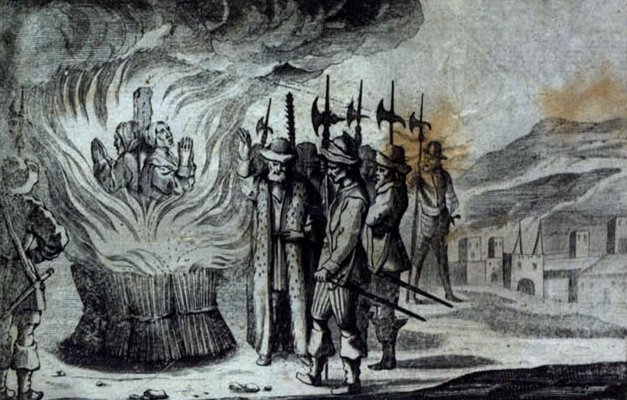
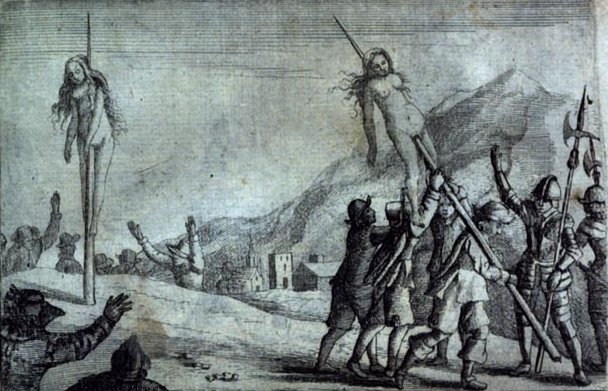
Little children were torn from the arms of their mothers, and dashed against the rocks; or, more horrible still, they were held betwixt two soldiers, who, unmoved by their piteous cries and the sight of their quivering limbs, tore them up into two halves. Their bodies were then thrown on the highways and the fields. Sick persons and old people, men and women, were burned alive in their own houses; some were hacked in pieces; some were bound up in the form of a ball, and precipitated over the rocks or rolled down the mountains … Some were slowly dismembered, and fire applied to the wounds to staunch the bleeding and prolong their sufferings; some were flayed alive; some roasted alive; others were disembowelled; some were horribly and shamefully mutilated, and of others the flesh and brains were boiled and actually eaten by these cannibals.
Without doubting the capacity of man’s inhumanity to man, the cannibalism charge reminds that we’re dealing with propaganda alongside historiography. And what great propaganda — like, babies-torn-from-incubators great.
Thumbnails (click for a larger, disturbing view) of selected images of this date’s atrocities from Samuel Morland’s The History of the Evangelical Churches of the Valleys of Piedmont
And there’s little doubt as to the overall savagery of the affair, which could well have become the opening salvo in a full-scale sectarian cleansing campaign. (A later addendum to Foxe’s Book of Martyrsnarrates the ensuing Piedmontese armed struggle, petering out before any definitive resolution in the field.)
Outrage at this hecatomb spread in Protestant Europe — which would also refer to the day’s doings as the “Bloody Easter,” since it corresponded with the eve of that celebration as reckoned by the Julian Calendar (source).
It was felt especially in Protectorate England, which intervened diplomatically.
A “day of solemn fasting and humiliation” was promulgated in Albion, along with collections for the relief of the survivors. Oliver Cromwell personally put £2,000 into the kitty.
More importantly, he dispatched diplomat Samuel Morland† to force the House of Savoy to lay off the persecution; in fact, he threatened to disrupt high statecraft between England and France unless the French twisted arms on behalf of the Waldensians.
Written correspondence for Morland’s diplomatic tour addressed to Louis XIV of France and various other continental potentates, as well as a fiery bit of oratory that Morland delivered to Savoy, all seem to have originated from the pen of Republican scribbler John Milton — the future author of Paradise Lost.‡
Milton, for whom the whole thing was more than just a day job, was further moved to put his umbrage at the slaughter into sonnet form:
Avenge O Lord thy slaughter’d Saints, whose bones
Lie scatter’d on the Alpine mountains cold,
Ev’n them who kept thy truth so pure of old
When all our Fathers worship’t Stocks and Stones,
Forget not: in thy book record their groanes
Who were thy Sheep and in their antient Fold
Slayn by the bloody Piemontese that roll’d
Mother with Infant down the Rocks. Their moans
The Vales redoubl’d to the Hills, and they
To Heav’n. Their martyr’d blood and ashes sow
O’re all th’ Italian fields where still doth sway
The triple Tyrant: that from these may grow
A hunder’d-fold, who having learnt thy way
Early may fly the Babylonian wo.
* The Waldensians in question here are interchangeably known as the Vaudois for their geographic region, actually above the Piedmont and abutting the Swiss region also known as Vaud. (These pages have visited the latter.)
This date in 1647 marked the execution of five supposed witches in Trentino.
Secular and modernist as this grim site‘s curators confessedly stand, we have perhaps given too little credence to those devout officers of the law who labored in those years to uphold the throne of heaven besieged by Satan’s varied earthly minions.
Montague Summers
In an effort to balance the record, we present this date’s account as rendered by a guy who took the supernatural a bit more seriously: Montague Summers.
Summers is a weird figure, but if he wasn’t really a throwback believer in Rome’s phantasmagoric early modern theology, he was the century’s most sublime performance artist.
Converting to Catholicism as an Anglican deacon, he went about in spooky clerical robes although his ordination status remains unclear to this day, immersed his capacious mind in supernatural arcana, and penned voluptuously eloquent books credulously treating the spectral evidence another era had given against sorcerers, vampires, lycanthropes, and suchlike habitues of the Monster Manual.*
I have endeavoured to show the witch as she really was -– an evil liver: a social pest and parasite: the devotee of a loathly and obscene creed: an adept at poisoning, blackmail, and other creeping crimes: a member of a powerful secret organization inimical to Church and State: a blasphemer in word and deed, swaying the villagers by terror and superstition: a charlatan and a quack sometimes: a bawd: an abortionist: the dark counselor of lewd court ladies and adulterous gallants: a minister to vice and inconceivable corruption, battening upon the filth and foulest passions of the age.
Summers projected (perhaps intentionally) a mysterious and vaguely sinister persona and did not disdain to cultivate a friendship with nefarious occultist Aleister Crowley, his contemporary. There were even rumors of an unwholesome interest in pederasty.
We’re confident that none of this has done his sales a bit of harm. So who are we social pests and parasites of the blogosphere not to batten upon it ourselves?
The below is drawn from Summers’ The Geography of Witchcraft — and as the reader will perceive, Geography at least purports to treat the flying-off-to-infernal-orgy stock in trade of those bygone witch hunters as legitimate evidence of the lead crone’s “attendance at the Sabbat, sometimes, no doubt, an experience on the psychic plane, for she was undoubtedly a medium of unusual powers, and sometimes in actual fact.”
A typical case of Witchcraft, and one which owing to its prominence and the meticulous investigations of the authorities has luckily been reported in full, attracted considerable attention in the winter of 1646 and the following spring. It will, moreover, be found to present so many factors and features, which occur again and again in the contemporary trials of wellnigh every European country, that it may profitably be dealt with in some detail.
A certain old woman of Castelnovo, Maria Salvatori, nicknamed “la Mercuria,” who had long been suspected of sorcery, was arrested on 26 October, 1646, and formally examined. At first the two principal charges, sufficiently damning in themselves, seem to have been that at her communions she did not swallow the Sacred Host, but kept It in her mouth to spit It out secretly and reserve It for some abominable purpose, and also that by her ecbolic spells she had caused the young Marchesa Bevilacqua to miscarry in childbirth. She was again interrogated on 8 November and put to the torture of the cord when she accused Domenica, the widow of a certain Tomaso Camelli, and Domenica’s daughter, Lucia, the wife of Antonio Caveden, both of whom dwelt at the hamlet of Villa, of being rank witches. She also avowed she had taken a Host from her mouth to give to Lucia Caveden, who thereby confected a charm which caused the abortion of the Marcioness. She added that she had also bewitched Cristoforo Sparamani, the son of Cecilia Sparamani, and that a certain Delaito Cavaleri was a necromancer and a worshipper of Satan. A further interrogation followed on 15 November, as a result of which the court, consisting of Paride Madernino, delegate in all criminal and civil cases in the districts of Castelnovo and Castellano, and his assessor Giovanni Ropele, doctor utriusque iuris, promptly gave orders to GiuseppeCoriziano, “bargello di questa turia,” to arrest Domenica and Lucia. This was done, and on Saturday, 24 November, 1646, at Nogaredo, the proceedings against the witches were formally opened. “Processus Criminalis pro destructione lamiarum.” On 27 November Domenica Carnelli was questioned by the judges, but they got little enough out of her. Two days following Lucia Caveden was brought before the tribunal. She vehemently declared that the charges were all malice; the hag Salvatori was her enemy; and with many cries she called Heaven to witness her innocence, repeatedly exclaiming “per grazia del Signor Iddio no son una stria” But the next day she proved less firm and implicated yet another woman, Domenica Gratiadei, who was immediately thrown into prison, a number of suspicious objects being found in her house when it was closely searched by the officers. Certain pots of a dark unguent and a mysterious powder being produced in court, Lucia Caveden confessed that these were for the destruction of human life and cattle. Seeing that the game was up Domenica Gratiadei, upon being put to the torture, soon laid bare all the secrets of the infernal sisterhood. She had made this unguent with which she annointed herself to attend the Sabbat “trasformata in gatto,” she had cast the evil eye on Cristofero Sparamani, she had renounced her baptism, defiled the Blessed Sacrament, adored Satan with divine honours. The judges were filled with horror, and trembled at the hideous tale of diabolism these women poured forth. Cecilia Sparamani, a plain honest woman, was next summoned as a witness and told how her son fell into fits of no ordinary kind. The doctors had acknowledged their skill baffled, and in spite of the prayers of two Capuchin fathers and the exorcisms of Monsignore the Bishop of Brondolo, this preternatural sickness still persisted. She informed the court that as soon as summer came and the roads were passable she intended to take the boy to the shrine of S. Antony at Padua, to whom she had a special devotion.
On 18 December, 1646, Benvenuta, the daughter of Domenica Gratiadei, made a startling confession. She declared that she had been taken by her mother “as if in a dream” to a place where there was dancing and singing, where she had been welcomed by a large number of revellers, and especially by a young man, who having kissed and fondled her awhile afterwards had connexion with her. This was, her mother averred, Satan himself. When closely questioned as to these proceedings the girl could only reply: “Tutto mi sembra, come ho detto, un sogno: e parevami che sempre vi fosse il diavolo in forma di quel giovene.” It would seem from these very striking and significant words that the girl was a hypnotic subject, entirely under her mother’s control, and that on these occasions she passed into a semi-trance state. The case dragged on throughout the months of January and February, 1647. There were interminable interrogations, and a large number of persons were gradually implicated.
On 2 January 1647, Domenica Gratiadei gave a detailed description of the Sabbats she had attended. She and an old warlock named Santo Peterlino always led the coven. “The rest followed in the shape of cats; but the Devil went first of all.” They enjoyed banquets, dances, plays, music, songs, and afterwards all worshipped Satan, presenting him with Hosts which they kept from their last communion. Before attending the Sabbat she anointed herself with an unguent made of “the Blessed Sacrament, the blood of certain small animals, Holy Water, the fat of dead babies” which was mixed with horrible imprecations and blasphemies to confect the charm.
On 10 January, a strange figure, Maddalena Andrei, nicknamed “La Filosofa,” first appears in the case. She confessed that she had assisted in the making of the ointment and had also adored the Devil who frequently appeared to her, “brave, like a gallant captain, dressed all in red.” On 9 March, when Giuseppe Goriziano entered the cell of La Filosofa to summon her to court he found her lying dead upon the floor. The common people believed that she had been carried off by Satan, especially as the Archpriest of Villa, Don Giovanni Bragliardi, shrewdly suspecting that the unhappy woman had committed suicide, refused her sepulture in consecrated ground.
This long and complicated Witchcraft-trial at length came to an end in April 1647. The court was throned with an excited yet hushed crowd, when the judge Paride Madernino and his assessors the Counts of Lodrone and Castel-Romano delivered the sentences. Domenica Camelli, Lucia Caveden, Domenica Gratiadei, Catterina Baroni, Zinevra Chemola, Isabella and Plonia Gratiadei, and Valentina Andrei were condemned to death. Maria Salvatori, “la Mercuria,” and Maddalena Andrei, “la Filosofa” had expired in prison. The condemned were beheaded and their bodies burned. It would seem, however, that Isabella and Polonia Gratiadei and Valentina Andrei managed to escape and could not be traced. The execution of the rest took place on 14 April, 1647, when Leonard Oberrdorfer the common hangman carried out the judicial sentence.
The chief witches here naturally fall into four groups each constituted of one old and one young woman, Domenica Camelli and Lucia her daughter; Domenica Gratiadei and Benvenuta her daughter; Isabella Gratiadei and Plonia her daughter; Maddalena Andrei and her daughter Valentina. The chief of the coven was undoubtedly Domenica Gratiadei, whose vile confessions, a mixture of most horrid blasphemies and lewdest obscenity, convince her of being a wretch wholly devoted to evil, and an active propagandist of the Satanic cult. It was she who had debauched her own daughter to “the Devil,” that young man whose name and individuality do not appear, but who may be guessed to have been a noble of the district, using the witches for his own ends and, presumably, supplying them with money to carry out his dark designs. That the whole gang frequently attended the Sabbat, at which he was not unseldom present, there can, I think, be no question.
This case is recounted in much greater detail in Italian in this Google book; this page has another summary, also in Italian.
* “[I]n every way a ‘character,’ and in some sort a throwback to the Middle Ages,” the London Times blurbed Summers at his death (obituary in the Aug. 11, 1948 issue). But his “preoccupations with the supernatural, however, represented only one side of his nature. His solid services to learning lie rather in his copious editorial and critical work on the English Restoration drama — a field in which he possessed the most comprehensive and expert knowledge.”
For exemplars of the stuff more topical to this post, one can also peruse free online his The Vampire: His Kith and Kin and his translation of the notorious witch-persecution manual Malleus Maleficarum.
Francesco Baldovino was a gentleman in affluent circumstances, of a handsome person, and of engaging manners. His domestic establishment was princely. He had a large sum in the Funds. In short, every adventitious advantage, which fortune brings, was within his reach, excepting one; Baldovino was not a noble.
It is said that, at the period of the War of Chioggia, he desired to become, among the rest, a candidate for the honours of the peerage. But, his paternal ancestor having been implicated in some manner in the Bocconio conspiracy of 1300, the family laboured under a certain obloquy, and Baldovino was a disappointed man.
Among his numerous acquaintance was one Bartolomeo D’Anselmo, also a cittadino of great wealth, and also an unsatisfied expectant of nobility. It happened on Friday, the 4th March, 1413, that Baldovino and D’Anselmo met at the Minorites, and began to discuss their common grievance. “We,” cried Baldovino, at once launching into diatribe, “pay taxes enough forsooth; yet those of the Council enjoy the emoluments of office.”
“True,” returned his companion, “and indeed we ought to make it our business to see if we cannot get for ourselves a share in the administration. Devise some plan in which I may co-operate.”
“The way would be,” whispered Baldovino, “to collect a company of our following, and to massacre them as they are leaving the Council, particularly the College, the Decemvirs, and the Avogadors.”
D’Anselmo said, “That is an excellent plan. How then do you purpose to find your men?”
“I intend,” the other continued, “to seek a good many trusty fellows, who will be at my elbow to compass this matter for us on Sunday that is coming.”
“I, too,” rejoined D’Anselmo, “will bring some.”
So they parted.
Bartolomeo D’Anselmo was not a bad man; but he was a man of no steady principle, and of an exceedingly nervous temperament. He had hardly bidden farewell to Baldovino, when the treasonable dialogue which had passed between them began to haunt his imagination. He found himself a prey to a variety of unwholesome and chimerical fancies. The echoes of his own words grated on his ears. The sound of his own voice threw him into a cold sweat.
He conceived it more than possible that they might have been overheard, and that they were betrayed. He pictured himself arrested, dragged before the Ten and into the chamber of torture, put to the question, condemned to an infamous and horrid punishment. If there had been eavesdroppers, he was pretty sure that this would be his destiny; and he knew that there was only one method of escaping from the danger.
He was base enough to pursue that method; D’Anselmo turned evidence, on the same day, against his friend.
The informer was pardoned and ennobled.
The man, whom with such vile and pitiful cowardice he had denounced, was taken into custody, examined under the cord, and on Saturday morning the 5th, at eight o’clock, was executed between the Red Columns, where he was left hanging three days, as a warning to traitors.
(Thanks to Carl Pyrdum, III, the author of the hilariously incisive blog Got Medieval, for this guest post — which originally appeared as part of his decidedly irreverent Medieval Months stroll through the Catholic Church’s quirky calendar of saintly feast days. -ed.)
While not one of the Holy Helpers proper, St. Agatha, whose feast falls on February 5, has special powers to heal ailments of the breasts, on account of having had hers cut off for refusing to worship pagan idols.
Like Bartholomew, she is usually depicted in the unfortunate after state in iconography, carrying her severed breasts before her on a tray or plate.
Because detached breasts sort of resemble bells, she’s the patron saint of bellfounders, and because they also kind of resemble dough, she works double duty as the patron of bakers, too. Oh, and just to be clear, that last sentence isn’t one of those clearly nonsensical sentences I pepper my writing with for purposes of the comedy. Agatha is the patron saint of severed boobs and everything that kind of looks like a severed boob.
The treats on the left are a traditional Cataniacassata known as “Agatha’s breasts” or “Virgin breasts” (“Minni di Vergini”). Image (c) Gergely Sipos and used with permission.
“They say,” quoth ecclesiastical historian Eusebius, “that Fabianus having come, after the death of Anteros, with others from the country, was staying at Rome, and that while there he was chosen to the office through a most wonderful manifestation of divine and heavenly grace.”
For when all the brethren had assembled to select by vote him who should succeed to the episcopate of the church, several renowned and honorable men were in the minds of many, but Fabianus, although present, was in the mind of none. But they relate that suddenly a dove flying down lighted on his head, resembling the descent of the Holy Spirit on the Saviour in the form of a dove.
Thereupon all the people, as if moved by one Divine Spirit, with all eagerness and unanimity cried out that he was worthy, and without delay they took him and placed him upon the episcopal seat.
Fabian seems to have been a competent administrator and had the luxury of occupying St. Peter‘s throne during the lull in persecutions under the Roman Emperor Philip the Arab. If you like the highly speculative hypothesis that Philip was not merely sympathetic to Christians but actually a Christian himself,* then Pope Fabian is probably the guy who baptized him.
Fabian paid the piper for those years on easy street with Philip by refusing to make the requisite sacrifices and delivering himself to a demonstrative** martyrdom in January 250. A Greek epitaph — “Fabian, bishop and martyr” — has been discovered in the catacombs.
With the surly Decius hovering around to lop off the next Roman head bold enough to submit to a bishop’s cap, the papacy stood vacant for more than a year before (with Decius out of town on campaign — for good, as it turned out) said papacy made up for lost time when it was claimed by two men set at loggerheads by the persecutions themselves: the little-known caretaker Cornelius (the Church’s official successor) and Novatian (the schismatic antipope).
The always recommended History of Rome podcast deals with this period in episode 110.
* If Philip the Arab was Christian, then he would displace Constantine the Great as the realm’s first Christian ruler; the faithful might regard the transfer of that distinction as a downgrade.
** Edward Gibbon, much less impressed than the Church with Decius’s severity, notes that
[t]he martyrs, devoted to immediate execution by the Roman magistrates, appear to have been selected from the most opposite extremes. They were either bishops and presbyters, the persons the most distinguished among the Christians by their rank and influence, and whose example might strike terror into the whole sect; or else they were the meanest and most abject among them, particularly those of the servile condition, whose lives were esteemed of little value …
On this date in 1479, a fugitive of the previous year’s Pazzi Conspiracy — an ill-starred attempt by the Pazzi family to overthrow the Medici — was hanged in Florence.
Bernardo Baroncelli had actually struck the first blow on the Pazzi conspiracy’s big day, planting a dagger in the chest of Giuliano di Piero de’ Medici in the theatrical setting of Florence’s Duomo, with the theatrical declaration, “Here, traitor!”
Must’ve been a sight to see. Giuliano wound up dead, but the rest didn’t work out so well.
Baroncelli, however, managed to evade the resulting paroxysm of civic vengeance and hightail it to Ottoman Istanbul, where he had some contacts.
Unfortunately for Bernardo, Florence had some contacts there, too. Ottoman relations with the various Italian city-states were actually quite strong, and Florence in particular enjoyed lucrative trade arrangements bringing its wool textiles to Bursa to exchange for silk.
So you can understand the effusion for Mehmet the Conqueror* (and the interest of said Mehmet the Conqueror) in this bit of Florentine diplomatic correspondence quoted in The Papacy and the Levant:
By letters of Bernardo Peruzzi we have learned with great pleasure how that most glorious prince [Mehmet] has seized Bernardo Bandini, most heinous parricide and traitor to his country, and declares himself willing to do with him whatever we may want — a decision certainly in keeping with the love and great favor he has always shown toward our Republic and our people as well as with the justice of his most serene Majesty … although as a result of the innumerable benefits done by his most glorious Majesty in the past for the Republic and our people, we owe him the greatest indebtedness and are the most faithful and obedient sons of his Majesty, nevertheless because of this last benefit it would be impossible to describe the extent to which our obligation to his most serene Majesty has grown.
A Florentine representative quickly sailed for the Ottoman capital to make the arrangements, and returned with the hated Bandini on Dec. 24. Five days later, he was hanged over the side of the Bargello.
A tan colored skull-cap, a doublet of black serge, a black jerkin, lined and the collar covered with a black and red stippled velvet.
A blue coat lined with fur of fox’s breasts.
Black hose.
Bernardo di Bandino Baroncelli.
In the video game Assassin’s Creed II, one of the missions (assigned by Giuliano’s surviving brother, Lorenzo the Magnificent) is to kill Bernardo Baroncelli … but not with trade relations and diplomacy.
The rebels were hunted to their retreat: the other brother was caught in a cave and summarily executed, which must have been at the back of Aberra and Asfawossen’s mind when they surrendered under a pledge of safe conduct.
‘Now I tell you to surrender’, wrote Graziani, ‘and I assure you nothing will happen to you. Why do you want to die uselessly?’
Only his cousins had remained with Dejaz Aberra: Mesfin Sileshi and the two younger men, Lij Merid Mangasha and Lij Abiye Abebe. They suspected Italian treachery. ‘If you want to be killed’, said Mesfin, ‘shall I kill you?’ …
The exact sequence of the events that followed is difficult to disentangle … Aberra and Asfawossen finally decided to submit. Aberra however sent his wife and baby son away with Mesfin and the two cousins, a last-minute concession to their pleas and threats.
A letter was sent up to General [Ruggero] Tracchia who had now occupied Fikke:
“To General Tracchia
“As you have assured me in your letter ot me that our lives will be spared, we shall assemble our armies and receive you by peaceful parade in a place called Bidigon.
“Aberra Kassa”
Ras Hailu in person led Aberra and Asfawossen to General Tracchia’s camp. While they were in the tent drinking coffee with the General, the men of their escort were disarmed, apparently without difficulty, and taken away (they were released the next morning). A group or carabinieri entered the tent and arrested the two brothers. It was 21 December, three days after Ras Imru had surrendered. At 7 p.m. the men in the escort heard a volley of shots in the centre of the town.
Tracchia sent a laconic cable to Graziani: ‘Dejaz Aberra and brother shot dusk in piazza of Fikke’. Graziani sent a cable to Lessona (Italian link) repeating Tracchia’s message and adding ‘Situation Salale liquidated’.
This reference to the Salale or Selale branch of the Ethiopian royal family was not entirely correct, however.
Not liquidated was the youngest brother, Asrate Kassa, who had escaped to exile and would return with Haile Selassie’s post-Mussolini government. Asrate ultimately qualified for these dolorous pages himself, however, as one of the victims of the 1974 Derg purge.
Of more immediate concern for Graziani and his ilk: Abera Kassa’s widow Kebedech Seyoum (French link) legendarily rose from childbirth after learning of her husband’s execution to become one of the Ethiopian resistance’s greatest military leaders. She’s a national hero in Ethiopia … and there’s also a Laboratorio Femminista Kebedech Seyoum in Rome, dedicated to the study of ant-fascist women.
On an unspecified date presumably around early December of 1327 — the timeframe is approximated by action’s story’s commencing on “a beautiful morning at the end of November” — the Inquisition burns the nameless peasant lover of the narrator in Umberto Eco’s novel The Name of the Rose.
Adso of Melk is apprenticed to the scientific-minded William of Baskerville — a deliberate allusion to Sherlock Holmes — when the monk is dispatched to an Italian monastery to sniff about for heresy.
The Name of the Rose unfolds a labyrinthine murder mystery around a literal labyrinth (a maze-like library) as William and Adso fight crime and the superstitious dogmatism of the Church. Well … William fights these things. Young Adso mostly comes along for the ride and keeps the action signposted for the reader with his cluelessness.
As a teenage boy, Adso has his own demons to confront.
During their short stay at the monastery, Adso has a chance, and scorching, sexual encounter with a peasant girl from the lands owned by the monks. This subplot intersects with a relentless Inquisitor — the real-life historical figure Bernard Gui* — in pursuit of refugee Dolcinians and other heretical types who were actually running around northern Italy at this time.
The long and short of it is that the girl is condemned to the stake as a sorceress on ridiculous circumstantial evidence that the reason-favoring duo is in no position to repel, and that Gui is eager to trump up further to politically muscling Dolcinian-friendly monks.
The very watchable 1986 cinematic adaptation of the novel, starring Sean Connery as Brother William and Christian Slater as Adso, takes some liberties with Eco’s text on the matter of the girl.
In the novel, her execution happens “off-camera” but with a numbing certitude; it’s an evil in the world that no protagonist can prevent, and Adso just has to get used to the idea.
I was tempted to follow her … William, grim, restrained me. “Be still, fool,” he said. “The girl is lost; she is burnt flesh.”
Directly after convicting the girl for witchcraft, and nabbing two heretical monks in the process, Gui departs the convent towards the papacy’s then-residence at Avignon for a gratifying show trial. The monks are the real prize; Brother William prophesies that the girl
will be burned beforehand, along the way, to the edification of some Catharist village along the coast. I have heard it said that Bernard is to meet his colleague Jacques Fournier (remember that name: for the present he is burning Albigensians, but he has higher ambitions), and a beautiful witch to throw on the fire will increase the prestige and the fame of both.
The smitten Adso is heartbroken over this cruelty.
“So the cellarer was right: the simple folk always pay for all, even for those who speak in their favor … who with their words of penance have driven the simple to rebel!”
…
The only sure thing was that the girl would be burned. And I felt responsible, because it was as if she would also expiate on the pyre the sin I had committed with her.
I burst shamefully into sobs and fled to my cell, where all through the night I chewed my pallet and moaned helplessly, for I was not even allowed — as they did in the romances of chivalry I had read with my companions at Melk — to lament and call out the beloved’s name.
This was the only earthly love of my life, and I could not, then or ever after, call that love by name.
The film indulges a happier and very implausible fate for Adso’s hot little number: in this version, the executions take place on-site at the monastery, and other peasants riot, murder the Inquisitor, and free our oblate’s muse. Hey, in a work that’s all about faith, why not a little deus ex machina?
Warning: SpoilersThe Name of the Rose is a detective story, and the clips below intercut the execution scene with the mystery’s big reveal. Don’t watch them if you want to approach the film or the book without knowing how it all plays out.
The movie’s softhearted approach has the benefit of allowing a more cinematic and literal presentation of Adso’s choice between the life of the mind/soul and the life of the flesh. The clip below is spoiler-safe, since you already know which one he chooses.
To geek out on this book’s complex tapestry of allusions, you could do worse than this archived study guide.
* Played by F. Murray Abraham in the film. Gui wrote a notable tract on examining heretics; dust off your Latin to read it on Google books here, or get the gist with this English-translated excerpt.
This is the feast day of the early Christian saint Cecilia.
There’s more than serendipity in that name’s pop culture connection: Cecilia is the patron saint of music for the rather slight reason that her heart sung only for God even when she was forced to marry the pagan Valerian. Seriously, Christianity didn’t have any early martyr with a stronger biographical context for a portfolio as significant as music?*
Being the go-to divine intermediary for something this big made Cece a popular saint centuries after her martyrdom, supposed to be either later in the 2nd century or early in the 3rd. (As with many other martyrs’ legends, Cecilia survives several executions before the Romans finally manage to cut her head off.)
Musician and songwriter Paul Simon knew enough St. Cecilia lore to explicitly use her in her musical-patronage role in a different song, “The Coast” (lyrics). The song “Cecilia” deepens immensely if it’s understood as mixed frustration and exaltation with the minstrel’s inconstant artistic muse.
Nor would that be the only 20th century musical homage for this accessible saint. In a more traditional vein, Benjamin Britten set to music a W.H. Audenpoem about Cecilia, creating the Hymn to St. Cecilia.
Blessed Cecilia, appear in visions
To all musicians, appear and inspire:
Translated Daughter, come down and startle
Composing mortals with immortal fire.
Fans of classical music should hit YouTube for Handel’s Ode for St. Cecilia’s Day, which appropriately premiered on this date in 1739. Here’s a nibble:
* So far as we know, blogging remains a niche of divine patronage as-yet unfilled. We propose to accept the protection of the patron saint of lost causes.






 “They say,”
