1268: Conradin of Swabia

On this date in 1268, 16-year-old boy-king Conradin was beheaded in Naples with his best friend.

This short-lived son of German king Conrad IV inherited his call on the purple at the age of 26. 26 months.

While the infant king worked on his ABC’s in Swabia, different regents tried to keep his Sicily and Jerusalem thrones warm in the far-flung empire.

Knowing an opportunity when he saw it, Conradin’s uncle and “regent” Manfred usurped him in Sicily, tipping over the first domino in a peninsular political chain that would fell both relatives. With Manfred’s accession, the rival power of the papacy now faced an active military strongman at its doorstep — and it, in turn, sponsored French noble Charles of Anjou to oppose, and eventually overthrow, Manfred.

By the time all this played out, Conradin was, if not exactly a seasoned man of the world, at least old enough to hear his voice cracking and start noticing girls. By the standards of medieval Europe, that was plenty old enough to press his injured rights in battle.

Accordingly, Conradin — Corradino, to the Italians — led Hohenstaufen boots down the boot to reclaim Sicily. No dice.

His captor’s attitude was summed up in the sentiment, Conradi vita, Caroli mors — “Conrad’s life is Charles’s death,” somewhat doubtfully ascribed to the counsel of Pope Clement IV — so when you think about it, it was no more than self-defense to cut short that vita. And his buddy’s, too, since the scaffold was already hired for the day.


Conradin of Swabia and Frederick of Baden Being Informed of Their Execution in Prison in Naples, by Goethe buddy Johann Heinrich Wilhelm Tischbein. Did either try the Sicilian Defence?

He turns to clasp with longing arms his friend,
And turning, sees the fatal blow descend,
Then presses with his lips the severed head,
Last greeting of the dying to the dead.
One quivering flash, a shock that is not pain,
And those he parted death unites again.
So perished Conradin, but legends tell
That as the trenchant blade descending fell,
An eagle, that, unseen by human eyes,
Had poised aloft, down swooping from the skies,
For one short instant hovered o’er the slain,
And dyed his pinions with a crimson stain,
Then wildly shrieked, and upward soaring sped
To witness for the blood unjustly shed.

-Tribute in purple poetry by William John Rous (Here’s a more prose-y review of Conradin’s campaign and demise)

This upward-soaring, crimson-pinioned raptor saw off the Hohenstaufen dynasty of the Holy Roman Empire.

In the unstable years that followed, as rival princes and factions jockeyed for influence, there’d be some serious nostalgia for the bygone Hohenstaufens. But there is opportunity as well as peril in change, and though it may be that this fractious realm was neither Holy, nor Roman, nor an Empire, it emerged from its interregnum with its first Habsburg ruler — of many.

What’s left of Corradino di Svevia (and Frederick of Baden) lies entombed at a Neapolitan church, watched over by a monumental 19th century marble sculpture of the youth.

On this day..

1951: Antonio Riva and Ruichi Yamaguchi

On this date in 1951, the first two foreigners — Italian merchant Antonio Riva and Japanese bookseller Ruichi Yamaguchi — were convicted and immediately executed in Beijing for a supposed plot to assassinate Mao Zedong.

According to Time magazine’s coverage of the affair, Radio Peking said that

“the streets they passed through [en route to execution] were thronged with people who expressed their feelings .. . with shouts of ‘Down with imperialism! Suppress counterrevolutionaries! Long live Chairman Mao!'”


No relation.

Riva (English Wikipedia entry | Italian) was a World War I fighter ace who had relocated to Beijing/Peking in the 1920s to peddle aircraft and training the Chinese Koumintang.

(In 1936, Riva married Catherine Lum, the daughter of American wood block artist Bertha Lum and sister of Eleanor Peter Lum, who took after mom.)

When the guys those planes were being used against won the Chinese Civil War, Riva mulled an expedient departure, but reportedly declared (Spanish link) that he could do business under any regime type.

The Communist government decided he had a different sort of business in mind. Citing Chinese state media, the London Times (Aug. 18, 1951) described the plot thus:

the conspirators planned to fire mortar shells at a reviewing stand outside the Tien An gate of the forbidden city in Peking during a procession to celebrate China’s national day on October 1 last year.

Several others, both Chinese and foreigners, drew long prison sentences as part of the “conspiracy” uncovered in a one-hour trial. The most illustrious of those was the Italian bishop Tarcisio Martina.*

Though Riva and Yamaguchi were the first foreigners officially executed by the new Chinese government, they were far from the last. All the more remarkable, then, that in a country that carries out thousands of executions per annum, Antonio Riva is thought to have been the last European citizen put to death there until Akmal Shaikh in 2009.

The Shaikh case helped rekindle interest in Riva’s execution — a timely confluence, since a recent book, L’ uomo che doveva uccidere Mao, critiqued the case against the Italian aviator.

* American diplomat Col. David Barrett, safely beyond the reach of the Maoists at Formosa, was a supposed ringleader.

On this day..

1936: Aboune Petros, Ethiopian bishop

On this date in 1936, the Italian forces occupying Ethiopia executed anti-occupation cleric Aboune Petros.

War on Ethiopia had been Benito Mussolini‘s monument to muscular Italian nationalism.

By May of 1936, it had forced Haile Selassie into exile and established control of the country. Mission accomplished!

At last Italy has her empire.

-Mussolini

As is often the case, the war of conquest instead transmogrified into a war against continuing resistance to foreign military occupation, and the colony of Italian East Africa was a short-lived and bloody affair.

The Duce will have Ethiopia, with or without the Ethiopians.

-Italian Gen. Rodolfo Graziani

(Though the progressive counterpart to Italy’s iron-fisted approach to troublemakers was monumental construction, and 1930s-era fascist architecture is still to be seen in Addis Ababa today.)

Ethiopian Orthodox patriarch Aboune — it’s a title that can also be rendered Abuna or Abune — Petros cut a public profile a little too sympathetic to the native subversives. When the Italians demanded that he tone it down, he replied (according to a hagiography that appears several places online),

The cry of my countrymen who died due to your nerve-gas and terror machinery will never allow my conscious to accept your ultimatum. How can I see my God if I give a blind eye to such a crime?

On July 28, Italians repelled a large* Abyssinian insurgent attack by the sons of Ras Kassa between Addis Ababa and Petros’s stomping-grounds of Dessie; the next day, Petros was escorted to an abrupt martyrdom to the mirroring causes of national self-determination and anti-insurgency realpolitik.

His sacrifice is commemorated in statuary as well as a couple of notable theatrical pieces, Yedam Dems (The Voice of Blood) by Makonnen Endalkachew** and Petros Yachin Saat (Petros At That Hour) by Tsegaye Gebre-Medhin.

* On the scale of thousands. It “showed a certain tenacity,” according to the London Times‘ droll Rome correspondent in a July 30 story.

** Not the same guy as the post-colonial Prime Minister who was executed in a 1974 purge.

On this day..

1501: Antonio Rinaldeschi, bad gambler

This date in 1501,* the Italian city-state of Florence celebrated a “double feast”: that of St. Mary Magdalene, which marked a civic carnival every July 22; and, the hanging of sacrilegious gambler Antonio Rinaldeschi on the walls of the Bargello.

Eleven days prior, Rinaldeschi was having a bad run of wagering at The Fig Tree tavern.

Like Jesus is some people’s co-pilot, the Virgin Mary must have been Rinaldeschi’s card-counter — for, stalking out of the premises much the poorer, our doomed punter blasphemously uttered “words that are better kept silent” about her. Then, passing an image of Holy Mother at the piazza Santa Maria de Alberighi, he gathered up some nearby dung and flung it at the sacred pic.

This dry poo maybe should have just slid right off, but the Lord works in mysterious ways.

Write William Connell and Giles Constable in “Sacrilege and Redemption in Renaissance Florence: The Case of Antonio Rinaldeschi” (Journal of the Warburg and Courtauld Institutes, vol. 61 (1998), and the source of most of this entry’s narrative),

a portion of it, resembling a rosette (‘quasi pareva una rosetta secha’), stuck to the Virgin’s diadem, above the nape of her neck. The dirtied image drew much attention. The archbishop came to look. Candles and votive images were brought before the fresco, which quickly became an object of popular devotion.

Someone saw something and the trail led back to the ill-tempered cardsharp within days, who tried to stab himself to death when he realized what was about to go down. He copped to the crime pretty quickly (at least one source says it was so that he could be executed in preference to being lynched), and his corpse dangling out the Bargello window decorated the other Mary’s regularly-scheduled homage of parades and horse-races.

(And, now that it was no longer needed as evidence, the miraculous ordure was cleaned off the statue.)

Florence at the dawn of the 16th century was truly a place where religion could get you killed. This was the city that had elevated severe Dominican friar Savonarola to dictator and morals enforcer in the 1490s (Savonarola especially hated gambling), then overthrew and burned him in 1498.

Our authors think there’s some evidence that the first couple years of the 1500s were a period when the populist religious fanatics who once grooved on Savonarola’s violent party pooper act were back on the march as against, say, the more out-of-touch syphilitic reckless gambling blasphemer element that was now, post-Savonarola, enjoying free run of the town. Having one of the latter excrement-ize a Marian monument is the sort of thing that would have led the Florentine Fox News: naturally, he had to be made an example of.

To help you bear that example in mind, a nine-panel painting, “The History of Antonio Rinaldeschi”, attributed to the hanged man’s contemporary Filippo Dolciati, can be seen in Firenze’s Stibbert Museum.

Madonna + manure, meanwhile, has its own art legacy … and the combination is still good for raising a ruckus to this day.


The Holy Virgin Mary, by Chris Ofili: a black Mary smeared with elephant dung.

* The primary sourcing on the chronology of the execution is sketchy enough that it’s possible Rinaldeschi was hanged on July 21, before midnight — rather than in the dark early hours of July 22.

On this day..

1916: Cesare Battisti and Fabio Filzi

On this date in 1916, the Austro-Hungarian empire executed Cesare Battisti and Fabio Filzi for treasonous Italian nationalism.

It was the multiethnic Habsburg state that was itself dying of its constituents’ national aspirations; in little more than two years, the state entity that carried out this day’s sentences would no longer exist at all.

Pre-World War I, Battisti (English Wikipedia entry | Italian) was actually a Socialist representative in the Austrian parliament.

When the unpleasantness broke out, though, he made a break for the peninsula where he agitated* (successfully) for Italian entry into the fray against Austria-Hungary. Irredentists had long coveted Habsburg properties with a heavy Italian population, like the Adriatic port of Trieste and Battisti’s own native Trento; the war offered an opportunity to swipe those territories, notwithstanding Italy’s putative prewar alliance with the Austrians.

Although already 40 years of age when Italy entered the war, the intrepid Battisti enlisted to fight. He was captured along with an otherwise obscure subaltern, Fabio Filzi, on the Alpine slope of Monte Corno (now known as Monte Corno Battisti) repelling the Austrian Strafexpedition.**

Austria did not stand on ceremony with these men; their capture took place on July 10, their trial on July 12, and their executions at the Castello del Buon Consiglio — an ironic Calvary, for a parliamentarian — later that same day. (To complete the scene, the strangulation-hanging was botched when Battisti’s first rope broke.)

The Austrian writer Karl Kraus would observe that “they thought they were hanging Italy, but it was really Austria on the gallows.”

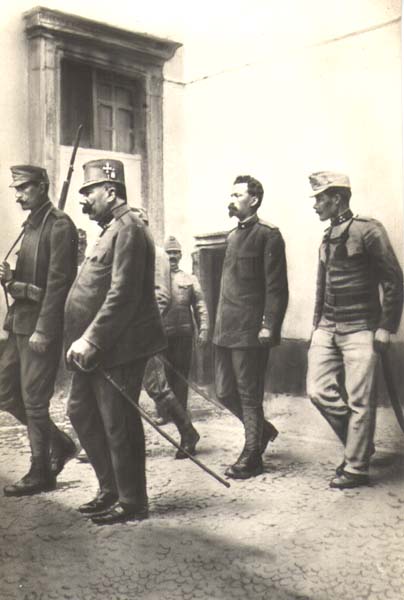
Whichever one it was, they took a lot of pictures.


Battisti and Filzi as prisoners.


Battisti leaving the courtroom en route to his execution.


Battisti approaches the scaffold.


Battisti waiting at the scaffold as the sentence is read.


The Austrian army offers a prayer and salute to the shrouded body of Cesare Battisti.

* As a socialist who broke against the internationalist position and in favor of violent nationalism, Battisti was an ally of Benito Mussolini. It was Battisti, actually, who pioneered the socialist-nationalist-newspaperman act upon which Mussolini would later raise is own star, to such an extent that Battisti’s paper, Il Popolo — the apparent inspiration behind Mussolini’s own subsequent paper, Il Popolo d’Italia — gave the still-obscure future Duce some of his earliest gigs.

A martyr’s death during World War I fortuitously spares Battisti’s legacy the unpleasant association with his friend’s postwar turn towards fascism, so there are many streets and plazas named for Battisti, as well as a memorial in Trento. He’s also honored by name in the 1918 patriotic tune La Leggenda del Piave (lyrics).

** “Punitive expedition”.

On this day..

1441: Corrado Trinci, Lord of Foligno

On this date in 1441, Corrado Trinci was executed in Foligno.

Once the hereditary lord of that venerable town,* Trinci (English Wikipedia page | Italian), had turned tetchy with his Guelph family’s onetime papal patrons and suffered the consequences.

As the proper captain of an Italian city-state in the 15th century, Trinci had taken a few spins around the wheel of fortune in battle with his neighbors. He kicked off his reign in operatically sanguinary style when a neighboring town‘s castellan murdered Trinci’s brothers, suspecting one of them of adultery with his wife. Trinci revenged himself by sacking Nocera Umbra, which still holds a civic relay race (Italian link) commemorating the occasion.

Trinci didn’t fare as well when it came to picking on someone his own size.

For the next generation, Trinci would do the Machiavellian dance characteristic of his time and station — by turns allied with, at war with, or plotting with the papacy, Condottiero Francesco Sforza, the archbishop of Florence, and miscellaneous other peninsular neighbors and rivals. He was down. He was back up. He was beaten. He fought back. Etc.

Trinci pushed the wheel of fortune one turn too far by rebelling (again) against papal authority in the mid-1430s. His march on the Vatican-controlled Duchy of Spoleto was an initial success —

Corrado brought to Foligno four hundred youths of Spoleto, the standard of Spoleto, the chains, the locks from the city gates, the seal, and the clapper from the great bell of the commune.

Durante Dorio, as quoted and translated by Sergio Bertelli

That was in 1436. By 1439, Foligno itself (with Trinci inside it) had capitulated to a papal siege. Spoleto really wanted its clapper back.

Trinci was imprisoned with his family, and after a couple years’ languishing, put to death on this date. While both the English and Italian Wikipedia entries currently assert that he was strangled, the principal source for this gentleman’s biography, the freely-available Istoria della Famiglia Trinci by Durante Dorio, flatly asserts that the washed-up brawler was dispatched by decapitato.

By whatever method Corrado laid down his life, he retired with it not only the fame of his family but its Lordship of Foligno. The title fell extinct: Foligno became part of the Papal States and remain so right up to Italy’s 19th century unification.

* When next in central Italy, be sure to visit the lovely Palazzo Trinci. Corrado commissioned the Ottaviano Nelli frescoes in the chapel.

On this day..

193: Didius Julianus, who bought the purple from the Praetorians

On this date in 193, Didius Julianus lost the rulership of Rome for which he had paid so dearly.

And his life.

Julianus‘s path to these doleful pages begins with the assassination of the notorious Emperor Commodus at the end of 192.

That man’s successor, Pertinax, was a notable bust with the Praetorian Guard, the elite imperial bodyguard whose status as the only military unit in Rome made it potential — and here, actual — kingmakers.

The Praetorians expected the payoff that had become customary for new executives, and when Pertinax proved less than liberal on that particular budget item, they turned right around and overthrew him.

To see that there would be no mistake the next time around, the Praetorians dispensed with the pretense and brazenly auctioned the purple.

Roman aristocrat and historian Cassius Dio was a witness to this hot mess.

Didius Julianus, at once an insatiate money-getter and a wanton spendthrift, who was always eager for revolution and hence had been exiled by Commodus to his native city of Mediolanum, now, when he heard of the death of Pertinax, hastily made his way to the camp, and, standing at the gates of the enclosure, made bids to the soldiers for the rule over the Romans. Then ensued a most disgraceful business and one unworthy of Rome. For, just as if it had been in some market or auction-room, both the City and its entire empire were auctioned off. The sellers were the ones who had slain their emperor, and the would-be buyers were Sulpicianus and Julianus, who vied to outbid each other, one from the inside, the other from the outside. They gradually raised their bids up to twenty thousand sesterces per soldier. Some of the soldiers would carry word to Julianus, “Sulpicianus offers so much; how much more do you make it?” And to Sulpicianus in turn, “Julianus promises so much; how much do you raise him?” Sulpicianus would have won the day, being inside and being prefect of the city and also the first to name the figure twenty thousand, had not Julianus raised his bid no longer by a small amount but by five thousand at one time, both shouting it in a loud voice and also indicating the amount with his fingers. So the soldiers, captivated by this excessive bid and at the same time fearing that Sulpicianus might avenge Pertinax (an idea that Julianus put into their heads), received Julianus inside and declared him emperor.

Cassius Dio, Book 74

The ignoble achievement is the only thing Didius Julianus is now remembered for.

While Julianus and the Praetorian guard were conducting their damnable business in the capital, three Roman generals in the provinces claimed the throne for themselves.

For centuries the Roman legions had been scattered beyond the Italian peninsula as a hedge against military coups. But after decades of relative stability at the top,* Rome was about to get a bracing reminder of what civil war looked like.

Praetorians — a few cohorts worth of men not in fighting trim — were fine for bullying Senators, but in an outright civil war, they were no match for the legions. The Praetorian Guard’s power to arbitrate the succession was contingent upon the beneficiary’s capacity to cement his own legitimacy by commanding the loyalty of (most of) the state apparatus.

And it turned out that buying the sceptre on spqrBay was not the way to get folks to bend their knees to it.

Septimius Severus, the imperial claimant nearest to the capital, commenced a relentless and virtually unresisted march on Rome, co-opting the troop garrisons and towns as he swept down the peninsula and spurning Julianus’s desperate diplomatic entreaties.

Cassius Dio’s record of Julianus scrambling to defend Rome against Severus is full of black humor.

Julianus … caused the senate to declare Severus a public enemy, and proceeded to prepare against him. In the suburbs he constructed a rampart, provided with gates, so that he might take up a position out there and fight from that base. The city during these days became nothing more nor less than a camp, in the enemy’s country, as it were. Great was the turmoil on the part of the various forces that were encamped and drilling, — men, horses, and elephants, — and great, also, was the fear inspired in the rest of the population by the armed troops, because the latter hated them. Yet at times we would be overcome by laughter; for the Praetorians did nothing worthy of their name and of their promise, for they had learned to live delicately;** the sailors summoned from the fleet stationed at Misenum did not even know how to drill; and the elephants found their towers burdensome and would not even carry their drivers any longer, but threw them off, too. But what caused us the greatest amusement was his fortifying of the palace with latticed gates and strong doors. For, inasmuch as it seemed probable that the soldiers would never have slain Pertinax so easily if the doors had been securely locked, Julianus believed that in case of defeat he would be able to shut himself up there and survive.

In the end, Severus took Rome without striking a blow: the Praetorians switched sides again, and the Eternal City delivered itself from the one usurper to the other. Cassius Dio, again, in media res

the soldiers, convinced by letters of Severus that if they surrendered the slayers of Pertinax and themselves kept the peace they would suffer no harm, arrested the men who had killed Pertinax … We [the Senate] thereupon sentenced Julianus to death, named Severus emperor, and bestowed divine honours on Pertinax. And so it came about that Julianus was slain as he was reclining in the palace itself; his only words were, “But what evil have I done? Whom have I killed?” He had lived sixty years, four months, and the same number of days, out of which he had reigned sixty-six days.

(Actually, Julianus had killed someone: foreseeing that the Praetorians were liable to turn coat yet again, Julianus had the Praetorian prefect who sold him this lemon of an empire put to death for trying to cut a deal with Severus. Despite this negative feedback, the transaction took place on a strict no-refunds, no-exchanges basis.)

A harsh deal for Didius Julianus was a pretty good one for the Roman Empire. Septimius Severus cleaned up his other rival claimants, and ran the empire capably for the next generation.

Kick back with this review of the the dreadful interlude of Didius Julianus with episodes 98 and 99 of the enjoyable History of Rome podcast.

* “The period in the history of the world during which the condition of the human race was most happy and prosperous,” in the judgment of Edward Gibbon.

** The Praetorians were also de-motivated because their promised donative had not been forthcoming.

On this day..

71 B.C.E.: The followers of Spartacus

… a Thracian of Nomadic stock, possessed not only of great courage and strength, but also in sagacity and culture superior to his fortune, and more Hellenic than Thracian. It is said that when he was first brought to Rome to be sold, a serpent was seen coiled about his face as he slept, and his wife, who was of the same tribe as Spartacus, a prophetess, and subject to visitations of the Dionysiac frenzy, declared it the sign of a great and formidable power which would attend him to a fortunate issue.

-Plutarch, The Life of Crassus

On an uncertain date roughly around this time in 71 B.C.E., some 6,000 survivors of the shattered rebel slave army of Spartacus in Rome’s Third Servile War were crucified along the Appian Way.

The specific chronology of this legendary warrior, leader of the last major slave revolt against Rome, is necessarily foggy, but in fine, he broke out of a gladiators’ camp in 73 B.C.E. and went on to lead a slave army some 100,000 strong up and down the Italian peninsula for two solid years, repeatedly stomping Roman forces sent to suppress him.

His motivations remain mysterious; if one likes, one can project back on him an anachronistic anti-slavery project, but it’s more likely he was just trying to get by day by day as the greatest empire* on the planet harried his every move and internal divisions tore at the rebel camp.

Nevertheless, Spartacus and army prospered, and plundered, in the very heart of that empire, and gave Senators reason to fret the security of their capital even as their legions carried Roman arms from Spain to Palestine.

The army (for the gladiators organized it with military discipline, realizing a mob would be easy prey for Rome) was trapped, at last, at the toe of the Italian boot by Roman plutocrat Crassus, later to become a patron of, and fellow triumvir with, Julius Caesar. Abandoned by pirates with whom the slave army attempted to negotiate passage, it was a desperate situation. Spartacus, writes Appian, “crucified a Roman prisoner in no-man’s land to demonstrate to his own troops the fate awaiting them if they were defeated.”

Duly inspired, Spartacus and his army broke out of the Roman circumvallation around February of 71 B.C.E. Hemmed in by a second Roman force, the slaves turned to fight their pursuer, Spartacus dramatically sticking a blade into his own warhorse before the fight as another one of those conquer-or-die pregame speeches.

In The Spartacus War, Barry Strauss estimates April of 71 B.C.E. for that decisive battle. The slaves lost it; Spartacus died in combat, and his ancient calumniators vied to sing his heroism on the field.

But 6,000 survivors did not go down fighting to the death. These, Crassus staked out along one of Rome’s principal highways, the carcasses left to disintegrate there for months or years.

He’s easy to admire now,** but slave revolts scare the bejeezus out of slave societies, and the Spartacus rising would keep generations — centuries — of Romans sweating about a potential repeat. (At least, elite Romans, the ones whose voices remain for us.)

Their pejorative take on Spartacus (aside from his personal valor and martial excellence, for which even hostile writers gave him credit) was long the received wisdom on this upsetter of divinely established social order. “From a small and contemptible band of robbers,” sniffed Saint Augustine of the gladiators, “they attained to a kingdom.” They “enjoyed whatever pleasures they wished, and did what their lust suggested.”

The present-day reader’s readiest association is likely the much more admiring — and famously homoerotic, which is now yet another connotation for the gladiator’s name — Stanley Kubrick classic Spartacus, which turns 50 this year and gave to the cinematic canon the stirring “I’m Spartacus!” scene as the captured slave army defiantly embraces death.

This episode is completely ahistorical, but so what? One of the wildest things about this sword-and-sandal production is how much of it isn’t made-up. Like the premise: in the lifetime of Julius Caesar, a few guys busting out of gladiator school using nothing but kitchen utensils threatened for two years to turn the Eternal City and its far-flung realms upside-down.

* Okay, still a republic, if you like. But those days were fast coming to a close.

** Especially for modern leftist radicals; Marx and Che Guevara were both big fans; German communists Rosa Luxemburg and Karl Liebknecht named their movement for Spartacus, and it was during Berlin’s “Spartacus Week” that they were murdered.

A number of sports clubs in the former Soviet bloc also carry the Spartacus name, including Russian football power Spartak Moscow as well as several clubs in Bulgaria, which currently governs most of the rebel slave’s ancestral homeland of Thrace.

A few books about Spartacus

On this day..

37: Some poor wretches, despite the death of Tiberius

The Roman Emperor Tiberius expired at Misenum on this date in 37 A.D.


The Death of Tiberius, by Jean-Paul Laurens. Tacitus records that the aged princeps was thought to have expired, to the great relief of all, when word came that he was reviving. “[Praetorian prefect] Macro, nothing daunted, ordered the old emperor to be smothered under a huge heap of clothes.”

As Tiberius had been spending his last years terrifyingly purging Rome of alleged “traitors,” his death was met with some considerable relief. Great news: charismatic young prince Caligula is in charge now!

Anyway, despite the old man’s unpopularity and the manifest injustice of his treason trials, Tiberius’s death did not quite halt momentum of political butchery. Ever thus with bureaucracies.

According to Suetonius,

The people were so glad of his death, that at the first news of it some ran about shouting, “Tiberius to the Tiber,” while others prayed to Mother Earth and the Manes to allow the dead man no abode except among the damned. Still others threatened his body with the hook and the Stairs of Mourning, especially embittered by a recent outrage, added to the memory of his former cruelty. It had been provided by decree of the senate that the execution of the condemned should in all cases be put off for ten days, and it chanced that the punishment of some fell due on the day when the news came about Tiberius. The poor wretches begged the public for protection; but since in the continued absence of Gaius [Caligula] there was no one who could be approached and appealed to, the jailers, fearing to act contrary to the law, strangled them and cast out their bodies on the Stairs of Mourning. Therefore hatred of the tyrant waxed greater, since his cruelty endured even after his death.

But Tiberius’s cruelty didn’t endure too long after his death. Pretty soon, Caligula’s cruelty would have the stage all to itself and Tiberius survivors would be yearning for the good old days.

The History of Rome podcast covers Tiberius’s crazy years and the transition to Caligula here.

* It’s not completely explicit that it was on this same March 16 that news of the emperor’s death hit Rome; therefore, it’s conceivable that the drama described here played out on a subsequent date.

On this day..

1289: Ugolino della Gherardesca, ravenous

On an uncertain date in March 1289, fallen nobleman Ugolino della Gherardesca was immured in a Pisan tower with two sons and two grandsons — all doomed to starve to death and land in the Inferno.

Hungry? Ugolino with his starving whelps, as chiseled by Jean-Baptiste Carpeaux. (Ugolino was around 70 at his death, so his sons and grandsons were actually quite a bit older than these tots.) Auguste Rodin also sculpted Ugolino, more literally following Dante’s narrative.

In the dangerous Guelph vs. Ghibelline political landscape, Gherardesca had a knack for switching sides.

Originally a Ghibelline, he was banished once for plotting but returned with the support of Guelphs, and was made podesta to negotiate with Pisa’s Guelph enemies, Florence and Lucca.

Having made the unpopular but perhaps politically necessary decision to buy peace with Florence at the expense of territory and castles, Ugolino schemed to extend his own authority in Pisa, only to find himself hoisted on his own petard when onetime plotting-partner Archbishop Ruggieri Ubaldini had Ugolino and descendants seized for (wait for it) … treachery.

Months later, Archbishop Ruggieri ordered the keys to their dungeon thrown into the Arno and left them to starve to death.

Ugolino’s fate is mostly remembered by way of Dante, who places both Ugolino and Ruggieri deep in hell — where the treacherous noble has at least the satisfaction of gnawing vengefully on the treacherous cleric, but detaches his maw long enough to deliver himself the poem’s longest speech by any of the damned.

Here’s Dante’s Ugolino, from the tail end of Canto XXII through most of Canto XXIII.

I beheld two spirits by the ice
Pent in one hollow, that the head of one
Was cowl unto the other; and as bread
Is raven’d up through hunger, th’ uppermost
Did so apply his fangs to th’ other’s brain,
Where the spine joins it. Not more furiously
On Menalippus’ temples Tydeus gnaw’d,
Than on that skull and on its garbage he.

“O thou who show’st so beastly sign of hate
‘Gainst him thou prey’st on, let me hear,” said I
“The cause, on such condition, that if right
Warrant thy grievance, knowing who ye are,
And what the colour of his sinning was,
I may repay thee in the world above,
If that, wherewith I speak be moist so long.”

HIS jaws uplifting from their fell repast,
That sinner wip’d them on the hairs o’ th’ head,
Which he behind had mangled, then began:
“Thy will obeying, I call up afresh
Sorrow past cure, which but to think of wrings
My heart, or ere I tell on’t. But if words,
That I may utter, shall prove seed to bear
Fruit of eternal infamy to him,
The traitor whom I gnaw at, thou at once
Shalt see me speak and weep. Who thou mayst be
I know not, nor how here below art come:
But Florentine thou seemest of a truth,
When I do hear thee. Know I was on earth
Count Ugolino, and th’ Archbishop he
Ruggieri. Why I neighbour him so close,
Now list. That through effect of his ill thoughts
In him my trust reposing, I was ta’en
And after murder’d, need is not I tell.
What therefore thou canst not have heard, that is,
How cruel was the murder, shalt thou hear,
And know if he have wrong’d me. A small grate
Within that mew, which for my sake the name
Of famine bears, where others yet must pine,
Already through its opening sev’ral moons
Had shown me, when I slept the evil sleep,
That from the future tore the curtain off.
This one, methought, as master of the sport,
Rode forth to chase the gaunt wolf and his whelps
Unto the mountain, which forbids the sight
Of Lucca to the Pisan. With lean brachs
Inquisitive and keen, before him rang’d
Lanfranchi with Sismondi and Gualandi.
After short course the father and the sons
Seem’d tir’d and lagging, and methought I saw
The sharp tusks gore their sides. When I awoke
Before the dawn, amid their sleep I heard
My sons (for they were with me) weep and ask
For bread. Right cruel art thou, if no pang
Thou feel at thinking what my heart foretold;
And if not now, why use thy tears to flow?
Now had they waken’d; and the hour drew near
When they were wont to bring us food; the mind
Of each misgave him through his dream, and I
Heard, at its outlet underneath lock’d up
The’ horrible tower: whence uttering not a word
I look’d upon the visage of my sons.
I wept not: so all stone I felt within.
They wept: and one, my little Anslem, cried:
“Thou lookest so! Father what ails thee?” Yet
I shed no tear, nor answer’d all that day
Nor the next night, until another sun
Came out upon the world. When a faint beam
Had to our doleful prison made its way,
And in four countenances I descry’d
The image of my own, on either hand
Through agony I bit, and they who thought
I did it through desire of feeding, rose
O’ th’ sudden, and cried, ‘Father, we should grieve
Far less, if thou wouldst eat of us: thou gav’st
These weeds of miserable flesh we wear,

‘And do thou strip them off from us again.’
Then, not to make them sadder, I kept down
My spirit in stillness. That day and the next
We all were silent. Ah, obdurate earth!
Why open’dst not upon us? When we came
To the fourth day, then Geddo at my feet
Outstretch’d did fling him, crying, ‘Hast no help
For me, my father!’ There he died, and e’en
Plainly as thou seest me, saw I the three
Fall one by one ‘twixt the fifth day and sixth:

“Whence I betook me now grown blind to grope
Over them all, and for three days aloud
Call’d on them who were dead. Then fasting got
The mastery of grief.”
Thus having spoke,

Once more upon the wretched skull his teeth
He fasten’d, like a mastiff’s ‘gainst the bone
Firm and unyielding. Oh thou Pisa! shame
Of all the people, who their dwelling make
In that fair region, where th’ Italian voice
Is heard, since that thy neighbours are so slack
To punish, from their deep foundations rise
Capraia and Gorgona, and dam up
The mouth of Arno, that each soul in thee
May perish in the waters! What if fame
Reported that thy castles were betray’d
By Ugolino, yet no right hadst thou
To stretch his children on the rack. For them,
Brigata, Ugaccione, and the pair
Of gentle ones, of whom my song hath told,
Their tender years, thou modern Thebes! did make
Uncapable of guilt.

(According to Dante, the Wayfarer, Ugolino’s daughter married Guido Novello, and the couple actually hosted Dante at one point in his long exile.)

Dante’s quite understandable speculation that Ugolino might have been driven to cannibalize children has been recently disputed by scientists examining the apparent remains of this unfortunate bunch. But it hardly matters now … and Dante was sure right about the cannibalism scene’s dramatic potential.

On this day..