1810: Tommaso Tintori, the first guillotined in Rome

It’s easy enough to accuse the Catholic Church of being behind the times.

But this date two hundred years ago found it in the criminological progressive vanguard (just ask Lord Byron!), conducting Rome’s first beheading by guillotine, that brave new instrument of egalitarian execution.

Okay, granted: it wasn’t the ecclesiastical authorities but the French occupiers who introduced the guillotine, as was their wont.

But when the Papal States were restored a few years later, after the Napoleonic Wars, the vicars of Christ were enlightened enough to keep this efficient device (and its sunk capital cost) around … at least as one option among the restored traditional sentences of hanging, quartering, and the local specialty, mazzolatura.

Biographical details of our milestone criminal are scarce on the ground, but we have his name, date of execution, and crime — omicidio — courtesy of the Italian list kept by the famed executioner Mastro Titta.

Seguono Le Giustizie Eseguite Nel Nuovo Edifizio Per Il Taglio Della Testa Nel Governo Francese.

106. Tommaso Tintori, reo di omicidio, li 28 febbraio 1810.

As one might guess, that “106” means that the prolific Titta had already notched 105 official kills in his 14 years as executioner prior to the guillotine. He would run his career total north of 500.

On this day..

1603: Not Tommaso Campanella

The wise were forced to live as the mad were accustomed, in order to shun death, such that the greatest lunatic now possesses the royal burdens. The wise now lived alone with their wisdom, behind closed doors, applauding only in public the others’ mad and twisted caprices.

-Tommaso Campanella

On this date in 1603, freaky-deaky Dominican philosopher Tommaso Campanella drew a life sentence — avoiding execution by dint of a painfully convincing performance of insanity.

Campanella had some problematically heterodox notions about the sun (namely, that it was going to consume the earth) and everything under it, and had had a recent scrape with the Inquisition.

What really got him in trouble was trucking with a Calabrian conspiracy to overthrow Spanish domination, apparently a product of the monk’s millenarian anticipation of a sort of proto-communist revolution.

Campanella was a strange guy, but this was quite a far-out plot.

As Joan Kelly-Gadol writes in this fine tome,

This took place, let it be noted, after he had written two works advocating a Papal monarchy for Italy and the world and two works promoting the interests of the Spanish Empire also in Italy and throughout the world.

Past performance is no guarantee of future returns. Once the conspiracy was betrayed,

Campanella was imprisoned … in the Castel Nuovo, one of the principal fortresses in which the Spaniards maintained a military garrison. He was arraigned before the civil tribunal for rebellion and before the ecclesiastical tribunal for heresy. His “examination” which began in January 1600 was gruesome. He claimed innocence in his first interrogation before the civil tribunal, was thrown into a dungeon, actually a cleft in the bedrock of the Castle, to remain there for seven days. Then followed torture. He “confessed,” admitting that he preached about the coming political upheaval but denying that he was part of a conspiracy to bring it about …

His desperation at this point can be gauged by the fact that by April of 1600 he began to feign madness. The ecclesiastical action against him began now, and he persisted in this attitude of insanity through three interrogations, including an hour of torture … On the fourth and fifth of June 1601, he was subjected to the cruel torture of “the vigil” to test whether his insanity was genuine. This was the usual torture of the rope, suspending the body of the victim by his tied hands over a blade which cut into his flesh whenever he yielded to the strain of holding himself in the air; but the vigil refined this cruelty by continuing it for forty hours. Campanella endured the ordeal without breaking.

And it wasn’t just a feat of toughness to beat the torturer at his own game, impressive as it is on those terms alone: Campanella pulled off a genius gambit exploiting the Inquisition’s own legal machinery to duck the separate capital charges he faced in civil and ecclesiastical court.

Joseph Scalzo’s “Campanella, Foucault, and Madness in Late-Sixteenth Century Italy”,* an academic paper that reads like a thriller, narrates Campanella’s “dangerous competition” with his persecutors.

In fine: on Easter Sunday 1600,** as he was approaching conviction and condemnation in his state trial for treason, Campanella began his insanity ploy, successfully forcing a delay in that case and initiating his separate church trial for heresy.

Then, by remaining stubbornly committed to what most of his examiners believed was a charade, Campanella won … by forcing them to inflict that juridically determinative 40-hour “vigil” torture.

the jurisprudence of the time accorded torture so much force, such as to annul all other proofs and “to purge circumstantial evidence”; if the torture had been vigorous and unusual. The accused came, all the more to avail himself of the result obtained, according to the scholarship of the criminologists most in vogue. Thus, Campanella had judicially to be regarded as insane, although everyone was persuaded that he probably simulated insanity. The consequence, in the tribunal of the Holy Office, was not indifferent: He was a “relapsed heretic,” and even if repentant, he would have been disgraced and consigned to the secular court of justice, which would have executed him; being mad, he could no longer suffer condemnation, and in the circumstance in which he might already have been condemned, he would have been spared the death penalty, to reason and repent.

(this is Scalzo’s quotation of Luigi Amabile, an Italian who wrote the book on Campanella; I have been unable to find the Amabile original online.)

Home free.

Having reached this judicial safe haven, Campanella soon — in fact, according to the man who tortured him, literally on the walk from the vigil back to his cell — resumed a recognizable rationality.

He’d languish in prison until 1626 (a few years after he got out, he had to flee to France), but he made the most of it. Campanella wrote his magnum opus, the utopian City of the Sun, while awaiting his sentence in 1602. A number of other works on a wide array of subjects — science, philosophy, theology, political governance (he returned to giving the Spanish empire supportive advice), a vigorous defense of Galileo — were also composed during his 27 years under lock and key.

Campanella’s visionary anticipation of radical egalitarianism would, like Thomas More‘s, help shape the utopian literary genre. But Campanella’s take, while still a theocratic one, lent itself to distinctly more subversive interpretation.†

For example, this Brezhnev-era Soviet essay‡ (unearthed and translated by Executed Today friend and sometime guest-blogger Sonechka) decants the Dominican’s heretical notions into Marxist orthodoxy.

How many times were the communists denounced by their enemies for this “commonality of wives”! Scientific communism, certainly, is not responsible for the figments of a monk like Campanella. But it is instructive to penetrate his logic. It is not commodification or dehumanization that hides behind Campanella’s “commonality of wives”. The women of the “City of Sun” have the same rights as men … The “commonality of women” is equivalent to the “commonality of men” on the basis of mutual equality. That is why, though [we are] decisively rejecting this type of family-free communism, it is necessary to consider who stands on the higher moral grounds — Campanella’s woman, alien to deceit and pretense, or a false bourgeois woman, whose lot in life is adultery and legalized prostitution.

Ultimately, this wild man not only got the high moral ground: he got to die in bed. Once in a while, we get a happy(ish) ending.

So although it actually has nothing to do with Tommaso, “La Campanella”“Little Bell”, a Paganini violin concerto — allows us here at this blog (in common with our day’s hero) an atypically soothing* denouement.

* Joseph Scalzo, “Campanella, Foucault, and Madness in Late-Sixteenth Century Italy”, The Sixteenth Century Journal, Vol. 21, No. 3 (Autumn, 1990)

** Campanella’s Easter 1600 madness was initiated only a few weeks after fellow intellectual omnivore Giordano Bruno was burned for heresy up the road in Rome. Strictly coincidence.

† Since so much of Campanella’s work was produced while the author was under duress — fighting capital charges, applying for clemency and release — it remains disputable just which parts of it can be taken to represent his real beliefs.

‡ L. Vorob’ev. “Utopija i dejstvitelnost”. (“Utopia and Reality”) in Utopicheskij roman XVI-XVII vekov (Utopian Novel of XVI-XVII century); Series “Biblioteka vsemirnoj literatury”, Khudozhestevnnaja literature, Moscow, 1971, p. 19.

On this day..

104 B.C.E.: Jugurtha

(Thanks to Daily Kos diarist “emperorhadrian” for licensing this guest post, originally published on that site June 24, 2007. -ed.)

The Jugurthine War was a key war in the final century of the Roman Republic.

Like the Americans in Iraq, Rome assumed that their war against Jugurtha, King of Numidia (a nation in north Africa), would be a cakewalk. They believed that Numidia was a nation of savages with a bizarre religion. They assumed that their own “shock and awe” attacks by the superior legions would decapitate and destroy the “evil doer” Jugurtha. They believed that in order to liberate the Numidians of their primitive ways, they had to impose the civilized will of the Roman state on this backward nation. Rome never expected that the Numidians would wage an insurgent war against their Roman occupiers. This war ended up dragging on for almost a decade. And in the end, it showed the depravity of the ruling party (the ultra-conservative republican Optimate party), which was sending the Roman Republic on its way to tyranny, empire and ruin.

In 148 BC, the King of Numidia, Masinissa, died. The Roman proconsul, Publius Cornelius Scipio Aemilianus, had been given authority by Masinissa to divide Masinissa’s estate. He divided it between Masinissa’s three sons, Micipsa, Gulussa, and Mastarnable. Soon after, Gulussa and Mastarnable died, leaving Micipsa as the sole King of Numidia. Around the year 134 BC, Micipsa sent Jugurtha (who was Masinissa’s grandson, but the son of another Numidian) to Spain with Scipio Aemilianius. Scipio was fighting the Celtiberians, who lived in a part of what is now Spain. Jugurtha was able to raise an army to help Scipio. Because of the valor of Jugurtha and his army at the Siege of Numantia, Scipio was able to win his war against the Celtiberians.

While fighting for Rome, Jugurtha worked alongside his future enemy, Gaius Marius. Jugurtha not only learned the superior Roman style of fighting, but he also learned of Rome’s weakness for money and thus bribery. Jugurtha described Rome as “urbem venalem et mature perituram, si emptorem invenerit” (“a city for sale and doomed to quick destruction, if it should ever find a buyer”). When Jugurtha returned to Numidia, Micipsa adopted Jugurtha, and decided to include Jugurtha in his will.

After the fall of Numantia, Jugurtha returned home with a letter from Scipio addressed to his uncle; in it, the commander praised Jugurtha’s exploits and congratulated Micipsa for having “a kinsman worthy of yourself, and of his grandfather Masinissa” (Sallust Iug. 9). On this recommendation the king formally adopted Jugurtha and made him co-heir with his own children

In 118, Micipsa died. He left his kingdom to Jugurtha and his two natural sons, Hiempsal and Adherbal. Shortly after Micipsa’s death, Jugurtha had Hiempsal killed. Adherbal fled to Rome. The Roman Senate sent a commission to Numidia to make peace. Jugurtha bribed the Romans on the commission, and thus the commission gave the better regions of the kingdom to Jugurtha.

In 113 BC, Jugurtha took his army and cornered Adherbal in his capital city of Citra. According to Sallust, Adherbal had the support of the people, but Jugurtha had the support of the best soldiers. A Roman Commission was sent to Numidia to forge a new peace. Jugurtha then bribed the Romans on this commission. The Romans thus allowed Jugurtha to storm Citra, and slaughter Adherbal and his supporters. Because Jugurtha slaughtered a number of Italian business people (including Roman Equites, or “Knights“), the Roman senate declared war on Jugurtha.

The Roman Senate sent an army under the command of the consul Lucius Calpurnius Bestia to fight Jugurtha. Bestia decisively defeated Jugurtha. But Jugurtha bribed Bestia, and thus was given unusually favorable terms. The Roman Senate viewed the favorable terms with suspicion, so it summoned Jugurtha to Rome. When Jugurtha arrived in Rome, he bribed two Tribunes, who thus prevented him from testifying. While in Rome, Jugurtha attempted to have his cousin and rival Massiva assassinated. Because of this, he was expelled from the city and returned to Numidia.

In 110 BC, the Roman Senate sent the praetor Aulus Postumus Albinus (who was the cousin of a consul for that year) to defeat Jugurtha. Because Jugurtha bribed key Romans involved in Albinus’ army (who then betrayed Albinus), Albinus was defeated.

The Roman Senate then sent the consul Quintus Caecilius Metellus to fight Jugurtha. At the Battle of the Muthul, a young Roman officer named Gaius Marius helped to reorganize Metellus’ legions, which then defeated Jugurtha. But Jugurtha was defeated because he forced his army to retreat before it could suffer heavy losses. The Romans did suffer their own heavy losses. Jugurtha disbanded his army, and had his soliders mount an insurgency to fight the Roman occupiers.

Marius returned to Rome. Dissatisfied with the slow pace of the war under Metellus, the Roman Military Assembly (one of the two Roman legislative assemblies, similar to the US Senate) appointed Marius consul (the Military Assembly, not the senate, appointed consuls). The Roman consuls had similar powers as the US President. The consulship was the highest constitutional office, and the consuls had imperium powers, which allowed them to command armies and conduct wars. The senate didn’t want Marius to be consul, because at this time it was dominated by an ultra-conservative republican party of aristocratic elites known as the Optimates. Marius belonged to the party that opposed the Optimates, the Populares. Partly because the senate didn’t like Marius, and partly because of the increasing difficulty Rome was having in recruiting armies, Marius was forced to raise his own army.

The capture of Jugurtha, from this French history of the Jugurthine War.

Marius took his army to Numidia to fight Jugurtha. But while Marius had been raising his army, Jugurtha allied with his father-in-law, Bocchus, the King of Mauretania. Marius defeated Jugurtha and Bocchus in several key battles. But much like with the American occupation in Iraq, Jugurtha’s strategy of insurgency warfare against the occupiers rendered all conventional victories irrelevant. Marius was playing a game of whack-a-mole. No matter how many times the Numidians were defeated, Jugurtha’s insurgents would regroup and keep fighting. It became clear that because of this, Rome could not defeat Jugurtha.

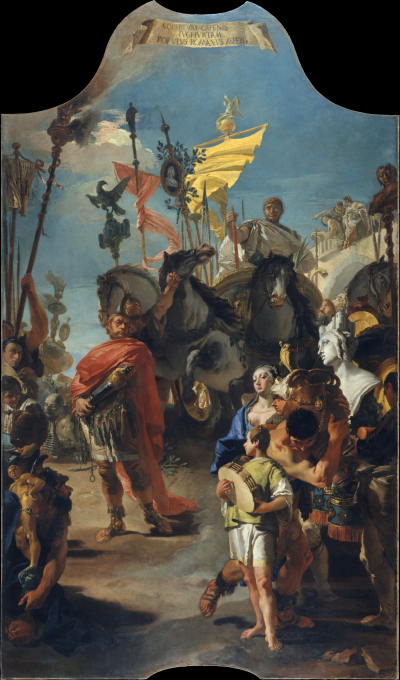
Marius sent his young Quaestor, Lucius Cornelius Sulla, to Bocchus. Sulla bribed Bocchus, and told him that Bocchus would be given a part of Numidia if he would betray Jugurtha. Bocchus then decided to give Jugurtha to Sulla. Sulla took Jugurtha to Rome, where Jugurtha was strangled in the Tullianum in Rome after marching in Marius’ January 1, 104 B.C. Triumph.


The Triumph of Marius (1729) by Giovanni Battista Tiepolo. The inscription in Latin reads “The Roman people behold Jugurtha laden with chains”.

The Jugurthine War was over. But in the process, several problems were exposed that would cause Rome serious pain in the future. Republicans in this country love to tell us that money in politics is harmless free speech. But as we saw in the Roman Republic during the Jugurthine War, money can be very corrupting. Rome almost lost the war because of money in politics, and the susceptibility of public officials to bribery.

In addition, this war saw the rise of two Romans who would play a key role in the events that directly preceded the fall of the Roman Republic. The first Roman made famous through this war was Gaius Marius. Gaius Marius would later hold the Roman Consulship an unconstitutional 7 times in 21 years (constitutionally, a Roman had to wait 10 years before being reelected consul).

The second Roman made famous through this war was Lucius Cornelius Sulla. Sulla and Marius would fight an unconstitutional civil war with each other several years after this war had ended. Sulla would illegally march his troops on Rome, and unconstitutionally legalize the mass killing of Marius’ supporters. Marius’ supporters in the senate would unconstitutionally prevent Sulla from fighting a war during one of Sulla’s consulships. Sulla would eventually seize absolute power for himself. Sulla would be the first Roman to be Dictator in almost 150 years. He would also be the first Roman in history to hold the dictatorship without the traditional six month term limit.

As dictator, Sulla would illegally change the Roman constitution to make himself and his party (the ultra-conservative republican Optimates) even more powerful. And most importantly, Sulla would set the example (of civil war on Romans, and then the seizing of absolute power) that the future tyrant Gaius Julius Caesar would follow.

In the end, the actions taken by key players in the war against Jugurtha would be repeated in the final destruction of the Roman Republic. The future triumvir Pompey would unconstitutionally hold multiple consulships in a short period of time. Crassus, another future triumvir, would illegally bribe politicians to get his way. And the future tyrant Julius Caesar would bribe, unconstitutionally hold the consulship, and become dictator for life (as Sulla had done). It was Caesar’s actions in this regard, as well as the similar actions of his adopted son and heir, Gaius Octavius (later Gaius Julius Caesar Octavianus, the Emperor Augustus) that would once and for all destroy the Roman Republic, and create the Roman Empire.

1. When when, and whenever death closes our eyelids,
2. Moving naked over Acheron
3. Upon the one raft, victor and conquered together,
4. Marius and Jugurtha together,
5. one tangle of shadows.

6. Caesar plots against India,
7. Tigris and Euphrates shall, from now on, flow at his bidding,
8. Tibet shall be full of Roman policemen,
9. And the Parthians shall get used to our statuary
10. and acquire a Roman religion;

11. One raft on the veiled flood of Acheron,
12. Marius and Jagurtha together.
13. Nor at my funeral either will there be any long trail,
14. bearing ancestral lares and images;
15. No trumpets filled with my emptiness,
16. Nor shall it be on an Atalic bed;
17. The perfumed cloths shall be absent.
18. A small plebeian procession.
19. Enough, enough and in plenty
20. There will be three books at my obsequies
21. Which I take, my not unworthy gift, to Persephone.

From Homage to Sextus Propertius, Canto VI by Ezra Pound

On this day..

1624: Marco Antonio de Dominis, posthumously

On this date in 1624, the recently-deceased body of unscrupulous Croatian prelate Marco Antonio de Dominis was burned at Rome’s Campo dei Fiori, along with all his manuscripts.

Hypothesizing

As a precocious young man Dominis taught mathematics, rhetoric and philosophy; in 1611, he produced a scientific treatise on the formation of rainbows through light refraction, De radiis visus et lucis. A century later, Isaac Newton would write* in Opticks that

it is now agreed upon, that this Bow is made by Refraction of the Sun’s Light in drops of falling rain. This was understood by some of the Antients, and of late more fully discover’d and explain’d by the famous ANTONIUS DE DOMINIS Archbishop of Spalato.**

More opportune was his advocacy of a moon-induced tide, which idea his contemporary Galileo erroneously scorned.†

Though he makes a “great men of Croatian science” list, the scientific dabblings are not what the man was chiefly known for.

Apostatizing

A caricature of Dominis made an appearance, around the time of the man’s bodily demise, in Thomas Middleton’s play A Game at Chess, as the “fat bishop” who switches sides from black to white and back.

And that’s the man’s legacy, in a nutshell.

Elevated to Bishop of Senj, and then Spalato, he got the Inquisition after him and raised dust for England and the Anglican church in 1616.

They called you great-bellied-Doctour, made fat under Antichrist; and some there were also that sayd, that before you ranne away from the Pope, you got your owne Neece with child, and that feare to be punished for it, made you trudge away with your great load of flesh in such hast.

John Floyd

In Albion the absconded archbishop settled into a fine tenured appointment on the king’s dole to denounce the papists like only a convert can do. As A Game at Chess would indicate, he also earned fame for his avarice and gluttony, and who knows how many other deadly sins.

The rep for opportunism grew when Dominis defected back to Holy Mother Church upon the election of an old intimate as Pope Gregory XV. His well-worn welcome in England as anti-papal vituperator had, too, become complicated by the progress of the proposed Spanish Match to wed Prince Charles to Europe’s leading Catholic monarchy — an ultimately abortive project, but nearing the acme of its fortunes at the time Dominis returned to Italy.

(The Spanish Match is the protracted political and diplomatic dance whose progress A Game at Chess allegorically tells. Dominis arranged his return to the Catholic fold through the Spanish ambassador in England, making the former a fit character for the playwright to project the double-dealing and skullduggery of the rivals’ negotiations.)

Theosophizing

Unfortunately for our unprincipled Renaissance man, Gregory himself yielded up the ghost almost immediately and left the Church in the hands of the aggressive Urban VIII. (Urban is the guy who forced Dominis’s old tidal rival Galileo to retract heliocentrism.)

Dominis — who seems to have been an ecumenical guy, maybe just a fancy way of saying he could accommodate any doctrine amenable to his ambition‡ — was evidently still trafficking with the unorthodox even after he returned, recanted, and renounced. (Renunciation in English | Latin).§

One contemporary reportedly said of Dominis

he was a malecontent knave when he fled from us, a railing knave while he lived with you, and a motley parti-coloured knave now he is come back.

The Inquisition imprisoned Dominis, and his death in Castel Sant’Angelo was not sufficient to end heresy proceedings against such as he left behind.

[H]is body was put into a well-pitched coffin, and that into another greater than it … until such time as the cause of the said Archbishop, still depending, should be determined by the Sacred Congregation; that according to their sentence, whatever justice did require, might be done upon him.

The sentence being framed and ready to be put in execution, the said body was … taken the twentieth of this present month of December, forth from the convent where it was left, and carried to the church of Minerva, and there laid upon a table in an eminent place, together with his picture and a little sack of books which he had printed; and where it stood all the night.

The next morning … the most illustrious and most reverend lods cardinals, supreme inquisitors, with many others … proceeded unto a definitive sentence, which was, to declare him unworthy of the favour of the Holy See apostolic, to deprive him of all his honour, benefit, or dignity, confiscate his goods, and give him over to the secular powers, as de facto they then gave him over, that he and his picture, together with the books he had written, should be burned …

INSCRIPTIO

MARCUS ANTONIUS DE DOMINIS,

LATE ARCHBISHOP OF SPALATRO,

Most impiously bent his style against the Church of God, which had extraordinarily well deserved of him; having wounded her and stabbed her through, he so left her without cure, and wretchedly betook himself to the English altars, that thence the swine might the more securely gruntle against the Pope and Catholics. Returning home again, but no convert, his apostatic spirit he forsook not. He died (and the voice of a penitent man would he had not uttered) impenitent. (Source)

* Dominis is still today sometimes credited as the first to explain both primary and secondary rainbows, in preference to Descartes, who nailed them 20 years later. According to The Rainbow Bridge: Rainbows in Art, Myth, and Science, that gave far too much credit to Dominis for either originality or accuracy, and may have been written intentionally to undercut Descartes. (R.E. Ockenden made the same claim about Newton’s exaggeration in “Marco Antonio de Dominis and His Explanation of the Rainbow” in the not-exactly-current Dec. 1936 Isis).

Maybe Newton explicator and Executed Today guest blogger Thomas Levenson of the Inverse Square blog could refract some light on this.

** Spalato, i.e., Split, the scenic Dalmatian city where the great Roman Emperor Diocletian famously retired to tend his cabbages.

† “Lately,” Galileo sniffed, “a certain prelate has published a little tract wherein he says that the Moon, wandering through the sky, attracts and draws up toward itself a heap of water which goes along following it.” As cited in Understanding the Heavens: Thirty Centuries of Astronomical Ideas from Ancient Thinking to Modern Cosmology.

There’s an interesting treatment of Galileo’s stubborn adherence to a wrong idea about the tides in a history-of-ideas context in “Galileo’s Claim to Fame: The Proof That the Earth Moves from the Evidence of the Tides,” by W. R. J. Shea in The British Journal for the History of Science, Vol. 5, No. 2 (Dec., 1970)

‡ Though he’s frequently read as a mere trimmer, it’s possible to give Dominis a much more sympathetic take. King James VI and I and the Reunion of Christendom argues that

it is difficult to explain his movements on this basis alone. Both in his journey to England and in his journey to Rome he took great risks, and in both cases gave up a reasonably secure position for one much less certain. Hacket, in the late seventeenth century, saw him not only as a place-seeker but as a man obsessed with an idea: “He lived and died with General Councils in his Pate, with Wind-Mills of Union to concord Rome and England, England and Rome, Germany with them both, and all other Sister-Churches with the rest, without asking leave of the Tridentine Council.” … [he] died for an ecumenical ideal which is only now, perhaps, beginning to be understood and appreciated … [and his] move [back to Rome] was the desperate attempt of a lonely, egotistical, and gifted man to find personal and spiritual fulfillment and, at the same time, to help to restore unity and coherence to a Europe being torn apart by religious conflict and war.

§ The Catholic Encyclopedia has Dominis re-relapsing when his pension expired along with Pope Gregory.

On this day..

1532: Solomon Molcho

(Thanks to Jonathan Shipley of A Writer’s Desk for the guest post. -ed.)

Solomon Molcho, a Portuguese mystic, burned at the stake on this date in 1532 for apostasy.

Solomon Molcho’s Shel Silverstein-esque stylized signature. You can see his robe in Prague, or here.

He was in Regensberg, Germany with Jewish messianic adventurer David Reubeni meeting with Emperor Charles V hoping to persuade the ruler of the Holy Roman Empire to arm Marranos (Sephardic Jews forced to adopt Christianity) against the Turkish onslaught.

Charles imprisoned them both, turning them over to the Inquisition in Mantau, Italy. Reubeni died in prison, possibly poisoned. Molcho, who chose at the stake not to return to Christianity, burned.

Molcho’s life ended in flame but started in the warm bosom of the high echelons of Portuguese society. Born Christian to Marrano parents around 1500, Molcho held the post of royal secretary in the high court of Portuguese justice.

That is, until Reubeni visited Portugal on a political mission.

Enamored with Reubeni, who claimed to be a prince descended from the tribe of Reuben, and who had gained favor with Pope Clement VII, Molcho wanted to join Reubeni in the adventurer’s travels. Reubeni refused. Molcho circumcised himself in hopes of gaining Reubeni’s favor. It was all for naught, and so Reubeni emigrated to Turkey.

Soon Molcho was wandering through the Land of Israel, a preacher who predicted the Messianic Kingdom would come in 1540. He, too, gained favor with Pope Clement VII and, after studying the Kabbalah, predicted natural disasters like a flood in Rome in 1530 and an earthquake in Portugal in 1531. After those predictions, and dabbling in strange experiments, Molcho claimed himself to be a precursor to the coming Messiah, if not the Messiah himself.

This troubled many. Now traveling with Reubeni — one a Kabbalist mystical messianic preacher, the other a peripatetic Jewish dwarf — they sermonized, and allied themselves, where they could.

But not with the emperor.

Molcho, in the provincial capital of Mantua, south of Lake Garda in the Po plain, was given one last opportunity to convert back to Catholicism. Asking instead for a martyr’s death, Molcho got it.

On this day..

1945: Anton Dostler, gone commando

On December 1, 1945, German General Anton Dostler was shot by the American military at Aversa, Italy, for war crimes.

Gen. Dostler readied for execution, from the U.S. National Archives. Click for larger image, or click here for the post-execution photo.

Specifically, General Dostler was condemned for having ordered the summary execution of American saboteurs who had been taken behind enemy lines.* Dostler was the first German general tried by an American military commission, and the first put to death for war crimes.

And his sentence did not sit well with all.

There had been a group of German saboteurs captured in the United States during the war who had themselves been executed (after becoming the subject of Supreme Court landmark Ex parte Quirin). Here, a mirroring act on the German side brought a death sentence for its (supposed) author.

Dostler’s scenario therefore raised interesting questions of war crimes law, jurisdiction … and politics.

The essential legal difference between the German saboteurs and the OSS men shot at La Spezia was that the latter were found to have been taken in uniform. If uniformed, they were entitled to prisoner of war status; if not, then a summary execution might have been (however repugnant) permissible.

It seems to be generally agreed, and even conceded by Dostler’s defense, that the saboteurs were indeed in uniform, though the notes of the trial are rather vague on the point; there’s an intriguing indication that the defense disputed the notion that the captive saboteurs’ uniform had the necessary “fixed distinctive sign recognizable at a distance.” (Time said that “they wore no insignia, had turned their field jackets inside out.”)

In a do-over, Dostler’s defense might have dug very deep into what met the Geneva Convention’s definition of a uniform.**

For the Germans, however, the saboteurs’ fate was decided by Hitler’s notorious Commando Order, inflicting immediate death on any enemy personnel (uniformed or not) captured behind German lines.†

Understandably, then, Dostler’s counsel seems to have been much more interested in pursuing the “superior orders” defense, and did so with gusto: in this early landmark trial, it was an as-yet untested strategem even though the Allied Powers had decided as a matter of policy not to protect potential war criminals on that basis. Not only was the Führerbefehl at work in general, but Dostler had kicked this specific decision upstairs to the office of Gen. Albert Kesselring, which had insisted upon the executions (to the point of directly phoning the fortress which held the Americans to ask why they weren’t dead yet).

Dostler defense attorney Col. Claudius Wolfe appeared to strike a chord with the tribunal’s career military officers in his closing summation, impressing upon them the danger to military order or to their own persons of establishing a precedent that subordinates can be held accountable for illegal orders from above.‡

We won the war this time, but no one knows who will win the next time. We might lose and then you gentlemen might find yourselves sitting where this man is now sitting…

If we find this man guilty because of political pressure or because he lost the war and is in our power, we might as well not have won the war. (New York Times, Oct. 12, 1945)

But a more immediate precedent was at stake: the many imminent war crimes trials including the Nuremberg proceedings. Many of those would never get off the ground if a “superior orders” plea could work for someone as high-ranking as a general — or if the first war crimes trial out of the gate resulted in an acquittal.

A son of one of Dostler’s defense team makes a hotly-stated case for the general here; some factual errors (e.g., the “Roosevelt administration”) detract from the piece, but his recollection of the backstage machinations as related by his father are fascinating if true.

Video of Dostler’s execution is available, in its original silent cut.

* A description of the attempted operation, with helpful maps, is here (pdf). Coincidental — but perhaps informative for the Third Reich’s decision-making apparatus — was the fact that the La Spezia saboteurs were captured on March 24, 1944, the very same date as a reprisal mass execution in Rome for a partisan attack the day before that had claimed 33 Germans.

** Here (pdf) is a review of the current legal terrain around the “uniform” issue, significantly shaped by World War II. Executive summary: commanders should give awfully wide latitude to hostiles wearing less-than-standard uniform unless said hostiles are clearly using their wardrobe as a ploy to get the drop on your guys.

† Actually, the text of the Commando order directed that enemy “commandos” should without quarter “be exterminated to the last man, either in combat or in pursuit” (a “no quarter” order being illegal itself, but not relevant here); but, that those who somehow managed to be captured should be handed over to the SS. German officers seem to have understood, probably accurately, that the high command simply wanted them dead and wasn’t fussy about distinguishing the circumstances. Dostler’s guys (per the Oct. 13, 1945 London Times) contended that Hitler’s citation in the Führerbefehl of Allied atrocities made the German policy in reality a Geneva Convention-legal reprisal order.

‡ A German officer down the chain of command, Alexander zu Dohna-Schlobitten, actually refused to sign the execution order for the Americans because — yes — the order violated the Geneva Conventions. The Wehrmacht sacked him, but did not prosecute him, for his scruples.

Part of the Daily Double: Lesser War Criminals.

On this day..

1815: Joachim Murat, Napoleonic Marshal

On this date in 1815, French Marshal-cum-Neapolitan King Joachim Murat was shot in Pizzo, Italy, for a failed attempt to regain his throne.

The charismatic cavalryman cuts a snazzy figure in the Napoleonic era, from its very infancy: it was Murat who secured for the 26-year-old Bonaparte the cannon used to deliver the “whiff of grapeshot” whose odor set Napoleon on the path to becoming Emperor.

Murat knew a good thing when he had it, and thereafter zipped around with the peripatetic conqueror, finding time between dashing mounted charges to marry Napoleon’s sister Caroline.

Murat’s honors multiplied with his commander’s victories: “First Horseman of Europe” (whatever that means); Grand Duke of Berg and Cleves; at last, in 1808, he was appointed King of Naples and Sicily, beneficiary via Caroline of the Corsican’s policy of installing family members to helm his satellite kingdoms.

Still, that elevation didn’t mean Murat would just retire to his Mediterranean villa and his mistresses: he was on call when Bonaparte went to invade Russia.

Leo Tolstoy, undoubtedly a hostile witness in his epic War and Peace, renders Murat as something of an oblivious dunderhead:

Though it was quite incomprehensible why he should be King of Naples, he was called so, and was himself convinced that he was so, and therefore assumed a more solemn and important air than formerly. He was so sure that he really was the King of Naples that when, on the eve of his departure from that city, while walking through the streets with his wife, some Italians called out to him: “Viva il re!” he turned to his wife with a pensive smile and said: “Poor fellows, they don’t know that I am leaving them tomorrow!”

But though he firmly believed himself to be King of Naples and pitied the grief felt by the subjects he was abandoning, latterly, after he had been ordered to return to military service — and especially since his last interview with Napoleon in Danzig, when his august brother-in-law had told him: “I made you King that you should reign in my way, but not in yours!” — he had cheerfully taken up his familiar business, and — like a well-fed but not overfat horse that feels himself in harness and grows skittish between the shafts — he dressed up in clothes as variegated and expensive as possible, and gaily and contentedly galloped along the roads of Poland, without himself knowing why or whither.

Like his fellow-Marshal Michel Ney, Murat nevertheless had the realpolitik chops to get on after their thrust to Moscow had so calamitously reversed — in Murat’s case, by cutting a deal with the Austrian Empire to retain his kingship.

But also like Ney, he couldn’t resist joining Napoleon’s ill-fated 1815 reunion tour. Murat could have survived the consequent loss of his throne, but made a quixotic bid to invade with only a handful of men the former possession whose people he quite wrongly imagined would rally to his cause.

Not the realization of the day-dreams of the most dreaming youth, not the visible acting of the strangest visions which the dramatist and romance-writer have conceived, could strike us with more wonder than the simple narration of that which befel the son of the baker of Cahors in his passage from the ranks of the French army to the throne and sceptre of Naples; and, alas! one step farther, an unquiet and a mournful one, to that small court in the castle of Pizzo, where the hero of a hundred fights, — the Achilles of the chivalrous French, — gazed for a second, with uncovered eye and serene brow on the party drawn out to send the death-volley home to his heart.

Well, this depiction of Murat’s end is plainly of more sympathetic character than Tolstoy would have done.

… the disgraceful tribunal, after consultation, declared, “That Joachim Murat, having by the fate of arms returned to the private station whence he sprung, had rashly landed in the Neapolitan dominions with twenty-eight followers, no longer relying upon war, but upon tumults and rioting; that he had excited the people to rebellion; that he had offended the rightful King; that he had attempted to throw the kingdom of Naples and the whole of Italy into confusion; and that therefore, as a public enemy, he was condemned to die, by authority of the law of the Decennium, which was still in vigour.” This very law, by a strange caprice of fortune, was one which Joachim himself had passed seven years before. He had, however, humanely suspended its operations many times, at particular seasons of his rule; and yet this very law, so passed, and so suspended by him, was made the instrument of his death.

The prisoner listened to his sentence with coolness and contempt. He was then led into a little court of the castle, where he found a party of soldiers drawn up in two files. Upon these preparations he looked calmly, and refused to permit his eyes to be covered. Then advancing in front of the party, and, placing himself in an attitude to meet the bullets, he called out to the soldiers, “Spare my face — aim at the heart.” No sooner had he uttered these words than the party fired, and he, who had been so lately King of the Two Sicilies, fell dead, holding fast with his hands the portraits of his family …

* More evidence that blood is thicker than water, since Napoleon and Murat were not chummy. According to Memoirs of Napoleon, His Court and Family, by the wife of another Napoleonic general,

The Emperor did not cherish for Murat the sincere friendship which he entertained for the other officers of the army of Italy. He used frequently to make him the subject of derision; and many of us have heard him laugh at the King of Naples, whom he used to call a Franconi King.

On this day..

1749: Antonio Camardella

On this date in 1749, an unrepentant Antonio Camardella was hanged in Rome’s Piazza di Ponte Sant’Angelo (Italian link).

Camardella offed prelate Donato Morgigni for stiffing him in a business arrangement, and repelled all sanctimonious summons to contrition. When a priest mounted the scaffold with him to make one last go of it, verse has it, Camardella insisted on dying impenitent, crying “vendetta!” even as he dropped.

Dannato fu alle forche un delinquente
Per preticidio, detto Camardella.
Un santo fratacchion ch’era assistente
Dichiarollo per anima rubella,
Perche egli morir volle impenitente.
Invano a pentimento ei lo rappella,
Vendetta grida il reo, ne altrui da retta;
Penzolon cade e grida ancor vendetta.

This devil-may-care display of ferocity evidently made an impression on the denizens of a city still ruled by the papacy: they were still talking about it a century later, when Roman sonneteer Giuseppe Gioachino Belli anachronistically situated him on the scaffold with Belli’s own contemporary, renowned executioner Mastro Titta.

This pairing (written in the Roman dialect) of iconic criminal with iconic headsman, observed by our youthful narrator and his father, makes for a vivid scene of coming-of-age in an Eternal City where the Catholic Church extends ritual control over both life and death.

Il giorno che impiccarono Camardella
Io mi ero appena cresimato.
Mi sembra adesso, che il padrino al mercato
mi comprò un pupazzo e una ciambella.
Mio padre prese poi il carrozzino
Ma prima volle godersi l’impiccato:
E mi teneva in alto sollevato
Dicendo: “Guarda la forca quant’è bella!”
Nello stesso istante al condannato mastro Titta
Applicò un calcio nelle terga, e papà a me
Uno schiaffone alla guancia destra.
“Prendi”, mi disse, “e ricordati bene
Che questa stessa fine è destinata
A mille altri che sono migliori di te.”
The day they hanged Camardella
I had just been confirmed.
It seems to me now that my godfather took me to the market
I bought myself a top and a sweet roll.
My father then took the buggy
But first he wanted to enjoy the hanging:
He lifted me up high
Saying, “See how beautiful the gallows!”
Suddenly Mastro Titta struck the condemned
A kick in the rear, my father struck me
A slap to the right cheek.
“Take it,” he said, “and remember well
That this same fate is destined
A thousand others who are better than you.”

On this day..

406: Radagaisus the Barbarian

Rome in the 5th Century was a difficult place for the general populace. The Roman Empire was at the front end of its long decline, and with its partitioning in 395 on the death of Theodosius I, a series of invasions was to follow that would shake confidence in the leadership of the Empire.

Possible etymological connection to the possibly proto-Slavic barbarian horde: shadowy Slavic god Radegast lends his gnarly visage to a Czech beer — and maybe to a Tolkein character.

Much of the activity in Rome at the time was tied to the young Visigoth King Alaric. Alaric initially invaded the Eastern Roman Empire, but he was met with resistance in Greece. During negotiations, the de facto head of the Western Roman Empire,* Stilicho, who has been claimed by some sources to have been born a Visigoth, marched on the Goths and prepared to engage in what likely would have been Alaric’s downfall.

According to accounts, Stilicho was called out of the neighboring province of Illyricum, and Alaric, now unencumbered of the prospect of a Western reinforcement, marched through Greece.

But Stilicho would not sit still, and in 397, he brought his army against the Goths and forced them into a difficult spot in the mountains of Pholoe, in the southern prefecture of Illia. Alaric slipped away,** moving his forces north and setting his sights on the Western Roman Empire, starting in northeastern Italy, in 400 AD.

While Stilicho was engaged on this eastern front, the Ostrogoths, led by the commander Radagaisus, prepared for their own invasion. While history is uncertain as to how the series of events transpired, it is clear that Stilicho bested Alaric at Pollentia and Verona and, because of a budding camaraderie with the defeated commander, enjoyed a few years’ respite from the Gothic invaders. Which was useful, because the Roman army had shrunken to a point where even small defeats were extremely costly to the Empire.

So it was that, when Radagaisus invaded Italy in 405, Stilicho had nearly all his army in place. Radagaisus marched with 100,000 people (likely) to 400,000 people (highly unlikely), though a relatively small percentage of these were thought to be armed. His trail of terror displaced uncounted Romans as Radagaisus made his way through northern Italy.

Finally, at the start of the 406 campaign, Stilicho had mustered sufficient forces to assault the invaders. As Radagaisus blockaded Florence, Stilicho amassed his regulars and, fortified also with recalled frontier soldiers, massacred the opposition. The battle was decisive, with the Roman army starving out the invading hordes, and Radagasius apparently quickly losing control of his loose band of warriors.

Whether he was turned on by his own men, or whether the Romans simply overran their enemies after a period of famine, Radagasius eventually fled the battlefield and was captured at one of Stilicho’s outposts. On 23 August 406, the man who called himself King Radagasius was beheaded.† Many of his soldiers defected to the Roman army — joining a long line of conscripts from conquered people — and his supporting band was scattered or enslaved.

Like Alaric, Radagasius has sometimes been indicated as King of the Goths, but his history is a little more murky than that. Radagasius (or Rhodogast, or Radegast, depending on the source) issued from northern Germany before making his march. He had united several tribes under his banner, but he could hardly be said to rule any region. And because of the remoteness of Ostrogoth territories and the limited written history on the region, it’s difficult to assess his true nature.

* Stilicho was protector of the underage Honorius, who has been regarded as weak and incompetent. Honorius died in 423, long after Stilicho was murdered.

** Alaric and Stilicho may have been conspiring at this point: Stilicho again claimed to have been recalled from the battlefield, but, owing to their common heritage and their later connections in defense of the Empire, it’s thought that Stilicho was actively recruiting Alaric for military service in defense of Rome.

† “The death of the royal captive, who was ignominiously beheaded, disgraced the triumph of Rome and of Christianity,” sniffed Edward Gibbon.

On this day..

1799: Eleonora Fonseca Pimentel, Neapolitan Jacobin

(Thanks to Jeff Matthews of the Around Naples Encyclopedia for allowing us to run this abridged version of a much more detailed entry in that encyclopedia that’s well worth the read. -ed.)

Failed revolutionaries usually wind up as footnotes in history books. Certainly, the period between 1789 (the beginning of the French Revolution) and 1805 (the year in which Napoleon crowned himself emperor) is one of such turmoil in Europe that it is easy not to see any but those who are larger than life.

Eleonora Fonseca Pimentel vaulted onto the Naples literary scene as a teenage pop princess with a hit poem for the nuptials of King Ferdinand and Maria Carolina (the latter was Marie Antoinette‘s sister).

Pimentel parlayed her puissant pen into a permanent position on the salon circuit, doing late-18th-century literary things like quoting classics and maintaining voluminous correspondences.

By the revolutionary 1790’s, she’d risen to become the aforementioned Queen Maria Carolina’s librarian, but was among those inspired by the liberta, egalita, fraternita of the French Revolution. When Napoleon tore through northern Italy and conquered as far as Rome, the monarchy rode out to reconquer the Eternal Cityget itself decimated, and Naples’ dreamers had their chance.

Pimentel turned her literary talents to the Republic’s service, including some outstandingly vituperative verse savaging the exiled Maria Caroline as a lesbian and threatening her with the guillotine.

-ed.

Eleonora Fonseca Pimentel is one such overlooked person. She was a major figure, but on a small stage, connected with the little known and failed Neapolitan revolution and subsequent short-lived Neapolitan republic of 1799. It was a sister of the French republic and one of many set up in the 1790s in Europe, all of which—the Neapolitan version included—have been relegated to the status of “also-rans” in history.

Eleonora was an unlikely revolutionary. She was born in Rome in 1751 of Portuguese nobility and would be hanged in Piazza Mercato in Naples in 1799 in a grotesque caricature of an execution. Her executioner, Maria Caroline of Hapsburg, Queen of Naples during the Neapolitan Revolution was also born in 1751. That was also the decade of the great Lisbon earthquake, about which an anonymous poet wrote lines as if describing the dramatic events that would soon shake Europe the way the earth had shaken Portugal:

With her last earthquake this round world shall rise,
The sun shall lose his fires in endless night,
And the moon turned to blood, glare horrid light,
When comets dire shall sweep athwart the sky,
And stars like leaves before the tempest fly.

Certainly, the last days of one of Portugal’s daughters, Eleonora Fonseca Pimentel, seem contained in that verse.

Stendahl, in Rome, Florence and Naples (1826) , reports at length a conversation about the Neapolitan Revolution and its grisly conclusion with a young man he identifies only as T***, an eye-witness to the events, themselves. Stendahl concludes: “I have been careful to suppress, during the course of this narrative, all the more gruesome details. Robespierre, whatever his faults, has this at least to be said in his favor: he did not count a majority of personal friends among the total number of his victims. Those whom he sacrificed, he sacrificed to a system, however ill-founded; not to his petty, personal spite.”

In Piazza Mercato, the fortunate among those sentenced to death* were beheaded swiftly. The less fortunate, among whom was Eleonora, were hanged. In her case, it was a ghoulish affair. Her body was left dangling from the gallows for a day, exposed to further jibes and humiliation, such as the popular verse making the rounds at the execution (cited in Albanese 1998):

A signora donna Lionora,
che cantava ncopp’ o triato,
mo abballa mmiezo ‘ o mercato,
viva viva ‘u papa santo,
c’ha mannato i cannuncini,
pe scaccià li giacubini!
Viva a’ forca ‘e Masto Donato
Sant’Antonio sta priato.

Roughly:

To lady Eleonora
who used to sing upon the stage
and now dances in market square,
long live the Holy Pope,
who sent us the guns
to chase away the Jacobins!
Long live the gallows and Master Donato [a traditional name for the hangman]
Praise be to Sant’Antonio.

Eleonora was calm at the gallows. She asked for some coffee, and—true to her intellect to the last—her last words were in Latin: “Forsan et haec olim meninisse juvabit,” a citation from Virgil—“Perhaps one day this will be worth remembering.”


Giuseppe Boschetto, La Pimentel Conducted to the Gallows, 1869

One of the most interesting memories of the Revolution is the Palazzo Serra di Cassano, on via Monte di Dio. It was the home of Giovanni Serra, Duke of Cassano, one of Eleonora’s closest friends. Looking down at the crowd as he was about to die, he said, “I have always wanted good for them and now they cheer at my death” [cited in Albanese 1998]. The next day, his father closed the portal of the building that opens onto the Royal Palace and said it would remain closed until the ideals his son had died for were realized. The door is still closed.

The greatest memorial in recent memory, however, was when Vanessa Redgrave, the English actress, stepped out on the stage of the San Carlo Theater on Friday, January 8, 1999, and recited, in magnificent Italian, the title role in Eleonora, a 3-hour oratorio, an absolute hymn of praise to Eleonora Fonseca Pimentel. It was composed by Roberto de Simone, prominent Neapolitan composer and musicologist. The production had had a two-week run-up in the Neapolitan daily, il Mattino, replete with histories of the Neapolitan revolution, fragments of Eleonora’s poetry, long citations from historical heavyweights such as Benedetto Croce, and even the news that a descendant of Eleonora’s (through her brother’s line), another Fonseca Pimentel, would be at the premiere. The production, itself, was generally well received. The next day, the critic from il Mattino called it “an allegory of all the martyrs in history” (Gargano 1999). “Art is liberty,” he wrote, “and must free itself from the bonds of time like an ever-evolving presepio,” thus comparing the production to the traditional Neapolitan manger scene that celebrates the birth of the Savior. Heady praise, indeed.

Visit the Around Naples Encyclopedia for an expanded version of this post with much more about Eleonora Fonseca Pimentel’s biography, the unfolding of the Revolution, and its legacy.

Bibliography

Acton, Harold. The Bourbons of Naples. London: Prion Books, 1957.
Albanese, Camillo. Cronache di una Rivoluzione, Napoli 1799. Milan: Franco Angeli, 1998.
Bradford, Ernle. Nelson, The Essential Hero. London: MacMillan, 1977.
Croce, Benedetto. “Eleonora de Fonseca Pimentel.” Monograph. Rome: Tipografia nazionale, 1887.
Croce, Benedetto , et al. La Rivoluzione Napoletana. 1999 reprint by Tullio Pironti, ed. Naples: Morano, 1899.
Croce, Benedetto. “Eleonora de Fonseca Pimentel e il Monitore Napoletano” in La Rivoluzione Napoletana di 1799. Bari: Laterza, 1926.
Cuoco, Vincenzo. Saggio Storico sulla Rivoluzione Napoletana nel 1799. Milano: 1806.
Diana, Rosario. Forward to Vincenzo Cuoco, Pl atone in Italia. Naples: Pagano, 2000.
Gargano, Pietro. “Quei martiri nostri fratelli.” Il Mattino, January 9, 1999.
Gurgo, Bice. Eleonora Fonseca Pimentel. Napoli: Cooperativa Libreria, 1935.
Irace, Clorinda. E.F.P. Le tracce, i luoghi. Naples: Lions Club, 1977.
Macciocchi, Maria Antonietta. Cara Eleonora. Milan: Biblioteca Universale Rizzoli, 1993.
Stendahl. Rome, Florence and Naples. 1826.(Richard N. Coe, trans.) London: John Calder, 1959.
Urgnani, Elena. La Vicenda Letteraria e Politica di Eleonora de Fonseca Pimentel. Il Pensiero e la storia. Ed. Istituto Italiano per gli Studi Filosofici. Vol. 54. Naples: La Città del Sole, 1998.

On this day..