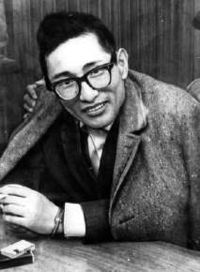
1949: Traycho Kostov, Bulgarian purgee

On this date in 1949, leading Bulgarian communist Traycho (Traitcho, Traicho) Kostov was hanged in Sofia.

A journalist and agitator from way back, Kostov was a casualty of the postwar political chasm between east and west.

He’d been the number three man in Bulgaria’s communist hierarchy at the time of his fall in January of 1949, but had also been considered close to Yugoslavia’s independent socialist leader Josip Broz Tito. Like Tito, Kostov was a little too into his own country’s national economic sovereignty as against the purported greater good of a Soviet-dominated eastern bloc.

Stalin had overtly split with Tito in 1948. Over the next few years, Soviet satellites in eastern Europe would systematically eliminate perceived Titoist elements — and submit to economic integration on Moscow’s terms.

So a propagandist could write, comparing Kostov to the Hungarian minister who had swung for Titoism just weeks before, that

[i]f Laszlo Rajk could be regarded as the right arm of Tito’s plans for Eastern Europe, Traicho Kostov, member of the Bulgarian Politburo and Deputy Premier, was certainly his left arm. I sat in a crowded court in Sofia in December, 1949, heard and watched Traicho Kostov and ten other accused and dozens of witnesses testify to a Yugoslav plan for Bulgaria every whit as diabolical and bloodthirsty as that for Hungary. In reality there was only one overall strategic plan with “Operation Rajk” and “Operation Kostov” as tactical moves.

Specifically, “Operation Kostov” entailed spying for western (plus Yugoslavian) powers and plotting to overthrow the People’s Republic.

Although his enemies had browbeaten Kostov into political self-denunciation at party summits, the man stoutly repudiated guilt at trial — which was not necessarily the norm in the show trial genre.

Kostov’s ten fellow defendants received prison terms rather than the rope, and some of them were alive to enjoy the official rehabilitation that followed Stalin’s death.

On this day..

1655: Henry Manning, Protectorate spy

“There certainly can be no doubt,” wrote a Venetian diplomat late in the rule of Oliver Cromwell, “that Charles [II] is betrayed by some of those who stand about him, otherwise it would be impossible for Cromwell to find out the secret plans he meditates.”

And indeed, on this date* in 1655, just such a one was shot by the exiled royalists as a Protectorate spy.

Henry Manning, the son of a royalist colonel who died fighting for Charles’s late beheaded father, had impeccable credentials for the Stuarts. The alleged English king was now parked on the continent, trying to conjure up some route back to the throne.

So when the pedigreed Manning turned up at exile camp, packing “a considerable sum of money” he was willing to give to the cause, he was welcomed with open arms.

Too open.

While royalist courtiers blabbed, Manning was filing enciphered reports for Cromwell’s spy chief (and the source of that considerable sum of money) John Thurloe. And these reports disclosed royalist collaborators in England who were rounded up in great numbers in 1655 — a year in which Cromwell dissolved parliament and resorted to direct military rule, growing correspondingly more worried about plots against his person.

It seems that Cromwell’s intelligence men lacked a certain subtlety, however. After an English traveler illicitly met with Charles on the continent during the dead of night, and was picked up for questioning when he returned to the island, the Stuart men naturally reasoned that only the small handful of people involved in that meeting could have been the mole. Manning was done for as soon as his apartments were searched.

Under interrogation, Manning gave up everything he knew, trying desperately to save his skin by offers of turning double-agent and exploiting his relationship with the Protectorate for the royalists’ benefit.** As late as December 14 the captured spy — hearing “sad rumours of a sudden end intended me, nay, to-morrow morning” — addressed a letter to royal aide Edward Nicholas, “humbly crav[ing] you would once more try his most gratious Majesty.”

His Majesty’s concern, however, was of fading into ridiculousness and irrelevance, and the play here was to make an example of treachery. Without apparent legal sanction — the word of the shadow king Charles was law enough here, and his German hosts were content to look the other way — Manning was pistoled to death in a woods outside of Cologne, and the fact made known abroad.

Everyone who’s had a look at Henry Manning agrees that the guy was a small and abject man, easy prey for these great ministers of state. But then, when Thurloe himself was arrested for treason upon the monarchy’s eventual restoration, he procured his own parole by spilling his secrets to King Charles.

* The Gregorian date, per the Holy Roman Empire where Manning was shot — not the Julian date still in use in England. Note as well that the 15th is the most readily inferred date from the available evidence, particularly Manning’s letter of the 14th, but that the event itself does not appear to have been affirmatively recorded on this (or any) specific date by contemporaries. There’s little room for variance, as correspondents are commenting on the death of Manning by the end of December.

** “The end and aim of spying in all its five varieties is knowledge of the enemy; and this knowledge can only be derived, in the first instance, from the converted spy. Hence it is essential that the converted spy be treated with the utmost liberality.” –Sun Tzu

On this day..

1417: The Falstaffian John Oldcastle

On this date in 1417, the heretical knight John Oldcastle was burned at St. Giles Fields.

Oldcastle was a country gentleman who helped King Henry IV put down the Welsh and married up, into the Cobham family. He became good friends on campaign with Henry’s heir, the future Henry V.

Though Oldcastle was a privileged member of medieval England’s 1%, he supported positively dangerous change.

In Oldcastle’s youth, the radical preacher John Wycliffe was abroad in the land, and Oldcastle at some point — nobody seems able to say exactly when — cottoned to the egalitarian movement Wycliffe spawned, Lollardy.

A century-plus ahead of the Protestant Reformation, Lollards challenged the corruption and impiety of the Catholic Church, urging adherents to look to the scriptures themselves.

Protestant writer John Bale later reclaimed Oldcastle as a proto-Protestant martyr.

The truth of it is, that after he had once throughly tasted the Christian doctrine of John Wicliffe and of his disciples, and perceived their livings agreeable to the same, he abhorred all the superstitious sorceries (ceremonies, I should say) of the proud Romish church … He tried all matters by the scriptures, and so proved their spirit whether they were of God or nay. He maintained such preachers in the dioceses of Canterbury, London, Rochester, and Hereford, as the bishops were sore offended with. He exhorted their priests to a better way by the gospel; and when that would not help, he gave them sharp rebukes.

This sort of thing gave right-thinking Christians the vapors. It was in response to this “perverse people of a certain new sect” that England instituted the law authorizing heretic-burning, which would in Tudor hands become such a prodigious maker of martyrs.

Fresh to the throne as a 27-year-old, Henry V didn’t want to consign his old buddy to the flames, and generally stalled prosecution and leaned on his friend as much as he could.

But his friend remained obstinate in his errors, and eventually delivered a confession squarely rejected the Church’s authority.

Doomed as a heretic, Oldcastle busted out of the Tower of London when his sentimental sovereign gave him a lengthy reprieve — whereupon the condemned fugitive began fomenting rebellion with his outlawed movement.

although the King by proclamation promised a thousand markes to him that could bring him forth, with greate liberties to the Cities or Townes, that woulde discouer where hee was: by this it maye appeare, howe greatly he was beloued, that there could not one he found, that for so great a reward would bring him to light.

Holinshed’s Chronicle

It did take some doing but Oldcastle — the Lord Cobham — was finally hunted to ground in November 1417. Upon his return to London in chains, the heresiarch was condemned on the basis of his previous conviction, and “consumed with fire, gallowes, and all.” (Holinshed)

As the late king’s notorious boon companion, John Oldcastle was queued up for immortality in Shakespeare’s Henry IV, part 1. But his part in this buddy play got rewritten at the last minute (and after the first draft) into the fellow we know as Falstaff.* It was reportedly the Lord Cobham of Shakespeare’s time who insisted upon the switch, squandering literary immortality for some passing family pride.** Traces of the original character remain in the text; in the play‘s opening dialogue, Prince Hal calls Falstaff “my old lad of the castle.”

(In part 2, Shakespeare’s epilogue goes out of the way to insist that “Falstaff shall die of a sweat … [while] Oldcastle died a martyr, and this is not the man”. Hal does eventually execute his old buddy, Oldcastle-style, in Henry V: that buddy is not Falstaff, but their mutual drinking companion Bardolph.)


No actual John Oldcastle connection, but if Shakespeare gets to pun around with the name …

* Cadging the name from another Hundred Years’ War soldier, John Fastolf.

** The Lord Cobham whom Shakespeare wished to avoid offending was involved just a few years later in the anti-Stuart Main Plot — and only spared execution by a last-second pardon while he was literally standing on the scaffold.

On this day..

1861: William Johnson, impulse deserter

One hundred fifty years ago today, a now-long-forgotten deserter from the Union Army was shot in Washington, D.C. This sad event in the then-novel American Civil War received lavish coverage in the pages of Harper’s Weekly, which we reproduce below.

THE EXECUTION OF JOHNSON.

ON page 828 we illustrate the military execution of Johnson, who was shot at Washington for desertion on 13th. The culprit’s crime is clearly described in the following extract from his confession:

I had not the slightest intention of deserting up to a few minutes before I started in the direction of the enemy’s lines. The way I came to leave our army was this: I was on the outposts, and after dinner, when out watering my horse, I thought I would go to the first house on the Braddock road and get a drink of milk. When I rode up to the house I saw a man and a boy. I asked the man for some milk and he said he had none, and to my inquiry as to where I could get some, he said he did not know, except I should go some distance further on. I said I thought it would be dangerous to go far, and he remarked that none of the rebels had been seen in that vicinity for some time. It was then that I conceived the idea of deserting. I thought I could ride right up to the rebel pickets and inside the enemy’s line, go and see my mother in New Orleans, stay for a few weeks in the South, and then be able to get back to our regiment again, perhaps with some valuable information. I never had any idea of going over to the rebels, and as it is I would rather be hung on a tree than go and join the rebel army. I don’t see what under heaven put it into my head to go away. I acted from the impulse of the moment. When the man at the house said none of the enemy had been seen lately in that vicinity I asked where it was that the five rebels I had heard of had been seen some time ago, and he said it was at the round house on the left-hand side of the road. I asked him where the road led to. He said to Centreville, and so I went that way. Riding along on the Braddock road, some miles beyond our pickets, I suddenly came across Colonel Taylor, of the Third New Jersey regiment, with his scouting party. I thought they were the rebels, but at first was so scared that I did not know what to say. However, I asked him who they were, and he said they were the enemy. Said I to him, “I’m all right, then.” “Why so?” said he. “Because we are all friends,” said I; “I am rebel too—I want to go down to New Orleans to see my mother.” Then he asked me how our pickets were stationed. I told him two of our companies which had been out went in that day toward the camps. He asked if I thought he could capture any of them, and I told him I did not think he could. He asked why, and I replied that there were a number of mounted riflemen around. The head scout asked me what kind of arms the Lincoln men received, and at the same time said, “Let me see your pistol.” I handed him my revolver. Colonel Taylor took it, and cocking it, said to me, “Dismount, or I will blow your brains out!” I was so much frightened I thought my brains had been blown out already. 1 dismounted, delivered up my belt and sabre, while at the same time they searched my pockets, but there was nothing in them except a piece of an old New York Ledger, I believe. Then he tied my hands behind me, and sent me back to camp in charge of three men, besides another who took my horse.

He was duly tried by court-martial and found guilty. The sentence having been approved, it was ordered that it be carried into effect on 13th. The following extracts from the Herald report complete the melancholy history:

The spot chosen for the impressive scene was a spacious field near the Fairfax Seminary, a short distance from the camp ground of the division. The troops fell into line, forming three sides of a square, in the order designated in the programme, precisely at three o’clock P.M.

In the mean time the funeral procession was formed at the quarters of Captain Boyd, Provost Marshal of the Alexandria division, near the head-quarters of General Franklin. Shortly after three o’clock it reached the fatal field.

The Provost Marshal, mounted and wearing a crimson scarf across his breast, led the mournful cortege. He was immediately followed by the buglers of the regiment, four abreast, dismounted. Then came the twelve men—one from each company in the regiment, selected by ballot—who constituted the firing party. The arms—Sharp’s breech-loading rifle—had been previously loaded under the direction of the Marshal. One was loaded with a blank cartridge, according to the usual custom, so that neither of the men could positively state that the shot from his rifle killed the unfortunate man. The coffin, which was of pine wood stained, and without any inscription, came next, in a one-horse wagon. Immediately behind followed the unfortunate man, in an open wagon. About five feet six inches in height, with light hair and whiskers, his eyebrows joining each other, Johnson presented a most forlorn spectacle. He was dressed in cavalry uniform, with the regulation overcoat and black gloves. He was supported by Father M’Atee, who was in constant conversation with him, while Farther Willett rode behind on horseback. The rear was brought up by Company C of the Lincoln Cavalry, forming the escort.

Arriving on the ground at half past three o’clock, the musicians and the escort took a position a little to the left, while the criminal descended from the wagon. The coffin was placed on the ground, and he took his place beside it. The firing party was marched up to within six paces of the prisoner, who stood between the clergymen. The final order of execution was then read to the condemned.

While the order was being read Johnson stood with his hat on, his head a little inclined to the left, and his eyes fixed in a steady gaze on the ground. Near the close of the reading one of his spiritual attendants whispered something in his ear. Johnson had expressed a desire to say a few final words before he should leave this world to appear before his Maker. He was conducted close to the firing party, and in an almost inaudible voice spoke as follows: “Boys,—I ask forgiveness from Almighty God and from my fellow-men for what I have done. I did not know what I was doing. May God forgive me, and may the Almighty keep all of you from all such sin!”

He was then placed beside the coffin again. The troops were witnessing the whole of these proceedings with the intensest interest. Then the Marshal and the chaplains began to prepare the culprit for his death. He was too weak to stand. He sat down on the foot of the coffin. Captain Boyd then bandaged his eyes with a white handkerchief. A few minutes of painful suspense intervened while the Catholic clergymen were having their final interview with the unfortunate man. All being ready the Marshal waved his handkerchief as the signal, and the firing party discharged the volley. Johnson did not move, remaining in a sitting posture for several seconds after the rifles were discharged. Then he quivered a little, and fell over beside his coffin. He was still alive, however, and the four reserves were called to complete the work. It was found that two of the firing party, Germans, had not discharged their pieces, and they were immediately put in irons. Johnson was shot several times in the heart by the first volley. Each of the four shots fired by the reserves took effect in his head, and he died instantly. One penetrated his chin, another his left cheek, while two entered the brain just above the left eyebrow. He died at precisely a quarter to four o’clock.

The troops then all marched round, and each man looked on the bloody corpse of his late comrade, who had proved a traitor to his country.

On this day..

1952: Hard Luck Billy Cook

On this date in 1952, the short and brutal life of William Cook ended in the San Quentin gas chamber.

A quintessential “terrible upbringing” criminal, young Billy was ditched with his siblings by their alcoholic widower father in an abandoned mine when he was a small child.

Though brothers and sisters found foster parents, Billy — afflicted by physical deformity and an ungovernable temper — had to make his way as a ward of the state. Constantly delinquent through his adolescence, he was institutionally handed off to the state penitentiary at age 17.

He got out at 22, with a grudge against the world and a knuckle tattoo reading “H-A-R-D L-U-C-K”, resolved — so he told his derelict father — to “live by the gun and roam.”

In a 22-day spree looping from California to Texas and Oklahoma and then back again, Cook slew six people: an entire vacationing family in Oklahoma, and then another kidnapped motorist in California. Taking drivers hostage was how he navigated America’s growing intercity road network, making the Cook story readily adaptable to titillate cinema-goers who knew the loneliness of the open road, in 1953’s The Hitch-Hiker. (Teaser line: “Who’ll be his next victim … YOU?”)

Cook took little care for his own secrecy and had to flee to Mexico to avoid a dragnet. Surprisingly, even the police chief of Santa Rosaria in Baja California recognized the wanted man, and he was captured there unawares and extradited back to the Golden State.

“I hate everybody’s guts,” he reportedly explained upon his capture. “And everybody hates mine.”

On this day..

1970: Akira Nishiguchi, Vengeance Is Mine inspiration

On this date in 1970, Japanese serial killer Akira Nishiguchi was hanged for murder.

Born in 1925, Nishiguchi (English Wikipedia entry | Japanese) spent the war years in juvenile detention but emerged in time to work as an interpreter for the U.S. occupation.

He was arrested repeatedly (Japanese link) as a con man during the 1950s. Police had him pegged as a nonviolent serial fraud artist, but in 1963 he killed two drivers to steal from them, then went on the run in Tokyo.

For 78 terrifying days, his face — those fraud convictions came with fingerprints that identified him as the killer — gazed out of wanted posters as Nishiguchi scraped by in cheap hotels and desperate disguises, committing three more murders in the process. Finally, an 11-year-old girl recognized him, posing as a lawyer.

Nishiguchi is the subject of the 1979 Shohei Imamura film Vengeance Is Mine. (Review | Another)

On this day..

1852: Jose Forni, the first legal hanging in California

Detail view (click for the full image) of the hanging of Jose Forni (Forner)

“My friends! You have come to see an innocent man die. I die for having killed an assassin. He attempted to rob me; I resisted; he stabbed me and fled. Maddened and smarting from my wounds, I pursued, overtook, and killed him. I am a native of Valencia, Spain. I have but few friends in San Francisco.

I have resided in Cuba, where I have many friends. I was tried by a judge and jury who were utter strangers to me. I could produce no witnesses in my favor. What led to my killing my assailant is known only to God and myself. What I have said is true. After I have spoken these few words I shall never speak more. No doubt those who tried me acted justly according to the testimony. They could not have known the truth. The Americans are good people; they have ever treated me well and kindly; I thank them for it. I have nothing but love and kindly feelings for all. Farewell, people of San Francisco! World, farewell.”

Jose Forni’s last words (translated from Spanish)

Having so declaimed, Jose Forni (or Forner) dropped through a trap on San Francisco’s Russian Hill and into the history books as the first hanging under color of law in the state of California.

Forni was pretty small potatoes for such a milestone, a Spanish immigrant caught stabbing to death a Mexican in broad daylight a mere three months before.

Despite Forni’s mysterious last statement, everyone was in fact pretty sure they knew what led to the killing.

Forni was found with a sash containing $350. This sash, a Mexican style not popular with Spaniards, had been observed in the possession of the victim Jose Rodriguez earlier that evening, by a gambling-hall dealer who saw Forni follow Rodriguez out the door. (Source)

Forni stuck to the story that it was his, and that Rodriguez had tried to jump him and take it when Forni set the sash down to relieve himself. And that then, after he’d been stabbed in the leg, he chased down the assailant.

Yeah, right.

“It was a proud day for the law,” wrote (doc) historian Hubert Howe Bancroft. “It was a happy sight, I say, this hanging of the moneyless, friendless Spanish stranger.”

If this doesn’t seem like the sort of thing hippy-dippy San Francisco would ordinarily strut about, bear in mind that the previous year, a standing Committee of Vigilance had formed itself and meted out extrajudicial lynchings without waiting on “the quibbles of the law, the insecurity of prisons, the carelessness or corruption of the police, or a laxity of those who pretend to administer justice.” Similar committees operated elsewhere in the state.

So the fact that Forni was suffered to wait on the quibbles of the law was a sort of progress. And it does sound, from the report in the next week’s (December 16) Alta California, as if the populace were jolly pleased to see it.

A continuous line of human beings was pressing up the hill all the morning, until a crowd numbering three thousand at least had gathered together [n.b. – nearly a tenth of San Francisco’s population at this time -ed.] … the assemblage was indeed a singular one — there being at least one-fourth of the number composed of youths, women and children. Women elbowed their way as near as possible to have a full view of the gallows, whilst others were on horseback and in carriages, riding around with as much gaiety as if on a pleasure drive.

But what was most shocking was to see respectable looking parents taking their little sons and daughters into such a heterogenous crowd, to witness such a terrible spectacle. Despite the slight rain, they stood it out with heroical fortitude and patience worthy of a better occasion. Before the prisoner had arrived, the small boys amused themselves with playing marbles, the bigger ones with dog fights, whilst others whiled away the time recounting their experience in such matters.

Reflecting on the homicide that had occasioned all this festivity, the Alta prayed that “our criminal records never be stained again with the history of such a dark and bloody transaction.”

Yeah, right.

On this day..

1999: James Beathard, on the word of a known liar

(Thanks to Mary O’Grady for the guest post. -ed.)

Murder is not a common occurrence in Trinity County, Texas. The shotgunning of three members of the Hathorn family in their trailer home on the evening of October 9, 1984 remains notorious, even among locals who were not yet born on the date of the crime.

Clues scattered at the crime scene, African-American human hairs and Kool cigarette butts, were supposed to convince authorities that a certain sort of suspect had killed Gene Hathorn, Sr., his wife Linda Hathorn, and their teenaged son Marcus Hathorn. Mr. Hathorn’s recent receipt of a $150,000 property settlement and his recent disputes with his elder son, Gene Hathorn, Jr., led law enforcement in a different direction. Less than one month after the bodies were found, Gene Hathorn, Jr., and his running buddy James Lee Beathard faced charges of capital murder.

Prosecutors developed evidence that Gene Hathorn, Jr., hatched the plot to kill his family in order to inherit his father’s new wealth. It seems he was unaware that his father had formally disinherited him three weeks before he was murdered.

James Beathard was first to stand trial.

Called to the witness stand by District Attorney Joe Price, Gene Hathorn, Jr., testified against Beathard, to devastating effect. Hathorn claimed that Beathard entered the trailer, killed all three victims, and planted the false clues, while he himself fired only one shot through a window. Beathard was sent to death row.

When the younger Hathorn was brought to trial, District Attorney Price reversed his theory from Beathard’s trial, depicting Hathorn as the “inside man” and the strategist who believed he had concocted the perfect crime. Gene Hathorn, Jr., joined James Lee Beathard on Texas’s death row. Hathorn recanted his testimony against Beathard. No appeals court took notice.

In the mid-1980s, Texas’s male death row occupied part of the aging, red brick and steel Ellis I prison unit outside Huntsville. For prisoners such as James Beathard and Gene Hathorn who conformed themselves to the rules, a considerable amount of communication with other prisoners and with the outside world remained possible. Each of these sons of East Texas soon found himself editor of a death row periodical, the Lamp of Hope in Hathorn’s case and the Texas Death Row Journal for Beathard. Over the years, Beathard emerged as a prolific letter-writer and essayist, publishing a brief nonfiction piece describing life on death row in the British Guardian Weekly in August, 1996.

Beathard’s talent as a correspondent won him considerable sympathy during his fourteen years on death row. As they exchanged letters, American playwright Bruce Graham fictionalized Beathard in his short play, Coyote on a Fence.

James Beathard’s intelligence and powers of articulation were unusual among death row prisoners. Since he could be trusted to exit and re-enter his cell with no fuss and to refrain from blithering forth psychotic delusions, he was sometimes trotted out when prison authorities needed a condemned man to meet the press.

James Beathard’s appeals ran out at last in 1999. He was executed, still protesting his innocence, on December 9th of that year.

His partner in crime, Gene Hathorn, Jr., won an appeal in 2009 based on his trial attorney’s failure to introduce evidence of his father’s abuse of him in childhood. He is now serving consecutive life sentences, reportedly working as a prison cook in general population.

On this day..

2009: Yang Yanming, hedge fund manager

On this date in 2009, China executed a rogue securities trader for disappearing around $10 million.

The first person executed for securities corruption in China, Yang used his position as a trader for Galaxy Securities to embezzle some 65 million yuan for personal gain.

He never disclosed the money’s whereabouts, presumably taking the secret with him to the grave. (Or to the organ donor market.)

As gangster capitalists go, Yang could hardly be considered exemplary either by scale or by ruthlessness. His peculation undoubtedly harmed many people, but there’s no known whiff of violence about him; he was caught after attempting suicide.

But by the same token, the occasional sacrifice of such middling malefactors potentially helps discharge some of the tension generated by the structural inequality accompanying China’s new oligarchy. What to do in such a world?

“Preserve your moral integrity and don’t set too much store by business results,” Yang told a newspaper prior to his execution. You said it, brother.

On this day..

1869: Nicholas Melady, the last public hanging in Canada

Thanks to John Melady, author of Double Trap, for the guest post about his kinsman. -ed.

I was standing with my father, looking at the ruins of an old house. I thought what remained of the brickwork was interesting, until Dad said, rather offhandedly: “And this is where the murder happened.” I was rather shocked, and asked what he meant.

His answer led me to write Double Trap, the story of the last public hanging in Canada.

Briefly, the tale goes something like this.

A man named Nicholas Melady Senior, my great-grandfather’s half brother, amassed substantial landholdings in Huron County, Ontario Canada, prior to 1868. In the years just before that, he played various family members off against each other, and depending on his whim, one or other of them would be promised his inheritance. His son Nicholas Junior was used worst of all. He worked without pay for his father, was promised all or at least some of the lands, but then was told he would get nothing — several times.

One night, Nicholas Senior, who was commonly called The Old Man, was in bed with his new wife, when Nicholas Junior and two of his friends, all of whom were drunk, broke into the Old Man’s house. A terrible fight ensued, and it included a hand gun and an axe, but at the end of the thing, the Old Man and his bride were dead.

After some very shoddy detective work, Nicholas Junior and his two friends were rounded up and lodged in a basement cell of an old house in nearby Seaforth, Ontario. (The local magistrate owned the place.) Part of that cell still exists, including the barred window the culprits would have looked through — at the rest of the cellar. It is rather creepy to visit, and while I researched Double Trap, I did not want to be there for long, and never at night.

In due course, the three desperadoes were sent to an even more chilling old jail in Goderich, Ontario. (It is now a Canadian historic site, and is visited by throngs of people every year.) There, Nicholas Junior’s friends ultimately turned against him.

However, before that happened, local detectives used a unique stratagem to gain evidence against Nicholas. I could never be sure where they got the idea. They hired a beautiful young woman who was born in Michigan, (who was likely a prostitute) and talked her into spending time in a cell in the jail. She was paid to gain the trust of Nicholas, and hopefully a confession.

In that sense, she was the first part of the “double trap,” in the book’s title.

The woman was given the name “Jenny,” and in time, by dropping notes where he would find them, and ultimately putting herself in a position where she could whisper to him through his cell window, (she positioned herself in the women’s exercise yard; he was inside his cell), she caused him to fall in love with her. All of her notes, and his as well, were used in the trial that followed. The two never actually touched each other.

When she walked into the courtroom during the trial and took the stand to describe her job and show the letters Nicholas had written, he was utterly speechless with shock. He had completely trusted her, and to him, her betrayal was total.

The execution of Nicholas Melady was a macabre affair, as were events leading up to it. His death cell was positioned quite close to where he was hanged. He could hear workers building his scaffold, and while I cannot prove it, I believe he would have been able to witness the construction of the thing. The death cell still exists, and in researching this book, I visited it several times. Now that is creepy.

So is the ground where he took his final few steps, out to the scaffold. It was built on top of the prison wall. He went up the steps on the inside, then lurched to his death, down the outside of the wall — where all the spectators waited to see the spectacle. His fall, through the trapdoor in the gallows floor was the second trap of the book’s title.

The execution was the last public one in Canada. Three weeks later the government of the country abolished public executions because they were regarded as too barbaric. There was controversy however, around the one for Nicholas. Many people felt he had been betrayed, by his accomplices, and by “Jenny,” and so lots of talk in the community made the public officials fear that there would be demonstrations the day of the death.

For that reason, they moved the execution time up by about three hours. “Only” about 300 people witnessed it. Several thousand came to see the spectacle later in the day, but by the time they reached the site, the show was over. His body was cut down, and for reasons I could never fathom, was actually waked for two days in the same house where the killings took place. Lots of the curious came to see the corpse of the killer, laid out for display.

The day after the execution, the New York Times was the first newspaper on the street with the story. I could find no trace of “Jenny,” or what became of her after her jailhouse job. Her testimony in court was never really challenged.

I was able to position myself in the cell where Nicholas was when he whispered to “Jenny.” I then went into the women’s exercise yard and by leaning against the jail wall easily understood how the conversations between the two transpired.

The book is Double Trap, by John Melady. Published by Dundurn, and available in the United States at Dundurn Publishing, 2250 Military Road, Tonawanda, New York 14150. In Canada, the pub address is: Dundurn Publishing, 3 Church Street, Suite 500, Toronto, Ontario M5E 1M2 In Britain, the address is: Gazelle Book Services Limited, White Cross Mills, High Town, Lancaster, England LA1 4XS.

On this day..