1292: Johann de Wettre, medieval Europe’s first documented sodomy execution

On this date in 1292, Johann de Wettre, “a maker of small knives,” was condemned to die at Ghent for sodomy.

De Wettre was consequently (whether on September 8 or subsequently) “burned at the pillory next to St. Peter’s” in what appears to be the earliest documented execution of homosexuality in Christian Europe. Whether he was a habitual or a one-time offender, how he was detected and prosecuted, and the fate of his male partner — all of these are obscure.

One can safely suppose that de Wettre was not the first European executed for sodomy; perhaps the scanty lines we have of his death are only fortuitously preserved because he suffered his very public fate in one of Europe’s largest and most prosperous cities.

However accidental, de Wettre’s stake is a landmark for Christendom’s emerging conception of same-sex desire as not only a capital crime, but a downright existential threat.*

No matter what Leviticus might say on the subject, the late Middle Ages furnish no documented examples of official persecutions but a rich corpus of same-sex literary amour, often penned by monks — a class of men whose debauchery (real or alleged) would come to invite violent attacks in the coming centuries.

O would that I had been my own messenger
Or been that letter which your hand softly touched;
And tht I had had then the same power to feel I have now,
And that you could ot recognize me until I wanted you to.
Then I would have explored your face and spirit as you read,
That is, if I could have restrained myself long enough.
The rest we would have left to nature and the gracious gods.
For God is readier than man to grant indulgence.

Baudri of Bourgueil, the eventual bishop of Dol-en-Bretagne (via Rictor Norton)

Horace composed an ode about a certain boy
Whose face was so lovely he could easily have been a girl,
Whose hair fell in waves against his ivory neck,
Whose forehead was white as snow and his eyes black as pitch,
Whose soft cheeks were full of delicious sweetness
When they bloomed in the brightness of a blush of beauty,
His nose was perfect, his lips flame red, lovely his teeth —
An exterior formed in measure to match his mind.

Marbodius, bishop of Rennes (via Scott Bidstrup)

Now, the Church was still issuing plenty of edicts proscribing same-sex activity around this period, so whether or not the ability of these men and many others to produce overtly homoerotic verse while still prospering within the holy orders constitutes “toleration” is a lively scholarly debate. Suffice it to say that around the 12th and 13th centuries there was a social and legal shift underway from treating sodomy predominantly as a vice for personal penance, to treating it as, well …

If a sodomite had been executed, and subsequently several times back to life, each time he should be punished even more severely if this were possible: hence those who practice this vice are seen to be enemies of God and nature, because in the sight of God such a sin is deemed graver than murder, for the reason that the murderer is seen as destroying only one human being, but the sodomite as destroying the whole human race.

-Neapolitan jurist Lucas de Penna, Commentaria in Tres Libros Codicis (c. 1360) (via Johansson and Percy)

For this diabolical new construction of homosexuality Warren Johansson coined the term “the sodomy delusion”:** “a complex of paranoid beliefs … to the effect that non-procreative sexuality in general, and sexual acts between males in particular, are contrary to the law of Nature, to the exercise of right reason, and to the will of God and that sodomy is practiced by individuals whose wills have been enslaved by demonic powers.” It was a conception that would find its way into law and popular prejudice in the centuries following our Ghent knifemaker’s immolation — and would continue thereafter, evolving across revolutions† religious, political, and economic to shape public discourse about homosexuality down to the present day.

* And also a potent political weapon. Same-sex deviance featured prominently in the charges used to destroy the Knights Templar in 1307.

** Johansson explicitly sets “the sodomy delusion” alongside “the witchcraft delusion” and “the Judeophobic delusion” as analogous phenomena.

† A piquant coincidence: Thomas Cromwell, the great Henrician minister of state, when he fell shared the scaffold with the first man executed under England’s new (in the 16th century) Buggery Act.

On this day..

1732: Pompey, poisoner of James Madison’s grandfather

On this date in 1732, a Virginia slave entered American presidential lore at the end of a noose.

The Madisons were “planters, and among the respectable though not the most opulent class”* resident in Virginia from the 1650s or so — and would in time bequeath the new American Republic its fourth president, James Madison.

We are concerned for today’s post with President Madison’s paternal grandfather, Ambrose Madison. Alas, concern will not necessarily translate to elucidation, for most of the Madison family’s records and correspondence were destroyed in the 19th century: the first Madison generations are shadowy historical figures. Ann Miller has pieced together the fragments in the short book “The Short Life and Strange Death of Ambrose Madison”, published by the Orange County (Va.) Historical Society, and that is the primary source for this post.**

Ambrose Madison was a local grandee of King and Queen County, with landholdings elsewhere in Virginia; it was Ambrose Martin who in the 1720s acquired (via his father-in-law, a land surveyor) the Orange County grounds that would become the great Madison estate Montpelier.

In 1732, Madison moved his family to the Montpelier property. By that time, he controlled 10,000 acres in present-day Orange and Greene Counties, and was gobbling up land elsewhere — like the new frontier of westward settlement, the Piedmont.

And of course, Madison owned human beings, too. The inventory of his estate from 1732 lists 29 black slaves by their first (sole) names: ten adult men, five women, and 14 children.

In the summer of 1732, Ambrose Madison took ill and started wasting away towards death. The fact was apparent to Madison and those around him; the last weeks of his life were taken up in settling affairs. (He made out a will on July 31.)

Shortly before Madison’s death on August 27, two of his slaves — a man named Turk and a woman named Dido — along with another slave, Pompey, property of a neighboring plantation, were arrested on suspicion of having poisoned Madison. No record survives to indicate how or why they would have done so.

If grievances can only be guessed-at, they are not difficult to guess. At the same time, for aught we know the trio might have been falsely accused: there had never been a murder in the vicinity, but Madison’s death came just months after a gang of slaves committed a series of armed robberies and shot at three white people.† As we have seen from later and better-documented slave resistance, southern whites were prone to great paranoia where the prospect of servile rebellion was concerned. And as Madison was a healthy fellow in his mid-thirties, attributing his unexpected death to poison was a natural move.‡

As Miller notes,

It is likely that Ambrose Madison’s case sent ripples of fear — even panic — through the region … the court [appeared] eager to have a quick trial (and, perhaps, to make quick examples of those found guilty and hopefully deter any other slave rebellions).

All three slaves were convicted together on September 6 of “feloniously Conspiring the Death” of Ambrose Madison. Pompey hanged the next day — after he’d been appraised (at £30) to compensate his owner for the destruction of property. Turk and Dido were only found to be “concerned in the said felony but not in such a degree as to be punished by death but … by Whipping.” They suffered 29 lashes apiece “on their bare backs at the Common Whipping post, and thereafter to be discharged”.

We must deny the fact, that slaves are considered merely as property, and in no respect whatever as persons. The true state of the case is, that they partake of both these qualities: being considered by our laws, in some respects, as persons, and in other respects as property … Let the compromising expedient of the Constitution be mutually adopted, which regards them as inhabitants, but as debased by servitude below the equal level of free inhabitants, which regards the slave as divested of two fifths of the man.

-(Future President) James Madison awkwardly defending the three-fifths compromise in the Federalist #54

Madison’s principal heir was his only son, James — a nine-year-old boy at the time of the events in this post.

The family brush with slave revolt did not deter this future Col. Madison from resuming (once he came of age) the family trade in land acquisition. He had 108 slaves of his own by the time that he died in 1801.

Col. Madison’s more famous son, the U.S. “founding father” and eventual president also named James, had slaves in the White House but was deeply conflicted about the horrid institution.

“He talked more on the subject of slavery than on any other, acknowledging without limitation or hesitation all the evils with which it has ever been charged,” a slavery abolitionist who visited Madison (post-presidency) reported of the evening’s tete-a-tete. “Mr. Madison spoke strongly of the helplessness of all countries cursed with a servile population, in a conflict with a people wholly free.” Madison eventually came to support the fantastical solution of resettling U.S. slaves to an African colony; still, beset by debts, he never quite saw his way to manumitting his own slaves — not even in his will.

Whether the fate befalling his grandfather ever entered into President Madison’s considerations on the subject is left to posterity’s imagination; the documents surviving in his hand never mention anything about grandpa Ambrose.

* Per James Madison, Sr., Ambrose Madison’s son and the U.S. president’s father.

** Since the primary sources available are so scarce, there seems to be little that can be said with confidence of Ambrose Madison’s personality. Miller suspects him a skinflint, on the basis of a merchant’s exasperated correspondence: “I am sorry to find you complain of the cost of the Goods I sent you” … and the same man again two years later: “have Ship’d the Goods you ordered … I don’t expect that you’ll like the Cotton, you order the Cheapest.”

† A slave named Jack, owned by Mildred Howell, was hanged on May 2, 1732 for this affair. The fate of his seven compatriots history passes over in silence.

‡ Miller notes in an appendix several other trials of slaves for poisoning in 18th century Virginia, including some that resulted in acquittal — possibly militating against the railroading hypothesis.

On this day..

1899: Armstead Taylor and John Alfred Brown, horribly

From the Wilkes-Barre (Pa.) Times, Aug. 18, 1899:

ROCKVILLE, Md., Aug. 18 — Armstead Taylor and John Alfred Brown, negroes, were hanged here this morning for the murder of Mr. and Mrs. Rosenstein at Slidelle in March last.

The drop fell at 10:15[?]. The hanging was a horrible botch. the knot did not slip but the drop was long enough. The men writhed, groaned and uttered inarticualate [sic] sounds for nearly ten minutes.

The murders for which they were convicted and sentenced to be hanged were committed at Slidelle, a little station two miles north of Boyds, Md. on March 13 last.

Louis Rosenstein, the postmaster of the hamlet[,] lived with his aged parents in the rear of the post office. They were said to have plenty of money. Early one morning they were attacked and the man’s skull was crushed and the woman’s head pounded with some blunt instrument.

The store was ransacked and a little over $3,000, a pair of shoes and several articles were taken.

Louis Rosenstein died the day after of his injuries and Mrs. Rosenstein lingered until May when she succumbed in a hospital at Baltimore.

Taylor went to Washington and soon attracted attention by spending money in a lavish manner in Georgetown. Suspicious neighbors gave the police the information that led to his capture.

Before Taylor was arrested, however, Sergeant Fritz Bassau of the Washington police force gave up his life. Taylor shot him down as he was climbing the stairs to arrest him, where he was concealed in the house at Georgetown. He also shot Officer Gowon in the hand.

Taylor was taken back to Montgomery county, but did not stand trial for injuring the policemen. His trial was begun at Frederick on July [?] and Brown’s a week later. Both were convicted and sentenced to be hanged August 18.

Strong efforts were made to have Brown respited, it being believed by many that he was only an accessory after the fact.

The men mounted the scaffold at 10:15. They were both calm and exhibited nerve. As they were placed on the door the sheriff asked if they had anything to say. Taylor made a rambling statement in an almost inaudible voice. He appeared weak and swayed upon his feet. He said:

Gentlemen, I done both the killings myself. My Uncle Brown is not guilty. I am the guilty man, but I expect to go to heaven.

Brown refused to make any statement beyond that he had forgiven his enemies and had found salvation.

The deputies then adjusted the rope, before placing the black caps on their heads. Both men smiled and Brown said good-bye to some friends in the crowd who spoke to him.

Sheriff Thompson tok [sic] a board about six feet in length, walked over to the side of the scaffold, reached down and inserted the end of a plank in the wire ring and sprung the trap.

The bodies fell through simultaneously and began to writhe and sway in a horrible manner. Taylor seemed to be conscious and appeared to be trying to speak.

The priests pronounced it the most horrible execution they had ever seen.

On this day..

1915: Leo Frank lynched

One hundred years ago today, Leo M. Frank was lynched to an oak tree at Marietta — one of the most notorious mob murders in American history.

Methodically extracted hours before from the Midgeville State Penitentiary by an Ocean’s Eleven-style team of coordinated professionals, Frank’s murder was as shocking in 1915 as it reads in retrospect.

The well-heeled Jewish Yankee was factory superintendent at the National Pencil Company in Atlanta when a 13-year-old girl in his employ was discovered in the factory’s basement — throttled and apparently raped. That was in 1913; for the ensuing two years, the prosecution of Mary Phagan’s boss as her murderer would play out in sensational press coverage.
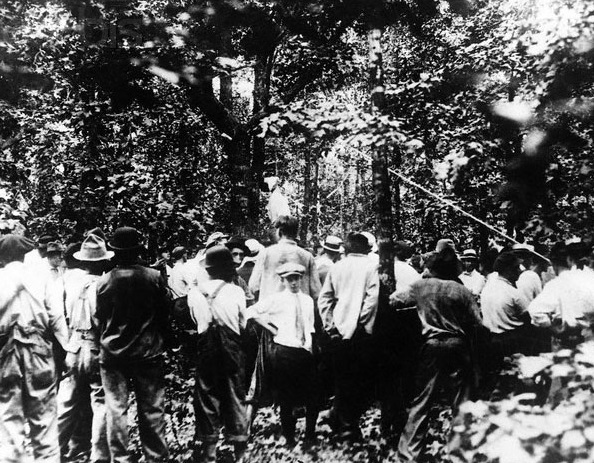
Frank is today widely thought innocent of the crime, although the Georgia Board of Pardons and Paroles has balked at issuing an unconditional pardon since so little of the original evidence survives. (A 1986 pardon came down “without attempting to address the question of guilt or innocence” in recognition of the slanted trial and the failure to protect Frank from lynchers.) But this was much more than a courtroom drama; the Frank affair crackles with the social tensions of early 20th century America. Industry and labor; integration; sexual violation; sectional politics; race and class and power.

Populist Party politician Thomas E. Watson, whose magazines made a dishonorable intervention by openly agitating for (and then celebrating) Frank’s lynching, captures the Zeitgeist for us as he fulminates against the nationwide campaign to grant the convicted murderer a new trial: “Frank belongs to the Jewish aristocracy, and it was determined by the rich Jews that no aristocrat of their race should die for the death of a working-class Gentile.” Frank came to enjoy (if that’s the right word) the editorial support of most of the country’s major papers, but the meddling of northern publishers, and of fellow Jews in solidarity,* arguably led Georgians to circle wagons in response. Present-day Muslims called upon to disavow every bad act by every other Muslim would surely recognize this no-win position.

But then we must also add that Watson himself, a lawyer, had been approached by Frank’s defense team hoping to enlist his bombast to defend their man at trial. The white supremacist demagogue would have been perfect for the job, for the legal battle pitted the credibility of a black janitor named Jim Conley against that of Frank.

Here amid the nadir of American race relations Frank’s team made its own ugly and unsuccessful pitch for racial solidarity with his neighbors. When formulaically asked by the court that had convicted him for any statement to mitigate the impending sentence, Frank replied that

my execution will make the advent of a new era in Georgia, where a good name and stainless honor count for naught against the word of a vile criminal; where the testimony of Southern white women of unimpeachable character is branded as false by the prosecution, disregarded by the jury and the perjured vaporings of a black brute alone accepted as the whole truth.

This violent collision of two vulnerable minorities each with the keen sense that one or the other of them was being outfitted for WASP America’s nooses makes for riveting and sometimes bizarre reading. Newspapers could hardly fail to note that the all-white jury (Leo Frank’s defense team struck all the blacks) had, as Frank complained, privileged the account of just the sort of “black brute” that Southern courts were accustomed to scorn, or railroad. Thus we have the NAACP organ The Crisis taking umbrage that “Atlanta tried to lynch a Negro for the alleged murder of a young white girl” but “a white degenerate has now been indicted for the crime.” It was likewise reasoned by some that since Conley was a young black man with a criminal record who was a potential suspect in the Deep South in the murderous sexual assault of a little white girl, “the mere fact that Conley did not long ago make his exit from this terrestrial sphere, via a chariot of fire is convincing proof that he, at least, is not the man who committed the deed.”** (New York Age, Oct. 29, 1914.)

In the end it was a zero-sum game between Jim Conley and Leo Frank: one of them was the murderer; each accused the other. Their respective desperate interests permeated to their respective communities. After Frank’s lynching, hundreds of Jews left Georgia; many who remained took pains to downplay their Jewishness.

By whatever circumstance police zeroed on Frank and the white community’s passion followed — tunnel vision that would eventually manifest itself in a circus courtroom atmosphere where the prosecuting attorney was cheered and defense witnesses hooted at and the ultimate outcome more demanded than anticipated. The judge feared that an acquittal would result in the summary lynching of not only Frank but his defenders.


Mary Phagan was killed on Confederate Memorial Day, the “holiday” this ballad alludes to.

Unusually for the time, appeals on the case reached the U.S. Supreme Court which declined to intervene — although two justices filed a dissent citing the egregious trial atmosphere.

Mob law does not become due process of law by securing the assent of a terrorized jury …

This is not a matter for polite presumptions; we must look facts in the face. Any judge who has sat with juries knows that in spite of forms they are extremely likely to be impregnated by the environing atmosphere … we think the presumption overwhelming that the jury responded to the passions of the mob …

lynch law [is] as little valid when practiced by a regularly drawn jury as when administered by one elected by a mob intent on death.

But that mob would still have its say. On the eve of Frank’s scheduled June 22, 1915 hanging, outgoing governor John Slaton commuted the sentence.

“Feeling as I do about this case, I would be a murderer if I allowed this man to hang,” the governor said. “It may mean that I must live in obscurity the rest of my days, but I would rather be plowing in a field than feel for the rest of my days that I had this man’s blood on my hands.”†

Frank was spirited away to the penitentiary under cover of darkness; it was hoped that the remote and reinforced edifice would deter any reprisal. It turned out that the furies who hunted Franks could not be dissuaded by mere inconvenience: a committee calling itself the Knights of Mary Phagan formed with the open object of organizing the intended mob vengeance — and indeed it was almost superseded in July of that year by a fellow-prisoner who slashed Frank’s throat as he slept.

Frank survived that murder attempt only to await the next one. Who knows what fancies frequented him in those weeks when he ducked from the shadow of the gallows to that of the lynching-tree, object of pity or hatred. He had time on the last day to savor his impending fate when the Knights methodically cut their way into the penitentiary — snipping the phone wires and disabling the vehicles — and marched their man out with nary a shot fired. Then, a convoy of automobiles “sped” (at 18 miles per hour) all the way back to a prepared execution-site at Marietta. The drive took seven or eight hours over unpaved country lanes, and for every moment of it Frank surely knew how it would end.

* Frank was a chapter president of the Jewish fraternal organization B’nai B’rith; the Anti-Defamation League of B’nai B’rith was founded in 1913 as a direct outgrowth of the Frank campaign.

As a contrasting response, the American Jewish Committee declined to participate in the Frank campaign for fear of lending counterproductive credence to charges such as those voiced by the New York Sun (Oct. 12, 1913):

The anti-Semitic feeling was the natural result of the belief that the Jews had banded to free Frank, innocent or guilty. The supposed solidarity of the Jews for Frank, even if he was guilty, caused a Gentile solidarity against him.

** Maurianne Davis’s Strangers and Neighbors: Relations between Blacks and Jews in the United States has a trove of interesting editorial comment from Frank’s contemporaries in the black press, and the Jewish press. Conley was actually the confessed accessory, and served a year in prison for it: he said that he complied with Frank’s order to hide the body for fear that his “white” boss could easily get Conley lynched for the crime. Conley also wrote (under Frank’s directive, he said) the preposterous “murder notes” found with the body that purported to be Mary Phagan’s dying indictment of Newt Lee, the African-American night watchman.

† The allusion to political suicide suggests Slaton’s mind was on the precedent of Illinois Gov. John Altgeld, whose career was destroyed by pardoning some of the Haymarket anarchists. If so, Slaton was quite correct; he actually had to flee Georgia altogether and could not return to the state for more than a decade.

On this day..

1575: Charles du Puy-Montbrun, unequal

The intrepid Huguenot commander Charles du Puy-Montbrun was beheaded on this date in 1575.

We turn for this account to a 19th century history in the public domain by Henry Martyn Baird:


Whatever military advantages the Huguenots obtained in various parts of the realm were more than outweighed by the death of “the brave Montbrun.”

This daring and energetic leader, the terror of the enemy in Dauphiny, had just defeated a large body of Swiss auxiliaries, upon whom he inflicted a loss of eight or nine hundred men and eighteen ensigns, while that of the Huguenots scarcely amounted to half a dozen men.

But his brilliant success in this and other engagements had made Montbrun and his soldiers more incautious than usual.

They attacked a strong detachment of men-at-arms, and mistaking the confusion into which they threw the advance guard for a rout of the entire body, dispersed to gather the booty and offered a tempting opportunity to the Roman Catholics as they came up.

Montbrun, who, too late, discovered the danger of his troops, and endeavored to rally them, was at one time enveloped by the enemy, but would have made good his escape had there not been a broad ditch in his way. Here his horse missed its footing, and in the fall the leader’s thigh was broken.

In this pitiable plight he surrendered his sword to a Roman Catholic captain, from whom he received the assurance that his life would be spared.

The king and his mother had other views.

Henry, on receiving the grateful news of Montbrun’s capture, promptly gave orders that the prisoner be taken to Grenoble and tried by the Parliament of Dauphiny on a charge of treason.

Vain were the efforts of the Huguenots, equally vain the intercession of the Duke of Guise, who wished to have Montbrun exchanged for Besme, Coligny‘s murderer, recently fallen into Huguenot hands.

Henry and Catherine de’ Medici were determined that Montbrun should die. They urged the reluctant judges by reiterated commands; they overruled the objection that to put the prisoner to death would be to violate good faith and the laws of honorable warfare.

Catharine had not forgotten the honest Frenchman’s allusion to her “perfidious and degenerate” countrymen.

As for Henry, an insult received at Montbrun’s hands rankled in his breast and made forgiveness impossible. Some months before, the king had sent a message to him in a somewhat haughty tone, demanding the restoration of the royal baggage and certain prisoners taken by the Huguenots.

“What is this!” exclaimed the general. “The king writes to me as a king, and as if I were bound to obey him! I want him to know that that would be very well in time of peace; I should then recognize his royal claim. But in time of war, when men are armed and in the saddle, all men are equal.”

On hearing this, we are told, Henry swore that Montbrun should repent his insolence.

In his glee over the Huguenot’s mishap he recalled the prophecy and broke out with the exclamation, “Montbrun will now see whether he is my equal.”

Under these circumstances there was little chance for a Huguenot, were he never so innocent, to be acquitted by a servile parliament.

Accordingly Montbrun was condemned to be beheaded as a rebel against the king and a disturber of the public peace. The execution was hastened last natural death from the injury received should balk the malice of his relentless enemies.

A contemporary, who may even have been an eye-witness, describes the closing scene in words eloquent from their unaffected simplicity.

He was dragged, half dead, from the prison, and was carried in a chair to the place of execution, exhibiting in his affliction an assured countenance; while the Parliament of Grenoble trembled and the entire city lamented. He had been enjoined not to say a word to the people, unless he wished to have his tongue cut off.

Nevertheless he complained, in the presence of the whole parliament, of the wrong done to him, proving at great length his innocence and contemning the fury of his enemies who were attacking a man as good as dead. He showed that it was without cause that he was charged with being a rebel, since never had he had any design but to guarantee peaceable Frenchmen from the violence of strangers who abused the name and authority of the king.

His death was constant and Christian. He was a gentleman held in high esteem, inasmuch as he was neither avaricious nor rapacious, but on the contrary devoted to religion, bold, moderate, upright; yet he was too indulgent to his soldiers, whose license and excesses gained him much ill-will and many enemies in Dauphiny. His death so irritated these soldiers that they ravaged after a strange fashion the environs of Grenoble.

The death of so prominent and energetic a Huguenot captain was likely to embolden the Roman Catholic party, not only in Dauphiny but in the rest of the kingdom. In reality, it only transferred the supreme direction in warlike affairs to still more competent hands.

The young lieutenant of Montbrun, who shortly succeeded him in command, was Francois de Bonne, better known from his territorial designation as Sieur des Lesdiguieres, a future marshal of Henry the Fourth.

Although the resplendent military abilities of Lesdiguieres had not yet had an opportunity for display, it was not long before the Roman Catholics discovered that they gained nothing by the exchange.

Lesdiguieres was as brave as his master in arms, and he was his master’s superior in the skill and caution with which he sketched and executed his military plans. The discipline of the Huguenot army at once exhibited marked improvement.

On this day..

2000: Brian Roberson, “Y’all kiss my black ass”

(Thanks to Robert Elder of Last Words of the Executed — the blog, and the book — for the guest post. Fans of this here site are highly likely to enjoy following Elder’s own pithy, almanac-style collection of last words on the scaffold. -ed.)

“To all of the racist white folks in America that hate black folks and to all of the black folks in America that hate themselves: in the infamous words of my famous legendary brother, Nat Turner, ‘Y’all kiss my black ass.’ Let’s do it.”

—Brian Roberson, convicted of murder, lethal injection, Texas.
Executed August 9, 2000

Roberson was convicted in the stabbing death of James Boots, seventy-nine, and his wife, Lillian, seventy-five, who lived across the street from him in Dallas. Roberson was African-American and his victims were Caucasian. Amnesty International issued a memo before the execution urging action and “expressing concern at the prosecutor’s systematic exclusion of African-Americans from the trial jury.” Roberson claimed he was “juiced up” on PCP and liquor during the crime. His last words were alternately recorded as “You ain’t got what you want.”

Later that same year, Roberson’s twin brother, Bruce, was arrested for allegedly threatening then President-elect George W. Bush. In a New York Times article, officers reported that Bruce wanted “to take him down.” The piece continued: “Mr. Roberson told them that Mr. Bush ‘stole the election and he’s not going to get away with it.'” Bush had been governor at the time of Brian’s execution.

On this day..

1933: The Simele Massacre of Iraq’s Assyrians begins

August 7 is Assyrian Martyrs’ Day, in remembrance of the Simele Massacre that began this date in 1933.

A Mesopotamian Christian people* whom the past century has hard pressed, Assyrians were in the post-World War I aftermath of the Ottoman Empire angling for some form of a self-governing enclave in the British Mandate, and were highly alarmed at being consigned to the tender mercies of an independent Iraq after 1932.

The Assyrian Nation which is temporarily living in Iraq, having placed before their eyes the dark future, and the miserable conditions which are undoubtedly awaiting them in Iraq, after the lifting of the mandate, have unanimously held a Conference with me in Mosul … At the conclusion of lengthy deliberations, it was unanimously decided by all those present that it is quite impossible for us to live in Iraq.

WE ARE POSITIVELY SURE THAT IF WE REMAIN IN IRAQ, we shall be exterminated in the course of a few years.

WE THEREFORE IMPLORE YOUR MERCY TO TAKE CARE OF US, and arrange our emigration to one of the countries under the rule of one of the Western Nations whom you may deem fit. And should this be impossible, we beg you to request the French Government to accept us in Syria and give us shelter under her responsibility FOR WE CAN NO LONGER LIVE IN IRAQ AND WE SHALL LEAVE.

-A (disregarded) 1931 petition by the Assyrian patriarch to Great Britain (via this topical book)

Assyrians have a tragically voluminous register of atrocities endured; the one in question for this date perhaps resonated deeply enough to emblazon the date on the calendar because it ground up Assyrian bodies and national aspirations alike during the formation of the modern Middle East.

WE SHALL LEAVE, the petition said; in July 1933, 600-plus Assyrians crossed into French Mandate Syria, seeking asylum. They were refused, and sent back to Iraq — and encountered a hostile Iraqi army unit, resulting in a firefight with 33 Iraqi casualties.

This date’s massacre was the army’s revenge — or rather the start of a five-day bloodbath featuring numerous summary executions of Assyrian civilians. And not only that, but for the army and for Iraqis, even a unifying communal experience to strengthen adherence to the unfamiliar new state of Iraq. “The Assyrian pogrom,” Kanan Makiya opined, “was the first genuine expression of national independence in a former Arab province of the Ottoman Empire.”

For those on the receiving end of the incipient national consciousness, the experience was quite different. One observer described Assyrian refugees he met later in August as “utterly panic-stricken … their spirit was completely broken.”

Simele was also among the major inspirations for jurist Raphael Lemkin, who later in 1933 — and citing the Assyrian experience as well as the earlier Ottoman slaughter of Armenians — presented to the League of Nations his concept of the Crime of Barbarity. This idea Lemkin would eventually develop into the concept of genocide (he’s the guy who coined the term).

* Saddam Hussein‘s ex-Foreign Minister, the late Tariq Aziz, was an Assyrian.

On this day..

2008: Jose Medellin, precedent

On this date in 2008, Mexican national Jose Medellin was executed by Texas, pleasurably sticking its thumb in the eye of the International Court of Justice.

U.S. state and local officials have often displayed the ugly-American tendency to view binding treaty obligations as a Washington thing of no moment to the likes of a Harris County prosecutor. So when Medellin was arrested for the 1993 rape-murder of two teenage girls in a Houston park, the idea of putting him right in touch with Mexican diplomats to assist his defense was, we may safely suppose, the very farthest thing from anyone’s mind.

Yet under the Vienna Convention, that is exactly what ought to have occurred. The idea is that consular officials can help a fellow on foreign soil to understand his unfamiliar legal circumstances and assist with any measures for his defense — and by common reciprocity, every state is enabled to look after the interests of its nationals abroad.

A widespread failure to do this, in death cases and others, has involved the United States in a number of international spats over the years.

Jose Medellin was among more than 50 Mexican prisoners named in one of the most noteworthy of these: the Avena case, a suit by Mexico* against the United States in the International Court of Justice.

In its March 31, 2004 Avena decision, the ICJ found that U.S. authorities had “breached the obligations incumbent upon” them by failing in these instances to advise the Mexican nationals it arrested of their Vienna Convention rights, and of failing in almost all those cases likewise to advise Mexican representatives that a Mexican citizen had been taken into custody.

“The appropriate reparation in this case,” the 15-judge panel directed, “consists in the obligation of the United States of America to provide, by means of its own choosing, review and reconsideration of the convictions and sentences of the Mexican nationals.”

If you think the Lone Star State’s duly constituted authorities jumped right on that “obligation,” you must be new around here.

Several years before, the United Nations Special Rapporteur on Extrajudicial, Summary or Arbitrary Executions visited the United States and filed a report complaining “that there is a generalized perception that human rights are a prerogative of international affairs, and not a domestic issue.”

“Domestic laws appear de facto to prevail over international law, even if they could contradict the international obligations of the United States,” the Special Rapporteur noted.

Texas, famed for not being messed with, took a dim view indeed to being bossed about from The Hague. Indeed, the very concept of foreign law and international courts is a gleefully-thrashed political pinata among that state’s predominant conservative electorate.

U.S. President George W. Bush — a former Texas governor who in his day had no time at all for appeals based on consular notification snafus — in this instance appealed to Texas to enact the ICJ’s proposed review.† In fact, he asserted the authority to order Texas to do so.

Texas scoffed.

“The World Court has no standing in Texas and Texas is not bound by a ruling or edict from a foreign court,” a spokesman of Gov. Rick Perry retorted.

This notion that America’s federalist governance structure could insulate each of her constituent jurisdictions from treaty obligations undertaken by the nation as a whole naturally seems preposterous from the outside. But in the U.S., this dispute between Washington and Austin was resolved by the Supreme Court — and the vehicle for doing so was an appeal lodged by our man, Medellin v. Texas.

The question at stake in Medellin was whether the treaty obligation was binding domestic law on its own — or if, by contrast, such a treaty required American legislative bodies to enact corresponding domestic statutes before it could be enforced. The high court ruled for the latter interpretation, effectively striking down Avena since there was zero chance of either Texas or the U.S. Congress enacting such a statute.

Medellin, the decision, spelled the end for Medellin, the man — and, at least for now, the end of any prospect of effectual intervention in American death penalty cases by international tribunals.

* Mexico, which no longer has the death penalty itself, has the heavy preponderance of foreign nationals on United States death rows at any given time.

** The Texas Attorney General’s press release announcing Medellin’s execution included a detailed appellate history of the case which pointedly excluded anything that happened in the ICJ.

† The Bush administration did take one effective step to avoid a similarly embarrassing situation in the future: it withdrew the U.S. from the consular notification convention.

On this day..

1629: Louis Bertran, martyr in Japan

On this date in 1629, Spanish Dominican Louis Bertran was burned at Omura, Japan for evangelizing, along with two Japanese-born converts known as Mancius of the Holy Cross and Peter of the Holy Mother of God.

Bearing the Gospel to the far-flung corners of the globe was sort of the family business: Bertran’s more famous relative and namesake, Louis Bertran(d), ministered to the New World so tirelessly that he’s been unofficially known as the Apostle of South America.

For two generations by this point, Christianity had struggled under intensifying official persecution — the shogunate deeply suspicious of the infiltration of western clerics who so often it seemed from Japan’s neighbors to bring along with them some patron king’s overweening navy.

Just a few years on from these martyrdoms, Japan closed itself to outside interference altogether. (More or less.)

On this day..

1941: Ben Zion bar Shlomo Halberstam, the second Bobever Rebbe

(Thanks to Meaghan Good of the Charley Project for the guest post. -ed.)

On this date in 1941, less than two months after the Nazis invaded the Soviet Union, they executed the Hassidic Rabbi Ben Zion Halberstam along with his son, Rabbi Moshe Aaron, three of his sons-in-law, and a number of other Jews.

Born in Galicia in 1874, Ben Zion was the son of Grand Rabbi Shlomo Halberstam in the village of Bobov. After the father’s death in 1905, the Chassidim elected the son Grand Rabbi in his place.

During World War I, the Bobever Rebbe fled to Austria, but he returned to Poland once hostilities ceased and founded a highly regarded yeshiva. During the mid-thirties he lived in the town of Trzebinia in south central Poland, and developed a following of thousands of disciples.

He was a farsighted man and in 1938, when Germany expelled its Polish-Jewish minority, he wrote an open letter to the Jews of Poland explaining the terrible situation and asking them to help their displaced brethren. After the Nazis invaded Poland, Haberstam fled to Lvov,* which was under Soviet control and relatively safer. He hid there in a disciple’s house, and his followers tried and failed to get him papers to travel to the United States.

In June 1941, Nazi Germany invaded the Soviet Union. By June 30 they’d reached Lvov, and by July 25, Rabbi Halberstam and several other members of his family were placed under arrest and marched to the Gestapo prison.

As Yad Vashem records,

Rabbi Ben Zion [he was 67 years old by then] was weak, and could not keep up with the fast pace of the march. When he fell to the back of the column, the policemen whipped him and shouted at him to move faster. The march continued until the prisoners arrived at the Gestapo headquarters. Rabbi Ben Zion’s family tried everything to win their release, but after three days, he was executed at the Yanover forest together with his son, three sons-in-law and the other prisoners.

They were a mere 19 kilometers from the future site of Auschwitz.**

Although the Halberstam family suffered significant losses during the Holocaust, at least one of Ben Zion’s sons survived, and so their dynasty did not die out. There exists today a community of Bobover Hassidim in Borough Park, Brooklyn.


Rabbi Ben Zion Halberstam in the center, pictured during his time in Trzebinia. The bare-faced youth directly over the rabbi’s shoulder is Moshe Aaron Halberstam, the son who would eventually be shot at the rabbi’s side.

* Called Lviv in Ukrainian, Lvov in Russian, Lwow in Polish and Lemberg in German; the city is at the heart of Galicia, and has changed hands repeatedly between these countries. Right now it’s Lviv.

** Although the smaller Auschwitz I camp for political prisoners existed from 1940, Auschwitz II-Birkenau, the Reich’s metonymical extermination facility, was constructed towards the end of 1941.

On this day..