1622: Samuel Korecki, defeated magnate

On this date in 1622, the swashbuckling Ruthenian nobleman Samuel Korecki was strangled by the Ottomans.

Korecki English Wikipedia entry | Polish) was a szlachcic of the Polish-Lithuanian Commonwealth at that empire’s early 17th century peak.

Korecki’s clan hung its zupans at Korets, in present-day western Ukraine, and the young Samuel fought gleefully in the early 1600s in the train of the legendary commander Stanislaw Zolkiewski when the Polish army was ravaging Russia.

Samuel Korecki married the daughter of Jeremi(ah) Mohila or Movila, a boyar who contended for the Moldavian at the turn of the century; it was by this link that he too became drawn into the politics of that frontier realm, along with several other powerful families of the Polish-Lithuanian Commonwealth. This period is known as the Moldavian Magnate Wars.

Though a dependency of the Ottomans, Moldavia had proven appealing in the past for Polish adventurers. The late Mohila had bequeathed power in Moldavia to his son Constantine but after some years Constantine’s tributary payments to Istanbul started to lag. His resulting deposition by the sultan saw Constantine flee to Polish territory — and his brother-in-law Korecki come to his aid by mounting an armed expedition meant to depose the Ottoman replacement.*

Korecki was captured by the Turks in the process, dramatically escaped via Greece and Italy (and a celebrity-making papal audience into the bargain), then returned to the field only to be captured again at the Battle of Cecora in 1620.

This decisive Ottoman victory portended ill and not just for Korecki personally.


19th century woodcut illustrating the death of Samuel Korecki. (Source)

As our man was hauled back to Istanbul (he would not escape a second time), the rampant Turks drove for Ukraine with the intention of taking a bite out of it for the Sublime Porte.

The Poles were able to stanch the advance with a stand at Khotyn, but the Commonwealth would shift into an unmistakable decline thereafter; by mid-century, rebellious Cossacks had taken Ukraine over to Russian protection, while Swedish incursions from the north so greatly reduced Poland’s reach that the period is known as the Deluge. (For his part, the teenage Ottoman sultan Osman II went home from this campaign determined to reform the Janissary corps whom he blamed for the unsatisfying stalemate of Khotyn; these dangerous slave-soldiers vetoed the plan by murdering Osman instead.)

* Moldavia was a secondary foreign policy concern for the Ottomans, who were absorbed in this period by war with Persia.

On this day..

2014: Masanori Kawasaki

Japan is in the news this morning for the surprise hanging of 68-year-old Masanori Kawasaki.

Kawasaki stabbed to death his sister-in-law Keiko Miura and her two granddaughters in 2007.

“It was an extremely cruel case,” Justice Minister Sadakazu Tanigaki said in announcing the execution.

Nevertheless, every execution no matter the circumstances of the crime draws controversy in Japan, which only hangs a handful of inmates in a typical year* and many of them only after very long waits. (At under seven years from stab to rope, Kawasaki’s was very fast by Japanese standards.)

Japan’s death penalty is distinguished — apart from the very fact of its existence, which makes it the only G8 country besides the United States to boast an active death chamber — by hangings conducted without prior announcement. Once a prisoner’s final appeals are turned down (Kawasaki’s were rejected in 2012) he can essentially be executed at any time the Justice Minister signs off, and have no more warning than the hour it takes to dash off final letters and final prayers. The condemned must acclimate day by day to the continual haunts of a capricious death that might snatch them at any moment.

Amnesty International can’t be far from the mark in the response issued by its East Asia Research Director to Kawasaki’s hanging: “Death row inmates live under the constant fear of execution, never knowing from one day or the next if they are going to be put to death. This is adds psychological torture to an already cruel and inhumane punishment.”

Another Japanese death row inmate, Shigeo Okazaki, also died this June 26 of 2014. He suffered respiratory failure.

* Kawasaki’s was the first hanging of 2014.

On this day..

1646: Jan Creoli, for sodomy in slavery

(Thanks to Meaghan Good of the Charley Project for the guest post. -ed.)

On this date in 1646, a black slave named Jan Creoli was executed in Manhattan, part of what was then called New Netherland and is now New York.

Creoli had been caught having carnal knowledge of a ten-year-old boy, another slave named Manuel Congo. Several of his own fellow Africans turned him in to the authorities. When Manuel Congo was brought face-to-face with Creoli, the boy “without being threatened in any way confessed to the deed in the presence of the prisoner.”

In her book Brothers Among Nations: The Pursuit of Intercultural Alliances in Early America, 1580-1660, author Cynthia J. Van Zandt notes,

The statement that a ten-year-old child who had been raped might “confess to the deed” seems startling to modern eyes, but it is highly significant for understanding Dutch authorities’ actions. As far as New Netherland’s officials were concerned, Manuel Congo was not just a victim but also a participant in the crime of sodomy despite his age and the fact that he had been raped. Dutch officials in New Netherland and in the United Provinces regarded sodomy as one of the worst social crimes possible, every bit as serious as murder.

Confronted with his victim’s testimony, Creoli admitted his guilt and shamefacedly added that he’d also committed sodomy while in the Dutch Caribbean colony of Curacao.

He was accordingly executed: tied to stake, garrotted, and his body burned to ashes. Little Manuel got off lightly: he was only whipped.

On this day..

1340: Nicholas Behuchet, Battle of Sluys naval commander

On this date in 1340, the English and French fought an early naval engagement of the Hundred Years’ War: the Battle of Sluys.

The English won the battle … and the French admiral wound up hanging from a mast.

At the outset of the Hundred Years’ War in 1337, the French bossed the Channel and inflicted devastating sea raids on the English coast. In the long war’s first major battle at sea, a French fleet in September 1338 overwhelmed an English flotilla carrying valuable English wool to the Low Countries.

Nicholas Behuchet, one of the French commanders at this earlier battle, did not hesitate to massacre his prisoners.

Thus conquering did these said mariners of the king of France in this winter take great pillage, and especially they conquered the handsome great nef called the Christophe, all charged with the goods and wool that the English were sending to Flanders, which nef had cost the English king much to build: but its crew were lost to these Normans, and were put to death.

England’s allies were in the Low Countries, so too many battles like this stood to strangle the English cause in the crib. For near two years, French privateers had leave to ravage the English coast, while French troops overran Flanders and made the English Queen Philippa* hostage.

Seeking a breakout, King Edward III requisitioned English merchant cogs — there was no standing navy at the time — into a fleet of perhaps 160 or 200 vessels, heavy with soldiers to invade Flanders.

On June 24, two days after setting out from the Orwell estuary at Ipswich, Edward’s armada boldly fell upon a larger French fleet anchored at the Flanders port of Sluys.

The medieval chronicler Froissart’s account makes for riveting reading.** This was no stately ballet of seamanship but a gory close-quarters melee: as was characteristic for the time, the “sea” battle was mostly just about coming together for the respective fleets’ marines to board one another’s ships and murder anyone on board who wasn’t worth a ransom. The French admiral Behuchet lashed his ships together across the mouth of the harbor, a sort of floating breastwork that would enable the French soldiery to shimmy up and down the entire line no matter where the English focused their attack.

To the sound of “scores of trumpets, horns and other instruments,”

Fierce fighting broke out on every side, archers and crossbowmen shooting arrows and bolts at each other pell-mell, and men-at-arms struggling and striking in hand-to-hand combat. In order to come to closer quarters, they had great iron grappling-hooks fixed to chains, and these they hurled into each others’ ships to draw them together and hold them fast while the men engaged. Many deadly blows were struck and gallant deeds performed, ships and men were battered, captured and recaptured. The great ship Christopher [a large English cog previously captured by the French and situated in the French front row -ed.] was recovered by the English at the beginning of the battle and all those on board were killed or taken prisoner …


An illustration of the Battle of Sluys from Froissart’s chronicle. Note the mast of the ship at far left: it displays the English arms quartered with the French, Edward III’s heraldic assertion of sovereignty over both realms.

It was indeed a bloody and murderous battle. Sea-fights are always fiercer than fights on land, because retreat and flight are impossible. Every man is obliged to hazard his life and hope for success, relying on his own personal bravery and skill … [it] rage[d] furiously from early morning until afternoon, during which time there were many notable feats of arms and the English were hard put to it to hold their own, since they were opposed by hardened soldiers and seamen, who outnumbered them by four to one.

Edward III took an arrow or crossbow bolt to the leg — great-man historical legend has it that it was fired by Nicholas Behuchet himself — but captained his flotilla to an overwhelming victory, capturing most of the French ships and destroying the French, their Genoese allies, “and all who were with them … [they were] killed or drowned, not a single one escaping in the general slaughter.” Poetic license aside, it was a spectacular triumph for the English — and a crushing defeat for the French.†

In the 1596 play Edward III, which might have been co-written by Shakespeare, imagined the scene in the report of an escaped mariner:

Purple the sea, whose channel filled as fast
With streaming gore that from the maimed fell
As did the gushing moisture break into
The crannied cleftures of the through-shot planks.
Here flew a head dissevered from the trunk,
There mangled arms and legs were tossed aloft
As when a whirlwind takes the summer dust
And scatters it in middle of the air.
Then might ye see the reeling vessels split
And tottering sink into the ruthless flood,
Until their lofty tops were seen no more.

Let it not be said that in this instance the commander escaped the consequences of his folly. Behuchet, who insisted against advice on lashing the boats together and thereby sacrificed all maneuverability, didn’t have much room for maneuver himself when the victorious English hanged him at battle’s end from the mast of his own ship.

* Seen elsewhere in these pages successfully begging her husband’s pardon of the famed Six Burghers of Calais later in the war. Philippa was a homegrown native of the Low Countries, and her marriage to Edward III reflects the alliance between their respective regions.

** For a snappy modern gloss on the battle, check this excerpt of Dan Jones’s The Plantagenets: The Warrior Kings and Queens Who Made England.

It is said that no courtier dared give King Philip VI of France the horrifying news until a jester availing his station’s license for cheek informed him that “Our knights are much braver than the English.” Asked why, the fool replied, “The English do not dare jump into the sea in full armour.”

On this day..

1977: Jerome Carrein, the second-last in France

At dawn this date in 1977, child murderer Jerome Carrein was guillotined in the courtyard of Douai prison. He was the second-last person executed in France’s history.*

He was a vagabond ex-convict who slept most nights in the slough of rural Arleux, cadging food enough off relatives and a pitying local barkeep.


The Marsh at Arleux by Jean-Baptiste-Camille Corot (1871)

It was a more bestial appetite that saw him into the guillotine’s annals: on October 27, he pursuaded an eight-year-old schoolgirl, the daughter of his benefactor publican, to come along with him. Once he had her in the swamps, Carrein attempted to ravish little Cathy Petit. As Cathy struggled, Carrein later explained — he confessed almost immediately — “I saw red. I felt lost in the idea that she would denounce me, so I threw her in the pond.”

Her drowned corpse was discovered the next day.

The growing reluctance of the French state to slice off heads in the 1970s did not express itself in interminable wait times on death row. Carrein was condemned to death on July 12, 1976, during the run-up to Christian Ranucci‘s execution for a similar abduction/child murder.

That conviction was vacated a few months later for a trial irregularity, but the retrial took place in the wake of another high-profile trial: anti-death penalty crusader Robert Badinter had successfully defended a man named Patrick Henry from the guillotine in yet another nationally known child murder case, winning a life sentence instead. There was no small public outcry over this outcome, and Carrein’s prosecutor explicitly called on the jury in his second case to avenge with severity to Carrein the “rape of public conscience” perpetrated by leniency to Henry. (London Times, June 24, 1977)

Pierre Lefrance, speaking for Carrein’s defense, ventured his own appeal to the jurors’ wider sensibilities — in this case, of the growing likelihood that capital punishment was nearing the end of the line in France: “Were the death penalty to be abolished at last in the next year or two, would you wish that Carrein was the last man guillotined in France?”

The invaluable French-language guillotine.cultureforum.net has a forum thread on this case; be sure to note the appearance on page 3 of a poster claiming to be the daughter of Jerome Carrein’s first wife.

* It was also the first execution of France’s last official chief executioner, Marcel Chevalier.

On this day..

1310: Badoer Badoer, Venetian rebel

A Venetian rebel was beheaded on this date in 1310.

Our grim tale actually tacks back to an altogether different death: the sudden January 31, 1308 demise of Azzo VIII d’Este, lord of Venice’s neighbor Ferrara.*

The resulting power vacuum saw Venice under the Doge Pietro Gradenigo tangle for influence in Ferrara with the Papal States of Pope Clement V.

This controversial intervention briefly put a Venetian puppet ruler in charge of Ferrara, but it also led Clement to excommunicate Gradenigo and place La Serenissima under a papal interdict.

The moral force which the condition of society lent to such a measure was immense … It paralyzed trade; it dried up the sources of industrial wealth; it laid a country under every civil and religiou disability; it shed over society an atmosphere of gloom; it affected every relation of life … At home it fomented agitation, gave colour and pretext to the worst motives, and evoked all the latent distempers of the public mind. Abroad, it legitimized rebellion, imparted to moribund antipathies a new vitality, and transformed wavering allies into open enemies. (From History of the Venetian Republic, vol. II, whose detailed narrative of the events relevant to this post continues in Volume III)

Clement also had more temporal weapons to fight with, and he used them to ruthless effect.

In August 1309, papal troops overran the Venetian garrison at the Ferrara fortress of Tedaldo and handled the prisoners like they had the Dolcinians, choking the Po with Venetian corpses.

Conditions were ripe for some disturbances in La Serenissima. The Ferrara thing was a complete debacle, and not only was the same guy still in charge, but his previous foreign policy resume basically consisted of being repeatedly outmaneuvered by Genoa.

Hotheads of three leading families of the Venetian opposition who had vainly counseled neutrality in the Ferrara affair, the Quirini, the Badoer, and the Tieopolo, embarked an audacious plot to mount a coup d’etat toppling the Doge and the whole Ground Council of noblemen by whom he ruled. The conspirators were to act on the morning of June 15 — but hours before that, a vacillating confederate had betrayed them. As a result, when the ferocious Marco Quirini arrived at the Piazza San Marco that morning with his men-at-arms, the Doge had a surprise force waiting to rout him under a furious downpour.

Quirini at least had the honor of dying in hopeless battle for his cause. His son-in-law and co-conspirator Bajamonte Tiepolo, who was to arrive at the same square via the Mercerie, dithered and showed up only when Quirini was already defeated and dead. Legend has it that a woman named Giustina Rosso killed Tiepolo’s standard-bearer dead by hurling (or just accidentally dropping) a mortar upon the rebels as they advanced up the street. (Present-day tourists traversing this upscale shopping street can catch a small bas-relief commemorating this character near the clock tower where the Mercerie opens onto St. Mark’s.)

Tiepolo belatedly charged the square, and was like Quirini repulsed; however, he was able to fall back across the Grand Canal, cutting the bridge against his pursuers, and holed up in a makeshift fortress hoping for reinforcements from the last-arriving of their fellows, Badoer Badoer.

The latter, however, was intercepted on his way to reinforcing the revolutionaries’ position and taken prisoner, which defeat of his hopes led Tiepolo and Doge alike to prefer a negotiated surrender to the charnel house that would have resulted from storming the redoubt. His followers were amnestied and Tiepolo himself sent into exile.

But Badoer Badoer was not covered by this deal. The Council he had proposed to overturn instead tried him for treason, and voted his condemnation on June 22 — a sentence put into immediate effect.

The exiled Tiepolo’s home was razed to the ground and replaced with a column eternally damning his memory:

This land belonged to Bajamonte
And now, for his iniquitous betrayal,
This has been placed to frighten others
And to show these words to everyone forever.

That column today has been removed to a museum — evidently one needs special permission to find it — but a worn stone outside a souvenir shop labeled “Loc. Col. Bai. The. MCCCX” marks the spot where it stood for four centuries.

The plot’s other legacy to Venice was the Council of Ten, a sort of inner secretariat of the Grand Council. Introduced in July 1310 as an emergency measure, the Ten soon became a permanent feature of the state, and an increasingly powerful one into the 17th century. The “temporary” council ended up lasting until the Napoleon finally toppled a by-then tottering Venetian Republic in 1797.

* In the Inferno, Dante accuses Azzo of assassinating his father.

On this day..

1962: Gottfried Strympe, purported terrorist

The novel East German polity was coming in the late 1950s to a crossroads that saw security paranoia ratchet up dramatically.

Emigration to West Germany accelerated considerably as the 1960s began, eventually giving rise to the infamous Berlin Wall.

In the countryside, forced collectivization implemented in 1960 produced resistance all its own. Agricultural output plummeted (the knock-on effects of a 1959 drought helped too); according to Patrick Major’s Behind the Berlin Wall: East Germany and the Frontiers of Power, groceries and everyday household items became markedly more difficult to procure in the early 1960s, sapping productivity throughout the economy as city workers queued for hours and black-market exchanges proliferated.

Following the Soviet Union’s great tradition of attributing economic trouble to running-dog wreckers, East Germany introduced the death penalty for politically motivated economic sabotage* — for example, the 206 cases of arson it attributed among 862 rural fires in 1960. (Figures as per Major.)

Our figure today, Gottfried Strympe, fell foul of these laws. In reality, he was no cackling secret agent but a disturbed loner.

He lurked about the eastern city of Bautzen opportunistically by turns the petty thief or the peeping tom.

Unfortunately for Strympe, who did some spells in psychiatric wards, his deviance extended past the titillation of spying a Hausfrau in her bustier to the much more menacing diversions of pyromania.

The poor man needed a social worker; what he got was the executioner. The charge sheet dramatically attributed his 28 acts of arson (crimes that each caused only minor property damage, and no human casualties) to the inspiration of “West German and American imperialists.”

Strympe, you see, had often visited a father (deceased in 1958) in West Berlin, back before the Wall sealed that city. Of course on those trips, Strympe picked over a Whitman’s sampler of western decadences, from pornography to Social Democracy. On this basis, the Stasi attributed his incendiarism to “terrorism” rooted in “an antisocial attitude strengthened by his stays in West Berlin.”

Strympe had a public show trial, the better that “the population of Bautzen will recognize the danger of communication and travel to West Berlin” (with props of said population — workers’ and civic groups — obligingly supplying the requisite demands for the traitor’s execution).

He was beheaded by Fallbeil at Leipzig on June 21, 1962.

* See Politische Strafjustiz in der Ära Ulbricht: Vom bekennenden Terror zur verdeckten Repression by Falco Werkentin.

On this day..

1979: Bill Stewart, ABC News reporter

On this date in 1979, the American Broadcasting Company journalist Bill Stewart was executed at a somocista checkpoint during Nicaragua’s bloody civil war.

And what is more, the deed was caught on film — pre-emptively balking the crumbling Nicaraguan dictatorship of the ability to, say, blame the killing on the Sandinista rebels.

Warning: This is the execution footage.

Stewart was stopped in a marked press vehicle in Managua, ordered to lie down, and then kicked and shot through the head while colleagues looked on. Though his summary execution by national guardsmen was taped by fellow journos in the convoy, the reasons for it are well into the fog of war: even the identity of the guardsman who pulled the trigger isn’t known. (The commander of the roadblock would claim that it was a “Private Gonzalez” who conveniently died in combat later the very same day.) The immediate “investigation” promised by dictator Anastasio Somoza didn’t really have much chance to get off the ground before Somoza himself had to take to the skies fleeing, on July 17, the collapse of his own regime. Whether the executioner also escaped the revolution, fled into exile, became a Contra guerrilla, or actually did die in the fighting, only God can say.

“The murder of American newsman Bill Stewart in Nicaragua was an act of barbarism that all civilized people condemn,” said U.S. President Jimmy Carter, who of course was backing Somoza.* “Journalists seeking to report the news and inform the public are soldiers in no nation’s army. When. they are made innocent victims of violence and war, all people who cherish the truth and believe in free debate pay a terrible price.”

Stewart’s career and murder are a principal inspiration for the 1983 film Under Fire.

* Or more precisely by this point, backing Somocismo sin Somoza — ease out the unpopular Somoza but keep the same system.

On this day..

1936: Arthur Gooch, the only execution under the Lindbergh Law

This date in 1936 marks the first and only occasion that the federal government hanged a (non-murdering) kidnapper under the Lindbergh Law.

Even before the notorious Lindbergh baby kidnapping case, the “snatch racket” of kidnappings for ransom had claimed a firm foothold among Depression-era America’s moral panics. The bill that would become known as the Lindbergh Law was actually introduced in Congress three months before little Charles Lindbergh, Jr. disappeared out the window of his New Jersey nursery. Its sponsors were Missouri lawmakers concerned that gang-ridden St. Louis was becoming a kidnapping hub, like the high-profile 1931 abduction of Dr. Isaac Kelley.*

The theory behind the bill — and this was particularly relevant to St. Louis, a border port right across from Illinois and accessible via the Mississippi River to the whole Midwest — was that kidnappers could more easily ply their nefarious trade by carrying their hostages over a convenient border and exploiting the respective states’ inability to coordinate with one another. By elevating interstate kidnapping to a federal felony, the idea was to put manhunts into the hands of the FBI, whose jurisdiction was the entire United States.

The Lindbergh case provided just the right impetus for Congress to advance into law a bill that might otherwise have died quietly in committee. There’s just something to be said for being the one with a plan at the right time … even though the Lindbergh baby was found dead four miles away from the house he was plucked out of, and probably never crossed a state line himself.

At any rate, the Lindbergh Law also made kidnapping alone a capital crime, even if the abductee was not harmed. And it is for this that Arthur Gooch ascended into barstool trivia.

Gooch’s life and case are the focus of this 125-page Master’s thesis (pdf), but the long and short of it is that Gooch and a buddy named Ambrose Nix were on the lam after busting out of the Holdenville, Okla., jail, and ended up heading south to Texas.

They committed a robbery in Tyler, Texas on November 25, 1934. The next day, while stopped with a flat at a service station in Paris, Texas — close by the Texas-Oklahoma border — two policemen approached the suspicious vehicle. In the ensuing struggle, Nix managed to pull a gun on everyone and force the subdued cops into the back of their own patrol car, which the fugitives then requisitioned to high-tail it over the Oklahoma border. There they released their captives unharmed. There had never been a ransom attempt.

A month later, Gooch was arrested in Oklahoma — while Nix died in the shootout, leaving his partner alone to face the music.

Arthur Gooch was a career criminal, and the fact that he violated the Lindbergh Law was easy to see, but his crime also wasn’t exactly the scenario that legislation’s drafters had foremost in mind. In fact, Gooch also underscores one of the oft-unseen dimensions of the death penalty in practice: the discretionary power of prosecutors and judges at the intake end of the whole process.

Gooch attempted to plead guilty to his charge sheet, but his judge, former Oklahoma governor Robert Lee Williams, refused to accept it. Williams was explicit that his reason was that the Lindbergh Law’s language required a jury verdict to impose a death sentence.

By contrast, in October of 1934 — a month before the legally fateful confrontation at the Paris service station — a black farmhand named Claude Neal suspected of the rape-murder of a white girl was dragged out of protective custody in Alabama and taken across the adjacent Florida state line, where an angry mob lynched him. Despite the urging of the NAACP, FDR’s Attorney General Homer Stille Cummings completely refused to interpret Neal’s abduction as a Lindbergh Law kidnapping. The two cases even turned on the same phrase of the Lindbergh statute: interstate kidnapping “for ransom or otherwise.” While Cummings decided pre-emptively that “or otherwise” didn’t cover lynch law, one of his U.S. attorneys would go to the Supreme Court in January 1936 to argue for a broad interpretation of that phrase in the context of Gooch’s appeal.

But even without a comparison to Claude Neal’s murder, the justice of executing Arthur Gooch was hotly disputed by a vigorous clemency campaign. The chance intercession of a state line had elevated a small-time crime committed further to avoiding arrest into a capital offense, basically on a technicality. “It would be a rotten shame to hang that boy when a short jail term is his desert,” one Oklahoma City society woman argued to the Jeffersonian Club. “Gooch was given an application of the poor man’s law.” It seems clear that for Judge Williams as for President Roosevelt (who denied Gooch’s clemency appeal) the result was heavily influenced by the political exigencies of pushing a tough-on-crime standard, and by Gooch’s previous history as a crook. (He’d broken out of jail in the first place because he was a member of a group of local hoods in Okmulgee that committed several armed robberies.)

Gooch was philosophical at the end. “It’s kind of funny — dying,” he mused. “I think I know what it will be like. I’ll be standing there, and all of a sudden everything will be black, then there’ll be a light again. There’s got to be a light again — there’s got to be.” We can’t speak to what Gooch saw after everything went black, but it definitely wasn’t “all of a sudden”: Oklahoma’s executioner, Richard Earnest Owen, was an old hand with his state’s electric chair, but the federal execution method was hanging, which Owen had never before performed (and never would again). Gooch took 15 minutes to strangle at the end of the rope.
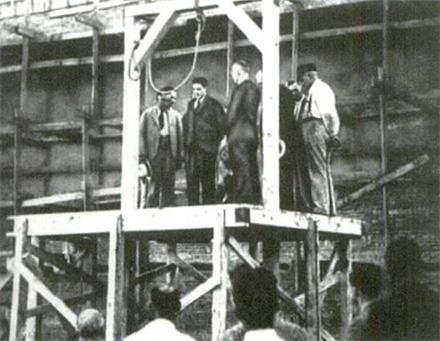

Arthur Gooch on the gallows

* The Kelley kidnapping, unsolved for several years, eventually traced to the strange character Nellie Muench. Readers (at least stateside ones) who follow that trailhead should be sure to keep an eye out for the cameo appearance of Missouri judge Rush Limbaugh, Sr. — grandfather of the present-day talk radio blowhard.

On this day..

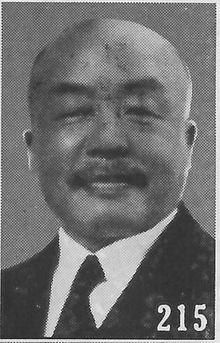
1950: Chen Yi, 228 Massacre author

On this date in 1950, Taiwan’s former nationalist governor Chen Yi was shot for a dalliance with the Reds.

A Kuomintang officer since China’s 1920s Warlord Era, Chen Yi was from 1934 Chiang Kai-shek’s governor of Fujian province — the mainland territory directly across from the island of Taiwan. Chen had the honor at the end of World War II of accepting Japan’s surrender of Taiwan — the occasion commemorated by Taiwan’s unofficial October 25 holiday, Retrocession Day. Postwar, he became governor of that island, back before it was synonymous with nationalist China itself.

His life ended in 1950, when Chiang suspected him of negotiating with the Red Chinese who had overrun the mainland. By that point, however, Chen’s political career was already history, courtesy of the most lasting of his legacies, the 228 Massacre (or more diplomatically … “Incident”).

Taiwan’s new managers — the place had been in Japanese hands since 1895 — made an immediate mess after 1945. Taiwan’s productive economy was essentially siphoned for the civil war the KMT had underway against the Communists, as well as for the venal enrichment of various well-connected mainlanders who hopped over to Formosa for plum assignments that displaced Taiwan’s own local elites.

Billowing inflation fed ethnic resentments, and the whole situation boiled over, as the name implies, on 2/28 of 1947.

On that date, frustrations boiled over* in island-wide protests that turned to riots and even took over administration of Taipei and many other cities. Chen, on whose watch the many grievances had accumulated, suppressed those with enormous violence. Chen regained control of the situation only with considerable violence: well over 10,000 are thought to have been killed in suppression during early March, many of them executed in cold blood by mainland military reinforcements.

An American who had just arrived in China from Taihoku said that troops from the mainland arrived there March 7 and indulged in three days of indiscriminate killing and looting. For a time everyone seen on the streets was shot at, homes were broken into and occupants killed. In the poorer sections the streets were said to have been littered with dead.

There were instances of beheadings and mutilation of bodies, and women were raped, the American said.

Two foreign women, who were near at Pingtung near Takao, called the actions of the Chinese soldiers there a “massacre.” … people were machine gunned. Groups were rounded up and executed.

The man who had served as the town [of Pingtung]’s spokesman was killed. His body was left for a day in a park and no one was permitted to remove it.

While effective in reasserting political power, this didn’t exactly bury the animosities between Taiwanese and mainlanders. It did put an end to Chen Yi’s governorship, however, since it was on his watch that things came to this pass in the first place. Given he then doubled as the author of the bloodbath, he assured himself a place of opprobrium in Taiwanese history.

In 1949, the Kuomintang nationalist government fled rout on the mainland and holed up on Taiwan, implementing an authoritarian state under martial law with a running “White Terror” against dissidence, often broadly conflated with communism. Until political liberalization in the late 1980s, public discussion of 228 was strictly taboo.

Today, there’s enough distance that the event is openly commemorated; indeed, Lee Teng-hui, the politician who embraced Taiwan’s democratic transition around the end of the Cold War, was himself a participant in the 228 protests. There are a variety of memorials and parks remembering 228 in present-day Taiwan … but you’d have to look very hard to find one for Chen Yi.

* The specific boiling point for the protests was a violent confrontation on February 27 when state agents had seized the unlicensed cigarettes of a local peddler. The way things were going, however, there was always going to be something like this to catalyze Taiwanese anger.

On this day..