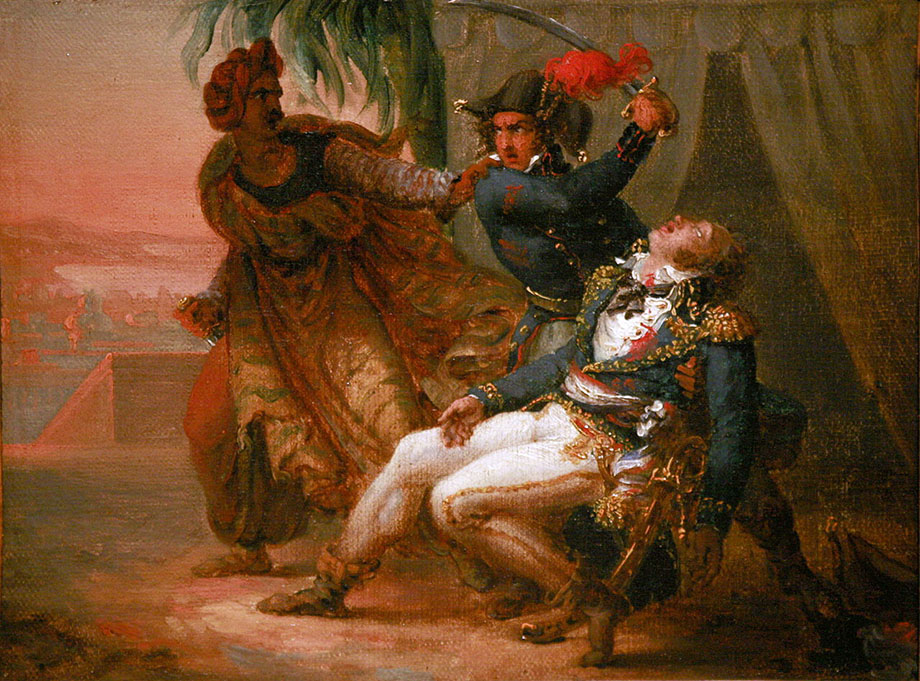
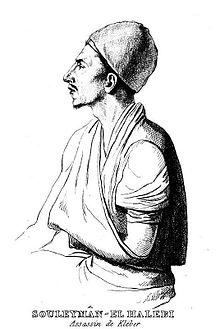
1800: Suleiman al-Halabi, assassin of General Kleber

On this date in 1800 — which was the same date they buried his victim — the 23-year-old student Suleiman al-Halabi was put to death in Cairo for assassinating French General Jean Baptiste Kleber.

Casualty of the brief Napoleonic adventure in Egypt, Kleber had received supreme command of the expedition when Napoleon himself returned to France the previous year — a mission which involved running the English naval blockade that trapped the Armee d’Orient.
Kleber, a product of the French Revolution’s military meritocracy who had attained his rank capably suppressing the Vendee royalists, was certainly up to the martial tasks at hand. He routed a larger Ottoman-English-Mamluk force in March of 1800, and then smashed a revolt in Cairo.

But the Napoleonic invasion often figures as a periodization marker for this region: the germ of liberalism and nationalism that would tear apart the Ottoman Empire and set the scene for a recognizably modern Middle East. So it’s somewhat fitting that Kleber would be undone by a figure who could be lifted from the evening news,* the anti-occupation insurgent.

Suleiman al-Halabi (English Wikipedia entry | French) was a Syrian Kurd hailing from Aleppo. (“al-Halabi” means “of Aleppo”)

He had been in Cairo to study, but after a return visit home was induced by the Turks to attend himself to punishing the invader instead. He then made his way back to to Egypt where, disguising himself as a beggar, where he was able to approach the general innocuously and dagger him to death.

The French, of course, had just a few years before this point introduced its most distinctive execution device in place of the ghastly old methods, and employed it with egalite for commoner and king alike. Nor was France, as an imperial power, reluctant about exporting its invention to the every corner of earth.

But in this particular instance, the French decided to prioritize, er, cultural sensitivity.

The committee, after carrying through the trial with all due solemnity and process, thought it necessary to follow Egyptian customs in its application of punishment; it condemned the assassin to be impaled after having his right hand burned; and three of the guilty sheikhs to be beheaded and their bodies burned.

The “guilty sheikhs” in question were men to whom the killer had confided — not his plan, exactly, but the fact that he was on a jihad mission. Hey, close enough.

As for Suleiman al-Halabi himself,

The executioner Barthèlemy sat down on Suleiman’s belly, drew a knife from his pocket, and made a large incision to widen the rectum, then hammered the point of the stake into it with his mallet. Then he bound the patient’s arms and legs, raised the stake the air and mounted it in a prepared hole. Suleiman lived for four hours, and he had lived longer save that, during the absence of Barthèlemy, a soldier gave him a drink which caused his immediate death.

(Impaling victims could live for agonizing days, but the water caused Suleiman, mercifully, to quickly bleed out.)

Not content with going all Vlad the Impaler, the French then paid homage to the invasion’s scientific sub-theme** by shipping Suleiman’s remains back to France for use as an anthropological exhibit.† His skull still remains at the Musee de l’Homme to this day. What’s left in his homeland(s) is a martyr’s memory.

According to the scholar al-Jabarti, whose chronicle is one of the principal sources on this episode, the investigation indicated that Suleiman undertook his mission for no ideology save his family’s desperate need of the purse the Porte was willing to offer. But in the ensuing decades’ growth of nationalism and, eventually, anti-colonialism, the brave young Muslim dying on a spike to slay the French commander could not help but be viewed in an exalted light. (Notably, at the acme of Arab nationalism, the Egyptian writer Alfred Farag celebrated Suleiman as an avatar of resistance in a 1965 play. “I do not kill for revenge,” Farag’s Suleiman avers — and when pressed for the reason, he has a one-word reply: “Justice.”)

* Indeed, the name has been in the news: there’s a Suleiman al-Halabi neighborhood in Aleppo that has seen fighting during the ongoing Syrian civil war. Since it’s even a Kurdish neighborhood one can’t but suspect that it’s named for the man featured in this post; however, I haven’t been able to establish that with certainty. If any reader knows, a comment would be most welcome.

** Napoleon brought a corps of scientists and intellectuals along on his invasion, kicking off the modern Egyptology craze. His mission also uncovered the Rosetta Stone — although that artifact now resides in the British Museum because of the aforementioned naval blockade.

† According to Dark Trophies: Hunting and the Enemy Body in Modern War, phrenologists hailed Suleiman’s skull as an outstanding exemplar of criminality and fanaticism.

On this day..

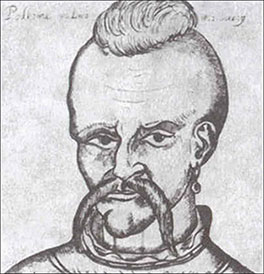
1578: Ivan Pidkova, Cossack hetman

On this date in 1578, Cossack hetman Ivan Pidkova lost his head in Lviv.

Pidkova* — the name means “horseshoe” and alludes to the horsemanship that would be de rigueur for a Cossack leader — had risen by his aptitude to leadership of the Zaporozhian Cossacks in present-day Ukraine.

His death was a bid to promote himself from the steppe to power over neighboring Moldavia, and in fairness to Ivan Moldavia was worth a go.

Its throne was held at that time by a new guy named Peter the Lame, and although the nickname just referred to Peter’s physical deformity, he was a creature of the Ottoman court who scarcely knew Moldavia before he became its vassal ruler in 1574. He was twice temporarily deposed before finally voluntarily resigning in 1591 so that he could retire to the comforts of Italy.

The first deposition came courtesy of our man Pidkova.

Claiming kinship with Peter’s late predecessor Ivan III,** Pidkova seized Iasi and proclaimed himself hospodar of Moldavia until the arrival of Ottoman reinforcements refuted the conceit.

This whole border region between the Polish-Lithuanian Empire to the north and the Ottomans to the south was a perennial trouble spot. Putatively subjects of the Polish crown, the refractory Cossacks were known to raid Ottoman territory illicitly and provoke diplomatic headaches on both sides of the border.

At this particular moment — 1578, that is — the Polish king Stephen Batory had only just concluded a truce with the Ottomans. As Batory had war with Russia to worry about, he was more than keen to keep his southern frontier calm; Polish troops captured the Cossack pretender and had him put to an exemplary death.


Monument to Ivan Pidkova in present-day Lviv. Image (c) stacy2005ua, a prolific photographer of Lviv’s environs whose work can be enjoyed at FaceAndHeart.com or on Flickr, and used with permission.

Ukraine’s national bard Taras Shevchenko celebrated Ivan Pidkova in an eponymous 1839 poem:

There was a time in our Ukraine
 When cannon roared with glee,
A time when Zaporozhian men
 Excelled in mastery!
They lived as masters — freedom’s joy
 And glory were their gain:
All that has passed, and what is left
 Is grave-mounds on the plain!
High are those ancient tumuli
 In which were laid to rest
The Cossacks’ fair white bodies
 In silken cerements dressed.
High are those mounds, serene and dark
 Like mountains they appear,
Their gentle whispers in the wind
 Of freedom’s fate we hear.
These witnesses of ancient fame
 Hold converse with the breeze;
The Cossacks’ grandson reaps the grass
 And sings old memories.
There was a time when in ukraine
 Even distress would dance,
And sorrow in a tavern drank
 In honeyed brandy’s trance.
There was a time when life was good
 In that Ukraine of ours …
Recall it then — perhaps the heart
 May briefly bathe in flowers.

II.

A murky cloud from Liman’s shore
 Covers the sun from sight;
The sea is like an angry beast
 That groans and howls with might.
It floods the mighty Danube’s mouth.
 “My fellows, come with me
Within our barks! The waves are wild.
 Let’s have a merry spree!”
The Zaporozhians rushed out;
 The stream with ships was roiled.
“Roar on, O sea!” they all sang out,
 As waves beneath them boiled.
Billows like mountains round them surged,
 They saw no land, no sky.
Yet not a Cossack heart grew faint,
 Their eagerness ran high.
A bold kingfisher flies o’erhead
 As on they sail and sing;
The brave otaman in the van
 Leads on their mustering.
He strides the deck, and in his mouth
 His pipe grows cold from thought;
He casts his glances here and there
 Where exploits may be wrought.
He curled his long black whiskers,
 He twirled his forelock free,
Then raised his cap — the vessels stopped:
&nbsp:”Death to the enemy!
Not to Sinope, comrades,
 Brave lads beyond all doubt!
We’ll drive on full to Istanbul
 To seek the Sultan out!”
“Well spoken, our fine chieftain!”
 They roared in chorus back.
“I thank you, lads!” He donned his cap.
 Again the seaward track
Beneath their keels began to boil;
 And once more thoughtfully
He paced the deck in mute content
 And gazed upon the sea.

That translation is via The Poetical Works of Taras Shevchenko; the original in Ukrainian can be enjoyed here. The exact text of that poem also comprises the lyrics of this jam:

* Or Ioan Potcoava, as Ivan came from Romanian stock.

** Moldavia’s own “Ivan the Terrible” — no relation to his Russian contemporary, of course.

On this day..

Feast Day of St. Vitus

June 15 is the feast date of the early Christian saint and martyr Vitus.

The 6th century roster Martyrologium Hieronymianum gives us “In Sicilia, Viti, Modesti et Crescentiae”. From this nub grew a legend of the young child of a Roman Senator who turned to Christianity and would not apostatize, fleeing finally to Lucania with his tutor Modestus and his nanny Crescentia and eventually exorcising a demon possessing the son of the Christian-hunting, Empire-quartering Roman sovereign Diocletian. They were all — boy, tutor, and nanny — tortured to death for their troubles; that occurred either by means of or (manifesting God’s customary disdain for the pagan persecutors) after surviving execution in a boiling pot, which has become Vitus’s most typical iconographical emblem. (For example, as seen on the coat of arms of the Austrian town Sankt Veit im Pongau.)


The Martyrdom of St. Vitus, anonymous c. 1450 painting

This story doesn’t have much historical merit, but shrines and chapels to Vitus date as far back as the 5th century so Vitus, whomever he was, had real importance to early Christians.

His cult became especially prominent in medieval central Europe. Prague’s imposing Gothic cathedral bears his name, because Wenceslaus, Duke of Bohemia* allegedly retrieved for it the saint’s arm in a reliquary.**

While many places are dedicated to St. Vitus in Germany, Hungary, and Croatia, the man has red-letter treatment in Serbia — owing to this also being the date in 1389 that the Serbs’ Tsar Lazar was martyred by the Turks at the Battle of Kosovo. As a result, the feast date Vidovdan is a major celebration in Serbia (and to some extent Bulgaria and Macedonia), where it is observed on June 28th — the Gregorian date presently corresponding to the Julian calendar’s June 15th.

The same Vitus who cheers Balkan nationalists trod a completely different path into medical textbooks.

For centuries, Europeans were known to break out in curious ecstatic mass dancing, even sometimes dancing themselves to death. Generally believed today to be psychosocial afflictions, these dancing manias became widely associated with St. Vitus (his patronage includes both dancers and epileptics), whose intercession would be sought to calm the capering souls.

Dancing manias stopped happening in the 17th century or so, but the link between Vitus and involuntary rollick gave the name St. Vitus’s Dance to the condition Syndenham’s chorea — which is characterized by uncontrolled dance-like movement.

* The very Good King Wenceslaus who looked down on the feast of Stephen.

** Speculatively, Sanct Vid might have been selected for Christian veneration in this area to facilitate replacement of the similarly-named Slavic god Svantovid. An active (albeit declining) pagan community persisted in Prague as late as the 12th century.

As with most Slavic deities, Svantovid’s exact characteristics and the extent of his veneration are very poorly documented; however, in 1168, the Wendish fortress of Arkona was conquered by the Danes and the forced Christianization of its inhabitants is commemorated in Laurits Tuxen‘s late 19th century image of Archbishop Absalon casting down Arkona’s idol of Svantovid. (It’s also commemorated by the name of the neo-pagan Russian metal band Arkona.)

On this day..

1972: Sanong Phobang, Thanoochai Montriwat, and Jumnian Jantra

On this date in 1972, three hardened criminals were shot at Bangkok for a savage stabbing murder.

We turn for the particulars here to The Last Executioner, the memoirs of Thailand’s last prison executioner, Chavoret Jaruboon. We’ve posted about him before.

Our setting in 1972 finds Thailand under martial law, an especially nasty interlude during the “three tyrants” era when the dictatorial government had been overthrown from within and was ruling by decree.

One of those decrees came down for Sanong Phobang, Thanoochai Montriwat, and Jumnian Jantra just days after they were arrested for a shocking crime: in the course of trying to pick a woman’s pocket at a bus stop, they’d turned on a bystander who noticed the crime and shouted at the woman to look sharp. The infuriated trio boarded the departing bus, trapped the good Samaritan, and stabbed him to death.

Upon determining that the guys were violent career criminals, the authorities just sent an order to have them summarily shot. Snap executions on executive authority were common in this year.

The criminals heard the execution order read only immediately before the sentence was carried out, although by that time they had inferred their fate from the fact that they had been driven to the death house. (And been given a few moments to write their families. We’re not dealing with monsters here!)

We join our executioner’s narrative, noting that at this early stage in his career he was not yet the man who shot the prisoners, but an “escort” on the execution team who readied the prisoners for the executioner.

Suddenly it hit the three of them that this was it. Thanoochai fell out of his chair and screamed for mercy.

“Please don’t kill me sir. Let me see my mother first, she knows people, let her help me, please let me see her!”

The prisoners hugged each other and cried like children.

… at 5.25pm the other escort and myself led Jumnian out of the tower and over to the execution room. Nobody spoke. I think I half expected him to faint but he didn’t. He had resigned himself to his fate and was like ‘a dead man walking’. We had blindfolded him at the gazebo and when we reached the room we firmly secured him to the cross … Mui [the executioner] readied himself over the Bergmann [MP 34/1] and waited for the flag to drop. He fired one shot, which sent eight bullets into Jumnian’s back. He died instantly.

I headed back with the other escort to collect Thanoochai. He blanched when he saw us but didn’t try to resist as we brought him out of the tower. However, all hell broke out at the execution room. He shocked me by suddenly tearing off the blindfold and shouting out for his mother. He kept insisting that his mother be allowed to see him as she could save him because of who she knows, and implored us not to kill him. All the time he was shouting his pleas his eyes roved around wildly searching for his mother but of course she wasn’t there. She was probably in her kitchen praying for him. The staff just stood there staring at him in horror. He really seemed to think his mother was going to appear and save him.

Then he remembered his friend who had gone before him and began to call out for Jumnian.

“Nian! Are you in there? Answer me man. Do you hear me? Answer me you asshole. Are you dead? Why don’t you answer me?”

The silence was almost cruel, as if he was being taunted in his madness on top of everything else … Thanoochai realised that Jumnian would never reply to his shouts, followed by the realisation that it was also too late for him. He crumpled to the floor in front of the execution room, surrounded by staff, and began to cry quietly. … All his fight had gone now, but he still had not lost hope. As we half dragged, half carried him into the room, he still called out for his mother;

“Please help me Mom, please help me.”

… It took four of us to get him standing in front of the cross … I pushed my knee into his back to force him against the cross so that we could bind him to it. One guy tied his hands up around the cross; another guy tied his weight while the other escort and I tried to stop his squirming. Only when he was completely secure did he finally shut up.

At 5.40pm Mui fired 12 bullets into Thanoochai.

… [after the third, more routine, execution] the room stank of blood, sweat and gun powder. There was a lot of blood from each of the men all over the floor and the sand bags. Unfortunately the floor is never cleaned immediately after a shooting. Sand is just thrown down to blot up the puddles and left there overnight for the inmates, who are in charge of the room, to tidy up the following morning.

At this point, Chavoret Jaruboon muses on the spookiness of the execution cell and the belief among some members of the team that the spirits of the shot haunt the place.

The next morning, he tells of being visited by the mother of the panicked Thanoochai Montriwat, who related a dream:

I dreamt about my son last night. He was crying and when I asked him why he didn’t answer. He just stood there and then blood started to ooze out of every part of his body … He told me he lost his shoes and asked me to get them back. He just kept repeating that. I don’t really understand but I’m afraid he won’t be able to rest in peace, which is why I need your help.

Sure enough, one of the prisoners tasked with tidying up the bodies for delivery to the Buddhist temple had taken Thanoochai’s shoes for himself. Thailand’s future last executioner had them retrieved and delivered to the grieving mother.

She was a good woman and kept begging her son’s victims to see into their hearts if they could forgive her son. She was going to cremate the body and wanted Thanoochai to feel in the consuming flames, the goodness and forgiveness emanating from everyone he had hurt which would fill him with regret and sorrow for his criminal ways. A parent’s love can be the purest love there is; no matter what a child does he is forgiven and still fiercely loved.

On this day..

1535: Elisabeth Wandscherer, wife of Jan van Leiden

On this date in 1535, in the doomed Anabaptist commune of Münster, the dictator Jan van Leiden personally beheaded one of his 16 wives.

If it seems unfathomable from the standpoint of the 21st century to picture the famously pacific Anabaptists as millenarian theocratic polygamists, that’s in no small measure due to Leiden himself.

His kingdom of Münster lasted only a year, but its wreckage at the end led the successive strains of this Reformation movement towards very different forms of radicalism than Leiden’s sword-arm exercised.

The background preceding Anabaptist Münster was municipal conflict among Catholics, Lutherans, and Anabaptists. Small wonder that when the Anabaptists — the wild-eyed radicals among these groups — got control of the place,* the Catholic Prince-Bishop put Münster under siege.

That cordon of enemy troops strangling the city shaped much that followed.

Münster’s leading Anabaptist theologian, Bernhard Rothmann, defended polygamy thus:

God has restored the true practice of holy matrimony amongst us. Marriage is the union of man and wife — “one” has now been removed — for the honor of God and to fulfill his will, so that children might be brought up in the fear of God …

Freedom in marriage for the man consists in the possibility for him to have more than one wife … This was true of the biblical fathers until the time of the Apostles, nor has polygamy been forbidden by God. (Source)

In the first place, it killed the Anabaptists’ original leader Jan Matthys when Matthys trusted his theology so far as to believe an Easter Sunday (1534) sortie against the Prince-Bishop’s men would enjoy divine favor. Instead, Matthys’s head wound up on a pike.

This decapitation — literal and figurative — dropped leadership onto the head of our man Jan, which got very big indeed over the subsequent 14 months. Or at least, so say Jan’s foes and eventual killers; as observed by the Communist intellectual Karl Kautsky, who mounted a late 19th century defense of the Anabaptists, we know these Münster rebels almost exclusively through the dark glass of their mortal enemies’ lurid propaganda.

The Anabaptist city council (which Jan soon dissolved) had already expelled all citizens who refused adult re-baptism, the movement’s signature (and namesake) tenet. Citizens, however, meant men: the wives didn’t get run off with their husbands and evidently were often left behind to tend households and property that the men expected to resume soon enough.

As a result, the gender imbalance in besieged Münster reportedly ran to 3:1, and Jan goggled at his good fortune like a 25-year-old would do. (He was actually only 25 years old, a former barkeep. He was also already on a bigamous second marriage.)

Having already declared himself king and basically the divine intercessor, and gotten the city to go along with it, Jan van Leiden promulgated polygamy on July 23 — directing men to seek out second and third brides as their first and second ones got pregnant. Barefoot and pregnant, ladies! Maybe it would have been a great plan for explosive population growth, if only that Catholic army under the walls had consented to just hunker down for a generation or two.(Introduction of polygamy triggered an immediate internal revolt led by a blacksmith named Möllenbeck, which Jan’s team crushed.)

There’s always been the assumption, though, that this move so alien to any other strand of the Reformation throughout Europe was more personal than political. Jan took sixteen wives. One was Matthys’s former wife, soon elevated to Queen; most of the rest were in their teenage years.

Many — who can say just how many? — were probably content to indulge his reputedly (reputed by his enemies!) voracious libido because

  1. the besieged city soon began starving; and,
  2. the guy didn’t take to dissension

In its last months, Münster’s people, faint with hunger, were fed dozens of public executions, of the morally corrupt or the politically unreliable. Considering that the withering city sheltered a mere 9,000 souls at the outset,** it was a positively Stalinesque pace, surely exacerbated by the fast-deteriorating strategic situation.

Elisabeth Wandscherer, one of those 16 wives, is supposed to have been beheaded in the market on June 12, 1535, by the very hand of her husband for her “disobedience.” By the account of a hostile Catholic chronicler, said disobedience consisted in remonstrating with Jan van Leiden over the luxury of his own household vis-a-vis the suffering city, and seeking leave to desert Münster.

Whatever added measure of loyalty, vigilance, or zeal might have been anticipated from such a scene was by this point far too little to preserve the city. Before the month was out, the Prince-Bishop had overrun Münster and held Jan van Leiden in chains — now bound in his own turn for the executioner.

Even to this day, Münster’s town hall has a slipper said to have once belonged to Elisabeth Wandscherer.

* By means of an entirely legal municipal election.

** Population figure per this biography of Jan van Leiden.

On this day..

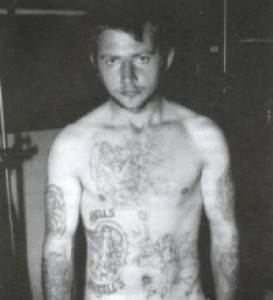
1902: Hirsh Lekert, Jewish assassin

On this date in 1902, the Jewish socialist Hirsh Lekert was hanged in Vilna (Vilnius) for his attempt on that city’s governor.

The 22-year-old shoemaker, active in the Bund since childhood, was aggrieved along with many others by repressive measures taken against that leftist council by Vilna governor Victor von Wahl — culminating with the calculated humiliation he inflicted by personally overseeing the flogging of 20 Jews and 6 Poles arrested at a May Day demonstration.
As was the style at the time, Lekert took some retaliatory potshots at the municipal dictator on May 18, 1902. He scored a couple of flesh wounds before the police on hand beat him all to hell.

And that was pretty well that. Lekert got sent to face a military tribunal with a foreordained result. But he made his bones with posterity by refusing to apologize and instead fearlessly vindicating his action as a defense of the Jewish worker’s dignity.

This carried his legend in the early 20th century Jewish community much further than one might assume.

For Jewish Workers Bund, “the first great attempt at the organization of the Jewish masses for secular and independent political activity,”* Lekert’s uncompromising embrace of revolutionary violence created an internal controversy: radical workers saw a martyred hero; elites, and the Bund officially, were much more wary of terrorism provoking official backlash in an empire where Jewish communities were still liable to be targeted by pogroms at any time. All this during a renaissance of cultural and political thought among Eastern European Jewry.

Even decades later, the esteem remaining Lekert from his sacrifice gave his name power. Another generation of Jewish terrorists — in Mandate Palestine — was incensed at the British for flogging some Irgun members, leading Menachem Begin to invoke Lekert as his justification for kidnapping several British soldiers and flogging them. (Source) The British had no stomach for this, and desisted with floggings.

Artistic tributes followed as well — folk songs; plays by Arn Kushnirov and H. Leyvik; the bust that illustrates this post; a monument in Soviet Minsk; even this appearance in a 1927 silent film called His Excellency:

And from the hellish Vilna Ghetto under Nazi occupation, the great poet of the Holocaust Abraham Sutzkever depicted his “Teacher Mira” trying to keep her students’ heads up by reminding them of the Vilna cobbler who fought back.

Her skin, a windowpane in stains of dusk,
Mira must not reveal the darkness thus.
She bites her lip, of courage she will tell:
About Hirsh Lekert, how he fought and fell.

* Koppel Pinson, “Arkady Kremer, Vladimir Medem, and the Ideology of the Jewish ‘Bund'”, Jewish Social Studies July 1945.

On this day..

1715: Margaret Gaulacher, Cotton Mather ignorer

American poet Jill McDonough wrote this moving sonnet to the Irish servant Margaret Gaulacher (sometimes also called Margaret Callahan), who was hanged on this date in 1715 for the infanticide of her (ill-)concealed newborn.

June 4, 1715: Margaret Gaulacher
Boston, Massachusetts

The news that week includes a lyonefs
displayed, attacking Fowls and Catts. They watched
her feeding time, remarked on her mercilefs
cruelty. Meanwhile, Cotton Mather preached
against Hard-hearted Sinners, and Hardnefs of Heart.
He helped with her confession, which reflects
on attempts to destroy her unborn child, a part
of her Wicked crime, completed through Neglect.
Now hers is a Stony Heart, of Flint. Ah! Poor
Margaret, behold: the congregation calls
on your wondrous Industry, Agony, your death four
days off. Pray for a Clean, and a Soft Heart; don’t fall
from this fresh gallows to the Mouths of Dragons,
unconcerned, adamant, so little broken.

I believe the poet here may be getting “June 4” here from the Espy file of historical U.S. executions. Unfortunately that date is not correct; it’s unequivocal in primary colonial news accounts that this hanging occurred on Thursday, June 9.*

But McDonough is spot on about the Cotton Mather vs. Hard-hearted Sinners theme of the execution. That vigorous gallows evangelist favored — he surely thought it was “favored” — the poor condemned wretch with every exertion private and public of his considerable rhetorical powers to save her soul ere she swung.

Gaulacher never quite submitted in the way Mather thought a proper condemned woman ought.

The illiterate woman signed off on an obviously Mather-written statement admitting the justice of her sentence and warning (as was standard scaffold fare) any hearers against her iniquities: “Swearing and Cursing … Profanations of His Holy Sabbaths … Rebellion against my Parents … the Sins of Unchastity.” But this pro forma gesture was the end of it; she obdurately refused to make a public show of Mather-friendly contrition and continued to show in private an unbecoming bitterness at her execution — in Mather’s eyes, clear evidence that she had not made a proper peace with her maker.

We have no access to the hanged woman’s inner life save via an interlocutor who obviously wasn’t on her same wavelength. Maybe she loved her unchaste carnal life too much to part with it in resignation. Likely, though she kept her Catholicism hidden from Mather, she didn’t feel right at home with the stridently Protestant settlement’s rituals and its congregationalist conversion milieu. Like them or not, however, she had to endure them: within a month of Margaret Gaulacher’s hanging, a book of two lengthy Cotton Mather sermons delivered to her in the presence of the entire congregation of Boston’s Second Church was being advertised for sale.

The text below consists of extracts from those two sermons — the parts where Rev. Mather gets personal and directly addresses his charge — surmounted by the explanatory introduction. Mather’s deep conviction that Gaulacher’s soul is in dreadful peril leaps from the page; so too does the silent prisoner’s rejection. The full publication can be perused in pdf form.


The OCCASION.

What gave Occasion to the Sermons here Exhibited, was an Amazing Instance of what the poor Chidlren of Men abandoned unto Ignorance and Wickedness may be left unto! A prodigious Instance of that Hardness of Heart, which especially the Sins of Unchastity, accompanied with Delays of Repentance, do lead unto.

Margaret Gaulacher, an Irish Woman, arrived the last Winter from Cork in Ireland, a Servant, that soon found a Place in a Family where she would not have wanted Opportunities and Encouragements for the Service of GOD.

She had been by her part in a Theft brought into Trouble in Ireland; and after her Transportation hither, it was not long before she was found in Thievish Practices.

Ere she had been long here, it was begun to be suspected, that she was with Child, by a Fornication; But she so Obstinately all along denied it, that at last she must feel the Effects of her Obstinacy.

She was delivered of her Illegitimate, when she was all alone; and she hid the Killed Infant out of the way; which was within a little while discovered.

Of her Behaviour in the Time of her Imprisonment, and of the Means used for her Good, there is an Account given in our Sermons.

The Woman was of a very Violent Spirit; and the Transports and Furies thereof, sometimes were with such Violence, as carried in them, one would have thought, an uncommon Degree of Satanic Energie.

By’nd by, she would bewail her Passions, and promise to indulge herself no more in such Passionate Outrages. One who owns himself to be a Roman-Catholick, affirms to me, that she privately Declared herself unto him, to be in her Heart, of his Religion; But she never would own any thing of that unto the Ministers who visited her with the Means of her Salvation.

A Gracious and Worthy Servant of God, Mr. Thomas Craighead, (a Faithful and Painful Minister of the Gospel, who came from Ireland, much about the same time that she did) having Instructed her, and used many Charitable Endeavours for her Good, was desired by her to be near her at her Execution; who accordingly Pray’d with her there, and continued his Instructions unto the Last.

She said little, but reff’d herself to the Paper which had been read Publickly in the Congregation just before.

And yet she Frowardly let fall one Word, which did not seem very consistent with it; For which fretful Strain of Impatience, being rebuked, she added, Then the Lord be Merciful unto me! and spoke no more.

All that remains for us to do, is to leave her in the Hands of a Sovereign GOD, whose Judgment, and not ours, has the Disposal of her; and make the best Improvement we can of such a Tragical Spectacle; for which the ensuing Sermons are some Essays.

But, I ought now if I can, to Refresh my Readers, with something that shall be more Agreeable, more Comfortable; have less to Trouble them; something that may be the Reverse of so shocking a Spectacle, as has here given Troublesome Idea’s unto them.

Of this we have a very Tragical Instance now before our Eyes. One who by hardening her Heart has brought herself into wonderful Mischief; and continues to harden her Heart, after the wondrous Mischief has come upon her like a Whirlwind from the Lord.

Ah, poor Creature; Thou hast been Guilty of many Sins, and Heinous ones. But, Oh! Don’t add this to all the rest, this Comprehensive one, this Atrocious one; To harden thy Heart after all, and so to bind all fast upon thy Soul forever.

God has done a dreadful Thing upon thee, in leaving thee to a Crime for which thou art now as one Wicked overmuch, to Dye before thy Time, and e’re twenty five Years have rolled over thee, the Sword of Justice with an untimely Stroak must cut thee off. But it will be a much more dreadful Thing, if thou art left after all unto an hard Heart, that will not Repent of thy Abominations, and of thy Bloodguiltiness.

f thou hadst not hardened thy own Heart exceedingly, Oh! what Things would be seen upon thee; other Things than are yet seen upon thee! Verily, A soft Heart would Mourn and Weep and Bleed, for a Life sweell’d away in Sin against the Glorious GOD. A soft Heart would soon Drown thee in Tears, from the View of the doleful Things thy Sin has brought upon thee. A soft Heart would make thee own the Justice of God and Man in what is now done unto thee; and would Silence thy Froward and Fretful and Furious Gnashing upon such as thou has no Cause to treat with so much transported Fury.

It breaks the Hearts of the Good People in the Place, to see thy Deplorable State: They are concerned, when they see thy Lamentable State: But above all, to see, that thou art thyself no more concerned for it; no more affected with it; so little Broken in Heart. And shall not thy own Heart at length be Broken, when thy own State comes into thy Consideration?

One once could say, God makes my Heart Soft, and the Almighty Troubles me. And will it not make thy Heart Soft, when thou thinkest on the amazing Trouble, which thou shalt feel from the Wrath of the Almighty GOD, if thou Dye in thy Sins? Verily, All the Sorrows thou seest here, are but the Beginning of Sorrows, if thou art not by a broken Heart prepared for the Salvation of God.

But then, What an Heart-breaking Thought is this? Margaret, There is yet Mercy for thee, if thou wilt not by an hard Heart refuse the Mercy; The Mercy, thro’ which Rahab the Harlot perished not; The Mercy, thro’ which Mary Magdalene had her many Sins forgiven her; This Mercy is ready to do Wonders for thee. A Merciful Saviour Invites thee; O come unto me, and I will do Wonders for thee.

Come and fall down before Him, and beg the Blessings of a soft Heart at His Gracious Hands. I know not of any Advice that can be so Proper, or so Needful for thee, as this; No Prayer of so much Importance to be made by thee as this.

The Ignorance which lays Chains of Darkness upon thee, is a sore Encumbrance on thy Essays for turning to God. Yet thou art not so Ignorant, but thou canst make this Petition to thy SAVIOUR. Lord, soften this hard Heart of mine! And, Lord, Bestow a New, and a Clean, and a Soft Heart upon me! And, God be Merciful to me a sinner; yea, an Hard-hearted Sinner!

Now, May the Gracious Lord accordingly look down upon thee.

of those who are sure of having the Arrest of Death presently served upon them, there is none that has a more affecting Assurance of it, than a poor Daughter of Death, who is this Afternoon to have her Soul Required of her. Ah! poor Creature! Dost not thou fear God, seeing thou art under a Condemnation, to a Tragical Death which is to be this Afternoon executed on thee; and within three or four Hours, thy Soul will be Required of thee; within three or four Hours thy Soul must make its Appearance before a Terrible GOD! Oh! What, what will be the Condition of that Perishing Soul, if no Fear of God be found in it, when it Appears before him? —

There is indeed a vast Abundance even to a Profusion, of Instructions, bestow’d more Privately on such Malefactors as Dye among us: No Place upon Earth does equal this Place for that Exercise of Charity. And this poor Creature has had a very particular Share thereof: Not only have the Ministers of the Gospel done their Part, in Visiting of her, but also many Private Christians have done theirs, in a most Exemplary manner. As of old in Jersualem it was the Usage of the Ladies, to Prepare for the Dying Malefactors, that Potion which was called, The Wine of the Condemned, so the Young Gentlewomen here in their Turns, have Charitably gone to the Prison every Day for diverse Weeks together, and because of her not being able to Read, have spent the Afternoons in Reading Portions of the Scriptures, and other Books of Piety, to this Condemned Woman, and giving their Excellent Councils unto her. Nevertheless, we chuse in a more Publick way also to direct a few Words of our Sermons, unto such Persons, when we have them among our Hearers; Because, the Preaching of the Gospel, is the Grand Ordinance of our Saviour, for the Conversion of a Sinner from the Error of his way; an we would wait upon our Glorious LORD, in that way which he has Ordained, hoping, still hoping, to see a Soul saved from Death!

Wherefore once more, O miserable Woman, entering into an Eternity to be trembled at; Once more, thou shalt hear the Joyful Sound of the Gospel, inviting thee to the Fear of God, and the Faith of thy only Saviour. And if there be not in this Last Essay, a more saving Impression from the Glorious Gospel of the Blessed God made upon thee, than thou hast yet felt from any former ones, — Oh! the dreadful, dreadful Consequences! What will become of thee! — Can thy Hands be Strong, or can thy Heart endure, in the View of what a Terrible GOD will order for thee? — Behold, Ah! poor Margaret, Behold a mighty Congregation of People, with Hearts Bleeding for thee, and Wishing and Praying and Longing to see the fear of God making some Discoveries in thee. And shall thy Heart still remain unaffected with thy own Condition; discovering still a total Estrangement from the fear of God! No Tears are enough, Tears of Blood were not enough, to be employ’d on so prodigious a Spectacle!

I am sorry, I am sorry, that I find myself obliged so much to speak it. Even since thou hast been under Condemnation, thou hast not feared God. Not many Hours are passed, since I saw in thee, so much Rage, and so Unrighteously harboured, and so Indecently Vomited, against some Vertuous Children of God, that it was too Evident, this fear of God had not yet begun to soften thee.

But if the fear of God enter not into thy Soul, before thy Soul be driven out of thy Body, which will be now, — alas, before many Minutes more be expired, thy Desolate, Forsaken, Miserable Soul, can have no part in the Kingdom of God. My Soul cannot be safe, if I forbear to tell thee so!

Ah, poor Creature, Art thou wiling to Dye unreconciled unto the God, whom thou hast Affronted with infinite Provocations? To Dye, and all into the Mouths of Dragons, who have so long poisoned thee, and enslaved thee? To Dye and be cast into the Eternal Burnings, from whence the Smoak of the Torment will ascend forever and ever? What? Shall all the Means of Good, which in a Religious Place have been used for thee, with hopes that they might find out one of the Elect of God, serve only to aggravate thy Eternal Condemnation at the last? Oh! Dreadful Consideration!

But, Oh! Be Astonished at it! There is yet a Door of Hope set open for thee; It will for one Hour it may be, stand open yet! Oh! Be full of Astonishment at such an Heart-melting Declaration, as is now to be made unto thee. A Compassionate SAVIOUR, is yet willing, to Cleanse thy Soul with His Blood, from the Sins, which by casting off the fear of God thou hast fallen into; yet willing to create in thee a Clean Heart that shall be filled with the fear of God, if he be sought unto; yet calling to thee, O look unto me and be Saved! And yet affording unto thee that Encouragement, in Joh. VI. 37. He that cometh unto me, I will in no wise cast out.

And, Oh! What wilt thou now do under these Astonishing Invitations? Wilt thou not improve these few Minutes with a most wondrous Industry and Agony? Do so, and be no longer such an Hard-hearted Prodigy! Fall down before thy SAVIOUR, and cry out; O my Saviour, Take pitty on my Soul, and now at the Last, let Sovereign Grace break forth, with a good Work of thy fear in my Soul! Cry out, O my Saviour, Let my Sin be all pardoned, and let all Sin be as Abominable unto me, as it is unto all that fear thy Name! Let thy Outcries pierce the very Heavens.

But, be it known unto thee, If the fear of God be in thee, it will be a thing more Bitter than Death unto thee, that thou hast Sinned against His Glorious Majesty; Thy Malice against every Neighbour will be extinguished; Thou wilt submit with Patience, to the Punishment of thy Iniquity; And thou wilt be an Holy, Humble, Thankful Soul, and quite another Creature! — God of His Infinite Mercy make thee so!

* n.b. — a Julian calendar date, as were all British colonies until England herself transitioned to the Gregorian calendar in 1752.

On this day..

1989: Stefan Svitek, the last in Czechoslovakia

The last execution in the history of the former state of Czechoslovakia occurred on this date in 1989.

Staggering home extremely drunk late one autumn night, Štefan Svitek (English Wikipedia entry | Czech) found the door locked and the pregnant Roma wife he regularly battered disinclined to open it.

So Svitek opened it himself by grabbing an obliging ax and splintering it to pieces.

Then he turned the ax on poor Marie and the family’s two daughters.*

Even the most aggressive executioners — and Czechoslovakia was not that — don’t hang every homicide. Svitek might have doomed himself in the final analysis with his disturbing sexual proclivities, especially since they surfaced during his rampage. He reportedly carved up the bodies, sliced off his late wife’s breasts and even cut the still-stirring embryo of his next child out of her womb, and pleasured himself over all the fresh gore. He would later describe it as the most intense sexual experience of his life.

It emerged at trial that Svitek’s youth in an alcoholic home had warped his animal urges so severely that he turned his lust upon animals, taking special gratification in castrating them.

This last operation Svitek also perpetrated on his own self as he fled in panic from his domestic charnel house. He also attempted to commit suicide by hanging.**

Svitek broke that rope. On the 8th of June in 1989, he did the same (metaphorically) to Czechoslovakia’s.

Svitek’s hanging June 8, 1989, was not only the last ever in the soon-to-be-defunct Czechoslovakia, but the last associated with either of Czechoslovakia’s successor states, neither of which have the death penalty on the books. (Svitek was hanged in Bratislava, the Slovakian capital; the last execution in the Czech half was that of Vladimir Lulek earlier in 1989.)

Update: Documentary, in Slovak (via the Twitter machine).

* One was Svitek’s own child, the other was his wife’s by her previous marriage. They were four and six years old.

** Another possible kink?

On this day..

1820: Louis Pierre Louvel, anti-Bourbon assassin

On this date in 1820, Louis Pierre Louvel was guillotined at Paris’s Place de Greve for murdering the heir to the French throne.

Louvel (French link) was a Bonapartist saddler, so embittered by the return of the ancien regime that he vowed on the day of the Restoration to exterminate all the Bourbons.

While his attempt to greet the returning Louis XVIII in April 1814 with a dagger came to naught, Louvel’s patience paid off six years later.

On February 13, 1820, he surprised the Duke of Berry outside the opera and plunged a knife into his chest.

The Duke, who expired the next morning, was not the heir to the throne: he was the younger of two sons of the Comte d’Artois, who was the brother of the still-reigning Louis XVIII. These Bourbons, however, seemed congenitally unable to reproduce: Louis XVIII would die childless, leaving the aforesaid Comte d’Artois to inherit as Charles X; the oldest of Artois’s children also had a childless marriage.

So the potential future of the dynasty looked a murky thing in 1820. The Duke of Berry had an infant daughter, and the guy looked like maybe the only male in the royal family’s younger generation who might be capable of fathering a son. Louvel’s blow potentially set the stage for an eventual succession crisis.*

The killer was promptly arrested and made no bones about his action, avowing that he acted without aid or accomplice. He had, he said, no particular personal beef with the Duke: it’s just that he considered the guy’s entire family traitors whose presence dishonored the nation. (Here’s a complete French account of his trial.)

Because Louvel had his head cut off by the guillotine, he was not around to experience the miraculous September delivery by Louvel’s widow of a posthumous son and heir. In time, this son would become the Legitimist pretender to the French throne.

As a matter of fact, the prideful Count of Chambord could have become king after the Franco-Prussian War and the Paris Commune wiped away the Second Empire. But to the grief of practical-minded monarchists, he publicly refused to accept the offered throne that he’d been waiting all his life for unless the nation also gave up the beloved tricolore flag associated with the regicidal Revolution. France said no thanks, and hasn’t had a monarch since.

* One more immediate consequence of Louvel’s strike: the liberal monarchist prime minister Elie Decazes came under opportunistic attack by ultra-royalists for giving aid and comfort to the terrorists with his moderate policies. Decazes was forced to resign and briefly went into exile in England due to the Ultras’ fulminations.

On this day..

1962: Henry Adolph Busch, Psycho

(Thanks to Meaghan Good of the Charley Project for the guest post. -ed.)

On this day in 1962, 30-year-old Henry Adolph Busch went to the gas chamber at San Quentin State Prison in California.

Condemned for the murder of his aunt, he had in fact slaughtered three Hollywood women and nearly killed a fourth.

Busch’s childhood was about what you would expect for a multiple murderer. Born Charles C. Hutchinson, he spent the first six years of his life being passed around to various foster homes before he was adopted by his much older half-sister, Mae E. Busch, and her husband Henry.

He emerged from those first six years emotionally scarred, and physically too: emaciated and with a deformed jaw. (En route to his adult “rat-like” face, enormous ears, and scrawny physique “like a string bean.”)

Years six through adulthood were no treat, either. Schoolmates teased young Henry about his appearance, and he had serious problems with his adoptive mother: one evaluation noted that Mae was a cold parent and “usual maternal feeling between mother and son seemed totally lacking.”

The youth also had difficulty maintaining concentration and suffered from terrible headaches, so it’s no wonder he did badly at school. He joined the Army but was dishonorably discharged; after that he became an optical technician and was viewed as “an excellent lens polisher” and a good employee.

Busch blurs the line between “spree killer” and “serial killer” (the former being itself a poorly defined medium between serial killer and mass murderer). He knew all of his victims, which isn’t typical for a serial murderer. Four months passed between his first and his second murders, but he went on to kill two women and attack a third within the space of three days.

That first victim was 72-year-old woman named Elmira Myrtle Miller, whom Henry had known since he was a child. On May 2, 1960, he dropped by her house and they watched The Ed Sullivan Show together. According to Busch, during the TV program he began to have irresistible thoughts of killing the old woman.

So he did. When Miller turned around to cover up her birdcages for the night, Busch seized her and strangled her to death. He pulled her housecoat up over her waist and tore her underclothes in an attempt to make the murder look like a sex crime, but made no attempt to molest her body.

Elmira’s murder baffled the police; months passed, without any solid leads.

On September 4, the 29-year-old Busch was in his adopted mother’s apartment building when he encountered 65-year-old Shirley Payne, who also lived there. He asked her out on a date to see the hot new film Psycho.

They watched the movie, went to his apartment and had sex. As Payne was getting ready to leave, Busch, again, jumped her from behind and strangled her. He wrapped the body in a sheet and stowed it under the sink temporarily. Fluid was oozing from Shirley’s eyes and nose, so the next day he bought a waterproof sleeping bag and put the body inside it.

Now getting the hang of this murder thing, Busch drank the draught deeply. The very next evening, he went to visit his favorite aunt, Margaret Briggs … and brought along a knife and a pair of handcuffs. They watched television until the early morning hours. He wanted to tell Margaret about Shirley’s murder and ask for advice, but when he started to confide in her she told him that, whatever his problem was, she was too tired to talk about it tonight.

So he strangled her too. After her death, he cut the clothing off her body. The police would subsequently discover numerous bruises and some cigarette burns on the corpse, something Busch never explained.

Henry went to sleep in Aunt Margaret’s bed. The next day he drove her car to work, where he asked a co-worker, 49-year-old Magdalena A. Parra, if she’d like to grab a coffee with him before their shift started. She agreed and got in his car, and immediately he tried to throttle her.

Magdalena was able to fight him off, however, and her screams caught the attention of two truck drivers. Busch bolted from the car; the truckers gave chase. He only went around the corner before he gave up and allowed them to catch him. The police initially thought Busch had just been trying to steal Mrs. Parra’s purse, but, he immediately confessed to the attempted homicide as well as the murders he’d committed during the previous 48 hours. He would eventually cop to Elmira’s slaying too.

In the aftermath of his arrest, predictably, the newspapers suggested Psycho might have given Busch the idea to attack Mrs. Payne. But it’s hard to reconcile the blame-the-movie idea with the inconvenient fact that he had killed before the movie was even released. When asked for comment, Psycho‘s director Alfred Hitchcock said violence was ubiquitous in cinema and his movie wasn’t any more likely to cause someone to commit murder than any other film.

When a doctor, William J. Bryan, examined him prior to his trial, Henry Busch said he’d been wanting to kill someone for years, but had always kept the urges in check, except for one time in the Army when he killed a POW. He said he probably would have kept killing people if he hadn’t been caught in the act with Mrs. Parra, and that he’d had his eye on his landlady for his next victim.

Dr. Bryan (who, it should be noted, was an expert hypnotist but not a psychiatrist) diagnosed the defendant with a schizoid personality and said he didn’t think Busch was capable of forming the intent to commit murder. Bryan suggested Busch’s murders, all of women significantly older than he, were inspired by Henry’s mommy issues: “The killings themselves seem to represent an attempt to possess the desired maternal object, at the same time destroying the power of the object to hurt.”

The state argued that Busch knew exactly what he was doing and was motivated not by mental illness but by pure and simple sadism. The prosecution suggested Shirley Payne had been raped before her death, a contention unsupported by the medical evidence.

In the end he was convicted of attempted murder of Mrs. Parra, second-degree murder in the Miller and Payne cases, and first-degree murder in the case of his aunt. The sentence was death.

Dispute about Henry Busch’s mental state continued as he waited to die. His mother, who testified that he had never been normal, appealed on his behalf. Even his fellow denizens of death row sent a petition to Governor Edmund “Pat” Brown, saying they thought Henry’s life should be spared because it was obvious to them he was mentally ill. But the governor decided to let the law take its course.

Henry Busch is buried at Forest Lawn in Glendale.

On this day..