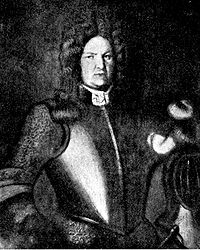
1663: Corfitz Ulfeldt, in effigy

On this date in 1663, Danish noble Corfitz Ulfeldt — then a fugitive abroad — was executed in effigy.

Ulfeldt (English Wikipedia page | Danish) is notorious as his country’s greatest traitor.

To commit great betrayals, one needs to begin with great trust. Ulfeldt was the son of a chancellor and was married off to Leonora Christina, the daughter of King Christian IV.

When Christian died, Ulfeldt was the de facto ruler of the realm or a few months in 1648 while the elective monarchy sorted out where to pass the crown next.

The choice ultimately fell to the late king’s son Frederick III, but this saturnine prince was distrusted by the Danish nobility, who forced on him as the price for his power a Haandfaestning — a sort of temporary Magna Carta circumscribing a monarch’s power for the period of his individual reign. It set a less than comradely tone for the two men’s relationship.

In 1651, an accusation surfaced that Ulfeldt was in on a plot to poison the king — an accusation that cost Ulfeldt’s lover her own head. Deciding that he didn’t need to be around when the next specious regicide allegation made the rounds, Ulfeldt pre-emptively fled the country.

From there, Ulfeldt’s lust for power and personal enmity for Frederick would light his path to infamy.

He signed up with Sweden’s King Charles X — Denmark’s greatest foreign rival — and mounted an invasion of his native country, possibly even financed by stolen Danish treasure. Rewarded with a Swedish noble title, he promptly began double-dealing against them, until his disgusted new sovereign dispossessed him, leading Ulfeldt to return hat in hand to Copenhagen.

Imprisoned there for that whole leading-an-enemy-invasion incident, Ulfeldt again managed to wriggle out and immediately tried to raise a German army against Denmark. Really — enough, dude.

Frederick certainly thought he’d seen enough too. Not having the compulsive traitor available to execute bodily, he resorted to the weird ritual of punishing a mannequin, and ordered the prison governor:

Know that you have to command the executioner in our name, that to-day, November 13, he is to take the effigy of Corfitz, formerly called Count of Ulfeldt, from the Blue Tower where it is now, and bring it on a car to the ordinary place in the square in front of the castle; and when he has come to the place of justice, strike off the right hand and the head, whereafter he is to divide the body into four parts on the spot, and carry them away with him, whilst the head is to be placed on a spike on the Blue Tower for remembrance and execration.

A few months after, the hunted Ulfeldt was reported to have died in Switzerland, a report considered highly suspicious in his native land. Nevertheless, he was never captured or heard from again, so whenever or however he died, it seems he managed to cheat the executioner of his flesh. As to the judgment of posterity: that, he had long since squandered.

The royal and loyal widow Leonora Christina enjoys a reputation quite a bit more favorable than her husband. She swallowed every draught of his exile, and more — remaining imprisoned under harsh conditions long after Corfitz’s death, only released in 1685 with the passing of King Frederick’s wife, her vengeful personal enemy. In that time, and in between fending off in her dungeon the local vermin, lecherous jailers, and the poison of personal bitterness, she wrote voluminous and well-regarded memoirs.

On this day..

1793: Jean-Sylvain Bailly, moonstruck

See Bailly, likewise of Paris, time-honoured Historian of Astronomy Ancient and Modern. Poor Bailly, how thy serenely beautiful Philosophising, with its soft moonshiny clearness and thinness, ends in foul thick confusion — of Presidency, Mayorship, diplomatic Officiality, rabid Triviality, and the throat of everlasting Darkness! Far was it to descend from the heavenly Galaxy to the Drapeau Rouge: beside that fatal dung-heap, on that last hell-day, thou must ‘tremble,’ though only with cold, ‘de froid.’ Speculation is not practice: to be weak is not so miserable; but to be weaker than our task. Wo the day when they mounted thee, a peaceable pedestrian, on that wild Hippogriff of a Democracy; which, spurning the firm earth, nay lashing at the very stars, no yet known Astolpho could have ridden!

Carlyle

On this date in 1793, French astronomer turned revolutionary Jean-Sylvain Bailly was guillotined during the Paris Terror.

Bailly ditched a family trade in the arts — his father was a supervisor at the Louvre — and turned his gaze skyward.

Studying astronomy under Lacaille, Bailly made a quick splash in astronomical circles with meticulous work on Halley’s Comet and the moons of Jupiter. He was inducted into the French Academy of Sciences while still in his twenties. Not quite the guy every schoolchild knows, but a significant scientist in his time. As one twentieth-century reviewer put it,*

Bailly was not a great thinker or the discoverer of new concepts; no case can be made for placing his name beside those of Newton, Leibnitz, and Laplace. But he should not be denied a niche among the numerous competent and persevering work-a-day scientists who, perhaps, in the long run make possible the achievements of a few great men. His observations and reductions, his application of a mathematical discipline to the movements of the heavenly bodies, and his detailed publications had brought him, by 1766, considerable credit among fellow scientists.

His “considerable credit” in the public sphere, enhanced by his widely-admired writing, set him up for election to the Estates-General in 1789. Indeed, Bailly was elected to head the body’s Third Estate.

On June 20th of that pregnant year, days after the Estates-General had constituted itself a National Assembly with ambitions far outstripping the limited purpose of revenue collection the king intended them for, Louis XVI locked the delegates out of their meeting-room.

Bailly, in consequence, would lead one of the pivotal actions of the embryonic French Revolution. “I do not need to tell you in what a grievous situation the Assembly finds itself,” he said to the assembly reconvened at a nearby tennis court. “I propose that we deliberate on what action to take under such tumultuous circumstances.” The result of that deliberation was the Tennis Court Oath.


Detail view (click for the full image) of Jean-Sylvain Bailly administering the Tennis Court Oath, in Jacques-Louis David‘s sketch of the event.

When the Paris provost — an archaic municipal office — was shot by the mob on Bastille Day, Bailly became the City of Light’s first mayor.

But as with other principals of the Revolution’s earliest stirrings, like Bailly’s ally Lafayette, the man was left behind by the rapid progress of events. He’d been two years retired out of public service in Nantes when he was hailed before the Revolutionary Tribunal on the preposterous charge of having conspired in Louis XVI’s attempted flight and guillotined on that basis.

A lunar crater — the largest crater visible from earth — is appropriately named after this prolific observer of the heavens.

* Edwin Burrows Smith, Transactions of the American Philosophical Society, New Series, Vol. 44, No. 4 (1954).

On this day..

1861: Sushun, by Empress Dowager Cixi

One hundred fifty years ago today, Qing China’s last great ruler, the Empress Dowager Cixi, having seized the helm of the state she would drive for 47 years, had her deposed predecessor executed.

Formally, China was being “ruled” at this time by the illustrious Tongzhi Emperor, age five.

This child’s old man, depressively self-medicating at the drubbing China was taking in the Second Opium War, had died young, leaving his only son the throne, in care of a council of regents.

As one of the late monarch’s key advisors, Sushun was among that eight-strong panel, and he was popularly regarded as the worst of the lot — vicious, drunken, spendthrift, and just the guy to blame (along with co-regents Zaiyuan and Duanhua) for all the vicious, drunken, and spendthrift stuff the deceased emperor had put his seal to. Or, just the sort of stories trumped up by the rivals of the man really steering the state. Either way is good.

The Empress Dowager Cixi (1905 photograph)

More perilous for Sushun was his burgeoning rivalry with “the Concubine Yi,” the master of harem politics and mother of the new boy-emperor. She had long distrusted the courtier.

Recast in both title and name with her lover’s passing, the woman now known as “Empress Dowager Cixi” was able to obstruct the regency’s policies. And she did one better than that, intrepidly allying with disgruntled princes to engineer a coup d’etat against Sushun’s faction.

The end of Sushun’s regency arrived within months, and transpired within days: less than a week separated Sushun’s liberty from his beheading in a vegetable market. (Striking a liberal pose, Cixi declined to have him put to death by lingchi.) Cixi’s side simply took him into custody, decreed his execution on the attainder of a secret committee, and speedily carried it out. Zaiyuan and Duanhua were ordered to commit suicide the same day.

“Surely,” wrote a British diplomat who had only barely avoided execution at the hands of the lately toppled regime, “we may trace the finger of God in these events, and trust that they augur well for the future of China … we yet may see peace or order return to this poor torn country.” Peace and order and a robust opium market, he meant.

But whatever the form, the poor torn country was in the hands of the Empress Dowager Cixi from here on in.

For a half-century, she would be the consummate survivor — but it was survival during an epoch of terminal decline for the Qing. Riven by conflicts within and without, the imperial system simply couldn’t adapt.

And when the cagey Empress Dowager finally died in her 73rd year, the whole enterprise came apart.

On her deathbed in 1908, Cixi named as emperor the toddler Puyi. A few years later, revolution ensured that Puyi would be the last person ever to hold that title.

On this day..

1600: Ishida Mitsunari, Konishi Yukinaga and Ankokuji Ekei for the Tokugawa Shogunate

On this date in 1600, the emergent Tokugawa Shogunate beheaded three men as rebels in Kyoto after they lost one of the pivotal battles in Japanese history.

The Battle of Sekigahara, on Oct. 21 of that same year, had pitted the shogunate’s founder Tokugawa Ieyasu against a coalition known as the Western Army.

This was the culmination of Japan’s bloody process of national unification.

The preceding ruler, Toyotomi Hideyoshi, had more or less unified Japan under central authority to end a century of civil war. But when Hideyoshi shuffled off leaving a five-year-old heir, a squabbling coterie of regents began elbowing for position.

The political scene eventually crystallized into one of those regents — the said Tokugawa Ieyasu — against all the others. Give yourself a gold star if you guessed that the guys who had their heads lopped off by the Tokugawa Shogunate played for the “all others” team.

Ishida Mitsunari

Ishida Mitsunari, a daimyo who served the late national unifier Hideyoshi, became the focal point of the opposition to Ieyasu.*

Mitsunari failed in a 1599 assassination bid on Ieyasu, and so the two came to outright warfare the following year — a war that Ieyasu economically won by routing Mitsunari at the Battle of Sekigahara.

That, in turn, cleared the way for Tokugawa Ieyasu eventually to take the title of shogun and found his eponymous dynasty — a dynasty whose intellectuals circled that decisive battle as the keystone in the arch.

“Evildoers and bandits were vanquished and the entire realm submitted to Lord Ieyasu, praising the establishment of peace and extolling his martial virtue. That this glorious era that he founded may continue for ten thousands upon ten thousands of generations, coeval with heaven and earth!”

Hayashi Gaho, a little on the optimistic side

Captured after Sekigahara, the “evildoer” Mitsunari was beheaded this date alongside two of his allies: a Christian convert named Konishi Yukinaga, and Ankokuji Ekei of the powerful Mori clan.

* Ishida Mitsunari wasn’t one of the regents; rather, the anti-Ieyasu regents ended up adhering to him.

On this day..

1973: 14 during the Caravan of Death

Fourteen early-morning executions in Chile on this date in 1973 heralded the end of one of the Augusto Pinochet dictatorship’s most notorious human rights abuses: the Caravan of Death.

For this “caravan” picture not camel-borne spice traders but a helicoptering death squad. In the bloody aftermath of Pinochet’s September 11, 1973 coup against the elected socialist government, the new strongman’s buddy Gen. Sergio Arellano Stark took this evil-omened chopper on a south-to-north tour from prison to prison beginning September 30 — leaving its wares behind at each stop, in the form of spent shells and murdered men.


Arellano and Pinochet were all hugs hours before the caravan departed.

The intended consumer of this murderous spectacle, according to the human rights organization Memoria y Justicia, was as much the military itself as it was the political opposition. “One of the reasons,” said one officer at Arellano’s very first stop,

was to set a drastic precedent in order to terrorize the presumed willingness of the Chilean people to fight back. But without a doubt, it was also intended to instill fear and terror among the commanders. To prevent any military personnel, down to lowest ranking officers, from taking a false step: this could happen to you!

And indeed, several officers were also sacked along the way, a couple even imprisoned and tortured. Their lenient treatment of presumed subversives constituted “failure to fulfill military duties”: one can readily imagine the impression made upon junior officers in Pinochet’s armed forces.

Said subversives had it worst of all, of course.

These were people already in prison, many having voluntarily turned themselves in upon request after the coup; they were drug out of cells in the dark of night and machine-gunned, or worse. Close to 100 defenseless political detainees died this way over a three-week span.

The Caravan reached Antofagasta on October 18, where Gen. Arellano was received by the zone chief Gen. Joaquin Lagos.

Arellano’s unit did its dirty work overnight: the names of its 14 victims on this date’s early hours are recorded here. One was an 18-year-old student, one a 66-year-old “maritime worker”. Several were figures in local government.

Lagos was horrified the next morning when he discovered what his guests had been up to — and he immediately gave Pinochet his resignation.

I felt hurt, powerless and angry [Lagos later said] that a criminal action of this nature that had been committed in my jurisdictional zone and behind my back.

Lagos had the juice to make this sort of gesture without winding up in prison himself: indeed, he gave Pinochet his resignation (and the reason) personally.

Though Lagos has said that Pinochet seemed much more concerned about his (Lagos’s) attitude towards the atrocity than the atrocity itself, he (Lagos) also remembers Pinochet placing a call to Gen. Arellano and, not reaching him, leaving his nomadic deputy a message “not to do anything more.” The Caravan did stop on Oct. 22: maybe, Lagos’s resignation did the trick, at least to the extent one can attribute any cause to the cessation. This outcome will always rate a bullet point on the brief against the “superior orders” defense.

Relatively speaking, these unfortunates are only one puddle of blood among seas from the Pinochet years. Still, the Caravan of Death in particular was (and still is) a focus of the indictments handed down against him after the return of civilian government, thanks in no small part to Gen. Lagos’s willingness to go on the record about it — and as a result, many of the legal maneuvers around Pinochet in the last years of his life, both in Europe and Chile, concerned this horrible affair.

Pinochet finally died in December 2006 while under house arrest for two specific Caravan of Death murders. While alive, however, his legal team predictably attempted to blame local commanders for the Caravan’s atrocities; in response to this gambit, Lagos went public on television with his version (which human rights organizations also tend to credit) — along with horrifying descriptions (Spanish link) of the death squad’s activites that left him too “ashamed” to return the victims’ remains to their loved ones.

They were torn apart. They were no longer human bodies. I wanted to at least put the bodies back together again, to leave them more decent, but you couldn’t.

They cut eyes out with daggers. They broke their jaws and legs

They shot them to pieces, first the legs, then the sexual organs, then the heart, all with machine guns.


From an entire album that Dark Order devoted to the Pinochet dictatorship.

Part of the Themed Set: Illegitimate Power.

On this day..

1707: Johann Patkul, schemer

On ths date (N.S.) in 1707, Livonian nobleman Johann Patkul was broken on the wheel at Kazimierz Biskupi, Poland for a decade’s treasonable scheming against the Swedish crown.

Livonia — essentially present-day Latvia, plus a chunk of Estonia — was at this time a part of the Swedish Empire in the latter’s twilight as a world power.

Financially pinched after the protracted and bloody but indecisive Scanian War, the Swedish king Charles XI imposed his great reduction — a heavy tax on the landed aristocracy allowing the crown to reclaim as its own any property that it had held formerly and granted out. There was a lot of such land mortgaged out generations before to raise capital for the Thirty Years War. War giveth, war taketh away. Hands up everyone who feels bad for the nobility.

Of course, all the 17th century nobles felt bad for the nobility.

Johann Patkul was the young — maybe too young — man deputized by Livonian bluebloods to go complain about it to Charles. When sharp but respectful eloquence predictably failed to obtain his ends, he dropped the “respectful” part — and for this lese majeste had to bug out of Sweden with an in absentia death sentence at his heels.

Having failed to obtain pardon from the offended monarch or from his heir Charles XII, Patkul just decided to change teams full stop. You could call this treachery (Charles XII did) but this is an age before nationalism. What was the Swedish royal house to a Latvian noble if he could get a better deal elsewhere?

“Elsewhere” for Johann Patkul meant Polish-Lithuanian king Augustus the Strong, and/or Russian tsar Peter the Great. Our refugee aristocrat spent the 1700s conducting vigorous behind-the-scenes shuttle diplomacy to engineer an alliance against his former masters and carve their respective pounds of flesh out of Sweden. Patkul himself, of course, would get a healthy bite from Livonia for his trouble.

In this campaign Patkul was merely an “unhappy instrument” (as a British correspondent quoted here put it): the antagonists in question had ample reason of their own for this statecraft; had they not, some itinerant conspirator pining for a lost manor could scarcely have conjured it.

But Patkul was a useful instrument: energetic, discreet, willful, and so he could surely claim some ownership of the product. Think of him as the convenient enabler — the Ahmed Chalabi of the Great Northern War that tore apart the Baltic environs for the first two decades of the 18th century.

It was rather fitting, then, that Patkul was devoured by his offspring when Sweden forced a peace upon Poland that resulted in Patkul’s being handed over to the Swedish authorities. The man’s extradition was specified by name in the treaty.

Patkul’s brutal execution inflamed some outside opinion against the Swedes (which presumably mattered not a whit to the progress of hostilities); a purported account of his execution-eve conversation with his confessor is given in this extremely sympathetic English pamphlet.

Though it’s safe to say that Patkul didn’t get what he wanted — let’s guess that the public shattering of his bones prior to a protracted death by exposure was towards the “worst case scenario” end of the calculus — the Great Northern War did indeed loose Livonia from the Swedish yoke … in favor, instead, of the Russian. Peter the Great accepted Livonia’s capitulation in 1710.

Mission accomplished.

Patkul is not to be confused with Baron Peikel/Pykul, a different fellow who was also executed for disobedience to Sweden in 1707.

On this day..

1354: Cola di Rienzi, last of the Roman Tribunes

On this date in 1354, Cola di Rienzi (or Rienzo) was slain by a miserly Roman mob — rather a lynching than an execution, but by any name the tragic end to one of history’s most amazing political careers.*

“Almost the only man,” in the estimation of his admiring biographer Edward Bulwer-Lytton,** “who ever rose from the rank of a citizen to a power equal to that of monarchs without a single act of violence or treachery.”

So magnetic was that era’s revival of classical learning that young Rienzi’s plebeian parents found a way on an innkeeper’s wages to immerse the boy in Cicero, Seneca, and the rest. As Gibbon put it, “the gift of a liberal education, which they painfully bestowed, was the cause of his glory and untimely end.” (Surely this is an object lesson for present-day families contemplating the daunting cost of university education.)

And the oratorical gifts he thereby developed found ready exercise lamenting Rome’s medieval degradation.


This View of the Campo Vaccino actually dates to 1636, but you get the idea. “Campo Vaccino”: that’s “cow pasture,” also known (to you, me, and Julius Caesar) as the Roman Forum.

Rome had bled away the grandeur of its imperial past without recovering the liberty of its populace. A haughty and dissolute aristocracy tyrannized the brackish city: a brawl between rival factions took Rienzi’s own brother’s life, with no prospect of justice.


Rienzi vows to obtain justice for his murdered brother, depicted in a pre-Raphaelite painting by the young William Holman Hunt.

Added to this civic humiliation (though only fortuitous for Rienzi’s political opportunity), the papacy itself had decamped for its captivity in Avignon.

What to do?

How about — overthrow the bastards?

Astonishingly, for Rienzi, to dare was to do: on Pentecost in 1347, he rallied a Roman mob and proclaimed the Republic re-established — taking for himself the ancient honorific of Tribune and the real power of an autocrat. The nobility routed in disarray, or else submitted to the sudden new authority.

For the balance of the year, Rienzi’s word was law in Rome, and as a messianic, popular dictator he cleared woods of bandits, imposed the death penalty for (all) murderers, and beat the aristocracy’s re-invasion with a citizen militia. He audaciously began to resume the primacy of the caput mundi: as “Tribune”, Rienzi summoned delegations from the other Italian cities, and presumed to arbitrate the disputes of neighboring kingdoms. Audacity veered into delirium as he pressed demands on the likes of the Holy Roman Emperor. He acquired a taste for fine wine and good clothes.

“Never perhaps has the energy and effect of a single mind been more remarkably felt than in the sudden, though transient, reformation of Rome by the tribune Rienzi,” Gibbon marveled. “A den of robbers was converted to the discipline of a camp or convent: patient to hear, swift to redress, inexorable to punish, his tribunal was always accessible to the poor and stranger; nor could birth, or dignity, or the immunities of the church, protect the offender or his accomplices.”

The great humanist Petrarch, Rienzi’s contemporary, was smitten by the unfolding revolution.

But almost as soon as Rienzi’s republic began, the man fell: another invasion found the Roman in the street deaf to the alarm bells, and Rienzi fled.

“He was a dreamer rather than a man of action,” is the charge of the Catholic encyclopedia; excitable, injudicious, spendthrift, and prey to the “Asiatic” emoluments of his station.

This career alone would merit a remembrance, but Rienzi had a second act.


Richard Wagner’s first hit opera — though hard to come by in the wild nowadays — was Rienzi, der Letzte der Tribunen (synopsis), from a libretto based on Bulwer-Lytton’s homage.

After a long spell in exile, he was captured by the Holy Roman Emperor and transferred to the papacy, where he remained comfortably imprisoned for a couple of years. When the pontiff’s hat changed heads to Innocent VI, the latter freed the illustrious ex-Tribune and dispatched him back to Rome under the title of Senator — intending him a catspaw to re-assert the supremacy the papacy had abandoned by moving away.

Within weeks of arrival in 1354, Rienzi again made himself master of the city.

And within months thereafter, he had fallen again — to his death.

He is charged in this last term with severity (the execution of a high-born freebooter, Fra Monreale, in particular), with avarice and abuse of power and once more with political incompetence.

Gibbon claims that Rienzi “contracted the habits of intemperance and cruelty: adversity had chilled his enthusiasm, without fortifying his reason or virtue; and that youthful hope, that lively assurance, which is the pledge of success, was now succeeded by the cold impotence of distrust and despair.” We incline to prefer Bulwer-Lytton’s more generous estimation of a man who with no resource save his own brilliance twice recovered to his low-born person the tattered remnants of the purple and dared against a thousand mighty antagonists to lift it on the standard of the Gracchi. Flaws, and they fatal, he possessed in abundance: but greatness even more.

At any rate, all the scolds upon Rienzi’s imperfections were so much froth in 1354. He certainly did not succumb to the greater virtue of the polis, but merely to its shortsighted refusal to bear a levy:

it was from a gabelle on wine and salt that he fell. To preserve Rome from the tyrants it was necessary to maintain an armed force; to pay the force a tax was necessary; the tax was imposed — and the multitude joined with the tyrants, and their cry was, “Perish the traitor who has made the gabelle!” This was their only charge — this the only crime that their passions and their fury could cite against him.

Rienzi’s eloquence, so often his decisive weapon, failed to move the shortsighted mob that besieged him, and he was hauled to a platform in the Capitol where public executions had been performed at his behest. “A whole hour, without voice or motion, he stood amidst the multitude half naked and half dead: their rage was hushed into curiosity and wonder: the last feelings of reverence and compassion yet struggled in his favour; and they might have prevailed, if a bold assassin had not plunged a dagger in his breast.” (Gibbon)

If this amazing character’s contradictions seem difficult to reconcile and his actions sometimes perplexing, Bulwer-Lytton argues in Rienzi’s defense that we must view him as a complex man ultimately fired not by political ambition but by religious zealotry. One thinks of Savonarola, the prim monk who mastered Florence and perished in flames, save for the essential detail: Rienzi’s loss “was bitterly regretted … for centuries afterwards, whenever that wretched and degenerate populace dreamed of glory or sighed for justice, they recalled the bright vision of their own victim, and deplored the fate of Cola di Rienzi.”


Statue of Rienzi in Rome. (cc) image from ZeroOne.

* And surely in keeping with the time-honored way for Roman chiefs to fall.

** We’ve encountered Bulwer-Lytton glancingly in these pages; his novel Zanoni climaxes with the beheading of its fictional title character in one of the last carts of the French Revolution’s Terror, and he wrote a novel (savaged by Thackeray) about executed intellectual Eugene Aram. The “biography” in question for this piece is actually a work of historical fiction, Rienzi, Last of the Roman Tribunes; the quoted sections are from Bulwer-Lytton’s (non-fiction) afterword.

On this day..

1816: Camilo Torres, Manuel Rodriguez, and other leaders of independent New Granada

On this date in 1816, Spain hanged the leaders of a breakaway former New World possession in a vain effort to maintain control of what is now Colombia.

The United Provinces of New Granada was la Patria Boba, the “foolish fatherland” of Colombia: a welter of rival provinces and municipalities which capitalized on the mother country’s fall to Napoleon to declare independence and immediately commence fratricidal civil war.

The United Provinces had leave of several years for this foolishness before the Peninsular War ended with the restoration of Ferdinand VII, who promptly dispatched a massive expedition under the notorious command of Pablo Morillo to bring these disobedient satellites to heel … and to hemp.

The gentlemen whose death-day we commemorate today were the ones at the seat of government when the music stopped playing. Those positions, and even the forms of government itself, had been regularly reshuffled in the Patria Boba as federalist and anti-federalist, republican and royalist, threw their respective weights (and armies) around.

Morillo, who is still infamous in Colombia for his cruelty, had the most weight of all.

As Morillo’s reconquista invaded the Provinces, Camilo Torres (English Wikipedia page | the much more detailed Spanish) resigned the presidency. Torres is best-remembered now as the author of the Memorial de Agravios (Spanish link; it translates as “Memorial of Grievances” or, more Office Space-ishly, “Memorandum of Grievances”).

This incendiary document prophetically insisted that

the union between America and Spain [rest on] the just and competent representation of its people, without any difference among its subjects that they do not have because of their laws, their customs, their origins, and their rights. Equality! The sacred right of equality. Justice is founded upon that principle and upon granting every one that which is his.

-Memorial de Agravios, as translated in The Independence of Spanish America, by Jaime Rodriguez

Stuff like this was liable to get you on Morillo’s enemies list political office or no; cowing — or killing — seditious intellectuals was part of his whole project.

Torres, his predecessor and vice president (same guy) Manuel Rodriguez, and several other ministers of state were nabbed together trying to make an escape to sea.

Morillo had them subjected to a snap trial, and Torres and Rodriguez were executed this date along with Pedro Felipe Valencia (Spanish link) and Jose Maria Davila; simultaneous property confiscation left the men’s survivors penniless. (Later, Simon Bolivar would personally support the widow Torres.)

Once hemp got through with the necks this day, old-fashioned blades did their redundant work: Torres’s head was hewed off and mounted in Bogota for public viewing.

It’s noteworthy that the author of this sort of nasty warning to the public would later sign his name opposite his New World antagonist Simon Bolivar in a Treaty of Armistice and Regularization of War (more Spanish) undertaking to stop murdering prisoners and non-combatants and fight only “as do civilized peoples” — one of the seminal documents in the development of human rights and the law of war.

Spanish speakers may appreciate this timeline site on the life and times of Camilo Torres.

* Torres, that Colombian Tom Paine, took some overt inspiration from the recent American Revolution, arguing that “to exclude the Americas from such representation … would forever alienate their desires for such a union.” After all,

If the English government had taken such an important step, perhaps today it would not rue the separation of its colonies. But a feeling of pride and a spirit of vanity and superiority led to the loss of those rich possessions.

On this day..

1936: Grigory Zinoviev and Lev Kamenev, Old Bolsheviks

During the purges of the 1930s, Josef Stalin showed a particular relish for eliminating the Old Bolsheviks whose red credentials predated the revolution. (And potentially, outshone his own.)

Zinoviev

On this date in 1936, one of the oldest of them, Grigory Zinoviev, was shot with his longtime ally Lev Kamenev.

These guys had been major movers and shakers among the early Bolsheviki, adherents of Lenin during the first decade of the century when the aspiration for a Communist Russia seemed hopelessly far-fetched. Zinoviev rode with Lenin from Switzerland to Petrograd in the famous sealed train after the February Revolution toppled the tsar. (Not so Kamenev: he was serving time in Siberia, but was freed by the revolution.)

In the years that followed, both played leading roles in the Soviet government despite their impolitic opposition to the Bolshevik coup in October.

Kamenev was briefly head of state in 1917, and he married Leon Trotsky’s sister. Zinoviev was the longtime head of the Communist International, in which capacity he showed Moscow’s public face for communist movements in other countries. Bela Kun was another ally of Zinoviev’s.)

In this capacity, he’s known in British history for the “Zinoviev letter”, a purported summons to Anglo agitation that was actually a dirty trick dropped before an election to help the Tories sweep to power.*

Those were the good old days — when Lenin was fading away and Zinoviev, Kamenev, and Stalin were the “troika” running things. They should have checked with the Romans how triumvirates work out.

Because of their alliance, Zinoviev and Kamenev provided the decisive support that enabled Stalin to remain General Secretary of the party after the public airing of Lenin’s Testament warning against him. Without Zinoviev and Kamenev at this crucial moment, Stalin probably could not have survived politically; the name Koba might have gone into history books as little more than a terror to the paperwork of some forgotten bureau. (And the pre-revolutionary Caucasus!)

Talk about hoisted by your own petard.

Having been helpfully maintained in his position against Lenin’s dying wish, Stalin soon marginalized these formerly useful creatures. Their last decade was doomed to a spiral of failing power struggles, sinking rank, furtive dissension, and craven submission to party discipline.

Stalin at length destroyed them at the first great Moscow show trial, the Trial of the Sixteen — which hyped a “Trotskyite-Zinovievite” plot in a nicely Orwellian twist. (Despite Kamenev’s marital connection, Trotsky was actually a political rival.) The charge sheet must have reminded the defendants on every one of their dwindling days of the alliance with Trotsky they could have made back when they mattered.

The Trial of the 16 defendants would help to write the script for succeeding acts of this awful theater: after fighting the allegations, Zinoviev and Kamenev agreed to plead guilty on private assurances that their lives would be spared.

But once he had their “admissions” on the record, Stalin altered the deal.

Not only Zinoviev and Kamenev, but all 16 from the trial of the 16 were shot shortly after midnight this date.

From exile, their “conspirator” Trotsky called it the “end of an epoch”.

His obituary for Zinoviev and Kamenev minces no words about the men’s personal shortcomings (“they lacked sufficient character”), but still achieves a certain elegaic sympathy for these former fellow-travelers and their shared movement, now swallowed by Stalinism.

I have had the occasion to hear tranquil petty bourgeois tell me in the days between the beginnings of the trial and my internment: “It’s impossible to understand Zinoviev … He is so lacking in character!” And I would reply: “Have you yourselves experienced the full weight of the pressure to which he has been subjected for a number of years?” Unintelligent in the extreme are the comparisons, so widespread in intellectual circles, of the conduct in court of Danton, Robespierre and others. These were the instances of revolutionary tribunes who found the knife of justice suspended over them, directly in the midst of the arena of struggle; at a time when they were in the full flower of their strength, with their nervous system almost untouched and, at the same time, when they despaired of all hope of salvation.

[By contrast] For ten years they [Zinoviev and Kamenev] had been enveloped by clouds of slander paid for in heavy gold. For ten years they had swayed between life and death, first in a political sense, then in a moral sense, and lastly in a physical sense. Can one find in all past history examples of such systematic, refined and fiendish destruction of spines, nerves and all the fibers of the soul? Zinoviev or Kamenev would have had more than ample character for a tranquil period. But the epoch of grandiose social and political convulsions demanded an extraordinary firmness of these men, whose abilities secured them a leading place in the revolution. The disproportion between their abilities and their wills led to tragic results.

* There are numerous theories of the Zinoviev Letter’s origin; one has it that spy Sidney Reilly had a hand in it.

On this day..

1510: Richard Empson and Edmund Dudley, tax collectors

On this date in 1510, the new king Henry VIII had his dad’s most hated tax collectors beheaded on Tower Hill.

Better days: Empson (on the left) and Dudley (on the right) pal around with Henry VII.

When Henry Tudor conquered Bosworth Field to emerge from the War of the Roses as King Henry VII, he brought the baggage of being the son of some Welsh squire.

His shaky legitimacy exposed the newborn Tudor dynasty to existential threats from every quarter; even putative allies proved liable to turn against him.

Henry consequently looked for every opportunity to centralize power away from institutions that could check or threaten him and into his own hands — nowhere more notoriously so than in the realm of taxation.* Aggressive tax collection would not only regenerate the crown’s blasted treasury; it would widen his own scope of action.

Whether Henry’s historical repute for cupidity is well-deserved is a topic beyond the scope of this site, but the fact that he does have such a reputation can be attributed in no small degree to this date’s featured players.

These two persons, being lawyers in science, and privy councillors in authority, as the corruption of the best things is the worst, turned law and justice into wormwood and rapine. … Neither did they, toward the end, observe so much as the half-face of justice, in proceeding by indictment; but sent forth their precepts to attach men and convent them before themselves, and some others, at their private houses, in a court of commission; and there used to shuffle up a summary proceeding by examination, without trial of jury; assuming to themselves there to deal both in pleas of the crown and in controversies civil. Then did they also use to inthral and charge the subjects’ lands with tenure in capite, by finding false offices, and thereby to work upon them for wardships, liveries, premier seisin, and alienations … When men were outlawed in personal actions, they would not permit them to purchase their charters of pardon, except they paid great and intolerable sums; standing upon the strict point of law, which upon outlawries giveth forfeiture of goods; nay, contrary to all law and colour, they maintained the king ought to have the half of men’s lands and rents, during the space of full two years, for a pain in case of outlawry. They would also raffle with jurors, and enforce them to find as they would direct, and if they did not, convent [summon] them, imprison them, and fine them. These and many other courses, fitter to be buried than repeated, they had of preyig upon the people; both like tame hawks for their master, and like wild hawks for themselves; insomuch as they grew to great riches and substance.

Francis Bacon‘s History of the Reign of King Henry the Seventh

Richard Empson and Edmund Dudley were two powerful parliamentarians of less than lordly stature who had been elevated to this bad-cop role for their loyalty and aptitude. There, they became lightning rods for public resentment. It’s a path that had once taken a French counterpart from the common stock to the robes of state to (once his patron monarch died) the scaffold. Empson and Dudley trod it exactly.

Even in Henry’s lifetime, his newly intrusive taxes risked fearful public reaction.

The pretender Perkin Warbeck knocked Henry for the “robberies, extortions, the daily pilling of the people by dismes [tithes], taskes [contributions], tallages [tolls], benevolences, and other unlawful impositions and grievous exactions” he imposed, “agreeable to the meanness of his birth.” Tax backlash helped generate at least some of Warbeck’s popular support.

By the twilight of Henry’s rule in the first decade of the 1500’s, he had mastered these threats and could take advantage of political tranquility to really focus on his accounting. And he’d figured out that by ratcheting up enforcement of already-existing levies, he could avoid the dangerous confrontations that might result from summoning Parliament to ask it for money. It’s from this period most of all that he gets his historical Ebenezer Scrooge image, and the tool he employed for it, the Council Learned in the Law, got its extreme unpopularity.

Henry died in April of 1509 at the age of 52, leaving his son Henry VIII an overflowing treasury and countless grievances against the tax collectors who made it happen.

As the Council Learned’s leading lights, Empson and Dudley — “the king’s long arms with which … he took what was his” — immediately became targets once their royal protector was in the ground. They were hailed before the greenhorn king and the Privy Council to justify themselves within days of Henry VII’s death.

Interestingly, because a royal pardon amnestied all crimes except “felony, murder, and treason,” the malfeasance of these two councilors — whose real offense was unimpeachable loyalty to the last sovereign — had to be exaggerated into rather fantastical charges of treason in order to satisfy petitioners against them while avoiding undue embarrassment for the late king or the other aides who had served him.

In the year or so he lay in the dungeon awaiting his fate, “a pson most ignorant, and being in wordlie vexacon and trowble, also wth the sorrowfull and bitter remembrance of death,” Edmund Dudley wrote a treatise on the right arrangement of a society dedicated to the young new master who held Dudley’s life in his hands. The Tree of Commonwealth can be read here.

Yale professor Keith Wrightson introduces an interesting lecture — “Early Modern England: Politics, Religion, and Society under the Tudors and Stuarts” — with Dudley’s Tree of Commonwealth social schema.

Remember both, since now each thrive,
on perquisite ill gotten,
Empson & Dudleys case survives,
when they’re hang’d, dead, & rotten;

-From an 18th century colonial Virginia ballad titled “Remonstrance”, comparing this date’s centuries-old executed to a contemporary politician (Richard Beale Davis, “The Colonial Virginia Satirist: Mid-Eighteenth-Century Commentaries on Politics, Religion, and Society,” Transactions of the American Philosophical Society, Vol. 57, No. 1 (1967))

Update: The History of England podcast covers these two blokes here.

* The phrase “Morton’s fork” comes from Henry’s extractive machinations. Named for his Lord Chancellor John Morton, the original dilemma was a “fork” the crown used to stick taxpayers: those living high on the hog were made to pay up, since they obviously had enough to spare … and those living modestly were also made to pay, since they perforce must have saved enough to spare.

On this day..