On this date in 1573, William Kirkcaldy of Grange was hanged at Edinburgh. A marker at Edinburgh Castle honors the man who “held this castle for Queen Mary from May 1568 to May 1573 and after its honourable surrender suffered death for devotion to her cause.”
It’s a surprising epitaph.
The fellow’s father, James Kirkcaldy, was one of the realm’s prominent Protestants, and young William worked in France as an English secret agent in the 1550’s while that same Queen Mary held court there as the consort of crown prince turned underprepared child-king Francis II.
After Francis died in 1560, his widow returned to Scotland — not only as Mary, Queen of Scots but as a potential Catholic champion for the throne of England itself.
Kirkcaldy was a natural enemy in a confusing political situation. Scotland in the 1560s slid into civil war between the “Marian” party and the (more Protestant, more pro-English) “king’s men” supporting the regents governing in the name of Mary’s son, James VI.*
As one might expect, Kirkcaldy was a king’s man. He beat Mary in battle in 1567 and took her prisoner, helping force her abdication; after she escaped and had another go at it, he beat her again, and Mary fled to England, never to see Scotland again.
But a funny thing happened to Kirkcaldy on his way to the winner’s circle. In the jockeying that followed Mary’s flight, a fellow pol pulled him over to the Marian party.
Kirkcaldy’s considerable talents now strained themselves for the return of the monarch and the curtailment of the regents. He lost.
When it came again to open conflict, the king’s men (backed by aid from England) trapped Kirkcaldy in Edinburgh Castle and besieged it until the man was forced to surrender to the scanty mercy of his captors and the immortality of that latter-day plaque.
The biggest name in the Dominican Republic’s successful separation from Haiti is generally reckoned to be liberal visionary Juan Pablo Duarte, but he’d been exiled to Venezuela by 1843.
In his absence, the republican cause coalesced around the 26-year-old Sanchez — who was saluted as chief of the government junta by the rebels whose February 27, 1844* seizure of Ozama Fortress commenced the victorious Dominican War of Independence. This makes him kinda-sorta the first head of state for his country.
This circumstance returned Duarte from exile, but the latter lost the ensuing presidential election to rancher Pedro Santana, who steered the country towards Spanish annexation as a hedge against Haitian recapture. Santana re-exiled Duarte, and booted Sanchez as well. Ironically, he had to take refuge in Haiti.
If the evil seek pretexts to sully my conduct, we respond with a charge saying loudly, but without boasting, that I am the Dominican flag.
His attempt to invade the Dominican Republic to prevent the Spanish takeover quickly foundered, and within weeks of his capture he was shot at San Juan de la Maguana.**
Just a couple of years later, a different revolt achieved the same objective. Their successors in the independent Dominican Republic continue to honor Francisco del Rosario Sanchez as one of the nation’s foremost visionaries.
His son, Gen. Juan Francisco Sanchez, went on to become the country’s Minister of Foreign Affairs.
* February 27 is the Dominican Republic’s Independence Day.
** He was the second member of his family executed by Pedro Santana: a province of the Dominican Republic is named for his sister, the independence movement’s first female martyr.
On this date in 1934, in the coda to Hitler’s Night of the Long Knives purge of the Nazi party, the emerging dictator had his longtime ally shot.
Bavarian World War I veteran Ernst Röhm (Roehm) had been a National Socialist brawler of the earliest vintage: after the armistice, he was among the Freikorps paramilitaries to topple the short-lived Munich Soviet. He joined the NSDAP’s predecessor, the German Workers’ Party, before Hitler himself, and he stood trial with the future Fuhrer after helping Hitler attempt the Beer Hall Putsch. They were so tight, Hitler politely ignored Röhm’s open homosexuality.
But most importantly, Röhm was the energetic organizer of the Sturmabteilung, or SA — the party’s private army ready at arms for street battles with Communists, roughing up Jews, Praetorian Guard duty for party brass, and various and sundry other unpleasantries.
An SA brownshirt tosses a book on the pyre at a May 10, 1933 book burning.
Röhm grew the SA like a weed. At well over 4 million men by the time of Hitler’s Chancellorship, it greatly outnumbered the army itself.
This gave Röhm personal designs on absorbing the army into his paramilitary instead of the other way around, and it gave Röhm the literal boots on the ground to manifest his own commitment to the “Socialist” bits of the “National Socialist” project. His noises about the “second revolution” to come after the Nazis had already obtained state power were most unwelcome.
“One often hears voices in the bourgeois camp to the effect that the SA have lost any reason for existence, but I will tell these gentlemen that the old bureaucratic spirit must yet be changed in a gentle or, if need be, an ungentle manner.”
Well, those gentlemen weren’t about to wait around to be changed in an ungentle manner. Hitler was induced to sacrifice the man who raised him to power in favor of those who could keep him there, personally arrested his old friend and aide-de-camp as the June 30 purge got underway.
A sucker for nostalgia, Hitler didn’t have Röhm killed outright — the fate of many others in those terrible hours — but instead shipped him to Stadelheim Prison in Munich.* After due consideration, though, the treacherous chancellor did what he was always going to do.
Hitler ordered a revolver to be left in his cell, but Röhm refused to use it: “If I am to be killed, let Adolf do it himself.” According to an eyewitness at the 1957 Munich trial of those involved, he was shot by two S.S. officers who emptied their revolvers into him at point blank range. “Röhm wanted to say something but the S.S. officer told him to shut up. Then Röhm stood at attention — he was stripped to the waist — with his face full of contempt.”
A nice twist of the Long Knife by its wielders: they justified the purge on the grounds of an imminent coup attempt by the dead SA boss,** branding the murders of Röhm and his comrades … the Röhm-putsch.
In the dark hours this date in 1934, a bargain with the devil was sealed in blood.
Months before, even mere hours before, it was still possible for longstanding adherents of the National Socialist Workers’ Party to demand the “Socialist” part of the program.
The SA and the SS will not tolerate the German revolution going to sleep and being betrayed at the half-way stage by non-combatants. … It is in fact high time the national revolution stopped and became the National Socialist one. Whether [the bourgeoisie] like it or not, we will continue our struggle — if they understand at last what it is about — with them; if they are unwilling — without them; and if necessary — against them.
Populist, not Bolshevik. (In fact, stridently anti-communist.) Nevertheless, a distinct menace by the have-nots against the haves.*
Especially so because they were the words not of some impotent scribbler but of Ernst Roehm, commander of the the Nazis’ paramilitary brownshirts. And threatening, too, for Adolf Hitler for this same reason: his ascension the previous year to the Chancellorship had entailed terms with a German elite who needed but mistrusted the man’s mass party. Something was going to have to give.
The Communist exile Leon Trotsky’s 1933 analysis of the infant Nazi Germany’s dynamics proved prescient.
The banner of National Socialism was raised by upstarts from the lower and middle commanding ranks of the old army. Decorated with medals for distinguished service, commissioned and noncommissioned officers could not believe that their heroism and sufferings for the Fatherland had not only come to naught, but also gave them no special claims to gratitude. Hence their hatred of the revolution and the proletariat. At the same time, they did not want to reconcile themselves to being sent by the bankers, industrialists, and ministers back to the modest posts of bookkeepers, engineers, postal clerks, and schoolteachers. Hence their “socialism.”
…
German fascism, like Italian fascism, raised itself to power on the backs of the petty bourgeoisie, which it turned into a battering ram against the organizations of the working class and the institutions of democracy. But fascism in power is least of all the rule of the petty bourgeoisie. On the contrary, it is the most ruthless dictatorship of monopoly capital. … The “socialist” revolution pictured by the petty-bourgeois masses as a necessary supplement to the national revolution is officially liquidated and condemned.
The Night of the Long Knives this date took those blades to the “socialists”, to the men like Roehm whose dreams of redistribution were reckless enough to picture his working-class militia supplanting the German army proper.
As its price of power, the Nazi leadership purged these dangerous elements.
At 2 a.m. this date, Hitler flew to Munich to personally arrest Roehm on the pretext of averting an imminent coup by Roehm’s SA.** Elsewhere in the Reich, coordinated arrests and summary executions destroyed the Nazi party’s “left”, and throughout this date, and continuing into the next, did not scruple to sweep up whatever other conservative elements Hitler considered unreliable.
It was a dangerous but ultimately decisive move. Albert Speer saw Hitler on July 1, and remembered him ebullient at the triumph.
Hitler was extremely excited and, as I believe to this day, inwardly convinced that he had come through a great danger. … Evidently he believed that his personal action had averted a disaster at the last minute: “I alone was able to solve this problem. No one else!”
The final death toll is uncertain. Hitler copped to 77 in a speech to the Reichstag two weeks later which chillingly claimed that “in this hour I was responsible for the fate of the German people, and thereby I became the supreme judge”; it is likely that the true number is much higher. But its effect went far beyond those immediately killed: it tamed the SA’s independence, and permanently subordinated it to the military; and, it brought Adolf Hitler the dictatorial power that would make the succeeding years so fruitful for this blog.
Roehm himself died on July 2, initially spared for his many good offices for the Nazi cause before Hitler realized he could not leave him alive.
The armed forces, apparently the day’s big winner, would pay a price of their own for the arrangement.
“In making common cause with” the murderous purge, observed William Shirer in The Rise and Fall of the Third Reich, “the generals were putting themselves in a position in which they could never oppose future acts of Nazi terrorism.” As the quid for the quo, soldiers were soon required to swear “unconditional obedience” to Adolf Hitler, and this oath would give countless Wehrmacht officers sufficient reason or excuse to eschew resistance to their leader until much too late.
Barely a month after the Night of the Long Knives, the ancient German President Hindenburg died in office. Hitler, who now commanded the clear allegiance of his nation’s elites and had savagely mastered his own party besides, succeeded the powers of Hindenburg’s vacant office along with those of his own Chancellorship and became the German Fuehrer.
* When the Nazis were knee high to the Weimar Republic, their party program sought such radical stuff as abolition of rentier income, generous old-age pensions, and nationalizing trusts.
** The historicity of any actual coup plot is generally dismissed, although the event is still known in German by the expedient sobriquet the Nazi leadership gave it, Roehm-putsch.
Early this morning this date in 1925, just hours after his condemnation for an eponymous rebellion against the newborn Turkish Republic, Sheikh Said Piran was publicly hanged.
This founding member of the Kurdish anti-Ankara martyrology had sparked a momentarily-successful rising against Turkey, fired by grievances that have not ceased to resonate since.
“Oppressive and vile towards the Kurds,” Sheikh Said declared. (pdf)
For several years we have been able to read in the newspapers and official documents about the oppression, insults, hatred, and enmity that the Turk Republic [sic] accords to the Kurdish notables and dynasties. There is a lot of evidence available from authentic sources that they want to subject the Kurdish elite to the same treatment to which they subjected the Armenians
The February revolt quickly made him master of the majority-Kurdish eastern province of Diyarbakir, but a massive Turkish counterattack drove him east, encircled him, and had the Sheikh in irons by mid-April.
The government arrogated martial law powers to itself and appointed Orwellian courts called Independence Tribunals to prosecute Kurdish elites, rebels or no. (Some Kurdish intelligentsia were hailed to Diyarbakir from Istanbul.) Hundreds hanged, without even counting wholesale extrajudicial retribution against Kurdish civilians.
the repression of the 1925 rising was accomplished with a brutality which was not exceeded in any Armenian massacres. Whole villages were burnt or razed to the ground, and men, women and children killed.
Mass hanging of Kurds at Diyarbakir, May or June 1925 (Source)
Despite prosecutors’ avowed intention to extirpate the separatist sentiment “root and branch,” ithasn’texactly put the whole Kurdish issue to bed.
* A past-is-prologue artifact from the time: the “Issue of Mosul“, a prickly international relations dispute over control of the historic city, accurately suspected to be sitting on a lot of oil.
Turkey claimed it as part of its historic heartland, but Great Britain had seized it just before World War I ended and wound up hanging onto it for the embryonic Iraqi state. Kurds who also considered it part of their homeland got short shrift altogether. It’s still disputed today among Iraqis, situated as it is just on the edge of Kurdish Iraq.
On this date in 1535, Catholic prelate John Fisher was beheaded on Tower Hill for refusing to endorse Henry VIII as the head of the Church of England.
The longtime Bishop of Rochester had only been elevated to the cardinalate weeks before by the new Pope Paul III, in the vain hope that the sublimity of the position would induce King Henry to ease the prelate’s imprisonment.
Henry eased it, all right. Permanently.*
Forbidding the official hat to be delivered to Albion, Henry declared he would dispatch its owner’s head to Rome instead.
A jury including the father of the usurping queen who had occasioned all this trouble — Anne Boleyn, of course, bound for the block herself in less than a year — condemned the aged ecclesiastic to death for treason.
He was hustled to the scaffold on this date to beat the June 24 feast day of his patron and namesake Saint John the Baptist, Christ‘s Biblical precursor who was … beheaded by a ruthless king whose marriage the Baptist had denounced. Struck a little too close to home, that.
Fisher’s friend and fellow-traveler both spiritual and temporal, Sir Thomas More, followed the cardinal’s footsteps to Calvary a fortnight later.
* It’s possible Henry had been out for Fisher’s blood for some time. As a foe of the king in his so-called Great Matter of many years’ standing, Fisher was the presumed target of a 1531 assassination-by-poison attempt that resulted in a horrific execution by boiling alive.
On this date in 1381, a mob’s summary execution on Tower Hill of some nobby English lords marked the acme of that country’s most noteworthy peasant revolt.
The trigger for the revolt was an onerous poll tax levied to finance the realm’s escapades in the Hundred Years’ War, but as Barbara Tuchman notes,
the fundamental grievance was the bonds of villeinage and the lack of legal and political rights. Villeins could not plead in court against their lord, no one spoke for them in Parliament, they were bound by duties of servitude which they had no way to break except by forcibly obtaining a change of the rules. That was the object of the insurrection, and of the march on the capital that began from Canterbury.
Late medieval England was in the throes of economic, and therefore social transformation.
Manorial lords’ traditional power over their peasants had become untenable for a labor pool depleted by the Black Death, survivors of which found themselves consequently in-demand and suddenly blessed with leverage. As one chronicler recorded,
There was so marked a shortage of labourers and workmen of every kind in that period that more than a third of the land in the whole realm was left idle. All the labourers, skilled or unskilled, were so carried away by the spirit of revolt that neither King, nor law, nor justice, could restrain them. … The entire population, or the greater part of it, has become even more depraved… more ready to indulge in evil and sinfulness.
Rentiers put a forceful kibosh on “sinfulness” like rising wages and labor mobility, legislating backwards feudal rights and pre-plague wage levels.
Who Then Was The Gentleman?
It was a ground fertile for insurrectionary sentiment, like the class-warfare sermon of subversive Lollard preacher John Ball:
When Adam delved and Eve span, Who was then the gentleman? From the beginning all men by nature were created alike, and our bondage or servitude came in by the unjust oppression of naughty men. For if God would have had any bondmen from the beginning, he would have appointed who should be bond, and who free. And therefore I exhort you to consider that now the time is come, appointed to us by God, in which ye may (if ye will) cast off the yoke of bondage, and recover liberty.
This cry for justice anticipated the Levellers by almost three centuries.
Poll Position
But these 14th century downtrodden had some rough levelling of their own in mind, and when the poll tax set spark to tinder, the conflagration spread with terrifying rapidity.
[T]here were some that desired nothing but riches and the utter destruction of the noblemen and to have London robbed and pilled; that was the principal matter of their beginning, the which they well shewed; for as soon as the Tower gate opened and that the king was issued out with his two brethren and the earl of Salisbury, the earl of Warwick, the earl of Oxford, sir Robert of Namur, the lord of Vertaing, the lord Gommegnies and divers other, then Wat Tyler, Jack Straw and John Ball and more than four hundred entered into the Tower and brake up chamber after chamber …
These guys were after, above all, John of Gaunt,* the Dick Cheney of 14th century England right down to the malevolent name and underwhelming military achievements: the throne at this time held the posterior of 14-year-old (in 1381) Richard II, and the widely reviled uncle John ran (and freely looted) the realm with a council of loathsome optimates.
London Calling
Luckily for John, he happened to be off at the Scottish frontier when the Peasants’ Revolt rolled into London; the mob settled for destroying his opulent Savoy Palace on June 13.
The next day, it rampaged through the Tower of London
… and at last found the archbishop of Canterbury, called Simon, a valiant man and a wise, and chief chancellor of England, and a little before he had said mass before the king. These gluttons took him and strake off his head, and also they beheaded the lord of Saint John’s and a friar minor, master in medicine, pertaining to the duke of Lancaster, they slew him in despite of his master, and a sergeant at arms called John Leg; and these four heads were set on four long spears and they made them to be borne before them through the streets of London and at last set them a-high on London bridge, as though they had been traitors to the king and to the realm.
Simon’s severed, and incredibly well-preserved, skull has been resident in a cubby at St. Gregory’s Church of Sudbury for lo these six hundred years. It made news recently when it was retrieved for a CT scan to (among other things) reconstruct Simon’s real-life appearance.
Right, these executed-today guys.
Simon of Sudbury, Archbishop of Canterbury and Lord Chancellor of England, and Robert Hailes, Lord High Treasurer, neatly concentrated in their persons the political, financial, and religious power exercised by “the unjust oppression of naughty men.”
Still better, they were the advisors most directly connected to the poll tax. As a reward, they got their polls axed.
This was no mere provincial riot. A lower-class revolt had massed an overwhelming force in the very capital of the kingdom, with most of the main government ministers trapped therein — holed up and inconclusively debating one another about how to get out of this jam. And the movement aimed itself at the conquest of power: Tuchman (citing Benedictine chronicler Thomas Walsingham) says that rebel leader Wat Tyler was anticipated that “in four days’ time all the laws of England would be issuing from his mouth.”
In the end, the last thing between history and King Wat — and, if you’re willing to dream an anachronistic dream, a Commune of London — was the peasantry’s foolhardy reverence for the person of the pimply king.
Foreshadowing a later era’s “if only the tsar knew” naivete, the rebels who thirsted for the blood of Richard’s advisors fancied the king their champion. Young and handsome; regal; charismatic; and plausibly not implicated in the villeins’ grievances … you can understand why they thought that. But disarmed thereby of the ruthlessness necessary to strike him, Wat Tyler’s band instead went the way of the typical peasant rising.
Richard the Lionheart
The king’s own nerves were steel in this moment, when a lesser adolescent would have quailed from the perilous task of safeguarding the divinely ordained oligarchy with his own person. Richard was, at this point, still in his minority: other men took the country’s decisions in their own hands. Richard would one day have to fight them for his own kingly rights; but, on the evidence of this crisis, he had already grown up, and fast.
Perhaps reasoning that royalty is the best shroud, Richard invited the rebels out to Smithfield the very next day, June 15. When the royal teenager was in personal parley with Tyler, the king’s buddy William Walworth got into a scrape with the peasant and
gave him a deep cut on the neck, and then a great cut on the head. And during this scuffle one of the King’s household drew his sword, and ran Watt two or three times through the body, mortally wounding him. And he spurred his horse, crying to the commons to avenge him, and the horse carried him some four score paces, and then he fell to the ground half dead. …
when the commons saw that their chieftain, Watt Tyler, was dead in such a manner, they fell to the ground there among the wheat, like beaten men, imploring the King for mercy for their misdeeds.
(This source says that Tyler was retrieved from hospital for a summary execution of his own that same day. Others, such as Froissart, indicate that he died straightway from the wounds he suffered in the fray.)
Brazenly wielding the dread sovereign power over the minds of his subjects, Richard braved death by riding unprotected towards their lines, styling himself their “captain,” commanding their obedience. Peasant archers and pikemen who on that day might have turned English history on its head instead lowered their weapons and submitted themselves.
Though the ensuing bloodbath was a bit less wholesale than the one attending France’s recent Jacquerie, it went rough for the leaders, and concessions the king had made the rank and file vanished along with the danger to his crown. “Villeins ye are,” he would later tell a delegation of petitioners imploring him to effect his pledge to abolish serfdom, “and villeins ye shall remain.”
* John of Gaunt also kind of got the last laugh out of those tumultuous years: though John brokered compromises between the king and his rival nobles, John’s son was one of those rival nobles. After dad’s death, that young man overthrew Richard and established the Lancastrian dynasty as King Henry IV.
On this date in 1949, Albania’s former defense minister was purged.
One of the first purge victims in the Soviet satellites — though scarcely the last — Xoxe was induced to admit having labored “against the Party and the people.”
That put Xoxe on the wrong side of the emerging rift in the Communist bloc, between Soviet dictator Joseph Stalin and independent-minded Yugoslav strongman Josip Tito.
After Tito broke with Stalin in 1948, Moscow froze the naughty Yugoslavs out of the international communist club and began suppressing “Titoist” elements whose national political or economic orientation augured potential annoyance for Soviet supremacy.
Albanian chief Enver Hoxha in later years would become somewhat notorious as the last unabashed Stalinist leader in Europe. (Hoxha took an “anti-revisionist” stance on Khrushchev’s later denunciation of Stalin.) So you can see the bind Koci Xoxe was about to be in.
Hoxha’s own pro-Soviet orientation was akin in its way to Tito’s anti-Soviet orientation: for Tito, Moscow meant domination, but for Hoxha, Yugoslavia was the resented aspiring regional hegemon. Albanian economic ministers complained that trade links disproportionately benefited Belgrade, and Yugoslavia once high-handedly marched troops into Albania to contain a conflict in neighboring Greece.
At any rate, Hoxha went energetically along with Uncle Joe on the Tito question … whose answer, on this date, was a bullet for Hoxha’s former Defense Minister.
The fourth Duke of Norfolk, he inherited the title from the third Duke of Norfolk — his eponymous grandfather, the scheming courtier who had maneuvered nieces Anne Boleyn and Catherine Howard into disastrous matrimony with Henry VIII.
Having run afoul of his ruthless sovereign, this elder Howard then had the distinction of dodging execution only because the king himself dropped dead the very day before Howard was to have been beheaded.
The Norfolk title, however, did skip a generation, because grandpa Howard’s son Henry Howard was not so lucky, and abdicated his birthright at the block.*
That left our day’s principal, a mere boy of 10 when his father got axed, as his lucky grandfather’s heir apparent — to carry on the Howard scheming against his second cousin, Anne Boleyn’s lucky daughter Queen Elizabeth.
And young Thomas Howard would prove to be a chop off the old block.
Howard’s sympathies for Catholicism and for swinging an ever-bigger dick led him into a machination to wed Elizabeth’s northern rival Mary, Queen of Scots.
Lucky to get off with just a slap on the codpiece, Howard went right back at it with an unabashed Spanish-supported conspiracy to depose Elizabeth, again in favor of Mary — the Ridolfi Plot.
This chicanery was sniffed out by Elizabeth’s pervasive spy network, and while Mary’s royal status enabled her to survive the revelation, Norfolk had already got down to his last chance.
The conflict between Elizabeth and Norfolk, heavily fictionalized and climaxing in the Ridolfi Plot, is essentially the plot of of the 1998 movie Elizabeth.
Having endured so much trouble from these nettlesome Howards, the crown left the Duke of Norfolk title vacant for nearly a century after this date’s beheading. It was finally restored to a mentally deficient Howard descendant with the post-Cromwell Stuart restoration.
* And that’s just on the dad’s side. His maternal grandfather and great-grandfather from the Stafford family also met their ends on the scaffold.
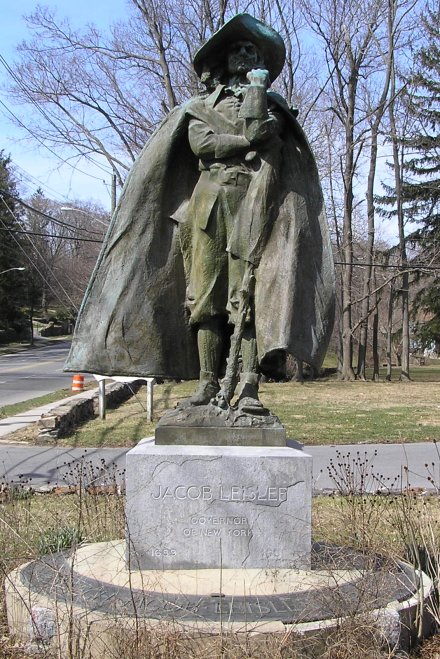
On this date in 1691, Jacob Leisler was executed in New York, a New World casualty of the Glorious Revolution back in the mother country.
In an era when transatlantic communication moved at the speed of a galleon, the 1688 overthrow of England’s Stuart monarchy initiated an agonizing period of political uncertainty in Albion’s far-flung American provinces.
And to the question of who was really in charge were appended the many local political issues of the colonies — religious, economic, political.
One of the empire’s dominant fault political fault lines in the foregoing years had been the succession to follow England’s last Catholic monarch, James II. For Calvinists whose dynastic champion was the House of Orange, the marriage of their guy William III to James’s daughter raised the prospect of an eventual claim on the English throne. Those hopes seemed dashed when James fathered a son, to the elation of Catholics who now aspired to a lasting Catholic line.
When word reached New York, still a majority-Dutch city thanks to its original mother country, of the ascent of that their countryman William III and England’s Protestant establishment had forcibly disinherited the infant prince and his dad, it did not take long for local Dutch factions to run off the former King James’s plenipotentiaries. (An irony, since New York was named for that very same now-deposed King James: he’d been the Duke of York when it was seized for the Dutch in the 1660s.)
That ex-monarch’s brief reign had seen the establishment of a much-resented Dominion of New England, welding together everything from New Jersey to Maine into a super-colony whose high-handed boss was arrested by a Boston mob. (He sailed for England.) That gentleman’s lieutenant, in New York, likewise absconded as his own authority crumbled … a sort of American Glorious Revolution shadowing the one across the pond.
The Frankfurt-born Leisler was a colonial mercantile magnate, one of the 17th century’s wealthiest New Yorkers, notable for his Orangist sympathies and Calvinist religious inclination. It was to this important private citizen (who was also a militia captain) that de facto executive power fell in the New York colony — and it was indeed the New York colony specifically, since the reassertion of local prerogatives and pre-1685 administrative units had been one of the immediate consequences of the shakeout in America.
Statue of Jacob Leisler in New Rochelle, N.Y. — which Leisler helped create as a settlement for refugee Huguenots.
And once in the saddle, the Dutch Calvinist Leisler essentially ran a populist administration against the colonial oligarchy, which replied by vilifying him as a “usurper” and “rebel”.
Internal politics in New York and its neighbors during those months make fascinating reading.* Quakers and Catholics aligned against Protestants. Albany aligned against New York, until Leisler brought the former to heel. Clergy chose up sides. Leisler summoned a sort of proto-continental congress of colonial representatives (all the way to the West Indies) to hash out their situation.
And what was that situation? There had been a revolution, after all, and there was no agreed-upon representative of the royal authority present in New York. An assembly of militia leaders had asked Leisler to assume leadership, so was he really outside his rights to treat as his the London dispatches addressed to “such as, for the time being, take care for preserving the public peace and administering the law in New York”?
It’s a moment whose ferment of democratic energy can be read to presage the next century’s (proper) revolution.
Yet it was also not a revolution in the Cromwellian, world-turned-upside-down sense. For the English polity, and certainly for the conduct it preferred in its frontier possessions, continuity was the order of the day. Even in England herself, William and Mary were more than pleased to govern with Tories who could see their way to releasing their fealty to the Stuarts.
There was an empire to run, after all.
From that standpoint, Leisler’s anti-oligarchical policies and fractious disputes with other colonial elites were a bad business. There’s no sense in letting France make inroads because your governors are bickering over predestination or some such.
So formally, the realm’s new rulers continued all non-Catholic personnel in their posts. With the Dominion governors ejected, it was just a matter of dispatching fresh executives to take over. It’s just that this process required months … during which Leisler was managing New York the way he figured it ought to be managed, and his enemies were consequently painting him as a rebel.
Leisler pronounced himself, this whole time, anxious to submit his authority to the new governor upon the production of proper credentials. If he was surprised that the new monarchs tendered appointees of the very same factions recently expelled,** Leisler showed it only in his exactitude for procedure: because of a logistical cock-up, an aide to the new colonial governor arrived first, and when Leisler refused to hand over his fort without the royal warrant, a tense standoff ensued. It was resolved when the real governor, Henry Sloughter of ominous name, finally showed up.
Sloughter had his “predecessor” immediately arrested, along with others of his circle and harshly tried for treason and murder by a court stacked with anti-Leisler political enemies.†
Ultimately Leisler was condemned to die along with his secretary and son-in-law Jacob Milborne, but even Sloughter was loath to enforce the sentence. The story goes that Leisler’s most implacable foes had to get Sloughter drunk to put his signature on the death-warrant. (Sloughter died a couple of months later himself, for maximum operatic effect.)
On Saturday morning, May 16, 1691, the largest crowd ever gathered in New York City stood, rain soaked and weeping, all eyes fixed as a limp body was cut from the gallows and placed on the block. With a clean blow, the executioner’s ax cut off the head of the “halfe dead” Jacob Leisler — loyal lieutenant governor or rebel tyrant, depending on one’s point of view. Amid the “shrieks of the people,” fainting women (some “taken in labour”), and tumultuous jostling for “pieces of his garments” and strands of his hair, as “for a martyr,” the newly arrived and unfortunately named royal governor, Henry Sloughter, worried that his decision to execute Leisler might not, after all, end the “diseases and troubles of this Government.” Indeed, for years afterward New Yorkers bitterly divided over Leisler and the 1689 uprising that, in the wake of England’s Glorious Revolution, had led to his assumption of power in the provincial government.
-David Voorhees, who elsewhere contends that these divisions “continue to inform American politics to the present day.”*
A few years later, a more Leisler-friendly Parliament restored the dead man’s estate to his heirs, a sort of implicit admission that the whole head-chopping thing might have been a bit much.
This character figures to bear more historical consideration than he has heretofore enjoyed; further to that end, there’s a Jacob Leisler Papers Project devoted to marshaling at New York University the primary documents connected with Leisler.
* See, for instance, David Voorhees in “‘to assert our Right before it be quite lost’: The Leisler Rebellion in the Delaware River Valley” in Pennsylvania History, Winter 1997 — and, Voorhees again in “The ‘fervent Zeale’ of Jacob Leisler,” The William and Mary Quarterly, July 1994.
** Literally so: Francis Nicholson, whom Leisler ousted from New York, tried to get himself appointed governor; he was instead sent to Virginia and continued in royal service in the colonies for decades to come.
† e.g., Joseph Dudley, one of Leisler’s judges, whose penchant for authoritarian justice has been noted elsewhere in these pages.

 It’s a surprising epitaph.

 Bavarian World War I veteran
 This founding member of the
 The longtime Bishop of Rochester had only been elevated to the
 One of the first purge victims in the Soviet satellites — though