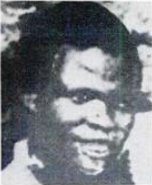
1985: Benjamin Moloise, revolutionary poet

On this date in 1985, poet Benjamin Moloise was hanged in Pretoria for murdering a (black) policeman in apartheid South Africa.

Moloise’s controversial execution occurred in the context of violent resistance to apartheid in South Africa’s black townships and an ultimately fatal crisis for the apartheid state.

The black majority, long treated as second-class citizens by the white powers-that-be, turned to increasingly confrontational tactics aiming to break official power at the township level. Attacks on black officials and police officers who administered state authority at that level were part and parcel.

Moloise was convicted in a plot to kill such an officer in 1983. (The African National Congress claimed responsibility for the killing, and said that Moloise wasn’t involved.)

His hanging approached as the township rising grew into a mass movement that the hardline government of P.W. Botha answered mostly with force* — so, little surprise that Botha spurned both American and Soviet entreaties not to hang Moloise and little surprise that the execution further escalated racial violence.

Furious black protesters rioted in downtown Johannesburg itself, which (like much of white South Africa) had theretofore remained mostly immune to the violence gripping the townships. Here’s a French news report on Moloise’s execution and its aftermath.

All of which dovetailed with a dramatic fall in South Africa’s international position, vividly symbolized by the months-long collapse of the rand — which bled about three-quarters of its value in 1985. International outrage at the blood shed to enforce South Africa’s color line subjected it to a cascade of diplomatic and economic sanctions in the mid-1980s.

Apartheid went out with the Cold War at the end of the decade — vindicating Moloise’s poetic final message, subsequently a staple message at anti-apartheid rallies.

I am proud to be what I am …
The storm of oppression will be followed
By the rain of my blood

I am proud to give my life

My one solitary life.

* It had implemented a state of emergency that very summer. At the same time, Botha pursued tweaks around the edges of apartheid to preserve it: weeding out “petty apartheid” provocations like whites-only/coloreds-only facilities, and implementing a new constitution with a tricameral, race-based parliament.

Part of the Themed Set: Illegitimate Power.

On this day..

1964: Nguyen Van Troi, Viet Cong urban guerrilla

On this date in 1964, South Vietnam executed a 17-year-old Communist for a plot to assassinate American Secretary of Defense Robert McNamara.

The young electrical worker and Viet Cong urban guerrilla Nguyen Van Troi was nabbed in the spring of 1963 trying to off both McNamara, famous for the megatonnage he would bestow on Southeast Asia, and U.S. ambassador Henry Cabot Lodge, Jr.

(Later, when the South Vietnamese client president whose guests these men ostensibly were was being shot in an armored personnel carrier with the Americans’ blessing, Ngo Dinh Diem might have had cause to wish this youth’s inhospitable gesture had not been undone by his men. Lodge was a particularly vocal advocate in the Kennedy administration for overthrowing Diem.)

For the months leading up to his public shooting, he became an international cause celebre; North Vietnam would later milk his martyrdom with a postage stamp, an award, and numerous public streets.

The international reach of his case was underscored when a Venezuelan revolutionary cell kidnapped an American officer shortly before Troi’s execution, and threatened to shoot him in retaliation. (They didn’t.)

Against this, South Vietnam counterposed the unedifying spectacle of a 17-year-old patriot put to death, energetically declaiming at the stake while cameras rolled,

It is the Americans who have committed aggression on our country, it is they who have been killing our people with planes and bombs…. I have never acted against the will of my people. It is against the Americans that I have taken action.

Naturally, he became a worldwide leftist martyr. There’s an Estadio Nguyen Van Troi in Cuba; American actor Troy Garity, son of Jane Fonda from her “Hanoi Jane” days, is also named for Nguyen Van Troi.

Robert McNamara, meanwhile, had many, many years yet to live, and many, many more Vietnamese deaths to burden his conscience.Troi’s widow wrote a 1965 book about him, out of print but still available on the used book market.

On this day..

1354: Cola di Rienzi, last of the Roman Tribunes

On this date in 1354, Cola di Rienzi (or Rienzo) was slain by a miserly Roman mob — rather a lynching than an execution, but by any name the tragic end to one of history’s most amazing political careers.*

“Almost the only man,” in the estimation of his admiring biographer Edward Bulwer-Lytton,** “who ever rose from the rank of a citizen to a power equal to that of monarchs without a single act of violence or treachery.”

So magnetic was that era’s revival of classical learning that young Rienzi’s plebeian parents found a way on an innkeeper’s wages to immerse the boy in Cicero, Seneca, and the rest. As Gibbon put it, “the gift of a liberal education, which they painfully bestowed, was the cause of his glory and untimely end.” (Surely this is an object lesson for present-day families contemplating the daunting cost of university education.)

And the oratorical gifts he thereby developed found ready exercise lamenting Rome’s medieval degradation.


This View of the Campo Vaccino actually dates to 1636, but you get the idea. “Campo Vaccino”: that’s “cow pasture,” also known (to you, me, and Julius Caesar) as the Roman Forum.

Rome had bled away the grandeur of its imperial past without recovering the liberty of its populace. A haughty and dissolute aristocracy tyrannized the brackish city: a brawl between rival factions took Rienzi’s own brother’s life, with no prospect of justice.


Rienzi vows to obtain justice for his murdered brother, depicted in a pre-Raphaelite painting by the young William Holman Hunt.

Added to this civic humiliation (though only fortuitous for Rienzi’s political opportunity), the papacy itself had decamped for its captivity in Avignon.

What to do?

How about — overthrow the bastards?

Astonishingly, for Rienzi, to dare was to do: on Pentecost in 1347, he rallied a Roman mob and proclaimed the Republic re-established — taking for himself the ancient honorific of Tribune and the real power of an autocrat. The nobility routed in disarray, or else submitted to the sudden new authority.

For the balance of the year, Rienzi’s word was law in Rome, and as a messianic, popular dictator he cleared woods of bandits, imposed the death penalty for (all) murderers, and beat the aristocracy’s re-invasion with a citizen militia. He audaciously began to resume the primacy of the caput mundi: as “Tribune”, Rienzi summoned delegations from the other Italian cities, and presumed to arbitrate the disputes of neighboring kingdoms. Audacity veered into delirium as he pressed demands on the likes of the Holy Roman Emperor. He acquired a taste for fine wine and good clothes.

“Never perhaps has the energy and effect of a single mind been more remarkably felt than in the sudden, though transient, reformation of Rome by the tribune Rienzi,” Gibbon marveled. “A den of robbers was converted to the discipline of a camp or convent: patient to hear, swift to redress, inexorable to punish, his tribunal was always accessible to the poor and stranger; nor could birth, or dignity, or the immunities of the church, protect the offender or his accomplices.”

The great humanist Petrarch, Rienzi’s contemporary, was smitten by the unfolding revolution.

But almost as soon as Rienzi’s republic began, the man fell: another invasion found the Roman in the street deaf to the alarm bells, and Rienzi fled.

“He was a dreamer rather than a man of action,” is the charge of the Catholic encyclopedia; excitable, injudicious, spendthrift, and prey to the “Asiatic” emoluments of his station.

This career alone would merit a remembrance, but Rienzi had a second act.


Richard Wagner’s first hit opera — though hard to come by in the wild nowadays — was Rienzi, der Letzte der Tribunen (synopsis), from a libretto based on Bulwer-Lytton’s homage.

After a long spell in exile, he was captured by the Holy Roman Emperor and transferred to the papacy, where he remained comfortably imprisoned for a couple of years. When the pontiff’s hat changed heads to Innocent VI, the latter freed the illustrious ex-Tribune and dispatched him back to Rome under the title of Senator — intending him a catspaw to re-assert the supremacy the papacy had abandoned by moving away.

Within weeks of arrival in 1354, Rienzi again made himself master of the city.

And within months thereafter, he had fallen again — to his death.

He is charged in this last term with severity (the execution of a high-born freebooter, Fra Monreale, in particular), with avarice and abuse of power and once more with political incompetence.

Gibbon claims that Rienzi “contracted the habits of intemperance and cruelty: adversity had chilled his enthusiasm, without fortifying his reason or virtue; and that youthful hope, that lively assurance, which is the pledge of success, was now succeeded by the cold impotence of distrust and despair.” We incline to prefer Bulwer-Lytton’s more generous estimation of a man who with no resource save his own brilliance twice recovered to his low-born person the tattered remnants of the purple and dared against a thousand mighty antagonists to lift it on the standard of the Gracchi. Flaws, and they fatal, he possessed in abundance: but greatness even more.

At any rate, all the scolds upon Rienzi’s imperfections were so much froth in 1354. He certainly did not succumb to the greater virtue of the polis, but merely to its shortsighted refusal to bear a levy:

it was from a gabelle on wine and salt that he fell. To preserve Rome from the tyrants it was necessary to maintain an armed force; to pay the force a tax was necessary; the tax was imposed — and the multitude joined with the tyrants, and their cry was, “Perish the traitor who has made the gabelle!” This was their only charge — this the only crime that their passions and their fury could cite against him.

Rienzi’s eloquence, so often his decisive weapon, failed to move the shortsighted mob that besieged him, and he was hauled to a platform in the Capitol where public executions had been performed at his behest. “A whole hour, without voice or motion, he stood amidst the multitude half naked and half dead: their rage was hushed into curiosity and wonder: the last feelings of reverence and compassion yet struggled in his favour; and they might have prevailed, if a bold assassin had not plunged a dagger in his breast.” (Gibbon)

If this amazing character’s contradictions seem difficult to reconcile and his actions sometimes perplexing, Bulwer-Lytton argues in Rienzi’s defense that we must view him as a complex man ultimately fired not by political ambition but by religious zealotry. One thinks of Savonarola, the prim monk who mastered Florence and perished in flames, save for the essential detail: Rienzi’s loss “was bitterly regretted … for centuries afterwards, whenever that wretched and degenerate populace dreamed of glory or sighed for justice, they recalled the bright vision of their own victim, and deplored the fate of Cola di Rienzi.”


Statue of Rienzi in Rome. (cc) image from ZeroOne.

* And surely in keeping with the time-honored way for Roman chiefs to fall.

** We’ve encountered Bulwer-Lytton glancingly in these pages; his novel Zanoni climaxes with the beheading of its fictional title character in one of the last carts of the French Revolution’s Terror, and he wrote a novel (savaged by Thackeray) about executed intellectual Eugene Aram. The “biography” in question for this piece is actually a work of historical fiction, Rienzi, Last of the Roman Tribunes; the quoted sections are from Bulwer-Lytton’s (non-fiction) afterword.

On this day..

1941: Nguyen Thi Minh Khai, Indochina Communist cadre

On this date in 1941, Vietnamese Communist cadre Nguyen Thi Minh Khai was shot as an anti-France insurrectionary.*

Khai (Vietnamese Wikipedia page | English) surely fit the description: she was a leader of the Indochinese Communist Party in the 1930’s, working directly with Ho Chi Minh in his Hong Kong exile. She would return in 1936 to the city later named for that redoubtable revolutionary as its ranking agitator.

Khai, the most famous of the Indochinese Wars’ vast ranks of women fighters, would marry fellow revolutionary Le Hong Phong, the chairman of the party, who died in prison in 1942. Khai’s sister’s marriage made Khai sister-in-law to the revolution’s military lion Vo Nguyen Giap.**

But her prominent position also made her a target.

Arrested by the French late in 1940, she was tortured and condemned to death. She was shot with other cadres, shouting last words that the decades yet to come would pretty well vindicate.

Long live the Communist party of Indochina. Long live the victorious Vietnamese revolution. (Source)

Readers whose Vietnamese is stronger than mine — i.e., extant in any form whatsoever — might get something out of this video:

As a national heroine, Nguyen Thi Minh Khai is the namesake of any number of public spaces in Vietnam, like schools and roads.


Paradoxical historiography: the street address visible to the right of the photo brands a revolutionary name onto an upscale coffee shop in Ho Chi Minh City. (cc) image from Lawrence Sinclair.

* Some sources give an April 1941 execution date, particularly April 25. I believe this may actually be the date Khai was condemned. There are also some sources indicating a guillotine execution; though the guillotine was certainly available, the bulk of the sources seem to say that Khai was shot.

** Giap is still going strong after all these years; he just turned 100 a few days ago. Khai’s sister was not as lucky; she died in French custody at the prison American pilots would later refer to as the “Hanoi Hilton”.

On this day..

1936: Grigory Zinoviev and Lev Kamenev, Old Bolsheviks

During the purges of the 1930s, Josef Stalin showed a particular relish for eliminating the Old Bolsheviks whose red credentials predated the revolution. (And potentially, outshone his own.)

Zinoviev

On this date in 1936, one of the oldest of them, Grigory Zinoviev, was shot with his longtime ally Lev Kamenev.

These guys had been major movers and shakers among the early Bolsheviki, adherents of Lenin during the first decade of the century when the aspiration for a Communist Russia seemed hopelessly far-fetched. Zinoviev rode with Lenin from Switzerland to Petrograd in the famous sealed train after the February Revolution toppled the tsar. (Not so Kamenev: he was serving time in Siberia, but was freed by the revolution.)

In the years that followed, both played leading roles in the Soviet government despite their impolitic opposition to the Bolshevik coup in October.

Kamenev was briefly head of state in 1917, and he married Leon Trotsky’s sister. Zinoviev was the longtime head of the Communist International, in which capacity he showed Moscow’s public face for communist movements in other countries. Bela Kun was another ally of Zinoviev’s.)

In this capacity, he’s known in British history for the “Zinoviev letter”, a purported summons to Anglo agitation that was actually a dirty trick dropped before an election to help the Tories sweep to power.*

Those were the good old days — when Lenin was fading away and Zinoviev, Kamenev, and Stalin were the “troika” running things. They should have checked with the Romans how triumvirates work out.

Because of their alliance, Zinoviev and Kamenev provided the decisive support that enabled Stalin to remain General Secretary of the party after the public airing of Lenin’s Testament warning against him. Without Zinoviev and Kamenev at this crucial moment, Stalin probably could not have survived politically; the name Koba might have gone into history books as little more than a terror to the paperwork of some forgotten bureau. (And the pre-revolutionary Caucasus!)

Talk about hoisted by your own petard.

Having been helpfully maintained in his position against Lenin’s dying wish, Stalin soon marginalized these formerly useful creatures. Their last decade was doomed to a spiral of failing power struggles, sinking rank, furtive dissension, and craven submission to party discipline.

Stalin at length destroyed them at the first great Moscow show trial, the Trial of the Sixteen — which hyped a “Trotskyite-Zinovievite” plot in a nicely Orwellian twist. (Despite Kamenev’s marital connection, Trotsky was actually a political rival.) The charge sheet must have reminded the defendants on every one of their dwindling days of the alliance with Trotsky they could have made back when they mattered.

The Trial of the 16 defendants would help to write the script for succeeding acts of this awful theater: after fighting the allegations, Zinoviev and Kamenev agreed to plead guilty on private assurances that their lives would be spared.

But once he had their “admissions” on the record, Stalin altered the deal.

Not only Zinoviev and Kamenev, but all 16 from the trial of the 16 were shot shortly after midnight this date.

From exile, their “conspirator” Trotsky called it the “end of an epoch”.

His obituary for Zinoviev and Kamenev minces no words about the men’s personal shortcomings (“they lacked sufficient character”), but still achieves a certain elegaic sympathy for these former fellow-travelers and their shared movement, now swallowed by Stalinism.

I have had the occasion to hear tranquil petty bourgeois tell me in the days between the beginnings of the trial and my internment: “It’s impossible to understand Zinoviev … He is so lacking in character!” And I would reply: “Have you yourselves experienced the full weight of the pressure to which he has been subjected for a number of years?” Unintelligent in the extreme are the comparisons, so widespread in intellectual circles, of the conduct in court of Danton, Robespierre and others. These were the instances of revolutionary tribunes who found the knife of justice suspended over them, directly in the midst of the arena of struggle; at a time when they were in the full flower of their strength, with their nervous system almost untouched and, at the same time, when they despaired of all hope of salvation.

[By contrast] For ten years they [Zinoviev and Kamenev] had been enveloped by clouds of slander paid for in heavy gold. For ten years they had swayed between life and death, first in a political sense, then in a moral sense, and lastly in a physical sense. Can one find in all past history examples of such systematic, refined and fiendish destruction of spines, nerves and all the fibers of the soul? Zinoviev or Kamenev would have had more than ample character for a tranquil period. But the epoch of grandiose social and political convulsions demanded an extraordinary firmness of these men, whose abilities secured them a leading place in the revolution. The disproportion between their abilities and their wills led to tragic results.

* There are numerous theories of the Zinoviev Letter’s origin; one has it that spy Sidney Reilly had a hand in it.

On this day..

1947: Three Jewish terrorists and two British hostages

On this date in 1947, three members of an Irgun commando team who had engineered a massive prison break of Zionist terrorists were hanged for the affair.

The Acre Prison Break was a meticulously coordinated operation by the Zionist underground in British Mandate Palestine that, a Conservative MP later charged, “reduced British prestige to a nadir.”

A team of guerrillas attacked the prison from the outside, coordinating with imprisoned Irgun and Stern Gang operatives who had explosives smuggled into their cells to help detonate their way through the walls. Hundreds of prisoners — most of them Arabs availing the opportunity — escaped.

According to the London Times (May 6, 1947), 16 escaping prisoners were slain in the affray, with eight British guards and police wounded.

More crucially for our purposes, five of the guerrillas who assailed the prison were captured. Three — Haviv Avshalom, Yaakov Weiss, and Meir Nakar — were taken armed, and sentenced to death by the British.

To browse the contemporaneous western press coverage is to visit a Holy Land very familiar to the present-day reader, filled with “terrorists” and “extremists” and “fanatics” and “murderers” abetted by “those who incite them from a safe distance and supply the funds and the weapons which they put to such deadly use.”* Except that this discourse was directed at Jews, not Arabs.

One good way to earn such an imprecation would be to kidnap two British soldiers and hold them hostage against the execution of the sentence. That’s exactly what the Irgun did.

The British searched for their men, but disdained to stoop the majesty of the law at the pleasure of some seditious blackmailer. So, early this morning at that same Acre Prison they had lately helped to liberate, Avshalom, Weiss, and Nakar went to the gallows.


Left to right: Avshalom, Weiss, and Nakar.

Palestine awaited with anxiety the expected discovery of two kidnaped British sergeants whom the Irgunists have vowed to kill in retaliation. The Mosaic law of vengeance applies and any show of clemency would be regarded by the extremists as evidence of cowardly submission.

New York Times, July 30, 1947

The Irgun had already applied that Mosaic law of vengeance.

On the evening of that same July 29, it hanged its two hostages, intelligence corps sergeants Clifford Martin and Marvin Paice. The bodies were moved and strung up in a Eucalyptus grove near Netanya, to be discovered the next day, booby-trapped with a land mine. A scornful note announced their condemnation for “criminal anti-Hebrew activities.”


The bodies of Sgts. Clifford Martin and Marvin Paice, as discovered on July 31, 1947, hanging from Eucalyptus trees.

Moderate, mainline Zionists were horrified.

Of all the crimes that took place till this day on this land, this is the most grievous and disgusting one and will stain the purity of our peoples struggle for freedom. May this act of hanging remain as a sign of Cain on the doers of this disgraceful deed! The heavens and the earth are my witnesses that most of our population took desperate measures to free the hostages and prevent this shame.

-Netanya Mayor Oved Ben Ami

Said disgraceful deed-doers were far from apologetic.

And you could say they had a point, since although the threat did not prevent the death sentences at hand from being carried into execution, its example proved to be a lively deterrent: Avshalom, Weiss, and Nakar were the last Zionists executed by the British. Then-Irgun leader, and later Israeli Prime Minister, Menachem Begin made no bones about the trade.

The Brits were a little less sanguine about “the sergeants affair”.

A Times editorial for Friday, Aug. 1 fulminated against “the violent deeds of the Palestine terrorists [that] will not readily be effaced,” comparing them to “the bestialities practised by the Nazis themselves.”**

Over the ensuing long weekend’s summer bank holiday, racist riots against Jews shook Britain. Jewish businesses, cemeteries, and synagogues were smashed up and vandalized all over the island, to the horror this time of milquetoast liberals like the Manchester Guardian, with again-familiar lines like: “to answer terrorism in Palestine with terrorism in England is sheer Hitlerism. We must be desperately careful to see that we do not let ourselves be infected with the poison of the disease we had thought to eradicate.”

Fine points for debate in Britain, which within months was bugging out of the Levant as open war engulfed Palestine — the violent birth pangs of modern Israel and its embrace of its own subject populace with its own frustrated national ambitions pursued by its own violent extremists.

* London Times editorial, May 21, 1947.

** Irgun propaganda’s riposte: “We recognize no one-sided laws of war. If the British are determined that their way out of the country should be lined by an avenue of gallows and of weeping fathers, mothers, wives, and sweethearts, we shall see to it that in this there is no racial discrimination.”

On this day..

1844: The Bandiera brothers

On this date* in 1844, the Italian nationalists Attilio and Emilio Bandiera were shot with seven companions at Cosenza, Italy.

The Bandieras (English Wikipedia page | Italian) were Venetian officers in the Austrian navy — sons, indeed, of an admiral in that service.

Having been caught out in a mutinous agitation, the patriotic lads had been obliged to flee to Corfu (then under British administration)

But whispers soon reached them of a nascent rising in the Kingdom of the Two Sicilies, and they took a small party to the toe of the Italian boot looking to get in on the glory.

They didn’t find the rumored revolutionaries — just martyrdom.

Reprieves preserved eight of the seventeen death-sentenced for the escapade; shot along with the renowned national martyrs together crying “Viva l’Italia!” were Nicola Riccioti, Domenico Moro, Anarcharsis Narde, Giovanni Verenui, Giacomo Rocca, Francesco Berti, and Domenico Lapatelli. (London Times, Aug. 12, 1844)

Venice visitors can pay their respects to the two at the Church of San Giovanni e Paolo, where they’re buried.

* There are some citations for July 23 out there, but the numerical bulk of the sources, and those closest to the event itself, clearly prefer July 25. e.g., the London Times of Aug. 12, 1844 cites the Journal of the Two Sicilies in reporting July 25; as noted by Mazzini and Marx, then-exiled Italian risorgimento figure Giuseppe Mazzini, who corresponded ineffectually with the martyrs, published a poem for this anniversary date in the July 25, 1846 edition of the Northern Star:

And in distant years the story
Still shall our children tell
Of those who sleep in glory
At Cosenza where they fell.

On this day..

1403: Thomas Percy, Earl of Worcester

On this date in 1403, Henry IV made sauce of the Earl of Worcester after the Battle of Shrewsbury.

Thomas Percy was the uncle of northern rebel Sir Henry Percy, evocatively known as “Hotspur”.*


Rampant: statue of Hotspur Harry Percy at Northumberland’s Alnwick Castle. (cc) image from Bootneck Photography.

This Northumberland lord, whose name hints at his reputation for for ferocity and impetuousness, was not necessarily incensed in principle at Henry Bolingbroke‘s usurpation of the English crown as Henry IV. In fact, he took an appointment to put down the anti-Lancastrian rebellion of Welsh troublemaker Owain Glyndwr. (Percy didn’t succeed.)

But this royal imposter didn’t pay off Percy richly enough in either coin or respect.

Hotspur left Wales to whomp the Scots at the Battle of Humbleton Hill, but King Henry’s demand that he turn over the big-name prisoners taken in that battle (instead of ransoming them for profit) — coupled with Henry’s own refusal to ransom Hotspur’s brother-in-law Edmund Mortimer from Welsh captivity — provoked a furious row between “king” and “subject”. Henry IV is supposed to have denounced Henry Percy a traitor and drawn a blade on him.

“Not here,” Hotspur raged, “but in the field!”

Alas: the field wasn’t kind to the Percies this time.

A revolt raised by a guy named Hotspur should hardly fail for want of ambition, and this one was the hottest of spurs: the Percies (with our day’s principal, Uncle Worcester) made a pact with Glyndwr (still going strong in Wales) and Glyndwr’s hostage-turned-son-in-law Edmund Mortimer (who was the uncle of the kid who should have been king) to give Bolingbroke the boot and carve up the realm between them.

Shakespeare represents this argument at the start of Henry IV, Part 1, and the conflict it engenders will drive that play’s story. This is Hotspur privately fuming after Henry has refused to help Mortimer (Act I, Scene 3):

let my soul
Want mercy, if I do not join with him: [i.e., Mortimer]
Yea, on his part I’ll empty all these veins,
And shed my dear blood drop by drop in the dust,
But I will lift the down-trod Mortimer
As high in the air as this unthankful king,
As this ingrate and canker’d Bolingbroke.

Orson Welles’ Chimes at Midnight abridges this and several other Shakespeare plays, and its opening action — after the Falstaff and credits — sets our stage. Worcester here is played by French Connection villain Fernando Rey.

Shrewbury was the result, a battle that up to the moment it commenced seemed amenable to mediation. Worcester himself negotiated face to face with King Henry, but refused to submit himself trusting the sovereign’s mercy. “On you must rest the blood shed this day,” Henry told him.

Some of that blood was Hotspur’s, as a result of a freak combat injury: he took a fatal arrow to the face when he raised his armor’s visor to get some air.**

Worcester didn’t outlive him by much — as depicted in Act V, Scene 4, he was summarily executed shortly after the battle:

KING HENRY IV

Thus ever did rebellion find rebuke.
Ill-spirited Worcester! did not we send grace,
Pardon and terms of love to all of you?
And wouldst thou turn our offers contrary?
Misuse the tenor of thy kinsman’s trust?
Three knights upon our party slain to-day,
A noble earl and many a creature else
Had been alive this hour,
If like a Christian thou hadst truly borne
Betwixt our armies true intelligence.

EARL OF WORCESTER

What I have done my safety urged me to;
And I embrace this fortune patiently,
Since not to be avoided it falls on me.

KING HENRY IV

Bear Worcester to the death and Vernon too:
Other offenders we will pause upon.

(Vernon was one of two knights executed with Worcester in Shrewsbury.)

* Yes, the English football club Tottenham Hotspur is named for the dashing Henry Percy. “Audere Est Facere” is the team’s motto, “to dare is to do” … even though that totally didn’t work out for Hotspur himself.

** Oddly enough, Hotspur’s opposite number Prince Henry (the future victor of Agincourt, Henry V), also got shot in the face in this battle.

On this day..

1898: Choe Si-hyeong, Donghak leader

On this date in 1898,* the second patriarch of the Donghak religion was put to death in Korea.

Like neighboring Japan, Korea was ripe for “new religions” late in the 19th century and into the 20th. And to the concussive effects of modernity were added, for Korea, those of colonialism: a fading dynasty pressured by both western and Japanese empire-building.

“Donghak arose at a time when Korea was on the verge of radical transformations,” writes Kirsten Bell.**

Internally, society was stagnating under a rigid Confucian social hierarchy, which saw destitute peasants over-taxed and generally ill-used by corrupt government officials and landed gentry (yangban). External forces such as the West’s encroachment into the East were also causing considerable alarm. Donghak arose in these circumstances and was … explicitly envisioned … as a rebuttal to the growing influence of the West in Korea; further, Donghak was constructed in explicit opposition to Roman Catholicism, known as “Western Learning.”

Donghak, or Tonghak, was “Eastern Learning” (that’s its literal meaning), a sort of synretic liberation theology for the peasantry in a put-upon peninsula.

This egalitarian movement, light on the dogma beyond the notion that an omnipresent divine inheres to every person, yielded its founder up to the laurels of martyrdom in 1864. That gentleman, Choe Je-u, passed leadership to his kinsman, our day’s subject, whose proselytizing and organizing built the religion over two succeeding generations.

“Despite ongoing government persecution, Donghak proved popular with the disaffected masses,” Bell notes.

Choe Si-hyeong published the Donghak scriptures and planted countless secret Donghak societies around Korea. Rooted as they were in a lower class with an axe to grind, these burgeoning cells tended increasingly towards the revolutionary. In 1894, they tended all the way: the Donghak Peasant Revolution.

In this dramatic affair, a surging peasant-nationalist army marched on Seoul with every prospect of overturning the decrepit monarchy — which unworthily preserved itself by inviting a Chinese intervention.†

This, in turn, precipitated an (uninvited) Japanese response, which became the First Sino-Japanese War, whose titular belligerents had it out all over the Korean peninsula.

Japan, with its modern army, cleaned up in the fight, a signal of its rise as regional hegemon. (It would soon annex Korea altogether.) And just in passing, it routed that ambitious peasant army late in 1894, scattering Donghak adherents to the hills.

Choe Si-hyeong was finally captured and put to death in 1898. Still, that wasn’t the end of the line for Donghak: rebranded Cheondoism after its original moniker became unfortunately affixed to the word “revolution,” the faith is still going strong with well over one million adherents in present-day South Korea.

Choe Si-hyeong is the subjet of the 1991 Im Kwon-taek film Fly High, Run Far.

* The precise date is asserted in Buddhism in the Modern World but generally not extremely easy to come by. I’d rather have access to a clear primary source or a larger consensus of secondary sources or a pony.

** “Pilgrims and Progress: The Production of Religious Experience in a Korean Religion,” Nova Religio: The Journal of Alternative and Emergent Religions, August 2008.

† The Qing were about to be squeezed by a similar domestic movement, the Boxers.

On this day..

1776: Jamaican slave rebels

In our late constant disputes at our tables (where by the by every Person has his own waiting man behind him) we have I am afraid been too careless of Expressions, especially when the topic of American rebellion has been by the Disaffected amongst us, dwelt upon and brandished of with strains of Virtuous Heroism.

what mind of a Slave will not recoil and burn into Resentment; when he shall have been the frequent witness of Sedition and Ingratitude in the Conduct of his Master — when he shall hear the Obligation of a subject to his Lord spurn’d at — the Blood spilt by Rebells extoll’d … Obedience to Laws and Authority upon all these Occasions mentioned with a strong Idea of Slavery. And Men toasted into Immortal Honours for Encountering Death in every form, rather than submit to Slavery let its Chains be ever so gilded.

Dear Liberty has rang in the heart of every House-bred Slave, in one form or other, for these Ten years past — While we only talk’d about it, they went no farther than their private reflections upon us & it: but as soon as we came to blows, we find them fast at our heels. Such has been the seeds sown in the minds of our Domestics by our Wise-Acre Patriots.

–Rev. John Lindsay, Hanover Parish, Jamaica

On July 3, 1776, as tensions between the North American colonies and England came to a head, the garrison at Hanover, Jamaica sailed from Lucea to reinforce General William Howe.

The departure of this regiment was the pre-arranged signal for the parish’s slaves — both imported Coromantee and, more ominously for the slaveholder, the generally less-rebellious Creoles — to mount a general rising.

The only reason it didn’t happen was because it was sniffed out — after the regiment left, but before the date planned out by slaves passing word from estate to estate.

For a century or so, lucrative sugar and coffee cultivation on the island (and elsewhere around the thought to have been imported to Jamaica before the slave trade was abolished in 1808.

Planters reaped stupendous profits from this harvest of misery, but perpetually stood in danger of reaping the whirlwind, too. At the time of the intended rebellion, there were 20 or more slaves for every white around Hanover. A Hanover militia officer said in the days after the plot was uncovered that he was “deeply Concerned in the Intended Insurrection, the Number of the Troop is small and the Duty severe, Our apprehensions are great upon the occasion as we know not where it will end.” As the number of implicated slaves mounted past 100, a planter lamented that “there appears to be no end to this horrid affair.”

As jumpy as they were, the authorities managed to keep a lid on this situation through the usual methods, which gives this site its excuse to notice the affair.

We have try’d — found Guilty and Executed Yesterday the following Conspirators, Blue Hole Harry, and Leander of the Spring Estate, Charles of the Baulk, Peter of Batchelors Hall, Prince belonging to John Priest of Lucea, and Quamino to Sir Simon Clarke, these are the Chief Ring-leaders and the most Active in Promoting the Intended Insurrection and We propose proceeding tomorrow in trying the Other Chiefs.

-Report to Sir Basil Keith from the magistrates of Hanover, Jamaica, July 20, 1776

Slavery persisted in Jamaica, dogged by regular rebellions, for another 57 years, until Samuel Sharpe’s revolt helped finally convince Parliament to ban it. Whether that past is really past … that’s another question.

For more, see Richard B. Sheridan, “The Jamaican Slave Insurrection Scare of 1776 and the American Revolution,” The Journal of Negro History July, 1976, which is the source of the quotes in this article.

On this day..