On this date in 1958, Nuri al-Said, the Prime Minister of Iraq’s deposed Hashemite monarchy, was captured trying to flee Iraq in disguise, and immediately slaughtered
A onetime Ottoman officer turned veteran of the Arab Revolt under the eventual King Faisal I, Nuri al-Said (or as-Said) was a preeminent politician for much of the Kingdom of Iraq era and practically the personification of Baghdad’s pro-British posture.
A figure of wide popular loathing — crowds chanted for his death at the funeral of King Ghazi in 1939, attributing the young ruler’s untimely death to Nuri’s hand — he had managed to escape the 14 July Revolution‘s initial hours and had one last night on the lam to contemplate the terrible fate of the royal family that he served.
He was not destined to avoid it.
Captured in disguise the next day and put to summary death, after which the mob vented its fury upon him.
On this date in 1958, Iraq’s Hashemite dynasty got the Romanov treatment from coup-making nationalist officers.
Having already overstayed their welcome as agents of British-American control in the oil-rich Gulf State, the Hashemites were doubly burdened to be led by the inexperienced King Faisal II, who was all of 23 years old.
For much of the recent past, while this underaged grandson of the Arab Revolt hero matriculated at an English boarding school, his sovereignty had been exercised by his uncle and regent ‘Abd al-Ilah — a practitioner, like all of Iraq’s leadership, of a staunchly pro-British and -American policy that increasingly rankled Iraqis.
Captured royal family members — including not only King Faisal but the aforementioned ‘Abd al-Ilah and al-Ilah’s wife and mother, plus a number of royal servants — were all summarily machine-gunned in the palace courtyard, after which the royal corpse was given over to public abuse.
“His legs and arms were decapitated, stomach disemboweled with his intestine gushing outside” recalled one of the king’s helpless royal guards of the late king. “His corpse was later suspended from a building until one came with a dagger in his hand to try to divide it into two pieces. The corpse was burned, cut many times until it was thrown in the Tigris river when night came.”
Today there’s an honorable tomb in Baghdad where Faisal reposes, and considering the many terrors that have befallen Iraq in the intervening decades, one can even find pockets of nostalgia for the monarchy.
On this date in 1941, the fascist artist Alexandru Bassarab was killed in World War II — generally believed to be among captured Romanian prisoners of war summarily executed by Soviet troops.
A woodcut/linocut specialist — as evidenced by his gaunt self-portrait to the right — Bassarab was an early adherent of the Iron Guard and became one of its outstanding propagandists.
His very Deus Vult-vibing work Arhangel, for example, was used by the Guard as a banner at the 1940 state funeral it threw for far-right martyr Corneliu Codreanu. (The Iron Guard was shorthand nomenclature for an organ formally named the Legion of the Archangel Michael — and its members hence known as Legionnaires.)
But the Iron Guard’s moment at the political apex was a brief one, and when it was sidelined by a different right-wing strongman, Ian Antonescu, Bessarab found himself arrested and forced into a front-line army unit recapturing (appropriately) Bessarabia. He disappeared into presumed Soviet custody and execution near Tiganca, in present-day Moldova.
His work, including apolitical pieces, was taboo in postwar Communist Romania, but has enjoyed a bit of rediscovery since the end of the Cold War
On this date in 1978, the South Yemen president Salim Rubai Ali was executed after an attempted self-coup.
The very first president of the short-lived (1967-1990) polity, Salim had been an anti-colonial fighter in the National Liberation Front but had his reservations about his coalition partner’s tilt towards the Soviet model and figured he wouldn’t mind being solely in charge.
He attempted in June 1978 to seize power against other top coalition officials; Ali Nasir Muhammad, who is still an important political figure in unified Yemen to this day, overthrew the short-lived putsch and executed the former boss.
The reader will be unsurprised to find a provincial governor to be an exponent of federalism, and this put him at loggerheads with the ferocious Buenos Aires dictator General Juan Manuel de Rosas.
He logged a more specific head about a year before his death by attempting to negotiate a province-level arrangement with the French fleet blockading Argentina,* for which extravagance of federalism Rosas forced him to vacate his office and conceal himself in internal exile. Eventually Cullen was betrayed, and his arrestors putatively escorting him to the capital for trial rudely informed him once they reached the soil of Buenos Aires province that they were in fact licensed to shoot him out of hand.
Cullen’s son, Patricio, served as Santa Fe governor from 1862 to 1865, and also met a violent death.
* In response to a law that permitted the Argentine armed forces to conscript foreign nationals, including Frenchmen.
On this date in 1861, the Mexican statesman Melchor Ocampo was summarily executed by right-wing guerrillas.
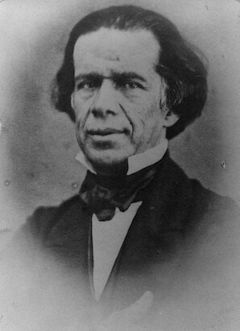
Once a seminarian, Ocampo (English Wikipedia entry | Spanish) turned his face towards public life, becoming a most eloquent exponent of the era’s movement of liberalism and anticlericalism.
He was among the faction who rebelled in 1854 against recurrent strongman Santa Anna; he served in the ensuing epochal presidency of Benito Juarez and helped to draft the liberal constitution that governed Mexico until 1917. Secular, egalitarian marriage vows promulgated in 1859 by Ocampo are still used in many marriage ceremonies to this day.
The revolutionary social reordering of these years was achieved only by civil war, a conflict remembered as the Reform War which ended only when the conservatives surrendered Mexico City on New Year’s Day of 1861.* Ocampo, who had the stature to stand for president himself, preferred to consolidate the victory by throwing his support to Benito Juarez in the ensuing elections.
Retiring thereafter to private life, he was targeted by one of the numerous remnant right-wing militias that still persisted in the countryside months after the putative conclusion of the Reform War. These abducted him from his home in Michoacan on May 30 and held him for some days, permitting him to write his last letters, before having him shot and strung up on June 3. His remains currently repose in honor at Mexico City’s Rotunda of the Illustrious … as do those of Ocampo’s longtime comrade Santos Degollado, who undertook to hunt down and revenge himself upon his friend’s killers but instead became their prey.
The town of Melchor Ocampo is, quite obviously, named for the man; his surname has been attached as an honorific to his home region of Michoacan, one of Mexico’s 32 states (officially called Michoacan de Ocampo) and to Tepeji del Rio de Ocampo, the place where he was executed.
It was the morrow of the outbreak of Ireland’s 1798 rebellion against British rule. This rising commenced on May 24 and foundered within weeks leaving a harvest of patriotic martyrs in its wake but those in the moment had not the advantage of hindsight — so as news of the fighting reached County Wicklow, adjacent to the rebel epicenter of Wexford, loyalists there authored a couple of notable summary atrocities by way of pre-emption.
On May 25, the British garrison at Carnew took 28 United Irishmen prisoners already being held in Carnew Castle and had them shot out of hand in an alley.
A similar mass execution of 36 nationalist prisoners occurred on the following day, May 26, at Dunlavin Green.
A century ago today, seven hostages taken from the German pre-Nazi Thule Society were executed by the short-lived Munich Soviet just before it was crushed by right-wing militias.
The Thule Society (logo at right) was a Bavarian volkisch club with a profound interest in stuff like crackpot race theory and Teutonic mythology; its very name alludes to a legendary territory hypothesized since antiquity to lie at the fringes of the world, often associated with Scandinavia and with the origins of the Aryan race.*
Society members figured in the founding of the German Workers’ Party (DAP), the party which became the National Socialist German Workers’ Party (NSDAP), better known as the Nazis. Former Thuler Hans Frank was among those eventually hanged via the postwar Nuremberg trial.
On April 30, 1919, all these seven were executed by order of the Communist sailor Rudolf Egelhofer, together with either two or three captured Freikorps prisoners, an affair known as the Münchner Geiselmorde (“Munich hostage-murder”).
Countess Haila von Westarp
The very next day, the Freikorps broke through Munich’s defenses and commenced the bloody rout that destroyed the Munich Soviet.
The Thule Society as a body survived and briefly prospered after its brush with the revolutionaries’ muzzles — the eventual Nazi party newspaper Völkischer Beobachter was previously a Thule Society-owned periodical called the Münchener Beobachter — but it fizzled out into a memory during the 1920s.
Still, this esoteric nursemaid to the infancy of national socialism features prominently in histories of Third Reich occultism; aficionados might wish to browse some of its iconography in this Pinterest gallery, or just punch their distinctive name into your search environment of choice and feel that third eye opening.
* The element Thulium is named for Thule, because it was discovered by a Scandinavian chemist; the U.S.’s Thule Air Base in Greenland developed from an Arctic Circle trading post established and named by a Scandinavian explorer. (From which he launched a series of early 20th century “Thule Expeditions”.)
Greek independence hero Athanasios Diakos died by Ottoman impalement on this date in 1821.*
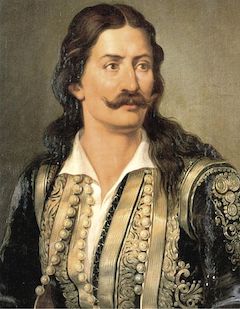
Though he acquired his nickname Diakos (“deacon”) from a youthful spell in a monastery, this fellow Athanasios (English Wikipedia entry | Greek) while the Turks still governed Greece made his way as a klepht — Greece’s version of the Balkan hybrid outlaw/guerrilla archetype, similar to the hajduk figures among the South Slavs. All of these outlaw types took to the mountains where they could subsist as brigands and mercenaries beyond the reach of the Porte, and seek opportunities where they might to strike at Ottomans. Many of the Greek persuasion, Diakos included, adhered to the Filiki Eteria secret society that aspired to liberate Greece.
With the onset of the Greek War of Independence in early 1821, Diakos jumped right into the fight. Picturesquely, he met a much larger Turkish detachment in battle at Thermopylae where he made like Leonidas and with a handful of companions heroically held out against impossible odds at the Alamana Bridge.
Captured wounded, Diakos spurned the temptation of an officer’s commission in the Turkish army should he but switch sides with words that remain legendary in his homeland to this day: “I was born a Greek, I shall die a Greek.” He was impaled at the city of Lamia, fearlessly musing, “Look at the time Charon chose to take me, now that the branches are flowering, and the earth sends forth grass.”
He’s a very famous and beloved figure in Greece, albeit much less so in parts beyond. The village where Diakos was allegedly born has been renamed for him full stop.
* The narratives I’ve seen run a bit hinkie between the Battle of Alamana on April 22 and the great klepht’s death on April 24 since there’s a two-day gap and everyone seems to agree that he was ordered for execution “the next day”. I’m sticking to the agreed death date here, which is universal, but as best I can discern the timeline alternatives for accounting the missing day appear to break down between the notion that Diakos was impaled on the 23rd and lingered on his spike overnight before death, and that it was not until the 23rd that the Ottoman commander had the opportunity to interrogate him and decide his fate and thus “the next day” was the 24th. I haven’t located a source that appears dispositive on this issue.
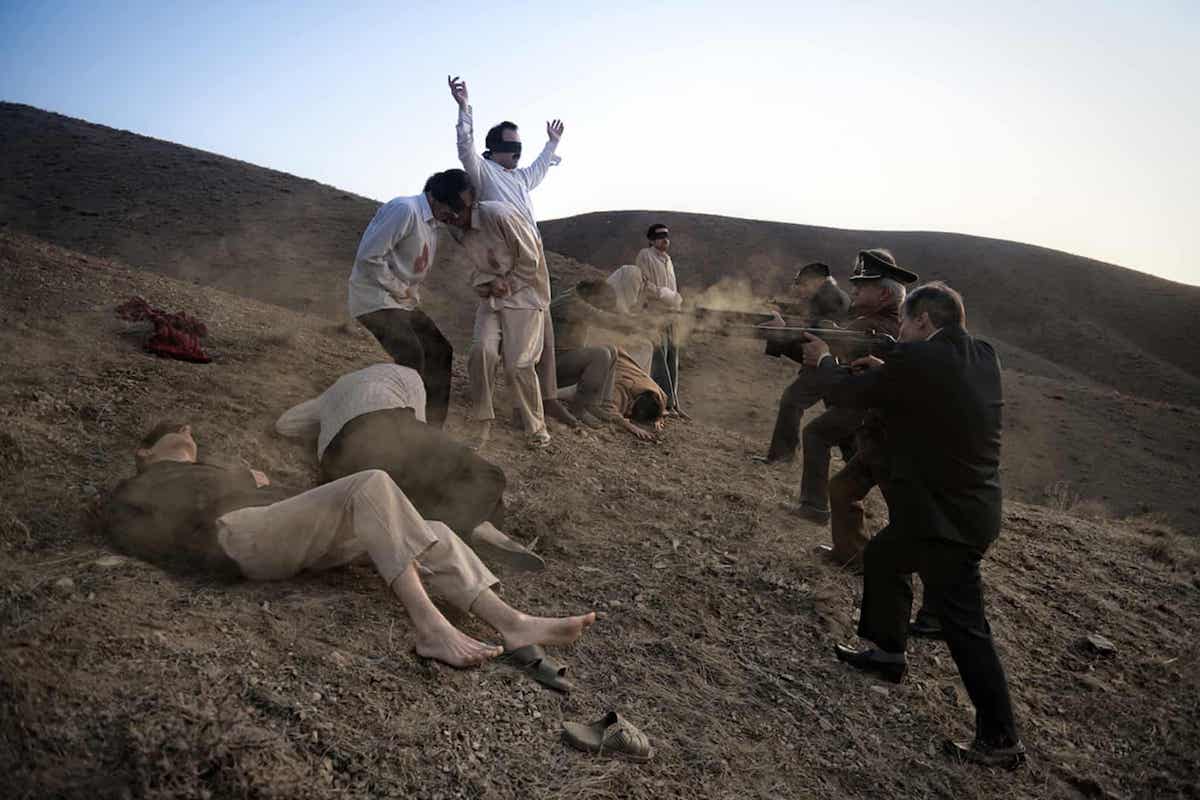
On this date in 1975,* Iran extrajudicially executed nine political prisoners.
This photo is a dramatic re-staging — evocative of a famous photo of executions in revolutionary Iran a few years later, or perhaps in the white-clad central prisoner’s raised arms, the Goya painting that forms this very blog‘s frontispiece. (Contrary to the reconstruction, the executioners had just one Uzi and took turns spraying it at their victims.) It’s part of a fascinatingproject by Azadeh Akhlaghi to portray 17 pivotal deaths in Iran’s history.
We took the prisoners to the high hills above Evin. They were blind-folded and their hands were tied. We got them off the minibus and had them sit on the ground. Then, [SAVAK agent Reza] Attarpour told them that, just as your friends have killed our comrades, we have decided to execute you — he was the brain behind those executions. Jazani and the others began protesting. I do not know whether it was Attarpour or Colonel Vaziri who first pulled out a machine gun and started shooting them. I do not remember whether I was the 4th or 5th person to whom they gave the machine gun. I had never done that before. At the end, Sa’di Jalil Esfahani [another SAVAK agent, known as Babak] shot them in their heads [to make sure that they were dead].
“We took them out of the jail and put them in a minibus and drove them to the hills. We had only one submachine gun, an Uzi, among us, so we took turns shooting them … we didn’t give them a chance to make a last declaration. We blindfolded them and handcuffed them and then shot them. I think was the fourth to shoot. We took the bodies back to the prison. and we had the newspapers print that they were killed during a jailbreak. We had the coroner confirm this version.”
The victims were Ahmad Jalil-Afshar, Mohammad Choupanzadeh, Bijan Jazani, Mash’oof (Saeed) Kalantari (Jazani’s maternal uncle), Aziz Sarmadi, Abbas Sourki, Hassan Zia Zarifi, Mostafa Javan Khoshdel and Kazem Zolanvar.\
The last two named were members of the People’s Mujahedin of Iran, the still-extant MEK back when it was still a standard Marxist revolutionary movement and not a cult.
The first seven named were members of the Organization of Iranian People’s Fedai Guerrillas, a proscribed Communist guerrilla organization.
The proceedings that had landed them in prison in the first place had already put them in the global spotlight especially given the horrific torture applied to the defendants. (Among other things, these seven were adopted by Amnesty International as watchlist political prisoners.) International pressure had staved off juridical death sentences … so the matter was handled extra-juridically instead, with the standard insulting cover story, “shot trying to escape.”
Iran reaped a considerable diplomatic fallout from these murders. Its embassies around the world were rocked by protests of emigres and human rights campaigners in the ensuing weeks; that May, a team of communist assassins gunned down two American Air Force officers stationed in Tehran to train the Shah’s security forces — claiming responsibility “in retaliation for the murder of nine of our members.” (UPI dispatch from Boston (US) Globe, May 21, 1975)
There’s a lengthy lecture on Jazani et al by Communist historian Doug Greene.
* Some sources give April 19 instead. I have not been able to resolve the discrepancy to my satisfaction.

 A onetime Ottoman officer turned veteran of the Arab Revolt under the eventual King Faisal I, Nuri al-Said (or as-Said) was a preeminent politician for much of the Kingdom of Iraq era and practically the personification of Baghdad’s pro-British posture.
 Having already
  On this date in 1941, the fascist artist Alexandru Bassarab was killed in World War II — generally believed to be among captured Romanian prisoners of war summarily executed by Soviet troops.
 The very first president of the short-lived (1967-1990)
  Cullen (
 Once a seminarian, Ocampo (
 The
The 
 Though he acquired his nickname Diakos (“deacon”) from a youthful spell in a monastery, this fellow Athanasios (