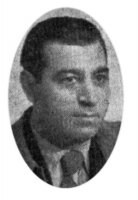
1954: Jonas Žemaitis, Lithuanian Forest Brother

Lithuanian anti-Soviet partisan Jonas Žemaitis was shot in Moscow’s Butyrka prison on this date in 1954. He’s one of the big names in the Forest Brothers movement that kept up a hopeless fight against Moscow from 1944 into the 1950s.

An artillerist of Polish ancestry who deserted the retreating Red Army and surrendered himself the Wehrmacht arriving in the summer 1941, Žemaitis is breezily credited in state histories (and as of this writing, both English and Lithuanian Wikipedia pages) of essentially taking the war years off because “he did not want to serve the Nazis.” That was sure considerate of the Nazis! Instead the fellow just mined peat since he preferred not to get involved.

Now, peat production was and is an important economic sector in Lithuania; indeed, even this seemingly innocuous activity hints at exploitation of Jewish slave labor. But there is circumstantial and even eyewitness evidence that Žemaitis’s participation in one of the Reich’s most thorough exterminations was quite a bit more nefarious than vegetation management.

One could turn here to Joseph Melamed, a survivor of the Kovno Ghetto who collected witness testimonies and published thousands of names of alleged Lithuanian “Jew-Shooters” (zydsaudys). Melamed has charged that Žemaitis put his Polish fluency to use facilitating genocide and “having proved his efficiency and diligence in murdering Jews, was rewarded by the SS and promoted to the rank of Colonel” in the Police Battalions, Lithuanian paramilitaries that worked hand in glove with Nazi executioners.*

Or alternatively, one could rely on the plain fact that Žemaitis was a trained, early-30s officer in a desperate war zone where everyone was being pressed into action, and that anti-Soviet fighters afterwards treated him as a General. That’s not the profile of a figure who simply kept his head down while the Great War raged past him.

The post-USSR independent state of Lithuania, which has not been shy about whitewashing Holocaust collaborators, absolutely rejects such inferences and has retroactively elevated Žemaitis to its officially recognized head of state during his postwar resistance; there’s a Vilnius military academy that’s named for him.

* Melamed is now deceased but during his latter years Vilnius accused him of slander. Modern Lithuania is ferociously determined about apotheosizing the Forest Brothers; officially, the Venn diagram between wartime genocidaires and the postwar anti-Soviet resistance consists of two different shapes on two different planets.

On this day..

1939: Manuel Molina, Valencia socialist

Spanish trade unionist Manuel Molina Conejero was shot in Paterna on this date in 1939. Expect Spanish-language links throughout this post.

A longtime labor activist and (in 1910) co-founder of the mechanical sawmills union, Molina won election as a deputy of the Spanish Socialist Workers Party (PSOE) in 1936 — the left-wing electoral victory that triggered General Francisco Franco’s rebellion and the start of the Spanish Civil War.

Molina was part of PSOE’s moderate faction, led by Indalecio Prieto, and was appointed civil governor of Valencia when Prieto’s rival Francisco Largo Caballero was forced to resign the presidency during the chaotic Barcelona May Days.

He was arrested by the Francoists upon their victory in the civil war.

There’s a street named for him in his home city.

On this day..

851: Saints Flora and Maria of Cordoba, militants

November 24, 851 was distinguished by the beheadings of Saints Flora and Maria of Cordoba.

These Christian denizens of Muslim Spain embraced their own martyrdoms by purposefully denouncing Islam before a Qadi. In Flora’s case, she qualified as an apostate by virtue of her Muslim father.

While in Cordoban prison being entreated by Islamic scholars to reconsider their path, they were admonished to militancy by another inmate, St. Eulogius, himself a future martyr in a like cause. Citing the example of courageous Biblical heroes like Esther, Elogius’s Exhortation to Martyrdom calls on the virgins not to shrink in the face of of their impending tribulations, even if they were to be threatened with rape.

Unfortunately we don’t have the voice of Flora and Maria, even at second-hand. Their actions certainly announce that they like Eulogius were not ecumenical where Islam was concerned. As Charles Tieszen notes in Christian Identity amid Islam in Medieval Spain Eulogius’s language in his confrontational epistle is determinedly martial, with much about arming oneself for battle with the enemy while calling Muhammad

“forerunner of the … possessed man, servant of Satan, full of lies and son of death and perpetual ruin.” Eulogius goes further, coupling his criticism of Islam and its Prophet with a condemnation of the wider Cordovan Christian community (nostra ecclesia), which in his opinion, approved of Islam by its silence. Accordingly, Flora and Maria must not recant upon their previous insults of Muhammad when they faced the qadi again. If they did, their recantations were to be equated with telling outright lies.

Likewise, any retreat by Flora and Maria was to be equated with Christians who remained silent when it came to passing judgment on Islam. In the end, Flora and Maria could do nothing but uphold their public decrials of Muhammad, for if they “… den[ied] having cursed their prophet, [they] will be cursed; and if [they] have not rejected what the Lord rejects, [they] will be guilty of double sin … And surely whomever we do not curse, on the contrary we bless, and whoever we do not reject, we admit in our fellowship as if we were befriending him.” Threats like these, as we have noted, were commonplace in martyrologies, especially texts that exhorted Christians to stay the course towards martyrdom. In the context of Muslim Cordova, it is difficult not to read the threats as a means for equating recanters with the enemy.

…

Eulogius lamented those Christians that so willingly accepted the presence of Muslims, their leadership, and their customs:

But we wretches, delighting in [Muslims’] crimes, rightfully condemn ourselves by the prophecies of the psalmist who says: “but they mingled with the gentiles and learned their works, they served their idols, and a scandal took place among them.” Oh, what agony, that we consider it a pleasure to be submitted to gentiles and we do not oppose carrying our yoke with the unfaithful. And thus, in our daily business, we participate in their sacrileges and desire their company more than, according to the example of Lot the patriarch, fleeing the territory of Sodom in order to save ourselves in the mountains.

The mid-9th century was an apogee of such militancy with a number of martyrs into the bargain … but the Christian community of Cordoba nevertheless remained submitted to the gentiles (pleasurably or otherwise) until 1236.

If a ready translation of the prelate’s text into English exists online I have not located it; flex your classical learning and peruse Documentum martyriale in Latin here or (adjacent a Danish translation) here.

On this day..

1789: Ann Davis, the first woman hanged at Sydney Cove

The first woman hanged in colonial Australia was Ann(e) Davis, on this date in 1789.

Convicted in London “for feloniously stealing, on the 27th day of April, eight pair of silk stockings, value 8s. the property of James Atkinson,” Davis was one of 101 female convicts transported to Sydney Cove with the First Fleet aboard the Lady Penrhyn.* Davis would have been in the crowd of onlookers the year before when the fledgling colony conducted its very first execution.

This spectacle did not un-sticky Davis’s fingers, for she was sentenced in Sydney Cove for again plundering wardrobes to the tune of

four linen shirts of the value of twenty nine shillings and six pence; one cheque shirt of the value of four pence; one linen waistcoat of the value of two shillings; two cambrick handkerchiefs of the value of three shillings; one silk waistcoat of the value of two shillings; one dimety waistcoat of the value of eighteen pence of the goods and chattels of the said Robert Sidaway; and one linen bed gown of the value of two shillings; one linen apron of the value of eighteen pence; two linen caps of the value of sixpence; one piece of a cap of the value of one penny; one muslin handkerchief of the value of six pence; and one pair of linen pockets of the value of one penny of the goods and chattels of Mary Marshall in the same dwelling house.

Davis attempted to plead her belly, failing to impress a jury of matrons impaneled to scrutinize her for pregnancy.

Seaman Jacob Nagle piteously recorded her end:

Some time after this, one of the wimen [Ann Davis] stole some wet clothes and was condemned and hung. She strove to bring a free man in guilty that belonged to our ship that was on duty on shore, it being proved by a number of witnesses that he was innocent and new nothing of it. Otherwise, she might have been saved, as the Governor left it to Captain Hunter, but he would not for give her, and when brought to gallos, leading her by two wimen, she was so much intocsicated in liquor that she could not stand without holding her up. It was dreadful to see heir going to aternity out of this world in such a senceless, shocking manne.

As noted by Australia’s Dark Heart the experience of dispatching this creature might have been especially traumatizing to the colony’s unwilling executioner James Freeman — for he was found roaring drunk a few days later and punished with 100 lashes.

* After discharging its human cargo, the Lady Penrhyn proceeded upon further circulating in the Pacific and the Far East; in 1788, she sighted and named the Cook Islands atoll of Penrhyn.

On this day..

1883: Mampuru, Sekukuni rival

On this date in 1883, the Boer South African Republic hanged Bapedi chief Mampuru.

Sekukuni

Mampuru is notable as the half-brother and rival — eventually murderous rival — of Sekukuni (also rendered Sekhukhune), the chief of the Pedi or Bapedi people. Their backstory is significant: Mampuru had been the intended heir of their shared father, King Sekwati, but the warlike Sekukuni had seized rulership instead when Sekwati died in 1861.

While Mampuru skulked in exile with the neighboring Swazi, it was Sekukuni who led his people’s resistance to the incursions of the Dutch Boers settling the Transvaal.

In 1876, he successfully fought off the Boer Transvaal Republic — which contributed to it becoming in 1877 the British Transvaal instead, at least according to the British.

Less successful was Sekukuni in the war soon prosecuted against him by the British. Extensively narrated here (also see part 1 of this same article sequence here), the upshot was that the British eventually trapped Sekukuni’s last defenders in a rocky hill remembered as the “Fighting Koppie” and captured him. The Swazi, with that displaced rival Mampuru, fought in this war with the British.

Sekukuni and his surviving family would be marched to Pretoria and imprisoned there until 1881.

In the intervening years, power was rebalanced all around among the players. Mampuru had been able to re-establish himself among the Bapedi with no small help from his British allies — but those British allies had been defeated by a Boer rebellion in the First Boer War.* One article in the settlement ending the Boer-British conflict permitted Sekukuni’s release.

As might be expected the ex-chief’s return to his homeland was scarcely welcomed by his brother. After some months of political acrimony, Mampuru settled the feud by having a team of assassins stab Sekukuni to death in his sleep, on the night of August 13, 1882.

For Mampuru, the sibling rivalry win was as Pyrrhic as it surely was satisfying, for he was immediately branded an outlaw by the Boer Transvaal and himself obliged to flee from the countrymen whom he meant to rule. When the Boers captured him, they had him condemned a murderer and hanged him stark naked for an audience of 200-plus white men in Pretoria. As an added indignity, they botched the hanging and dropped Mampuru to the ground on their first go, when the noose snapped. (In 2013, the jail where he hanged was renamed for Mampuru.)

Cowardly murderer or anti-colonial resistance martyr? That’s still up for debate.

* A result to be avenged/reversed 20 years on.

On this day..

1894: Santiago Salvador, William Tell bomber

Spanish terrorist Santiago Salvador died to the garrot on this date in 1894.

A central-casting figure from the heyday of anarchist bomb attacks on bourgeois society, Salvador highlighted the November 7, 1893 premier of opera season at Barcelona’s Gran Teatre del Liceu by chucking a couple of Orsini bombs from the balcony during the second act of William Tell.*

“My wish was to destroy bourgeois society,” he would explain. “I did not set out to kill certain people. I was indifferent to killing one or the other. My desire was to sow terror.” A more specific provocation (cited by Salvador at his trial) was the execution one month before of another anarchist, Paulino Pallas.

Salvador successfully escaped the scene amid the confusion and the hunt for him licensed a year of martial law with a plethora of offices ransacked and subversives sweated.

The man died with the requisite cry of Viva la Anarchia! upon his lips; however, anarchist violence in his parts did greatly abate in the ensuing couple of years, with the main theater of the propaganda-of-the-deed tendency now shifting to France.

* France’s Le Petit Journal had an explosive illustration of the event on the cover of its 26 November issue.

On this day..

1663: Volkmar Limprecht

Volkmar Limprecht, a pedagogue and city councilor of Erfurt in Thuringia, was beheaded on this date in 1663. Almost all the links in this post are in German.

“A Mephistophelian mixture of reckless egoistic ambition and restless energy, worldly agility, and unfettered frivolity,” our man Limprecht was a pedagogue turned demagogue who won election to the city council and briefly rode his acumen to control of the city and the absurd prospect of asserting leadership of the Electorate of Mainz.

The Elector, Johann Philipp von Schoenborn, dispatched an army to Erfurt to put it in its place, leading the city’s other grandees to overthrow Limprecht for self-preservation and have him condemned a traitor. He was beheaded the day after his sentence, and his head mounted on a spike as a gesture of submission to the Elector.

Google Books has digitized a public domain blackletter summary of the man’s fall here.

On this day..

2010: Li Haito, reliquarian

From IANS on Friday, Nov. 19 of 2010. (via)

China executes official for plundering cultural relics

Beijing, Nov 19 (IANS) China Friday executed an official for stealing and selling cultural relics protected by the state, reports Xinhua.

Li Haitao was the chief of the cultural relics protection authority of the imperial garden in the Hebei provincial capital of Chengde.

He was executed after China’s Supreme People’s Court approved the death penalty on a conviction of embezzlement, the Intermediate People’s Court of Chengde said.

By taking advantage of his post between 1993 and 2002, Li had stolen 259 cultural relics stored in the depository of the Eight Outer Temples, an imperial compound built on the three-century old Summer Mountain Resort.


Putuo Zongcheng, one of the Eight Outer Temples. (cc) image from Ana Paula Hirama.

Li, 50, replaced the relics with copies, inferior or incomplete objects, and asked his subordinates to alter the records.

The stolen items included gold gilded Buddha statues, five of which were listed as state relics under first class protection, 56 were in the second grade and 58 in the third.

Li pocketed more than 3.2 million yuan ($482,240) after selling 152 stolen pieces.

Police have seized 202 relics and are still hunting for 57 other items.

Li’s four accomplices — Wang Xiaoguang, Yan Feng, Zhang Huazhang and Chen Fengwei — were given jail terms of up to seven years with fines.

His crimes went unnoticed until a Chinese expert found two royal cultural relics belonging to Beijing’s Palace Museum at an auction in Hong Kong in 2002.

The expert reported his discovery to the state cultural heritage authorities, which prompted a probe that found Chengde was the source of the relics.

Covering an area of 5.6 million sq metres, the Summer Mountain Resort was the temporary imperial palace of the Qing Dynasty (1644-1911) emperors Kangxi and Qianlong.

The mountain villa, the largest remaining classical imperial garden architecture in China, and the outlying temples were placed on the World Heritage list in 1994.

On this day..

1872: Joseph Garcia, for the Llangibby Massacre

Spanish seaman Joseph Garcia was hanged at Usk Prison on this date in 1872, for the Llangibby Massacre.

It occurred in the Welsh village of that name, inland from the mouth of the Severn where Garcia had alit as a mariner at Newport nearly a year before.

He’d committed a burglary there, and been committed to jail for his pains. His sentence was nine months … followed by release to a foreign land whose language he barely spoke, his ship long gone and no friend or occupation to direct him.

A “short, thin man, just five feet five inches tall, with a swarthy complexion, coarse black hair and beard,” Garcia trudged the road in to the farming town. Several times he was observed loitering there but his presence was really announced by the billows of smoke pouring from the home of William Watkins, a farmworker — and neighbors who rushed to the scene beheld the horror of its owner dead from a stab wound through his throat, his wife similarly dealt with, and all three of their small children also put to the blade — their wee corpses already partly charred from the fire.

The stranger’s foreignness invited attention, of course, and when he was arrested back at Newport circumstantial evidence appeared to confirm the connection: he had some injuries and bloodstains that suggested a scrap, a pair of boots that might have been stolen from Watkins, and some stolen household articles that a surviving daughter of Watkins fortunate enough to be away from the house at the fatal hour recognized as the family’s own. He also possessed a knife that he hadn’t been discharged with.

Then as now the fury for a swarthy outlander come uninvited to go a-viking among law-abiding Britons was potent; while legal proceedings were entirely regular, “the noise outside the court was powerful enough at times to prevent the witness from being heard, and from the character of the exclamations which permeated to the interior of the court the crowd appeared ready to lynch Garcia.” (Period press quoted here.) Indeed, such a sentiment was openly published in at least one broadsheet murder ballad:

May the murderers to justice quickly be brought,
And suffer the penalty they surely have sought,
Lynch law in some countries they would very soon find,
And their bodies be swinging on the trees to the wind.

On this day..

1925: Fritz Angerstein, crime without criminal

German spree killer Fritz Angerstein was beheaded on this date in 1925.

This tuberculotic managerial type (English Wikipedia entry | German) completes an infernal trinity of notorious mass murderers of Weimar Germany, along with Fritz Haarman and Peter Kürten.

He lived a life of moderate domestic angst, with a sickly wife Käthe whom he loved and who could not carry to term any of her six pregnancies with him; once they had contemplated committing suicide together but called it off; once (seemingly no more than that) Fritz had cheated on her, but he returned to his wife willingly and didn’t actually want to discard her. Things were frostier with the meddling mother-in-law and even known to come to blows, yet still little other than a bog-standard rocky in-law relationship.

By 1924 this family was mired in debt, living in a villa owned by the mining firm who had detected Angerstein’s peculation.

On the night of November 30 to December 1, 1924, as his wife lay coughing up blood, the man snapped and turned that company villa into a charnel house.

After wildly stabbing his wife to death with a hunting knife, Angerstein went downstairs to kill himself only to be interrupted in the act by a scream upstairs as his mother-in-law discovered her daughter’s corpse. He stalked upstairs and visited a like fate on that poor woman; when the family maid burst in, he chased her down the halls as she fled for the door of her attic chamber and hacked her down too.

In a home now with the stillness of the grave, Angerstein caught a few hours’ sleep to ready himself to continue the rampage in the morning.

His 18-year-old sister-in-law arrived overnight on a train: Angerstein butchered her with an axe. A clerk and a bookkeeper of the mining firm came later in the morning, reporting in for work: Anger axed them too. The gardener, the gardener’s assistant, even a german shepherd — all met the same fate.

One might anticipate that this slaughter would culminate in that suicide the man kept attempting but instead he gave himself some non-lethal stab wounds and attempted to set his house on fire, then summoned the police with a story about a deadly home raid by a gang of bandits. Forensics, and Angerstein’s own admissions, soon rubbished this cover story.

The out-of-nowhere senselessness of this bloodbath fascinated and perplexed observers who struggled over interpretations of the — the what? the criminal? the madman? the abyss of the modern soul? He had to be sure points of stress and provocation, ingredients that could plausibly suit the backstory of a monster, but they were also ingredients carried by numberless functionaries of state indistinguishable from Angerstein who were day by day merely quietly dissipating their pains in little hobbies or shabby love affairs, in career obsession, career neglect, alcoholism, cat-fancying, countryside rambles, newspaper perusal, games of darts down the pub, and all the million little ways that we little people pass our little days. That seemed to leave Angerstein’s own instance of these slings and arrows markedly insufficient for the extraordinary consequence, if the money troubles and ailing wife are really supposed to stand for cause. Why this explosion, from this guy, at this time? Surely it wasn’t merely because the hated mother-in-law had ruined the soup that night?

One prominent knight upon these lists was thinker-scribbler Siegfried Kracauer, who might be best-known to later generations as a film critic and a mentor of Adorno. In ruminations published as Tat ohne Täter: Der Mordfall Fritz Angerstein (Crime Without Criminal: The Murder Case of Fritz Angerstein), Kracauer decoded in Angerstein’s outrage the horror of relationships dehumanized, “become objectified, with emancipated things gaining power over people rather than people seizing hold of the things and humanizing them.” Small wonder, then that “the disfigured humanity that has been repressed into the deepest recesses of unconsciousness will reappear in hideous form in the world of things.” (Quoted in Cool Conduct: The Culture of Distance in Weimar Germany.)

A deed without a doer — that is the provocative, the incomprehensible aspect of the Angerstein case. The deed is inconceivable: an orgy of ax blows and arson. Intimidating in its mere magnitude, the crime bursts the bounds of customary statutes as only an elemental event can. It is impossible to do more than stare at it; it is not to be subsumed within existing categories. Nevertheless, there it is, an undeniable fact that, for well or ill, must be registered.

But where is the doer that belongs to the deed? Angerstein? The little, subordinate fellow with modest manners, a feeble voice, and a stunted imagination? … At bottom a mere petit bourgeois, Angerstein can be outfitted with a vicious appearance only in retrospect by overheated journalists. Had one encountered him prior to the crime on the street, one would have asked him for a light and quickly forgotten his features.

Even today, or today once again, he remains stubbornly at home in the narrow confines of inborn mediocrity. His behavior during the trial has been minimal in every respect. There have been no sudden eruption to help us chart a connection between the man and what he did, no outbursts to suggest a subterranean fiendishness, nor the kind of silence that would correspond to what happened. Instead, he has withdrawn into trivialities into a dull state of shock wholly incommensurate with its cause, a confused acceptance of what he himself does not understand.

Angerstein, in Professor Herbertz’s depiction of the events, did not commit the deed; the deed happened to him. Having transpired, it detached itself from him and now exists as a purely isolated fact for which there is no proper cause. It rose up out of nothing for the while of the murders, a dreadful “it” out there in space, unconnected with him. If the soup had not been burned — a triviality become a link in a chain of external causation — Angerstein’s victims would have gone on living and no one but his fellow citizens of Haiger would ever have heard his name. The crime looms gigantically over him; he disappears in its shadow.

…

In the winter of 1924, the event comes out of nowhere. Minor illegalities preceded it, a confusing swindle, no one knows how or why. Running amok, it seems that a physician’s attentions merely added to the burdens. His previously neatly bounded world was slipping through his fingers. The woman of his obsession draws him with her toward a longing for death, for an end to it all. He may have been thinking of suicide as he stabbed her — but why the frenzy with the hunting knife and the ax, why the senseless bashing of the skulls of uninvolved others? What sucked him, the minor administrator, for a night and a day into the cyclone of devastating violence?

…

Many details confirm the assumption that the quiet manager was caught unawares by some unknown something inside him. He admits that he himself cannot understand, cannot conceive, that the gigantic fact came out of him. His early attempts to deny it are ridiculously petit bourgeois. Now that he has acknowledged being the perpetrator, he gazes fixedly at what others designate his crime. His evasions from now on have to do with incidentals, his excuses with mere details. The actual misdeeds weigh on him like a block of lead he cannot cast off.

If he is conscious he flees into sleep, sleeping double the usual amount, because his memory wants to disappear. The fact outside there, which is undeniably related to him is completely overwhelming; he does not like to taste or feel it. Suicide is also beyond the bounds of his horizon, now narrowed to a point. His reading is the Bible, which perhaps brings him by way of detours into contact with his wife.

A deed without a doer that has nothing, but nothing, in common with those great crimes committed by people whose names live on in popular memory. Those crimes were manifestations of a will, however misguided; they were eruptions of unbridled natures, twisted minds, the expression of outsized drives and passions. They stemmed from a place in the guilty person, were not just there alongside him, existing inadequately in space.

The deeds that now go by the name of Angerstein lack a personal point of reference, without, however, that meaning that they were born of mental illness. That there is no sufficient reason for them in the consciousness of the doer is what turns them into a tormenting puzzle, what lends them the uncanny remove of mere facts. It may be that depth psychology is correct in claiming that they emerge to the light of day out of the craters of unconscious psychic life; it has not, however, solved the puzzle of how such a thing is possible.

On this day..