1938: Albert Dyer, sex killer (presumably)

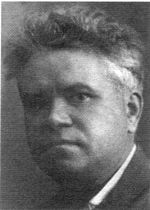
On this date in 1938, Albert Dyer hanged at California’s San Quentin prison for a triple rape-murder.

Dyer is a very modern bugbear, a monster right out of cable news and amber alerts and stranger danger.

As often with those, his path to infamy began with disappeared white girls — Jeanette Stephens, Melba Everett, and Madeline Everett, all ages 7 to 9 — who went to picnic at an Inglewood park one summer afternoon and never came home.

The police set about hunting for any known sex offenders in the area, but the offense would ultimately be attributed to a neighbor who was active with the concerned search parties that scoured the area.

Induced by a police threat to deliver him into the hands of a lynch mob, Dyer admitted to having lured the girls off on the pretext of catching rabbits, then strangling them to death and raping their corpses.

(Here’s a disturbing set of photos of the girls’ bodies.)

Dyer attempted to repudiate these confessions, which you’d have to say were obtained under a bit of duress. The case against him apart from self-incrimination was a tissue of meager circumstantial evidence; Dyer’s persona smacks of mental deficiency that might have left him easy prey for manipulation by his captors.

Newspapers described Dyer as “dull” and “stupid”, and in fact the defense attempted to cast doubt on the prisoner’s mental competence and the reliability of his confessions. The jury took agonizing days to reach a consensus, and the last man holding out against conviction would later say that he finally gave in after being led to believe that the judge considered Dyer guilty. (This revelation was among the defense’s last arguments for executive clemency, at the end of the process.)

In short, for all the horror of the crime, the case was not cut and dried in 1938. The passage of time — with our latter-day awareness of false confessions and developmental disability — will hardly make it more so, unless some forgotten crime locker still preserves a testable genetic sample. But no surprise, the popular press had a different take. The Los Angeles Times editorialized (Aug. 27, 1937) anticipating that

[t]he verdict of a jury that Albert Dyer must die for the murder of three Inglewood children is a long step toward the eradication of sex crime in California. It is the only outcome of the case that public opinion could afford to sanction.

The evidence against Dyer was overwhelming; and there could be no mitigating circumstance which could justify this State in letting such a miscreant go on living.

Even if Dyer is mentally defective, there is no reason for his continued existence. He could never be safe to have at large. Legally, his condition is not insanity; he knew what he was doing and that it was wrong. Eradication of such types is necessary for public safety.

And the death penalty is the best deterrent. If others have this criminal tendency, his fate may cause them to repress it. Dyer, hanged, may save the lives of countless California innocents. In any scale, the safety of children must weigh more heavily than his forfeited right to live.

Dyer was the second-last person hanged by the Golden State before the gas chamber came online to replace the gallows. His legacy was California’s 1939 passage of a law governing (pdf) the handling of “Sexual Psychopaths”. (This site suggests he was also posthumously exploited for the cause of marijuana criminalization.)

Part of the Themed Set: Americana.

On this day..

1936: Grigory Zinoviev and Lev Kamenev, Old Bolsheviks

During the purges of the 1930s, Josef Stalin showed a particular relish for eliminating the Old Bolsheviks whose red credentials predated the revolution. (And potentially, outshone his own.)

Zinoviev

On this date in 1936, one of the oldest of them, Grigory Zinoviev, was shot with his longtime ally Lev Kamenev.

These guys had been major movers and shakers among the early Bolsheviki, adherents of Lenin during the first decade of the century when the aspiration for a Communist Russia seemed hopelessly far-fetched. Zinoviev rode with Lenin from Switzerland to Petrograd in the famous sealed train after the February Revolution toppled the tsar. (Not so Kamenev: he was serving time in Siberia, but was freed by the revolution.)

In the years that followed, both played leading roles in the Soviet government despite their impolitic opposition to the Bolshevik coup in October.

Kamenev was briefly head of state in 1917, and he married Leon Trotsky’s sister. Zinoviev was the longtime head of the Communist International, in which capacity he showed Moscow’s public face for communist movements in other countries. Bela Kun was another ally of Zinoviev’s.)

In this capacity, he’s known in British history for the “Zinoviev letter”, a purported summons to Anglo agitation that was actually a dirty trick dropped before an election to help the Tories sweep to power.*

Those were the good old days — when Lenin was fading away and Zinoviev, Kamenev, and Stalin were the “troika” running things. They should have checked with the Romans how triumvirates work out.

Because of their alliance, Zinoviev and Kamenev provided the decisive support that enabled Stalin to remain General Secretary of the party after the public airing of Lenin’s Testament warning against him. Without Zinoviev and Kamenev at this crucial moment, Stalin probably could not have survived politically; the name Koba might have gone into history books as little more than a terror to the paperwork of some forgotten bureau. (And the pre-revolutionary Caucasus!)

Talk about hoisted by your own petard.

Having been helpfully maintained in his position against Lenin’s dying wish, Stalin soon marginalized these formerly useful creatures. Their last decade was doomed to a spiral of failing power struggles, sinking rank, furtive dissension, and craven submission to party discipline.

Stalin at length destroyed them at the first great Moscow show trial, the Trial of the Sixteen — which hyped a “Trotskyite-Zinovievite” plot in a nicely Orwellian twist. (Despite Kamenev’s marital connection, Trotsky was actually a political rival.) The charge sheet must have reminded the defendants on every one of their dwindling days of the alliance with Trotsky they could have made back when they mattered.

The Trial of the 16 defendants would help to write the script for succeeding acts of this awful theater: after fighting the allegations, Zinoviev and Kamenev agreed to plead guilty on private assurances that their lives would be spared.

But once he had their “admissions” on the record, Stalin altered the deal.

Not only Zinoviev and Kamenev, but all 16 from the trial of the 16 were shot shortly after midnight this date.

From exile, their “conspirator” Trotsky called it the “end of an epoch”.

His obituary for Zinoviev and Kamenev minces no words about the men’s personal shortcomings (“they lacked sufficient character”), but still achieves a certain elegaic sympathy for these former fellow-travelers and their shared movement, now swallowed by Stalinism.

I have had the occasion to hear tranquil petty bourgeois tell me in the days between the beginnings of the trial and my internment: “It’s impossible to understand Zinoviev … He is so lacking in character!” And I would reply: “Have you yourselves experienced the full weight of the pressure to which he has been subjected for a number of years?” Unintelligent in the extreme are the comparisons, so widespread in intellectual circles, of the conduct in court of Danton, Robespierre and others. These were the instances of revolutionary tribunes who found the knife of justice suspended over them, directly in the midst of the arena of struggle; at a time when they were in the full flower of their strength, with their nervous system almost untouched and, at the same time, when they despaired of all hope of salvation.

[By contrast] For ten years they [Zinoviev and Kamenev] had been enveloped by clouds of slander paid for in heavy gold. For ten years they had swayed between life and death, first in a political sense, then in a moral sense, and lastly in a physical sense. Can one find in all past history examples of such systematic, refined and fiendish destruction of spines, nerves and all the fibers of the soul? Zinoviev or Kamenev would have had more than ample character for a tranquil period. But the epoch of grandiose social and political convulsions demanded an extraordinary firmness of these men, whose abilities secured them a leading place in the revolution. The disproportion between their abilities and their wills led to tragic results.

* There are numerous theories of the Zinoviev Letter’s origin; one has it that spy Sidney Reilly had a hand in it.

On this day..

1930: Thomas Shipp and Abram Smith, strange fruit

On this date in 1930, two black youths were lynched in Marion, Indiana for murdering a white man and raping his girlfriend.

(The rape allegation — although it, and not the homicide, seems to have been the thing that triggered the lynching — was subsequently withdrawn, and there were even rumors that the white girlfriend was a lover and confederate of one of the lynched men. It’s just one strand in the very human tapestry around the “last classic lynching north of the Mason-Dixon line” explored by Cynthia Carr in Our Town: A Heartland Lynching, a Haunted Town, and the Hidden History of White America.)

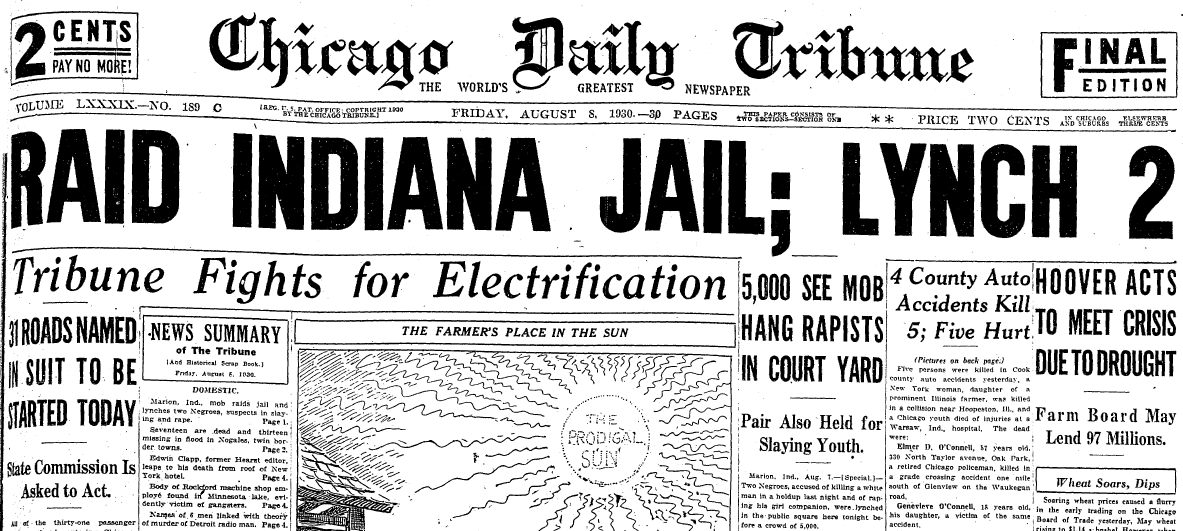
Thomas Shipp and Abram (or Abraham) Smith had been taken just the day before. The Chicago Daily Tribune (Aug. 8, 1930), for whom this event was banner news, reported that

Shipp, who is said to have confessed killing the white man, Claude Deeter, 23, of Fairmount, Ind., was hanged from an elm tree in the courthouse yard. Smith, whom the girl identified as her assailant, was thrown from a third floor window of the jail with a noose around his neck and strangled.

Reports of the crimes and confessions, published in Marion newspapers this afternoon, stirred this quiet community of 23,000 to intense excitement. There was no hint of the impending violence, however, until 8:30 p.m., when a motorcade of Deeter’s fellow townsmen arrived from Fairmount.

The Fairmount delegation, numbering about 100, gathered in the public square, openly displaying their guns and shouting for a lynching … The sheriff led his deputies to the front door, argued a moment with the leaders of the mob and then ordered the tear bombs thrown. Blinded, the lynchers fell back for a few minutes, but returned and began the sledge hammer siege which forced the jail doors within ten minutes. No shots were fired on either side.

Following the lynching the mob gathered in the square for an hour, some proposing to drive the 2,000 members of the Negro colony from the city and burn their dwellings. Peace officers from Indianapolis, Kokomo, Fort Wayne, and other towns were arriving however, and gradually the mob broke up.

The corpses hung in the square for hours, attracting throngs of gawkers — including a photographer able to snap this picture:


Teacher/poet Abel Meeropol ran across this photo of the Shipp-Smith lynching a few years later in a magazine, and it so “haunted” him — his word — that he penned the anti-lynching poem “Strange Fruit”. You know it from Billie Holiday‘s arresting vocal rendition.

Southern trees bear strange fruit
Blood on the leaves
Blood at the root
Black bodies swinging in the southern breeze
Strange fruit hanging from the poplar trees

Pastoral scene of the gallant south
The bulging eyes and the twisted mouth
The scent of magnolia sweet and fresh
Then the sudden smell of burning flesh

Here is a fruit for the crows to pluck
for the rain to gather
for the wind to suck
for the sun to rot
for the tree to drop
Here is a strange and bitter crop

Abel Meeropol was no passing sentimentalist himself, but a prolific left-wing activist. During the McCarthy years, he adopted the children of the Rosenbergs when the latter were electrocuted as Soviet spies. As faithfully as those two orphaned boys have carried the torch for their lost birth parents, they also still carry an adoptive surname: Michael Meeropol and Robert Meeropol.


A third person was almost lynched in the same Marion, Ind., incident, but 16-year-old James Cameron (sometimes called “Herbert” or “Robert” in the 1930 news reports) managed to convince the mob that he wasn’t involved. Just how he managed this feat and what he’d really been up to is another strand of Carr’s tapestry: many of the Marion blacks as well as whites she interviewed overtly mistrusted Cameron.

At any rate, the crowd let him off with a beating, and Cameron served time as an accessory to the crime.

After release, he became an anti-lynching activist in Indiana and, later, Wisconsin — where he founded a (since-shuttered) Black Holocaust Museum. He started several NAACP chapters.

Cameron was pardoned by Indiana Gov. Evan Bayh in 1993, and authored a memoir titled A Time of Terror: A Survivor’s Story.

In the more immediate aftermath, it was far from a given that this date’s effusion of summary justice wouldn’t cascade into a generalized racial pogrom.

As the Tribune article notes, the lynch mob mulled attacking the black community, ultimately dissuaded by the gradual arrival of lawmen. By the next day, the Indiana national guard had occupied Marion. The Tribune on Aug. 10 reported the town “peaceful to all outward appearances but acutely aware of an undercurrent of racial antagonism that it feared might flame into open warfare at any moment.”

Lest this seem a bit over-the-top, recall that all this went down just a few years since a lynch mob in Tulsa had metastasized into one of America’s most notorious race riots. The prospect of wholesale bloodletting was very real.

When the local attorney general and grand jury waved away the small matter of punishing mob leaders, several of whom were publicly known by name, Indianapolis attorney general (and Marion native) James M. Ogden drove up to town and personally filed indictments, to the fury of white residents.

“It was astonishing to see and feel the mob atmosphere that still prevailed nearly seven months after the murder,” wrote a correspondent for The Nation. Ogden’s deputies were “looked upon as enemies of the community, not only by the mob, but also by most of the court officials.” After all-white juries acquitted the first two people tried, the state dropped its remaining indictments.


The maelstrom of race and politics and history that emerged from that first fatal transaction — a brutal but banal Lover’s Lane heist — grew so far beyond the original cast of criminal and victim that they practically became secondary to the story.

On August 8, 1930, a wire story datelined Fairmount, Ind., ran in the Indianapolis Star (but not the Marion papers):

Deep regret that the negro slayers of their son Claude, were lynched in Marion last night by a mob, was expressed today by Mr. and Mrs. William Deeter, members of the Apostolic faith, a sect similar to the Quakers.

“God should have been the judge,” said the elderly Deeter. “They had no right to do it,” his wife assented.

Both are opposed to capital punishment and did not want to see the negroes put to death for their crime.

On this day..

1937: Pavel Vasiliev, peasant poet

On this date in 1937, Elena Aleksandrovna Vasilieva arrived to Moscow’s Lefortovo Prison to visit her husband, “peasant poet” Pavel Vasiliev.

“He’s been transferred to another place,” she was told.

He had been: six feet under, that very day.

Vasiliev hailed from a Cossack family in Kazakhstan, and he would fight his short life’s literary battles with a pugnacity reflecting his youthful work as a sailor and gold miner in Siberia. He was renowned for his boozing and carousing.

The early 20th century “peasant” literary movement was just the place for him.

While the Futurists waxed eloquent over the wonders of the new machine age, the peasant writers and poets were moved by a strong revulsion for industrialization … [and glorified the village and longed to return to the simple life of rural Russia. At the same time the futility of their dream was evident even to them, and their writings are often of a tragic bent.

And bents tended towards tragedy in the 1930s.

A little too outspoken for his own good, Vasiliev openly defended Nikolay Bukharin (arrested in February 1937) as “the conscience of peasant Russia,” and characterized the politically expedient denunciations made by fellow scribblers as “pornographic scrawls on the margins of Russian literature.”

It’s a remark that would age a lot better than the man who uttered it.

The admiration of many contemporaries — Pasternak considered Vasiliev brilliant (see this Russian biography; most of the information about Vasiliev online is in Russian) — could hardly aid a man coming under official fire for “kulak bohemian ideology.” Vasiliev did prison stints (Russian again) in the early 1930s for counter-revolutionary writing, and then for “malicious hooliganism” after whaling on a former friend who had denounced him in print.

I accept the title of a rumbler,
If the brattle of gusli is thunder.**

Pavel scorned the warning, leaving his widowed Elena to husband his many unpublished verses until they could finally be published (and the poet rehabilitated) in the 1950s, after Stalin died.

* The most famous poet of this school was Sergei Yesenin, whose death at the end of a hangman’s rope at age 30 is unfortunately not eligible for this site … since Yesenin put up the rope himself. Live fast, die young, and leave a beautiful corpse.

** Thanks to Sonechka for the translation assist.

On this day..

1938: Anthony Chebatoris, in death penalty-free Michigan

This post was contributed by Andrew Gustafson, a writer and cartographer based in Brooklyn, NY. Andrew’s work can be found on his website, and he regularly blogs about New York City history and culture for Urban Oyster Tours.

On this date in 1938, Anthony Chebatoris was hanged at the federal prison in Milan, Michigan, becoming the only person executed in Michigan since it gained statehood in 1837.

Chebatoris and an accomplice, Jack Gracy, rolled into Midland, Michigan on September 29, 1937, with the intention to rob the Chemical State Bank. They never did get their hands on the cash, and only one of them would leave the town alive, though with a proverbial noose dangling from his neck. The two men, armed with a pistol and a sawed-off shotgun, entered the bank and approached the bank manager, Clarence Macomber, with guns drawn. In the ensuing scuffle, Chebatoris shot Macomber and another bank employee, Paul Bywater. Upon hearing the shots, Frank Hardy, a dentist whose office was next to the bank, grabbed the loaded deer rifle he kept handy and went to the window to see what the commotion was about. As Chebatoris and Gacy abandoned the botched robbery empty-handed, Hardy began firing at the fleeing robbers, hitting Chebatoris in the arm and causing him to crash the getaway car he was driving. As the wounded men looked for another escape route, Chebatoris spotted a uniformed truck driver named Henry Porter, whom he mistook for a police officer, and shot him. The men then tried to hijack a truck to make their escape, but as Gacy attempted to climb into the cab, the sharpshooter Hardy shot him in the head from 150 yards away, killing him instantly.* Chebatoris took off on foot and was apprehended a short distance away, exhausted and bleeding.

Chebatoris would survive his injuries, as would the bank employees Macomber and Bywater. But the innocent bystander Henry Porter put our convict on the road to the gallows: after two weeks in the hospital, Porter would succumb to his injuries, and murder would be added to the charges against the surviving bank robber. Michigan had outlawed the death penalty for murder in 1846, becoming the first U.S. state to do so. But Chebatoris found himself subject to a legal system that had been changed by New Deal politics and the public’s panic over escalating violence and criminality. Federal prosecutors took on the case, under the authority of the National Bank Robbery Act of 1934, which was passed in response to the rash of bank holdups across the country. The law gave the federal government the authority to prosecute anyone involved in the robbery of a bank that was a member of the Federal Reserve System or the newly created Federal Deposit Insurance Corporation. Unluckily for Chebatoris, Chemical State Bank was a member of both.

With a mountain of evidence against him, Chebatoris was easily convicted, and on November 30, 1937, he was sentenced to death by federal judge Arthur Tuttle. The case set off a political controversy in Michigan, one that would pit an anti-death-penalty governor against federal judges and prosecutors who wanted the sentence passed down and carried out in the state. Under the federal statute, federal death sentences could only be carried out in states that had their own death penalty. While Michigan had long abolished capital punishment for murder and other crimes, it still kept an obscure law on the books allowing execution for treason (which has never been exercised, as it is unclear how one would commit treason against the state of Michigan). This loophole allowed the federal capital prosecution and execution to proceed within the confines of the staunchly abolitionist state.

In response to the decision, Michigan Governor Frank Murphy said, “There hasn’t been a hanging in Michigan for 108 years. If this one is carried out in Michigan, it will be like turning back the clock on civilization.” Illinois, which had its own electric chair, offered to finish off Chebatoris, but Judge Tuttle ordered that the execution should proceed in Michigan, noting, “The just verdict having been returned, the law was mandatory in the three respects, namely that the penalty should be death, that it should be hanging, and that it should be within the state of Michigan. These last two requirements resulted from the fact that Michigan has one statute providing for the death penalty by hanging. If the sentence had been different in any one of these respects, it would have been unlawful. I have neither the power nor the inclination to change the sentence.”

Chebatoris was transferred from the Saginaw County Jail, where he had been held throughout his trial, to the federal prison in Milan. At 5 a.m. on July 8, 1938, he was brought to the gallows, and before 23 witnesses, including an inebriated hangman named Phil Hanna, he was hanged. In the middle of the night before the execution, Hanna had arrived at the prison demanding that his three drunken friends be admitted to the hanging. After an argument with the warden and a call to the director of the Federal Bureau of Prisons, Hanna was allowed to proceed with execution, and the warden acceded to his demands (though at the time of the execution, the warden barred the three friends from the proceedings, knowing that the room was too dark, and Hanna too drunk, for him to notice their absence).**

Chebatoris’ execution was both a unique event and a bellwether for things to come in the federal death penalty system. Since 1927, he is the only person to be executed for a murder committed in a state that does not have its own death penalty statute. After World War II, executions, both federal and state, went into a steep decline across the United States, culminating in the 1972 Supreme Court decision Furman v. Georgia, which struck down every capital punishment statute in the land. Four years later, the death penalty was revived in Gregg v. Georgia, and it took barely six months for states to resume executions. The federal government was slower, however, and the first post-Furman federal death penalty statute did not appear until 1988. Since that date, however, we have seen the steady expansion of the federal death penalty, building on the precedents set by the National Bank Robbery Act. Rather than targeting bank robberies, the federal government has used the death penalty to take aim at other perceived scourges, employing it is a weapon in the various domestic “wars” on crime, drugs, and terrorism.

In the past twenty years, the federal death penalty has been transformed from a seldom-used punishment for pirates and crimes committed in the territories to an expansive weapon that can be imposed in a wide range of jurisdictions, leading the Criminal Defense Network to conclude that “virtually every homicide occurring within federal jurisdiction is now death-eligible.”† The greatest expansion of the federal death penalty came with the 1994 Violent Crime Control and Law Enforcement Act, which greatly expanded federal jurisdiction and authorized the death penalty for nearly 60 different crimes. And the reach of the federal death penalty has continued to expand, even into states like Michigan that have rejected capital punishment.

There are currently 58 people sitting on the federal death row, nine of whom committed their crimes in states that either do not have a constitutionally valid state death penalty statute or have active moratoriums on the death penalty.‡ Interestingly, all of those nine were sentenced to death during the tenures of Attorneys General John Ashcroft and Alberto Gonzalez, and their decisions to pursue capital prosecutions marked a departure from the actions of their predecessors. Early in his term, John Ashcroft revised the U.S. Attorneys Manual and removed language about the Department of Justice’s policy towards seeking the death penalty in states that did not have their own capital punishment statutes. Previously the manual stated that in these states, “penalty-driven decisions to file federal charges are inappropriate.” That language was removed, and presumably this opened the door for the increase in prosecutions, convictions, and death sentences handed out in federal districts located within abolitionist states. Since Chebatoris’ execution, no one who falls into this category has been executed, and current Attorney General Eric Holder has signaled a return to the earlier practices, meaning the federal government will be less inclined to pursue these kinds of cases. Nevertheless, it is likely that at least one of these nine will eventually be executed.

When that happens, Anthony Chebatoris will no longer be a solitary historical footnote.

* Hardy was a hero, but he is not nearly as celebrated as another bank robbery foiler, Northfield, Minnesota’s Joseph Lee Hayward, who is remembered annually at the town’s “Defeat of Jesse James Days.” Perhaps Midland could build its own tourist attraction around Hardy?

** For a detailed account of the case of Anthony Chebatoris, read Aaron Veselenak’s article in the May/June 1998 issue of Michigan History Magazine, “The Execution of Anthony Chebatoris.”

† From Burr, Dick, David Bruck and Kevin McNally (2009). “An Overview of the Federal Death Penalty Process.” Capital Defense Network.

‡ These death row inmates are: Carlos Caro (WV), Donald Fell (VT), Marvin Gabrion (MI), Dustin Honken and Angela Johnson (IA), Ronald Mikos (IL), Alfonso Rodriguez (ND), Gary Sampson (MA), and Kenneth Lighty (MD). For a description of their cases, visit the Death Penalty Information Center. All are held in the Federal Correctional Complex in Terre Haute, IN, with the exception of Gary Sampson, who is being held in New Hampshire. For more information on these cases, visit the Death Penalty Information Center.

On this day..

1934: Ernst Roehm, SA chief

On this date in 1934, in the coda to Hitler’s Night of the Long Knives purge of the Nazi party, the emerging dictator had his longtime ally shot.

Bavarian World War I veteran Ernst Röhm (Roehm) had been a National Socialist brawler of the earliest vintage: after the armistice, he was among the Freikorps paramilitaries to topple the short-lived Munich Soviet. He joined the NSDAP’s predecessor, the German Workers’ Party, before Hitler himself, and he stood trial with the future Fuhrer after helping Hitler attempt the Beer Hall Putsch. They were so tight, Hitler politely ignored Röhm’s open homosexuality.

But most importantly, Röhm was the energetic organizer of the Sturmabteilung, or SA — the party’s private army ready at arms for street battles with Communists, roughing up Jews, Praetorian Guard duty for party brass, and various and sundry other unpleasantries.


An SA brownshirt tosses a book on the pyre at a May 10, 1933 book burning.

Röhm grew the SA like a weed. At well over 4 million men by the time of Hitler’s Chancellorship, it greatly outnumbered the army itself.

This gave Röhm personal designs on absorbing the army into his paramilitary instead of the other way around, and it gave Röhm the literal boots on the ground to manifest his own commitment to the “Socialist” bits of the “National Socialist” project. His noises about the “second revolution” to come after the Nazis had already obtained state power were most unwelcome.

“One often hears voices in the bourgeois camp to the effect that the SA have lost any reason for existence, but I will tell these gentlemen that the old bureaucratic spirit must yet be changed in a gentle or, if need be, an ungentle manner.”

-Röhm, Nov. 5, 1933 (Source)

Well, those gentlemen weren’t about to wait around to be changed in an ungentle manner. Hitler was induced to sacrifice the man who raised him to power in favor of those who could keep him there, personally arrested his old friend and aide-de-camp as the June 30 purge got underway.

A sucker for nostalgia, Hitler didn’t have Röhm killed outright — the fate of many others in those terrible hours — but instead shipped him to Stadelheim Prison in Munich.* After due consideration, though, the treacherous chancellor did what he was always going to do.

Alan Bullock, in Hitler: A Study in Tyranny, described the final scene.

Hitler ordered a revolver to be left in his cell, but Röhm refused to use it: “If I am to be killed, let Adolf do it himself.” According to an eyewitness at the 1957 Munich trial of those involved, he was shot by two S.S. officers who emptied their revolvers into him at point blank range. “Röhm wanted to say something but the S.S. officer told him to shut up. Then Röhm stood at attention — he was stripped to the waist — with his face full of contempt.”

A nice twist of the Long Knife by its wielders: they justified the purge on the grounds of an imminent coup attempt by the dead SA boss,** branding the murders of Röhm and his comrades … the Röhm-putsch.

* The same prison where the White Rose resistance members were later executed.

** Reinhard Heydrich supplied a dossier implausibly alleging Röhm was on the take from the French.

On this day..

1934: Night of the Long Knives

In the dark hours this date in 1934, a bargain with the devil was sealed in blood.

Months before, even mere hours before, it was still possible for longstanding adherents of the National Socialist Workers’ Party to demand the “Socialist” part of the program.

The SA and the SS will not tolerate the German revolution going to sleep and being betrayed at the half-way stage by non-combatants. … It is in fact high time the national revolution stopped and became the National Socialist one. Whether [the bourgeoisie] like it or not, we will continue our struggle — if they understand at last what it is about — with them; if they are unwilling — without them; and if necessary — against them.

Populist, not Bolshevik. (In fact, stridently anti-communist.) Nevertheless, a distinct menace by the have-nots against the haves.*

Especially so because they were the words not of some impotent scribbler but of Ernst Roehm, commander of the the Nazis’ paramilitary brownshirts. And threatening, too, for Adolf Hitler for this same reason: his ascension the previous year to the Chancellorship had entailed terms with a German elite who needed but mistrusted the man’s mass party. Something was going to have to give.

The Communist exile Leon Trotsky’s 1933 analysis of the infant Nazi Germany’s dynamics proved prescient.

The banner of National Socialism was raised by upstarts from the lower and middle commanding ranks of the old army. Decorated with medals for distinguished service, commissioned and noncommissioned officers could not believe that their heroism and sufferings for the Fatherland had not only come to naught, but also gave them no special claims to gratitude. Hence their hatred of the revolution and the proletariat. At the same time, they did not want to reconcile themselves to being sent by the bankers, industrialists, and ministers back to the modest posts of bookkeepers, engineers, postal clerks, and schoolteachers. Hence their “socialism.”

German fascism, like Italian fascism, raised itself to power on the backs of the petty bourgeoisie, which it turned into a battering ram against the organizations of the working class and the institutions of democracy. But fascism in power is least of all the rule of the petty bourgeoisie. On the contrary, it is the most ruthless dictatorship of monopoly capital. … The “socialist” revolution pictured by the petty-bourgeois masses as a necessary supplement to the national revolution is officially liquidated and condemned.

The Night of the Long Knives this date took those blades to the “socialists”, to the men like Roehm whose dreams of redistribution were reckless enough to picture his working-class militia supplanting the German army proper.

As its price of power, the Nazi leadership purged these dangerous elements.

At 2 a.m. this date, Hitler flew to Munich to personally arrest Roehm on the pretext of averting an imminent coup by Roehm’s SA.** Elsewhere in the Reich, coordinated arrests and summary executions destroyed the Nazi party’s “left”, and throughout this date, and continuing into the next, did not scruple to sweep up whatever other conservative elements Hitler considered unreliable.

It was a dangerous but ultimately decisive move. Albert Speer saw Hitler on July 1, and remembered him ebullient at the triumph.

Hitler was extremely excited and, as I believe to this day, inwardly convinced that he had come through a great danger. … Evidently he believed that his personal action had averted a disaster at the last minute: “I alone was able to solve this problem. No one else!”

The final death toll is uncertain. Hitler copped to 77 in a speech to the Reichstag two weeks later which chillingly claimed that “in this hour I was responsible for the fate of the German people, and thereby I became the supreme judge”; it is likely that the true number is much higher. But its effect went far beyond those immediately killed: it tamed the SA’s independence, and permanently subordinated it to the military; and, it brought Adolf Hitler the dictatorial power that would make the succeeding years so fruitful for this blog.

Among those known to have been seized and executed and/or murdered this date:

Roehm himself died on July 2, initially spared for his many good offices for the Nazi cause before Hitler realized he could not leave him alive.

The armed forces, apparently the day’s big winner, would pay a price of their own for the arrangement.

“In making common cause with” the murderous purge, observed William Shirer in The Rise and Fall of the Third Reich, “the generals were putting themselves in a position in which they could never oppose future acts of Nazi terrorism.” As the quid for the quo, soldiers were soon required to swear “unconditional obedience” to Adolf Hitler, and this oath would give countless Wehrmacht officers sufficient reason or excuse to eschew resistance to their leader until much too late.

Barely a month after the Night of the Long Knives, the ancient German President Hindenburg died in office. Hitler, who now commanded the clear allegiance of his nation’s elites and had savagely mastered his own party besides, succeeded the powers of Hindenburg’s vacant office along with those of his own Chancellorship and became the German Fuehrer.

* When the Nazis were knee high to the Weimar Republic, their party program sought such radical stuff as abolition of rentier income, generous old-age pensions, and nationalizing trusts.

** The historicity of any actual coup plot is generally dismissed, although the event is still known in German by the expedient sobriquet the Nazi leadership gave it, Roehm-putsch.

On this day..

1937: Jan Sten, Stalin’s tutor

Anyone who has ever had an unedifying experience of pedagogy ought to be able to sympathize with Jan Sten, the Marxist philosopher once hired to tune up Joseph Stalin’s intellectual credentials and who on this date in 1937 was purged by his former pupil.

This account of Sten’s unfortunate (though hardly atypical) fate comes from the archive of Sten’s personal friend, one Yevgeny Frolov and is printed in Let History Judge: The Origins and Consequences of Stalinism.

Hardly anyone knew Stalin better than Sten. Stalin, as we know, received no systematic education. Without success Stalin struggled to understand philosophical questions. And then, in 1925, he called in Jan Sten, one of the leading Marxist philosophers of that time, to direct his study of Hegelian dialectics. Sten drew up a program of study for Stalin and conscientiously, twice a week, dinned Hegelian wisdom into his illustrious pupil. (In those years dialectics was studied by a system that Pokrovsky had worked out at the Institute of Red Professors, a parallel study of Marx’s Capital and Hegel’s Phenomenology of Mind.) Often Sten told me in confidence about these lessons, about the difficulties he as the teacher, was having because of his student’s inability to master Hegelian dialectics. Jan often dropped in to see me after a lesson with Stalin, in a depressed and gloomy state, and despite his naturally cheerful disposition, he found it difficult to regain his equilibrium. Sten was not only a leading philosopher but also a political activist, an outstanding member of the Leninist cohort of old Bolsheviks. The meetings with Stalin, the conversations with him on philosophical matters, during which Jan would always bring up contemporary political problems, opened his eyes more and more to Stalin’s true nature, his striving for one-man rule, his craft schemes and methods for putting them into effect … As early as 1928, in a small circle of his personal friends, Sten said: “Koba will do things that will put the trials of Dreyfus and of Beilis in the shade.”This was his answer to his comrades’ request for a prognosis of Stalin’s leadership over ten years’ time. Thus, Sten was not wrong either in his characterization of Stalin’s rule or in the time schedule for the realization of his bloody schemes.


Komar and Melamid‘s ironic 1981-1982 Stalin and the Muses travesties sycophantic Socialist Realism exaltations of Uncle Joe, like these. (More by K&M)

Sten’s lessons with Stalin ended in 1928. Several years later he was expelled from the party for a year and exiled to Akmolinsk. In 1937 he was seized on the direct order of Stalin, who declared him one of the chiefs of the Menshevizing idealists.* At the time the printer had just finished a volume of the Great Soviet Encyclopedia that contained a major article by Sten, “Dialectical Materialism.” The ordinary solution — and such problems were ordinary in those years — was to destroy the entire printing. But in this case the editors of the encyclopedia found a cheaper solution. Only one page of the whole printing was changed, the one with the signature of Jan Sten. “Dialectical Materialism” appeared over the name of M.B. Mitin, the future academician and editor in chief of Problems of Philosophy, thus adding to his list the one publication that is really interesting. On June 19, 1937, Sten was put to death in Lefortovo prison.

Seen in that light, a hostile review on RateMyProfessors.com doesn’t sound so bad at all.

* Menshevizing idealism — here’s an official Soviet definition from the 1970’s — was among Stalin-era “polemical by-words for philosophical heresy.” (Robert Tucker, “The Rise of Stalin’s Personality Cult,” The American Historical Review, Apr. 1979)

On this day..

1938: Yakov Peters, Siege of Sidney Street survivor

On this date in 1938, a Soviet purge claimed (among others*) Yakov (Jacob) Peters, former Cheka executioner and once the subject of a headline-grabbing trial in England.

Peters was a trusted (and ruthless) operator in the Soviet internal police from the start of the Revolution: he helped interrogate Lenin‘s would-be assassin Fanya Kaplan in 1918.

And he was the guy Trotsky had on speed-dial when Cheka founder Felix Dzerzhinsky was arrested by the Left SRs during their abortive 1918 uprising against their erstwhile revolutionary allies, the Bolsheviks.**

Dzerzhinsky was disarmed and locked in a room. his assistant, M.I. Latsis, was captured in the Cheka Lubianka headquarters. “No point in taking him anywhere, put this scum against the wall!” shouted a sailor, but one of the leaders, Alexandrovich, intervened, saying, “There is no need to kill, comrades; arrest him, but do not kill.” Dzerzhinsky’s assistant Yakov Peters was urgently summoned by Trotsky, who ordered him to crush the uprising by attacking the Left Eser headquarters. Alexandrovich was caught at a railway station, and Latsis, whom he had saved from execution, personally shot him. Mass executions in Cheka prisons followed. (Source)

Like a lot of old Bolsheviks, Peters’s early service to the cause didn’t age too well. He ran afoul of some bureaucratic intrigue or point of party discipline or other and caught a bullet in 1938. (Khrushchev rehabilitated him.)

For anyone in England watching the fate of this distant apparatchik, the proximity to bloodbaths would have had a familiar hue.

Peters was one of a gang of Latvian revolutionaries who came to cinematic public attention in London when, in the course of being rounded up for a December 1910 murder, they engaged the police in a stupendous East End firefight on January 2, 1911 — the Siege of Sidney Street. (It’s also known as the Battle of Stepney.)

Armed like soldiery, the Latvians easily outgunned the bobbies who had them hemmed into a cul-de-sac, and they fired on John Law with ruthless effect. This necessitated a call to the Scots Guard — whose deployment was okayed by Home Secretary Winston Churchill, the latter captured on film that day awkwardly milling about the scene of the urban combat.


(Translated directly to the city’s cinemas as soon as that same evening, Churchill’s image came in for public catcalls owing to his support for a relatively open immigration policy for eastern Europeans.)

This incident was a landmark in crime, policing, media — recognizably modern in its trappings of nefarious immigrant terrorists, politicized state funerals for policemen, and of course, the live-on-the-scenes camera work.

Since Britain was a ready hand with the noose at this time, one might think an execution would have been just the denouement.

However, responsibility for the policememen slain in the affray had been officially assigned to a different gang member, George Gardstein — who was killed when the besieged house burned down — and there was little usable evidence against those who were finally put on trial for the gang’s various crimes. Most of the witnesses were dead, fled, or completely unreliable, so the surviving Latvians all walked.

(Since the identity of one of the first guys to start shooting when the police rang always remained murky, there are some theories — such as in this out-of-print book — that Peters himself had been one of the gunmen on-site, and/or that he could be identified with the absconded and never-captured gang leader “Peter the Painter”.)

Whatever the exact measure of blood on Yakov Peters’s hands from Sidney Street, there would be a lot more where it came from.

While Peters went off to his different fate in revolutionary Russia, the dramatic scene he left behind has naturally attracted continuing retrospective attention in England. The testimony of witnesses, who also recollect the shootout’s anti-immigrant fallout, is preserved in this BBC Witness radio program:

[audio:http://downloads.bbc.co.uk/podcasts/worldservice/witness/witness_20110127-0950a.mp3]

And, on this BBC Four television special:

* e.g., Russian Civil War officer Nikolay Gikalo and Romanian Jewish revolutionary Leon Lichtblau.

** And in favor of resuming Russia’s ruinous involvement in World War I!

On this day..

1930: William Henry Podmore, inculpated

On this date in 1930, criminal forensics claimed an apparent — albeit controversial — victory with the hanging of William Henry Podmore.

Podmore was noosed by a chain of circumstantial evidence investigators used to connect him to a murder scene — that, specifically, of his former employer Vivian Messiter, whose badly decomposed corpse was found tucked in a garage nine months after it went missing.

The ensuing investigation went like a Roaring Twenties version of CSI.

First, famed pathologist Bernard Spilsbury established a cause of death: blunt force to the skull, apparently delivered by a bloodied hammer found nearby.

After that, it was a matter of connecting some malefactor to the handle of the hammer.

[A] scrap of paper, about two inches square, which was found behind a barrel in [the] garage … led ultimately to the conviction of the murderer. This fragment was caked with dirt and soaked in oil, and had been repeatedly trodden under foot, and the problem was to remove the dirt and oil, without also removing the pigment of the copying ink pencil.

After numerous experiments with various makes of copying ink pencil, petroleum spirit was found to be suitable for the purpose, and a message from a man calling himself “W. F. Thomas” was left upon the paper. Until then, it was not known that anyone of the name of “Thomas” (an alias of Podmore) had been in any way connected with the victim.*

This was still very far from placing a fellow on the gallows until a further bit of investigative prestidigitation produced an apparent motive:

a leaf from a note-book showing indentations which had, presumably, been made by the pressure of a pencil on another leaf of the book subsequently torn out. By means of photography with the use of oblique lighting to illuminate the edges of the indentations, words relating to bogus orders, with the initials of “Thomas,” were rendered visible.*

From such paper was the crown able to craft a case which the reader will readily discern: Podmore, a mechanic only temporarily in Mr. Messiter’s employ, had entered some fraudulent transactions upon which he claimed a commission, and a fatal altercation presumably ensued upon Messiter’s discovering the con. The fact that Podmore was already wanted for fraud and robbery elsewhere did not help the defendant’s situation.

The “Garage Murder” investigation played out for months throughout 1929, much of which Podmore spent in jail on the other larceny charges while the cloud of suspicion gathered over him. In early March 1930, trial bulletins on counsels’ disputes over this novel evidence — its admissibility, its weight and application to the theory of the crime, and the sleuthing techniques employed to gather it — filled the papers almost daily.


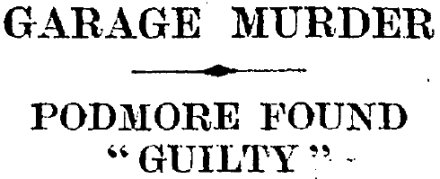
The “Blog” of “Unnecessary” Quotation Marks agrees. (Headline from London Times, March 10, 1930)

Evidence that fit “like a crossword puzzle” (in the summing-up of the state’s attorney) nevertheless did not amount to anything so ironclad that Podmore wanted for public support: in the couple of weeks between a rejected appeal and Podmore’s execution, 12,000 people signed a petition for his reprieve, including 79 Members of Parliament.**

(Those crossword forensic clues had been buttressed by that classic recourse of the prosecutor, dubious jailhouse-snitch testimony as to the convenient spontaneous confession of the accused allegedly delivered to perfect strangers in the most injurious possible situation: that such specious evidence might have proved decisive in a matter of life and death seems to have moved a lot of signatures to the clemency petition.)

Given the circumstances, the Home Secretary took the unusual step of issuing a statement on its denial of this measure to calm the “disquiet in the public mind” — and expressing his confidence beyond any “scintilla of doubt as to the prisoner’s guilt.”†

* C. Ainsworth Mitchell, “Scientific Documentary Evidence in Criminal Trials,” Journal of Criminal Law and Criminology Vol. 23, No. 2 (July-August, 1932)

** London Times, April 16, 1930

London Times, April 21, 1930. “I searched for many days,” Secretary Clynes said after the hanging (Times, April 23, 1930), “in the hope that I would find a reason for recommending a reprieve. I searched in vain.”

On this day..