May of 1297 marks the first appearance in the historical record of Braveheart hero William Wallace … so we mark today the undated (and presumably fictional) execution/murder of his wife that, by the most cinematic account possible, set Wallace on his own path to the scaffold.
The face that lifted a thousand claymores: Catherine McCormack as Braveheart‘s version of Marion, Murron MacClannough. Murron’s “execution” inspires William Wallace.
Marion (or Marian) Braidfute, she’s called by the Scottish poet Blind Harry in the epic dating near two centuries after famed rebel’s rising. Not wanting audiences to confuse her with Robin Hood sweetie Maid Marian, the Braveheart script renamed her Murron MacClannough.
In Mel Gibson’s gory silver screen epic, Wallace is, at this point, a determinedly apolitical commoner — a stance contrasting markedly with a backstory of nationalistic identity-forming experiences, like having his father and brother killed by the English. He’s radicalized only after his attempt to protect Murron from rape results in her demonstrative summary execution.
And of course, Wallace then wreaks a bloody revenge (complete with summary execution of his own) that soon has the country in flames.
Hollywood’s avenging-his-woman angle exploits a folkloric embroidery of a female character perhaps created by Blind Harry, writing in the 15th century. In “The Wallace”, the titular hero is already well along his conflict with the English crown when he weds Marion — whose story arc differs greatly from that of the peasant eye candy Mel Gibson taps. In the poem, Marion is exposed to the vengeance of the Sheriff of Lanark, William Heselrig, when Wallace goes off to fight and refuses to take her along.
Now fierce with Rage the cruel Foe draws near,
Oh does not Heaven make Innocence its Care!
Where fled thy guardian Angel in that Hour
And left his Charge to the fell Tyrant’s Power,
Shall his fierce Steel be redned with thy Gore
And streaming Blood distain thy Beauties o’er?
But now awaken’d with the dreadfull Sound
The trembling Matron threw her Eyes around,
In vain alace were all the Tears she shed
When fierce he waves the Fauchion o’er her Head
All Tyes of Honour by the Rogue abjur’d
Relentless deep he plung’d the ruthless Sword;
Swift o’er her Limbs does creeping Coldness rise
And Death’s pale Hand seal’d up her fainting Eyes.
Wallace slays Heselrig the next day, according to the poem — the actual historical event of May, 1297,* that marks Wallace’s emergence from the dim fogs of history. (In the film Braveheart, the chronology is unstated, but Wallace is revenged before Murron’s burial.)
The same year William Wallace lifted up his head from his den — as it were — and slew the English sheriff of Lanark, a doughty and powerful man, in the town of Lanark. From that time, therefore, there flocked to him all who were in bitterness of spirit, and weighed down beneath the burden of bondage under the unbearable domination of English despotism; and he became their leader. He was wondrously brave and bold, of goodly mien, and boundless liberality … So Wallace overthrew the English on all sides; and gaining strength daily, he, in a short time, by force, and by dint of his prowess, brought all the magnates of Scotland under his sway, whether they would or not.
* “In the month of May the perfidious race of Scots began to rebel.” (Walter of Hemingborough)
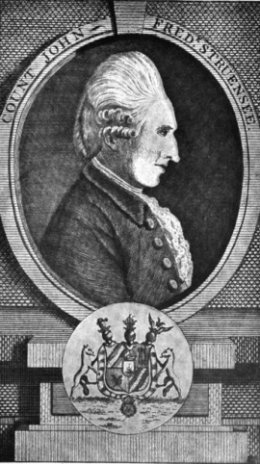
The 1700s were a time of radical reform, and as the Enlightenment reached the shores of Denmark, it suddenly became possible to be a professed atheist and not lose your head. That is, of course, as long as you didn’t also try to usurp the crown, undermine the aristocracy, and agitate the commoners while you were at it.
Such was the course that ended the rise of Johann Friedrich Struensee on this date in 1772. His friend and sometime cohort Enevold Brandt (Danish Wikipedia entry) was put on the block on the same day.
Struensee was born in 1738 in present day Germany and educated in Prussia, a doctor by trade and a budding Enlightenment political writer by practice. He seemed an unlikely character to involve himself in the court of King Christian VII of both Denmark and Norway, but Struensee was a vain and social man who managed to befriend the right people at the right time.
The first was Brandt. The second was Count Schack Karl Rantzau. A lawyer and Supreme Court justice, Brandt was a court favorite* and planted Struensee’s name as a capable doctor: young, kind, and competent, he would make a perfect personal physician for a king known for being a bit off: Christian was likely schizophrenic. Rantzau, meanwhile, was Count of the Holy Roman Empire, exiled from Copenhagen some 15 years before he met young Struensee, and eager to get back into politics.
In June 1768, Struensee took a post as the king’s traveling physician in England, and he immediately attached to Christian’s loneliness. The regent was interested in literature, philosophy, and music, and Struensee obliged him with patient regard for his charge, for which he was duly rewarded with access to a social life much more fulfilling than in Prussia. As a traveling physician, though, Struensee’s post had a finite span, and he lobbied hard to become a member of the Danish court.
With some help from others in the king’s court, Struensee managed to retain a permanent post, and his clamber up the nearest cliff to power began.
The young doctor, it seems, had a talent for playing two sides for personal gain. It started with the king, who had immense trust in Struensee and began to confide almost everything. Struensee was tactful with this information, adhering to an early form of patient-doctor privilege that endeared him to Christian. The other side was Queen Mathilde, Princess of Wales, by all accounts a beautiful woman who was not happy in Denmark and even less happy to be married to a mad and deteriorating king.
Mathilde initially disliked Struensee — or, at the very least, was indifferent to his actions. But near the end of 1769, the queen finally admitted Struensee into her chambers, and their relationship took off. He ably gamed Mathilde by convincing her that she was the kingdom’s future; Christian, meanwhile, remained ill, and Struensee remained a steady presence in his life. Come spring, Crown Prince Frederick VI also came under Struensee’s care, and as smallpox ravaged Copenhagen, the doctor pressed for inoculation. The king and queen assented, Frederick survived the epidemic, and Struensee garnered himself an official advisorship. It’s also suspected that, while Struensee and Mathilde watched over Frederick as he recovered from the inoculation,** their love affair began.
With a taste of power, Struensee pressed King Christian VII for cabinet changes — which he got — and was named Privy Councilor before 1770 was out. Now the principal advisor to the king, Struensee was able to advance his Enlightenment agenda, notably freedom of the press, the abolition of torture, limiting the death penalty, changing the rules of appointments, numbering the houses in Copenhagen, lighting the streets, and, perhaps in anticipation, removing penalties against those who produced illegitimate children. He was a bold visionary, but he also intoxicated by his growing power … and his programme obviously gored many an ox.
Struensee ascended still further early in 1771 when the king became practically unfit to rule. He was mentally faltering, and Struensee was all but running the show, and more.
In early July, the queen gave birth to a daughter who was widely assumed to be Struensee’s child. Days later, and just three years after being introduced to King Christian VII, Johann Friedrich Struensee effectively appointed himself Privy Cabinet Minister with dictatorial authority through one of King Christian’s edicts. Struensee’s orders would now have the force of law, and, as Christian’s proclamation noted, “They shall be immediately obeyed.”
Enevold Brandt (top), not to be confused with Brandt, the Big Lebowski lackey (bottom).
Struensee spent the next six months turning the European aristocracy inside-out and foisting an aggressive set of cabinet orders on the Danish people — over 1,000, by some counts. Having ridden on the coattails of a queen and king, he now pushed them aside. He moved the court to Schleswig-Holstein, in Prussia, and pleasingly enjoyed both the prerogatives of aristocracy and a middle class contempt for them.
Struensee was, to say the least, not a favorite abroad;† that he and his friends dominated the king and queen did not sit well with Danish commoners. Even Brandt was becoming disaffected, writing in a letter asking for either a larger salary or a resignation from the court:
No despot ever arrogated such power as yourself, or exercised it in such a way. The King’s pages and domestics tremble at the slightest occurrence: all are seized with terror. They talk, they eat, they drink, but they tremble as they do so. Fear has seized on all who surround the minister, even on the Queen…
But Brandt stayed on, and as 1771 drew to a close, Copenhagen became hostile territory for the royal family and their favorite doctor.
After the season’s first masquarade ball, on 16 January 1772, the Queen Dowager — Christian’s step-mother — Juliana Marie exposed Struensee’s affair and had Struensee, Brandt, the queen,‡ and many other Struensee accomplices arrested, ostensibly by order of the king.
Struensee was charged with lèse-majesté, a crime against the crown, for his affair with the queen; though he initially denied the charges — and though Mathilde did her best to shield him from harm — he was found guilty. Brandt was charged with the same crime for allegedly assaulting the king after being himself threatened with a flogging for impertinence (he even had a nip at Christian’s finger). Brandt’s punishment was the same. Each had his right hand chopped off, then was beheaded, drawn, and quatertered.
The queen, meanwhile, went into exile in France. Juliana Marie effectively ruled the kingdom through her son for over a decade, rolling back many of Struensee’s reforms and reverting power back to the aristocracy. This also turned out to be unpopular (the Danes and Norwegians are fickle people), and Mathilde’s son Frederick VI was able to regain power for his father in 1784, eventually moving to liberal reforms more in line with his erstwhile physician’s ideals.
Struensee’s epic rise and fall have spawned a variety of writings since his death. A memoir appeared just months after his execution which detailed his final months. He was also the subject of the Per Olov Enquist novel The Royal Physician’s Visit, which examines his life from multiple perspectives. Queen Mathilde’s life was put to ballet by Peter Maxwell Davies. And for a more contemporary cultural artifact, there’s the 2012 film A Royal Affair.
* Brandt was a court favorite, but after attempting to destroy the position of another minister, he was briefly expelled from Copenhagen, shortly after Struensee accepted his post.
** These inoculations predated “safe” inoculations by non-fatal, related disease strains such as cowpox. Frederick would have been made ill through the small pox strain Variola Minor, which had a mortality rate of about 1%. By contrast, Variola Major was fatal in about 30% of cases.
† While Struensee seems to have been book smart, his feel for international politics was limited, and his standing abroad would have unraveled had it ever raveled in the first place. He repeatedly upset the Russians, and Mathilde’s relatives were not pleased with him. Had he not been downed by public sentiment, it seems likely he would have fallen victim to one of his many royal detractors abroad.
‡ In a curious twist, Rantzau was the queen’s arrestor, and one of the principal conspirators in the dowager’s plot was a cabinet minister Struensee was responsible for ejecting very early in his career.
As of this date, it’s been 48 years since the United States military last carried out an execution — the Fort Leavenworth hanging* of John Arthur Bennett for rape.
An epileptic black soldier with a family history of mental illness, Bennett had enlisted to find a way up out of sharecropping. Instead, on Christmas Eve 1954, he drunkenly raped a 12-year-old girl near his base in Austria.
He spent six years awaiting execution — “six years,” observed the Los Angeles Times, “in which six other black soldiers were hanged while all four of the white men — many of them multiple murderers — were saved.”
Bennett dodged two execution dates, once receiving his stay during his last meal, but a seemingly compelling plea for clemency — the victim herself, and her parents, asked for mercy — availed Bennett nothing. His last frantic plea to the new president, John F. Kennedy, was dispatched with only hours yet to live.
I beg in the name of God … Will you please in the name of God and mercy spare my life?”
Coincidentally, but poignantly for this case, the Kirk Douglas vehicle A Town Without Pity opened a month before Bennett’s execution. In that film (trailer here), four American servicemen face capital trial for the rape of a German girl — and Douglas, as their lawyer, struggles to talk pity into someone so he won’t be obliged to humiliate the victim in court in order to save his clients from the noose.
The victim’s father in that movie is so blinded by his lust for vengeance that he forces Douglas to destroy his own daughter: striking contrast with the real-life father of Bennett’s flesh-and-blood victim, who wrote in support of clemency for his daughter’s assailant, “I know how hard it is for the parents when their own child is so close to the verge of death.”
Bennett’s milestone, however, is hardly assured of lasting much beyond this 49th year.
In 2008, President George W. Bush affirmed the death sentence of condemned Army cook Ronald Gray, the first such action by any U.S. president since Bennett’s day. According to the NAACP Legal Defense Fund’s Death Row USA most current as of this writing,** Gray is one of nine prisoners currently on the U.S. military’s death row.
* Curious to know about the procedure? The Library of Congress has that period’s Procedure for Military Executions — complete with exact diagrams — online in pdf form.
On this date in 1836, Mexican forces commanded by President Antonio Lopez de Santa Anna overran the Alamo — and executed those few of its defenders who survived the day’s battle.
That Alamo of blood and legend, and the countervailing interpretations it eclipses, are much beyond our scope here, but we are attracted to notice the reputed summary execution of five to seven defenders who had surrendered or otherwise been captured during the fight. (A few dozen mostly civilian noncombatants in the former mission also survived, and were not executed.)
“foreigners landing on the coast of the Republic or invading its territory by land, armed, and with the intent of attacking our country, will be deemed pirates.”
Who counted, at this moment, as “foreigners” among the Anglo settlers trying to break away from Mexico and their supporters among from the United States to which Texas would eventually attach poses a historiographical riddle. But then, Santa Anna wasn’t there to write a dissertation, but to win a war — and he was said to be sorely annoyed at the defenders having tied him down for a week and a half.
King of the Wild Frontier
Covered by most any definition of “foreigner” would have been the Alamo’s most famous defender, Tennessee frontiersman and former U.S. Congressman Davy Crockett. He had arrived in Texas just a few months before, on a rendezvous with destiny.*
It’s a matter of dispute whether Crockett was among those last few executed; in an event this emotionally remembered, every version of the Crockett death scene — from “found dead of injuries amid a heap of Mexican casualties” to “cravenly bargained for his life” — gores someone’s ox.
Even if the account of Crockett’s presence among the executed derives from a disputed source — well, this blog has not scrupled to highlight the fictional and the mythological, those executions whose resonance transcends factual accuracy.
And even if Davy Crockett was not among those anonymous souls put to death this day, it is by his name that they have their tribute, as in the 2004 film** The Alamo:
** This Disney film diddles with the Crockett legend that Disney helped to inflate in the 1950’s — to the annoyance, of course, of traditional-minded Alamo partisans.
“Ruthless Ruth,” as the press inevitably called her, was on the wrong side of 30 and married to a wet blanket on the wrong side of 40 from whom she couldn’t even get away during the day because they worked for the same boating magazine.
The banal hell of the bourgeoisie.
Ruth had a banal solution: commence affair with handsome, limp-willed corset salesman (also married) from New Jersey.
Given a large enough metropolis with a large enough pool of adulterous data points, it must be statistically inexorable that a certain proportion will resolve the love triangle by throttling the cuckold with a wire.
But only that remorseless calculator in the sky can compute why these two, of all those thousands, were the ones not to run off together, or let the affair fizzle, or just continue to rendezvous indefinitely into the future. They certainly weren’t constitutionally cut out for crime; they set up the room in a poor simulacrum of a robbery, and told of a couple of unknown Italians* who’d broke in and done poor Albert Snyder to death.
For their poor judgment and for the speedy collapse of their crummy alibi, journalism owes them a debt of gratitude.
The execution of a woman was quite sensational; Ruth Snyder was to be the first electrocuted since 1899.
For the occasion, The New York Daily News hired a Chicago Tribune journalist to witness the execution … and at the moment the current struck, Tom Howard hoisted his pant leg and secretly snapped with a one-use camera one of the most indelible images the death chamber offered the 20th century, to be splashed in a few hours’ time on the Daily News‘ cover under the headline
DEAD!
The Snyder-Gray adulterous melodrama and its violent conclusion inspired novelist James Cain‘s Double Indemnity, and the noir film of the same title with Barbara Stanwyck as the black widow at the center of the web.
It also inspired the state of New York to begin searching official witnesses to its electrocutions.
* Blame-the-Italians here is a Roaring Twenties Queens version of fingering the black man. The murder was committed in May 1927, just as the Sacco and Vanzetti case was approaching its climax.
On this date in 1878, John “Black Jack” Kehoe was hanged in Pottsville — as Pennsylvania’s anthracite trusts took a victory lap around the corpses of the Molly Maguires.
Even to say what the Mollies were is to take a side in their life-and-death struggle. Irish immigrants fleeing the potato famine had poured into Pennsylvania’s coal mining country in the mid-19th century, where life in the mines was nasty, brutish and short, and the pay wasn’t anything to write home about either.
In a time when capital ruthlessly hunted any intimation of labor organizing and the Irish were a distinctly second-class people, the (apparent, or at least alleged) response of the Mollies was natural: form a secret society, and wring by threat of bodily harm the concessions it could not pursue by collective bargaining. For the recent Irish transplants, the tableau of a Catholic underclass working for a Protestant landlord who owned (and gouged on) everything in sight had a certain familiar feel.
Terrorists? They certainly used violence to achieve political objectives, at least if the testimony of their foes is credited. But they weren’t the only ones.
Mine owners turned public and private violence on Irish radicals pushing for things like the eight-hour day. The notorious strike-breaking Pinkerton Detective Agency was detailed to infiltrate the Mollies.
The main blow against the Mollies was struck over a period of (extrajudicial) vigilante justice in the mid-1870’s, culminating in “Pennsylvania’s Day of the Rope” in 1877, when ten supposed members were (judicially) hanged around the Keystone State.
Kehoe, a power broker in mining country with some sway at the capital who was reputed to call the shots among the Maguires, faced the hangman singly a year later for an 1862 cold-case murder so doubtfully ascribed to Kehoe that the governor hesitated to sign the death warrant.
He signed it just the same, marking a sort of ceremonial “end to Molly-ism.” The New York Timesexulted two days hence “that the widely-extended and long-continued tyranny and terror of this association is at an end,” and all because the resolute executive had gone and sent a hempen message to “the savage and benighted population of the coal region.”
The lesson taught by the punishment of the Molly Maguires would have been shorn of much of its terror and impressiveness if the energetic and persistent efforts made in behalf of KEHOE, the reputed king of that organization, had resulted in rescuing him from the gallows. If they had even so far succeeded as to have caused his punishment to be commuted to imprisonment for life, the admonitory influence of his fate upon the murderous clain of whom he was the last surviving chief would have been greatly lessened, and the snake of Molly Maguire-ism, of which he was the forked tongue and fangs, might haply have been only scotched, not killed. … The law has shown that it has subtlety enough to hunt [the Molly Maguires] through every possible labyrinth of refuge and strip from them every artifice of disguise, and power enough to wring them out of the desperate grasp of sympathizing constituencies and crush them.
Florid.
Like we said, violence wasn’t the exclusive resort of one side. But the monopoly of violence … that was held, as always, by the same hands that held the monopolies. Sean Connery as Kehoe reflects on the uneven contest while awaiting his fate in a (fictional) exchange with the Pinkerton mole who condemned him from the 1970 film The Molly Maguires.*
Pennsylvania Gov. John Hartranft left office a few weeks later, and reflected in his outgoing address on the lessons “the manufacturers and operators” ought to draw from the late unpleasantness.
The Mollie Maguire murders, like the agrarian murders in Ireland, and the trades-union outrages, arsons, and machine-breakings in England, were not the work of the so-called criminal classes. They were essentially class murders … If some of the leading spirits of the class had been members of a board of arbitration as representatives of labor, with some of the employers or their agents as representatives of capital, it is not unreasonable to suppose that most of the disagreements that have kept the coal regions in a state of turmoil might have been amicably adjusted, and many of those who were assassinated and of those who have been hanged living to-day.
101 years later, Kehoe received what was thought to be the first and only posthumous pardon in the state’s history. The Mollies’ true extent, purpose and actual actions — even their very existence as anything but a stalking-horse for the more thorough conquest of surplus labor — remain hotly debated to this day, since the public record of this tight-lipped society consists of little beyond the courtroom testimony of a handful of parties thoroughly prejudiced to hostility by class interest or payoffs.
* Written by Walter Bernstein, who had only recently emerged from the Hollywood blacklist for his Communist proclivities.
On this date in 1943, pacifist novelist Erich Maria Remarque lost his youngest sister to the Nazi regime — beheaded because her “brother is beyond our reach.”
Actually, Elfriede Scholz was convicted (upon the denunciation of her landlady a few weeks before) by the kangaroo People’s Court for undermining the war effort. (“Wehrkraftzersetzung” — German has a word for everything.)
Like her brother, Elfriede was a staunch opponent of the Nazi government, and in 1943 that could certainly have sufficed to get her a one-way trip to Plotzensee Prison.
But Roland Freisler‘s verdict explicitly referenced (German link) her more famous brother — upon whom the Nazis would have poured out an interwar era’s worth of fury had they been able to get to him in America.
Ihr Bruder ist uns entwischt, aber Sie werden uns nicht entwischen! (Your brother is beyond our reach, but you will not escape us!
Remarque’s immortal anti-war novel All Quiet on the Western Front was banned and burned by war-glorifying Nazis (they also said Remarque was of Jewish descent, apparently without any factual basis).
Erna, Elfriede and Erich Remark — the author later restored an ancestral spelling of his name that had been Germanized in the 19th century — in happier times.
Remarque left Germany, an intellectual celebrity and man-about-town who rubbed shoulders with the likes of Marlene Dietrich (with whom he had a passionate affair) and Ernest Hemingway (with whom he did not).
The Nazis stripped his citizenship, and fumed that they couldn’t get their jackboots on him. (At one point, Goebbels invited Remarque to return. Sly.)
But Elfriede, they could get. She had stayed in her native Germany with her husband and family.
Not content with taking her head off, Berlin added a particularly vicious twist by billing the expatriate author 90 marks for the executioner’s trouble.
The author never said or wrote much about Elfriede, even his diaries. But years later, Erich Remarque dedicated his novel about life in a concentration camp, Spark of Life, to his late sister. Today, there’s a street named for Elfriede in the Remarques’ native Osnabruck.
Though not literally the Isles’ last hangman, Pierrepoint is the last one everyone thinks of, the man who defined the hangman’s job for the 20th century.
Discreet, orderly, and as quiet as he was efficient,* he was the brand-name executioner for stiff-upper-lip England of the waning empire, with over 400** hangings to his name from 1932 until he resigned over a fee dispute in 1956.
Despite his proper avoidance of the spotlight, Pierrepoint’s excellence at his craft would make him a celebrity — especially after the press fixated on his role hanging Nazi war criminals after World War II. The ready-made morality play upon the scaffold boards could hardly be resisted: the English grocer, meting out a dignified and precise measure of justice to the likes of the Beast of Belsen.
Hanging Around
Pierrepoint’s characteristic client wasn’t a war criminal, but a humdrum British murderer, only a handful of which attract especial remembrance today.
Still, in the immediate postwar years, the growing reach of the mass media and burgeoning public controversy over the death penalty would frequently put Pierrepoint in the middle of the era’s highest-profile hangings, including:
Like as not, this day’s affair hit the sturdy hangman harder than any of those.
James Henry Corbitt was a regular at “Help the Poor Struggler”, the piquantly named Oldham pub Pierrepoint bought and managed after World War II. Known as “Tish” to Pierrepont’s “Tosh,” the two had sung a duet of “Danny Boy” on the night that Corbitt went out and murdered his girlfriend in a jealous rage.
Corbitt was not exceptional as a criminal, and he was indisputably guilty; we wouldn’t notice him if not for his acquaintance with the man who put him to death.
But Pierrepoint would remember this one well, as he later wrote in his his autobiography:
I thought if any man had a deterrent to murder poised before him, it was this troubadour whom I called Tish. He was not only aware of the rope, he had the man who handled it beside him singing a duet. The deterrent did not work.
Remarkably, the most prolific executioner in British history had come out against the death penalty, or so it seemed. (He later backed away from a strong anti-death penalty position, though without retracting his original reservations. The death penalty had been a decade off the books by this point, in any case.)
It is I who have faced them last, young lads and girls, working men and grandmothers.
I have been amazed to see the courage with which they walk into the unknown.
It did not deter them then and it had not deterred them when they committed what they were convicted for. All the men and women I have faced at that final moment convince me that in what I have done I have not prevented a single murder. And if death does not work to deter one person, it should not be held to deter any … capital punishment, in my view, achieved nothing except revenge.
It’s an open question how much Tish’s hanging this day really contributed to Pierrepoint’s retirement six years later or his apparent change of stance on his trade. But it provides the gut-wrenching dramatic pivot for the film Pierrepoint: The Last Hangman.
Interestingly, while the hangman saw in Corbitt’s fate a troubling indictment of the death penalty, the hanged man’s son to this day still says dad deserved to die.
More on Albert Pierrepoint
For a man so ubiquitously present in the mid-century experience of Great Britain, and who undertook such a dramatic volte-face, it’s no surprise that Pierrepoint has attracted plenty of attention — including this website, and a number of books.
* The English practice was for Pierrepoint to pinion the prisoner’s arms in the condemned cell, escort him a few steps into a hanging chamber, hood him, and execute the sentence without further ceremony. The whole process took mere seconds — a record fast seven seconds from cell door to trap door in the case of James Inglis — which Pierrepoint seems to have had a gift for dignifying in his (usual) silence with a sort of calming paternal assurance.
Pierrepoint hanged six American soldiers under the auspices of U.S. military forces deployed to England during the Second World War, and confessed to considerable discomfort with that entity’s protracted pre-hanging procedures that had him standing on the scaffold with the condemned man for several minutes.
* And perhaps well over 600 hangings; the figures are disputed.
On this date in 2001, former pop singer and shaman Mona Fandey was hanged with two accomplices at Kajang Prison outside Kuala Lumpur, closing the noose on one of the world’s weirdest and most sensational recent crimes.
Aging B-list pop crooner Maznah Ismail — “Mona Fandey” was her stage name — had transitioned to a gig as a high-rent spiritualist and healer, known locally as a bomoh.
In that capacity, she and hubby Mohd Affandi Abdul Rahman landed a politician with more money than sense. After collecting a bunch of cash from him, they got him to lie down with his eyes closed as part of a ritual that was supposed to make money fall from the skies. Instead, the couple’s assistant Juraimi Hussin chopped off his head, and Mona went on a shopping spree.
The effect of the grisly celebrity murder was heightened by Mona’s cheery demeanor throughout the trial and thereafter, as if a murderess’ notoriety was the pinnacle she never achieved as an entertainer.
She and her husband maintained an unsettling placidity about their demise to the very end. Some sources say she uttered the mysterious remark, “I will never die” just before her hanging. (Others have everyone silent.)
The end of the three killers was hardly the end of such a headline-grabbing case in the public memory. Her cell is becoming a protected “heritage site”, and her story has been treated on screens both small and silver.
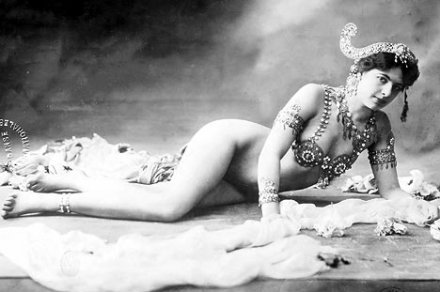
At 5 a.m. this date in 1917, Margaretha Geertruida Zelle — better known as Mata Hari — was awoken at Saint-Lazare Prison to news that it was her last day on earth.
She died in a muddy drill field outside Paris, facing a firing squad as she had lived: self-possessed, mysterious, her eyes (she refused a blindfold) open.
For the oldest profession, it may be there is nothing truly original, nothing new under the sun. But Mata Hari — thanks in no small part to her genuinely fatale end — redefined it for the dawning age of mass visual media and tapped the power of sexual allure for a commercial century.
She was already pushing 30 when she got into the exotic dance game, with a failed May-December marriage behind her from what a wag might call her first sexual bargain, to get out from under the thumb of her family and see the world. In Paris in the belle epoque, there were assuredly dancers younger, prettier. Margaretha, who here debuted the show name by which history would know here, surpassed them with showmanship.
She exploited her exotic olive-toned looks — there were rumors of Javanese or Jewish blood even in her childhood — and claimed to be an Indian princess; her talent for repackaging oriental exoticism with just the right amount of otherness combined with her willingness to push boundaries of eroticism made her an instant sensation. Naturally gregarious and unprudish, she segued into the courtesan biz on the side with dashing officers and wealthy industrialists.
Not bad for a thirty-something mother of two.
She comes at the start of our own era: sensual postcards and posed photos of Mata Hari were at once her pitch and her product; celluloid was just coming online, and 14 years after her death, she’d be portrayed by silver screen femme fatale Greta Garbo:
That’s her with the last object of her affections, a Russian aviator young enough to be her son, and a reminder that the birth of Greta Garbo’s era was also the death of Mata Hari’s own.
She was aging, for one thing. For another, of course, war shattered Europe. Famous, decadent, polyglot … those things that had been her passport suddenly became her liabilities. Globetrotting travel? Payoffs from a multinational cast of officers for her companionship?
There’s no take here on whether she was really, as convicted, a German spy of any variety at all — she seems to have been approached, to have tried her hand clumsily or to have been set up by either French or German intelligence, or simply to have behaved indiscreetly. Once she was caught up against events, her maneating reputation did her no favors.
Spying, she was terrible at. Commanding men’s attention? As a British correspondent reported, Margaretha Zelle owned her role to the very last.
The first intimation she received that her plea had been denied was when she was led at daybreak from her cell in the Saint-Lazare prison to a waiting automobile and then rushed to the barracks where the firing squad awaited her.
Never once had the iron will of the beautiful woman failed her. Father Arbaux, accompanied by two sisters of charity, Captain Bouchardon, and Maitre Clunet, her lawyer, entered her cell, where she was still sleeping – a calm, untroubled sleep, it was remarked by the turnkeys and trusties.
The sisters gently shook her. She arose and was told that her hour had come.
‘May I write two letters?’ was all she asked.
Consent was given immediately by Captain Bouchardon, and pen, ink, paper, and envelopes were given to her.
She seated herself at the edge of the bed and wrote the letters with feverish haste. She handed them over to the custody of her lawyer.
Then she drew on her stockings, black, silken, filmy things, grotesque in the circumstances. She placed her high-heeled slippers on her feet and tied the silken ribbons over her insteps.
She arose and took the long black velvet cloak, edged around the bottom with fur and with a huge square fur collar hanging down the back, from a hook over the head of her bed. She placed this cloak over the heavy silk kimono which she had been wearing over her nightdress.
Her wealth of black hair was still coiled about her head in braids. She put on a large, flapping black felt hat with a black silk ribbon and bow. Slowly and indifferently, it seemed, she pulled on a pair of black kid gloves. Then she said calmly:
‘I am ready.’
The party slowly filed out of her cell to the waiting automobile.
The car sped through the heart of the sleeping city. It was scarcely half-past five in the morning and the sun was not yet fully up.
Clear across Paris the car whirled to the Caserne de Vincennes, the barracks of the old fort which the Germans stormed in 1870.
The troops were already drawn up for the execution. The twelve Zouaves, forming the firing squad, stood in line, their rifles at ease. A subofficer stood behind them, sword drawn.
The automobile stopped, and the party descended, Mata Hari last. The party walked straight to the spot, where a little hummock of earth reared itself seven or eight feet high and afforded a background for such bullets as might miss the human target.
As Father Arbaux spoke with the condemned woman, a French officer approached, carrying a white cloth.
‘The blindfold,’ he whispered to the nuns who stood there and handed it to them.
‘Must I wear that?’ asked Mata Hari, turning to her lawyer, as her eyes glimpsed the blindfold.
Maitre Clunet turned interrogatively to the French officer.
‘If Madame prefers not, it makes no difference,’ replied the officer, hurriedly turning away. .
Mata Hari was not bound and she was not blindfolded. She stood gazing steadfastly at her executioners, when the priest, the nuns, and her lawyer stepped away from her.*
The officer in command of the firing squad, who had been watching his men like a hawk that none might examine his rifle and try to find out whether he was destined to fire the blank cartridge which was in the breech of one rifle, seemed relieved that the business would soon be over.
A sharp, crackling command and the file of twelve men assumed rigid positions at attention. Another command, and their rifles were at their shoulders; each man gazed down his barrel at the breast of the women which was the target.
She did not move a muscle.
The underofficer in charge had moved to a position where from the corners of their eyes they could see him. His sword was extended in the air.
It dropped. The sun – by this time up – flashed on the burnished blade as it described an arc in falling. Simultaneously the sound of the volley rang out. Flame and a tiny puff of greyish smoke issued from the muzzle of each rifle. Automatically the men dropped their arms.
At the report Mata Hari fell. She did not die as actors and moving picture stars would have us believe that people die when they are shot. She did not throw up her hands nor did she plunge straight forward or straight back.
Instead she seemed to collapse. Slowly, inertly, she settled to her knees, her head up always, and without the slightest change of expression on her face. For the fraction of a second it seemed she tottered there, on her knees, gazing directly at those who had taken her life. Then she fell backward, bending at the waist, with her legs doubled up beneath her. She lay prone, motionless, with her face turned towards the sky.
A non-commissioned officer, who accompanied a lieutenant, drew his revolver from the big, black holster strapped about his waist. Bending over, he placed the muzzle of the revolver almost – but not quite – against the left temple of the spy. He pulled the trigger, and the bullet tore into the brain of the woman.
Mata Hari was surely dead.
* Inevitably, a story got around that she’d opened her funereal coat to the firing squad, revealing no clothing beneath it.


 Such was the course that ended the rise of


 The main blow against the Mollies was struck over a period of (extrajudicial) vigilante justice in the mid-1870’s, culminating in “Pennsylvania’s Day of the Rope” in 1877, when ten supposed members were (judicially) hanged around the Keystone State.
 Actually, Elfriede Scholz was convicted (upon the denunciation of her landlady a few weeks before) by the kangaroo People’s Court for undermining the war effort. (“Wehrkraftzersetzung” — German has a word for everything.)

 Aging B-list pop crooner Maznah Ismail —