On this date in 1792, Jacques Cazotte, a writer distinctly out of step with his times, was guillotined for treason in Paris.
The Martinique-born Cazotte (English Wikipedia entry | French) was into his 40s when he launched the writing career that earns him notice enough for this blog.
He wasn’t a liberte, egalite, fraternite kind of guy: Cazotte’s works, like Le Diable Amoureux (The Devil in Love),* were fantastical, Gothic — far from the rationalist fare of the Enlightenment.
And that wasn’t exclusively a literary posture.
Cazotte fancied himself gifted with prophecy — enthusiasts’ accounts have him prophesying the course of the Revolution — and preferred the mystical enlightenment of the illuminati to the Voltairean kind.** He viewed the onset of the French Revolution with horror.
When some scribblings to that effect were discovered in his papers, the mystical goose was cooked. The French Wikipedia entry credits his daughter with saving his life during the September Massacres … buying the 72-year-old only a few weeks of life.
Cazotte’s Le Diable Amoureux has the devil as a young man’s servant girl, endeavoring to seduce him. Here is Cesare Pugni‘s balletic rendition, Satanella, with its grand pas de deux, “Le Carnaval de Venise”:
Cazotte finds his way to us, as the dark arts are wont to do, through more meandering channels as well.
Le Diable Amoureux inspired supernatural mystery The Club Dumas by Spanish author Arturo Perez-Reverte. That novel in turn was riffed by Roman Polanski for the weird 1999 flick The Ninth Gate (review), starring Johnny Depp. (Cazotte’s book is explicitly referenced in both its progeny.)
Although only tangentially related, this digression into the occult gives us leave to notice one of the many cultural ephemera of executions linked to no particularly blog-friendly date. The Club Dumas and The Ninth Gate make use of striking woodcuts of modern vintage but after a style of centuries past that help unlock the central puzzle.
Charged with esoterica, the topical-looking “hanged man” print comes clearly modeled after its tarot cousin … although the tarot version, in most instances, is hoped to be of less deadly effect upon the plot.
On this date in 1560, a French peasant was hanged outside the home he had made with another man’s wife in the southwestern French village of Artigat (or Artigues).
A poignant, perplexing tale of identity and social place — and possibly even of love — the story of Martin Guerre is at once exactingly local to its time and place, and timeless in its principals’ humanity.
As told in Natalie Zemon Davis’ captivating social history The Return of Martin Guerre, the restless (or ill-tempered) young titular peasant — impotent with his wife Bertrande, tense living with his father-in-law, chafing in rural Artigat — got out of town in 1548, joined one of the soldiering companies crisscrossing Europe, and was heard of no more.
In the centuries before fingerprints, credit cards, cell phones and Facebook, Guerre just disappeared. Constrained by Catholic law not to remarry without proof of his death, Bertrande just had to wait.
Until “Martin” returned in 1556 simply by reappearing at Artigat — moved in with Bertrande — resumed the vanished man’s name and with it his place in the village. There were suspicions from the first that he wasn’t quite right … but this man had Martin’s stories, and the villagers didn’t have so much as a photograph to test him against.
Martin was accepted in Artigat for three-plus years, fathered two children with Bertrande, and managed the estate as head of household. In Davis’s telling, he appears much the better husband and father than the pre-1548 version, and this bolsters her case that Bertrande must have been complicit in the fraud that unraveled in 1560.
Property and inheritance conflicts with Martin Guerre’s uncle (now married to Bertrande’s widowed mother) brought to the courts the novel case: was this man really Martin Guerre?
The inconclusive tools for establishing identity and a deft defense by “Martin” must have made for a riveting legal drama (French link) — with villagers taking up competing sides and the man put to the test of his memory of Martin’s life, which he impressively aced. So thoroughly did the man command the role that
the gesture, deportment, air, and mode of speaking of the prisoner were cool, consistent, and steady; while those who appeared in the cause of truth were embarrassed, hesitating, confused, and on certain points contradictory in their evidence. (Source)
On the point, perhaps, of acquittal, the case was resolved like any legal potboiler should be: with the dramatic reappearance of the real Martin — for so all the conflicting witnesses quickly agreed him to be, and so confessed the imposter husband, Arnaud du Tilh (or Arnaud du Tilb), a peasant from a nearby village also nicknamed “Pansette”. A onetime army buddy of Guerre’s, the enterprising du Tilh had been mistaken for Guerre, and had pieced together enough of the absconded husband’s life that by dint of total recall and superhuman audacity, he made for his own the place in the world that Martin Guerre disdained.
The sentence of the court was that Martin Arnaud
make amende honorable in the marketplace of Artigat, in his shirt, his head and feet being bare, a halter about his neck, and holding in his hands a lighted torch; to beg pardon of God, the king, and the justice of the nation; of the said Martin Guerre, and de Rols his wife; and this being done, the said du Tilh shall be delivered into the hands of the executioner, who after making him pass through the streets, and other public places in the said town of Artigat, with a rope about his neck, at last shall bring him before the house of the said Martin Guerre, where, on a gallows set up for that purpose, he shall be hanged and strangled, and afterwards his body shall be burnt. (Source of the translation, slightly tidied up based on the French version here)
Arnaud du Tilh, and Martin Guerre with him, passed thereupon into the historical memory, for in assigning names to bodies, had the court really sorted out who was who? What does it mean to drop out of one’s society … and what rights can one expect to command upon returning? What did it mean to be Martin Guerre but to live in the house of Martin Guerre and manage the affairs of Martin Guerre? And the characters: Arnaud with his mysterious spark of bravado; Martin and his sudden and unexplained reappearance; the two of them as if cast for one another’s roles in life and crossed up by the gods.
And the mysterious Bertrande — what did she do, and what did she want?
A bit of Rorschach history, then, which accounts for the still-robust liveliness the tale enjoys four and a half centuries later. And let’s admit: a bit of wistfulness for the time you could start on a clean sheet just by changing your name. (Although illiterate 16th century peasants had achieved TSA-quality security protocols in this respect.)
Natalie Zemon Davis, whose own account has been criticized for overclaiming Bertrande’s role and motivations, also consulted as she was writing it for a Gerard Depardieu film of the same title.
A short-drop strangulation is not the way you’d want to go. It turns out, though, that Steven Spielberg (ever the sentimentalist) seriously tidied up the proceedings.
As you watch the video of the real Amon Goeth’s exit below — and it’s a snuff film, so proceed advisedly — consider the following:
Amon Goeth does bear a passing fair resemblance to Ralph Fiennes.
To judge by their getup — dig the masks! — the executioners might have been Batman and Robin.
To judge by the discharge of their duties, the executioners might have been Larry, Moe and Curly. Goeth survived two drops (notice the executioner on the right gesticulating in frustration as the second try fails) before they finally got it right:
On this date in 1930, one of the most nihilistic criminals in American history was hanged for murder at Leavenworth Federal Penitentiary — in character to his last breath, a sneer at the hangman about to put him to death:
“Hurry it up, you Hoosier bastard! I could hang 10 men while you’re fooling around!”
Panzram — according, at least, to an autobiography which is largely unverifiable — had the chops to back up his taunt.
A Minnesota-born son of German immigrants, Panzram was into the juvenile detention system by adolescence, and at 14 hopped a freight train bound for a life of vagrancy. In Panzram’s recounting, his boyhood was a hellscape — even knowing what he became, it’s possible to feel compassion for the the killer’s remembrance, “Everybody thought it was all right to deceive me, lie to me and kick me around whenever they felt like it, and they felt like it pretty regular.”
Worse was to come for Carl — sexual molestation, a gang-rape by fellow hobos — and much worse by Carl.
The rape may have shattered the restraints on his conscience … or maybe they was already gone by then. “Might makes right” became his credo; to alcoholic and thief he added a portfolio of rape and enthusiastic homicide, crisscrossing the country (with a side trip to Africa), escaping or wheedling out of jails when he was picked up for something, and finding it amazingly easy to slay his fellow men.
A full narrative of Panzram’s grisly career is available at trutv.com. Much of this is, again, sourced only to Panzram himself, so the possibility of bloodthirsty braggadocio cannot be dismissed; even at a fraction of its alleged scope and brutality, his career was a triumph in horror.
While I was sitting there, a little kid about eleven or twelve years old came bumming around. He was looking for something. He found it, too. I took him out to a gravel pit about one-quarter mile away. I left him there, but first I committed sodomy on him and then killed him. His brains were coming out of his ears when I left him, and he will never be any deader.
It was the murder of a fellow inmate at the federal prison in Leavenworth, Ks., that sealed his fate. Panzram was in his late 30’s by this time, facing a long prison sentence. Something between the fury that fueled him and the desperate reality of not seeing the outside again until he was an old man may have impelled him to check out intentionally: he had warned that he would murder an inmate, and he responded to anti-death penalty campaigners’ attempts to save him by threatening to kill them, too.
In my lifetime I have murdered 21 human beings, I have committed thousands of burglaries, robberies, larcenies, arsons and last but not least I have committed sodomy on more than 1,000 male human beings. For all these things I am not in the least bit sorry.
It seems the fate of common criminals, even those as prolific and infernal as Panzram, to shuffle into obscurity in fairly short order. Among devotees of the dark underbelly, Panzram may be well-known; to the larger public, he’s long forgotten.
Panzram’s memoirs, released as Killer: A Journal of Murder, were turned into a 1996 James Woods vehicle of the same title:
Interestingly, Panzram is also name-checked in another more famous literary artifact: In the Belly of the Beast, the tour de force of Norman Mailer protege Jack Abbott, who had conned the litterateur into backing his bid for parole, was rather boldly dedicated to Carl Panzram.* It will not surprise the reader to learn that Abbott, upon his release, killed again.
But a new generation is waiting to rediscover its butchers … and a new documentary, Panzram, is in production to bring the story back to silver screens and Netflix queues of the 21st century.
* Abbott was writing to Mailer while the latter was banging out his book about notable executee Gary Gilmore.
On this date in 1305, Scottish knight Mel Gibson — er, William Wallace — was hanged, drawn and quartered at Smithfield for treason to a British crown he refused to recognize.
Among the lesser (but more pertinent here): that they weren’t — you knew this already — offering the former Guardian of Scotland the opportunity to reduce his suffering with a public submission, or use the stage for theatrical defiance. Hanging, drawing and quartering was a brand new execution Edward I was experimenting with for emasculating, disemboweling, and (so the idea went) utterly cowing the rebellious hinterlands of the British Isles. Wallace may have been just the second person to suffer it.
But only a pointy-headed blogger could possibly care when the main point is that back before Christendom succumbed to nancy decadences like Vatican II, men wore woad, defenestratedqueers, and tapped top-shelf babes.
Among the few things known for certain about William Wallace is that he did not score with Isabella of France. Or with Sophie Marceau.
Mel’s bloodbath only riffs the already-fantastic 15th century epic of “the Wallace” by Scottish minstrel Blind Harry, which in turn got a lyrical call-out in Robert Burns’ 18th century Scottish patriotic tune Scots Wha Hae.
National martyrs — and, sure, it helps to die at the right time, as Wallace did just before Robert the Bruce secured Scottish independence — feed a train of hungry authors and ready audiences in every time, place and medium.
However genuinely flesh-and-blood the limbs that wrought his feats and were torn apart on this day, Wallace returns to his generations of interlocutors half-shrouded in mythology. Seven centuries on, his contested (and sometimes absurd) use as precedent or metaphor stakes a claim to his Truth at least as compelling as battlefield tactics at Stirling Bridge. What does he “really” have to tell us? No matter how grisly his end, William Wallace doesn’t get to decide: it’s between you, me, Mel, and a few billion other folks.
Only a character really worth remembering is worth that kind of fictionalizing.
On this date in 1848, a pregnant 20-year-old socialite and her forbidden lover were shot at the order of an Argentine dictator.
Virtually a lens for the contradictory currents of gender, class and power in her time, Camila O’Gorman was the daughter of an elite family of (as her name suggests) Irish extraction, and a bosom friend of the daughter of her future executioner, dictator Juan Manuel de Rosas.
She fell into a torrid affair with Gutierrez, the family priest, and in 1847 eloped with him, a grand gesture of romanticism that brought a government warrant for their capture to “satisfy religion and the law and to prevent further cases of immorality and disorder.”
A scandal, as one might suppose — there was much chatter over who seduced whom, and whether it was a kidnapping — but a manhunt (and womanhunt)? Rosas appears psychotically enraged by two young people crazy in love, and still more so for summarily decreeing their death when he had them in his clutches. Another priest, it turned out, handed them over — more in sadness than in anger, in the manner of such folk, but understanding deep down that the arbitrary law is the law and immorality and disorder don’t go about preventing themselves.
O’Gorman was the first woman executed in independent Argentina, and she was eight months pregnant: the better to “satisfy religion” (though not the law, which forbade the execution of a pregnant woman), O’Gorman’s unborn child was baptized … by making her mother drink holy water.
The lovers were then shot together at the town of General San Martín, then known as Santos Lugares de Rosas.
The pregnant O’Gorman, borne to her firing squad. The image comes from this Argentinian page (in Spanish) about the heroine.
Camila and Uladislao’s brave sense of freedom upset the structured norms of a society used to obeying through fear. Their only way of facing the tyrannical power was escaping from a society which would never understand. They did not give up on their love to please the Restorer [Rosas], as was expected in those days. They never showed signs of repentment, [sic] on the contrary their peaceful minds reflected their clean consciences.
…
And among the many questions this tragic true story might raise, there’s one that particularly appals [sic] us: why did Rosas shoot Camila knowing the law stated a pregnant woman could not be murdered? Was that baby guilty of his parents’ “crime”?
He evidently was, since by being born he would symbolise the testimony not only of the criminal act, but also the evidence of “disobedience” of a moral code imposed by a fearful dictator.
On the screen, O’Gorman and Gutierrez’s doomed love was the topic of one of the first Argentine feature films (a century-old silent film now thought lost), and an Academy Award-nominated 1984 film with plenty of talking:
Minutes after midnight this date in 1944, four senior Wehrmacht officers who had come within an ace of murdering Adolf Hitler less than 12 hours earlier were summarily shot in Berlin — the first of thousands executed for the most famous assassination attempt on the Fuhrer.
One of those rare moments where historical epochs (arguably) turn on the minutest exigencies of chance, the so-called July 20 plot had seen Col. Claus Schenk Graf von Stauffenberg insinuate a bomb into Hitler’s conference room in modern-day eastern Poland, then fly back to Berlin to mount a coup d’etat.
Blam
Stauffenberg had every reason as he left Wolfsschanze to believe the devastating blast at 12:42 p.m. must have killed the Nazi dictator. Little did he know that another officer at the table where the high command was plotting strategy for the eastern front had, in the name of legroom, shifted the deadly satchel to the other side of a heavy oak table support — shielding Hitler from the brunt of the explosion.
Four men died. Hitler had hearing loss, an injury to his right arm, and one hell of a grudge.
Stauffenberg weaseled out of the confused bunker and flew back to Berlin, expecting that his confederates were even then launching Operation Valkyrie — a contingency plan for martial law in the case of civic disturbance that the conspirators intended to use to mount a coup.
Failure to Communicate
Control and distribution of information was not the least of the many threads in the tapestry of July 20, 1944. Hitler had risen to power on his artful grasp of propaganda; today, his headquarters’ mastery of communications would overpower the putschists’ rank amateurism.
While en route, Stauffenberg had no ability to communicate to the wider world. Landing in Berlin three hours after the not-quite-deadly-enough blast at Wolfsschanze, he must have been stunned to find that Valkyrie had not been launched. Apparently, fragmentary reports from the east were unclear as to whether Hitler had survived; everyone was reluctant about committing himself.
Frantically, Stauffenberg — already deeply committed — rallied his comrades and set the treasonable gears into motion. But by this time, communications with Hitler’s headquarters had been re-established and contradictory reports of the assassination attempt’s success were flying in Berlin. Stauffenberg’s sincere but incorrect eyewitness testimony of Hitler’s death became increasingly untenable. Compounded by the sluggish and ill-coordinated action of the conspirators, officers of a more opportunist bent soon began lining up with the bad guys.
Joseph Goebbels, the senior Nazi in Berlin and Hitler’s wizard of public relations, was inexplicably left unmolested for hours — long enough to phone the radio station (also never seized) an announcement of Hitler’s survival. “To think that these revolutionaries weren’t even smart enough to cut the telephone wires! My little daughter would have thought of that.”
Conspirators’ orders to military units around Berlin went out late, piecemeal, and far too often fell on ears already deaf to the appeals. In some cases, the proclamations that should have been queued up for inundating the airwaves instantaneously were with some other officer not on the scene, and consequently were haphazardly redrafted on the fly — for telex operators who had caught the day’s drift themselves and intentionally delayed or ignored them.
From the perspective of a radio editor it was tragic. Tragic because the way in which details were handled made it obvious that this revolt had had very lithe chance of succeeding. (Source)
The coup fell apart almost as soon as it began.
Fromm Here to Eternity
Most decisively of all, timely information had prevented any participation by Gen. Friedrich Fromm, Stauffenberg’s commanding officer and the head of the Reserve Army — it was that position that allowed his aide access to Hitler’s person, and it was under his authority that the putschists were issuing their Valkyrie orders.
Fromm fell in the “opportunist” camp, and would have been ready to strike had the Fuhrer been demonstrably killed. But a telephone connection straight from the scene of the crime assured him that Hitler had survived … and that his adjutant was a wanted man.
Fromm the potential collaborator quickly turned the tables on Stauffenberg and company late on the night of the 20th.
The Schwein Abides
Before advancing to our heroes’ foreordained fate, take a moment to appreciate this newsreel rushed into production to assure the German public that everything was under control. It’s an impressive advance on statist slick-talking from Germany’s World War I clunkers (like this):
Notice Hitler greeting Mussolini — the two had been scheduled to meet that day; it would be their last encounter in this world. His maimed right arm hanging concealed beneath a greatcoat, Hitler shakes left-handed.
Fromm … had quickly made up his mind to eliminate these men and not only to cover up the traces — for though he had refused to engage actively in the plot, he had known of it for months, sheltering the assassins and not reporting their plans — but to curry favor with Hitler as the man who put down the revolt. In the world of the Nazi gangsters it was much too late for this, but Fromm did not realize it.
He … announce[d] that “in the name of the Fuehrer” he had called a session of a “court-martial” (there is no evidence that he had) and that it had pronounced death sentences on four officers: “Colonel of the Genera Staff Mertz, General Olbricht, this colonel whose name I no longer know [Stauffenberg, his aide], and this lieutenant [Haeften].”
…
In the courtyard below in the dim rays of the blackout-hooded headlights of an Army car the four officers were quickly dispatched by a firing squad. Eyewitnesses say there was much tumult and shouting, mostly by the guards, who were in a hurry because of the danger of a bombing attack — British planes had been over Berlin almost every night that summer. Stauffenberg died crying, “Long live our sacred Germany!”
The courtyard of the Bendlerblock on modern-day Stauffenbergstrasse in Berlin, where Col. Stauffenberg and three compatriots were shot. Photo by Daniel Ullrich, licensed by CC-by-sa.
Minutes after they died, the SS arrived on the scene and forbade any further executions of potential witnesses.
Fromm’s gambit didn’t work any better than Stauffenberg’s had: he was arrested right away, and was himself later shot.
What If?
While the afternoon’s theatrics may have been doomed from the moment Hitler arose unkilled from the bomb’s debris, his miraculous escape from death — “confirmation of the task imposed upon me by Providence,” he told the nation in a radio address an hour after Stauffenberg’s execution — is an inexhaustible mine for historical hypothesizing.
That the bomb could have, and would have with the least change in the principle variables, slain the dictator is widely accepted; a 2005 reconstruction of the blast scene by the Discovery Channel supports that belief in the context of the cable-documentary-friendly format* of Adolf Hitler plus slow-mo explosives. (Parts 1, 2 and 3 of this series set up the episodes excerpted here with the plot’s historical background and the crew’s investigation into the precise dimensions of the blast space — a combination of file footage, modern recreation shots, talking heads, and tromping about the forest in the modern remains of Wolfsschanze.)
But that’s the easy what-if.
More problematic — and well into the realm of bar-stool dickering — are the questions of what would have happened if the explosive had hit its target.
Stauffenberg enjoys latter-day popularity in Germany — the street where he was shot bears his name — in no small measure because of the confessedly quixotic nature of the attempted murder. Indeed, he probably died at the height of his potential popularity for history.
But it’s not for nothing that this attempt (though it did have many botched antecedents) took place in the weeks when Germany’s military position went from desperate to disastrous. Over the preceding two months, Soviet offenses had pushed the front back to the prewar Polish border, and the Normandy landing had opened a rapidly expanding western front. The assassination had a healthy dose of self-interest … and therefore was at least potentially antithetical to other interests at play in the great conflagration.
The motivation of sparing the Fatherland the ravages of war on its own soil is not ignoble of itself, of course. But given this opposition circle’s years-long failure to take effective action against Hitler while he went from successful crime to successful crime, one might ask a little more than a late-breaking suicidal gambit for unreserved historical vindication.
The German military’s deal with the devil had seen Europe’s greatest armed forces squandered by its dumbest commander. The end result would bleed the Nazi state white at unspeakable human cost … but also, arguably, towards one of the better postwar outcomes imaginable.
And would the coup even have achieved the goal of leaving Germany unoccupied? It seems impossible to think that any outcome would have been worse than Hitler, and the last year of the war was also its bloodiest … but among the spectrum of counterfactual alternatives, the appealing possibilities mostly seem to work out in spite of the plotters, rather than because of them.
1. Civil War?
Countercoups, or even outright civil war, might very likely have erupted between rivals for succession. This might have worked out as the best-case situation — fragmenting German resistance and hastening the inevitable — but it might also have given Germany a leaner, meaner fascism with a path to enduring long-term. Predicting any particular arrangement of players to emerge from this black box is a just-so story, and any of them probably leads to one of the other three alternatives; certainly the plotters weren’t banking on their own subsequent overthrow.
2. Status Quo Ante?
The coup might have utterly failed to obtain peace. German was close to defeat; the Allies were demanding unconditional surrender, and the entire point of the plot was to surrender on better terms than that. Had no quarter been offered, the putschist government might then have fought on (either by choice, or by the compulsion of internal politics) to much the same end, although quite plausibly with much less gratuitous bloodletting in the camps. Accidentally abating the Holocaust would be a very significant plus, of course, but probably not what posterity has in mind when it goes naming streets for the man.
3. World War Against Russia?
The new government might have successfully made peace with the western Allies, which was its fervent hope. Under the circumstances of the summer of 1944, that practically implied the continuation of the global war with the capitalist and fascist powers aligning against the USSR. The horrors of the eastern front up to the summer of 1944 then would likely pale in comparison to what followed. You could tell the story so that it all works out in the end, but replacing the long Cold War with an immediate hot war, especially with the United States less than a year away from its first successful A-bomb test, isn’t exactly a presumptive improvement.
4. 1918 Redux?
In the all but unimaginable case that the post-Hitler government successfully sued for peace on both its fronts (or accepted unconditional surrender), it would have had to give up to a Soviet buffer zone much of what the Soviets ultimately conquered. Millions who died fighting for it, and millions more who died in concentration camps while the fighting played out, and millions of women raped by the conquering Red Army, would have considered that arrangement an improvement; still, the peace itself could have ensconced a less crazy and therefore more durable military dictatorship in central Europe, which wouldn’t necessarily seem like an altogether positive outcome vis-a-vis the actual postwar history. More worryingly, this might have horribly recapitulated the post-World War I scenario in which the liberal politicians who accepted defeat, and not the crazed reactionaries who caused it, were blamed for the loss, fueling the subsequent rise of some unattractive revanchist successor state. Precisely because that example would have been uppermost in the officers’ own minds, it’s hard to believe this least-bloodthirsty path would have been the actual consequence of the coup.
And so on …
Second-order effects from any of these possibilities generate a novelist’s trove of alternative histories. What would the map of eastern Europe have looked like? Whither European Jewry … and therefore the postwar state of Israel … and therefore the political chessboard in the Middle East? What would an early resolution in Europe have meant for the Pacific theater, or for the Chinese revolution? How would decolonization movements have been affected had the war concluded earlier, or had it transformed into a worldwide anti-Communist war?
Postscript
Somewhere in those alternate realities, staff at the re-education camp are bantering over happy hour about what would have happened if Stauffenberg had failed.
Who knows if “internally peacable European social democracies” are a bullet point for the pie-eyed optimists, or the incorrigible pessimists?
A few of the books about Stauffenberg and Operation Valkyrie
Poor Col. Stauffenberg is due to be played by a smirking Tom Cruise in the biopic Valkyrie, a role that has drawn some slightly overheated controversy in Germany over Cruise’s adherence to Scientology.
On this date in 1824, Irish convict Alexander Pearce received the Catholic last rites and was hanged in Australia’s Hobart town jail for murdering and cannibalizing a fellow con during an escape attempt.
When Pearce, a petty thief who had been sentenced in England to penal transportation, was caught at King River after fleeing a Tasmanian prison colony. He had human flesh in his pocket … pretty much as alleged in this court scene from the docudrama “Exile in Hell”:
… or, at least, there is no record of Pearce, who was defended by no lawyer, contesting the charges. He is said to have had other food available at this time; it seems he killed his young companion when he realized the boy would hold him up … then ate him, because he liked the taste.
You’re wondering how he knew he liked human flesh, right?
Incredibly, the crime for which he was hanged was not Pearce’s first incident of cannibalism — not even his first incident of confessed cannibalism.
During a previous escape attempt in 1822 with six other men, the party had plunged ill-equipped into forbidding terrain, and fallen to … well, you know. Here’s a newspaper account by the author of a book about Pearce:
As the journey continued, one by one, the weakest man was killed with an axe and butchered to provide food for the others. After five weeks of endless walking, only three men were left: [Robert] Greenhill, Pearce and [Matthew] Travers.
…
Driven by extreme hunger, Greenhill finally faced the prospect of having to kill his injured friend Travers, who had been bitten on the foot by a venomous tiger snake. With Travers’ foot now gangrenous, Greenhill and Pearce half-dragged and carried their injured companion for five days until Travers begged them to kill him. The only weapon left was the axe. They killed him in his sleep, and ate his flesh.
…
Pearce and Greenhill struggled on for eight days, playing cat and mouse with each other, desperate to stay awake, fearing that the other would attack him if he closed his eyes and nodded off. It was Pearce who kept awake long enough to grab the axe and kill the sleeping Greenhill with a blow to the head.
Months later, when the law finally caught up with Pearce, he admitted to killing and eating his companions. He wasn’t believed: authorities figured his collaborators were still on the run and Pearce was covering for them, so they sent him back to the prison colony.
On this date in 1535, Sir — later Saint — Thomas More kept his conscience at the expense of his head on Tower Hill.
For all More‘s greatness — as intellectual, polemicist, lawyer, statesman, father — none of his many gifts at the end could avail him beside his commitment to Catholicism at the dawn of the English Reformation.
Yet it is for those gifts that he cut such a commanding presence in his times, for those very reasons that his sovereign hounded his first citizen to assent to the divorce and remarriage he was fixed upon.
A devotee and friend of Erasmus from years before, More was in Henry’s more orthodox youth the king’s very scourge of Protestantism. His scatological invective against Martin Luther in Responsio ad Lutherum — much in the impolite tenor of Catholic-Protestant rhetoric continent-wide, it should be noted — is of the sort to crimson the cheeks of the milquetoast modern:
Since he has written that he already has a prior right to bespatter and besmirch the royal crown with shit, will we not have the posterior right to proclaim the beshitted tongue of this practitioner of posterioristics most fit to lick with his anterior the very posterior of a pissing she-mule until he shall have learned more correctly to infer posterior conclusions from prior premises?
Over that hairshirt, he wore the robes of state. But his engagement with the world had a selective bent that must have exasperated his colleague and predecessor as Lord Chancellor, Cardinal Wolsey. Orson Welles and Paul Scofield spar here in the definitive More hagiography A Man for All Seasons over the intellectual’s delicate refusal to dirty his gloves with the great matter of state before them — the annulment the king demanded of his marriage to the Queen (and More’s friend) Catherine of Aragon:
Peas in a pod, these two: Wolsey, the cleric grounded in realpolitik; More, the barrister who trusts to God. (More considered holy orders as a young man.)
Our man’s reputation for honesty in a den of hypocrites has certainly outrun Wolsey’s. Still, all More’s disdain for the deal-making that invests the sovereign majesty and all his foreboding for the relationship he had with his dangerous king were not quite enough to stop him accepting the Chancellorship and the opportunity to stamp out Lutheranism … knowing perfectly well the simultaneous thrust of Henry’s boudoir policy.
It all cuts quite a contrast to More’s (barely) pre-Reformation text, Utopia (available free from Project Gutenberg), which named a literary genre and described an imagined society of tolerant primitive communism that surely would have blanched at its inventor’s coming role in the state’s machinations:
I can have no other notion of all the other governments that I see or know, than that they are a conspiracy of the rich, who, on pretence of managing the public, only pursue their private ends, and devise all the ways and arts they can find out; first, that they may, without danger, preserve all that they have so ill-acquired, and then, that they may engage the poor to toil and labour for them at as low rates as possible, and oppress them as much as they please
…
[E]very man might be of what religion he pleased, and might endeavour to draw others to it by the force of argument and by amicable and modest ways, but without bitterness against those of other opinions; but that he ought to use no other force but that of persuasion, and was neither to mix with it reproaches nor violence* …
It’s not a given that More himself agrees with every (or even any) sentiment expressed in Utopia, but his most famous work’s criticism of the death penalty too liberally applied makes interesting reading.
[E]xtreme justice is an extreme injury: for we ought not to approve of those terrible laws that make the smallest offences capital … God has commanded us not to kill, and shall we kill so easily for a little money [i.e., execute petty thieves]? But if one shall say, that by that law we are only forbid to kill any except when the laws of the land allow of it, upon the same grounds, laws may be made, in some cases, to allow of adultery and perjury: for God having taken from us the right of disposing either of our own or of other people’s lives, if it is pretended that the mutual consent of men in making laws can authorise man-slaughter in cases in which God has given us no example, that it frees people from the obligation of the divine law, and so makes murder a lawful action, what is this, but to give a preference to human laws before the divine? and, if this is once admitted, by the same rule men may, in all other things, put what restrictions they please upon the laws of God.
This insistence on the supremacy of divine law over human institutions forms the basis of his objection to parliament’s overthrowing the papacy — which he expressed openly only after he was convicted by obviously perjured “jailhouse snitch” testimony
[Y]ou have no authority, without the common consent of all Christians, to make a law or Act of Parliament or Council against the union of Christendom.
Paul Scofield bears enjoying in the role in A Man for All Seasons:
More is sometimes suspected of desiring martyrdom since he marched so unerringly into it, but he also made every attempt to survive Henry’s demand the he affirm the royal remarriage and the king’s ecclesiastical supremacy by withdrawing silently from the public sphere rather than openly opposing it. More had by every account an enviable, downright happy life at his own hearth, and a tender and intellectual relationship with his favorite daughter Meg. (Meg corresponded with her father in prison, collected his works, and retrieved his head from London Bridge.)
But by his way of thinking — Meg tried to talk him out of it — he couldn’t swear to the Act of Succession acknowledging the king’s right to divorce Queen Catherine and disinherit her daughter Mary if Henry decided to force the choice. And in the king’s eyes, there was no middle ground for someone of the ex-Chancellor’s stature.
Henry could see to it, though, to cut his old friend a break and commute the sentence from drawing and quartering to “mere” beheading, here depicted in the past season of the Showtime series The Tudors.
More’s last moments as rendered here — the ironic remark at the foot of the scaffold, “See me safe up: for my coming down, I can shift for myself”;** his generous answer to the headsman’s plea for forgiveness — are well-documented. Undoubtedly, his sturdy martyr’s bearing, the extension of a life of joyful piety, helped cement for posterity the fame he held in life.
And that dying address — “I die the King’s good servant, but God’s first” — gathers in one sentiment free of bombast or self-pity the irreconcilable demands of conscience that would lead many thousands besides More to Henry VIII’s scaffolds, and rings equally true to less lethal challenges to the conscience in every land and time since.
Anne Boleyn, who caused More’s fate, shared it less than a year afterwards.
Thomas More was canonized by the Catholic Church in 1935 — the patron saint of politicians. Rather bizarrely, July 6 is also his feast day on the Anglican calendar, a tribute to the nearly universal regard his memory enjoys.
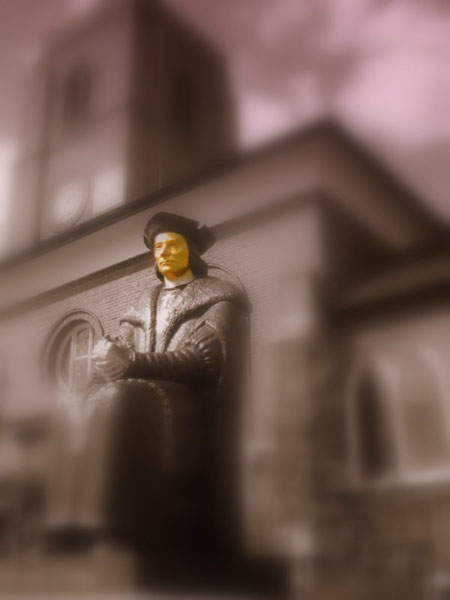
Chelsea resident Thomas More’s statue at the (Anglican) Chelsea Old Church.
* Despite its religious tolerance, More’s Utopia — anticipating Dostoyevsky — maintains:
a solemn and severe law against such as should so far degenerate from the dignity of human nature, as to think that our souls died with our bodies, or that the world was governed by chance, without a wise overruling Providence … since a man of such principles must needs, as oft as he dares do it, despise all their laws and customs: for there is no doubt to be made, that a man who is afraid of nothing but the law, and apprehends nothing after death, will not scruple to break through all the laws of his country, either by fraud or force, when by this means he may satisfy his appetites.
On this date in 1947, Ding Mocun was shot for “conspiring with a foreign government to overthrow China” in Shanghai by the Kuomintang.
This former Communist turned right-wing radical may be most readily recognizable outside China as the real-life inspiration behind Ang Lee’s steamy 2007 art-house menace to undergarments Lust, Caution.
That incident was authored by Ding’s young plaything, who turned out to have a very serious side indeed. (Ding had her shot.)
While the attempt on the turncoat spy’s life really happened, there’s some dispute over whether Chang really had this particular woman strongly in mind over the twenty-plus years she composed her story. There’s more about the evolution of the fictional story here, but you’ll need Chinese skills to follow the links to Chang’s evolving text.
At any rate, Ding’s actual death would come by order of a more august character: Chiang Kai-shek.
Why so many people out to get him?
Despite his nationalist credentials, when Ding lost a party struggle in 1938, he found a gig with the collaborationist government of Japanese-occupied China running a nasty intelligence unit that made nationalists and Communists disappear. That’s the sort of resume anyone would be touching up come the mid-1940’s, and Ding went with a revision (not widely credited, though it has its advocates) that he was secretly passing information to the nationalist resistance all along. And as the nationalists and Communists turned on one another in the postwar power vacuum, it looked like his usefulness to the Kuomintang might get him off the hook after all.
It worked for a while, but Chiang — or so goes the story — caught a tabloid expose about Ding catching R&R at a lake when he’d used a medical pass to get out of prison, and impulsively ordered him shot.
Perhaps Ding’s status as official evildoer vis-a-vis a China whose messy birth many are old enough to remember helps account for the resonance of literary works that engage him as a human being. In a nonfiction vein, Konrad Lawson’s layered critique of the pro-Ding apologia linked above thoughtfully evokes the complexity of Ding’s era and the challenges it poses for historiography.


 Virtually a lens for the contradictory currents of gender, class and power in her time,
 While en route, Stauffenberg had no ability to communicate to the wider world. Landing in Berlin three hours after the not-quite-deadly-enough blast at Wolfsschanze, he must have been stunned to find that Valkyrie had not been launched. Apparently, fragmentary reports from the east were unclear as to whether Hitler had survived; everyone was reluctant about committing himself.

 Based on
