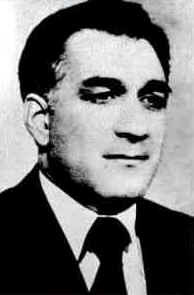
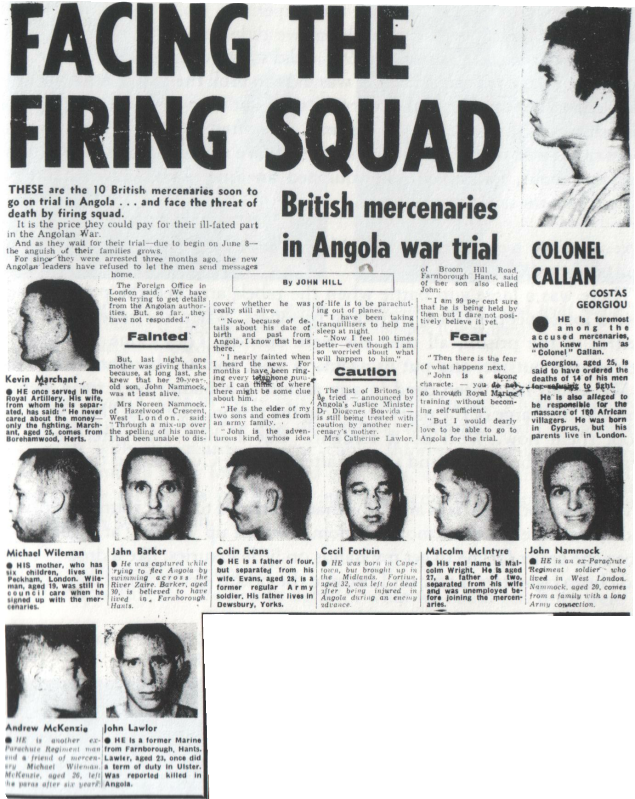
1976: Costas Georgiou and three other mercenaries in Angola

On this date in 1976, three Britons and one American were shot in Angola by a military police squad for murders committed as mercenaries earlier during the year.

Costas Georgiou.

They were among 13 foreigners sentenced at the Luanda Trial, which occurred on the pivot of Angola’s transition from generation-long anti-colonial insurrection on towards generation(s)-long civil war. Between them, more than half a million Angolans died, but this date belonged to a couple of unrepresentative Anglos.

Long story short, the immediate aftermath of Angolan independence in late 1975 was a scramble for control among the several factions who had been fighting the Portuguese … along with a scramble among interested outside states to line up their allies in this resource-rich Cold War prize.

Small wonder that foreign soldiers of fortune soon found their way into the chaotic scene.

Over the course of the first few months of independence, the Popular Movement for the Liberation of Angola (MPLA) more or less consolidated state power, and it proceeded to prosecute supporters of a rival guerrilla movement for their part in the conflict immediately after independence.

Thirteen foreign mercenaries who were captured by MPLA-supporting Cuban troops — the other nine drew long prison sentences — were charged in a show trial with war crimes for their conduct in the field in a case that made the western gun-for-hire an emblem of colonial depravity.

The most notorious of the bunch was Costas Georgiou. A Greek Cypriot emigre to Britain, he had gone to Angola as “Colonel Callan” and was wanted by Scotland Yard for there ordering a mass execution of other British mercenaries — an act he admitted at trial. Even the inevitable London Times editorial against the trial (June 29, 1976) agreed “the proceedings against Callan, if not the rigours of the sentence may be conceded.”

The others looked much less culpable, almost arbitrarily selected for death from among the ranks of unprepossessing, sometimes barely-there mercs. American Daniel Gearhart, a Vietnam veteran drowning in debt, had apparently been in the field for a mere three days and never so much as fired a shot; that he had advertised in Soldier of Fortune magazine was held to aggravate the charges against him, and in vain did the father of four insist that being tried for his life was enough to scare him straight out of the business.

Angolan defense attorneys, while also appealing against the legality of the trial on grounds of both international and domestic law, spoke that revolutionary language of decolonization in defending their charges. Georgiou, according to Maria Teresinha Lopes, was

“a colonized man … [treated in England as] a sub-human, just a Greek, just a ‘boy’.”

Another Angolan defense attorney argued against the death penalty because

“To condemn them to death while ignoring their social origin in terms of revolutionary justice would deny the theory which guided our revolution. My clients are an integral part of the exploited class.” (Both comments from London Times, June 19, 1976)

The era of decolonization was a time for idealism, but not the sort that would shrink from bloodshed.

In denying the doomed men clemency, Angola’s first independent president Agostinho Neto denounced

Mercenarism, instrument of the aggressive designs of imperialism … a scourge of the African continent and a grave threat to the peace, freedom and independence of the peoples …

It is imperative that the practice of mercenarism be banished once and for all from our planet. It is urgent that all states and peace-loving forces fight it most energetically.

We are applying justice in Angola not only in the name of our martyred people but also for the good of the brother peoples of Namibia, Zimbabwe and all the peoples of the world against whom imperialism is already getting ready to prepare new mercenary aggressions.

(Text dated July 9, and reprinted in the July 10 London Times)

You could just about substitute the word “terrorism” for “mercenarism” and read it on today’s campaign trail.

Juridically, Angola pursued these warriors as peoples who had fought unlawfully and could therefore be placed outside the protections conferred on soldiers by the Geneva Conventions — and subjected to the liberating power of revolutionary violence.

That this ad hoc concept of “mercenarism” could be exploited to license an outrage upon humanity was a notion relentlessly denounced by British and American officials,* who had not yet fully explored the utility of the “unlawful combatant” construct in extending the reach of their own security states.

As for all that peace-loving, brother-peoples stuff in the execution order?

What actually happened after the mercenaries were shot was that the two biggest former anti-colonial guerrilla movements in Angola morphed into Cold War proxies — the MPLA of the Warsaw Pact, supported by its control of the country’s oil; UNITA of NATO, supported by its control of the country’s diamonds — and bled the country dry in a horrific civil war.

* Henry Kissinger, then President Gerald Ford’s Secretary of State, complained that Angola’s decision

to ignore both the law and the facts … cannot help but affect adversely the development of relations between the United States and Angola.

On this day..

1960: Oliviu Beldeanu, for the Berne incident

On this date in 1960, Romanian anti-communist Oliviu Beldeanu was executed at Jilava prison for a headline-grabbing protest he’d orchestrated in Switzerland five years before.

Beldeanu (here‘s his Romanian Wikipedia page) was the ringleader of a group of Romanian exiles who’d commandeered the Romanian embassy in Bern(e) in February 1955.

The aptly-named Berne Incident was meant to be a symbolic protest — Communist symbols smashed, damaging secret correspondence released, that sort of thing — but it did also result in an embassy driver being shot to death.

These “legionary fascist groups”* and “traitors abroad,” (pdf) (in the official lexicology of Bucharest) were handled fairly gently by Switzerland, predictably keen to stay clear of diplomatic incidents.

Beldeanu et al drew lenient prison sentences from which they were released early.

And that would have been the end of it … but a Communist cloak-and-dagger operation after the ex-cons were freed lured Beldeanu to Berlin. He was kidnapped by the East German Stasi and flown to Romania, there to be subject to a perfunctory trial and speedy execution.

* “Legionary fascist” denunciations — associating the Switzerland activists with Romania’s notorious Iron Guard — cited by Paul Nistor, “The five who scared … America, too. The immediate effects of the attempt in Bern (1955) over the Romanian diplomacy”, Valahian Journal of Historical Studies, Dec. 2009.

On this day..

1974: Mun Segwang, errant assassin

This morning in Seoul, Mun Segwang (various similar transliterations possible) was hanged for an assassination attempt four months earlier.

Mun, a Japanese-reared Korean who needed a translator for his subsequent trial, tried to gun down dictator Park Chung-hee at a Independence Day speech Aug. 15.

Mun missed Park, but he did kill two others: a high school student; and, Park’s wife Yuk Yeong-su, the seated white-clad figure in the middle of the assassination footage who can be seen beginning to crumple on stage as the camera pans away.

South Korea figured him as the agent of a North Korean/Communist plot, which conclusion Japan and the North rejected vehemently. (Trial evidence also indicated that he read The Day of the Jackal.)

Park got lucky this time, but the autocrat was successfully iced five years later by his own intelligence chief. (Guess what happened to him.)

On this day..

1959: Cho Pong-am, Presidential runner-up

A half-century ago today, South Korean strongman Syngman Rhee, winner of that country’s 1956 presidential election, had the runner-up hanged for treason.

Cho Pong-am (or Cho Bong-am), who cut his teeth as a young Communist in the 1920’s and 30’s but had become an independent socialist since, won over 2.1 million votes as the Progressive Party candidate in 1956, on a platform of peaceful reunification with North Korea — the outstanding political issue in South Korea at the time.

The position had some popularity as against Rhee’s “march North” policy of conquering North Korea by force. Peaceful unification and support for the Progressive Party continued to grow after 1956, to Rhee’s fury.

Probably in fear of the increase in popular sentiment favourable to ‘peaceful unification’, the Rhee regime was determined to destroy the Progressive Party. On 13 January 1958, Cho Pong-am was arrested, together with other party officials, on charges of espionage and violation of the National Security Act … Given the fact that the government had suspected Cho’s ideological orientation, and that Communist infiltration of the South was increasing at that time … the arrest of the progressive leader might have been caused partly by the government’s genuine fear of Communist subversion. Cho’s trial, however, clearly indicated that the main purpose of Rhee’s action was to suppress political opposition, and especially to control the idea of ‘peaceful unification’.

Cho Pong-am was indicted on charges that his advocacy of ‘peaceful unification’ by elections in North and South Korea denied the sovereignty of the ROK and consequently was subversive in nature, and that he had been in secret contact with North Korean agents. … police and prosecution officials admitted that the espionage case against Cho was ‘very weak’, and indicated that they were expending considerable effort on analysing his concept of ‘peaceful unification’ in order to classify it as a crime against the ROK.

… Seoul district court, in July, sentenced him to five years’ imprisonment … [and] found that the Progressive Party’s platform did not violate the National Security Law. Three months later, however, the appellate court, reversing the decision of the district court, sentenced Cho to death … [and] ruled that his unification formula represented a plan to overthrow the ROK government.

Cho was hanged just one day after the Supreme Court rejected his appeal — “sudden and highly questionable,” to the American embassy that hurriedly attempted to impress Rhee’s Foreign Minister with the damage this execution could do to South Korea internationally. Cognizant, perhaps, of such concerns, Seoul imposed press censorship from August 1 on further reporting about the case.

Rhee himself would be forced from office by popular outcry the following year after attempting to steal the 1960 election, but “the tragic end of Cho Pong-am and his Progressive Party made it unequivocally clear that a serious leftist movement could not be openly promoted in South Korea without falling victim to violent suppression by the Government.” (Source)

Update: He was posthumously rehabilitated in 2011.

On this day..

1962: Gheorghe Arsenescu, Romanian partisan

On this date in 1962, partisan Gheorghe Arsenescu was put to death at Bucharest’s Jilava Prison.

Arsenescu was a leader and co-founder of one of Romania’s several bands of anti-communist resistance units. Arsenescu’s Haiducii Muscelului — the Muscel Outlaws — were a band of 30 to 40 in the Carpathian fooothills who scarcely posed a serious threat to the Romanian state, but who nevertheless managed to elude capture for nine solid years in the 1950’s.

(More about the Haiducii in this Romanian pdf.)

Arsenescu was finally nabbed in 1960, a few months after his former comrades Toma and Petre Arnautoiu had themselves been executed. According to Revolution and Resistance in Eastern Europe, Arsenescu’s wife and father were also given long prison sentences for aiding him.

This band was perhaps most especially notable for one of its members who not only survived capture, but outlived the Communist regime: Elisabeta Rizea.

Crippled by torture, Rizea became a potent symbol in post-Communist Romania of the resistance of Arsenescu and others.

On this day..

1948: Witold Pilecki, Auschwitz infiltrator

On this date in 1948, Polish resistance hero Witold Pilecki was shot by Poland’s Communist government for a variety of subversions.


Witold Pilecki as an officer (top), imprisoned in Auschwitz (middle), and at his fatal trial (bottom).

A former cavalry officer turned Home Army figure,* Pilecki authored one of the Great War’s most daring (and oddly obscure) covert escapades. In 1940, he volunteered to infiltrate Auschwitz — whose operations were then largely opaque to the Polish resistance — and allowed himself to be rounded up by the Gestapo.

Pilecki spent 31 months in the notorious concentration camp, organizing an inmate resistance network and shipping intelligence about the camp’s operations to the Polish resistance and (through them) the western Allies.

Though his pleas for a raid to liberate Auschwitz were in vain, Pilecki’s report catalogued the today-familiar horrors of the camp.

One bit, as it turned out, was a bit of foreshadowing.

The fourth and most heavy kind of punishment was an execution by shooting: death effected quickly, how much more humane and desired by those undergoing torture. “Execution” is not the right term; the right one would be “shooting dead,” or just “killing.” … The butcher Palitsch** — a handsome boy, who did not used to beat anybody in the camp, as it was not his style, was the main author of macabre scenes in the courtyard. Those doomed stood naked in a row against the Black Wall, and he put a small calibre rifle under the skull in the back of their heads, and put an end to their lives.†

Pilecki escaped Auschwitz in 1943, rejoined the Home Army, and had the good fortune to wind up in Italy at war’s end.

Instead of retiring to write his memoirs, he slipped back into Poland to spy on the postwar Communist government … but the man who had lived through Nazi internment couldn’t pull the same trick on the reds, who were in the process of rooting out anti-Communist resistance elements.

Polish Prime Minister (and fellow Auschwitz survivor) Jozef Cyrankiewicz provided testimony against Pilecki in his show trial (Polish link) on espionage and arms charges.

Pilecki was executed May 25, 1948, at Warsaw’s Mokotow Prison just as he had seen so many killed at the Black Wall — with a single shot to the back of the head.

Pilecki was posthumously rehabilitated by the post-Cold War Polish government, and honored with the country’s highest decoration

* Pilecki co-founded an early resistance organization, the Secret Polish Army (Tajna Armia Polska, or TAP), subsequently absorbed by the Home Army.

** Gerhard Palitsch — or Palitzsch — was a notorious SS roll-call man thought to have personally executed some 20,000 people in the manner described by Pilecki.


An illustration of Gerhard Palitsch executing prisoners at the Black Wall, by Polish inmate Jan Komski

Disliked by camp commandant Rudolph Hoess, Palitsch’s proclivity for taking inmate mistresses eventually got him busted for race defilement, whereupon he himself landed in the camp’s confinement, obliged to “[beg] inmates who used to tremble before him for bread.” (People In Auschwitz)

He was not for the ovens or the Nuremberg trials, however, and instead found himself mustered to the eastern front, eventually dying in action against the Red Army in Hungary. This page (in Polish) assembles various inmate recollections of Gerhard Palitsch.

† As the translation in the cited source is a tad uneven, I’ve taken the liberty of cleaning it up a bit.

On this day..

1952: Nikos Beloyannis, the man with the carnation

Before dawn on this date in 1952, four Greek Communists were shot outside Athens for treason.

Nikos (Nicholas) Beloyannis (or Mpeloyannis), the most prominent among them, spent a goodly portion of his adult life in prison for his subversive opinions — first at the hands of the interwar Greek nationalist government, then the Nazi occupation, then the British.

His many years’ service to communism was, unbeknownst to him, even then being horse-traded away as Stalin and Churchill carved up post-World War II spheres of influence.

Uncle Joe ceded Greece to the West — so the reds were left dangling during the Greek Civil War, and guys like Nikos got fitted for left martyrology.


The Execution of Beloyannis, by Peter de Francia.

“The man with the carnation” — it was his signature prop at the mass show trial where he drew a death sentence for “conspiring to overthrow by force the present regime in Greece.”

The trial, and the outcry that greeted its swift and questionable resolution, helped establish an enduring international reputation among fellow-travelers.

(From The Man With The Carnation, released after the fall of the Papadapoulos dictatorship.)

On this day..

1961: Patrice Lumumba

No brutality, no torture has ever made me plead for mercy, because I prefer to die with my head up, with unshakable faith and deep confidence in the destiny of my country, rather than live in submission and spurning of scared principles.

-Patrice Lumumba’s last letter to his wife

One person’s “murdered under controversial circumstances” is another person’s “executed.” By most unbiased accounts, Patrice Lumumba was both.

A strident anti-colonialist caught in the most inflammatory of Cold War power struggles, Lumumba remains a controversial figure.

In 1956, Patrice Lumumba was a mail clerk in Belgian Congo recently out of prison for embezzlement of post office funds. Though previously involved with the Liberal Party of Belgium, a colonialist political party, after prison, he helped found the Mouvement National Congolais, a pro-independence national party (an important distinction at the time, as most pro-independence parties were at least partially tribal in nature).

Convicted in 1959 of inciting an anti-colonial riot and sentenced to 6 months in prison, Lumumba was released early as Congo won its independence and the MNC became an important political force. Just how important became apparent the following June, when the 35-year-old Lumumba was ratified as the newly independent Congo’s first prime minister.

From criminal to high statesman in just over a year, Lumumba took his new power in stride, and watched in disgust as the deposed King Baudouin of Belgium attended the new nation’s first Independence Day celebration, and before a fawning international media condescendingly congratulated Belgium’s colonial beneficence to its former slave plantation.

Struck from the day’s official celebrations in favor of the the lukewarm exhortations of the new President Kasa-Vubu, Lumumba found time on the day’s unofficial program. Strident, emotional, and unabashed in its anticolonialist, nationalist, and pan-Africanist bent, Lumumba’s famous speech was roundly criticized by the domestic and foreign press, but well-received by the crowd and ultimately delivered directly to history.

Lumumba’s tenure as prime minister was short-lived, however.

Mere weeks after independence, a mutiny on army bases broke out in reaction to Lumumba’s ill-fated decision to leave the military out of a government pay raise. The resulting anarchy quickly spread throughout the country, and the province of Katanga, with the support of King Baudouin and powerful mining companies, declared independence. As United Nations troops failed to quell the situation, Lumumba appealed to the Soviets, whose intervention succeeded only in causing Lumumba’s political support to crumble.

Kasa-Vuba dismissed Lumumba in September; in response, Lumumba declared Kasa-Vuba deposed — quite illegally, as it happens — and appealed to the Senate, from whom he managed to win a vote of confidence.

At this point, in the heat of the Cold War, things got interesting.

Deposed again, this time in a CIA-endorsed coup, Lumumba found himself under house arrest and under the protection of UN troops. Not certain whether to trust the rule of the various laws surrounding him, Lumumba slipped out under the cover of night and escaped to nearby Stanleyville (now Kisangani), where he believed he had enough supporters to set up his own government — and army, whom one supposes he had by then resolved to pay rather better.

Pursued by forces loyal to the new government, Lumumba was captured and arrested in early December 1960 and charged with “inciting the army to rebellion.” Devoid of his former UN protection, the man who would be the leader of a newly free nation watched as he became a pawn in a much larger struggle. UN Secretary General Dag Hammarskjöld appealed to the process of law –- whatever that was –- while the USSR jumped a step ahead, demanding that Lumumba be immediately released and reinstated as prime minister and all UN forces withdrawn.

So much for that. The UN Security Council convened, and, a week later, the USSR’s resolution was defeated. Another, Western-backed resolution that would have given the UN power to act as impartial arbitrator was vetoed by the USSR.

At this point, caught between hostility of Cold War politics and the ever-hazy idea of “international law,” Lumumba languished in the military barracks of an even more hostile government. Hearing of plans for his transfer to barracks at the now-subdued Katanga province, Lumumba was wild on the plane trip and was forcibly restrained after appealing to other passengers to intervene on his behalf. Late at night after his arrival at his new prison, Lumumba was driven to an isolated spot and executed by firing squad. News of his death was not released until three weeks later, when it sparked protests in several European cities over the role of the Belgian government, which denied any involvement.

The extent of US and Belgian involvement in Lumumba’s death remains the subject of ongoing speculation. So does the question of what might have been.

On this day..

1979: Hafizullah Amin

On this date in 1979, the 104-day term of Afghan president Hafizullah Amin met a violent end as a Soviet-engineered coup raised the curtain on a war destined to bring misery to both Cold War combatants.

The Soviet Union’s ongoing intervention in Afghan politics had through the 1970’s steadily mired it deeper into an unstable political situation.

Now, it was running out of patience with the country’s president, Hafizullah Amin.
He’d got the best of rival Nur Mohammad Taraki in a power struggle that September, but to the political chaos and the blossoming Islamic insurgency roiling his country, Amin added a level of brutality that was all his own, and a streak of diplomatic independence that was distinctly unwelcome in Moscow.

Amin was a Communist himself, and both he and the predecessor he’d murdered had wanted ever-increasing Soviet aid to keep the country stable.

But that proved to be a Faustian bargain.

Though Kabul radio would announce that Amin had been tried and summarily executed for “crimes against the state,” the short-lived dictator’s fate had been decided two weeks before when the Soviet Politburo passed a secret resolution for his ouster — having lost whatever confidence it had once held in him as a dependable satellite governor.

“The Soviet Union,” said the New York Times in a more innocent time,

has seemed deeply troubled by the inability of either the Taraki or Amin governments to put down the rebellions in Afghanistan, which have been largely tribal but also militantly anti-Communist.

Amin survived a KGB poisoning, so the Red Army dispensed with subtlety by raiding the palace, plucking their preferred satrap out of exile in eastern Europe to take Amin’s place.

It would not see the last of Afghanistan until 10 years, 15,000 Soviet dead, and hundreds of thousands of Afghan casualties later.


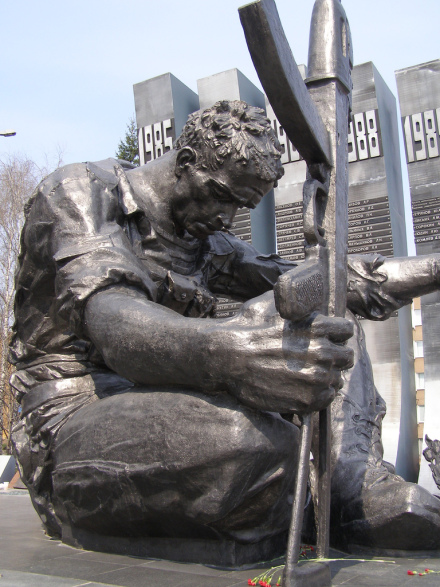
A memorial in Ekaterinburg, Russia, to the Soviet dead in the Afghan war. Image courtesy of beatdrifter (Andy Holmes).

On this day..

1939: The 18 corpses of the rebellion

On this date in 1939, 18 junior officers of the Thai military were shot in Bangkok.

Ostensibly condemned for being part of a coup plot to depose the adolescent King Ananda Mahidol in favor of his abdicated predecessor Prajadhipok, they were in reality the casualties of a purge by the Field Marshal-turned-Prime Minister Phibun Songkhram.

It’s alternatively transliterated “Phibun Songkhram” or “Pibunsonggram”, and familiarly abbreviated to “Por”, but by any name he dominated Thai politics for a generation.

One of the military leaders of the bloodless 1932 Siamese Revolution that made the country a constitutional rather than an absolute monarchy, Phibun had in 1938 muscled his way to the Prime Ministership.

Beset by assassination attempts linked to royal revanchists to whose purposes the young turk’s programme was deeply inimical, Phibun determined to break the back of monarchism en route to a modernized, militaristic nationalism (pdf) that would be right at home in the imminent world war.*

As 1939 opens, we join the narrative of Paul Handley’s The King Never Smiles:

Phibun swept the capital and arrested 50 royals, nobles, and soldiers in the clique of his People’s Party rival Colonel Song Suradej for plotting his overthrow …

Whatever the truth behind the cabal, its quashing came to represent the final victory of the 1932 revolutionists and the constitutionalists over the monarchists. To mark it, Phibun commissioned a huge monument to the constitution, later called Democracy Monument, in the middle of the city’s main thoroughfare, Rajadamnoen (“royal progress”) Avenue.


The Democracy Monument in Bangkok.

The eighteen officers who took it in the shorts on this date were not joined by condemned VIPs like royal blood Prince Rangsit, who copped a commutation. It’s widely thought now that the “Songsuradet Rebellion” — or aptly-named “Rebellion of 18 Corpses” — was trumped-up, if not an phantasm altogether.

The Democracy Monument was not the only bulwark of Thai nationalism thrown up by Phibun in the year between the “conspirators'” January arrest and their deaths this day.**

He dropped the old absolutist name “Siam” in favor of the more nationalistic “Thailand” in June of that year; made the date of the 1932 revolution a national holiday; stripped the language of class-distinctive structures; and pressed irredentist claims against neighboring French colonies.

And if the royal house was efficiently marginalized by Phibun, it would yet develop in the latter part of the century into one of the region’s weightiest political entities† … intertwined with the Thai military Phibun helped hoist to pride of place, a formula that has left coups and unstable governments a presistent feature of the political landscape down to the present day.

* And subsequently, too. Despite aligning with the Axis powers during World War II, Phibun was a feted anti-Communist dictator as Washington started counting dominoes in Southeast Asia in the 1950’s.

** The Wikipedia page for the rebellion claims that the executions were carried out in batches of four per day. A New York Times report of December 6, 1939 said that all 18 had been executed the previous day.

† The current King Bhumibol Adulyadej, who coincidentally turns 81 today, is the world’s longest-reigning monarch as of this writing … with no shortage of concern about the conflict his passing may unstop.

On this day..