On this date in 1957, the dissolute son of a wealthy banker went to see Jesus on the guillotine at Paris’ La Santé Prison.
Annoyed that his estranged father wasn’t keen to finance his dream of moving to the South Pacific for a life on permanent vacation, Jacques Fesch robbed a moneychanger on the Rue Vivenne to raise the revenue — and then shot dead a police officer who gave him chase, orphaning a four-year-old girl.
Outrage at the murder of a policeman was redoubled as the callow hedonism — adultery, an abandoned illegitimate kid, and nary a hard day’s work in his life — of its privileged perp became widely known. Then, too, there’s the novelty of a financial sector scion requiring a firearm for larceny.
Fesch’s Catholic lawyer, Paul Baudet, undertook the Dostoyevskyan mission of saving client’s life and soul alike. The disinterested kid called him “Pope Paul” or “Torquemada,” but gradually — and then all of a sudden — something got through there.
Little by little I was led to change my ideas. I was no longer certain that God did not exist. I began to be open to Him, though I did not yet have faith. I tried to believe with my reason, without praying, or praying ever so little! And then, at the end of my first year in prison, a powerful wave of emotion swept over me, causing deep and brutal suffering. Within the space of a few hours, I came into possession of faith, with absolute certainty. I believed, and could no longer understand how I had ever not believed. Grace had come to me. A great joy flooded my soul and above all a deep peace. In a few instants everything had become clear. it was a very strong, sensible joy that I felt. I tend now to try, perhaps excessively, to recapture it; actually, the essential thing is not emotion, but faith. (Source)
Almost overnight he gave himself to monklike asceticism, but the legal situation was not as promising as the spiritual. French President Rene Coty declined to spare him under pressure from police, and on grounds that leniency to a cop-killer would blow back on officers then trying to quell rebellion in Algeria.
Tell your client that he has all my esteem and that I wanted very much to reprieve him. But if I did that, I would put the lives of other police officers in danger. (Source)
Fesch didn’t want to die, but he accepted his penalty with resignation.
Now, my life is finished. ‘Like a little spring flower which the divine Gardener plucks for His pleasure,’* so my head will fall — glorious ignominy — with heaven for its prize! (Source)
His prison writings have filtered out widely since his beheading, and fed a burgeoning personal cult; he is often compared with the penitent “good thief” crucified with Christ. The valence of that conversion for the death penalty as a contentious political or theological issue, however, is not necessarily abolitionist. Fesch himself mused that imminent execution might have been the very thing that moved his soul.
Do you know, sometimes I think, in good faith and with horror, that the only way I can be saved [in God] is perhaps not to be saved [from the guillotine] in the human sense of the word? (Source)
Controversially, the layabout who slew a policeman has been latterly proposed for canonization within the Catholic Church — although Fesch’s defenders here observe that saints from Paul on down have often had unsavory backstories.
The young man is much better known in Romanic lands than among Anglophones — here’s an Italian homily for him:
In the small hours after midnight on the night of July 16-17 90 years ago, the former Tsar Nicholas II, his wife, children, and four family retainers, were shot in a Yekaterinburg basement by their Bolshevik jailers.
Doting family man, vacillating dictator, as weak and rich as Croesus … the doomed Emperor and Autocrat of All the Russias was a man small of stature. His reign emerged under a bad star when 1,300 Muscovites were trampled to death in the crush for his coronation largesse; 18 years later, Nicholas‘s support for Serbia against Austria-Hungary was instrumental in pitching Europe into World War I, a blunder for which he reaped a whirlwind long in the making.
When an anti-Bolshevik force approached Yekaterinburg (or Ekaterinburg), where the deposed royals had been stashed in a commandeered private residence,* Yakov Sverdlov (for whom the city was subsequently renamed) ordered the prisoners shot — not only the tsar, but his beloved wife, their hemophiliac heir, and those four daughters who had to be bayoneted because the state jewels secreted in their corsets shielded them from the gunfire.
The executioners (here’s the account of their leader; here’s another guard’s version) did their best to destroy and conceal the remains, helping fuel subsequent rumors that one of the children had survived and escaped.
Those rumors are only now, with post-Soviet investigation and DNA forensics, being debunked, and not yet to the satisfaction of all comers. This very week, Moscow affirmed (though the Orthodox church has not accepted) that the last of Nicholas’s family had been accounted for:
Modern nostalgia for this unimpressive sovereign is making a minor comeback, with Nicholas absurdly contending in a current poll for the title of “greatest Russian” … supported not only by the miseries of the state that succeeded his, but by the family’s decent and accessible private life.
Even a monarchist — especially a monarchist! — shouldn’t reason that the greatest monarch is the one who drove the bus over the cliff. But much is forgiven a martyr. Indeed, like Charles I of England, the last Romanov monarch has been posthumously saddled with divine sanction; he and all the family are certified “passion bearers”. (Update: And possible future relics!)
A handful of the many books about the Romanovs and their fall
* The Ipatiev House where the tsar was held (and shot) no longer stands. On its spot is a church consecrated five years ago yesterday to the Romanov canonization.
Update: The Romanovs were officially rehabilitated by the Russian Supreme Court on October 1, 2008.
On this date in 1535, Sir — later Saint — Thomas More kept his conscience at the expense of his head on Tower Hill.
For all More‘s greatness — as intellectual, polemicist, lawyer, statesman, father — none of his many gifts at the end could avail him beside his commitment to Catholicism at the dawn of the English Reformation.
Yet it is for those gifts that he cut such a commanding presence in his times, for those very reasons that his sovereign hounded his first citizen to assent to the divorce and remarriage he was fixed upon.
A devotee and friend of Erasmus from years before, More was in Henry’s more orthodox youth the king’s very scourge of Protestantism. His scatological invective against Martin Luther in Responsio ad Lutherum — much in the impolite tenor of Catholic-Protestant rhetoric continent-wide, it should be noted — is of the sort to crimson the cheeks of the milquetoast modern:
Since he has written that he already has a prior right to bespatter and besmirch the royal crown with shit, will we not have the posterior right to proclaim the beshitted tongue of this practitioner of posterioristics most fit to lick with his anterior the very posterior of a pissing she-mule until he shall have learned more correctly to infer posterior conclusions from prior premises?
Over that hairshirt, he wore the robes of state. But his engagement with the world had a selective bent that must have exasperated his colleague and predecessor as Lord Chancellor, Cardinal Wolsey. Orson Welles and Paul Scofield spar here in the definitive More hagiography A Man for All Seasons over the intellectual’s delicate refusal to dirty his gloves with the great matter of state before them — the annulment the king demanded of his marriage to the Queen (and More’s friend) Catherine of Aragon:
Peas in a pod, these two: Wolsey, the cleric grounded in realpolitik; More, the barrister who trusts to God. (More considered holy orders as a young man.)
Our man’s reputation for honesty in a den of hypocrites has certainly outrun Wolsey’s. Still, all More’s disdain for the deal-making that invests the sovereign majesty and all his foreboding for the relationship he had with his dangerous king were not quite enough to stop him accepting the Chancellorship and the opportunity to stamp out Lutheranism … knowing perfectly well the simultaneous thrust of Henry’s boudoir policy.
It all cuts quite a contrast to More’s (barely) pre-Reformation text, Utopia (available free from Project Gutenberg), which named a literary genre and described an imagined society of tolerant primitive communism that surely would have blanched at its inventor’s coming role in the state’s machinations:
I can have no other notion of all the other governments that I see or know, than that they are a conspiracy of the rich, who, on pretence of managing the public, only pursue their private ends, and devise all the ways and arts they can find out; first, that they may, without danger, preserve all that they have so ill-acquired, and then, that they may engage the poor to toil and labour for them at as low rates as possible, and oppress them as much as they please
…
[E]very man might be of what religion he pleased, and might endeavour to draw others to it by the force of argument and by amicable and modest ways, but without bitterness against those of other opinions; but that he ought to use no other force but that of persuasion, and was neither to mix with it reproaches nor violence* …
It’s not a given that More himself agrees with every (or even any) sentiment expressed in Utopia, but his most famous work’s criticism of the death penalty too liberally applied makes interesting reading.
[E]xtreme justice is an extreme injury: for we ought not to approve of those terrible laws that make the smallest offences capital … God has commanded us not to kill, and shall we kill so easily for a little money [i.e., execute petty thieves]? But if one shall say, that by that law we are only forbid to kill any except when the laws of the land allow of it, upon the same grounds, laws may be made, in some cases, to allow of adultery and perjury: for God having taken from us the right of disposing either of our own or of other people’s lives, if it is pretended that the mutual consent of men in making laws can authorise man-slaughter in cases in which God has given us no example, that it frees people from the obligation of the divine law, and so makes murder a lawful action, what is this, but to give a preference to human laws before the divine? and, if this is once admitted, by the same rule men may, in all other things, put what restrictions they please upon the laws of God.
This insistence on the supremacy of divine law over human institutions forms the basis of his objection to parliament’s overthrowing the papacy — which he expressed openly only after he was convicted by obviously perjured “jailhouse snitch” testimony
[Y]ou have no authority, without the common consent of all Christians, to make a law or Act of Parliament or Council against the union of Christendom.
Paul Scofield bears enjoying in the role in A Man for All Seasons:
More is sometimes suspected of desiring martyrdom since he marched so unerringly into it, but he also made every attempt to survive Henry’s demand the he affirm the royal remarriage and the king’s ecclesiastical supremacy by withdrawing silently from the public sphere rather than openly opposing it. More had by every account an enviable, downright happy life at his own hearth, and a tender and intellectual relationship with his favorite daughter Meg. (Meg corresponded with her father in prison, collected his works, and retrieved his head from London Bridge.)
But by his way of thinking — Meg tried to talk him out of it — he couldn’t swear to the Act of Succession acknowledging the king’s right to divorce Queen Catherine and disinherit her daughter Mary if Henry decided to force the choice. And in the king’s eyes, there was no middle ground for someone of the ex-Chancellor’s stature.
Henry could see to it, though, to cut his old friend a break and commute the sentence from drawing and quartering to “mere” beheading, here depicted in the past season of the Showtime series The Tudors.
More’s last moments as rendered here — the ironic remark at the foot of the scaffold, “See me safe up: for my coming down, I can shift for myself”;** his generous answer to the headsman’s plea for forgiveness — are well-documented. Undoubtedly, his sturdy martyr’s bearing, the extension of a life of joyful piety, helped cement for posterity the fame he held in life.
And that dying address — “I die the King’s good servant, but God’s first” — gathers in one sentiment free of bombast or self-pity the irreconcilable demands of conscience that would lead many thousands besides More to Henry VIII’s scaffolds, and rings equally true to less lethal challenges to the conscience in every land and time since.
Anne Boleyn, who caused More’s fate, shared it less than a year afterwards.
Thomas More was canonized by the Catholic Church in 1935 — the patron saint of politicians. Rather bizarrely, July 6 is also his feast day on the Anglican calendar, a tribute to the nearly universal regard his memory enjoys.
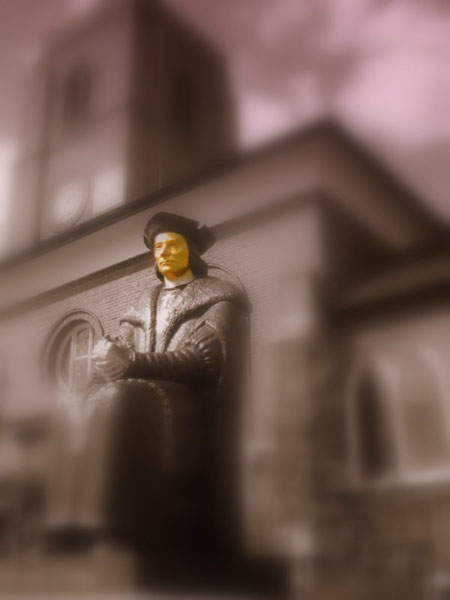
Chelsea resident Thomas More’s statue at the (Anglican) Chelsea Old Church.
* Despite its religious tolerance, More’s Utopia — anticipating Dostoyevsky — maintains:
a solemn and severe law against such as should so far degenerate from the dignity of human nature, as to think that our souls died with our bodies, or that the world was governed by chance, without a wise overruling Providence … since a man of such principles must needs, as oft as he dares do it, despise all their laws and customs: for there is no doubt to be made, that a man who is afraid of nothing but the law, and apprehends nothing after death, will not scruple to break through all the laws of his country, either by fraud or force, when by this means he may satisfy his appetites.
On this date in 1431, Joan of Arc (also Jeanne d’Arc, even though d’Arc wasn’t really her name at all) was burned at the stake for heresy in the marketplace of Rouen, France.
A Joan of Arc statue in Philadelphia, Pennsylvania.
Very much has been written and said about this strange figure, the Maid of Orleans — not quite so much larger than life as she seems otherworldly to it: in her mystical exaltation, in her unthinkable elevation from the illiterate peasantry to military command (and bizarrely effective intervention in the intractable Hundred Years’ War).
Apotheosis to the ranks of France’s national heroes is the least of it; Joan’s iconography extends well outside her homelands and well beyond the project of feudal restoration that was her short life’s concern.
Her myth has had a robust afterlife, but her accomplishments in the flesh were quite real — staggering, even. At the nadir of France’s fortunes, she convinced the French dauphin Charles VII of her divine inspiration in April 1429 and, far more aggressive (and some would say lucky) than the army’s noble commanders, immediately relieved the English siege of Orleans. By July, she had captured Reims, where Charles was crowned king.
The next year, Joan was captured by the Burgundians, who sold her to the British, who in turn subjected her to an ecclesiastical inquiry — what became a remarkable, exhaustively documented three-week interrogation, in which she deftly matched wits with academic persecutors over the reality and nature of her divine visions.
She was immediately considered a martyr by her own side — and twenty years later, when the war had finally ended, another court reversed the verdict against her — but her universal appeal and cultural ubiquity remained a long time off.*
“Dark-minded man!”
The Maid of Orleans answered, “to act well
Brings with itself an ample recompense.
I have not reared the oriflamme of death —
Now God forbid! The banner of the Lord
Is this; and, come what will, me it behooves,
Mindful of Him whose minister I am,
To spare the fallen foe: that gracious God
Sends me a messenger of mercy forth,
Sends me to save this ravaged realm of France,
To England friendly as to all the world;
Only to those an enemy, whose lust
Of sway makes them the enemies of man.”
The romantic 19th century took up her standard when the trial records were uncovered — liberals cottoned to her lowly birth, conservatives to her monarchist project, all France to her proto-nationalism, all Catholics to her faith (she was elevated to sainthood in the early 20th century; May 30 is also her feast day). The Vichy government and the French Resistance both claimed her in World War II. Her gender and sexuality have invited modern attention, just as they did for her judges: she works (anachronistically, of course) as a girl-power pop feminism icon, and her masculine social role gives her queer cachet; she made a point of keeping her virginity, but may have been sexually assaulted in prison, an event that figures in Andrea Dworkin’s Intercourse.
Joan stands equal to such varied identities because the mysteriously personal qualities of her story invite the observer into it, and those qualities hold precisely because of her fiery end this day. What would Joan have been in five or ten years’ time, had she escaped capture or held to her temporary renunciation of wearing men’s clothes (the head-scratching but subtly profound charge that finally doomed her)? An aging commander with the gloss off her, a partisan of some faction of the abject French court, a hostage somewhere being ransomed for gold plate or quietly poisoned off?
Her myth and its antithesis work because she came in radiance from dust, and followed her conscience — her God, her will, her destiny, or what have you — back to dust.
Though adapted many times for the screen, the definitive Joan of Arc film remains the 1928 silent treament La Passion de Jeanne d’Arc, scripted largely from the original trial transcripts. The movie’s lead Maria Falconetti — and indeed the very silence of the medium — convey something of that mysterious, multifaceted meaning left to us tantalizingly suspended between the 19-year-old who stood at the stake this day and the legend that arose from her ashes.
Books about Joan of Arc
(The Mark Twain book is in the public domain and available free at Project Gutenberg in both text (part 1 | part 2) and audio (part 1 | part 2) forms.)
* Shakespeare, for instance, writing Henry VI Part I about Charles VII’s English opposite number, has Joan in a rather more negative light than a modern reader is used to seeing — as a witch and a whore. In her last battlefield appearance, she summons demons …
Enter Fiends
This speedy and quick appearance argues proof
Of your accustom’d diligence to me.
Now, ye familiar spirits, that are cull’d
Out of the powerful regions under earth,
Help me this once, that France may get the field.
… who fail to aid her although she offers them her body. Later, condemned to the stake, she cravenly tries to plead her belly by claiming that she slept with several other characters.
On this date in 1649, the struggle between parliament and crown cost the Stuart monarch Charles I his head.
Charles‘ political clumsiness and unreconstructed authoritarianism had seen the realm whose unitary sovereignty he insisted upon blunder from disaster to disaster: into bankruptcy, military defeat, religious conflict and the English Civil War.
What is beyond dispute is that the confrontation between monarch and subject, pitting against each other political and economic epochs, theories of state and power, rates as one of history’s most captivating courtroom dramas.
Charles refused to answer the court’s charge of treason, occasioned most particularly by the king’s fomenting the Second Civil War while already a defeated prisoner of parliament following the first Civil War. He rested firmly on royal prerogatives against what some interlocutors take to be an almost desperate plea by his judges for some hint of acknowledgment that could open the door to compromise:
[A] King cannot be tried by any superior jurisdiction on earth. But it is not my case alone — it is the freedom and the liberty of the people of England. And do you pretend what you will, I stand more for their liberties — for if the power without law may make laws, may alter the fundamental laws of the kingdom, I do not know what subject he is in England that can be sure of his life or anything that he calls his own. Therefore, when that I came here I did expect particular reasons to know by what law, what authority, you did proceed against me here.
It must be borne in mind that the trial of a king was a completely unprecedented event. Charles might be forgiven his attitude, even if it smacked of the impolitic high-handedness that had forced this deadly test of powers.
Parliament’s position — here in the words of its President — is distinctly in the stream of political discourse (if not always actual practice) ascendant in the West to this day.
Sir, as the law is your superior, so truly, sir, there is something that is superior to the law and that is indeed the parent or author of the law — and that is the people of England.
…
And therefore, sir, for this breach of trust when you are called to account, you are called to account by your superiors — “when a king is summoned to judgment by the people, the lesser is summoned by the greater.”
The modern and the medieval, facing each other at the bar.
A fragment from a World War II bomb-damaged and only-recently-rediscovered Hippolyte Delaroche painting situating Charles in the Christlike pose of enduring the mockery of his captors.
Charles played his lordly disdain to the end, refusing to admit parliament’s jurisdiction by making any sort of plea.
The line between heroic defiance and pig-headed obstinacy being very much in the eye of the beholder, the confrontation is typically played straight-up for its arresting clash of principles — as in the 1970 biopic Cromwell, with Alec Guinness as the monarch:Probably more troubling for the parliamentary party than the regicide taboo was consideration that the execution would transfer royalist loyalties from a man safely imprisoned to an heir beyond their power, who could be expected to (as in fact he did) resume the civil war.
Competing philosophies expounded for the competing interests; the dispute involved the era’s intellectual titans, in conflict over the most fundamental concepts of the state. Thomas Hobbes wrote his magnum opusThe Leviathan as a royalist exile in Paris, and its abhorrence for rebellion and divided sovereignty unmistakably reflects the English Civil War experience. John Milton earned his bread as a republican polemicist; his poetic celebration of Satan’s failed rebellion in Paradise Lost, written after the Stuart restoration, can be read as a political critique.
Separated at the block? Charles I and Hobbes’ Leviathan
It’s conventionally thought that the beheading was conducted by a radical minority, though that supposition is debatable, colored as it is by the ultimate restoration of the crown. But although England would have a king again, the weight of political authority would steadily, permanently, gravitate towards parliament, organ of the merchant classes who would steer England henceforward.
Did it have the right? Two implacable powers each claimed an indivisible object; “between equal rights, force decides.” So on this cold winter’s afternoon — Charles wore thick undergarments, so he would not shiver with the appearance of fright — the deposed king was marched to a scaffold erected at Whitehall. He gave a short final address, with the famous words for his principle of martyrdom — “a sovereign and a subject are clean different things” — then laid his head on a low block, where a masked executioner (never definitively identified) cleanly chopped it off.
After the monarchy’s restoration, Charles was canonized as a saint by the Church of England: he’s still the last person so venerated, an odd salute to a mortal career of unalloyed arrogance and incompetence. Observance of the cult was toned down in the 19th century, although a Society of King Charles the Martyr dedicated to its preservation still exists; monarchists of a more secular inclination also continue to mark his martyrdom on this anniversary.
“The most interesting thing about King Charles the First is that he was five foot six inches tall at the start of his reign, but only four foot eight inches tall at the end of it.”
On this date in 1581, three English Catholic martyrs were hanged, drawn and quartered at Tyburn, casualties of the bloody confrontation between religious and secular power of the English Reformation.
Edmund Campion — later sainted — was the towering figure among them and the great attraction for those that thronged the Tyburn scaffold on a rain-drenched Friday.
A brilliant Oxford scholar once tipped as a possible future Archibishop of Canterbury, Campion abjured his Anglican holy orders in favor of Rome — a mortal peril in Elizabethan England.
He slipped away to Ireland, then to the continent and safety. But at age 40, after nearly a decade abroad, the missionary zeal of the converted called him back to Albion as part of a secret Jesuit mission. Hunted from the day he set foot back in Britain, he survived a year on the run, an underground minister to an illicit faith.
Though priestly investiture alone technically made him capitally liable, a government with millions of Catholic citizens grappled for some firmer ground upon which to condemn the renowned intellectual. Since Campion succumbed neither to torture nor to blandishments, nor to the surreal interludes when he was hauled out of his dungeon and made to debate with the Crown’s theologians, he was finally convicted on the strength of made-to-order witness testimony to the effect that his mission had some vague upshot of undermining Queen Elizabeth’s hold on her subjects.
In effect, it was very much like convicting him for his faith: the Anglican-Catholic conflict had crystallized, and dozens of priests would follow the route of Campion in the years to come. Between a mutually implacable state and church, either flesh or soul must burn.
Not a few of those who trod the martyr’s path would take inspiration from the beatific Jesuit — as young Henry Walpole, whose own route to Calvary is said to have begun when he was spattered by Campion’s blood this day and come full circle to his own execution 15 years later. Walpole’s embrace of martyrdom fairly glows from his proscribed tribute to Campion:
Hys fare was hard, yet mylde & sweete his cheere,
his pryson close, yet free & loose his mynde,
his torture great, yet small or none his feare,
his offers lardge, yet nothing coulde him blynde.
O constant man, oh mynde, oh vyrtue straunge,
whome want, nor woe, nor feare, nor hope coulde chaunge.
…
Yee thought perhapps, when learned Campion dyes,
his pen must cease, his sugred townge be still.
But yow forget how lowd his deathe yt cryes,
how farre beyond the sownd of tounge or quill.
yow did not know how rare and great a good
yt was to write those precious guiftes in bloode.
His best-know work was “Campion’s Brag”, the scornful nickname his foes gave to an apologia he produced while underground in England … and to whose steady words Edmund Campion proved true this day:
[B]e it known to you that we have made a league — all the Jesuits in the world, whose succession and multitude must overreach all the practices of England — cheerfully to carry the cross you shall lay upon us, and never to despair your recovery [to Catholicism], while we have a man left to enjoy your Tyburn, or to be racked with your torments, or consumed with your prisons. The expense is reckoned, the enterprise is begun; it is of God, it cannot be withstood. So the Faith was planted: so it must be restored.
But Protestant England did withstand the enterprise. The generation to come saw Catholic ideas and writing put to withering siege, Campion’s not least among them. For all the tribute of history to the man of Christlike fortitude, it is by no means apparent that the enjoyments of Tyburn and the kindred “practices of England” did not, after all, lay a cross heavier than English Catholics could bear.
This date annually is the feast of iconic — perhaps mythological — Christian martyr Saint Catherine, said to have been put to death in the 4th century for her faith.
One of the most popular Catholic saints, St. Catherine was reputed to have been a beautiful young maiden of Alexandria — so wise as to convert every pagan scholar sent to dispute her, so devoted as to be mystically betrothed to Christ.
Catherine was condemned by one of the last pagan rulers of Rome to torture on a breaking wheel, which shattered when it touched her — so she was simply beheaded. (The story is related in didactic iconography in this triptych.)
Despite this inauspicious debut, the breaking wheel was Catherine’s iconic attribute, by which her frequent appearances in devotional art can be recognized.
This gruesome instrument of torture was also known as the “Catherine wheel” in medieval Europe, from which English derives the deceptively winsome-sounding name of a firework.
The saint became the patron of those condemned to this horrific death as well as a diverse swath of the wider society: wheelwrights, mechanics, and other laborers who worked with wheels for apparent reasons; teachers, philosophers and scribes for her learning; girls, virgins and young maids for her purity. Single women seeking husbands still offer her supplication:
St. Catherine, St. Catherine, O lend me thine aid
And grant that I never may die an old maid.
A husband, St. Catherine.
A handsome one, St. Catherine.
A rich one, St. Catherine.
A nice one, St. Catherine.
And soon, St. Catherine.
Catholic recountings of the saint’s legend can be read here and here. More St. Catherine’s Day customs are enumerated here.
On this date in 1226, Count — although he had been stripped of this title — Frederick of Isenberg, a German noble, was broken on the wheel for the murder of his cousin, the Archbishop of Cologne.
The proximate cause of the dispute between the two was said to have been Frederick‘s exploitation for his own benefit of an abbey he administered, to which the Archbishop, Engelbert of Berg, took exception. Underlying the conflict are the the outlines of power politics in fractious medieval Germany.
Engelbert was an aggressive and effective Archbishop, and the power he won for his diocese came at the expense of other claimants. Frederick was not likely the only noble menaced by the inroads of the vigorous bishop. One theory has it that, despite the 47 wounds found on the cleric’s body, the ambush Frederick laid for him aimed only to capture him as a hostage — a not unheard-of negotiating strategem of the period.
No matter Frederick’s intent, what he achieved was excommunication and the loss of all lands, title and wealth — including his castle, razed by the Archbishop’s successor. A year after the murder Frederick was captured returning from Rome, where he had sought to have his excommunication lifted. He suffered one of the more excrutiating forms of execution, his shattered body lingering alive overnight displayed atop a stone pillar.
Engelbert, who in life had been no stranger to worldly politics and himself had been excommunicated in his youth for backing an anti-papal power, was incorporated into the Catholic Church’s martyrology for his death in defense of the abbey and (though never formally canonized) has sometimes been venerated as a saint.

 Annoyed that his estranged father wasn’t keen to finance his dream of moving to the South Pacific for a life on permanent vacation, Jacques Fesch robbed a moneychanger on the Rue Vivenne to raise the revenue — and then shot dead a police officer who gave him chase, orphaning a four-year-old girl.