1978: 12 coup plotters in Yemen

With president Ali Abdullah Saleh perhaps on the verge of being forced from power in the Arabian peninsula’s unmanned drone bombing range, Yemen, we thought a quick glance back at the infancy of his reign was in order.

It was this date in 1978 that Saleh, here just months on the job after a predecessor was assassinated, finished taking his demonstrative vengeance against a bushel of soldiers alleged to have been planning to overhrow him. New York Times, Nov. 6, 1978:

Vengeance is swift in the lands at the southern tip of the Red Sea. On Oct. 26, 17 persons convicted of attempting a coup against Somali President Mohammed Siad Barre last April were publicly executed by firing squad in Mogadishu. The 17 were said to have sought to overthrow President Barre because of his handling of the so-called Ogaden war with Ethiopia which led to a rupture in Somalia’s alliance with the Soviet Union and ended with Somalia forces retreating ignominiously from the Ethiopian province they had tried to annex. In a similar vein, after an abortive coup in North Yemen against President Ali Abdullah Saleh’s pro-Egyptian and pro-Western regime last month, the firing squads were busy. Soon after the attempted coup was crushed, nine army officers were executed. Yesterday, 12 more men were shot. Four of the accused were reported to have confessed at their trials that they had received money and arms from radical Libya.

On this day..

1818: Matthew Clydesdale, galvanic subject

On this date in 1818, murderer Matthew Clydesdale was publicly hanged at Glasgow’s High Court building, along with a habitual burglar named Simon Ross.*

This was the city’s first hanging in a decade and accordingly drew a throng of gawkers.

But they weren’t there only to mete out justice to the killer of elderly Alexander Love: there as another attraction, too. Ross, the small-timer, was done for after his hanging and buried away unceremoniously.

But Clydesdale’s body “was put into a coffin, and was forthwith conveyed, for the purpose of dissection, to the Professor of Anatomy. The cart was followed by a large portion of the crowd.” (London Times, Nov. 11, 1818)

Before a mob of rubbernecking — sometimes fainting — onlookers, the flesh that had lately belonged to Matthew Clydesdale was subjected to the fashionable and creepy science of galvanism.

Andrew Ure and James Jeffray hooked up a galvanic battery and for an hour excited the corpse with various electrically-charged proddings. Ure, at least, dreamt of the hypothesis that the right jolt to the right spot might in principle achieve a Frankenstein-like reanimation.

We are almost willing to imagine, that if, without cutting into and wounding the spinal marrow and blood-vessels in the neck, the pulmonary organs had been set a-playing at first … life might have been restored. This event, however little desirable with a murderer, and perhaps contrary to law, would yet have been pardonable in one instance, as it would have been highly honourable and useful to science.

I mean, you’d have to think it would at least be good enough for tenure.

Regrettably failing in this honourable endeavor, the gentlemen of science did make such grisly sport with their subject as to strike awe and terror into the astonished crowd.

every muscle of the body was immediately agitated with convulsive movements … the leg was thrown out with such violence as nearly to overturn one of the assistants, who in vain attempted to prevent its extension …

Every muscle in his countenance was simultaneously thrown into fearful action: rage, horror, despair, anguish,and ghastly smiles united their hideous expression in the murderer’s face …

When the one rod was applied to the slight incision in the tip of the forefinger, the fist being previously clenched, that finger extended instantly; and from the convulsive agitation of the arm, he seemed to point to the different spectators, some of whom thought he had come to life.

* Two others condemned for the same date’s harvest of souls — James Boyd (housebreaking) and Margaret Kennedy (passing forged notes) — were reprieved.

On this day..

1324: Petronilla de Meath, the first Irish woman burned for heresy

On this date in 1324, Ireland entered the witch-burning club by burning to death servant Petronilla de Meath for the infernal traffickings of her escaped mistress.

Alice Kyteler, the stock of a successful family in the prosperous medieval trading hub, was the real target of what Jeffrey Burton Russell reckoned “complex machinations prompted by politics and greed.”

Kyteler was on to her fourth husband and had done well from her previous matches: a little too well, in fact. The various stepchildren from Kyteler’s various marriages were aggrieved that she took the assets she married into, and lavished them on her own son from the first union — a lad sporting the unfortunate handle of William Outlaw, and the unfortunate profession of moneylender.

When these restive relations presented to the local bishop a complaint couched in a supernatural hocus-pocus, family spat met an emerging and violent continent-wide jurisprudence around hunting impiety. That bishop was English-born and French-trained Franciscan Richard de Ledrede, who saw behind the tissue of rumor and folklore a diabolical hand bent on tearing down the edifice of faith.

In this he was merely a man before his time. Civil law in these parts had previously treated witchcraft as a petty criminal offense, but in the century to come it would be promoted to existential menace, with the body count to match. That transformation was already well underway closer to Europe’s continental heart.

A veritable witches’ brew of dangerous charges against Alice ensued: that she spellbound men to steal their money; that she conducted arcane magical rituals to summon demonic aid; that she took a supernatural familiar to bed; and more. Alice and William had their own clout, however, and the case graduated into a rousing political donnybrook against the controversial bishop, “this vile, rustic vagabond from England”** — who, not obtaining the cooperation expected, outraged and/or terrified his congregants further by placing his diocese under an interdict.*

Alice eventually escaped Ireland no worse the wear — at least bodily — while William Outlaw got off with a penance.

But their politically punchless servant Petronilla (or Petronella) de Meath was left holding the bag and achieving an unwanted milestone. She would be made to confess to a litany that, while familiar by now, must have been exotic stuff in 1324 Kilkenny — a brand-new import courtesy of the church hierarchy. We’ll give this as translated from the Latin Contemporary Narrative of the proceedings by William Renwick Riddell in “The First Execution for Witchcraft in Ireland,” Journal of the American Institute of Criminal Law and Criminology, Mar. 1917

On this same day was burned Petronilla of Midia, the heretic, one of the accomplices of the said Dame Alice, who after she had been flogged by the Bishop through six parishes for her sorceries, then being in custody, confessed publicly before all the clergy and the people that at the instance of the said Alice she had wholly denied the faith of Christ and of the Church, and that she had at Alice’s instigation sacrificed in three places to devils, in each of which places she had sacrificed three cocks at cross-roads without the city to a certain demon. who called himself Robert Artson (filiam Artis) one of the inferior order from Hell, by shedding their blood and tearing them limb from limb, from the intestines of which, with spiders and black worms like scorpions with a certain plant called millefoil and other plants and disgusting worms along with the brain and the swaddling bands of a child dead without baptism, she, in the skull of a certain thief who had been beheaded, and on the instruction of the said Alice, made many confections, ointments, and powders for afflicting the bodies of the faithful, and for producing love and hatred and for making the faces of certain women on the use of certain incantations appear to certain persons to be hored like goats. She also confessed that many times she at the instance of the said Alice and sometimes in her presence had consulted devils and received responses; and that she had agreed with her (Alice) that she (Alice) should be the mediator between her and the said devil Robert, her (Alice’s) friend.

She also confessed publicly that with her own eyes she was a witness when the said demon in the form of three Ethopians carrying three iron rods in their hands appeared to her said mistress (Alice) in broad daylight and (while she was looking on) knew her (Alice) carnally, and after such a shameful act he with his own hand wiped clean the place where the crime was committed with linen from her bed.

Amongst other things she said that she with her said mistress often made a sentence of excommunication against her own husband with wax candles lighted and repeated expectoration, as their rules required. And though she was indeed herself an adept in this accursed art of theirs, she said she was nothing in comparison with her mistress, from whom she had learned all these things and many more; and indeed in all the realm of the King of England there was none more
skilled or equal to her in this art …

Publicly confessing her detestable crimes, she was burned in presence of an infinite multitude of people with due solemnity.

And this was the first heretical sorceress burned in Ireland.

A podcast about this case for Irish Heritage Week can be found here or here. (Two different links, but the same podcast.)

Feminist artist Judy Chicago set a place for this unfortunate woman at her Dinner Party, an installation piece featuring dining places for 39 notable women from history.

Here’s a picture of Petronilla’s place setting at the “dinner party”, and an interpretive description from the Brooklyn Museum.

* More on the political jousting in Bernadette Williams, “The Sorcery Trial of Alice Kyteler,” History Ireland, Winter 1994.

** Comment by one of Dame Kyteler’s kinsmen and allies.

On this day..

1972: Evelyn Anderson and Beatrice Kosin, missionaries

On this date in 1972, Vietnamese communists in Laos summarily executed two American missionaries.


Evelyn Anderson (top) and Beatrice Kosin

Evelyn Anderson and Beatrice Kosin were nurses dispatched to southeast Asia with the Christian Missions of Many Lands, which does what it says on the tin.

On Oct. 27, 1972, North Vietnamese communists seized the town of Ban Kengkok, near Savannakhet.

Though several other western missionaries escaped, and were evacuated by helicopter, Anderson and Kosin were captured and tied up in a hut.

A mission to extricate them was scratched — allegedly from on high because the ongoing secret negotiations between the U.S. and North Vietnam on ending the war had just reached a turning point. Someone evidently felt this a skirmish across the border concerning (and possibly killing) good Christian heartland girls might prove politically inflammatory at this delicate moment.*

So it didn’t happen, and that October 1972 diplomatic breakthrough eventually formed the basis of the Paris Peace Accords, publicly unveiled in January 1973, that set the framework for American withdrawal and gave Henry Kissinger his controversial Nobel Peace Prize.

This was all very nice — but also very far from Anderson and Kosin, who were left to swallow to the dregs their sacrificial draught.

A coded message sent early on Nov. 2, 1972 (American radio operators intercepted it) ordered their immediate execution, and the directive was accomplished without delicacy: the hut they were held in was simply torched, with them still inside.

* Also notice that this is days before the U.S. presidential election.

On this day..

1943: Not Anatoly Kuznetsov, insignificant little chap

(Thanks to Meaghan Good of the Charley Project for the guest post. -ed.)

On November 1, 1943, a fourteen-year-old boy named Anatoly Kuznetsov came within seconds of execution in his hometown of Kiev in Nazi-Occupied Ukraine. As he admitted decades later, his crimes were numerous and all were worthy of the death penalty, according to the laws of the Germans. They included such grave sins as stealing beets, breaking curfew and sticking up an anti-Nazi leaflet.

By the time I reached the age of fourteen, I had committed so many crimes on this earth that I should have been shot many times over. […] Moreover, I was not a member of the Party or the Komsomol, nor a member of the underground; I was not a Jew or a gypsy; I did not keep pigeons or have a radio set; I did not commit any crimes openly; and I did not get taken as a hostage. I was in fact a most ORDINARY, unexceptional, insignificant little chap in a peaked cap.

But if the regulations drawn up by the authorities had been observed scrupulously, according to the principle of ‘If you did it you pay the penalty,’ then I had LOST THE RIGHT TO BE ALIVE twenty times over.

I persist stubbornly in remaining alive, while the number of my crimes increases in a catastrophic manner, so that I have stopped counting them. All I know is that I am a terrible criminal who has still not been caught.

The closest young Kuznetsov actually came to being killed was on November 1, 1943.

His very existence in Kiev had become a capital offense by then: all the civilians were supposed to have followed the German Army as it retreated from the city ahead of the advancing Russians, on pain of instant death.

Yet Kutznetsov stayed, hiding in abandoned buildings and bombed-out ruins, drinking rainwater, eating whatever he could find. By November 1 he had been dodging the evacuation order for over a month. And so he was called to account:

At that moment I heard a noise. I started, raised my head and saw a German soldier carrying a rifle; then I caught sight of another one on the street outside … When I thought they were not looking in my direction I dodged round the corner of the house, again cowering down rather stupidly, not looking round and averting my eyes from them in a sort of superstitious belief that they would not see me. I heard someone shout, “Hey! … Hey!” and I straightened up and stopped.

The soldier eyed me very sternly. He was a dark-haired, stocky fellow of about thirty, rather awkward in his movements, wearing old, muddy boots. His was a very ordinary, everyday type of face … In German he said:

“Come here.”

I took a few steps along the wall.

“You’ll be shot,” he said sternly, and started to raise his rifle.

It was, apparently, loaded, since he did not shoot the bolt. Another German came up, took him by the arm and said something in a very calm and indifferent tone, which sounded roughly like: “Don’t do it, there’s no point.” (That’s what I thought he said.)

The second soldier was rather older, quite an elderly man, with sunken cheeks. The dark-haired one answered him back and turned his head away for a moment. In that brief moment—I realized—I ought to have jumped up and dashed away… The dark one simply raised his rifle, turned his head for a moment, said something to the elder one, and that was the last moment of my life. […]

Right in front of my face — not in the cinema, or in a picture or in a dream — I saw the black hole at the end of the barrel, and had in my nose the unpleasant smell of gunpowder (meanwhile the elder German apparently went on saying something, but the dark one — alas! — wouldn’t listen); ages seemed to pass and there was no shot.

Then the end of the barrel dropped from my face to my chest and I realized at once in amazement that that, apparently, was how I was to be killed — shot in the chest!

Then he lowered the gun altogether. […]

He had only to squeeze his finger. I suppose on November 1st every year I ought to remember and thank that finger, the forefinger on his right hand, which let me live.

Five days later, the Red Army arrived and Kiev was liberated.

Kuznetsov would grow up to write a memoir and documentary history of his experiences during the occupation, including his aforementioned brush with death. The book, Babi Yar: A Document in the Form of a Novel, is considered a classic in the literature of World War II and the Holocaust. Parts of it have already been quoted on Executed Today.

Kutznetsov died in London in 1979. He was forty-nine years old.

On this day..

Executed Today’s Fourth Annual Report: Wrung, Wan and Quartered

Against all probability, yesterday’s post completes the fourth full year of daily death-blogging here since Executed Today launched on Halloween 2007. That’s 1,461 straight days, including a February 29.

It’s also a couple of trips overseas, a long move, a random hospitalization, and whatever else it is that comprises a life.

Back when I first started toying with this concept, I told people who asked where the material came from that the annals held such a vast forest of heads on pikes that if the blog didn’t go for 3-5 years it would only be for want of its writer’s energy.

The sentiment was a means of setting a bar for myself. Short of three to five years, the project would have been ill-done, relative to my vision for it, no matter how compelling the reason to abandon it.

Though it’s absurd in a site that’s all about endings, I have to admit that I never thought about what winding down would look like — what comes after three to five years, and when.

Although a great deal of the lowest-hanging fruit has obviously been plucked, the upper branches are so heavy with ripe delectables that there would be ample scope for three to five more years without even counting on new cases. (As we observed last year, more human beings are added to the executioner’s register day by day than are disposed of in this chronicle.)

I wouldn’t bet on that longevity … but then, I wouldn’t have bet on actually making it this long in the first place.


Charley Workhorse

As always, I depend heavily on guest contributors, enumerated in detail below.

But special gratitude is due (and regularly experienced) to Meaghan Good of the Charley Project.

For reasons best known to herself, Meaghan “adopted” this site sometime after she discovered it and has been an absolutely prolific contributor — all while maintaining a vast and important site of her own on missing persons in the U.S. By my count, Meaghan has squeezed in time for 32 posts in the past 15 months, and that’s not counting those that are queued up for the months ahead. She’s got a nose for a great story, a knack for retelling it, and an unnatural level of patience for my scatterbrained harried-editor act. She’s been the margin between a night’s sleep and a total constitutional collapse so often that it’s fair to say she’s been the margin that has enabled Executed Today to keep up its run at all.

Meaghan, thank you.


Traffic

Overall traffic to the site grew last year, but only modestly: from 1.6 million pageviews during the November 2009 – October 2010 period, to 1.9 million pageviews in the succeeding twelvemonth. (It’s north of 4.6 million all-time to date.)

I like to think it’s a discerning crowd that hangs about for what, after all, is an exceedingly niche subject with no marketing muscle. Exponential growth is fun while it lasts, but if you ever catch me complaining that my audience is too small, please slap some sense into me. I’m thrilled that so many people so regularly stop by to visit.

Top Search Terms

Not a whole lot of news in this department relative to previous years — excluding the searches on “executed today” and “executedtoday”, the top 10 searches (and the top 50, and the top 100 …) are overwhelmingly the names of executed individual men and (especially) women.

executed today ted bundy
michael x
ruth snyder
thomas cromwell
lingchi
charles starkweather
najibullah
albert pierrepoint
ling chi
samuel doe
soraya manutchehri
thomas cromwell execution botched
maggie dela riva
amon goeth
karla faye tucker
rainey bethea
masha bruskina
hamida djandoubi
caryl chessman
nam cam

Twitter

The Twitter feed has more than doubled to about 1,100 followers, who have endured 7,200 tweets.


Top Posts

The most popular posts on Executed Today have a familiar look about them. And it’s not just the accumulation of preceding years’ traffic stats; most of the top posts on this list are also among the top posts week in and week out.

1. January 24, 1989: Ted Bundy

Home of a thousands-long comment thread on everything Bundy, this one post has been viewed nearly 100,000 times on its own — more than numbers two through four on this list combined.

2. September 9, 1990: Samuel K. Doe

Overthrown Liberian dictator tortured to death as the cameras rolled.

3. August 14, 1936: Rainey Bethea

America’s last public hanging.

4. July 4, 1946: Eleven from the Stutthof Concentration Camp

5. July 28, 1540: Thomas Cromwell

The Tudor politician is the only fellow from before the 20th century among the site’s top 40 posts.

6. September 27, 1996: Dr. Mohammad Najibullah

The former Soviet-backed Afghan ruler hanged from a traffic pylon by the Taliban has been the year’s biggest mover: it was merely #35 as of last October, but it’s been second-most-trafficked (behind only Bundy) during the past year.

7. December 23, 1948: Hideki Tojo and 6 other Japanese war criminals

8. May 15, 1916: Jesse Washington lynched after conviction

9. July 21, 1944: Col. Claus Schenk Graf von Stauffenberg

The only top-50 executee to be portrayed on celluloid by Tom Cruise.

10. May 22, 1946: Karl Hermann Frank

This site is basically sponsored by World War II.

11. April 10, 1905: Fou Tchou Li, by a thousand cus
12. May 25, 1948: Witold Pilecki, Auschwitz infiltrator
13. June 19, 1953: Julius and Ethel Rosenberg
14. July 19, 2005: Mahmoud Asgari and Ayaz Marhoni, gay teens
15. July 8, 1999: Allen Lee “Tiny” Davis, the last electrocuted in Florida
16. November 28, 1950: James Corbitt, the hangman’s mate
17. January 12, 1928: Ruth Snyder and Judd Gray, Double Indemnity inspiration
18. September 10, 1977: Hamida Djandoubi, the last guillotined in France
19. October 26, 1941: Masha Bruskina, Kiril Trus and Voloda Shcherbatsevich, partisans
20. May 17, 1972: The rapists of Maggie dela Riva
21. September 13, 1946: Amon Goeth, Schindler’s List villain
22. August 27, 1979: Eleven by firing squad in Iran
23. June 25, 1959: Charles Starkweather, Nebraska spree killer
24. June 6, 1997: Henry Francis Hays, Klansman
25. April 7, 2007: Du’a Khalil Aswad, honor killing victim
26. June 17, 1939: Eugen Weidmann, the last public beheading in France
27. Ma 16, 1975: Michael X
28. February 1, 1968: Nguyen Van Lem
29. December 11, 1962: Arthur Lucas and Ronald Turpin
30. Unspecified date, November 1942: Partisans by the Sonderbataillon Dirlewanger
31. January 31, 1945: Private Eddie Slovik, the last American shot for desertion
32. October 9, 1967: Ernesto “Che” Guevara
33. November 29, 1941: Zoya Kosmodemyanskaya
34. February 17, 2004: Cameron Todd Willingham We beat the national media to the news that Rick Perry executed an innocent man, but the national media has had its revenge by filing enough Willingham stories to bury this link. That’s okay: we’ll take it.
35. December 13, 1945: The Belsen war criminals
36. August 8, 1944: Eight July 20 plotters
37. January 9, 1923: Edith Thompson and Frederick Bywaters
38. June 20, 1864: William Johnson
39. May 10, 1994: John Wayne Gacy
40. February 3, 1998: Karla Faye Tucker
41. July 28, 1794: Maximilien Robespierre
42. July 15, 1977: Princess Misha’al bint Fahd al Saud and her lover
43. March 28, 1757: Robert Francois Damiens, disciplined and punished
44. December 30, 1896: Dr. Jose Rizal
45. May 9, 1947: Willie Francis, this time successfully (in contrast to the first time)
46. August 14, 2004: Dhananjoy Chatterjee, the last hanged in India … for now
47. Unspecified date, late 41 BCE: Arsinoe IV, Cleopatra’s sister
48. December 20, 1786: Hannah Ocuish, age 12
49. June 3, 2004: Nam Cam, Vietnam crime lord
50. March 16, 2005: Mohammed Bijeh, the desert vampire

The most-trafficked post actually put up since last Halloween is that of Eva Dugan, a grisly botch in Canada — which is #123 all-time and stands a good chance at cracking the top 50 by this time next year.


Guest Content

This blog gets by with a little help from its friends; close to 10% of the content has been written by guest authors.

I was enormously grateful in Year IV for these guest posts:

July 8, 1938: Anthony Chebatoris

Carl Pyrdum III

Dick Haws

dogboy

Elizabeth M. Hull

Mary O’Grady

Meaghan Good

(An amazing collection. See above.)

Michael Baney

Mike Dash

Robert Perkinson

Robert Perske

  • Jan. 6, 1939: Joe Arridy, posted the day before Arridy was posthumously pardoned, a guest post + interview with one of the campaigners who helped make that pardon possible

Undine

Expert interviews also helped liven up these posts:


Editor’s Picks

Other than guest posts, which are always among the best content on the site, these are a few of the everyday posts that I found most interesting to write.

… and especially appropriate to year four of the site:

On this day..

1893: Bertha Zillmann, completely prostrate

From the Birmingham (England) Daily Post, Nov. 1, 1893 (and also reproduced here)


A WOMAN BEHEADED IN GERMANY.

The Berlin correspondent of the Daily News telegraphs that on Monday, for the first time in many years, a woman was beheaded in Germany. The prisoner had murdered her husband by poisoning him, after he had brutally ill treated her and her children. At the trial the woman said she would reserve her defence, but she was sentenced to death, and the Emperor confirmed the sentence. Yesterday the woman, whose name was Zillmann, was informed that she was to die. She had hoped to be pardoned, and burst into tears.

She was on Sunday taken to Plotzensee, where the execution took place. There she asked for coffee and a well-done beefsteak, saying, “I should like to eat as much as I like once more.” To the chaplain the woman declared her innocence to the last moment. In the night she spoke continually of her miserable married life, and of her five children. On Monday morning, however, she was quite apathetic while being prepared for the execution. Her dress was cut out at the neck down to the shoulders, and her hair fastened up in a knot, her shoulders being then covered with a shawl. At eight the inspector of the prison entered Zillmann’s cell, and found her completely prostrate, and not capable of putting one foot before the other. Two warders raised her up, and led her to the block. Without a sound she removed the shawl from her shoulders, and three minutes after eight the executioner had done his work.

On this day..

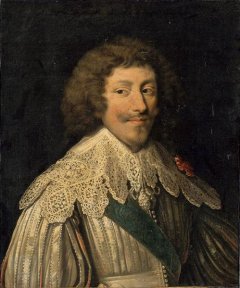
1632: Henri II de Montmorency

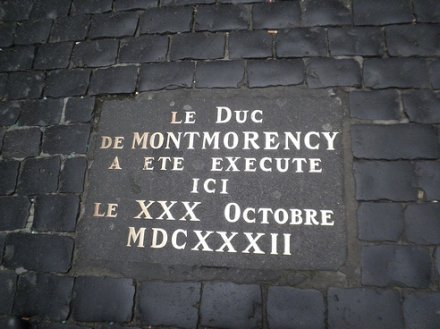
On this date in 1632, French noble Henri II de Montmorency was beheaded at Toulouse for rebellion against Louis XIII.

The lordly Montmorency (English Wikipedia page | French), sister to a famous knockout whom Henri IV wooed, was a Grand Admiral for his achievements knocking heads during the 1620s’ Huguenot rebellions. (It was Montmorency who, in the naval battle to capture Re Island, commanded the English ships controversially supplied by the Duke of Buckingham.)

His undoing? He hated Cardinal Richelieu‘s guts.

The red eminence had just attained his rank as Louis XIII’s consigliere, and set about using it to centralize the state in the king’s hands.

Toward that end, Richelieu pressed Montmorency to give up his “grand admiral” title, fearing that “grand” military generals running around the realm were liable to become a locus of sedition sooner or later. Similarly, Richelieu reduced Montmorency’s power as governor of Languedoc.* He wanted, altogether, fewer stumbling-blocks of leftover feudal authority laying about his absolute monarchy.

A seething Montmorency finally jumped — or was he pushed? — into outright rebellion in the party (French) of treacherous royal brother Gaston, duc d’Orleans. The rebel force barely materialized, and was easily beaten at Castelnauday.

Orleans fled the country, not half so committed to his revolt as Montmorency — who assailed the king’s lines practically alone. The latter, captured wounded on the battlefield, was attested to have given a ferocious account of himself in a hopeless cause: “seeing a single man charge through seven ranks and still fight at the seventh, he judged that that man could be only M. de Motmorency.”

Jolly good show, and all the more reason for Richelieu to take his head, to make an example of the man to other powerful men who demanded clemency for the rebellion as if it were Montmorency’s birthright. Richelieu would argue in his memoirs that this pitiless act to pacify the realm at the risk of his own popularity was the height of patriotism.


Plaque at the spot of Montmorency’s execution in Toulouse. Image (c) [Cova] and used with permission.

The Montmorency title eventually became that of the Dukes of Enghien, in which guise it’s associated with an altogether more famous execution.

* Among Montmorency’s other titles, less obnoxious to Richelieu, was viceroy of New France — that mysterious land across the Atlantic. There’s a Montmorency Falls in Quebec, named for him by Champlain.

On this day..

1935: Del Fontaine, punch drunk boxer

On this date in 1935, Canadian pugilist Del Fontaine was hanged at Wandsworth Prison, “the bravest fellow we ever saw go to the scaffold.”

Winnipeg-born as Raymond Henry Bousquet, Fontaine twice won the Canadian middleweight belt.

But a grueling, 98-fight career took its toll on the man.

By the end — when he had crossed the pond for a couple years traversing the English rings — Del Fontaine was visibly punch-drunk. The onetime champion lost 12 of his last 14 fights.

Punch drunk — scientific name dementia pugilistica — is just the classic diagnosis for “concussed all to hell,” afflicted by traumatic brain injury and its mind-altering long-term effects: Depression, violence, mood swings, loss of judgment and impulse control. Those are the kinds of behavior patterns that tend to brush up against the criminal justice system.

The syndrome’s popular name suggests its most visible injury, to motor skills — a symptom Fontaine’s colleagues in the business could readily diagnose.

Del shouldn’t have been in the ring at all for his last fight. He wasn’t in a fit state,” fellow prizefighter Ted Lewis testified at Fontaine’s trial, recalling a Newcastle bout that ended in a flash on three first-round knockdowns. “As a boxer, he has received more punishment than anyone I have ever seen.” The house doctor at a Blackfriars venue Fontaine had appeared at earlier in 1935 said the fighter complained of double vision and sleeplessness, and couldn’t walk straight. (London Times, Sep. 17, 1935)

If 1935 was a few decades’ shy of our present-day understanding of concussions, it was still well-enough known to those who had experience of the punch-drunk that psychological changes accompanied the physical impairments. Those who knew Del Fontaine knew he wasn’t right in the head.

The reason this tribunal had to sit for the humiliating public probe of Fontaine’s mental crevasses was that Fontaine had left his wife and kids behind when he crossed the Atlantic. Once he got to the Isles, he took up with an English sweetheart in Bristol.

This Hilda Meek, a West End waitress a decade the junior of her lover, became the object of an obsessive infatuation. In a fit of jealous rage, Fontaine gunned her down (and her mother too, although mom survived) when he caught Meek making a date with another man.

Fontaine was captured, unresisting, dolorously on the scene, and openly admitted his actions. Acquittal on the facts would be a nonstarter; diminished responsibility because of dementia pugilistica was the best defense gambit available.

The highly restrictive legal bar against an insanity defense aced out the legal maneuver: however impulsive and moody a lifetime of concussions had left him, they couldn’t be said to have prevented him “knowing right from wrong.” Still, his case attracted a fair bit of public sympathy, and when a petition for clemency went nowhere, hundreds of people, including a number of other boxers, turned up at Wandsworth to protest on the morning the punch-drunk Del Fontaine hanged for murder.

On this day..

1628: John Felton, assassin of the Duke of Buckingham

The rack, or question, to extort a confession from criminals, is a practice of a different nature: this being only used to compel a man to put himself upon his trial; that being a species of trial in itself. And the trial by rack is utterly unknown to the law of England; though once when the dukes of Exeter and Suffolk, and other ministers of Henry VI, had laid a design to introduce the civil law into this kingdom as the rule of government, for a beginning thereof they erected a rack for torture; which was called in derision the duke of Exeter’s daughter, and still remains in the tower of London: where it was occasionally used as an engine of state, not of law, more than once in the reign of queen Elizabeth but when, upon the assassination of Villiers duke of Buckingham by Felton, it was proposed in the privy council to put the assassin to the rack, in order to discover his accomplices; the judges, being consulted, declared unanimously, to their own honour and the honour of the English law, that no such proceeding was allowable by the laws of England.

William Blackstone, Commentaries on the Laws of England, vol. iv (via Harper’s)

Although the jurisprudence of 17th century England with its proscription of legal torture* still stacks up favorably next to that of Berkeley law professors, it certainly did not stand in the way of assassin John Felton‘s execution on this date in 1628.

Felton, an army officer passed over for promotion, stabbed to death nobby royal favorite George Villiers, Duke of Buckingham at Portsmouth — a private grievance fused to a widespread public one. Reams of laudatory verse churned out in the two months between crime and punishment suggest the popular opprobrium for the duke.**

Or you, late tongue-ty’d judges of the land,
Passe sentence on his act, whose valiant hand
Wrencht off your muzzels, and infranchiz’d all
Your shakl’d consciences from one man’s thrall?
But O! his countrie! what can you verdict on?
If guiltie; ’tis of your redemption.

Felton’s victim, the Duke of Buckingham — portrayed in 1625 by Rubens.

Villiers, “handsomest-bodied” scion of the minor gentry, had parlayed his comeliness into power as the favorite (and possibly the lover) of King James I. He had, as Alexandre Dumas put it in The Three Musketeers (in which adventure Buckingham is an important character) “lived one of those fabulous existences which survive, in the course of centuries, to astonish posterity.”†

Buckingham latched himself to the king’s 20-something son and heir Charles I and became a dominant influence in foreign policy as well as wildly unpopular in England. He raised Protestant hackles with Machiavellian statecraft like angling for a Spanish queen and aiding the French against the Huguenots, and since he exercised a share of the royal power he vigorously upheld the rights of the crown as against those of the commons. An opponent once compared him to Sejanus.

Indeed, Buckingham helped the youthful Charles, king since March of 1625, set the tetchy tone for his relationship with Parliament that would define his rule and ultimately cost the monarch his own head. When Parliament demanded Buckingham “be removed from intermeddling with the great affairs of State” as a condition for coughing up any more money, Charles haughtily dissolved Parliament rather than give up his favorite.

That forced the king into sketchy expedients like the “forced loan” and, when the money disputes continued after Buckingham’s death, the king’s eventual legislature-free Personal Rule that set up the Civil War.

So one can see how the sudden 1628 murder of this resented courtier, to whom was imputed every fault and abuse of Charles himself, would have been celebrated. “Honest Jack” — the assassin’s widely-honored nickname — was likewise credited with every perceived virtue of the Parliamentarian party. Juridically, the man was doomed — but in the popular eye,

[t]he passage of Felton to London, after the assassination, seemed a triumph. Now pitied, and now blessed, mothers held up their children to behold the saviour of the country; and an old woman exclaimed, as Felton passed her, with a scriptural allusion to his short stature, and the mightiness of Buckingham, “God bless thee, little David!” Felton was nearly sainted before he reached the metropolis. His health was the reigning toast among the republicans.

In fact, the man who had recently tutored future literary giant (and future Cromwellian agent) John Milton was sentenced by the Star Chamber have an ear cut off for drinking Felton’s health. (The sentence was remitted thanks to some pull with Archbishop William Laud.)

While he’s sometimes described — or dismissed — as merely a disgruntled careerist, the assassin’s own ideological commitment ought not be downplayed. Whatever Felton’s personal pique, the assassination was unambiguously political: our killer had returned from war wounded and melancholy and proceeded to marinate in the era’s anti-monarchical currents. In time, Felton came to understand — surely in concert with many of his countrymen now forgotten by time — that there was a greater good to be served by the sin of murder.

He had left behind in his trunk a few propositions that underscored his state of mind: “There is no alliance nearer to any one than his country” and “No law is more sacred than the safety and welfare of the commonwealth.” He justified himself at trial in similar terms, and did so without desiring to escape the extremities of the law that his crime demanded.

Felton had really expected to be killed in the act of the assassination himself. To that end, he had left a note pinned in his hat that is as good an elegy for him as any a republican ballad. “That man is cowardly and base and deserveth not the name of a gentleman that is not willing to sacrifice his life for the honor of his God, his king, and his country. Let no man commend me for doing it, but rather discommend themselves as to the cause of it, for if God had not taken away our hearts for our sins, he would not have gone so long unpunished.”

While Felton played his part in the generations-long struggle to subordinate king to parliament, the most immediate beneficiary of this affair was not so much the Commons as it was the noble rival who usurped the late Buckingham’s power — the Earl of Strafford.

* Certain though we are of the human rights commitment of Felton’s prosecutors, the man himself made sure of it by dint of a deft bit of interrogatory jujitsu. Menaced with the prospect of torture, he cheerfully resigned himself to it — “Yet this I must tell you by the way,” he added. “That if I be put upon the rack, I will accuse you, my Lord of Dorset, and none but yourself.”

That’s the way to convince judges not to torture you.

** An entirely less negative remembrance commemorates Buckingham and “accursed” Felton at the Portsmouth Cathedral.

† Felton also appears in The Three Musketeers, committing the murder of Buckingham at the instigation of the seductive fictional villain Milady de Winter just days before the musketeers execute Milady herself.

On this day..