1667: Chatan Chocho, Ryukyu diplomat

On this date in 1667, the uncle of the sessei — think Chief Minister or Grand Vizier — of the Ryukyu Kingdom covering the island chain south of Japan was beheaded for a diplomatic scandal.

The Ryukyu Kingdom was a weak state that made its way in vassalage to burlier neighbors, including mainland China to its west and the Japanese feudal state Satsuma to the north. Satsuma had defeated Ryukyu in war in the early 17th century, and according to Angela Schottenhammer (The East Asian Mediterranean: Maritime Crossroads of Culture, Commerce and Human Migration) Satsuma dominated Ryukyu to the extent of providing it gold, silver, and tin — not native to Ryukyu — for the latter to send as offerings to China.

The primary interest of Satsuma lay in trade with China … Since Satsuma did not have direct contacts with China and [China] officially did not want to have any relation with Satsuma, Satsuma controlled the lucrative tribute trade activities of the Ryukyus with China backstage. As far as we can tell from the available documents, Satsuma issued a series of orders to the Ryukyuans to conceal their relations with them from the Chinese, especially during the times of a Chinese investiture mission staying in Ryukyu, in order to successfully continue to obtain Ryukyuan products. Ryukyuan tribute missions were secretly used by Satsuma to obtain highly prized Chinese products for resale in Japan. The Satsuma-Ryukyuan relationship, like Robert Sakai describes, “was maintained side by side with the tributary relationship between China and Ryukyu”. This practice was carried on in the Qing dynasty. It is clear that the Ryukyus contituted an asset to Satsuma as an economic bridge between China and herself.

This trilateral relationship will help to explain the beheadings that occasion this post.

Our man Chatan Chocho, a former member of the Ryukyuan governing council, was chagrined to discover in 1665 that the emissary Eso Juko, recently dispatched from Ryukyu to China, had been ambushed by so-called “pirates” who were actually Chatan’s very own retainers in disguise. They made off with the gold offerings that were bound for the young Chinese emperor.

Needless to say this was an offense against statecraft and commerce far more serious than mere brigandage. Satsuma investigated it with al the urgency due its economic bridge with China.

It’s known as the Chatan Eso Incident, which tells you that Chatan’s attempt to bury his own connection to the crime by having those involved murdered privately did not succeed. In its capacity as the Ryukyuan boss, Satsuma ordered both Chatan and Eso condemned to death, and delivered them to Ryukyu to execute the sentence. Their children were scattered to outlying islands in internal exile. (It’s not clear to me whether Eso, the envoy who got robbed, was viewed as actively complicit in the heist, or if his execution flowed from the failure to complete his mission or a general policy of maximal due diligence.)

* I’m reporting this, with trepidation, per the dates in Wikipedia entries. I have had no luck at all tracing a primary source for this date; nor even the original calendar register to confirm whether “July 11” is indeed a correct Gregorian rendition. The best that I can report is that, per this calculator that served us well in our Torii Suneemon post, July 11 corresponds to 20th-21st Satsuki (the fifth month) of the Japanese lunisolar calendar, and 1667.5.21 is the date reported in the Chinese Wikipedia entry for the incident. That is very thin sourcing indeed; there’s ample scope for error here.

On this day..

1919: Henry Perry, made more vicious

“The war has done great good for some persons, it has taught them discipline, and made honest and honourable men of people who started badly. But the brutalities of war may have made more vicious a person who was vicious before.”

Sir Percival Clarke, prosecuting Great War returnee Henry Perry (aka Henry Beckett) for slaughtering the Cornish family of Stukely Road in Forrest Gate, London. For more, see the indispensable Capital Punishment UK Facebook post here.

On this day..

1709: Christopher Slaughterford, “Vengeance, Vengeance!”

The aptly named Christopher Slaughterford hanged on this date in 1709 — condemned, quite possibly wrongfully, for murdering his fiancee Jane Young.

Slaughterford owned a maltings at Shalford in Surrey and was known to be paying court to Miss Young when the latter went missing on the evening of the 5th of October, 1703. She turned up weeks later, dead in a pond and it was clear from the state of the body that it had been no accidental fall.

The closest relations of the victim in such cases are natural first suspects, and it was no exception with Slaughterford. With his neighbors murmuring, he turned himself in and stood trial at the Kingston assizes, winning acquittal: there was no firm evidence against him.

But the good people of Shalford not being satisfied with this outcome subscribed a second, private prosecution against Slaughterford. Some witnesses swore they’d been seen together that evening; Slaughterford and his lodger said he’d been at home. Such information as survives does not license one to make a categorical assertion of Slaughterford’s innocence but even for the time it was no better than a weak circumstantial case.”Some of the depositions against him seem very striking; yet the testimony in his favour is equally clear. There appears nothing in the former part of his life to impeach his character; there is no proof of any animosity between him and the party murdered; and there is an apparent contradiction in part of the evidence against him,” laments the Newgate Calendar. “The charitable reader must, therefore, be inclined to think this man was innocent, and that he fell a sacrifice to the prejudices, laudable, perhaps, of his incensed neighbours.”

Slaughterford for his part carried his denial of guilt all the way to the noose, signing this statement on the day of his hanging.

GUILDFORD, JULY 9, 1709

Being brought here to die, according to the sentence passed upon me at the Queen’s-Bench bar, for a crime of which I am wholly innocent, I thought myself obliged to let the world know, that they may not reflect on my friends and relations, whom I have left behind me much troubled for my fatal end, that I know nothing of the death of Jane Young, nor how she came by her death, directly or indirectly, though some have been pleased to cast reflections on my aunt. However, I freely forgive all my enemies, and pray to God to give them a due sense of their errors, and in his due time to bring the truth to light. In the mean time, I beg every one to forbear reflecting on my dear mother, or any of my relations, for my unjust and unhappy fall, since what I have here set down is truth, and nothing but the truth, as I expect salvation at the hands of Almighty God; but I am heartily sorry that I should be the cause of persuading her to leave her dame, which is all that troubles me.

As witness my hand this 9th day of July.

While the Young family was poor, they were in respect of Slaughterford’s life mightier than the sovereign herself: a private prosecution admitted no intervention by other courts or crown once a conviction was secured. Perversely, he’d have been better off having been convicted at his first trial, when the unreliable evidence might have recommended him as a good case for mercy.

Having been shown no clemency in life, Slaughterford offers none in death. Legend has it that his angry spirit now haunts the High Street of Guildford where he hanged, bearing a halter about its neck and a terrible cry of “Vengeance, Vengeance!” upon its spectral lips.

On this day..

1986: Kevin Barlow and Brian Chambers, Dadah is Death

On this date in 1986, Malaysia hanged Australian nationals Brian Chambers and Kevin Barlow for trafficking heroin.

The two men were nabbed together at the Penang island airport with 179 grams of heroin in their packs. While Chambers was an experienced drug courier, Barlow was a rookie; reportedly, his visible nervousness in the airport gave the game away. (He had also refused out of revulsion to pack the product into his stomach or anus.)

Although the amount they carried far exceeded Malaysia’s then-brand-new 15-gram threshold for an automatic death sentence, “Westerners” so-called had never yet actually been hanged there. The two were initially sanguine about their situation, expecting a mixture of bribes and diplomatic logrolling to do the trick.

Over the 20 months between arrest and their July 1985 trial, they realized their true predicament.

According to Bruce Dover, who covered their trial for Australia’s Herald Sun, “They turned on each other. The parents and family members who Barlow and Chambers had early agreed to ‘keep out of it’ now watched on helplessly from the court gallery, as each man tried to implicate the other in a desperate gambit that at best would send one man to the gallows while the other walked free … [and] in their efforts to save themselves, each had condemned the other to die.” In Dover’s estimation, the very best they could have hoped to achieve was to have one man shoulder the blame to save the other.

International appeals from all the usual suspects — Australia Prime Minister Bob Hawke, the Pope, various human rights organizations, and even Margaret Thatcher (because Barlow was a British-born dual citizen) — failed to move the Malaysian Prime Minister Mahathir Mohamad. If anything, the clamor only strengthened the domestic political imperative to advertise Malaysian resolve in a high-profile case against the special pleading of foreign busybodies.*

“Like many people of European descent, they [Barlow and Chambers] have assumed that a white skin was protection against local laws,” a Kuala Lumpur newspaper editorialized. “That is also the unspoken assumption among many in the foreign media who are now in this country. The two men should be hanged.”

They were.

A 1988 Australian television film about the Barlow and Chambers case, Dadah Is Death — “dadah” being the Malaysian word for drugs — is a star-studded affair, featuring Julie Christie on the marquee as Kevin Barlow’s mother in her fight to save her son, opposite appearances by then-little-known youngsters Hugo Weaving, Sarah Jessica Parker, and John Polson.

* A similar script played out in neighboring Singapore with a Dutch smuggler a few years later.

On this day..

1961: Edwin Bush, Identikitted

On this date in 1961, Edwin Bush was hanged at Pentonville Prison. On March 3 of that same year, he’d stabbed to death an assistant at a Loondon antiques shop just off Charing Cross, using a pair of antique daggers from the shop’s own stock. (The scene of this long-ago crime is presently a bookstore.)


The Identikit sketch, and the actual photo, of the culprit.

Although a small-time criminal, Bush was an important milestone in the evolution of the panopticon.

Poor Elsie May Batten had been attacked early in the morning, and nobody witnessed the crime. The killer/robber (he stole a sword that he later sold for 15 quid — nothing else) hadn’t left behind any usable physical clues.

“It could have taken weeks to identify the culprit,” notes this MyLondon.News profile, “but luckily a change in police technology would be of great assistance.” This new system, called Identikit,

used a standardised set of facial features to help a witness build a more accurate picture of a suspect.

In shop owner Louis Meier’s interview, Identikit was used to build a picture of the suspicious man who had gone into the shop the day before Elsie’s killing to admire the sword.

Another witness, who had seen a man and his blond girlfriend try to sell a sword on St Martin’s Lane that very same day, also did the Identikit procedure. Two facial likeness from two different witnesses were unmistakably the same man — and they were printed in the local newspapers asking people if they had seen a man looking like this and his blond girlfriend.

Janet Wheeler, the 17-year-old blond girlfriend of Bush, saw the Identikit and joked about how they fitted the description, unaware of what her boyfriend had done.

But Eddie couldn’t count on such naivete from Londoners who weren’t his girlfriend. An eagle-eyed beat cop recognized Bush from the same wanted pictures and arrested him on March 16, just steps away from the antiquarian. He was with Janet, shopping together for engagement rings. Once they had him, fingerprints, lineup identifications, and eventually a confession all fell into place.

What’s been left unspoken thus far is the story’s racial character, but that factor permeates everything. Edwin Bush’s mixed Asian-white parentage helped consign him to the periphery of London’s economic life, his unusual look possibly helped cinch the surveillance triumph for Identikit … and if Bush is to be believed, it was everyday racism that triggered his crime.

Provoked, he said, when he visited the store just to browse for the second consecutive day only to have Batten drop a racial slur on him (“You niggers are all the same. You come in and never buy anything.”), Bush

went back to the shop and started looking through the daggers, telling her that I might want to buy one, but I picked one up and hit her in the back. I then lost my nerve and picked up a stone vase and hit her with it. I grabbed a knife and hit her once in the stomach and once in the neck.

Of course, only Bush and Batten were present for their conversation, and it must be acknowledged that when Bush made this allegation about his victim, he needed to give the courts reason to mitigate his sentence.

You can hear all about the case on your run or commute in episode 7 of the Murder Mile UK crime podcast.

On this day..

1945: Harold Pringle, the last Canadian military execution

The only Canadian soldier to be executed during (… actually well after!) World War II, Harold Pringle, caught a fusillade in Italy on this date in 1945.

A 16-year-old — he fibbed about his age — enlistee from small-town Ontario, Pringle joined the Hastings and Prince Edward Regiment.

Pringle and a mate in the Hasty P’s name of “Lucky” MacGillivray linked up with some British deserters to form a black market outfit in conquered Rome. The “Sailor Gang”* enjoyed several weeks of picaresque living in the lawless city. Unsurprisingly, as Allied military authorities got control of the place they were eager to make examples of these minor gangsters. (Major gangsters were a different matter.)

The shooting death of that mate MacGillivray gave military prosecutors the means to sink the Sailors. One of their number was induced by a sweetheart deal to finger Pringle as for murdering him. Pringle and his comrades all contended that “Lucky” had been shot by mischance during one of the outlaws’ frequent drunken bouts, and having died en route to the hospital, Pringle shot him up posthumously in hopes of making the body look like it had been prey to a gang hit.

Despite all the trouble taken to secure a very dubious conviction, the execution itself was carried out in great secrecy by a tiny rump contingent of Canadians — all their fellows had already been withdrawn from Italy — who were not to speak of it afterwards.

According to Andrew Clark, the author whose research revealed the event to the wider public in A Keen Soldier: The Execution of Second World War Private Harold Pringle, it all came down a political balancing act. Canadian Prime Minister William Lyon Mackenzie King faced a June 1945 election (followed by formation of a coalition government) that a controversial execution might complicate.

However, the British had executed two of their guys in the Sailor Gang case, and reciprocity was expected on a diplomatic level. So the solution was to do it as quietly as possible, and cover it with an official secret designation. Even Pringle himself didn’t find out his sentence was confirmed until the morning of the execution.

Book CoverBook Cover
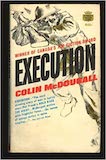
Left: The classic antiwar novel inspired by the Pringle case, which was the only novel published by Colin McDougall. Right: The 2002 nonfiction treatment that brought the affair to the public eye. Below: A 1955 episode of Four Star Playhouse also seems to be based on the Pringle case, and Colin McDougall is credited with the story.**

There’s a riveting audio interview here with a member of the Hastings and Prince Edward Regiment who had guard duty on the condemned youth on the last night of his life. “Just as brave as could be,” Orville Marshall reports.

* There’s another infamous troupe of deserter-gangsters operating in Rome in this same period, the Lane Gang. The said “Lane” — whose real name was Werner Schmiedel — was hanged by American authorities in June 1945.

** McDougall served in Italy up to the end of Canada’s involvement there, and that is surely how he came to know about the secret execution in a general sense; any more specific vector of information appears to be unknown. However discovered, Pringle clearly haunted McDougall: he took several years to write his magnum opus, and also published a short story in McLean’s in the early 1950s called “The Firing Squad”.

On this day..

1855: Pietro Fortunato Calvi, the last Belfiore Martyr

Italian Risorgimento martyr Pietro Fortunato Calvi was hanged on this date in 1855 in Mantua.

The son of a Paduan police commissioner when that province rested in Austrian hands, Calvi — that’s an Italian link, as are almost all in this post — was an army lieutenant who was drawn by the swirl of patriotism into the Revolutions of 1848. He commanded a 4,600-strong militia in Venice where the abortive proclamation of a republic was suppressed by Austria.

He fled to exile in Turin, then part of the mainland remit of the independent Kingdom of Sardinia. But his sympathy for an attempted Milanese insurrection in those parts wore out his welcome with his new hosts, and he was obliged to find refuge in Switzerland.

From there, he and four companions launched a romantic, doomed expedition to sound out the alpine north for patriotism that might be stirred into revolution anew. Their mission was compromised by a spy, however, and the quintet was soon arrested.

Transported to Mantua for trial, Calvi successfully protected his companions by throwing all the responsibility upon himself and went to the gallows with a stirring declaration as he ought.

what I have done I have done of my own free will, that I would do it again, in order to expel Austria from the States it so infamously usurped … Pietro Fortunato Calvi, rather than betraying his homeland, offers his corpse.

The place of his execution, the valley of Belfiore, has conferred its name upon a host of Italian patriots who hanged there in the 1850s. Our guy Calvi was the last of these Belfiore martyrs.

Belfiore, Mantua, Padua, Venice, Turin, and all the rest were part of a united Italy within a generation.

Italian speakers might enjoy this biography of Pietro.

On this day..

1936: Saburo Aizawa, incidentally

Lieutenant Colonel Saburo Aizawa was shot on this date in 1936.

The Aizawa Incident — an assassination — emerged from the conflict between the Kodoha (“Imperial Way”) and Toseiha (“Control”) factions of the Imperial Japanese Army.

Both these philosophies were authoritarian, militaristic, and aggressively imperialist.

However, Kodoha officers — disproportionately younger junior officers — were more radically right-wing. Their leading light, General Sadao Araki, who had been War Minister in the early 1930s, espoused a philosophy that “linked the Emperor, the people, land, and morality as one indivisible entity, and which emphasized State Shintoism.”

Toseiha is described as the more moderate faction which in practice meant that they were a bit less totalizing and a bit more institutionally accommodating: in a word, it was just the mainline outlook of the army brass. According to Leonard Humphreys, Toseiha “was not really a faction … it really consisted only of officers who opposed the Kodoha.”*

Our day’s principal accused Toseiha bigwig Tetsuzan Nagata of putting the army “in the paws of high finance” when he forced out a Kodoha ally and Araki protege in 1935, following a failed Kodoha coup d’etat. And in revenge for this perceived betrayal, Aizawa dramatically murdered Nagata with a sword in his office on August 12, 1935.

However boldly struck, this blow bespoke the dwindling prestige of the ultras.

In the months while Aizawa’s sure fate was arranged through the proper channels, the desperate Kodoha faction again attempted to seize power — and was sidelined for good when it again failed. Aizawa had the displeasure of going to his death amid the ruin of his cause.

* fn 24 on page 206 of The Way of the Heavenly Sword: The Japanese Army in the 1920’s, citing several other scholars with the same view — and noting that the names for these tendencies were both conferred by Kodoha propagandists, so nobody self-identified using the pejorative “Toseiha”.

On this day..

1778: Bathsheba Spooner, the first woman hanged in the USA

Bathsheba Spooner, the first woman executed* in the post-Declaration of Independence (i.e., post-July 4, 1776) United States.

The daughter of one of Massachusetts’s most prominent Tory loyalists — the latter fled to Nova Scotia during the events comprising this post, owing to the ongoing American Revolution — Spooner was married to a wealthy Brookfield gentleman whom she utterly despised.

From late 1777 into 1778, Bathsheba beguiled three young would-be Davids — Ezra Ross, a wounded former Continental Army soldier whom she nursed back to health; and James Buchanan and William Brooks, two redcoat deserters — into getting rid of Mr. Joshua Spooner.

Ross she sent on February 1778 business trip with her hubby and instructions to dose him with nitric acid. The youth chickened out and didn’t do it — but neither did he warn his proposed victim what was afoot.

A couple of weeks later, the Brits achieved by main force what their American opposite dared not attempt by stealth, and “on the evening of the first of March, about 9 o’clock, being returning home from his neighbors, near by his own door was feloniously assaulted by one or more ruffians, knocked down by a club, beat and bruised, and thrown into his well with water in it.” Ross, importantly, had been invited by his lover/sponsor to return and he helped to dispose of the body.

They had not a day’s liberty after this shocking crime, evidently having thought little beyond the deed; the very young Ross especially stands out for his naivete — certainly mingled with lust and cupidity as he contemplated the prospect of attaining a frolicsome, wealthy widow — when the wife went to work on him.

As She was going to Hardwick She asked me the Reason of my being so low Spirited?  I made answer It was my long absence from home.  She replyed that her Opinion was, I wanted some one to lodge with — I told her it would be agreeable.  She asked me if Such an One as her self would do?  I made answer If She was agreeable I was.  [Marginal notation: The Dialect was so.]  Upon which She said “After She came off her Journey she would See.”
 
N.B. After her Return She Gave me an Invitation to Defile her Marriage Bed; which I Expected. [accepted] And after that she proposed constantly every sheam [scheme] for her Husbands Death.  [Marginal notation: The spelling is so.]
 
Ezra Ross

The above is a written account given in jail to the preacher Ebenezer Parkman, who preached a thundering sermon three days after the executions titled “The Adultress Shall Hunt for the Precious Life””

a woman who … allows her loose imagination to range and wander after Others, nay not a few, & rove from [her husband] to pollute & defile the marriage bed [indulging] her own wanton salacious desires … How loathsome are all such, and how directly opposite the pure & holy Nature, Law, and Will of God.

So keep thee from the Evil woman, from the flattery of the tongue of a strange woman. Neither let her take thee with her eyelids. There are a thousand dangers, that poor young wretches are in by reason of the snres & traps which are everywhere laid … particularly the poor beardless youth not quite 18. (As quoted in Deborah Navas’s book about the affair, Murdered by his Wife)

Mrs. Spooner, whose Loyalist family ties did her no favors in this moment, sought a reprieve on grounds of pregnancy. Many condemned women in those days made such requests; more often than not they were temporizing devices that bought no more than the time needed for a panel of matrons to examine them and dismiss the claim. In her case, four examiners submitted a dissenting opinion to the effect “that we have reason to think that she is now quick with child.” Although overruled, they were correct: after the dramatic quadruple execution under a thunderstorm at Worcester’s Washington Square, an autopsy found that Spooner was about five months along with what would have been her fifth child.

According to an early 20th century Chicago Chronicle retrospective (retrieved here via a reprint in the Charleston News and Courier, Jan. 24, 1904) her grave can be located on a manor at Worcester that formerly belonged to the great New York City planner Andrew Haswell Green: Bathsheba Spooner’s sister was Green’s grandmother.

A full original record of the proceedings does not survive for us, but this public domain volume has a lengthy chapter about events, with an appendix preserving some of the original documents.

* We’re at the mercy of uncertain documentation in this context, of course, but there are at least none whose executions can be established that predate Spooner’s within the infant republic. Per the Espy file, a woman named Ann Wyley was hanged in Detroit in 1777, but at the time that city was under British administration as part of the province of Quebec.

For its part, Massachusetts hanged several more women in the 1780s, but has not executed any other women since the George Washington presidential administration. It’s presently a death penalty abolitionist jurisdiction.

On this day..

1523: Jan van Essen and Hendrik Vos, the first Lutheran martyrs


Christian reformer Martin Luther composed his hymn “Ein neues Lied wir heben an” (literally “A new song we raise” but commonly titled in English “Flung to the Heedless Winds”) in response to a major milestone for his movement: the first evangelicals executed for the faith, namely defrocked Augustinian monks Jan van Essen and Hendrik Vos (or Voes), who were burned on July 1, 1523 in Brussels. “How welcome must that fire have been which hurried them from this sinful life to eternal life yonder,” Luther wrote in a missive to the Low Countries. But it wasn’t that welcome: their entire Antwerp monastery had been suppressed as a heretical nest with all its denizens save these two fleeing the stake, many by way of recantation. Nevertheless, Jan and Hendrik would not be the last of the former Antwerp Augustinians to achieve the martyr’s crown and Luther’s tribute.

On this day..