On this date in 2005, Brian Steckel was executed by lethal injection for a Delaware rape-murder.
Steckel got 29-year-old Sandra Lee Long to let him into her apartment on the pretext of making a phone call. (This was 1994, pre-cell phones.) Then he throttled her, sodomized her, raped her with a screwdriver, and set her bedroom on fire. Then he fled. (Long survived the immediate attack; she would die of smoke inhalation from the arson.)
Hours later, he called The News Journal identifying himself as the “Driftwood Killer” and threatening his next prospective victim by name. Police took that woman into protective custody and traced harassing calls she’d been receiving to Steckel, who obligingly confessed when arrested.
And investigators took Steckel’s threats at their word — as well they might with Long’s ghastly murder already under his belt — and counted themselves lucky to have nipped a potential spree killer in the bud. Steckel “thought about committing a murder for a long time,” New Castle County detective John Downs said. “We got him relatively early in his career. This was something he’d worked at.”
Fond of the drink and none too stable, Steckel menaced his own attorneys, spat at prosecutors, soaked up the media attention, and sent dozens of letters from prison, including Long’s autopsy sent to Long’s mother with a scribbled taunt reading “Happy, Happy. Joy Joy. Read it and weep. She’s gone forever. Don’t cry over burnt flesh.” He also made and retracted various dubious confessions to various murders in various states, and alternated between slandering his (known) victim and calling himself an “animal” for killing her.
If the evil was unfeigned, so was the remorse. At the end of his trial, he surprisingly addressed the the jury with an assent to his own execution.
I didn’t know how to say I’m sorry. How do you tell someone’s family you’re sorry for strangling them? … How do you do such a thing? I don’t know. I ask you people to hold me accountable for what I did. I’ve gotten away with so much in my life that I stand here today … I know I deserve to die for what I did to Sandy. … I’m prepared to give up my life because I deserve to.
He carried a like sentiment to the gurney, where he was apologetic to the victim’s mother he had once mocked.
I want to say I’m sorry for the cruel things I did. I’m not the same man I was when I came to jail. I changed. I’m a better man … I walked in here without a fight, and I accept my punishment. It is time to go. I love you people … I’m at peace.
At this point where the repentant felon ought to close his eyes and exit, an awkward 12-minute delay followed while the lethal injection machine clicked several times and Steckel remained lucid, appending his last statement with observations like, “I didn’t think it would take this long.”
While state officials denied there was any problem with the exceedingly slow lethal injection, Steckel did not appear to have been rendered unconscious, and was awake when he finally snorted and convulsed into death.
Attorney Michael Wiseman, pursuing a later lawsuit against the state’s death penalty procedure, claimed that the main IV line was blocked and when executioners switched to the backup line, they didn’t bother (pdf) re-administering the anesthetic sodium thiopental that forms the first drug of the basic three-drug lethal injection cocktail. That omission meant that Steckel would have been conscious when he was hit with a paralytic dose of pancuronium bromide, and still conscious when that was followed with an excrutiating heart-stopping shot of potassium chloride. (More on the process.)
Wiseman even got a member of the execution team to testify that he was “okay with” causing Steckel suffering owing to the bestial nature of Steckel’s crimes. (The source for this is the January 29, 2009 News Journal; the article is no longer available online.)
A federal circuit court rapped Delaware for “occasional blitheness” and “isolated examples of maladministration,” but rejected the lawsuit.
After a five-plus year hiatus following Steckel’s execution, the Blue Hen State resumed executions in 2011, switching for the occasion to the trendy new anesthetic drug pentobarbital since execution chambers can no longer get hold of sodium thiopental. Just like Brian Steckel.
That’s far and away the most for governors under the modern US death penalty regime. But is it an all-time record?
Rick Perry is number one.
The answer appears to be “yes”: a review of state execution data reveals no other governor throughout the U.S. constitutional era who even approaches Perry’s body count, at least not when it comes to peacetime civilian cases. Only two other men — Perry’s predecessor George W. Bush, and Depression-era New York chief executive Herbert Lehman* — appear to have signed off on as many as one hundred executions.
In attempting to explore this question, I compiled this rough list of the U.S. governors who have overseen a large number (35+) of executions. Emphasis on rough. The method I’ve used here is just a quick manual comparison of the historical U.S. executions recorded in the Espy file to U.S. governor terms as reported on Wikipedia. Then, I backed out known federal executions, which for most of U.S. history took place in various state prisons. (For instance, Ethel and Julius Rosenberg were electrocuted at Sing Sing in New York … but not by authorities of the Empire State.)
I would not suggest sourcing anything one depends on to the figures in this chart without further investigation and qualification; the list is certain to contain errors, including:
Omissions or mistakes by the Espy file itself.
Miscalculations or misdating on my part.
Governors who served non-consecutive terms who I’ve failed to identify.
Any consideration of governors who might have been temporarily incapacitated or absent during their term with another party exercising the relevant powers in their stead
Civil War executions, which I simply steered around
Beyond attributing numerical counts to date ranges, this list reflects essentially no state- or period-specific research: it’s worth bearing in mind that the legal context and gubernatorial authority relative to the death penalty vary over time and between states. A name and a number on this list is not the same as judging a governor personally “responsible” for all or any of those executions, not even necessarily to the extent of having signed off on a death warrant. It’s only in the late 19th century and into the early 20th century that states centralized all executions away from localities and into state penitentiaries, with the familiar appeal-for-clemency ritual. A given governor’s personal involvement in a given local execution prior to that (and particularly in antebellum America) is not to be assumed. Even now, some states (present-day Texas included) limit the ability of the governor to extend clemency, or vest that power in an agency.
Caveats aside, here’s that rough (rough!) list:
The large numbers here predictably map to large states (with lots of people to commit lots of crime and generate lots of death cases) and/or long-serving governors. Rick Perry is about to start his 13th year as Texas governor, and this is actually a remarkably long tenure. Most governors in U.S. history have held the office for surprisingly brief periods, just 2-4 years.
For example, post-Reconstruction Jim Crow Georgia executed at a terrific pace (routinely ten or more executions per year, for decades on end) and several of its governors therefore appear on this list … but those governors had what you might call limited upside, as they were term-limited to two consecutive two-year terms. Had Georgia ever put an executive kingpin in the governor’s mansion for a decade or more, that person would easily rank up there with Bush and Lehman. (Not with Perry, though.)
Typical office tenures have somewhat lengthened into the 20th and 21st centuries, but this is just when the execution rate itself has fallen off. Many of the larger (50+) execution totals come from the period when those two trends crossed in the first half of the 20th century, with men (Ann Richards, George W. Bush’s predecessor, is the only woman to show) running large states for five-plus years.
This confluence also leads to the interesting appearance of liberal lions among the 20th century’s most prolific American executioners:
Liberal “Rockefeller Republican” Thomas Dewey, with 95 executions as New York’s governor.
Dewey’s running mate in the “Dewey Defeats Truman” presidential election, Earl Warren: he sent 82 to the gas chamber in a decade as California governor before he was appointed to leave his lasting legacy heading a left-leaning Supreme Court
Franklin Delano Roosevelt, who okayed 51 executions as governor of New York (and then 16 more federal executions as president)
Gifford Pinchot, who’s best known as the progressive-era father of the Forest Service, but also spent eight years as Pennsylvania’s governor and oversaw 81 executions.
Feel free to chime in with corrections, data points, musings, and bootless speculations in the comments.
* Herbert Lehman was the son of one of the founders of Lehman Bothers investment bank. Bush was the son of the founder of the inexplicable Bush political dynasty. We’re guessing nobody thought of their prolific-executioner connection when the Bush administration let Lehman Brothers go bankrupt in 2008.
On this date in 1858, a slave named Henry — property* of a local farmer named William Jackson — was hanged in Decatur, Georgia for attempted rape.
We have of this occasion a first-person account from a 16-year-old white neighbor of the Jackson farm, Catherine Hewes, and the impressions she recorded of it that evening are reprinted by John C. Edwards in “Slave Justice in Four Middle Georgia Counties” in the Summer 1973 Georgia Historical Quarterly. A few additional paragraph breaks have been added for readability, and [sic] notations where necessary either by myself or by Edwards; however, there are many other minor language irregularities not worth individually noting, and simply presented as-is.
The Execution of Henry Jackson a slave of William Jackson at Decatur Ga. at an early hour this morning I dressed myself and prepared to accompany my brother and Sister to Decatur, a beautiful village an [sic] the County site of DeKalb county Ga. As we lived four miles south of Decatur we crossed the Georgia R Road in sight of the village, where we stopped a few moments to enquire where the gallows had been located and were infomed that it was situated one mile north of the Court-house on the Shallow ford road.
By ten Oclock a great many people throned the streets, and clustered around the old weather beaten jail. Our little company had beome quite a respectable crowd before we reached the Public Square where we drove slowly through the immense mass of living beings. All along the way form the Court-house to the gallows Carriages, Wagons and carts were seen bearing on their living freight to the scene of the execution. The high and low the rich and the poor the free and the bond alike pressing forward to the gallows their desires of seeing the law enforced and crime meet its own reward.
After a slow tedious drive we arrived at the appointd place where the rough benches had been erected in an old field whos [sic surroundings were on the amphitheater order. For several hours I had been pleasantly situated and with good company which caused thime [sic] to pass by almost imperceptibly but when I was confronted by a “gallows,” the simple construction of which was two upright posts and a cross beam from the top of the posts I viewed it with horror.
My reflections gushed forth when my eye took in the surroundings. On one side of the gallows were the colored people and on the other side the white people who had gathered on the little hillock. It was quite gratifying to the feelings to see the willingness of slave owners to teach their Slaves an important lesson by sending them here to day. The gallows, yes here on this gallows ill-fated Henry, will have to give up his life for crime and go to his long home with God in eternity.
In the midst of my reflections I saw a vast crowd of people coming from Town toward the gallows[.] It was announced that “They are a coming.” and I looked and saw on [sic] Ox-cart coming on which rode the unfortunate Henry dressed in a suit of white sitting by the coffn which was to incase his lifeless form. They drove the Ox-cart near the gallows, then the drive unhitched the Sturdy oxen and proceeded to direct the cart by hand.
The Sheriff plased [sic] his guard and when the cart stopped under the gallows by the platform a negro man ascended the stand and sang Hymns. Many joined in singing aloud the praises of God, while I stood gazing on in amazement. At the conclusion of the Hymn he offered a very appropriate prayer which seemed to affect a great many. When he raised up from prayer he began exhorting the people from Acts 6-23 — “For the wages of sin is death, but the gift of God is eternal life through Jesus Christ our Lord.” [sic — she means Romans 6:23] When he had ended his discourse, the Rev. Jns. W. Yarbough got up and made a short, but very appropriate exhortation.
They closed the religious services, but the convict desired to speak to the people. His discourse was very affecting, so much so that some of the black women shouted praises to their immortal King. The mother of Henry screamed aloud and shouted with vehemence while her son stood on the platform speaking to the auditory. At the conclusion of his remarks the Officers began to fix for his execution. The Sheriff, Capt John Jones, a capital man, was very much affected during the Scene. They first tied his feet together, then his hands, and then adjusted his clothing. The Sherff then permitted him to look over the vast multitude which surrounded him for a few moments and then tied a white handkerchief over his face which excluded it from view.
The hangmans Knot was adjusted around his neck then the rope was passed over the cross-bar of the gallows[.]
All things read at 12 N the Sheriff descended the steps to the ground and with help drew the Cart on which the Convict stood from under him — leaving the dangling form of the poor victim suspended in the air by a rope. When the form dropped from the Cart, a loud groan went up from the people and then they people [sic] began to disperse.
After the untwisting of the rope and the shrugging of the shoulder had ceased the Dr. E N Calhoun (I believ [sic]) approached and took hold of the hand and after a few moments announced that life was extinct. We came back to town and staid [sic] a few hours, and while at the Old Washington Hotel Kept by Mr. Banks George, I saw the Sheriff Mr Jones bring the corps [sic] back and carry the coffin up a flight of rickety steps to the door of the second story of the jail and deposit it therein. Doubtlessly the Doctors will take advantage of this subject for anatomical investigation, and be found with sleeves rolled up chatting over the mortal remains of this deluded victim. We left town with Mrs Parker, masters Bob and Miss Betsy, and got home before night.
Cottage House DeKalb Ga.
Catherine M. Hewey
November 3, 1858
* Henry was William Jackson’s only slave, and the latter was not compensated by the state for Henry’s execution: it was a substantial loss to the master.
On this date in 1801, 73-year-old James Legg(e) was hanged for murdering his mate William Lamb(e) at Chelsea Hospital.
Both men were pensioned ensigns from His Majesty’s service. According to the trial transcript, Legg was sinking into obvious depression. A nurse of long acquaintance remarked on
a lowness, a melancholy and deranged state; knowing him so long, I took the opportunity of asking him what was the matter with him, and the reason of his melancholy; he told me his mind was confused; that he had no rest night or day; that he was hurried from place to place, and could not tell what he was doing; and I really was afraid he would make away with himself; I was always unhappy when he was out of my sight, for fear he should do himself an injury; I never mentioned it to the doctor, because he was harmless … sometimes when I spoke to him, he would start like a person surprized out of a sleep; sometimes he would give me an answer, and sometimes only just a bow; I still observed that lowness and melancholy, and that his head was always confused down to the time of this unfortunate event.
Ah. The “unfortunate event.” Legg took it to mind that Lamb was “a tyrannical tempered man” who gave him “repeated insults” and challenged him to a duel. (Lamb’s widow, the only witness to the murder, said her husband had no beef with his killer.)
When Lamb quizzically (or scornfully) discarded the pistol that the irate Legg had forced into his hand, Legg just shot him dead.
He probably had no expectation that he’d just punched his ticket to artistic immortality.
Legg hanged exactly a month after the homicide. During the interval, three Royal Academy of Arts members — sculptor Thomas Banks and painters Benjamin West and Richard Cosway — pulled some strings with the Chelsea Hospital surgeon Joseph Carpue to get Legg’s body after death.
These gentlemen had an idea that centuries of artistic representation of Christ’s crucifixion were nonsense from a physiological point of view.
It was a natural outgrowth of Europe’s long fascination with anatomical accuracy — a fascination that made liberal use of executed bodies.
Despite the centrality of Christ’s crucifixion to western culture, nobody had seen an actual crucifixion — not for centuries. So, sure, you can make the guy on the cross look like a proportioned, three-dimensional human being …
… but is this really what a proportioned, three-dimensional human being would look like when nailed to a cross?
That Chelsea surgeon Carpue and his artist friends had the best way to find out. (Well … the second-best.)
“A building was erected near the place of the execution; a cross provided,” Carpue recorded. After hanging, “the subject was nailed on the cross; the cross suspended … the body, being warm, fell into the position that a dead body must fall into … When cool, a cast was made, under the direction of Mr. Banks, and when the mob was dispersed it was removed to my theatre.” West supposedly exclaimed that he had “never before seen the human hand” until he saw James Legg’s nailed and stretched.
Carpue proceeded to flay the cadaver and make a second cast from the grisly skin-less ecorche … an artistic/anatomical practice of the age whose best-known product is Smugglerius, also cast from a hanged man.
On this date in 1912, investigative reporter Emile Gauvreau saw George Redding hanged at the Connecticut State Prison in Wethersfield.
“When I left the prison to write my story,” Gauvreau later wrote in his memoir My Last Million Readers,* “I found out why newspapermen drank and I had my first half tumbler of cognac.”
Gauvreau was 21 years old, and he wasn’t a pup any longer.
This hard-charging journo from a rough-and-tumbler age would later make a name for himself pioneering the lowbrow Big Apple tabloid style with his New York Graphic. (“The PornoGraphic”, it was nicknamed.)
And he made his bones for that classic career in newsprint — from high school dropout to cub reporter to the heights of the profession — by making bones of George Redding.
The case was the mysterious February 1912 murder of a Hamden produce peddler by the name of Morris Greenberg. Greenberg was lured to a wooded area en route to buy from a local farmer and shot dead there for his cash. Police were stumped.
Gauvreau at the time was busting hard at the police desk of the New Haven Journal-Courier (since merged into the New Haven Register). He took a page from Sherlock Holmes and went to work on the sensational case freelance … painstakingly eliminating Hamden residents until he was left with George Redding.
Redding was a young man on the make himself, a charming 21-year-old playwright who’d been throwing a lot of money around lately and was known to carry a sidearm.
Circling his friends and paramours, Gauvreau sealed the young man’s fate by laying hands on a damning confessional that Redding had sent a friend. Gauvreau even stage-managed the arrest so that he could shock rival papers and police detectives by breaking the whole story in his paper. All that was left for police was extracting Redding’s confession.
As mentioned last year, having Executed Today run for five years was, when the site was launched, the crazy-optimistic aspirational idea. October 30, 2012 completed five full years with nary a day missed since the debut; with this day’s Halloween post, we’re into the trackless seas of Year VI. Here there be dragons.
This site has a strange rhythm for authorship, like the spiritual transports of the monastic rule: perpetual sleep deprivation, numbing repetition, immersion in arcane texts. Some days it’s endless drudgery, and the prior has to nudge you awake mid-chant; other days, the ingredients mysteriously add up to some bizarre ecstatic state and the posts pour effortlessly out of the fingers.
The most sobering thought is that this site is the magnum opus of my life so far. If I get jumped by a vampire this Hallow’s Eve, this blog is the first thing in my obit. And like the undead, it would survive its owner’s corporeal death: as of this writing, there are more than 90 posts already pre-scheduled for the months ahead.
Which means that, yes, we’re planning to go after those Year VI dragons.
Traffic
Site pageview numbers show a steady growth, from 1.9 million in November 2010-October 2011 to more than 2.3 million in November 2011-October 2012. The site will enjoy its seven millionth all-time pageview tomorrow. While there’s nothing wrong with 20% growth, the “natural” growth path of the site is even higher. It’s just been suppressed of late by …
Care to celebrate with a fifth of vodka?
The great malware scare of 2012
Probably the less said about this the better. If you’re a regular visitor, you already know you’ve enjoyed intermittent spells of Google’s maddeningly non-transparent site malware scarlet letter over the past few months. I’m sorry. I’m trying.
I wish there were any indication that said efforts were to any purpose at all. Google (whose blacklist is the source of all the red flags) randomly interdicts the site every couple of weeks for no apparent reason. All site scans show everything clean, and Google must agree since it un-blacklists the same site without any changes a few hours later.
It’s certainly possible that there lies below a real and cunningly intermittent bug, but given that Google has blithely false-positived the site before, it’s also possible that Google just blithely false-positives the site.
I do any due diligence I can find to do, but with so much time seemingly run to waste one grows numb to the specific events: they blow in like the weather, remote from any causation or control or actionable information or evidence of actual harm. At the end of the day there’s an indifferent, unaccountable algorithm that’s either screwing up (but can’t be appealed), or else capturing an elusive piece of information (but not divulging it). And a site administrator who’s barely keeping up.
Frustrating.
Other, less irksome traffic facts
Just a few small snapshots from Executed Today’s statistical profile these days.
After standing for 3 1/2 years, the one-day traffic record set August 13, 2008 when Andrew Sullivan linked the site was finally overwhelmed on March 5, 2012 thanks to a link from Cracked.com.
That same link makes Cracked the top non-search engine traffic source for the entire year.
In a virtual tie behind Cracked: Wikipedia* links (led by Eva Dugan and Andrei Chikatilo), and Twitter links.
As we make the turn into Year VI, about 200 folks subscribe to Executed Today updates by email; these are part of the 1100-1200 who read the site via RSS feed.
Over 5,000 tweets emanated from the @executedtoday Twitter feed, bringing it to an alarming lifetime total of around 12,400 micro-updates; this has not deterred followers from hitching on at a net pace north of two per day, now numbering over 1900 in all.
The U.S., Canada, Australia, New Zealand, Ireland, and the U.K. (of which, overwhelmingly England) together constitute about 68.6% of the 1.1 million distinct site visitors over the past year. Half of the remainder hail from elsewhere in western Europe, apart from the British Isles.
The most prominent traffic sources outside of western Europe and North America? In descending order: Philippines, India, Poland, Brazil, Russia, Singapore, Malaysia, South Africa, Turkey, the Czech Republic, and Japan. All of these countries’ browsers called on Executed Today more than 5,000 times over the past year.
China just edged Serbia for 46th place on the traffic ranks, trailing Pakistan, Slovakia, and Thailand. Hong Kong, as a separate region, ranked 40th, but even China plus Hong Kong fell just short of 5,000 visitors for the year.
I had no recorded visits at all from North Korea, Western Sahara, or South Sudan. (But I did get six from East Timor.)
Slightly over 10% of the site’s visitors read it on a mobile device. The iPad barely topped the iPhone as the most popular such platform; each had about 4% of the site’s total traffic share. Android devices collectively notched about 3%.
Top Posts
The most popular posts on Executed Today to date are mostly 3+ years old, and owe their numbers in part to the statistical accumulation intrinsic to longevity. (The most popular posts that were actually written in the previous twelve months concern George Stinney, the 14-year-old whom South Carolina electrocuted for rape in 1944, and the Sikhs who assassinated Indira Gandhi … both 20th century executions, like almost all the all-time most-trafficked posts.)
These top 60 posts (and this list excludes the popular top-ten lists; all the “executions that defined decades” posts would be among the top 60) are truly an elite group on the site, comprising about one in 30 of all the daily posts in the blog’s first 1,827 days. In hard number terms, Ted Bundy (whose post is home to a long discussion thread closing in on 6,000 comments) has been viewed over 133,000 times, while the second- and third-place posts are around 50,000. Those posts at the bottom of this list have been viewed over 9,000 times apiece.
Guest-written content has been a mainstay on the site from day one and instrumental to its continued existence. Year V was no exception: some six weeks’ worth of posts were, er, executed by folk other than I.
Particular thanks go to Meaghan Good not only for her amazingly prolific contributions but for her flexibility around the site’s editorial needs. (Read: she’s been willing to let me bump posts out a year when something else comes up or there are competing schedule priorities. I do this to my own posts all the time, but I hate to ask it of others.) Meaghan wrote almost 10% of this past year’s posts, and she found almost all those executions through her own research as well.
I don’t know how or why she does it, but I’m so thankful that she does.
Just some of the everyday posts I particularly enjoyed researching, writing, or generally learning about this year.
Shahla Jahed, the footballer’s mistress who hanged after an Iranian O.J. trial
Jewish anti-slavery insurrectionist Isaac Yeshurun
Brokeback outback? The touching story of gay bushrangers
The Anabaptist Munster rebellionAllen Foster‘s dying allusion to youthful sparring dates with black pugilist Joe Louis got his gassing mentioned by Martin Luther King
Aris Kindt, the hanged thief who ended up on a Dutch dissection table … and in a Dutch master’s painting
Wyatt Outlaw’s lynching in 1870 North Carolina emblemized the tragic defeat of Reconstruction
Lady Hamilton, the Scottish lady-in-waiting in Peter the Great’s court, who may or may not have snuck into Scottish ballads
Take an example from Paul Warner Powell: please confirm your understanding of your Fifth Amendment rights before bragging about committing capital murder to a prosecuting attorney
Formerly a perfectly accepted local wise woman, Matteuccia di Francesco got burned at the stake after San Bernardino of Siena came around firing up witchcraft hysteria
Pierre Vigier‘s contested hanging in a Gascony whose putative ducal lord was the English king highlighted the confusing lines of feudal authority … and presaged the coming age of the nation-state
William Frederick Horry, which is really a post about the career of the cool and professional new guy who hanged him — William Marwood
Antioch’s Muslim defenders were perplexed by Crusader knight Rainald Porchet, who instead of arranging his own ransom incited his captors to martyr him
There was once a worldwide campaign to establish the innocence of James Hanratty, hanged on questionable circumstantial evidence in Great Britain. But latter-day DNA tests confirmed his guilt after all
Leo Tolstoy was pretty shaken up after seeing Francis Richeux guillotined. Consider that beside his depiction of an execution scene in War and Peace
Everyday heroes: Joan Peterson refused to help some unscrupulous local pols disinherit a local woman by accusing her of witchcraft. So those pols accused Joan of witchcraft instead
Public sympathy for Andrew Wilson, hanged for robbing an excise collector, caused his hanging to set off a chain of events triggering one of Edinburgh’s most destructive riots
A missionary preserved an account of Chief Zacharias Kukuri‘s hanging during the German genocide of the Herero in present-day Namibia
Extraordinary rendition during the Stuart Restoration, when three fugitive regicides were kidnapped from the Netherlands
A little misunderstanding about just how much “emancipation” the Russian serfs were getting led to Anton Petrov‘s revolt and subsequent execution
The dangers of theology: Danes like Michael Blodorn really got into “suicide-by-executioner”
Public defender Johnny Mostiler made out pretty well mailing in defenses for indigent people in Spalding County, Ga. His clientele, like Curtis Osborne, did not
Lee Akers survived one of the most horrific prison fires in history (author Chester Himes, then a fellow-prisoner with Akers, wrote about it) only to die in the Ohio electric chair
Francois de Montmorency was executed for his dedication to the weird and intractable subculture of dueling
A showy 1680 Madrid auto de fe was the last of its kind
Merchant mariner who tries to ram a submarine: hero or war criminal?
The great-grandfather of the current Dallas County District Attorney
French triple murderer Henri Pranzini‘s public guillotining was of interest both to the artist Gauguin and to a young St. Therese of Lisieux
Thackeray (maybe it was Thackeray) mocked sympathy for an 18th century philologist-murderer by penning a satirically sympathetic homage to an 18th century foundling-flogging murderer
This hilariously lowbrow patriotic travestying of art following Alexander II’s near-assassination at the hands of Dmitry Karakozov is one of my favorite anecdotes on the site
Beware the rampaging vegetariansBosavern Penlez‘s hanging under the riot act for grabbing some linens from a whorehouse being destroyed by a mob almost set off a riot of its own
The best post series of the year was all about Jamaica’s Morant Bay Rebellion
Linkbait
We also added new companions to the long-popular “10 executions that defined the 2000s” post. This was our take on the Nineties and Eighties death penalty cases that loomed largest.
Yes, sure, they attract plenty of clicks. But they’re not cynical features; it’s actually quite diverting to think about and write these up.
With the site set to surpass the 2,000-post mark in the year ahead, expect to see more roundup, highlight, and list-type posts that offer new views of the vast content reservoir hereabouts.
In addition, of course, to the usual steady stream of fresh daily posts replenishing said reservoir.
* I don’t place my own site’s links on Wikipedia — seems a little tacky — so any traffic from that quarter is as near to earned as possible.
On this date in 1907* an audacious would-be suicide bomber was executed by tsarist Russia.
Thousands of Russians immersed themselves in the late 1900s in revolutionary struggle after the Romanovs bloodily stopped the 1905 revolution. So many of them were executed that the gallows became known as “Stolypin’s Necktie”, after the sitting Prime Minister.
Twenty-one-year-old conservatory pianist and singer Evstolia Ragozinnikova got involved in a plot to assassinate the said Stolypin. (It was only one among several such plots, one of which finally succeeded in 1911.)
But “Tolia” feigned madness and then escaped the psychiatric hospital where she’d been confined. She rejoined her Socialist-Revolutionary conspirators, some of whom tried to get her to flee to Milan to further her musical studies.
Instead of concert houses, Ragozinnikova raised the curtain on her magnum opus on October 28* with a bid to land a Guy Fawkes-like blow against the autocracy.
Communist-turned-anticommunist Whittaker Chambers would, much later, remember in his correspondence with William F. Buckley the power that deeds like Ragozinnikova’s had to inspire, notwithstanding Lenin’s eventually-orthodox disavowal of terrorism. For Chambers, it was not material immiseration but spiritual disinheritance, existential despair — the sort that made artists into suicide bombers — that was the true midwife of Communism.
I may presume in supposing that the name of Ragozinikova is unknown to you. But the facts are these. In 1907, the Russian government instituted a policy of systematically beating its political prisoners. One night, a fashionably dressed young woman called at the Central Prison in Petersburg and asked to speak with the commandant, Maximovsky. This was Ragozinikova, who had come to protest the government’s policy. Inside the bodice of her dress were sewed thirteen pounds of dynamite and a detonator. When Maximovsky appeared, she shot him with her revolver and killed him. The dynamite was for another purpose. After the murder of Maximovsky, Ragozinikova asked the police to interrogate her at the headquarters of the Okhrana. She meant to blow it up together with herself; she had not known any other way to penetrate it. But she was searched and the dynamite discovered. She was sentenced to be hanged.
Awaiting execution., she wrote her family: ‘Death itself is nothing, … Frightful only is the thought of dying without having achieved what I could have done How good it is to love people. How much strength one gains from such love.’
Chambers aside, she’s not so well attested on the English-lanuage Internet; there’s a bit about her in Russian here and here, as well as some references to both Ragozinnikova and her peers in an academic pdf, “Women in the World of Gender Stereotypes: The Case of the Russian Female Terrorists at the Beginning of the 20th Century” by Nadezda Petrusenko in International Journal of Humanities and Social Science, April 2011.
* Gregorian dates. By the local Julian calendar in Russia, she committed her murder on October 15, and was hanged on October 18.
This date in 1885 saw the hanging in Grand Forks, North Dakota* of 19-year-old farmhand George Miller for butchering his employer’s wife and child in order to loot the farmhouse while the patriarch was away.
For this terrible American Gothic crime, we turn to the American Press.
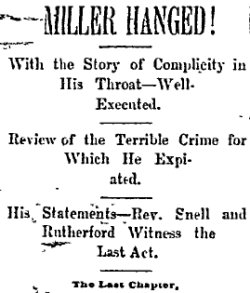
Miller was the first person hanged in North Dakota and the local Grand Forks Herald marked the date with a voluptuous recounting (occupying an entire page, plus two more columns on the next page) of the late scandal all the way to the felon’s scaffold accusation. Here it is, in its entirety …
In the middle of last January when all the earth was wrapped in a mantle of purity, an esteemed minister of the gospel, the father of a bright family of children and a devoted husband with a loving wife, resided on his prosperous farm in the township of Inkster, this county, surrounded with the 320 broad and fertile acres, horses and cattle and improved farming implements he called his own. His earthly possessions he had acquired by industry, thrift and economy, with the wifely assistance and the aid of the little boys and girl that had blessed their union. This gentleman was Rev. C. Y. Snell at one time minister of the Baptist church in Grand Forks, but who had, like nearly all settlers in Dakota taken advantage of his rights and acquired a farm, which had brought a handsome return. His summer’s work done, his grain garnered, he had sent three of his children to Grand Forks to acquire a good education in her public schools, and remaining at the farm, was his wife Abbie and little son Herbie, aged eleven, and the hired man George Miller, a young man of quiet demeanor, aged about 19 years, who had helped to garner the summer’s fruits and whom both Mr. and Mrs. Snell had implicitly trusted.
Thus situated on the 16th of January, Rev. Snell bade his wife and son good-be, little dreaming that the
SHADOW OF THE DEMON
was in his door and before another fortnight his loved ones would be prone, stark and mangled in the icy embrace of blood and horrid death. He went on his errand of good will to Mayville where he was engaged in missionary labor for his Lord and Master. On the 31st of January, two weeks after his absence, he received a telegram informing him of the doleful event — the murder of his wife and boy, and he hastened with bowed form and bleeding heart to the spot where the light of his joy had been ruthlessly extinguished.
OH RUEFUL SCENE!
The demon had done his worst! Have not the details of that heartless butchery been told again and again? Why not draw the veil upon the foul deed? The ghastly corpses of the innocent and unsuspecting sleepers — mother and son, hurled into eternity in a moment while taking the repose of the righteous — as found there by the neighbors a week after the tragedy — divulged the heartlessness of the assassin whoever he might be, and the thorough depravity of the soul that could impel the ruthless ax to deeds of death.
THE VILLAINOUS SHREWDNESS
with which the murderer had avoided suspicion was manifest in the fact that so long a time had elapsed before the discovery of the crime, and will be further apparent as the story progresses. He had been a companion of Henry Rutherford and to avoid immediate discovery, Miller the confessed criminal, had told the nearest neighbors that he intended to give Mrs. Snell a drive on Sunday and that he would haul wood the following week. Thus no suspicion was aroused until late in the week. Friday, Rutherford a simple, untutored laborer who lived alone at Bennett’s place about 60 rods from the Snell residence, thought it strange that there was no stir or animation about the place, and after finding the stock nearly famished, and watering it, alarmed the neighbors and the dreadful truth was discovered. The neighbors H.P. Reiton, Simeon, Miller, C.G. Gordon, Mr. Vietch, Henry Blakely and others found the dead bodies undisturbed and the rifled trunk with its empty money box and the robbed children’s bank just as the murderer had left them. Thus it was plain
THE MOTIVE WAS MONEY —
the sordid lust for gold that causes men to imperil their souls and makes of earth a probationary sheol for evil minds. Mr. Snell had sold considerable grain and when he left he took $300 with him, leaving some money, together with some keep-sakes and the children’s savings in the cash-box in the trunk. After he had gone, Miller sold more wheat and received from agent Holden $205, which he may have turned over to Mrs. Snell or not. But that the robbery of Mr. Snell in some way, was in his mind for a week before the crime was committed is shown by the testimony of Mr. Holden to the fact that Miller asked him a week before, whether he could deliver a load of wheat unknown to Mr. Snell and it further shows that the idea of robbery did not originated with Rutherford at a dance on the 20th of January, only four days before the murder as Miller claimed in his statement before the judge. It shows that the robbery was in contemplation by him without an accomplice and, being ignorant of the fact that Mr. Snell had taken $300 with him to Mayville, he doubtless committed the crime for more money that he received —
FLEEING FROM JUSTICE
After committing the crime, he hastily placed the ax beneath the bed, threw up the bedclothes over the faces of the dead, robbed the trunk of its keep-sakes, harnessed the best pair of horses in the stable, took Snell’s driving gloves and drove forty miles over the cold bleak prairie with the thermometer at 30 degrees below zero, arrived in Grand Forks at break of day Sunday morning in front of the Northwestern Hotel and ordered the team put away and his breakfast prepared. In the sled-box was an overcoat of the boy he had murdered which had probably been left there when the unsuspecting youth last accompanied him in the delivery of the wheat the proceeds of which he contemplated stealing. There was also left there the overalls which Miller had worn and upon which bright specks of blood had been discovered and whose dumb voices cry out testimony against the last black lie of the series which the obdurate murderer coined in the cell against poor simple Rutherford. With the team was Snell’s faithful dog, which followed the fleeing assassin. Upon his arrival here, he commenced a series of ingenious but
BASE COINAGES TO EVADE PURSUIT.
He told Powery, the clerk at the Northwestern Hotel, that he had come to meet his brother at the train and he might go to Winnipeg for a week. He also exhibited some gold pieces which he wanted changed, but the clerk had no change. The design of this story was too evidently to direct pursuit towards Winnipeg, if the team were soon identified as Snell’s. He soon walked off seemingly unconscious of any obligation to pay for his breakfast and next called at the Chicago clothing house, rousing Mr. Ephraim out of his late Sabbath repose. He told Mr. Ephraim a different tale. He was thrown of[f] his guard by the sharp questioning of Ephraim, while selling him the buffalo overcoat, black valise, pocket book, and other out-fit that later led to the capture and identification. He explained the possesion of his roll of bills, amounting to several hundred dollars by saying that he had sold a team of horses receiving $275 for it and intended to go to Turtle Mountain, thus evading the true objective point. He also got rid here of the tell-tale keep-sakes, the gold dollars which Mr. Snell had treasured for years, and the nickles, dimes and quarters which the little Snells had perhaps been years in gathering. Being shown the way to the barbershop of Mr. Kruger by Mr. Ephraim, after he had bought his disguise, he further changed his apperance by getting his hair cut close and his face shaved. Here he left the only clue to the direction in which he was intending to go, by inquiring whether a train left for Crookston, and up to the discovery of this fact by a HERALD representative, the officers seemed to be impressed with the fact that he had really gone to Winnipeg to which point as well as others they telegraphed as soon as it was learned that the team was left in this city. It must be remembered that it was not until the following Saturday that the tragedy was made known and in that time the murderer might have left the country, if he had not been paralyzed by his own wickedness and depravity. Learning at the barbershop that no train left for Crookston on Sunday, he walked to the station on the railroad track and bought a ticket for Fargo, displaying the new red pocket book to the agent. After spending a few days at Fargo among variety women, and having had his picture taken by a photographer, he went to Brainerd, Minn., where he stopped at the house of Malcolm McLaren for a few days more.
I’d be very surprised if our suspect was from Brainerd.
While at Brainerd, he associated with women of loose character and spent considerable money lavishing presents upon them. It seems that he met a female there whom he had formerly known in Iowa. At first he talked to Mr. McLaren about going into business. He wanted to do chores, when he learned that his money was nearly all gone. The St. Paul papers on Sunday morning following the discovery contain accounts of the murder with description of the hired man of Snells, but imperfect, as his disguise was not known, but when the statement of the Northwestern clerk about the gold pieces was published, Mr. Ephraim at once reported the Sunday morning transaction and it was thus that
HIS SIN FOUND HIM OUT.
His new outfit together with the way he had disguised himself were immediately telegraphed to the associated press by the HERALD and with it a statement of the reward offered. When the papers arrived at Brainerd, Miller had quietly decamped, realizing that he was too near the scene of the tragedy. But McLaren, an old detective immediately concluded that the fellow who had staid [sic] at his house was the person sought, and securing a deputization from the sheriff, he drew money for an indefinite trip, learned that Miller had boarded the train with a ticket for Anoka, and followed him up. On the same train went Hartley and another, bent on the same errand and watching McLaren. At Anoka, McLaren happened to strike the bus for the very hotel at which Miller was stopping and he now felt certain of
ARRESTING HIS MAN.
Miller was in his room and armed. McLaren knew the character of the brute better than the inexperienced who put any faith in his pretences during his last days. He concluded to wait till Miller came down, and while McLaren was at breakfast, he heard the murderer’s foot-falls on the stairs and entering the washroom. McLaren immediately left the table and coming up behind Miller with his pistol cocked arrested him, but as he did so, Miller laid his hand on the revolver in his hip-pocket, but the gun of the sheriff had the desired effect and he was disarmed. His attempt to get away from McLaren on various pertexts [sic] and his denial of all knowledge at the start are remembered. It was not until they were in the cars and coming back to Brainerd, that he
CONFESSED HE DID IT ALONE.
The way he happened to weaken was this, McLaren said to him, “Now you may as well tell all about it. I can tell you of a place in the forests where you will never be found, if you get away at the next station.” Miller then told his first story about how he was crazed with drink after being chid by Mrs. Snell, and killed her and the boy, and after getting over his stupor, and seeing what he had done, he stole the money and tried to get away. He reiterated this oft-told tale to Sheriff Jenks and others at Brainerd and again to reporters of Fargo papers, who managed to get up a considerable maudlin sentimentality for him. For prudential reasons, there having been a great deal of feeling that he should be given short shrift and a stout rope, he was kept at Fargo for several days, and finally brought here very quietly and lodged in jail. When it was known that he was in jail and likely to be tried speedily and executed according to law, popular excitement over the enormity of the crime subsided. The Rev. J.T. Davis and Rev. Snell, at an early day obtained an interview with Miller, and he reiterated the intoxication story as before in their presence, calling upon God to strike him dead if his story was not true. He also as positively stated to the gentelemen that he alone did the crime and no one was concerned with him in it.
It was not until after the Grand Jury had found a bill that this mild, child-like and bland assassin,
CHANGED BASE.
He then asserted that Henry Rutherford was with him, concocted the idea of robbery and urged it against his wishes, until he was finally persuaded to connive and assist, although Rutherford he said, actually did the horrible deed, while he did the running away to South America. In the face of his former statements this story only seemed to aggravate his villainy. However, able counsel, Judge C.B. Pratt, was assigned him and every thing that legal subtlety and experience could avail, was rallied to save his neck from the law’s penalty. The people, however, were fortunate in having so learned and able a coadjutor as District Attorney W.A. Selby and so just and firm a judge as Hon. W.B. McConnell; for, notwithstanding the able, artful and persistent defense made by Judge Pratt, justice was vindicated. Upon the defendant’s own plea of “guilty,” ascertained, verified and corroborated by all the witnesses, who fully and completely exonerated Rutherford from the suspicions cast upon him, and satisfied the conscience of the court, sentence of death was passed upon him and his appeal to the higher court sent back with an approval of the action of the District Court. His statement to the Judge, when informed of this action, suggesting some new matters not before mentioned, is still fresh in the recollection of everybody.
The last few days of his life seemed to have passed by him in a happy, careless, indifferent and easy frame of mind. He talked freely about his own execution, expressed no great sorrow or penitence for, at least the part he played in the atrocious crime, but pretended that he was glad the end was so near. His spiritual advisor, Rev. F. Doran conversed and prayed with him and did all in his power to turn his thoughts towards that awful Judge who hath decreed that “whoso sheddeth man’s blood, by man shall his blood be shed.”
HIS LAST NIGHT
on earth was uneventful. About eight o’clock he was left alone for a time in his cell and was seen from Bruce avenue to perform various antics, rising suddenly from his chair and jesticulating wildly with his arms as if again swinging the baleful ax which brained his helpless victims. He was restless and this has been observed that when left to himself and his thoughts, he was not the calm, self-possessed person he appeared to be when in the presence of visitors. During the evening, Rev. Snell had an interview with him for about an hour and a half. The prisoner claimed to others that he had succeeded in persuading Mr. Snell of the correctness of his last story. He was set up with by Deputy Sheriff Ackerman and others until after midnight. At one o’clock he retired and at 7:30 this morning he arose apparently refreshed. He ate a hearty breakfast consisting of beefsteak, potato, cake, etc. His cell has a window pane out and the wind being in the south, Miller was cold and was brought down into the office where he smoked a cigar, one of a number left him some days ago by some women who called upon him and were recognized by the prisoner as old acquaintances. The district attorney was present and inquired further about portions of Miller’s statement made to Rev. Doran. Presently Sheriff Pierce of Nelson county and friends came in, also County Commissioner Steele, Henry Rutherford and Mr. Vietch. Rutherford was told that Miller still insisted upon his story and was asked what he thought of it. He said, “then Miller lies. That is all.” Soon after an interview was had between
MILLER AND RUTHERFORD
in the presence of District Attorney. Miller said to Rutherford: “You know you had a hand in this thing as I have said.” Rutherford, without any trepidation replied: “It is a lie and you know it. I don’t like to be lied about.” Subsequently the statement in the nature of a history of his career and the crime was read in the presence of Rutherford who said nothing. When asked about it, he said it was “no such thing. It was all a dang’d lie!” When asked about the part in which Miller alludes to the false mustache, Rutherford said he had such a mustache but did not think Miller had ever seen it. He said he kept it in his trunk and described it to the district attorney corresponding with the description given by Miller. This circumstance and one in respect to changing wagon boxes, also a statement now made that the Snell stock was not famished, although the witnesses testified that it was, were industriously emplyoed [sic] last night and this morning to weaken the district attorney and cause him to apply for the respite of Miller. Mr. Snell himself after his interview with Miller last night seemed to have been influenced by his story and urged and begged the district attorney to intercede for Miller. Mr. Selby said he could do nothing unless Mr. Snell or some one on his behalf, would swear that Rutherford was an accomplice, when he would take such action as was proper in the cause of justice. Up to noon, Snell had done nothing of the kind. There was also pressure brought to bear from various sources to effect the same purpose, but none were willing to assume any responsibility.
THE LAST HOUR
was spent in the parlor of Sheriff Jenks with Revs. Currie and Doran who administered all the Christian consolation the solemnity of the occasion could afford. They talked to him, prayed for him and he himself made a fervid prayer. His nerve maintained his head erect to the end, which did not seem to fear.
ASCEND THE SCAFFOLD.
At 1:30 accompanied by Sheriff Jenks, he ascended the scaffold. The Sheriff suggested that if he had anything to say he should speak. Miller stood with the rope almost danging in his face, his hands clasped, and his body slightly bent. About two feet in front of him stood Henry Rutherford who, during Miller’s 15 minute talk, kept his gaze firmly fixed on Miller’s face. Rutherford looked like a person suffering great mental strain and slightly changed color at times while Miller was speaking, but his eyes never flinched. Rev. Mr. Snell occupied a position to the left of Rutherford, almost touching him and when Miller alluded to Rutherford’s alleged connection with the murder, Mr. Snell gazed almost fiercely into Rutherford’s face, Rutherford meanwhile keeping his eyes fixed on the doomed man. C.B. Pratt, Miller’s counsel, during the recital of the murderer’s statement, watched Rutherford closely.
Miller spoke with apparent effort and several times during the recital of his story had occasion to put his handkerchief to his eyes.
HIS LAST WORDS.
Gentlemen: — I am accused of the crime of murder which I did not commit. I have not committed murder. I was in company with the party and gave my consent, but gentlemen, I never committed the murder myself.
On the 30th day of January I was in Inkster with Mr. Rutherford. He and I sold 100 bushels of Mr. Snell’s wheat and we divided the money. That night we got home between eight and nine o’clock and Rutherford asked me how much wheat Mr. Snell had and I told him over 200 bushels besides a few loads which I had drawn. He wanted to know how much money was in the house and I told him as near as I could. He wanted to know how we could get it and I told him we could chloroform the folks and get it and he said he would do it. The 22nd, 23rd and 24th we were hauling grain to town and we talked again about getting the money. That night I went down to his house to supper and Mr. Blakely came in and that stopped our talk there. I went to Mr. Snells and that night I had a long conversation with Mrs. Snell and when it got about bed time I went to my room with my lantern and sat down on the bed and pulled off my rubbers when I heard a knock at the back door and went and opened it and Rutherford sad, George are you ready to do that? I said no, I hae had a long talk with Mrs. Snell and she is so good and kind to me that I cannot do it. He says you said you would do it and now you got to do it. He said dead folks tell no tales. He said he would do it and handed me a mustache to put on so folks would not know him and took the axe and went in and I went to the barn and harnessed one horse and was just putting one collar on the other when he came out and said, hurry up George I have done it. I tied the horse and I went in and found them dead. He says hurry up let us get away before anyone happens to catch us moving around so he hurried and got the team hitched up and I went to the house and got the money and gave him an even $100 and took $115 mysel and got what clothes I wanted. I wanted to change my clothes and put on a white shirt, but he said hurry up for I could get what clothes I wanted at Grand Forks. He brought the team up and tied them and I got what things I wanted and he helped me fasten up the storm door. He wanted me to go direct to South America and go right through. Said for me to write him when I got there and he would write me the circumstances here. At this ponit Miller was overcome with emotion and stopped a while.
Now gentlemen, every word hat I have told you is true and now as dear as that family was to me, I never could have consented to murder them as I was used there as their son. I was always treated well; they thought the world of me and I did of them but by the hands of another man’s deed I am to be hung and I am going to my grave and I am thankful that I can trust in God and feel that my sins have been pardoned.
And now I feel that the other party shall receive the same punishment that I have. It is not because I am down on him and it is not for malice but it is just what should be done. As dear and as good as that family was to me I could not go in and murder them. But thank heaven I am willing to die. This world would be no pleasure to me after this and I do not want to go to penitentiary. I am better satisfied to go to my grave. I am fully satisfied and feel that what has been done is just, as that family always used me like a son, always good, always dear in every shape, never refused me money, never refused me anything.
Now, gentlemen, I want you all to remember that this is the truth and nothing else. I won’t meet you any more in this world face to face but I hope we can all meet in the world to come.
When Miller had finished Henry Rutherford turned to District Attorney Selby and asked that he might make a statement of denial.
ADJUSTING THE ROPE.
Sheriff Jenks, who occupied a position on the scaffold just behind Miller, then approached and commenced binding the wretche’s [sic] hands and limbs with straps, and while placing the cap, which was of brown worsted, Miler again commenced to speak, and even while the sheriff was placing the noose around his neck Miller asked his executioner to say “good bye” for him to his friends.
THE DROP.
Barely a second’s time had elapsed from the moment the noose was adjusted before the trap was sprung, so adroitly and neatly did Sheriff Jenks do his work. Miller’s body shot down at 1:45 o’clock with a sickening thud, his neck being broken by the fall. A few moments after the drop the body quivered and the legs were slightly drawn up several times. Life was pronounced extinct 15 minutes after the fall by Coroner Roundwell and at 2:10 the body was cut down and carried into an adjoining cell, where the straps were removed. Shortly afterwards undertaker Caswell took charge of his remains which were interred this afternoon in the cemetery among the unknown sleepers. Thus ends this chapter of the bloodiest and most heartless murder in the annals of Dakota and the murder’s just doom, should be a warning to all evil-doers that there is no mercy for the slayers of the innocent.
MILLER’S STATEMENT.
Following is a statement prepared by Miller and given to Rev. Doran several days since. He swore to it this forenoon before Judge Cochrane, in presence of several gentlemen.
TERRITORY OF DAK.
GRAND FORKS, Oct. 30, 1885.
The last statement and confession of Geo Miller, before his execution in Grand Forks, Oct. 30, 1886.
TERRITORY OF DAK.,
COUNTY OF GRAND FORKS.
I, George Miller, was born in Toledo, Ohio February 17, 1866. My father and mother are both dead; about 12 years ago my mother died and my father 2 years later; have one brother, four years older than myself named Frank, two sisters both younger than I, two and four years; father was Bohemian; mother French; came from Iowa to Casselton last June, 1884, remained there 2 days; from Casselton to Larimore, arriving about the 13th of July, 1884, left there on the 11th, arriving at Mr. Snell’s that evening; at the expiration of four months hired to him for $30.00 a month; never refused to pay me; liked the family; first got acquainted with Henry Rutherford in Mr. Snell’s harvest field. He and I thrashed wheat together in August, 1884; often I met him at Mr. Bennet’s place in the evenings and was with him all through thrashing. Had hauled wheat once or twice before the dance by Brothrs [sic?] Bogs and also by Rutherford; went from Rutherford’s house; I furnished the cutter and he the horse; went together; he and I began to drink together; on the 1st of January took four or five drinks together that day in three different saloons and each took a pint of liquor home with us. The next day Rutherford went to Inkster; came back to “Vietches” where Mrs. Vietch was doctoring him, when Mrs. Snell and Essa Vickery saw him and told me that he was drunk; drank almost every time we went to Inkster; on the 20th of January, 1885, we sold five sacks of Mr. Snell’s wheat; I had 35 sacks of Mr. Snell’s wheat; Rutherford had 20 sacks of his own, we called it 10 bushels; spent most of it for liquor and cigars; changed sacks between the livery stable and saloon; he gave me half the money.
The dance was on Tuesday, the 20th of January; got to the dance about 8 or 9 o’clock, left about 3:30 a.m.; Rutherford asked me how much wheat I had hauled off; told him over 2000 bushels; he asked how much money there was about the house; I told him 6, 7, 8 or 9 hundred dollars; he said can’t we get it; I did not think we could, the trunk was too near the bed; he said we could kill the folks and get it; I did not want to do that, I said wait until we go to town and get some chloroform; Rutherford did not want to do this for fear we would be caught; nothing more was said about it for two days; coming from town I rode with him; he asked me what I thought about what we had talked about; told him it was not right to kill them for a little money;
And for what? A little bit of money.
he said we must work some plan to get it; I told him nothing must be done at this time. Nothing more was said until the Saturday it was done; we went to town together and on returning, when about to separate to go to our homes he asked me to come over that afternoon and help him sack up wheat, I told him I would; he said we would talk over this other thing, referring to the money of Snell’s.
In the afternoon I went over and we worked at the wheat and made all the arrangements to kill the folks; I was to leave with the team either for Larimore or Grand Forks and then take the first train for South America, we were both to go in and do the killing, I stayed at Rutherfords for supper, Harry Blakely came to call on Rutherford, we stayed and talked until eight or nine o’clock, then I started hom and Rutherford and Blakely started to go to Abner Veitches. I went to Mr. Snell’s and did the chores, Mrs. Snell was pleasant and talked pleasant, the last thing I did was to bed the horses and nail up the granary, that was about ten o’clock at night, I then went to the house and whittled my shavings and left them by the stove, pulled my rubbers off my felts and went into my room and set down on the front side of my bed, and was just going to pull of[f] my felts when Rutherford knocked at the kitchen door, I went to let him in, he says are you ready to do that, I told him no I was not, he said it had to be done, you gave your consent at the granary, “dead folks tell no tales.” I said if you want to do it you can, I won’t, he says all right, get me the ax, I went out and got it and when I gave it to him he pulled a false mustache out of his pocket and told me to put it on him, it was black and fastened in the nose with two wires, he had on woolen mittens. I think I got my coat, cap and mittens from the dining room and went to the barn while he did it and had one horse harnessed when he came out and said hurry up I have killed both of them, let us [get out of] the place before anyone sees us moving around, he led out one horse and took the other and hitched on to the sleigh, drove to the front door to hitch both horses, we both went in the house, I went into the bed room and got the money and took it into the dining room and divided it. He had $100, two $20, one $10 and one $50 bill, I had one hundred and fifteen dollars, he put his in his pocket and I put mine in my coat pocket, then I went into the bed room and changed coat and vest, then I got my overcoat and scarf and a large pair of mittens, fine boots and overshoes and handed them to him to carry to the sleigh for me. I took two or three blankets off my bed and took them with me. I got the key and locked up the door, he held up the storm door while I put the blocks against it, we got into the sled and rode up to his corner, he told me to go to South America, I told him I would, when he got to the corner we stopped and bid each other good-bye by shaking hands, he said as soon as I got there I was to write to him and he would let me know how things were, I told him I would.
GEO. MILLER.
Signed in the presence of
JAMES A. JENKS.
GEO. B. WINSHIP
TERRITORY OF DAK.,
COUNTY OF GRAND FORKS.
I, George Miller being first duly sworn on his oath says that I have heard read the foregoing statement by me subscribed and know the contents thereof and the whole thereof and that the statements therein made are true of my own knowledge.
GEO. MILLER.
Subscribed and sworn to before me this 30th day of October, 1885.
J. M. Cochrane,
Judge of Probate.
* At the time, not North Dakota but the Dakota Territory; North and South Dakota would attain statehood four years later.
Claude-Francois de Malet (English Wikipedia entry | French) had spent the years of his confinement for republican sensibilities painstakingly readying bogus orders and decrees for the eventual rollout of the most audacious putsch you’d ever want to putsch.
While Bonaparte was off on campaign trashing Russia, Malet broke out of his sanitarium and went to work.
Donning a general’s uniform, Malet on Oct. 23, 1812 presented a forged announcement of the Emperor’s recent demise … and started issuing orders. He bluffed the release of imprisoned allies, and got a legitimate general to order the arrest of Napoleon’s most prominent deputies in Paris. (It’s a good job that general obeyed Malet, because when one officer asked to kindly see the arrest warrant Malet was using on him, Malet responded by shooting him in the face.)
For a few hours that morning the Malet conspirators almost put themselves in control, almost normalized their sudden rearrangement of authority with its reassuringly familiar official paperwork. Later, when interrogated for the identities of his accomplices, Malet would retort, “You, yourself, Sir, and all of France — if I had succeeded!”
But the attempted coup which aimed so high ultimately made for little but tantalizing counterfactual history. Officers with clearer heads soon realized that they had received communiques from the Emperor dated after his purported October 7 death; one of those officers arrested Malet.
A tribunal was constituted later that same date. It had little difficulty condemning 14 (French link) during the small hours of the morning on Oct. 29. They were shot later that same day (at least, most of them were; there are oddly conflicting accounts on this point). This public-domain French text preserves a first-person narration of the scene, in which Malet himself — usurping authority to the very last — commands the firing platoon that’s lined up to shoot his comrades.
120 bullets riddled these unfortunates, who fell all except Malet. He stood on his hands and knees and raised his hands to his chest as he was only wounded, and retreated to the wall on which he leaned:
“And me, my friends!” cried he, “You forgot me!”
(One of the executed fellow-officers was Gen. Victor Lahorie. Lahorie’s lover was Sophie Trebuchet, and his lover’s son, Victor Hugo, was about to catapult himself to literary fame.)
While the Malet plot failed on its own terms, it got quite a lot farther than it had any right to expect — and this fact rightly alarmed the Corsican.
“Bad News From France”, by Vasily Vereshchagin, depicts a retreating Napoleon — bunking in an Orthodox church — finding out about Malet.
Was his position that precarious? And why, if some officers genuinely believed him dead, did nobody hail as emperor his infant son and designated heir?
Napoleon had already begun his catastrophic retreat from Russia when he got word of Malet’s attempted coup d’etat; the struggling Grande Armee was dwindling daily under the battering of cold, desertion, and Russian snipers. Now this?
Upon discovering his late narrow escape from a homefront conspiracy, Napoleon left his miserable troops under the command of Murat* and raced ahead of them back to Paris to secure his own position.
This new confluence of domestic vulnerability and foreign defeat marks the beginning of the end for Napoleon. Europe ganged up on the weakened French, and less than 18 months after Malet faced his executioners, France’s own generals forced Napoleon to abdicate.
* Murat soon ditched the army himself to try to preserve himself as King of Naples. (That didn’t end well.) The once-gigantic army’s remnants finally straggled home under the third-string leadership of Eugene de Beauharnais — the capable son of Josephine’s guillotined first husband.
This is the feast date (in Christianity’s western tradition) of Saint Jude.
Possibly one of the bit players among Jesus’s original 12 apostles — “Jude”/”Judah”/”Judas” was a common name among first-century Israelites, so there’s some confusion about the identities among various texts talking about various (?) Judes — St. Jude is aptly-for-this-blog considered the patron saint of “lost causes” or “situations despaired of”.
He’s traditionally supposed to have knocked around the eastern Mediterranean after the Nazarene‘s crucifixion, introducing Christianity (along with St. Bartholomew) to Armenia, which eventually became the first officially Christian kingdom. (Jude is also a patron saint of Armenia; his other patronage gigs include the Philippines, the Chicago Police Department, a a Brazilian football club, and countless hospitals.)
Despite making so many sad songs better, Jude was eventually martyred, possibly in Armenia, allegedly by halberd; as a consequence, that sinuous poleaxe is Jude’s iconographic symbol on the relatively rare occasions when he’s artistically depicted. It’s also something you can buy in pendant form: come on … embrace The Halberd. But again, there are different versions as to who martyred Jude and where, and considerable confusion over how many Judes those versions might be conflating.
At any rate, for those up against the executioner and despairing of any but the most improbable deliverance, St. Jude is your man.
There’s even St. Jude software which prevents execution … of rootkit exploits.
I, Francis Steinernherz, will be the first noble of my profession, where I shall have despatched one more knight of the Empire.”
“Thou hast been ever in my service, hast thou not?” demanded De Hagenbach.
“Under what other master,” replied the executioner, “could I have enjoyed such constant practice? I have executed your decrees on condemned sinners since I could swing a scourge, lift a crow-bar, or wield this trusty weapon; and who can say I even failed of my first blow, or needed to deal a second? The term of the Hospital, and his famous assistants, Petit Andre, and Trois Eschelles, are novices compared with me in the use of the noble and knightly sword. Marry, I should be ashamed to match myself with them in the field practice with bowstring and dagger, these are no feats worthy of a Christian man who would rise to honor and nobility.”
“Thou art a fellow of excellent address, and I do not deny it,” replied De Hagenbach. “But it cannot be — I trust it can — not be — that when noble blood is becoming scarce in the land, and proud churls are lording it over knights and barons, I myself should have caused so much to be spilled?”
“I will number the patients to your excellency by name and title,” said Francis, drawing out a scroll of parchment, and reading with a commentary as he went on, — ” There was Count William of Elvershoe — he was my assay-piece, a sweet youth, and died most like a Christian.”
“I remember — he was indeed a most smart youth, and courted my mistress,” said Sir Archibald.
“He died on St. Jude’s, in the year of grace 1455,” said the executioner.

 Steckel got 29-year-old Sandra Lee Long to let him into her apartment on the pretext of making a phone call. (This was 1994, pre-cell phones.) Then he throttled her, sodomized her, raped her with a screwdriver, and set her bedroom on fire. Then he fled. (Long survived the immediate attack; she would die of smoke inhalation from the arson.)


 In the middle of last January when all the earth was wrapped in a mantle of purity, an esteemed minister of the gospel, the father of a bright family of children and a devoted husband with a loving wife, resided on his prosperous farm in the township of


 Possibly one of the bit players among Jesus’s original 12 apostles — “Jude”/”Judah”/”Judas” was a common name among first-century Israelites, so there’s some
