1415: Jan Hus, reformer of religion and language

On this date in 1415, Czech theologian Jan Hus was burned at the stake at Konstanz for heresy.

This statue of Jan Hus in Prague’s Old Town is a tourist magnet. image (cc) autumnal fire

Hus might be the most consequential pre-Lutheran Christian religious reformer, and the Hussite faith he founded still persists to this day.

In his own time, Hus expounded a reformist theology inspired by John Wycliffe, and putting Holy Writ into the vernacular was essential to his program. His religious movement found common cause with a Bohemian political interest in exploiting western Christendom’s clown carful of rival popes to stake out greater national independence.

He eventually met his martyrdom by agreeing to come to the Council of Konstanz (Constance) under a guarantee of safe conduct, where prelates were going to sort out their rival popes and do the periodic Church reform thing.

Instead, Hus was seized and imprisoned — you don’t have to keep promises to heretics, see; it’s all a part of this noble era’s expediently plastic sense of honor — and tried and condemned and implored to recant and finally burned alive.*

But the disobedient movements Hus had kindled in life were not so easily reduced to ash.

In the aftermath of the great ecclesiastic’s execution, a significant conflict erupted in Bohemia. For a generation or so of the Hussite Wars, the man’s followers repelled Catholic incursions before they too finally succumbed.

Even then, it wasn’t over (and still isn’t). Though it wasn’t all specifically about the guy named Jan Hus — these things never are — the Catholic powers that be were still fighting and propagandizing against Hus centuries later, into the Counter-Reformation.

Today, the statue of Jan Hus that everyone flocks to see in Prague’s Old Town Square is flanked by a Catholic church on one side … and a Catholic church that’s become a Hussite church on another.


Since all of the above and a great deal more about Hus and Hussites is readily available at the search engine of your choice, we thought — after the above introduction — to redirect our conversation to a dimension of Jan Hus less widely recognized: his foundational role in the development of the modern written Czech language, and especially its use of diacritics. Hus is generally credited as the creator of the haček or caron.

Thanks to friend of the blog Sonechka for helping ferret out this excerpt, from the chapter on Czech by Robert Auty in The Slavic Literary Languages: Formation and Development, ed. Alexander M. Schenker and Edward Stankiewicz, Yale: 1980.

The religious reform movement associated with the name of Jan Hus (1371-1415) had important consequences for the Czech literary language. Knowledge of the Bible was an important element in the reform program of Hus and his followers: the Bible was to be made available to the people in their own language and priests had to be able to expound it in a clear and straightforward manner … The establishment and continuous polishing and revision of the scriptural text played a great part in the development of the written Czech vernacular. Moreover the Czech translation profoundly influenced the earliest Polish versions of the Bible.

…

Hus’s own views on the language emerge not only from his practice but also from various theoretical utteranes on the subject. It has been shown that in morphology and vocabulary he tried to modernize the language in accordance with the development of natural speech. In phonology however he took up a more conservative position … Hus was also critical of another element of contemporary Prague speech, the proliferation of Germanisms in the vocabulary. In this he took up a position similar to that of many of his countrymen four or five centuries later and castigated those who said handtuch (Ger. Handtuch) for ubrusec ‘towel,’ šorc (Ger. Schurz) for zástěrka ‘apron,’ trepky (Ger. Treppen) for chódy ‘steps,’ knedlík (Ger. Knödel) for šiška ‘dumpling’ and the like. It is interesting to note that many of the Germanisms to which Hus objected have in fact disappeared from the language; yet others have resisted; knedlík, for example, has become fully domesticated.


A Czech knedlík by any other name would still taste as chutný. (cc) image from Michal Sänger.

It is in all probability to Hus that we must ascribe the establishment of the orthography of modern Czech, for this is essentially based on the diacritic system expounded in the treatise known as De orthographia bohemica. Written at the beginning of the fifteenth century, the tract, though it cannot with absolute certainty be ascribed to Hus, is nevertheless held by the great majority of scholars to be his work. …

The revolutionary innovation advocated in De orthographia bohemica was the introduction of the diacritic system, that is to say the extension of the repertory of graphemes by the user of superscript marks. For the consonants the principle adopted was to use the unmarked Latin letters for sounds which (in the contemporary pronunciation) were identical in Latin and Czech, but to indicate specifically Czech sounds by means of a superscript dot over the letter concerned. Thus … č, š, ž, ř … [which] indicated not palatal articulation but non-Latin-ness. …

It seems most probably that he was influenced by the Hebrew practice of indicating by a dot (dageš) variant phonetic realizations of the same grapheme. We know that Hus learned some Hebrew, and this would seem the most obvious source of this orthographic device. …

The diacritic orthography was not immediately accepted, despite the fact that a handful of early fifteenth-century manuscripts employed it. It gained ground in the later fifteenth and especially in the sixteenth century and became adopted as the standard. With the advent of printing in the late fifteenth century the Gothic (black-letter) form of the Latin alphabet was used for Czech books as it was for German. When the forms of the letters were standardized Hus’s lozenge-shaped dot was changed to the ‘hook’ (haček) which lives on as the reversed circumflex of the present-day Czech alphabet. The indication of vowel length, originally similar to a comma, was systematized as an acute accent (referred to in Czech as &#269árka) …

By the time the Hussite wars ended in the 1430’s the Czech language was in use in most spheres of national life. It was established as a medium of administrative and legal documents, and it was increasingly used for learned and technical writings … When we consider that the relative uniformity of the phonological and morphological structure of the language remained unimpaired, and that its orthography was in the process of consolidation, we can establish the mid-fifteenth century as the period of origin of the Czech literary language as a normalized, polyvalent, nationally recognized idiom.

Czechs and their normalized, polyvalent, nationally recognized idiom get a public holiday and all the hačeks they can drink in Jan Hus’s honor today.

* Just to make sure everyone got the point, this same council ordered the remains of the long-deceased Wycliffe exhumed and posthumously “executed”.

On this day..

1983: Aleksandr Kravchenko, in Chikatilo’s place

On this date in 1983, Aleksandr Kravchenko was executed in the Soviet Union.

Kravchenko attempted to rape and then brutally strangled to death nine-year-old Lena Zakotnova in December 1978, dumping her body in a nearby river.

Oh … wait, no. That turned out to have been done by later-infamous serial killer Andrei Chikatilo: actually, Zakotnova was Chikatilo’s very first victim.

Sorry about beating that confession out of you, Sasha.

As for Russia’s present-day criminal justice system, there’s no more death penalty. But, “if a person ends up in a police cell as a suspect, he will find himself in court no matter what, and the court will find him guilty, guaranteed. And everyone knows it … you’ll end up in court, then straight to jail. The machine works automatically. It happens all the time.”

On this day..

1861: Francisco del Rosario Sanchez

This is the sesquicentennial of the execution of Dominican Republic independence hero Francisco del Rosario Sanchez.

Statue of Sanchez at the image (cc) PBT Foto

The biggest name in the Dominican Republic’s successful separation from Haiti is generally reckoned to be liberal visionary Juan Pablo Duarte, but he’d been exiled to Venezuela by 1843.

In his absence, the republican cause coalesced around the 26-year-old Sanchez — who was saluted as chief of the government junta by the rebels whose February 27, 1844* seizure of Ozama Fortress commenced the victorious Dominican War of Independence. This makes him kinda-sorta the first head of state for his country.

This circumstance returned Duarte from exile, but the latter lost the ensuing presidential election to rancher Pedro Santana, who steered the country towards Spanish annexation as a hedge against Haitian recapture. Santana re-exiled Duarte, and booted Sanchez as well. Ironically, he had to take refuge in Haiti.

If the evil seek pretexts to sully my conduct, we respond with a charge saying loudly, but without boasting, that I am the Dominican flag.

–Sanchez

His attempt to invade the Dominican Republic to prevent the Spanish takeover quickly foundered, and within weeks of his capture he was shot at San Juan de la Maguana.**

Just a couple of years later, a different revolt achieved the same objective. Their successors in the independent Dominican Republic continue to honor Francisco del Rosario Sanchez as one of the nation’s foremost visionaries.

His son, Gen. Juan Francisco Sanchez, went on to become the country’s Minister of Foreign Affairs.

* February 27 is the Dominican Republic’s Independence Day.

** He was the second member of his family executed by Pedro Santana: a province of the Dominican Republic is named for his sister, the independence movement’s first female martyr.

On this day..

1648: The leaders of the Salt Riot

On this date in 1648, the ringleaders of a short-lived rebellion over salt taxes were executed in Moscow.

Salt saker image (cc) Greg Bishop

The Salt Riot is exactly what you’d think from its name, right down to being over in a matter of weeks.

Common folk irked at a new salt tax* that made the commodity dramatically more expensive besieged tsar Alexei I at the beginning of June, soon joined by opportunistic Streltsy who hadn’t been paid in a while.

The specific target of their rage was the boyar Boris Morozov, the elder brother-in-law of the teenage monarch, and the true power behind the throne. He accordingly played the traditional role of bad cop to the tsar’s presumptive good cop.

Of course, both guys were really on the same team.

A few days of mayhem, a few boyars’ heads on pikes later, the Streltsy had been bought off and the rioters divided and quashed. Alexei avoided handing over Morozov to the vengeance of the mob, and “exiled” him to a monastery. He would return from “exile” in a few months, once everyone had chilled out and the rising could be taken with a grain of salt.


Salt Riot in Kolomenskoe, by Nikolay Nekrasov.

This passing spasm in the Russian polity left a long-lived and troublesome legacy: one of the demands of the rioters was the convocation of the Zemsky Sobor to hammer out a new legal code.

This happened to be a need for the Russian state anyway, since its rulers were governing by the haphazard issuance of countless ukases nobody could keep straight. So, 1649 saw the promulgation of the Sobornoye Ulozheniye, helpfully rationalizing the lawmaking process.

Win, and win! Except that this legislative milestone also codified serfdom in its most heavy-handed form, formally binding most Russian peasants to their estate without freedom of movement, and making this unhappy condition hereditary. The legal code, and the institution of serfdom subsisted until the 19th century.

* According to The Cambridge History of Russia, the salt tax itself had actually been abolished at the end of 1647, but “other direct taxes were tripled to compensate for the loss of revenue.”

On this day..

1934: Ernst Roehm, SA chief

On this date in 1934, in the coda to Hitler’s Night of the Long Knives purge of the Nazi party, the emerging dictator had his longtime ally shot.

Bavarian World War I veteran Ernst Röhm (Roehm) had been a National Socialist brawler of the earliest vintage: after the armistice, he was among the Freikorps paramilitaries to topple the short-lived Munich Soviet. He joined the NSDAP’s predecessor, the German Workers’ Party, before Hitler himself, and he stood trial with the future Fuhrer after helping Hitler attempt the Beer Hall Putsch. They were so tight, Hitler politely ignored Röhm’s open homosexuality.

But most importantly, Röhm was the energetic organizer of the Sturmabteilung, or SA — the party’s private army ready at arms for street battles with Communists, roughing up Jews, Praetorian Guard duty for party brass, and various and sundry other unpleasantries.


An SA brownshirt tosses a book on the pyre at a May 10, 1933 book burning.

Röhm grew the SA like a weed. At well over 4 million men by the time of Hitler’s Chancellorship, it greatly outnumbered the army itself.

This gave Röhm personal designs on absorbing the army into his paramilitary instead of the other way around, and it gave Röhm the literal boots on the ground to manifest his own commitment to the “Socialist” bits of the “National Socialist” project. His noises about the “second revolution” to come after the Nazis had already obtained state power were most unwelcome.

“One often hears voices in the bourgeois camp to the effect that the SA have lost any reason for existence, but I will tell these gentlemen that the old bureaucratic spirit must yet be changed in a gentle or, if need be, an ungentle manner.”

-Röhm, Nov. 5, 1933 (Source)

Well, those gentlemen weren’t about to wait around to be changed in an ungentle manner. Hitler was induced to sacrifice the man who raised him to power in favor of those who could keep him there, personally arrested his old friend and aide-de-camp as the June 30 purge got underway.

A sucker for nostalgia, Hitler didn’t have Röhm killed outright — the fate of many others in those terrible hours — but instead shipped him to Stadelheim Prison in Munich.* After due consideration, though, the treacherous chancellor did what he was always going to do.

Alan Bullock, in Hitler: A Study in Tyranny, described the final scene.

Hitler ordered a revolver to be left in his cell, but Röhm refused to use it: “If I am to be killed, let Adolf do it himself.” According to an eyewitness at the 1957 Munich trial of those involved, he was shot by two S.S. officers who emptied their revolvers into him at point blank range. “Röhm wanted to say something but the S.S. officer told him to shut up. Then Röhm stood at attention — he was stripped to the waist — with his face full of contempt.”

A nice twist of the Long Knife by its wielders: they justified the purge on the grounds of an imminent coup attempt by the dead SA boss,** branding the murders of Röhm and his comrades … the Röhm-putsch.

* The same prison where the White Rose resistance members were later executed.

** Reinhard Heydrich supplied a dossier implausibly alleging Röhm was on the take from the French.

On this day..

1569: Three Huguenot Parisians

France during its intractable 16th century Wars of Religion was a scary place to be on the wrong team at the wrong time — nowhere more so than Catholic Paris, for its Protestant Huguenot minority. This, after all, is the city that Henri IV had to capture by conversion, with that quotable bow to temporal expediency, “Paris is worth a mass.”*

On this date in 1569, that settlement lay decades in the future … but looming around the corner was the era’s signature atrocity, the St. Bartholomew’s Day massacre.

But Paris was already on tenterhooks in the 1560s as an abortive peace gave way to another installment of armed conflict, the “third war”, and the city girded itself against Huguenots without and within.


The state of the discourse: Catholic anti-Huguenot propaganda (click for larger image) from 1562 shows the heretics mounting a Catholic priest on the cross and shooting him. (Hey, don’t say it could never happen)

The September, 1568 Edict of Saint-Maur deprived Protestants of religious freedom, and municipal regulations confined most Huguenots to their homes — one part religious discrimination, one part pre-emptive crowd control in a city liable to pop out an anti-Huguenot pogrom at any moment. That happened in January to our day’s victims, Philippe and Richard de Gastines (father and son, respectively) and their in-law Nicolas Croquet, when a crowd attacked their home on suspicion of celebrating a Protestant Last Supper.

the seizure of the Gastines, along with several of their relatives and neighbors, took place amid widespread public disturbances … “The Huguenots were so hated by the Parisian populace that, if the king and authorities had let them have their way, there would not have been one [Huguenot] in the whole city who was not attacked.” De Thou added that crowds of people followed after the magistrates of Parlement when they left the Palais de Justice and so threatened them that they eventually pronounced a death sentence against the Gastines for a crime that would ordinarily have warranted banishment or a mere fine.**

The crowd also destroyed the subversive house. Upon the site of the former residence, the Parisian parliament erected a pyramid surmounted by a crucifix — the “Croix de Gastines”. This popular monument of religious chauvinism was maintained against a royal demand to demolish it for two-plus years, until the Marshall of France finally did so by force.†

But the Gastines were remembered by the Huguenot party, too.

The Protestant French poet Agrippa d’Aubigne, who grew up during this delirious age, retrieved the story of their martyrdom — and the somewhat incidental fact that Richard de Gastines had also been (non-capitally) convicted for a minor incident of supposed heretical evangelizing while languishing in prison — and made Gastines the eloquent exponent of Protestant fidelity in d’Aubigne’s poetical magnum opus, Les Tragiques. The relevant bit, rousing other prisoners to embrace the torments of martyrdom, is available in French here. (There’s a bit more about d’Aubigne’s martyr-making in this book.)

* And also the city where a Catholic assassin murdered that monarch.

** Barbara Diefendorf, “Prologue to a Massacre: Popular Unrest in Paris, 1557-1572,” The American Historical Review, Dec., 1985

† The Marshal literally had to shed blood to repel the throng attempting to defend the Croix. Frustrated of its public monument, the mob proceeded to sack two neighboring homes believed occupied by Protestant fellow-travelers. Both those domiciles were again of mob violence during the St. Bartholomew’s Day Massacre. (Diefendorf)

On this day..

1934: Night of the Long Knives

In the dark hours this date in 1934, a bargain with the devil was sealed in blood.

Months before, even mere hours before, it was still possible for longstanding adherents of the National Socialist Workers’ Party to demand the “Socialist” part of the program.

The SA and the SS will not tolerate the German revolution going to sleep and being betrayed at the half-way stage by non-combatants. … It is in fact high time the national revolution stopped and became the National Socialist one. Whether [the bourgeoisie] like it or not, we will continue our struggle — if they understand at last what it is about — with them; if they are unwilling — without them; and if necessary — against them.

Populist, not Bolshevik. (In fact, stridently anti-communist.) Nevertheless, a distinct menace by the have-nots against the haves.*

Especially so because they were the words not of some impotent scribbler but of Ernst Roehm, commander of the the Nazis’ paramilitary brownshirts. And threatening, too, for Adolf Hitler for this same reason: his ascension the previous year to the Chancellorship had entailed terms with a German elite who needed but mistrusted the man’s mass party. Something was going to have to give.

The Communist exile Leon Trotsky’s 1933 analysis of the infant Nazi Germany’s dynamics proved prescient.

The banner of National Socialism was raised by upstarts from the lower and middle commanding ranks of the old army. Decorated with medals for distinguished service, commissioned and noncommissioned officers could not believe that their heroism and sufferings for the Fatherland had not only come to naught, but also gave them no special claims to gratitude. Hence their hatred of the revolution and the proletariat. At the same time, they did not want to reconcile themselves to being sent by the bankers, industrialists, and ministers back to the modest posts of bookkeepers, engineers, postal clerks, and schoolteachers. Hence their “socialism.”

…

German fascism, like Italian fascism, raised itself to power on the backs of the petty bourgeoisie, which it turned into a battering ram against the organizations of the working class and the institutions of democracy. But fascism in power is least of all the rule of the petty bourgeoisie. On the contrary, it is the most ruthless dictatorship of monopoly capital. … The “socialist” revolution pictured by the petty-bourgeois masses as a necessary supplement to the national revolution is officially liquidated and condemned.

The Night of the Long Knives this date took those blades to the “socialists”, to the men like Roehm whose dreams of redistribution were reckless enough to picture his working-class militia supplanting the German army proper.

As its price of power, the Nazi leadership purged these dangerous elements.

At 2 a.m. this date, Hitler flew to Munich to personally arrest Roehm on the pretext of averting an imminent coup by Roehm’s SA.** Elsewhere in the Reich, coordinated arrests and summary executions destroyed the Nazi party’s “left”, and throughout this date, and continuing into the next, did not scruple to sweep up whatever other conservative elements Hitler considered unreliable.

It was a dangerous but ultimately decisive move. Albert Speer saw Hitler on July 1, and remembered him ebullient at the triumph.

Hitler was extremely excited and, as I believe to this day, inwardly convinced that he had come through a great danger. … Evidently he believed that his personal action had averted a disaster at the last minute: “I alone was able to solve this problem. No one else!”

The final death toll is uncertain. Hitler copped to 77 in a speech to the Reichstag two weeks later which chillingly claimed that “in this hour I was responsible for the fate of the German people, and thereby I became the supreme judge”; it is likely that the true number is much higher. But its effect went far beyond those immediately killed: it tamed the SA’s independence, and permanently subordinated it to the military; and, it brought Adolf Hitler the dictatorial power that would make the succeeding years so fruitful for this blog.

Among those known to have been seized and executed and/or murdered this date:

Roehm himself died on July 2, initially spared for his many good offices for the Nazi cause before Hitler realized he could not leave him alive.

The armed forces, apparently the day’s big winner, would pay a price of their own for the arrangement.

“In making common cause with” the murderous purge, observed William Shirer in The Rise and Fall of the Third Reich, “the generals were putting themselves in a position in which they could never oppose future acts of Nazi terrorism.” As the quid for the quo, soldiers were soon required to swear “unconditional obedience” to Adolf Hitler, and this oath would give countless Wehrmacht officers sufficient reason or excuse to eschew resistance to their leader until much too late.

Barely a month after the Night of the Long Knives, the ancient German President Hindenburg died in office. Hitler, who now commanded the clear allegiance of his nation’s elites and had savagely mastered his own party besides, succeeded the powers of Hindenburg’s vacant office along with those of his own Chancellorship and became the German Fuehrer.

* When the Nazis were knee high to the Weimar Republic, their party program sought such radical stuff as abolition of rentier income, generous old-age pensions, and nationalizing trusts.

** The historicity of any actual coup plot is generally dismissed, although the event is still known in German by the expedient sobriquet the Nazi leadership gave it, Roehm-putsch.

On this day..

1925: Sheikh Said Piran, Kurdish rebel

Early this morning this date in 1925, just hours after his condemnation for an eponymous rebellion against the newborn Turkish Republic, Sheikh Said Piran was publicly hanged.

This founding member of the Kurdish anti-Ankara martyrology had sparked a momentarily-successful rising against Turkey, fired by grievances that have not ceased to resonate since.

The secular nationalist Kemal Ataturk‘s intent to “Turkify” its peoples. The Kurdish populace’s frustrated national ambitions, indifferently bartered away by distant great powers dismembering the Ottoman Empire.* Ataturk’s abolition of the Caliphate.

“Oppressive and vile towards the Kurds,” Sheikh Said declared. (pdf)

For several years we have been able to read in the newspapers and official documents about the oppression, insults, hatred, and enmity that the Turk Republic [sic] accords to the Kurdish notables and dynasties. There is a lot of evidence available from authentic sources that they want to subject the Kurdish elite to the same treatment to which they subjected the Armenians

The February revolt quickly made him master of the majority-Kurdish eastern province of Diyarbakir, but a massive Turkish counterattack drove him east, encircled him, and had the Sheikh in irons by mid-April.

The government arrogated martial law powers to itself and appointed Orwellian courts called Independence Tribunals to prosecute Kurdish elites, rebels or no. (Some Kurdish intelligentsia were hailed to Diyarbakir from Istanbul.) Hundreds hanged, without even counting wholesale extrajudicial retribution against Kurdish civilians.

the repression of the 1925 rising was accomplished with a brutality which was not exceeded in any Armenian massacres. Whole villages were burnt or razed to the ground, and men, women and children killed.


Mass hanging of Kurds at Diyarbakir, May or June 1925 (Source)

Despite prosecutors’ avowed intention to extirpate the separatist sentiment “root and branch,” it hasn’t exactly put the whole Kurdish issue to bed.

Just ask Kurdish guerrilla Abdullah Ocalan, who received on this very same date 74 years later his own Turkish death sentence (since commuted).

* A past-is-prologue artifact from the time: the “Issue of Mosul“, a prickly international relations dispute over control of the historic city, accurately suspected to be sitting on a lot of oil.

Turkey claimed it as part of its historic heartland, but Great Britain had seized it just before World War I ended and wound up hanging onto it for the embryonic Iraqi state. Kurds who also considered it part of their homeland got short shrift altogether. It’s still disputed today among Iraqis, situated as it is just on the edge of Kurdish Iraq.

On this day..

1899: Ologbosere, of the Benin Empire

On this date in 1899, British forces occupying Benin City hanged a local tribal leader for the massacre whose perpetration had justified London’s, er, “humanitarian” intervention.

The locale of today’s post is “Benin”, but it’s important to note that this is not the modern country of Benin but rather the land just to the east currently situated in southern Nigeria — which was then the Benin Empire, at the tail end of a very long run.

Ruled from Benin City (also presently in Nigeria), this great African state had been in direct contact with European countries since the 15th century.

By the 19th, of course, it had waned with colonial incursions — but Benin itself had sagely declined to extend “free trade” to the powers that meant to dominate it, nor to cede sovereignty by signing a “protectorate” arrangement.

It was only a matter of time before Britain (or someone else) made an offer Benin couldn’t refuse.

In January 1897, a British expedition attempting to enter Benin during a religious festival against the orders of its oba (king) was slaughtered by a Benin force led by the oba‘s son-in-law, Ologbosere (alternatively, Ologbosheri). Britain claimed it was a diplomatic mission; Benin apparently believed the deputation meant to attack.

Regardless, the tactical victory would prove a strategic debacle.


New York Times, Jan. 21, 1897. The last paragraph of this article innocently observes that “the country is said to be very rich, and it would not be surprising to find that one result of the punitive expedition would be the annexation of the whole territory to the British possessions in West Africa.”

The circumstances of this encounter remain murky and hotly disputed to this day. (Here’s a Benin-sympathetic take.) We at Executed Today are confident that a global superpower would never misrepresent its intentions nor engineer a provocation in order to unseat a resource-rich dictator.

As we learn from the London Times (June 12, 1897),

The object of the mission is described as peaceful, and one version even asserts that the party were unarmed … it was intended to send a party to Benin city to ask the King to remove the obstacles which he places in the way of trade …

The King and his capital have a bad reputation. He is a “Ju Ju” follower and addicted to human sacrifices, the gruesome remains of which are to be found in abundance in his capital. He is said recently to have threatened death to the next white man who attempted to visit him, and there is but too good reason to fear that he has kept his word. A military expedition against him probably would have been necessary in any event sooner or later.


Why, less than a teaspoon of Ju-Ju is enough to …

Dispatched within days, the retaliatory Benin punitive expedition sacked Benin City by the end of February, sending its reigning oba into exile. The Benin Empire had fallen; as the journalist had predicted, it was folded into Britain’s colonial administration.

Punitive force personnel reported a veritable bloodbath perpetrated within Benin City by its outgoing administration, including that trump taboo, human sacrifice.

Naval intelligence officer R.H. Bacon wrote,

The one lasting remembrance of Benin in my mind is its smells. Crucifixions, human sacrifices, and every horror the eye could get accustomed to, to a large extent, but the smells no white man’s internal economy could stand. …

Blood was everywhere; smeared over bronzes, ivory, and even the walls, and spoke the history of that awful city in a clearer way than writing ever could. And this had been going on for centuries! Not the lust of one king, not the climax of a bloody reign, but the religion (save the word!) of the race …

the atrocities of Benin, originating in blood lust and desire to terrorise the neighbouring states, the brutal love of mutilation and torture, and the wholesale manner in which the caprices of the King and Juju were satisfied, could only have been the result of stagnant brutality …

[I saw] a crucifixion tree with a double crucifixion on it, the two poor wretches stretched out facing the west, with their arms bound together in the middle. The construction of this tree was peculiar, being absolutely built for the purpose of crucifixion. At the base were skulls and bones, literally strewn about; the debris of former sacrifices … and down every main road were two or more human sacrifices.

The synoptic reports of two other officers are excerpted in this tome; e.g.,

Seven large sacrifice compounds were found inclosed by walls … [containing earthen] altars [that] were covered with streams of dried human blood … [and] open pits filled with human bodies giving forth the most trying odours.

Whilst Britain set about making Benin safe for the olfactory nerves of long-barred merchandisers, Ologbosere persisted in the bush for more than two years. He was finally snared with the connivance of some local tribal chiefs keen to do business with the new boss.


Ologbosere, captured.

Tried on June 27 — just one day before his actual execution; the verdict, of course, foreordained — Ologbosere was damned by those chiefs’ testimony that the strike force he had led back in 1897 to precipitate the intervention “was not sent to kill white men — and we therefore decide that according to native law his life is forfeited.”
Ologbosere said otherwise, to no avail.

The king told me that he had heard that the white men were coming to fight with him, and that I must get ready to go and fight the white men … when all the people called the mass meeting at Benin City and selected me to go and fight the white men, I went. I had no palaver with the white men before.

The day I was selected to go from Benin City to meet the white men all the chiefs here present were in the meeting, and now they want to put the whole thing on my shoulders.


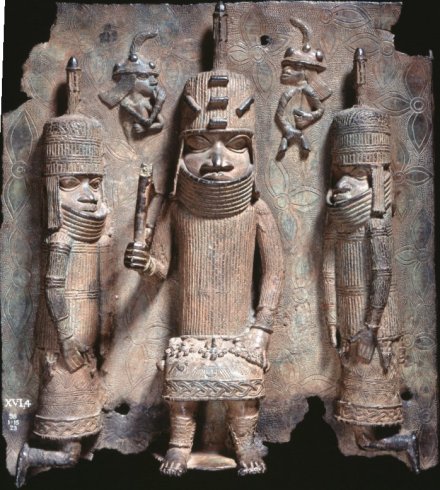
Great Britain’s punitive expedition also resulted in the capture of many hundreds of metal objects scattered to European museums and collections — collectively known as the Benin Bronzes. (It’s a misnomer: they’re actually brass.)

Hocked to defray the expense of their plundering, their diffusion around the empires’ continent helped broaden European appreciation for African art, and influenced modernist art movements. (Notably (pdf) German expressionism: tons of the bronzes ended up in Germany, and many can still be seen at Berlin’s Ethnological Museum.)

Nigeria, and the successor obas of Benin, have for decades besought their return in vain.


Cultural encounter: this Benin “bronze” shows the oba with two attendants, and the smaller floating heads of two European (Portuguese) traders.

More on this object, and its place in the story of Benin and Europe, in this episode of the BBC’s History of the World in 100 Objects; or, at the “bronze’s” page at the British Museum website.

On this day..

1845: Not William Weaver, defended by Abraham Lincoln

This date in 1845 was the appointed hanging of William Weaver, the first convicted murderer in Champaign County, Illinois.

While drunk, Weaver shot to death one David Hiltibrau and despite the able representation of one Abraham Lincoln was speedily convicted. (pdf)

Where the rail splitter failed, fortune prevailed.

“A few days — or nights rather — before that set for his execution,” we read,

a friendly auger passed to him afforded the means of escape. Just then delays were dangerous to poor drunken Bill Weaver, for Sheriff Lewis had the rope and scaffold ready, so he did not await a farewell word from friends, but sped away to the North, as the winds go. At that time the tangled forests and the untramped prairies afforded unexcelled means for seclusion and escape, and the condemned man, once a mile from town, might well bid farewell to every fear of being caught and hanged, as he doubtless did. Years afterward Weaver was heard from in far Northern Wisconsin, a useful, law-abiding citizen. No effort was ever made to bring him back from his delicious exile.

On this day..