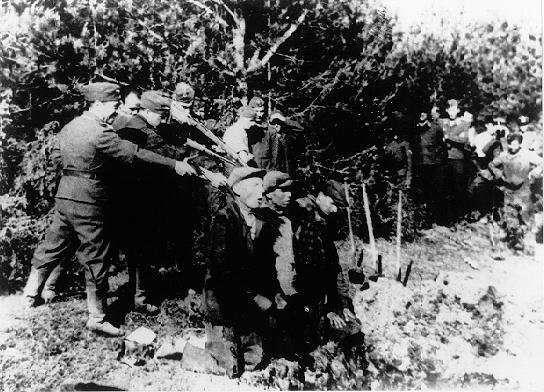
On an uncertain date in November 1942, this photograph of an SS unit executing anti-Nazi partisans in Belarus was taken.
Behind this striking but all too typical image of brutal field executions on the eastern front lies the sordid story of one of the strangest military formations in the Nazi service.
The Dirlewanger brigade was formed under a man whose fortuitous early enrollment in the NSDAP had enabled him to pull strings to get himself out of Dachau, where he had been sent after his second molestation conviction, and where unfolding events could have easily seen him on the other end of the firing squad.
Instead, Oskar Dirlewanger formed a unit of criminals and reprobates: poachers at first, and eventually, as it grew into the SS-Sonderbatallion Dirlewanger, men culled from the camps or soldiers condemned by the army, some literally trading the likelihood of execution themselves for service under one of the most disreputable commanders in the field.
Oh, and, just incidentally — it stuck them into a lawless environment where they could probably practice and refine their pathologies unchecked. Some “rehabilitation.”
As of this relatively early date, the convict floodgates weren’t yet entirely open, and the existing German volunteers were supplemented by a goodly portion of Soviet citizens recruited in the occupied territories. From 1942 to 1944, they hung around Belarus hunting guerrillas and doing to them — well, you know. (The original notion of using poachers was to exploit their ranger-like woodsman talents for anti-partisan warfare.)
Oh, and civilians. Tens of thousands of civilians. That almost goes without saying.
Sadly for Dr. Dirlewanger, events further south were undoing all his bloody work, for it was also in the November 1942 that the Red Army decisively turned the tide of the war with its counterattack at Stalingrad — in fact, it was this very date in 1942 that it completed its encirclement, stranding a quarter-million freezing Wehrmacht regulars on the banks of the Volga, only a handful ever to see Germany again.
The Dirlewanger brigade would have its own turn being minced by the Soviet war machine, though not before it had a notorious hand in drowning the Warsaw Uprising in blood.
Dirlewanger himself was tortured to death by Polish guards a few weeks after the war ended.
On this date in 1928, the man whose disguise christened one of the most bizarre crimes in Texas’s colorful history was lynched behind a theater … producing “The Noose”.
the most spectacular crime in the history of the Southwest … surpassing any in which Billy the Kid or the James boys had ever figured.
The story begins on December 23, 1927, in the town of Cisco, where a genial man dressed as Saint Nick strolled down the main drag dandling playful children en route to the First National Bank.
Santa — Marshall Ratliff — and three accomplices then conducted one of the most inept bank robberies in that craft’s ample stock of ineptitude.
A general gun battle erupted during the robbery, owing to the general citizenry being armed, and a standing reward available from the bank association for shooting a bank robber in the act. When the quartet finally fought their way to the getaway car — killing two cops in the process — they realized it was almost out of gas.
After a few days’ dodging a manhunt, everyone was rounded up, one of them in corpse form. Two of the surviving three drew death sentences, and Henry Helms sat in the Lonestar State’s electric chair on September 6, 1929.
But Kris Kringle — er, Ratliff — had his execution delayed by a sanity hearing that brought him back to Eastland County, where he feigned illness and killed a guard in an abortive escape attempt. The good folk decided they’d had about enough of due process.
Quoth a newspaper report of the day (reproduced in A.C. Greene’s book on the case):
All yesterday afternoon they gathered in little groups about the town and muttered about [the guard] Jones’ shooting which physicians said probably would prove fatal. Last night a crowd in front of the jail swelled to nearly a thousand at 8:30 o’clock.
At about 9 o’clock, some 200 men slipped into a side door of the jail and asked for the man. Jailer Gilborn refused to give him up. They overpowered Gilborn, took his keys and got Ratliff.
… He was dragged in the direction of the public square, but the crowd would not wait to go those few blocks.
At 200 yards from the jail a strong telephone cable was pointed out, a rope flung across it. A noose was put around Ratliff’s neck, a dozen men on the other end of the rope bent their weight, and Ratliff was jerked from the ground.
The rope broke. Messengers were sent for another, and again the mob set to its task. Then someone remembered that men about to die are usually given a chance to say a last word. For another moment he was lowered to the ground, but, displeased at his mumbling, the crowd yelled, “String him up!”
Today is International Students’ Day and a public holiday in the Czech Republic and in Slovakia thanks to the martyrdom of nine at the hands of the Nazi occupation forces this day in 1939.
The previous fall, Hitler had cowed the allied powers into ceding the mountainous Czechoslovakian Sudetenland to the Third Reich in order to avert war — leading to Neville Chamberlain‘s famously mistaken “peace in our time” speech.
In March 1939, Germany reneged its part of the bargain and gobbled up Bohemia and Moravia, essentially the modern Czech Republic.
That this would collapse Chamberlain’s vision of peace and set Europe’s powers on the road to war with Berlin was cold comfort to the occupied Czechs. They had their own problems.
On October 28, youth demonstrations in Prague against the occupation resulted in the shooting of Charles University medical student Jan Opletal
Two weeks later he succumbed to the injury, and his funeral turned into an anti-occupation riot forcibly quashed by German arms. According to the London Times account:
On November 17 at 3 a.m., the Gestapo entered all students’ colleges, men’s and women’s, without allowing them to dress, tied the students in groups of three, and dragged them away … Between 3 o’clock and 8 o’clock in the morning the Gestapo visited students’ homes and lodgings. Those opposing arrests and parents who withheld information were immediately shot at, and the wounded were refused attention. The Gestapo broke into high schools as well as into the university …
The prisoners were taken to the Ruzyn barracks and to the Sparta football stadium, where cold water was flung over them and were made to wait until the evening. Then, in the barrack yard, 124 students and teachers* were shot before their fellow-students, the first nine being presidents of students’ associations, including the brilliant young sociologist Dr. Matoushek [English Wikipedia entry | Czech], son of a former Minister of Commerce.
Universities in the cities were declared closed for three years; they would not in fact re-open until after the war.
The day, subsequently memorialized as den boje studentu za svobodu a demokracii (Day of the Students’ Fight for Freedom and Democracy), entered Czech history a second time a half-century later. A student protest at Opletal’s grave on this date in 1989 helped catalyze the Velvet Revolution that toppled Czechoslovakia’s Communist government.
* The larger figure was circulated in the days following by Czech sources. It is not clear to me whether that number proved unfounded, or whether subsequent memorials simply came to focus on the leading nine — whose executions are certain, and were even announced by German communique.
On this date in 1924, just two days after his sentencing, Japanese student Namba Daisuke was hanged for attempting to assassinate the the future emperor Hirohito.
Namba (or Nanba) was a 24-year-old Communist and son of a Japanese parliamentarian.* Inflamed by reports of Japanese atrocities in Korea and by the execution years earlier of leftist agitator Shusui Kotoku, Namba fired a pistol at the 22-year-old Prince Regent in a Tokyo intersection.**
It was a pretty simple case: no doubt he’d done it, and no sympathy for the assailant. The act shook Japan so deeply that Namba’s prosecutors stuck to the story that the offender must be deranged — even though he clearly was not. Under the circumstances, that wouldn’t cut enough ice to mitigate the sentence anyway.
Daisuke has made a blot upon Japanese history. He believed in violence and had determined to kill the Prince Regent. He committed a great crime in attempting to injure the imperial family, which has never oppressed the poor.
To which Daisuke had a direct reply:
Long live the Communist Party of Japan!
As is often the case, the gesture of violence against the established order provoked a still more repressive crackdown. The Prime Minister resigned for the security lapse, to be replaced a more conservative government that pushed through the radical-hunting measures of the Peace Preservation Law.
And the award goes to …
Simple enough as far as the assassin goes.
Let’s take a sideways turn into a digression from the blog’s macabre daily fare to ponder a strangely pleasant ripple effect of this young man’s shot.
According to Ben-Ami Shillony’s Politics and Culture in Wartime Japan, the incident forced the resignation of a senior police official charged with keeping an eye on subversives.
You’re welcome, Ichiro. (The Major League superstar won the Matsutaro Shoriki Award twice during his Japanese professional career, in 1994 and 1995.)
This gentleman, Matsutaro Shoriki, transitioned into a career as a media mogul, building up one of the country’s most prominent papers. In that capacity, he took to promoting baseball in Japan.
Though this imported sport had an existing — and growing — popularity from the first decades of the century, Shoriki became the father of Japanese baseball by sponsoring American all-star teams to play on Japanese tours and creating the country’s first professional baseball team.
Shoriki even survived an assassination attempt of his own, at the hands of a nationalist who thought bringing Babe Ruth to the Land of the Rising Sun was treasonable.
Today, he’s remembered generously and his name adorns one of Japanese baseball’s major awards. But if not for Daisuke Namba’s shot, he might have served those years moving paper in the tokko, trying to ferret out dangerous elements.
* The father had to resign his seat in the Diet, of course; not only his immediate family but his former schoolmasters and his whole hometown were put under the pall. According to Time, Namba’s relatives were formally released from their debt of shame by Hirohito in 1926, and took the unblemished name Kurokawa.
** Hirohito did not become Emperor until his father’s death in 1926.
At dawn this date in 1954, the last Foreign Minister of democratic Iran was shot in Tehran.
It was a year since the dramatic events of 1953, when a CIA-backed coup d’etat overthrew Iranian Prime Minister Mohammed Mossadegh (or Mosaddegh, or Mossadeq, or Mosaddeq) for contemplating oil nationalization.
Over several chaotic days of “Operation Ajax” (or TPAJAX), the Mossadegh government repulsed a first coup attempt, then succumbed to another.
After Mossadegh initially appeared to have maintained his hold on power, the autocratic Shah Mohammad Reza Pahlavi fled for his life to Iraq and thence to Rome. Fatemi, Mossadegh’s forceful young foreign minister, excoriated the Shah in words that themselves raised the specter of execution.
A traitor is afraid. The day when you, O traitor, heard by the voice of Teheran that your foreign plot had been defeated you made your way to the nearest country where Britain has an embassy. (Quoted in the New York Times.)
Either way, it was high stakes for all concerned in oil country. There’s been contentious debate over the extent to which the affair was also a Cold War proxy conflict — or whether the involvement of the country’s Communist party was incidental, a smokescreen, or an outright stalking-horse for the west.
The coup against Mossadegh has emerged as a major historical turning point — and after the Shah was himself dramaticallyoverthrown in the 1979 Iranian Revolution, not necessarily so successful for American foreign policy goals as it seemed at the time.
Appropriately — in fact, with eerie prescience given the events that then lay a generation in the future — a recently declassified 1954 CIA report on the coup made the first known use of a neologism that has since grown increasingly familiar: blowback.
Possibilities of blowback against the United States should always be in the back of the minds of all CIA officers involved in this type of operation. Few, if any, operations are as explosive as this type.
Maybe those possibilities should be in the front of the mind.
Today, there’s a street named for Fatemi in Tehran, and — strange to say — still some number of Americans who anticipate the greeting due liberators should they ever manage to roll a tank down it.
On this date in 1944, Hannah Szenes was shot by the Nazis in her native city of Budapest — a city she had left five years before, and to which she had returned as a British special operative.
But with the onset of war, she signed up with the British Special Operations Executive and was parachuted behind German lines in March 1944.
Her brief: to save both Jews and downed Allied pilots. It is often described as the only military expedition to relieve European Jewry during World War II.
Hannah was nabbed crossing into Hungary on a mission that her colleagues (rightly, it seems) deemed too perilous to attempt, and withstood months of torture without divulging her codes.
By the time she went in the dock for treason, Nazi control of Hungary was collapsing and judicial administration itself was breaking down to the timpani of falling shells. Her sentencing November 4 was postponed; on November 7, an officer peremptorily informed her that she had been condemned to death. It’s believed that she was actually never formally sentenced, merely mopped up ahead of the unstoppable Red Army, which on this very day first entered Budapest’s suburbs.
A writer as well as a fighter, Szenes’ poetry survived as her monument to life — like the present-day Israeli standard “Blessed is the Match”, also the title of the documentary excerpted above; and, her “Halikha LeKesariya” (“A Walk to Caesarea”), also known as “Eli, Eli” (“My God, My God”). Here it is sung by Regina Spektor.
These lines were reportedly her last-known verses from prison:
One – two – three … eight feet long
Two strides across, the rest is dark …
Life is a fleeting question mark
One – two – three … maybe another week.
Or the next month may still find me here,
But death, I feel is very near.
I could have been 23 next July
I gambled on what mattered most, the dice were cast. I lost.
On this date in 1941, Finnish pacifist Arndt Pekurinen was executed at the front for refusing to fight.
Initially conscripted in the 1920’s, Pekurinen had refused to serve under arms and spent 1929-31 in prison for his troubles. He was a minor cause celebre; British MPs and big international names like Einstein and H.G. Wells pressed for his release.
A change in the Finnish conscription law — the bill was called the “Lex Pekurinen” — finally saw him freed to civilian life, but he was drafted anew to fight the Soviet Union in the “Continuation War”. When he again refused, he was shot at Suomussalmi without trial — though two men refused to do it before someone finally agreed to be the executioner.
“Kun ihmisiä ei syödä, on niitä turha teurastaa.” (“As people are not eaten, butchering them is of no use.”)
A neglected figure during the Cold War, he’s enjoyed a latter-day rediscovery since the 1998 Erno Paasilinna book Courage: The life and execution of Arndt Pekurinen. In the decade since, Pekurinen has become a household name and a widely-admired figure. (The link is in Finnish.) A park in Helsinki was recently named for him. (Finnish again.)
Tangentially, the Nordic stock of our day’s victim and his era of militarism call to mind the hero of e.e. cummings’ “i sing of Olaf glad and big”. The allusions of this poem are American, and there’s no reason to associate it directly with Pekurinen — but it so happens that it was published in 1931, the year international pressure forced the end of Pekunin’s first prison stint:
i sing of Olaf glad and big
whose warmest heart recoiled at war:
a conscientious object-or
his wellbelovéd colonel(trig
westpointer most succinctly bred)
took erring Olaf soon in hand;
but–though an host of overjoyed
noncoms(first knocking on the head
him)do through icy waters roll
that helplessness which others stroke
with brushes recently employed
anent this muddy toiletbowl,
while kindred intellects evoke
allegiance per blunt instruments–
Olaf(being to all intents
a corpse and wanting any rag
upon what God unto him gave)
responds,without getting annoyed
“I will not kiss your fucking flag”
straightway the silver bird looked grave
(departing hurriedly to shave)
but–though all kinds of officers
(a yearning nation’s blueeyed pride)
their passive prey did kick and curse
until for wear their clarion
voices and boots were much the worse,
and egged the firstclassprivates on
his rectum wickedly to tease
by means of skilfully applied
bayonets roasted hot with heat–
Olaf(upon what were once knees)
does almost ceaselessly repeat
“there is some shit I will not eat”
our president,being of which
assertions duly notified
threw the yellowsonofabitch
into a dungeon,where he died
Christ(of His mercy infinite)
i pray to see;and Olaf,too
preponderatingly because
unless statistics lie he was
more brave than me:more blond than you.
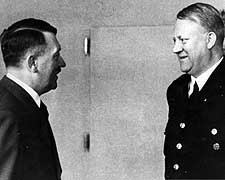
Just deserts for his efforts as chief of the fascist party Nasjonal Samling to aid the Nazi conquest of his home country. Quisling interrupted a radio broadcast on April 9, 1940 to proclaim himself Prime Minister* and order cooperation with invading Germans.
Although Quisling’s lack of popular support compromised his value even as a puppet, he remained as Minister President of Norway through the war — a crucial tool in Germany’s counter-encirclement jousting with Britain, nicely explained at the outset of Frank Capra’s American propaganda flick Why We Fight:
He enjoyed public regard commensurate with his station.
A 1944 cartoon in Sweden (which remained tenuously neutral and unoccupied during the war) indicates that Quisling had already made his name a byword for treachery. The caption reads:
“I am Quisling.”
“And the name?”
At 5 a.m. this date in 1917, Margaretha Geertruida Zelle — better known as Mata Hari — was awoken at Saint-Lazare Prison to news that it was her last day on earth.
She died in a muddy drill field outside Paris, facing a firing squad as she had lived: self-possessed, mysterious, her eyes (she refused a blindfold) open.
For the oldest profession, it may be there is nothing truly original, nothing new under the sun. But Mata Hari — thanks in no small part to her genuinely fatale end — redefined it for the dawning age of mass visual media and tapped the power of sexual allure for a commercial century.
She was already pushing 30 when she got into the exotic dance game, with a failed May-December marriage behind her from what a wag might call her first sexual bargain, to get out from under the thumb of her family and see the world. In Paris in the belle epoque, there were assuredly dancers younger, prettier. Margaretha, who here debuted the show name by which history would know here, surpassed them with showmanship.
She exploited her exotic olive-toned looks — there were rumors of Javanese or Jewish blood even in her childhood — and claimed to be an Indian princess; her talent for repackaging oriental exoticism with just the right amount of otherness combined with her willingness to push boundaries of eroticism made her an instant sensation. Naturally gregarious and unprudish, she segued into the courtesan biz on the side with dashing officers and wealthy industrialists.
Not bad for a thirty-something mother of two.
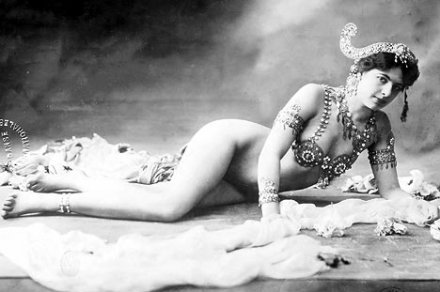
She comes at the start of our own era: sensual postcards and posed photos of Mata Hari were at once her pitch and her product; celluloid was just coming online, and 14 years after her death, she’d be portrayed by silver screen femme fatale Greta Garbo:
That’s her with the last object of her affections, a Russian aviator young enough to be her son, and a reminder that the birth of Greta Garbo’s era was also the death of Mata Hari’s own.
She was aging, for one thing. For another, of course, war shattered Europe. Famous, decadent, polyglot … those things that had been her passport suddenly became her liabilities. Globetrotting travel? Payoffs from a multinational cast of officers for her companionship?
There’s no take here on whether she was really, as convicted, a German spy of any variety at all — she seems to have been approached, to have tried her hand clumsily or to have been set up by either French or German intelligence, or simply to have behaved indiscreetly. Once she was caught up against events, her maneating reputation did her no favors.
Spying, she was terrible at. Commanding men’s attention? As a British correspondent reported, Margaretha Zelle owned her role to the very last.
The first intimation she received that her plea had been denied was when she was led at daybreak from her cell in the Saint-Lazare prison to a waiting automobile and then rushed to the barracks where the firing squad awaited her.
Never once had the iron will of the beautiful woman failed her. Father Arbaux, accompanied by two sisters of charity, Captain Bouchardon, and Maitre Clunet, her lawyer, entered her cell, where she was still sleeping – a calm, untroubled sleep, it was remarked by the turnkeys and trusties.
The sisters gently shook her. She arose and was told that her hour had come.
‘May I write two letters?’ was all she asked.
Consent was given immediately by Captain Bouchardon, and pen, ink, paper, and envelopes were given to her.
She seated herself at the edge of the bed and wrote the letters with feverish haste. She handed them over to the custody of her lawyer.
Then she drew on her stockings, black, silken, filmy things, grotesque in the circumstances. She placed her high-heeled slippers on her feet and tied the silken ribbons over her insteps.
She arose and took the long black velvet cloak, edged around the bottom with fur and with a huge square fur collar hanging down the back, from a hook over the head of her bed. She placed this cloak over the heavy silk kimono which she had been wearing over her nightdress.
Her wealth of black hair was still coiled about her head in braids. She put on a large, flapping black felt hat with a black silk ribbon and bow. Slowly and indifferently, it seemed, she pulled on a pair of black kid gloves. Then she said calmly:
‘I am ready.’
The party slowly filed out of her cell to the waiting automobile.
The car sped through the heart of the sleeping city. It was scarcely half-past five in the morning and the sun was not yet fully up.
Clear across Paris the car whirled to the Caserne de Vincennes, the barracks of the old fort which the Germans stormed in 1870.
The troops were already drawn up for the execution. The twelve Zouaves, forming the firing squad, stood in line, their rifles at ease. A subofficer stood behind them, sword drawn.
The automobile stopped, and the party descended, Mata Hari last. The party walked straight to the spot, where a little hummock of earth reared itself seven or eight feet high and afforded a background for such bullets as might miss the human target.
As Father Arbaux spoke with the condemned woman, a French officer approached, carrying a white cloth.
‘The blindfold,’ he whispered to the nuns who stood there and handed it to them.
‘Must I wear that?’ asked Mata Hari, turning to her lawyer, as her eyes glimpsed the blindfold.
Maitre Clunet turned interrogatively to the French officer.
‘If Madame prefers not, it makes no difference,’ replied the officer, hurriedly turning away. .
Mata Hari was not bound and she was not blindfolded. She stood gazing steadfastly at her executioners, when the priest, the nuns, and her lawyer stepped away from her.*
The officer in command of the firing squad, who had been watching his men like a hawk that none might examine his rifle and try to find out whether he was destined to fire the blank cartridge which was in the breech of one rifle, seemed relieved that the business would soon be over.
A sharp, crackling command and the file of twelve men assumed rigid positions at attention. Another command, and their rifles were at their shoulders; each man gazed down his barrel at the breast of the women which was the target.
She did not move a muscle.
The underofficer in charge had moved to a position where from the corners of their eyes they could see him. His sword was extended in the air.
It dropped. The sun – by this time up – flashed on the burnished blade as it described an arc in falling. Simultaneously the sound of the volley rang out. Flame and a tiny puff of greyish smoke issued from the muzzle of each rifle. Automatically the men dropped their arms.
At the report Mata Hari fell. She did not die as actors and moving picture stars would have us believe that people die when they are shot. She did not throw up her hands nor did she plunge straight forward or straight back.
Instead she seemed to collapse. Slowly, inertly, she settled to her knees, her head up always, and without the slightest change of expression on her face. For the fraction of a second it seemed she tottered there, on her knees, gazing directly at those who had taken her life. Then she fell backward, bending at the waist, with her legs doubled up beneath her. She lay prone, motionless, with her face turned towards the sky.
A non-commissioned officer, who accompanied a lieutenant, drew his revolver from the big, black holster strapped about his waist. Bending over, he placed the muzzle of the revolver almost – but not quite – against the left temple of the spy. He pulled the trigger, and the bullet tore into the brain of the woman.
Mata Hari was surely dead.
* Inevitably, a story got around that she’d opened her funereal coat to the firing squad, revealing no clothing beneath it.
On this date in 1959, a disturbed Japanese serial killer was hanged for eight murders.
A past generation’s emblem of monstrousness, Genzo Kurita (English Wikipedia page | Japanese) was invoked on the floor of the Diet as a reason to keep the death penalty.
And no wonder.
He was caught early in 1952 for murdering a 24-year-old and her 63-year-old aunt, and defiling the younger woman’s body. Those murders led to a death sentence a few months later, but they also led to a string of unsolved homicides: another murder-necrophilia crime the previous summer, and the notorious Osen Korogashi incident, when he threw a rape victim’s family over the Osen Korogashi cliffs.*
He got a separate death sentence for those murders (plus two other earlier ones) later in 1952.
A touch unstable — obviously — Kurita withdrew his own appeals in 1954 to get it over with, but it still took the ponderous Japanese death penalty system the best part of the decade to see him to the gallows.
Most of what’s online about Genzo Kurita is in Japanese, like this more detailed survey of his life in crime.
* The raped mother, and three children; one of the children survived. The Osen Korogashi (or Osenkorogashi) cliffs, as it happens, have their own eerily topical legend of the generous daughter of a cruel lord being thrown over the precipice in her father’s place, prompting him to see the error of his ways.

 In March 1939, Germany reneged its part of the bargain and


 Over several chaotic days of

 Initially conscripted in the 1920’s,
 By the time of his death, the Nazi collaborator (



 A past generation’s emblem of monstrousness, Genzo Kurita (