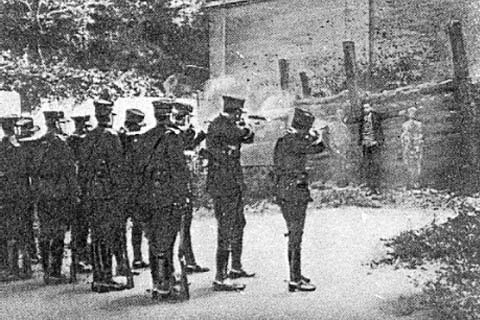
1903: William Ennis, wife-murdering cop

On this date in 1903, a nine-year veteran of the Brooklyn police became the first member of the thin blue line to die in the electric chair.

Then 31-year-old William Ennis had gunned down his estranged wife (and, not fatally, his mother-in-law) early the preceding year, and his attempt to claim insanity at trial was rejected as shamming.

This slice of New York color is the second story in this New York Times column reporting the day after the crime.

While in a frenzy of rage, as a result of heavy drinking and brooding over family troubles, William H. Ennis, a policeman attached to the Adams Street Station, Brooklyn, early yesterday morning broke into the hime [sic] of Mrs. Alice Gorman, his mother-in-law, in Canarsie, wounded her seriously with a bullet from his revolver, and then shot and killed his wife, who was living there.

He then rushed from the house and ran along the railroad tracks to East New York, two miles distant, where he was found asleep in a room in a hotel by the police several hours later. …

Two weeks ago Mrs. Ennis had her husband in court on a charge of non-support, and he was ordered to pay her a weekly stipend. At that time Ennis declared that he would “rot in jail” before he would pay his wife any money unless she left her mother’s house and returned to live with him. …

Early on Saturday morning he reported sick at Adams Street Station and was excused from duty. It was learned that he came to Manhattan and in the evening was arrested at Forty-second Street and First Avenue for intoxication and disorderly conduct, but at the East Thirty-fifth Street Station was allowed to go when it was found that he was a policeman.

On this day..

1945: The Belsen war criminals

On this date in 1945, British hangman Albert Pierrepoint executed eleven guards of the Bergen-Belsen concentration camp and two other Nazis in occupied Hameln.

Liberated only eight months before these hangings, Belsen provided the to-us-familiar store of Nazi atrocity stories. Forty-five sat in the dock at the Belsen trial under British military authority, including the notorious camp commandante Josef Kramer — better known as the Beast of Belsen — and the “Angel of Death” Irma Grese.

Those two, and nine others less distinctively nicknamed, faced the gallows. (They were hanged together with two other war criminal convicts not connected to the Belsen trial, Georg Otto Sandrock and Ludwig Schweinberger, for a total of 13.)

On December 13, 1945, Pierrepoint hanged Grese; then, Elisabeth Volkenrath; and then, Juana Bormann, each individually. Finally, the men were then dispatched in pairs.

(Other than Kramer, the most notable was Nazi doctor Fritz Klein, who gave this reading of medical ethics when queried while the camps were still operating: “My Hippocratic oath tells me to cut a gangrenous appendix out of the human body. The Jews are the gangrenous appendix of mankind. That’s why I cut them out.”)


Of all this batch, Irma Grese, the “beautiful beast”, enjoys the liveliest afterlife.

If one finds her pretty, then she was a pretty young thing — only 16 when she hitched herself to the SS; turning 22 during her fatal postwar trial.

Stalking the camp with her whip, and (rather conveniently) cited with the ravenous sexual appetite a B-movie screenwriter would give such a character, part of her siren song is plainly the fetishistic magnetism of Nazi women.

But in the numerous discussion threads about Irma Grese, any number of her advocates will emerge.

Can we leave it at the fascination that female war criminals inspire? Certainly few 22-year-old Einsatzgruppen men have the mitigatory evidence of a coming-of-age in farming and retail so lovingly emphasized, the precise measure of complicity in genocide analyzed in such detail (pdf).

Grese, perhaps, strikes as impressionable, in the youthful sense of absorbing one’s place from the world one inhabits. Her hangman wrote that “[s]he seemed as bonny a girl as one could ever wish to meet.” As a camp guard, she wins promotions; to her interrogators, she accepts responsibility equal to Himmler’s; among those condemned at the Belsen trial, she alone is defiant.

In that guise — and whether or not it is rightly attributed to her — she presents back to her interlocutor those timeless questions of personal identity and moral responsibility: where does abnormal psychology leave off into perfectly conventional psychology that just happens to occupy an abnormal world?

On this day..

1984: Alpha Otis O’Daniel Stephens: hear it live

On this date in 1984, Alpha Otis O’Daniel Stephens was electrocuted in Georgia for the execution-style murder of Roy Asbell after the latter surprised Stephens in the course of a burglary.

Stephens makes these pages for two reasons:

First, he survived his initial electrocution, requiring a second application of the lethal current — awful, though not exactly unheard-of.

Second, it emerged years later that the Georgia Department of Corrections was making audio recordings of its executions as a secret archive of the proceedings.

Several hours’ worth of these (subsequently leaked) recordings from various different Georgia electrocutions are available at SoundPortraits.org.*

We begin our trip back in time to Georgia’s execution chamber with the atmospheric sound of the warrant for his execution being read to the condemned and the witness — nicely juxtaposing the sentence of death with the body responsible for administering it: the Georgia Department of Offender Rehabilitation.

[audio:Alpha_Otis_O’Daniel_Stephens_warrant.mp3]

But the real action is the sound behind the curtain as prison officials realize the electrocution has not killed their man, wait agonizing minutes for the still-living body to cool enough for doctors to examine it officially, and begin the execution cycle anew. From the sound of it, they only barely killed him with the second pass: the officials are worrying openly that it looks like he’s still breathing very late in the procedure.

This file, obviously, comes with a content advisory sticker — though it lacks any directly identifiable hideous sound from the chair, or the prisoner, or the witnesses, the routine narrative of a prison bureaucrat as a man dies dreadfully in the next room is an altogether different order of horror.

[audio:Alpha_Otis_O’Daniel_Stephens_botched_execution.mp3]

This audio file was helpfully clipped by Dysfunctional Playground from the Pacifica radio Democracy Now! broadcast which aired it; the clip is itself an abridged version of a 20-minute original with long silences and unintelligible content excised.

The transcript of the abridged clip as aired by Democracy Now! follows below. Willis Marable, the main speaker on the tapes, was an assistant warden.


UNIDENTIFIED: Carry out the execution by the order of the court. There’s no reason to delay.

UNIDENTIFIED: Very well. On my count of three, press your buttons. One, two, three.

WILLIS MARABLE: The execution now has begun. There was one small jerk from the condemned at the time the execution was initiated. He is sitting very still now, and we are also now into the second phase of the execution. We are now into the third phase of the execution. No movement from the condemned. No activity, no movement from the witnesses. He appears to be relaxing a little bit more now. There’s sixty seconds remaining on the third phase of the execution. There is a slight movement from the condemned’s head. He seems to be moving his head from side to side slightly.

UNIDENTIFIED: I show the time is 12:19.

WILLIS MARABLE: Commissioner, he is still moving his head, and he seems to have slumped down in a relaxing-type position in the chair. But his head is moving from side to side slightly. Commissioner, Mr. Low, the execution is completed at this time. The electrical panel box is secured and locked. I do not detect any movement from the condemned at this time. He seems to have stopped moving his head and also his arms.

UNIDENTIFIED: I show the time is 12:20.

UNIDENTIFIED: You are in the lapse time countdown, is that correct?

WILLIS MARABLE: Yes, sir. We’re into the first minute of the lapse time now. No movement from any of the witnesses, and at this time no movement from the condemned. We have now completed one minute of lapsed time, four minutes remaining. Two minutes of lapsed time completed at this time, three minutes remaining. Still very little movement from any of the witnesses, and I detect no movement from the condemned at this time.

UNIDENTIFIED: I show the time is 12:22.

WILLIS MARABLE: Commissioner?

COMMISSIONER: Yes?

WILLIS MARABLE: Mr. Low?

COLONEL LOW: Yes.

WILLIS MARABLE: There is some slight movement. He’s still moving his head slightly. The only thing we can do is continue until the physicians can check him after the lapse time has expired.

COLONEL LOW: Don’t vary from your checklist.

WILLIS MARABLE: OK, sir. OK, we have completed three minutes of lapsed time, two minutes remaining. Commissioner? Mr. Low?

COLONEL LOW: Yes.

WILLIS MARABLE: He is still moving his head slightly, kind of a bobbing up-and-down movement. Commissioner?

COMMISSIONER: Yes.

WILLIS MARABLE: Mr. Low? We have completed four minutes of lapsed time. We have one minute remaining. And from my vantage point I do detect or it seems to be that he is breathing. Commissioner? Mr. Low? We have completed the five minutes lapsed time. Stand by for the physicians’ check. Commissioner?

COMMISSIONER: Yes?

WILLIS MARABLE: It appears the doctors agree with me that he’s still breathing. You want us to check him and then go through it again, or just go ahead and go through it again?

COMMISSIONER: Check him, and then go through it again. Definitely check him. Don’t vary from the checklist.

WILLIS MARABLE: Alright.

COMMISSIONER: Have them check him.

WILLIS MARABLE: OK. [inaudible] We’re going to do it again?

UNIDENTIFIED: It doesn’t say so.

WILLIS MARABLE: OK.

UNIDENTIFIED: It remains on.

WILLIS MARABLE: OK.

UNIDENTIFIED: The time is 12:26 and thirty seconds.

WILLIS MARABLE: Commissioner?

COMMISSIONER: Yes.

WILLIS MARABLE: The doctors have verified that he is still alive.

COMMISSIONER: Repeat the execution.

WILLIS MARABLE: Very well. You ready to go again?

COMMISSIONER: Better check all the connections. Val?

VAL: Yes, sir.

COMMISSIONER: Did you tell the witnesses that you’re repeating?

VAL: No, I didn’t.

COMMISSIONER: I think you should tell them.

VAL: OK. You want me to just advise them that—

COMMISSIONER: Just advise them—

VAL:—repeating the process and not go into any detail?

COMMISSIONER: That’s right.

VAL: OK.

WILLIS MARABLE: Commissioner? The superintendent is entering the execution chamber and approaching the mic at this time to advise the witnesses that we will proceed again with the execution.

COMMISSIONER: Well, listen, you can’t tell them—tell them there were some vital signs remaining, so the execution will repeat. See if you can get that message to them.

WILLIS MARABLE: It’s too late now. He’s already briefed them, and he’s on the way back in, sir.

COMMISSIONER: Fine, alright.

UNIDENTIFIED: I show the time is 12:28.

UNIDENTIFIED: OK, Commissioner, we’ll proceed at this time.

COMMISSIONER: Proceed.

UNIDENTIFIED: On my count of three, you press your button. One, two, three.

WILLIS MARABLE: Commissioner? Mr. Low? The execution is initiated again at this time. The condemned made one big jerk, and now he is relaxing in the chair. I do not detect any other movement from the condemned at this time. We have completed the first and second phase of the execution. We are now into the third phase. I do detect his head moving from side to side again. We’re still into the third phase of the execution. Commissioner? Mr. Low?

COMMISSIONER: Yes.

WILLIS MARABLE: He is still at this time moving his head from side to side and appears to be breathing. We’ll continue it just like we did previously.

UNIDENTIFIED: We’re going to have to check that [inaudible].

WILLIS MARABLE: We have fifteen seconds remaining on the third phase of the execution. Commissioner, Mr. Low, the third phase of the execution is completed. The equipment is switched off, secured at this time. We are now into the five-minutes lapse time.

COMMISSIONER: What is the status on the condemned?

WILLIS MARABLE: Sir, he appears to be breathing to me.

COMMISSIONER: You’re going to have to have them check those sponges and check their connections or something. There’s something they don’t have connected right, Willis.

WILLIS MARABLE: Yes, sir. Do you want us to go ahead and complete this whole thing and then—

COMMISSIONER: Yeah, complete the phase, and then you’re going to have to make the check.

WILLIS MARABLE: OK, sir. Commissioner, Mr. Low, we have completed one minute of lapse time. We have four minutes remaining. I might also advise at this time that I do not detect any movement from him at this time. He appears to have stopped moving. Still no movement from any of the witnesses. They were just sitting very still, observing the condemned in the chair.

UNIDENTIFIED: I show the time at 12:32.

WILLIS MARABLE: We have now completed two minutes of phase time, lapse time. We have three minutes remaining. I might also add that I do not detect any movement from the condemned. Commissioner, Mr. Low, we have now completed three minutes lapse time. We have two minutes remaining. There is still no movement from the condemned. Commissioner, Mr. Low, we have completed four minutes of lapse time. We have one minute remaining. Still no detectable movement from the condemned. He does seem to have stopped moving entirely. Commissioner, Mr. Low, we have completed our five minutes lapse time. Stand by for the physicians’ check.

At this time, the superintendent and the two physicians are entering the execution chambers for their check. The first doctor is now in the process of making his check for vital signs.

UNIDENTIFIED: I show the time at 12:36. I show the time is 12:37.

WILLIS MARABLE: The second doctor is still in the process of conducting his check for vital signs. The superintendent is at this time, Commissioner, Mr. Low, is still in the process of briefing the witnesses that at 12:37 hours this date the condemned was pronounced dead. He has instructed all witnesses to depart the witness room. Back to the front of the institution. At this time, the curtains are drawn.

* Here’s another recorded Georgia execution we’ve featured.

On this day..

1917: Thirteen black soldiers of the 24th U.S. Infantry Regiment

On this date in 1917, thirteen black soldiers were secretly hanged at dawn at a military camp outside San Antonio for their parts in a Houston race riot four months earlier.

During the nadir of American race relations and just months after America’s entry into World War I, the soldiers of this historic all-black unit had been dispatched to build military facilities in Harris County, where they met animosity from whites beyond the everyday insults of Jim Crow law. Here, the service of “arrogant, strutting representatives of black soldiery” was hated and feared.

When white police arrested a black infantryman who tried to prevent their detaining a drunk black woman, then beat up and shot at a black corporal sent to inquire after him, hostility boiled over. Over one hundred soldiers marched through the city — confronting a mob of white citizens and police who had likewise armed themselves. Fifteen whites and four blacks were killed in the ensuing confrontation.

This documentary segment is from Mutiny on the Bayou:

The next day’s Houston Chronicle knew just what to do about it.

Their lenient treatment has led negro soldiers to believe that the government is in sympathy with their arrogance and impudence toward white people …

A COURT MARTIAL, A HOLLOW SQUARE AND A FIRING SQUAD WILL SETTLE THE MATTER FOR ONCE AND FOR ALL.

No white Houstonian was ever prosecuted for the day’s events, but the largest court-martial in U.S. military history tried 63 black soldiers and condemned 13 to die:

Sgt. William C. Nesbitt
Corp. Larsen J. Brown
Corp. James Wheatley
Corp. Jesse Moore
Corp. Charles W. Baltimore*
Pvt. William Brackenridge
Pvt. Thomas C. Hawkins
Pvt. Carlos Snodgrass
Pvt. Ira B. Davis
Pvt. James Divine
Pvt. Frank Johnson
Pvt. Rosley W. Young
Pvt. Pat MacWharter

The sentence was carried out without appeal, the time and place only announced after the men had already hanged but evidently witnessed by the New York Times reporter who wrote that “the negroes, dressed in their regular uniforms, displayed neither bravado nor fear. They rode to the execution singing a hymn, but the singing was as that of soldiers on the march.”

Two more mass courts-martial would follow, resulting in six more hangings the following year.

For years afterward, the incident clouded and complicated race relations, especially in the War Department.

Some blacks openly applauded the mutiny as a justified resistance against racist provocation. This inflammatory opinion piece, quoted in Mark Ellis’ Race, War and Surveillance, landed the editor who agreed to run it in federal prison:

We would rather see you shot by the highest tribunal of the United States Army because you dared to protect a Negro woman from the insult of a southern brute in the form of a policeman, than to have you forced to go to Europe to fight for a liberty you cannot enjoy. Negro women regret that you mutinied, and we are sorry that you spilt innocent blood, but we are not sorry that five southern policemen’s bones now bleech [sic] in the graves of Houston, Tex.

Meanwhile, the Army noted “the tendency of the Negro soldier, with fire arms in his possession … to become arrogant, overbearing, abusive and a menace to the community in which he happens to be stationed.” It held down its black enlistment throughout the interwar period.

Sympathizers with the policy would continue — until the raw manpower requirements of World War II trumped the discussion — to cite the Houston riots both as evidence of the dangers of arming blacks, and the disloyalty of a populace willing to register open disgust with lynch law during wartime.

* Baltimore was the soldier who had come after the missing men; his altercation with a white policeman who answered, “I don’t report to any negro” and pistol-whipped him — and, it was incorrectly rumored among the 24th Infantry that night, killed him — triggered the riot.

Baltimore’s role is developed in a fascinating study of primary documentation on the case in Edgar A. Schuler’s “The Houston Race Riot, 1917” published in The Journal of Negro History, Vol. 29, No. 3 (July, 1944). Schuler also treats the interesting tensions between the Houston black community and the black regiment, and the emergence of a white narrative of uppity, out-of-control Negroes rather than ones responding (however wrongly) to specific provocations … which conveniently turned Jim Crow law from the problem into the solution.

On this day..

1939: The 18 corpses of the rebellion

On this date in 1939, 18 junior officers of the Thai military were shot in Bangkok.

Ostensibly condemned for being part of a coup plot to depose the adolescent King Ananda Mahidol in favor of his abdicated predecessor Prajadhipok, they were in reality the casualties of a purge by the Field Marshal-turned-Prime Minister Phibun Songkhram.

It’s alternatively transliterated “Phibun Songkhram” or “Pibunsonggram”, and familiarly abbreviated to “Por”, but by any name he dominated Thai politics for a generation.

One of the military leaders of the bloodless 1932 Siamese Revolution that made the country a constitutional rather than an absolute monarchy, Phibun had in 1938 muscled his way to the Prime Ministership.

Beset by assassination attempts linked to royal revanchists to whose purposes the young turk’s programme was deeply inimical, Phibun determined to break the back of monarchism en route to a modernized, militaristic nationalism (pdf) that would be right at home in the imminent world war.*

As 1939 opens, we join the narrative of Paul Handley’s The King Never Smiles:

Phibun swept the capital and arrested 50 royals, nobles, and soldiers in the clique of his People’s Party rival Colonel Song Suradej for plotting his overthrow …

Whatever the truth behind the cabal, its quashing came to represent the final victory of the 1932 revolutionists and the constitutionalists over the monarchists. To mark it, Phibun commissioned a huge monument to the constitution, later called Democracy Monument, in the middle of the city’s main thoroughfare, Rajadamnoen (“royal progress”) Avenue.


The Democracy Monument in Bangkok.

The eighteen officers who took it in the shorts on this date were not joined by condemned VIPs like royal blood Prince Rangsit, who copped a commutation. It’s widely thought now that the “Songsuradet Rebellion” — or aptly-named “Rebellion of 18 Corpses” — was trumped-up, if not an phantasm altogether.

The Democracy Monument was not the only bulwark of Thai nationalism thrown up by Phibun in the year between the “conspirators'” January arrest and their deaths this day.**

He dropped the old absolutist name “Siam” in favor of the more nationalistic “Thailand” in June of that year; made the date of the 1932 revolution a national holiday; stripped the language of class-distinctive structures; and pressed irredentist claims against neighboring French colonies.

And if the royal house was efficiently marginalized by Phibun, it would yet develop in the latter part of the century into one of the region’s weightiest political entities† … intertwined with the Thai military Phibun helped hoist to pride of place, a formula that has left coups and unstable governments a presistent feature of the political landscape down to the present day.

* And subsequently, too. Despite aligning with the Axis powers during World War II, Phibun was a feted anti-Communist dictator as Washington started counting dominoes in Southeast Asia in the 1950’s.

** The Wikipedia page for the rebellion claims that the executions were carried out in batches of four per day. A New York Times report of December 6, 1939 said that all 18 had been executed the previous day.

† The current King Bhumibol Adulyadej, who coincidentally turns 81 today, is the world’s longest-reigning monarch as of this writing … with no shortage of concern about the conflict his passing may unstop.

On this day..

1937: Masao Sudo, since rehabilitated

On this date in 1937, Japanese emigre Masao Sudo was shot in Moscow as a spy.

The executed man’s son, Dr. Mikhail Masaovich Sudo.

A true-red Communist who had fled increasingly right-wing Japan in the 1920’s and become a labor organizer in the far east, Sudo shared the tragic fate of the Japanese community in Stalin’s USSR, decimated by denunciations of one another.

Sudo was the father of Russian geologist Mikhail Masaovich Sudo, author of several abstruse texts (and also, it would appear, Japanese language primers for Russian speakers) — and under whom, apparently, you can take classes at the International Independent University of Environmental and Political Sciences.

Masao Sudo was rehabilitated in 1956.

On this day..

1990: Pastor Hossein Soodmand, apostate

On this date in 1990, Hossein Soodmand, a Muslim who had converted to Christianity in the 1960’s, was hanged for apostasy under the sentence of a sharia court in Mashad, Iran — the last known apostasy execution in the Islamic Republic.

Soodmand’s post-conversion ministry in the Assembles of God church was not the sort of thing to endanger life and limb under the westward-looking Shah. But after the 1979 Iranian Revolution, there was a new sheriff in town.

Soodmand was not the last convicted or condemned for the crime — and converting to Christianity is still a crime — and his story has been back in the news of late because he may be in danger of losing his generation-long grip on the milestone.

In fact, he could lose the distinction to the next generation of his own flesh and blood.

The hanged pastor’s son, Ramtin Soodmand, was arrested in August, ostensibly for anti-government propaganda. But having followed his father’s evangelical footsteps, there was considerable fear — only slightly abated by his subsequent release on bail — that he could be put on trial for his life.

Amnesty International even put out an action alert for him during his detention, as a prisoner of conscience.

Around the same time, the Iranian legislature voted overwhelmingly for a measure to codify apostasy as a capital crime: confusingly, apostasy isn’t yet among the state’s statutes, but can be referred to sharia courts empowered to levy verdicts out of the Islamic religious tradition. (Besides Christians, Iran’s Baha’i are the other most likely defendants.)

The fact that these courts’ occasional death sentences since Soodmand have not been carried out is itself a telling indicator that the juridical disposition of apostasy cases in Iran is very sensitive to political pressure.

Small comfort to Ramtin’s sister Rashin Soodmand, who lives in London, and gave this moving interview to the Telegraph while her brother was still in a Mashad prison. In it, she describes her father spurning a bargain to abandon his illicit denomination in exchange for his life.

Of course, my father refused to give up his faith … He could not renounce his God. His belief in Christ was his life — it was his deepest conviction.

On this day..

1950: James Corbitt, the hangman’s mate

On this date in 1950, famed British executioner Albert Pierrepoint carried out his most difficult assignment: hanging his friend.

Though not literally the Isles’ last hangman, Pierrepoint is the last one everyone thinks of, the man who defined the hangman’s job for the 20th century.

Discreet, orderly, and as quiet as he was efficient,* he was the brand-name executioner for stiff-upper-lip England of the waning empire, with over 400** hangings to his name from 1932 until he resigned over a fee dispute in 1956.

Despite his proper avoidance of the spotlight, Pierrepoint’s excellence at his craft would make him a celebrity — especially after the press fixated on his role hanging Nazi war criminals after World War II. The ready-made morality play upon the scaffold boards could hardly be resisted: the English grocer, meting out a dignified and precise measure of justice to the likes of the Beast of Belsen.

Hanging Around

Pierrepoint’s characteristic client wasn’t a war criminal, but a humdrum British murderer, only a handful of which attract especial remembrance today.

Still, in the immediate postwar years, the growing reach of the mass media and burgeoning public controversy over the death penalty would frequently put Pierrepoint in the middle of the era’s highest-profile hangings, including:

Tish and Tosh

Like as not, this day’s affair hit the sturdy hangman harder than any of those.

James Henry Corbitt was a regular at “Help the Poor Struggler”, the piquantly named Oldham pub Pierrepoint bought and managed after World War II. Known as “Tish” to Pierrepont’s “Tosh,” the two had sung a duet of “Danny Boy” on the night that Corbitt went out and murdered his girlfriend in a jealous rage.

Corbitt was not exceptional as a criminal, and he was indisputably guilty; we wouldn’t notice him if not for his acquaintance with the man who put him to death.

But Pierrepoint would remember this one well, as he later wrote in his his autobiography:

I thought if any man had a deterrent to murder poised before him, it was this troubadour whom I called Tish. He was not only aware of the rope, he had the man who handled it beside him singing a duet. The deterrent did not work.

Remarkably, the most prolific executioner in British history had come out against the death penalty, or so it seemed. (He later backed away from a strong anti-death penalty position, though without retracting his original reservations. The death penalty had been a decade off the books by this point, in any case.)

It is I who have faced them last, young lads and girls, working men and grandmothers.

I have been amazed to see the courage with which they walk into the unknown.

It did not deter them then and it had not deterred them when they committed what they were convicted for. All the men and women I have faced at that final moment convince me that in what I have done I have not prevented a single murder. And if death does not work to deter one person, it should not be held to deter any … capital punishment, in my view, achieved nothing except revenge.

It’s an open question how much Tish’s hanging this day really contributed to Pierrepoint’s retirement six years later or his apparent change of stance on his trade. But it provides the gut-wrenching dramatic pivot for the film Pierrepoint: The Last Hangman.

Interestingly, while the hangman saw in Corbitt’s fate a troubling indictment of the death penalty, the hanged man’s son to this day still says dad deserved to die.

More on Albert Pierrepoint

For a man so ubiquitously present in the mid-century experience of Great Britain, and who undertook such a dramatic volte-face, it’s no surprise that Pierrepoint has attracted plenty of attention — including this website, and a number of books.

Also of possible interest: Hangmen of England: History of Execution from Jack Ketch to Albert Pierrepoint (we’ve met Jack Ketch here before). More dry factual data about Pierrepoint, the father and uncle who preceded him in the post, and other recent practitioners in Britain’s colorful line of executioners is here.

* The English practice was for Pierrepoint to pinion the prisoner’s arms in the condemned cell, escort him a few steps into a hanging chamber, hood him, and execute the sentence without further ceremony. The whole process took mere seconds — a record fast seven seconds from cell door to trap door in the case of James Inglis — which Pierrepoint seems to have had a gift for dignifying in his (usual) silence with a sort of calming paternal assurance.

Pierrepoint hanged six American soldiers under the auspices of U.S. military forces deployed to England during the Second World War, and confessed to considerable discomfort with that entity’s protracted pre-hanging procedures that had him standing on the scaffold with the condemned man for several minutes.

* And perhaps well over 600 hangings; the figures are disputed.

On this day..

1922: Robert Erskine Childers, for carrying the gun of Michael Collins

On this date in 1922, Robert Erskine Childers was shot by the Irish Free State for carrying a gun its founding colossus had gifted him.

Many Irishmen were executed on either side in this terrible time, but Childers cuts a unique figure among them.

To begin with, he wasn’t all that Irish — “that damned Englishman,” fellow Republican turned Civil War enemy Arthur Griffith called him. The London-born son of a British scholar and an Irish mother, Childers was a lifelong Protestant, itself an anomaly since Irish nationalism mapped (and still maps) strongly to Catholicism.

You’d think he’d be a loyal man of the empire. Early on, that’s just what he was.

In his twenties, Childers volunteered for the Boer War, and he would later say the rank savagery and underlying injustice of England’s war “changed the whole current of my life and made me a Liberal and a Nationalist.” (Source.)

Laying down the sword, Childers took up the pen and wrote several books of military history. (Long since into the public domain, at least two can be read free online: War and the Arme Blanche, German Influence on British Cavalry.) He also wrote a novel, The Riddle of the Sands, that has a (debatable) claim as the first spy novel. Riddle has never gone out of print since it was published in 1903, though it is also available free online.

Both in fiction and nonfiction, Childers’ warnings against the German challenge to British hegemony were prophetic, but he was himself becoming a man divided. 1914 saw him running German guns to Irish nationalists aboard his yacht Asgard … and then signing up for the royal navy when World War I erupted.

The British crackdown on the Easter Rising during the war completed his radicalization; he moved to Dublin and turned his eloquence against the British.

Here, Childers was swept into the tragedy of the Irish War of Independence, and the civil war that followed it; though both were in the delegation that produced the contentious Anglo-Irish Treaty, Childers broke with Michael Collins over it and backed the IRA nationalists who fought the Irish Free State.

After Collins’s assassination, emergency laws promulgated the death sentence for anyone caught armed without authorization. Childers was a writer, not a partisan, but he was arrested in early November with a small sidearm — a gift Michael Collins had given him, back when they were on the same side. It was a time of bloody justice, and they threw the book at him.

Childers knew as well as Collins had that the internecine conflict would have to end. He checked out with awe-inspiring forgiveness; summoning his 16-year-old son to prison the night before his execution, Childers extracted a promise that the boy would find everyone who signed his death warrant … and shake their hands. (Young Erskine Hamilton Childers eventually became President of Ireland.)

Childers himself likewise shook the hands of his own firing squad, one by one. His last words (reported in a number of slightly different variations) were lightheartedly addressed to them:

Take a step or two forwards, lads. It will be easier that way.

On this day..

1927: Father Miguel Pro, “Viva Cristo Rey!”

On this date in 1927, the anti-clerical Mexican government made the emblematic martyr of the Cristero War.

This video is in Spanish, but the storyline is pretty easy to follow — young man finds faith, lives faith, dies faith.

Miguel Pro‘s dying cry, “Viva Cristo Rey!” — “Long live Christ the King!” — was a refrain of Cristeros, anti-government guerrillas who in the late 1920’s fought the revolutionary Mexican government’s attempts to forcibly restrict the power of the Catholic Church.

That conflict had been brewing for years, an outgrowth of Mexico’s own complex history of colonization and development — measures to restrict the church’s size, wealth, and social reach had been mooted and sometimes implemented well back to the middle of the 19th century.

Early in the 20th, the confrontation was merely a twist on its classic form: liberal state-builders and the Catholic hierarchy were (or increasingly saw themselves as) diametrically opposed in their vision for Mexico.

That conflict came to a head under president Plutarco Elias Calles, an irreligious northerner with a project of national capital development for whom the church’s intransigence from its agrarian strongholds was most unwelcome … and who seemed to delight in provoking Rome with sport like mandatory physicals for priests, not neglecting to publicize the incidence of venereal disease thereby revealed.

Liberals had already brought about drastically reduced clerical privileges in the Mexican Constitution of 1917; its somewhat draconian measures were neither fully enforced nor fully resisted, but initiated a period where the two hostile institutions rudely grappled for their respective spheres of influence on the ground.

Calles was the rudest grappler of all, and his 1926 Calles Law pushed for anti-clericalism stricter than the letter of the constitution … and sparked armed resistance.

It was an exceptionally dirty war with routine summary executions on both sides and thousands of Catholic refugees — a dangerous environment for any priest with legal sanctions against basically every practice of the vocation. (Photos of Cristeros, some in heroic resistance and others in grisly martyrdom, can be eyeballed here.)

Pro, a Jesuit who like many was forced underground, was under state surveillance and got picked up in the aftermath of an assassination attempt against a prominent politician. He was chosen to make an example of — without an actual trial, possibly because there’s no actual reason to think he was involved in the bombing.

Looking at these pictures of Pro’s last moments, it’s hard to believe that they were taken and circulated at government direction to cow the Cristero movement. Fail.


Led out to execution in a police courtyard. The place of his death today is (bizarrely) Calle Loteria Nacional.


Calmly at prayer before his death, under the eye of the firing squad commander.


Pro himself refused a blindfold. But why state authorities carrying out the execution with an eye towards public relations would allow him to die in this pose is anyone’s guess.


He blessed and forgave the firing squad, of course.


Just beginning to topple at the moment the bullets struck him.


Like many firing squad executions, this one failed to kill its victim with the ceremonial volley. Pro was finished off with a coup de grace.

Calles was simultaneously — the key measures were also enacted in 1926 — involved in a confrontation with the United States over oil rights, a situation that came to the brink of war, with Washington saber-rattling about “Soviet Mexico”. It’s tempting to wonder whether the two situations weren’t related, especially since the new American ambassador* who had arrived only the month before Pro’s execution would ultimately negotiate both situations’ resolutions.

While the natural resource politics went their separate way, the Mexican Revolution’s anti-clerical strain didn’t so much disappear by negotiation as fade away over decades, with regular new outbreaks.

One thinks of Mexico today as such so staunch a Catholic country that it’s hard to imagine that some of these provisions were only officially repealed in 1998.

As for Pro, he’s welcome in Mexico by now — celebrated by Pope John Paul II who ultimately beatified him, and the inspirational source of this hymn whose refrain is his famous last cry.

There’s a faithful site in his honor here, and apparently a shrine to him in Houston, Texas run by a group pushing for his canonization.

* The American ambassador in question, Dwight Morrow, invited Charles Lindbergh on a goodwill tour to Mexico, where the aviator would meet the diplomat’s daughter not long after Miguel Pro’s martyrdom. Little could Lindbergh and Anne Morrow suspect that their love match would set them on the path to their own famous encounter with capital punishment.

On this day..