1730: Olivier Levasseur, “La Buse”

On this date in 1730, the pirate Olivier Levasseur was hanged at Reunion Island– legendarily hurling into the crowd cryptic directions to his vast hidden treasure.

Supposedly a bourgeois son of Calais, Levasseur (English Wikipedia entry | French) made his start on the briny deep as a French naval officer-turned-privateer during the War of Spanish Succession, transitioning to full-time buccaneer after that conflict ended in 1714.

By the 1720s — and with a bad eye necessitating that most trite of pirate accessories, the eyepatch — Levasseur had a mixed-race crew raiding the east African coast and the Indian ocean.

His most renowned exploit put him decisively in piracy’s 1%.

Descending upon the Portuguese galleon Cabo — fat with gems and gold bars and loose guineas and silks and a gigantic decorative cross and a noble’s diamond-encrusted +3 vorpal sword, all en route from the wealthy colony of Goa but disarmed at anchor off Reunion Island after having barely survived a storm — Levasseur’s band was able to plunder something on the order of a present-day value well north of £1 billion.


A lot more than that.

This stupendous fortune, even after dividing it democratically with the crew, would cinch Levasseur’s fame, and his fate.

La Buse (“the Buzzard”; alternatively, “la Bouche”, “the mouth”) naturally tried to take advantage of the next available pirate amnesty to cash out and retire, but found that he’d be expected to cough up his loot as part of the deal. So he hoarded his treasure instead, hung up his pirate’s cutlass, and tried to hide out. He was eventually captured casually working as a ship’s pilot off Madagascar and strung up by the French; you can still pour out a rum for him at his grave at Saint-Paul.


By Tonton Bernardo (Own work) [CC-BY-SA-3.0 (http://creativecommons.org/licenses/by-sa/3.0)], via Wikimedia Commons

So much for Levasseur.

The reason we’re still talking about him three centuries on is that he’s alleged,* just before he dropped, to have hurled a bundle of parchments and/or a cryptogram necklace into the crowd assembled to watch him die, crying “find my treasure, who can!” or “my treasure for he who understands!”

And that’s pretty tantalizing stuff, considering the treasure has never since been found.

Levasseur’s boodle, if it did then and does still exist, is thought to be stashed somewhere on the Seychelles island of Mahe, and the slow and tantalizing unraveling of our corsair’s mysterious clues have seduced generations of treasure-hunters right into the present — like this fellow, or this one,** chasing after Masonic codes and rock etchings and Labors of Hercules and the promise of turning a five-figure investment in dynamite and scuba gear into a nine-figure payday and all the Discovery channel specials you can handle.

Until that day comes, Olivier is only a minor cinematic fixture. Basil Rathbone portrayed him (loosely) in the 1935 Errol Flynn vehicle Captain Blood (in that version, Rathbone dies by Flynn’s sword). An accessible treasure of this production, courtesy of YouTube: this 1937 radio drama of that same adventure, voiced by the principal actors:

* Here’s a skeptical take on the whole thing.

** If someone does have to find it, we’re rooting for this guy.

On this day..

1977: Hu Nim, Cambodian Minister of Information

On this date in 1978, peripatetic Communist intellectual Hu Nim vanished into Khmer Rouge Cambodia’s charnel house along with 126 others at Tuol Seng.

The child of a poor peasant’s family, Nim was a gifted young state worker who studied in Paris in the 1950s, where he met several future Khmer Rouge leaders.
Nim charted an independent — some might say hypocritical — course over the next two decades, serving uneasily as a leftist parliamentarian in Prince Sihanouk‘s nationalist coalition government, fleeing ahead of a conservative purge into the bush to join Communist guerrillas, then returning once more to Sihanouk’s now-leftist Chinese-backed government-in-exile. It’s a period whose interests and alliances don’t map straightforwardly onto the familiar Cold War axis.

Hu Nim’s stature as Minister of Information in the government-in-exile transitioned directly to that same portfolio when the Khmer Rouge came to power.

Maybe those old ties to the ancien regime did him in — Vietnam, after invading Cambodia, would seize on the late minister’s reputation for independence to damn the Khmer Rouge for purging a moderate socialist — but there was no ideological talisman for safety during those terrible years. Hu Nim’s longstanding pro-Chinese position was also a dangerous association come 1977, and Phouk Chhay, a fellow officer of the Khmer-Chinese Friendship Association, was among the batch of prisoners shot along with Hu Nim this date.

Early in 1977, a massive internal purge shook the regime; as many people (some 1,500) went to Tuol Sleng from mid-February to mid-April of that year as had gone in all of 1976.* Almost every one of these humans would be, in the terrible bureaucrat-ese of the security apparatus, “smashed.”

Hu Nim was one of these, a denunciation wrung from a local commander leading to his April 10, 1977 arrest. Under repeated torture over the ensuing three months, the ex-Minister of Information would write and re-write his confession, fashioning himself “a counterfeit revolutionary, in fact … an agent of the enemy … the cheapest reactionary intellectual disguised as a revolutionary,” a stooge of the CIA since the high school, and a skeptic of the disastrous forced agricultural collectivization who had swallowed his doubts lest “I would have had my faced smashed in like Prom Sam Ar.” The confession ultimately tallied 200-plus pages. (Here’s some of it.)

Four days after his arrest, Hu Nim submitted the first of seven draft “confessions” to his interrogator, who appended a note to Deuch, saying: “We whipped him four or five times to break his stand, before taking him to be stuffed with water.” On April 22, the interrogator reported: “I have tortured him to write it again.” Five weeks later, Hu Nim was abject: “I am not a human being, I am an animal.” (Source

* Official count for all of 1977: 6,330 “anti-party” types tortured and executed at Tuol Sleng, as against “only” 2,404 in 1975-1976 combined.

On this day..

1691: Jack Collet, sacrilegious burglar

On this date in 1691, Jack Collet was hanged for “sacrilegious burglary.”

This little-known highwayman ditched an apprenticeship with a Cheapside upholsterer to take the road, and carved a niche as the guy what robbed while dressed up as a bishop. (Once having lost his ecclesiastical garb at dice, he re-robed by sticking up a churchman on the road and forcing his victim to dis-.)

“As if he had been determined to live by the Church,” clucks the Newgate calndar, “he was at last apprehended for sacrilege and burglary, in breaking open the vestry of Great St Bartholomew’s, in London, in company with one Christopher Ashley, alias Brown, and stealing from thence the pulpit cloth and all the communion plate.”

For this bid to render un-from God, Caesar rendered Collet unto Tyburn.

On this day..

1945: Dr. Achmad Mochtar, quiet hero

On this date in 1945, Japanese forces occupying Indonesia cut off Dr. Achmad Mochtar’s head for a medical experiment gone horribly awry.

Officially, Dr. Mochtar had been responsible for a supposed vaccine whose administration killed hundreds of Indonesian forced laborers.

Latter-day research, however, indicates that it was the Japanese military who administered the vaccine (Indonesian link), an experimental tetanus-cholera-typhoid-dysentery combination shot, getting a trial run before it was administered to Japan’s own soldiers. When this drug proved lethal to most of its recipients, Mochtar and his staff at the Eijkman Institute were arrested in 1944 and subjected to harrowing torture.

According to Jakarta-based British researcher Kevin Baird, Mochtar agreed to take the fall for the experiment in exchange for the release of his colleagues.

“We think of this sort of heroism as the reserve of military men and not learned intellectuals,” Baird told the Guardian. “Achmad Mochtar was not only a hero of Indonesia, but a hero of science and humanity.”


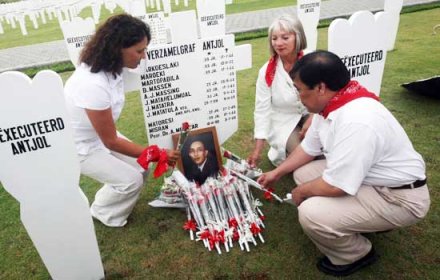
Present-day Eijkman Institute director Sangkot Marzuki (right), and two descendants of the executed man, Monique Mochtar (left) and Jolanda Mochtar (center) lay flowers at a 2010 memorial event after the doctor’s location in a mass grave was discovered. Achmad Mochtar’s name also graces a Sumatran hospital.

On this day..

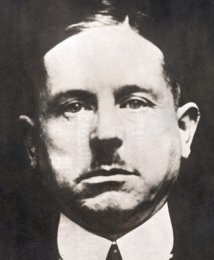
1931: Peter Kürten, the Vampire of Düsseldorf

On this date in 1931, the “Vampire of Düsseldorf” was beheaded for that city’s most infamous serial murder binge.

It was, perhaps, the logical end of a terrible journey.

A factory moulder and World War I deserter in his late forties, Peter Kürten commenced a series of uncommonly bestial rape-murders in early 1929 … the harvest of a lifetime’s twisted brutality.

He’d been the oldest of 11 children stuffed in a hellish one-room apartment with a violent drunk of a father who battered the children and openly raped their mother. Well, “if they hadn’t been married, it would have been rape,” in Peter’s words.

The future vampire took his refuge turning his own abuse on younger siblings and, with the help of a degenerate dogcatcher in the neighborhood, on obliging animals he could lay his hands on — which creatures he was soon learning to torture, and to rape, alongside more conventional human delinquencies like arson and burglary.

Kürten is known to have strangled at least one ten-year-old prior to World War I (he would also claim to have surreptitiously drowned a couple of school chums in his boyhood) but it was on the far side of the Great War — which he’d spent mostly in miserable prisons, nursing increasingly twisted fantasies of vengeance — that the beast truly emerged.

The spree that carried him to these pages began in Febuary 1929, when he slew an eight-year-old, attacked a middle-aged woman, stabbed a mechanic to death. Kürten’s crimes were irregular, but distinguished by a fiendish wrath: he abducted one young woman and hammered her to death in the woods outside town; he stabbed a five-year-old to death with scissors as he achieved his orgasm; he asked a teenager to run off and get him some cigarettes, so he could use her absence to slit her younger sister’s throat; he stabbed strangers randomly.

“I derived the sort of pleasure from these visions” of mayhem and cruelty, he said, “that other people would get from thinking about a naked woman.”

Düsseldorf endured a year of terror, finally aborted when Kürten’s own wife — whom he seems to have loved genuinely — turned him in, at Kürten’s own request, for the reward money.

At a packed trial, the accused’s accumulated hatred for the sadistic world poured out in words just as it had done in deeds over the months preceding.

I said to myself in my youthful way ‘You just wait, you pack of scoundrels!’ That was more or less the kind of retaliation or revenge idea. For example, I kill someone who is innocent and not responsible for the fact that I had been badly treated, but if there really is such a thing on this earth as compensating justice, then my tormentors must feel it, even if they do not know that I have done it …

Never have I felt any misgiving in my soul; never did I think to myself that what I did was bad, even though human society condemns it. My blood and the blood of my victims will be on the heads of my torturers. There must be a Higher Being who gave in the first place the first vital spark to life. That Higher Being would deem my actions good since I revenged injustice. The punishments I have suffered have destroyed all my feelings as a human being. That was why I had no pity for my victims.

-Kürten

Amateurs though we are, we incline to doubt the sufficiency of the tit-for-tat explanation. Kürten might well have believed that about himself, but the “vampire” moniker gets at an essential, organic sensuality about his crimes whose roots go quite a bit deeper than revenge.

“Tell me,” the doomed murderer is supposed to have asked a prison doctor shortly before facing the guillotine, “after my head has been chopped off will I still be able to hear; at least for a moment, the sound of my own blood gushing from the stump of my neck?”

The doctor indeed thought it possible the head might survive a few seconds.

“That,” mused the killer, “would be the pleasure to end all pleasures.”

Kürten is one of several predatory sex-slayers — also see the likes of Fritz Haarman and Carl Grossman — who prospered in interwar Germany, and helped to inspire Fritz Lang’s cinematic classic M. (Kürten is often thought the most direct model for that movie’s murderer, played by Peter Lorre. Lang denied that was the case, but in some countries’ releases it went out under the title not of M, but of The Vampire of Düsseldorf.)

Sources:

Murderpedia

TruTV

On this day..

2010: Michael Perry, Herzog subject

It was on this date in 2010 that Texas executed Michael Perry by lethal injection for his part in a triple homicide that netted a cherry-red Camaro.

Perry is the subject of the 2011 Werner Herzog documentary Into the Abyss; being a Herzog film, it comes recommended.

Abyss is “not an issue film; it’s not an activist film against capital punishment,” Herzog has said. “In this particular case, with this very senseless crime, so senseless it’s staggering, what fascinated me was that it points to a decay in family values and the cohesion of society, all these things that looked so big and beyond this case.”

Trailer:

Interview with Herzog:

Full movie, if it remains available:

On this day..

1799: Admiral Francesco Caracciolo, Neapolitan

On this date in 1799, Admiral Francesco Caracciolo was hanged by the British commander Horatio Nelson from the yardarm of the Sicilian frigate La Minerve in the Bay of Naples.

Poor Caracciolo (English Wikipedia entry | Italian) — and not to be confused with the Italian saint of the same name — got middled by the French Revolution.

He was a trusted admiral from a noble family, and indeed had served with the British Navy (Italian link). Caracciolo got tapped for escort duty to help King Ferdinand IV and his wife Maria Carolina* flee from a Naples threatened by French troops to the safety of a British fleet stationed at Sicily.**

But he seems to have been troubled by that flight by consciousness of a conflict between civic duty and duty to sovereign.

Carraciolo would later tell the drumhead court that condemned him that it was not he who had turned coat; rather, “the King deserted me and all his faithful subjects … The King collected everything that could be converted into specie on pretence of paying [the] army … and fled with it to Palermo, there to riot in luxurious safety. Who was then the traitor — the King or myself?”

With said King a-riot offshore, French conquest initiated in January 1799 the Parthenopean Republic, a fine obscurity for a pub bet today, but for Caracciolo a matter of life and death. He’d returned to Naples, supposedly to tend to his personal affairs; his prominence and popularity, he found, required him to choose between his allegiances.

Under whatever inducement of conscience or calculation, Caracciolo put to sea for the new Republic and engaged the Parthenopeans’ enemies, actually preventing one British landing attempting to restore his former boss.

Alas, the French — by whose arms alone was the puppet Republic supported — soon decamped for greater priorities than Naples, and the royalist elements had the city back in hand by June. While the political revolutionaries would face their own reckoning, the Jacobin admiral was caught attempting to fly and delivered to Nelson for the most summary simulacrum of justice.

“A slight breeze; a cloudy sky,” Lord Nelson’s laconic journal entry for June 29 reads. “Sentenced, condemned, and hung Francesco Caracciolo.”

Fairly or otherwise, this incident is one of the very few blots upon the beloved Nelson’s reputation. That’s partly for the haste with which it was conducted and partly for the jurisdictional matter of the British — to whom Caracciolo owed no loyalty, and against whom he had committed no treachery — doing the Bourbon monarchs’ dirty work by receiving the prisoner, conducting the trial aboard a British ship, and directing the sentence.

And it was all over under that single day’s cloudy sky.

Caracciolo was brought aboard the Foudroyant that morning, a five-member panel of Neapolitan royalist officers rounded up to try him, given a two-hour trial, and condemned to hang that very evening at 5. (Requests for a soldier’s death by shooting, or a day’s time to make peace with one’s maker, went begging.) At sunset, the body was cut down, loaded with weights, and cast into the sea.

They figured that was the last they’d seen of the admiral, but a few days later — with King Ferdinand now having moved onto the Foudroyant — the corpse somehow bobbed up to the surface right beside the ship, like a revenant spirit come to accuse the royal still too nervous to reside in Naples.

“What does that dead man want?” the shocked king is supposed to have exclaimed as he took sight of it.

“Sire,” answered a priest, “I think he comes to demand Christian burial.”


Ettore Cercone, L’ ammiraglio Caracciolo chiede cristiana sepoltura (Admiral Caracciolo requests a Christian burial). Horatio Nelson and Lady Hamilton are in the foreground.

He got it. An 1881 epitaph in the Chiesa di Santa Maria della Catena can still be read in his honor.

“Francesco Caracciolo, Admiral of the Republic of Naples, who fell victim of the hatred and the lack of mercy of his enemies. He was hanged at the mast on 29 June 1799. The people of Santa Lucia took it upon themselves to honour him with a Christian burial. The City Council of Naples, 1881.”

Naples’ harbor-front street, from which one would have had a fine view of Nelson’s fleet back in the day, is today known as the via Francesco Caracciolo. The Republic of Italy’s navy had a Caracciolo-class battleship type in production in the 1910s, but the line was discontinued before any of the four vessels reached completion.

* Sister of Marie Antoinette.

** Where Lord Nelson was banking the proceeds of his recent Egyptian exploits in the famously pleasing form of Emma, Lady Hamilton, the wife of the British envoy to Naples.

† Apropos of the preceding footnote, there’s been some grousing about Lady Hamilton’s role in all this. She was an intimate of the temporarily exiled queen, and the old Encyclopedia Britannica entry on Caracciolo slates her with having exploited her hold over the infatuated Nelson to work Maria Carolina’s vengeful will. We’re inclined to suppose that Nelson’s own reasons of warcraft-slash-statecraft, attempting to swiftly cow any potential Neapolitan resistance, suffice as explanation — whether right or wrong.

On this day..

1844: Gabriel de la Concepcion Valdes, “Placido”

On this date in 1844, Cuban poet Gabriel de la Concepcion Valdes was executed in Matanzas for conspiring to overthrow Spanish authority on the island.

His mother (who gave him up to an orphanage) was a Spanish dancer. His father (who adopted him back) was a “quadroon” barber. Valdes, aka Placido (Spanish link, which is true of most available online resources about him) grew up as a free mixed-race youth in a slave society.

This situated him in the privileged (relative to plantation slaves) but precarious position of the petty bourgeoisie, menaced not only by the prospect of economic reversal but by the vicissitudes of Spanish policy towards his caste — whose growth many colonial officials fretted warily.

Though Placido made his bread apprenticing as a print-maker and later making turquoise combs, he made his fame by dint of literary gift that was celebrated throughout Cuba and abroad. His “La siempreviva” won a literary competition when he was just 25, and led to an invitation to visit Spain (Placido declined it); the Cuban-born, naturalized Mexican poet Jose Maria Heredia visited Cuba in 1836 and made a point to look up Placido; and according to the out-of-print Cuba’s Romantic Poet: The Story of Placido by Frederick Stimson, the young Cuban was wildly popular with North American slavery abolitionists as well.

Placido is less well-remembered beyond his home island today, but arguably rates as Cuba’s most distinguished Romantic poet.

In the 1830s especially, when civil war in Spain put the reigning monarch on the liberal side, Placido was able to exploit the opening to write openly of Cuban political aspirations.

His La Sombra de Padilla, dedicated to Spain’s “wise and exalted Queen”, imagines one of Spain’s martyred comuneros charging him to venture his life for liberty against absolutism.

Better to fall prey to La Parca [the Grim Reaper]
Than to a despotic Monarca

But notwithstanding the war in Iberia, the exalted Queen still put Cuba under special (read: repressive) law. Placido’s prominence, having advocated for much more freedom than Cuba was slated to enjoy, subjected him to automatic Spanish suspicion as more authoritarian governance arrived in the 1840s.

The poet was arrested in the Conspiración de La Escalera (Conspiracy of the Ladder, so named for the structure its accused were tortured upon). This purported plot to raise a slave revolt may or may not (pdf) have really existed, but the crackdown it authorized sure did. Indeed, despite the “slave revolt” bogeyman, it was overwhelmingly free blacks whom the Spanish suppressed in this affair.

Gariel de la Concepcion Valdes, known as “Placido”, was shot with ten others, “miserable instruments of the most depraved machinations of immoral men, men who deserve the curse of the living and the opprobrium of generations to come,” just a week after his conviction.

The appointed lot has come upon me, mother,
The mournful ending of my years of strife,
This changing world I leave, and to another
In blood and terror goes my spirit’s life.

But thou, grief-smitten, cease thy mortal weeping
And let thy soul her wonted peace regain;
I fall for right, and thoughts of thee are sweeping
Across my lyre to wake its dying strains.

A strain of joy and gladness, free, unfailing
All glorious and holy, pure, divine,
And innocent, unconscious as the wailing
I uttered on my birth; and I resign

Even now, my life, even now descending slowly,
Faith’s mantle folds me to my slumbers holy.
Mother, farewell! God keep thee — and forever!

-Valdes, “Farewell to My Mother”

There are volumes of Placido’s poetry (in the original Spanish) freely available via public-domain Google books offerings here and here, with a short thumbnail biography here. For the nonfiction biographical exploration of Placido’s life, and detailed critical analysis of his poetry, this Vanderbilt master’s thesis (pdf) is highly recommended.

On this day..

1740: Artemy Volynsky

On this date in 1740, the Russian politician Artemy Volynsky was beheaded in St. Petersburg.

Volynsky, as famously corrupt as he was famously able, had worked himself up from Peter the Great’s dragoons into the circles of high statecraft but lost a power struggle in the notoriously cruel court of Empress Anna. He’d made it all the way to Anna’s cabinet, but there made himself the rival of powerful Baltic grand chamberlain Ernst Johann von Biron: in political terms, Biron and the fellow Balt who ran foreign policy had a west-facing, German orientation, while Volynsky looked east to Central Asia, India, and China; in personal terms, Biron was the lover of the queen, and Volynsky … was not.

After Volynsky beat up a poet, Biron had the excuse to have him investigated and was able to construct as treasonable some private correspondence about changing the way things are done in Russia, Biron thereby ridding himself of the rival.


Just a few months after Volynsky’s execution, Anna herself died, leaving an ill-starred one-year-old heir and an uncertain political situation.

In the event, Biron and his fellow Germanophiles were driven out of court by the Russian grandees, who then constructed the late Volynsky — by all indications as cutthroat and grasping as anyone else at court — as a patriotic martyr vis-a-vis the detested late ascendancy of the Baltic types.*

As a result, in 1741, a modest monument (later aggrandized) was set up to Volynsky et al at St. Sampson’s Cathedral.**

Further to that same end, the scaffold-bound 19th century Decembrist poet Ryleyev (Ryleev) paid his own tribute to Volynsky in verse. So far, I’ve only found Ryleyev’s “Volynsky” in Russian, but here’s a little taste [courtesy of blog friend Sonechka] of the gist:

He who resists the overweening
Expects no reward and asks for none
And forgetting even himself
Sacrifices all to the motherland.
Against the cruel tyrants
He will be free even in chains
At execution justly proud
And ever after exalted.


In that same vein, Ryleyev’s contemporary Ivan Lazhechnikov featured Volynsky as the protagonist of his historical novel The Ice Palace or The Ice House,† again whitewashing the man’s ample stock of disreputable qualities.

The book’s title alludes to a famous structure put up in the winter of 1739-1740 for the royal court’s amusement, a vast frozen edifice 20 meters tall and 50 meters wide, designed by the architect Pyotr Yeropkin … a Volynsky ally who ultimately shared Volynsky’s fate on June 27, 1740.

This sounds great, but the decadent amusement park soon became the scene for one of imperial Russia’s more infamous and bizarre horrors: Anna forced an ex-prince who had been demoted to court jester for marrying a Catholic to wed a homely Kalmyk serving-girl, with whom he would have to pass a “wedding night” naked in that icebox. (Somehow, they managed to survive.)


The yellow-clad Anna dances merrily while her terrified servants/prey brace to survive a winter night on the ice bed. Detail view; click for the full painting.

Volynsky’s machiavellian contribution to the ghastly scene had been to associate this spectacle with a celebration of Anna’s name day.

This bit of sucking up didn’t buy him quite enough time when it was all said and done, but it reminds of Volynsky’s highly mitigated claim on eternal exaltation.

* Remembered as the Bironovshchina. Compare to the Yezhovshchina, at the height of Stalin’s purges: why don’t these things ever get named for the actual chief executive?

** Saint Sampson the Hospitable has a June 27 feast date; the cathedral was dedicated in his honor because that was also the date, in 1709, of Russia’s watershed victory over Sweden at the Battle of Poltava.

† There’s more about this novel in the context of both 19th century literature and Volynsky’s own era in this pdf dissertation extract, pp. 7-22.

On this day..

1943: Marianne Elise Kurchner condemned for a joke

(Thanks to Meaghan Good of the Charley Project for the guest post. -ed.)

Sometime in the summer of 1943 in Nazi Germany, a young woman from Berlin named Marianne Elise Kürchner was guillotined for telling a joke.

Kürchner, who worked at an armaments factory, told the following joke to a coworker who denounced her:

Hitler and Göring are standing atop the Berlin radio tower. Hitler says he wants to do something to put a smile on Berliners’ faces. So Göring says: “Why don’t you jump?”

Not exactly a side-splitter. More like a neck-splitter: making jokes at Hitler’s expense was, in theory at least, a capital crime.

Mind you, most people who made nasty wisecracks about the Nazis faced no consequences at all. They were rarely denounced, and if they did come before a court they were usually given a warning, or at most a few months of “re-education” in Dachau.

The Nazis did occasionally use sedition as an excuse to arrest and execute people who’d gotten on their bad side for one reason or another, but ordinary Germans initially had little to fear.

However, as the tide of war began to turn against Germany, the punishments for sedition became ever more severe.

Marianne was called up before the People’s Court, whose president, Roland Freisler, was famous for both his long raving speeches berating defendants, and his death sentences. She admitted to making the joke but said she hadn’t been herself at the time, feeling bitter about the recent loss of her husband at the front.

Freisler would have none of it. In fact, he considered Marianne’s status as a war widow to be an aggravating factor. “The People’s Court,” Rudolf Herzog said of this case in his book Dead Funny: Humor in Hitler’s Germany, “made it a point of pride to take no account of individual suffering.” In his ruling, Friesler wrote:

As the widow of a fallen German soldier, Marianne Kürchner tried to undermine our will to manly defense and dedicated labor in the armaments sector toward victory by making malicious remarks about the Führer and the German people and by uttering the wish that we should lose the war … She has excluded herself from the racial community. Her honor has been permanently destroyed and therefore she shall be punished with death.

The People’s Court’s judgment was rendered on June 26, 1943. Marianne lost her head shortly thereafter.

On this day..