El Salvador campesino Jose Feliciano Ama was hanged in the town square of Izalco on this date in 1932 during a ferocious repression of the peasantry.
In an environment of desperate economic immiseration for nearly all Salvadorans below the landed oligarchy, the heavily indigenous western peasantry rebelled on January 22, 1932 — aided or led by the Communist Party.*
This fate of this rebellion might be inferred by its historiographical sobriquet, the Salvadoran peasant massacre — or simply la Matanza, the slaughter.
In numerical terms, it ran to well into the tens of thousands, maybe up to 40,000 — indiscriminately visited on peasants of originario complexion in the zone of rebellion, batches of them summarily shot into mass graves they’d been forced to dig for themselves.
In the Pipil town of Izalco, where coffee latifundias dominated the best agricultural land,* up to a quarter of the population was butchered. None of those put to la Matanza were more recognizable nor more vividly recalled than the local rebel leader Feliciano Ama English Wikipedia entry | Spanish), extrajudicially noosed in front of the Izalco church. Today a small plaque in this square honors him as a popular martyr.
Blood accumulates upon us. Verily, it does seem that the reins of justice have been loosely thrown to the devil, and that we are all driving at breakneck speed in the same direction.
On this date in 1866, four youths employed as teamsters in the Army corrals of Union-occupied Nashville were hanged for a brutal highway robbery/murder.
The victim was William Hefferman, a wealthy railway contractor. His assailants were George Crabb/Craft, James Lysaught, Thomas Perry/Ferry, and James Knight; Knight at 20 was the only one out of his teens. On the night of November 22, 1865, they held up Hefferman’s carriage. The situation turned deadly when Hefferman’s son-in-law, attempting to protect the old man from the blows of the assailants when he refused to give them any money, fired a shot that wounded Crabb — which led to a return shot that mortally wounded Hefferman. He succumbed to the wound a few days later.
This was the immediate, unsettled aftermath of the U.S. Civil War, occasion for a robust crime wave that held Middle Tennessee in terror. “Nashville is infested by bands of robbers and murderers,” complained the Ohio newspaper The Spirit of Democracy (Dec. 6, 1865). Hefferman’s murder would be one of the signal crimes of that interim and draw nationwide outrage — all of which helped the killers’ associates to shop them very speedily. The army’s drumhead court-martial was gaveled in within a week and the hoodlums were lucky to get that far. “Great excitement exists in the city,” a dispatch to the Daily Ohio Statesman (Nov. 28, 1865) reported. “The streets are thronged with men vowing vengeance and threatening lynch law. Tonight meetings are being held in each ward to form a citizen patrol. A spark may incite the crowd to mob law.”
As it was a military trial, the appeal went up the chain of command to U.S. President Andrew Johnson,* who denied it. However, such a proceeding would not have been licit under the imminent (April 1866) U.S. Supreme Court holding in Ex Parte Milligan — which held that military courts cannot try civilians wherever civilian courts are open.
It is their youth, their boyishness, that leaps off the page in the accounts of their last hours — such as this from the Cleveland Daily Leader of January 29:
The four Heffernan [sic] murderers were hung to-day, at thirteen minutes past twelve o’clock. Their real names are James Knight, Thomas Perry, George Crab and James Lysaught. Two had been in the rebel army.
Yesterday several orthodox ministers called, conversed and prayed with the prisoners, who exhibited some emotion. Afterward, Father Begrath, of the Catholic Church, was with them. They all professed the Roman Catholic faith. Knight and Perry were baptised. The other two had been baptised in infancy. The prisoners had previously shown great hardihood, singing such pieces as “Bold Jack Dunaho” and “Bingen on the Rhine.” The past two days had tamed them down, but they were still stolid, frivolous and careless, joking about their doom.
This morning, Perry’s brother brought him clothing. The parting scene between them was heart-rending, Perry giving way to tears and sobs. Colonel Innis provided the others with clothing. Lysaught said, at first, that he didn’t want any pants, as those he had on were good as gold to hang in. Crab was asked to tell who shot Hefferman. He replied, “That is not a fair question; I’ll never tell that in this world.”
Father Begrath came about ten o’clock to attend them in their last moments. Lysaught said he felt as gay as a lay. He said he had been badly treated, else he would be with his parents now. Father Begrath read a touching letter from Lysaught’s parents to the Bishop, asking him to have James’ grave marked that some day they might take the body away. He was earnestly exhorted to repentance, but he remained almost stolid. Some one in the room having a looking-glass, he jumped up, exclaiming, “By golly, I must look at my face once more.” Then turning to Crab, he remarked, “Look at yours — it is your last chance.”
Crab replied, “It aint any use.” Lysaught asked, laughingly, “afraid you’ll break the glass?” when all four seemed much tickled. Crab having eased Lysaught’s handkerchief, the latter playfully snatched it away, saying, “let me smell it everlasting.” Then, turning to Crab, said, “you’re enough to make a monkey grin.”
Perry was asked if he feared to die. He replied “I don’t dread it a bit. It’s best to take it easy, it’s got to come.”
Crab indicted the following letter to Byron Heston, Oswego, New York:
George Crab, the boy who used to run on the packet with you, in 1861, is about to be hung. He requests to be remembered, kindly, to yourself and family.
Perry took his brother aside at parting, and advised him never to indulge in sinful, lazy ways, never to swear, and to let alone whisky, cards and bad houses, “for the like of this has brought me to the gallows. I want you to take my body home and let mother see me. I am sorry she did not see me before I was hung. Tell her to meet me in a better world, as I am prepared to die. God bless you! Good-bye!”
When the priest left them for a few moments they began to chat and joke about the ropes that would hang them, the feeling of contrition being evanescent.
An immense crowd, numbering fifteen thousand persons, were on the ground. At twenty minutes past eleven, the prisoners were brought to the gallows, which they mounted with a firm step, and stood gazing around for nineteen minutes, while the charges and specifications and sentence were read. Perry composedly leaned against one of the uprights, and surveyed the crowd. Crabb took hold of the noose before him, and viewed it with a comic look, testing its strength with his thumb, and rubbing his head against the rope.
Knight buttoned his coat, chewing his cud of tobacco violently and showing nervousness. As his arms were bound he quivered a moment. During the prayer he knelt, bowing his head and holding his handkerchief to his nose, which was bleeding. His last words were: “I have no hard feelings against any one. I am going to a better world.” Lysaught took a farewell chew of tobacco, saying “Pretty rough, ain’t it?” He asked forgiveness of all whom he had injured, adding, “I am glad we had time for repentance; I am glad we were removed from the jail to the Penitentiary. If I had stayed at the jail I would have starved to death.” Crab also asked forgiveness for his misdeeds, and thanked Mr. Johnson, keeper of the Penitentiary, for his kindness. Just before the drop fell, he shrugged his shoulders and exclaimed, “It’s kind o’ cold.” A chum called on him on the platform, and was affectionately kissed by Knight and Crab; as he went down the steps, the former called out, “Take warning by this.”
Just before the drop fell, Perry held out his hat and said, “Jim Johnson give my brother that.”
At thirteen minutes after 12 o’clock the rope was cut, and the four bodies fell with a heavy thump. Lysaught’s neck was broken. The knot slipped with Knight and Crab, who died with many struggles and convulsive writhings. Perry died by strangulation, but did not move much.
After hanging twenty minutes the bodies were cut down and placed in common pauper coffins.
An early attempt was made to erect whisky, candy and apple stands among the crowd of spectators, but the military promptly interfered.
The bearing of the condemned showed that they had agreed to brave it out. Their highest estimation of conduct on such occasions seems to have been to die game. They certainly met death with as little show of fear as it possible to imagine in youths not out of their teens.
* By coincidence, Johnson had been the military governor of Tennessee during the war.
On this date in 1774,* in the British official John Malco(l)m was tarred and feathered and mock-executed by enraged Bostonians during the tense run-up to the American Revolution.
Malcom’s militant Loyalism put him sharply at odds with his city’s’s rising Patriot ultras — the sorts of people who, just a month before, had provocatively dumped British East India Company tea into Boston Harbor.
Malcom himself hadn’t been proximate to that event but as a customs official he’d made himself obnoxious on the docks before. In October of 1773, he seized a ship in Falmouth,** threatening “to sheath his sword in the bowels of any one who dared dispute his authority.” The sailors responded by sheathing John Malcom in a coat of tar and feathers and marching him through the streets.
This vigilante justice was meant to come up short of serious physical injury, and it did. But it was a crippling public disgrace, far beyond the streets of Falmouth — an ironic situation since Malcom’s own late brother Daniel was a celebrated Patriot bootlegger.† Back in Boston, Malcom found himself heckled in the streets about the incident to such an extent that he complained to the governor. (The governor told him to suck it up.) And it bubbled right to the surface in the incident that brings today’s post, too.
On January 25 of 1774, one of the Patriot participants in the aforementioned Boston Tea Party named George Robert Twelves Hewes‡ happened across the hated crown agent — “standing over a small boy who was pushing a little sled before him, cursing, damning, threatening and shaking a very large cane with a very heavy ferril on it.” (That’s according to the next week’s (Jan. 31, 1774) Boston Gazette, as are the subsequent quotes in this post.) Apparently the kid had crashed his conveyance into Malcom while out frolicking in the deep winter’s snow.
Hewes interceded for the child, and Malcom rounded on him: “you are an impertinent rascal, it is none of your business!” Flexing his class rank, Malcom further scolded the “vagabond” that he ought not address a gentleman in public. Hewes dissented and after an exchange of barbs cut Malcom to the quick with the retort, “be that as it will, I never was tarred or feathered.” This own brought Malcom’s heavy cane crashing into Hewes’s head, crumpling the Good Samaritan to the cobblestones.
Angry bystanders to the incident trailed Malcom home, and heaven only knows what hard words were traded on the way. He should have been worried and maybe he was, but his blood was up from Hewes’s insult: Malcom stood on the threshold and verbally sparred with his angry neighbors — “you say I was tarred and feathered, and that it was not done in a proper manner, damn you let me see the man that dare do it better! I want to see it done in the new-fashioned manner.” The man’s Falmouth tarring, you see, had been leniently poured over his clothes, which might have been hell on his dry cleaning bills but also minimized the injury that hot tar could do to naked skin. Now he was daring a rougher treatment at the hands of Bostonians who had certainly proven up to that challenge in the past.
Calmer heads knew this situation could spiral out of control and judiciously steered the irate official into his house. But Malcom was not to be stilled; when his wife opened a sash to implore the crowd to disperse, her husband exploited the opening to thrust a sword into the breast of a bystander. Luckily for both parties the blade struck bone, causing only a glancing flesh wound.
Somehow the irascible coot restrained himself in the house long enough for this disturbance to subside, while Hewes shook off his concussion well enough to swear out a warrant.
But by evening, word of this politically charged provocation had circulated in Boston, along with all Malcom’s bluster — “among other things, that he would split down the yankees by dozens, and receive 20l. sterling a head for every one he destroyed.” A crowd started assembling again at Mr. Malcom’s door, now dangerously intent on its purpose.
they got ladders and beating in an upper window, entered the house and took him without loss of blood, and dragging him out put him on a sled, and amidst the huzzas of thousand[s], brought him into King street. Several Gentlemen endeavoured to divert the populace from their intention, alledging that he was open to the laws of the land which would undoubtedly award a reasonable satisfaction to the parties he had abused; they answered he had been an old, impudent and mischievous offender — he had joined in the murders at North Carolina — he had seized vessels on account of sailors having a bottle or two of gin on board — he had in office, and otherwise, behaved in the most capricious, insulting and daringly abusive manner — and on every occasion discovered the most rooted enmity to this country, and the defenders of its rights — that in case they let him go they might expect a like satisfaction as they had received in the cafes of Richardson and the soldiers, and the other friends of government. With these and such-like arguments, together with a gentle crouding of persons not of their way of thinking out of the ring, they proceeded to elevate Mr. Malcom from his sled into the cart, and stripping him to buff and breeches, gave him a modern jacket, and hurried him away to liberty-tree, where they proposed to him to renounce his present commission, and swear that he would never hold another inconsistent with the liberties of his country; but this he obstinately refusing, they then carted him to the gallows, passed a rope round his neck, and threw the other end over the beam as if they intended to hang him: But this manoeuvre he set at defiance. They then basted him for some time with rope’s end, and threatened to cut his ears off, and on this he complied, and they the brought him home.
See, reader, the effects of a government in which the people have no confidence!
* There are a few other dates besides Tuesday, January 25 to be found out there, but newspaper reports from the time clearly place it on that day. Malcom himself later circulated a strange bulletin to Boston churches confirming the date with the words “John Malcom returns thanks to Almighty God, that again he is able to wait on him again in the public worship, after the cruel and barbarous usage of a cruel and barbarous savage mob in Boston, on the 25th evening of January last past confined him to house, bed and room.”
** The town of Falmouth is now Portland, Maine. Its most famous revolutionary war incident was put it to the torch by the British in 1775.
‡ Hewes lived to the ripe old age of 98. Enjoy a public domain 1830s biography drawn from personal conversation with the old veteran here … including Hewes’s recollection of the tarring and feathering, which in his telling was clearly extremely traumatic to his antagonist.
The people, however, soon broke open the door, and took Malcom into their custody. They then took him to the place where the massacre was committed, and their flogged him with thirty-nine stripes. After which, they besmeared him thoroughly with tar and feathers; they then whipped him through the town, till they arrived at the gallows, on the neck, where they gave him thirty-nine stripes more, and then, after putting one end of a rope about his neck, and throwing the other end over the gallows, told him to remember that he had come within one of being hanged. They then took him back to the house from whence they had taken him, and discharged him from their custody.
The severity of the flogging they had given him, together with the cold coat of tar with which they had invested him, had such a benumbing effect upon his health, that it required considerable effort to restore his usual circulation. During the process of his chastisement, the deleterious effect of the frost, it being a cold season, generated a morbid affection upon the prominent parts of his face, especially upon his chin, which caused a separation and peeling off of some fragments of loose skin and flesh, which, with a portion of the tar and feathers, which adhered to him, he preserved in a box, and soon after carried with him to England, as the testimonials of his sufferings in the cause of his country. On his arrival in England soon after this catastrophe Malcom obtained an annual pension of fifty pounds, but lived only two years after to enjoy it.
On relating this adventure, the very excitement which the affront must have wrought upon him, evidently began to rekindle, and he remarked with emphasis, I shall carry to my grave the scar which the wound Malcom gave me left on my head; and passing my finger over the spot to which he directed it, there was obviously such a scar, as must have been occasioned by the wound he had described.
Danish scheming archbishop Didrik Slagheck was burned in Copenhagen on this date in 1522 — sacrificed to his sovereign’s convenience.
Slagheck rolled into Stockholm in 1517 in the train of the papal legate who had been vainly dispatched to calm tempers during the run-up to what became the Swedish War of Liberation.
That’s liberation from Denmark, the effective overlord via the Kalmar Union joining those two countries and Norway besides. In 1520, with ecclesiastical mediation a bust and Sweden restive, the Danish king Christian II invaded. Slagheck made his villainous historical reputation by opportunistically hitching on with the vengeful king, the same king who would execute him in the end.
Things went great for Slagheck at first: he helped queue up the enemies list for the victorious Christian’s demonstrative mass beheading, the Stockholm Massacre. And he got his 30 pieces of krona right away in the form of an archbishopric which had come open along with its former owner’s neck on the occasion of said massacre. Thereafter he commanded troops in the field during the rebellion of Gustav Vasa. By 1521 he’d been kicked upstairs,
promoted to the position of archbishop of Lund, then a Danish see, entering the cathedral at his installation on November 25th with great pageantry and to the sound of martial music. During the same autumn, however, a papal legation in Copenhagen had been investigating what had taken place in Stockholm after the coronation, and five days after his installation as archbishop Slagheck was summoned to give an account of the advice he had given and the manner in which he had acted. Christian II decided to abandon him in an attempt to clear his own reputation, and Slagheck was executed and burnt in Copenhagen on January 24th 1522. (Source)
Claudius Smith, a feared Tory guerrilla during the American, was hanged in Goshen, N.Y., on this date in 1779.
“The Cowboy of the Ramapos” for his penchant for livestock-rustling in the Ramapo Mountains, Smith headlined a gang of pro-British criminals/partisans operating out of Monroe, N.Y., near the New Jersey border — a zone of dirty irregular warfare.
Quite a lot of legends apparently proliferated about this guy, including in his own time: one wanted poster described him as seven feet tall.
If you were a British loyalist in his neighborhood you might have figured him along the lines of an Anglo hajduk — the Balkan freebooters who straddled the line between social bandit and hero insurgent. To a Patriot, he was little better than a brigand, and not satisfied with riding off cattle and horses ventured also to invade farm houses for plunder. After one of his band’s deadly raids, Orange County Whigs complained to New York Gov. George Clinton, “we have not thought ourselves secure for a long time. We live so scattered that they can come in the dead of night to any one family & do what they please.”
So unsettled were the wartime frontiers that Gov. Clinton was notably unable to satisfy their petition for quite some time, and Smith’s raids, sometimes working in concert with the pro-British Mohawk commander Joseph Brant, continued to frighten those scattered revolutionists.
A Continental Army major named Jesse Brush finally captured Smith on Long Island late in 1778, and delivered him back to authorities at Orange County who gave him a proper trial and condemned him to hang for several robberies. (Murder wasn’t on the rap sheet.)
One month later, Smith’s son Richard with a band of cowboys revenged the execution by slaying a Goshen man named Richard Clark — and pinning to his corpse a warning to their persecutors.
A Warning to the Rebels
You are hereby warned from hanging any more friends to the government as you did Claudius Smith. You are warned likewise to use James Smith, James Flewelling, and William Cole well and ease them from their irons, for we are determined to hang six for one, for the blood of the innocent cries aloud for vengeance. Your noted friend, Capt. Williams and his crew of robbers and murders we have got in our power, and the blood of Claudius Smith shall be repaid. There are particular companies of us who belong to Col. Butler’s army, Indians as well as white men, and particularly numbers from New York that are resolved to be revenged on you for your cruelty and murders. We are to remind you that you are the beginners and aggressors, for by your cruel oppressions and bloody actions drive us to it. This is the first and we are determined to pursue it on your heads and leaders to the last till the whole of you is massacred.
Dated New York February 1779.
It was tall talk that the raiders couldn’t back up: rewards and informants soon broke up the band, leaving the cowboys and Claudius Smith to pass into history.
(Thanks to Victorian historian William Hepworth Dixon for the guest post, excerpted from his John Howard, and the Prison-world of Europe The date is confirmed, as many dates hereabouts often are, by reference to the voluminous logs at CapitalPunishmentUK.org. Dixon’s distaste for the execution spectacle was received opinion among his class of bourgeois chin-strokers by this time; not for nothing, public executions became within the ensuing generation a thing of the past.)
It is, we fear, a capital mistake, under any circumstance, to lend an air of importance to the death of a criminal; and to invest or environ it with anything like beauty, dignity and romance, infinitely mischievous. There should be nothing of the heroic about public punishments — nothing which the vulgar mind could possibly deem desirable, or in which the most depraved heart could sympathize.
Only a few months ago [10 January 1848 -ed.] the writer was present at the execution of [Thomas] Sale the murderer. The crowd collected to see the exhibition was enormous. Amongst that crowd was the mother of the culprit. When the wretched man came forward on the scaffold, he looked pale and ghastly; but his bearing was insolent, and he died with the apparent insensibility of a dog. “Bravo!” cried his mother, as the drop fell, and the murderer was launched into eternity, “I knew he would die game!” A woman who had lived in adulterous intercourse with the malefactor was with her; they had made up a party to come and see the last of “poor Tom,” and when the tragedy was over, sallied off to a public house and made a day of it. Nor was this all. Among the party was another of the Sales, — brother to the murderer, son of the woman who, instead of shame, had found a glory in his death; he had been liberated from gaol only two or three days before the execution. His history is the moral of the gallows. Within a few weeks he was again arrested on a charge of robbery; the crime was clearly brought home to him, and he now lies under sentence of transportation. Another brother had been already sent off to a penal colony, these terrible warnings — hangings and transportation — were inoperative, even to the blood of the sufferers. From the altitude of its own scaffold, to hurl defiance in the face of society, in the presence of thousands of witnesses, is a point of honor and of pride with the criminal class. It is being game. Within its own sphere the family of which we speak enjoys a sort of high pre-eminence — a heroism in guilt. Dr. Moore is not far wrong when he says that our mode of punishing murderers is such as to warrant the idea that our object is not to prevent any one from following their example. Death punishments should be secret, but at the same time swift and certain; surrounded by all the terrors of an unseen but inexorable doom. When he passes from the court in which he receives condemnation the culprit should be seen of the world no more. This arrangement would be merciful to him, for no sufferer can be wholly unmindful of the vast tribunal before which he is now called upon to die, and a thousand thoughts of who may be there, what eyes may gaze upon his fall, and how he must and will deport himself in presence of these exacting judges, rush into and occupy his mind, to the exclusion of all better and more needful thoughts: at the same time, it would be far more terrible to his compeers in guilt — as much more terrible as the dark mystery of a doom which leaves no room for hope, and yet much scope for fear, always is, — than an end which we have seen, a worst which we have known.
The French murderer Pierre François Lacenaire, guillotined on this date in 1836, aspired to be a man of letters … and at least ended up a man in letters.
Lacenaire (English Wikipedia entry | the more considerable French) was a respectable merchants’ son turned ne’er-do-well, dipping in and out of prison after deserting the army in 1829 to wallow in the vices of crime and poetry.
The ensuing years alternate prison stints for various thefts with scrabbling attempts to make a go of it with his quill on the outside that invariably collapse into more thefts. As criminal biographies go, his silverware-robberies and such scarcely leap off the page but his writings in prison flashed even before his homicidal infamy — notably his Villonesque “Petition d’un Voleur a un Roi Voisin” (“Petition of a Thief to his Neighbor, the King”)
Sire, de grâce, écoutez-moi!
Sire, je reviens des galères …
Je suis voleur, vous êtes roi,
Agissons ensemble en bons frères …
Les gens de bien me font horreur,
J’ai le coeur dur et l’âme vile,
Je suis sans pitié, sans honneur,
Ah! faites-moi sergent de ville.
Bon, je me vois déjà sergent,
Mais, sire, c’est bien peu, je pense,
L’appétit me vient en mangeant,
Allons, sire, un peu d’indulgence.
Je suis hargneux comme un roquet,
D’un vieux singe j’ai la malice;
En France, je vaudrais Gisquet,
Faites-moi préfet de police.
Grands dieux! que je suis bon préfet!
Toute prison est trop petite.
Ce métier pourtant n’est pas fait
Pour un homme de mon mérite;
Je sais dévirer un budget,
Je sais embrouiller un registre,
Je signerai “Votre sujet”
Ah! Sire, faites-moi ministre.
Sire! que Votre Majesté
No se mette pas en colére!
Je compte sur votre bonté,
Car ma demande est téméraire.
Je suis hypocrite et vilain,
Ma douceur n’est qu’une grimace;
J’ai fait… se pendre mon cousin,
Sire, cédez-moi votre place.n
Sire, please, listen to me!
Sire, I return from the galleys …
I am a thief, you are king,
Let’s act together like brothers …
Good people abhor me,
I have a hard heart and a vile soul,
I am without pity, without honor,
Ah! make me a city sergeant.
Well, I already see myself as a sergeant,
But, sire, it’s very little, I think,
Appetite comes to me while eating,
Come, sire, a little indulgence.
I’m snarling like a pug,
As malicious as a monkey;
In France, I would be worth Gisquet,
Make me the prefect of police.
Great gods! such a good prefect am I!
Any prison is too small.
However, this job is not done
For a man of my merit;
I know how to divert a budget,
I know how to confuse a register,
I will sign myself “Your subject”
Ah! Sire, make me minister.
Sire! that your majesty
Does not anger!
I count on your kindness,
Because my request is reckless.
I’m hypocritical and naughty,
My sweetness is only a grimace;
I made … hang my cousin,
Sire, cede me your place.
His cells, he said, were his “university of crime” although they scarcely turned him into a mastermind. He earned the valedictory hood in December 1834 when with an accomplice named Victor Avril he ax-butchered a transvestite pauper and his mother in Passage du Cheval-Rouge. Lacenaire and Avril had the mistaken belief that the victims were flush with cash.
What he lacked in criminal chops he atoned for in theatrical flair. At the men’s trial in November 1835, Lacenaire made the courtroom the anteroom of a society salon where he delighted fashionable intellectuals, taking “command of the proceedings by confessing all of his crimes in detail and stunned the courtroom with an improvised closing soliloquoy. Rumors circulated that he was to be pardoned after conviction and be made chief of a special branch of police. This sounded much like the familiar case of the bandit, Vidocq. In fact, Lacenaire claimed to have been inspired by Vidocq’s memoirs.”
“I kill a man like I drink a glass of wine,” he exaggeratedly memed to the journalist Jacques Arago — one of numerous philosophical bon mots. (“Whilst I had the capacity to write a play, I had also the capacity to kill. I chose the easiest.” “I love life and its pleasures, but if it ends, what does it matter? The punishment of death? A contradiction in terms: it is no punishment to send a being back again to insensibility and nothingness.”)
He occupied his last weeks producing poems and memoirs that were published after his death but the true success of his performance lay in its echoes through 19th century literature: Baudelaire would call him “one of the heroes of modern life,” and no wonder — in the judgment of Executed Today guest-bloggerHenry Brodribb Irving, “no French criminal, except perhaps Cartouche, has left so distinct an impression on the minds of his countrymen.”
Gautier wrote a poem about his hand, which although uncomplimentary also salutes its owner the “Manfred of the gutter”; Balzac made room for this Manfred in La Muse du Departement; Stendahl modeled the brigand Valbayre in Lamiel upon him. Victor Hugo, apparently unimpressed with the guy’s literary pretensions, worked him into Les Miserables as the crowning monster of society’s underbelly, “what is called in theaters a third sub-stage. It is the grave of the depths. It is the cave of the blind.”
The savage outlines which prowl over this grave, half brute, half phantom, have no thought for universal progress, they ignore ideas and words, they have no care but for individual glut. They are almost unconscious, and there is in them a horrible defacement. They have two mothers, both step-mothers, ignorance and misery. They have one guide, want; and their only form of satisfaction is appetite. They are voracious as beasts, that is to say ferocious, not like the tyrant, but like the tiger. From suffering these goblins pass to crime; fated filiation, giddy procreation the logic of darkness. What crawls in the third sub-stage is no longer the stifled demand for the absolute, it is the protest of matter. Man there becomes a dragon. Hunger and thirst are the point of departure: Satan is the point of arrival. From this cave comes Lacenaire.
Nor in the 19th century could a touchstone of French literature remain confined within the Republic’s borders. Oscar Wilde referenced Lacenaire in The Picture of Dorian Gray; and Dostoyevsky mentioned Lacenaire in The Idiot and perhaps modeled the famous axe murder in Crime and Punishment upon the same.
Although his fame has faded somewhat this curious figure remains of interest to more contemporary eyes. Michel Foucault juxtaposed him against the Vidocq — an underworld creature who becomes an agent of law, the opposite of Lacenaire’s path from respectability to gutter — and perhaps captured the man’s appeal to his era’s novelists.
As for Lacenaire, he is the token of another phenomenon, different from but related to the first — that of the aesthetic and literary interest beginning to be felt in crime: the aesthetic cult of crime.
Up to the eighteenth century crimes were only heroised in two modes: a literary mode when, and because, they were the crimes of a king, and a popular mode found in the broadsheets which narrate the exploits of Mandrin, or of a great murderer. Two genres which absolutely do not communicate with each other.
Around 1840 there appears the figure of the criminal hero, a hero because a criminal, and neither aristocratic nor plebeian. The bourgeoisie produces its own criminal heroes. This is the same moment when the separation is effected between criminals and the popular classes: the criminal cannot be allowed to be a popular hero, he must be an enemy of the poor. The bourgeoisie constitutes for itself an aesthetic in which crime no longer belongs to the people, but is one of those fine arts of which the bourgeoisie alone is capable.
Lacenaire is the model for this new kind of criminal. His origins are bourgeois or petit-bourgeois.
His parents have done some bad things, but he has been properly brought up, he has been to school, he can read and write. This enabled him to act the leader in his milieu. The way he speaks of other criminals is typical: they are brutal animals, cowards and incompetents. He, Lacenaire, is the cold, lucid brain. Thus the new hero is created, displaying all the signs and tokens of the bourgeoisie. That brings us in turn to Gaboriau and the detective novel, in which the criminal is always of bourgeois origins. You never find a working class criminal in nineteenth-century detective novels.
Cinemaphiles should look to Lacenaire in the 1945 classic film Les Enfants du Paradis (clip below) as well as a 1990 biopic, Lacenaire.
On this date in 1959, in the city of Santa Clara lately captured by Cuban revolutionaries, Col. Cornelio Rojas Fernández, commander of the city’s defeated government garrison, was shot without trial by the order of Che Guevara.
It was just one among hundreds of vengeful executions being visited in those weeks upon authorities of the deposed Batista regime.
Viewers of the televised public shooting saw the stocky commander — the grandson of a hero of the 19th century Cuban War of Independence — walk unafraid to his death in an armed escort, where he exhorted his onlookers until the firing detail sent his fedora flying.
Rojas’s granddaughter Barbara Rangel remains an energetic advocate of her father’s innocence, from Florida. A kinsman named Pedro Rojas Mir was among those killed in the 1961 Bay of Pigs debacle when anti-Castro exiles mounted a failed invasion of Cuba.
An Iranian criminal named Yaqub (or Yaghoob) Ali was publicly hanged on this date in 2011, at Kaj Square in Tehran’s tony Sa’adat Abad neighborhood.
Not ten weeks earlier, he had in those same environs perpetrated a grisly public stabbing of his ex’s new boyfriend. The crime outraged Iranians the nation with the wildfire online and TV promulgation of video showing the mauled victim, one Mohammad Reza, helplessly bleeding to death on the street in broad daylight, unaided by any passerby — including two policemen who had witnessed the men’s altercation without intervening.
“The entire country was under shock after the incident,” according to a Tehran journalist. “No-one understands how the wounded man could have been left without assistance for so long. There is a general feeling that the incident is symptomatic of the growing insecurity in the country, especially in Tehran.”
The embedded video and the photo of the execution further down this post are very much Mature Content.
The speedy public hanging accordingly attracted a throng of angry onlookers.
According to an AFP wire story, “Separately, the ISNA news agency said that a convicted drug trafficker, identified only by his initials A.A., was executed in a prison in the town of Shirvan in northeast Iran. No other details were given.”
Juan Oliva Moncusi (sometimes given as Moncasi) was publicly garroted at Madrid’s Campo de Guardias on this date in 1879 for his failed assassination attempt on King Alfonso XII the previous October 25.
Everywhere he was received with hearty welcomes; the crowds cheered, and ladies showered bouquets of flowers upon him from the balconies. As the royal cortege passed along the principal street of Madrid a young man pressed through the soldiers who kept the line, and, drawing a pistol, fired point-blank at Alfonso. The bullet missed its aim. The would-be assassin was instantly seized, and he proved to be one Juan Oliva Moncasi, a cooper, twenty-three years of age. He had for several years been noted in the district of Tarragona, in the province of Catalonia, where he was born, for his exaggerated ideas in politics. He was uncommonly daring and cool in his behavior after his arrest, and he declared that he did not feel the slightest remorse. He had meditated this crime for a long time past, and came to Madrid with the firm resolve to carry out his design. He admitted that he had forfeited his life, but said he believed that he was, like Nobiling and Hoedel, furthering the objects of his school in social questions.
Source are at odds over whether to characterize this young man as a socialist or an anarchist, but his attack — succeeding the aforementioned separate assassination attempts by Nobiling and Hoedel upon the German Kaiser, and followed by the November 1879 attempt on the Italian king by Giovanni Passannante — shook Europe’s crowned heads. The anarchist Kropotkin would complain in his memoirs of the harassment he endured in Switzerland by authorities who suspected a coordinated international plot.
Although that proved not to be the case, Moncusi’s errant bullet might have actually insured the continued existence — down to the present day — of the Bourbon line in Spain, for in view of the year’s campaign of attentats “the royal advisers deemed it urgent that the succession to the throne should be assured” and accelerated negotiations to wed Alfonso to the Habsburg princess Maria Christina.
And not a moment too soon. When Alfonso died young of dysentery in 1885, Maria Christina was pregnant with what proved to be a posthumous son and heir.

 In an environment of desperate economic immiseration for nearly all Salvadorans below the landed oligarchy, the heavily indigenous western peasantry rebelled on January 22, 1932 — aided or led by the Communist Party.*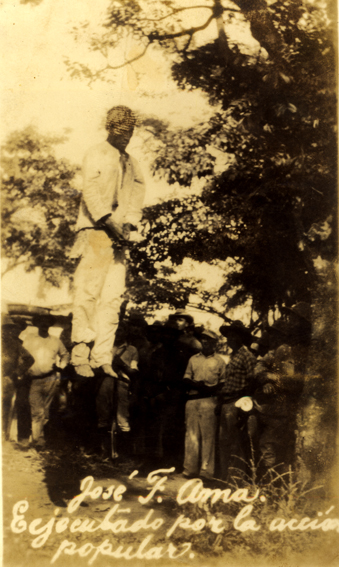


 Lacenaire (
 On this date in 1959, in the city of
 Source are at odds over whether to characterize
