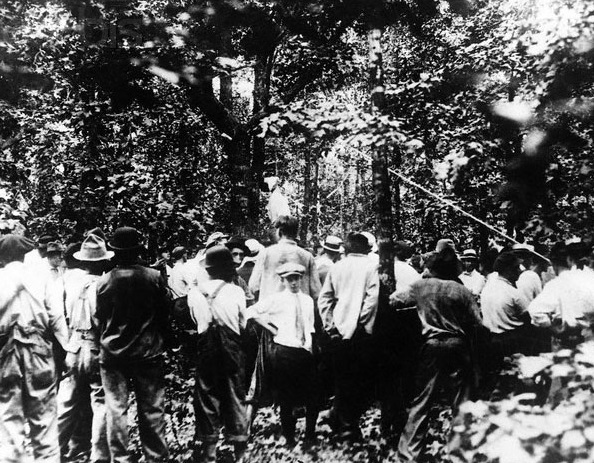
Whatever might be said, from a state’s perspective, for the virtues of making a public spectacle of capital punishment, the scaffold could also double as a subversive rostrum.
Religious martyrs, vaunting outlaws, courageous dissidents — all these sometimes sought to speak their own dangerous voices through the sermon of their deaths. If most such displays are usually better remembered by rhetoricians than historians, it is still true that public executions carried the potential to whipsaw against the authorities conducting them. In these pages, we have seen the commoners who are supposed to be the spectacle’s audience force their way into proceedings by rescuing a woman at the block (murdering the executioner), tearing down the breaking-wheel and carrying away its prospective victim in triumph, rampaging through Edinburgh and lynching a brutal gendarme in the hanging party, and eerily refusing to attend a Italian execution in a show of silent menace.
And apart from high drama when the place of execution is put to its usual function, the site itself has underappreciated potential for popular expropriation.
That brings us to this date’s subject, courtesy of the Anne Boleyn Files: a grisly and caustic comment left on the gallows by some unknown Protestant in the first year of Queen Mary‘s Catholic reign. To situate this event in time and context, the Protestant rebellion of Thomas Wyatt had been crushed just two months before, leading to the precautionary beheading of potential Protestant rival Lady Jane Grey. Three days after the events here, on April 11, 1554, Wyatt himself went to the block.
The same 8. of April, being then Sunday, a cat with hir head shorn and the likenes of a vestment cast ouer hir, with hir fore feet tied togither, and a round peece of paper like a singing cake [communion wafer] betwirt them, was hanged on a gallowes in Cheape, neere to the crosse, in the parish of S. Mathew, which cat being taken downe, was caried to the Bish. of London, and he caused the same to be shewed at Pauls crosse, by the preacher D. Pendleton.
There’s no no record that the heretical “executioner” was ever outed, despite publication of a reward.
The xiij day of Aprell was a proclamasyon was made that what so mever he where that could bryng forth hym that dyd hang the catt on the galaus, he shuld have XX marke for y labur.
California on April 7, 1836 saw the first known installment of what would become a rich tradition of history of vigilance committee lynchings in the state — over an affair of the heart.
Maria del Rosario Villa had abandoned her husband Domingo Felix (or Feliz) back in 1834 to take up with a vaquero named Gervasio Alipas (or Alipaz). The honor-stricken husband spent two years fruitlessly trying to reconcile until in 1836 at his behest the alcalde successfully pressured Maria into returning to her husband.
But on the couple’s return trip to their ranch, the lover Alipas intercepted them and did the husband Felix to death. Narciso Botello’s* annals describe that Alipas “took hold of his [Felix’s] horse and threw himself on Felix, grabbed him by his neckerchief, and pulled him off, dragging him along downhill and twisting the neckerchief, strangling him” — then pitched the choking victim into a gully where he finished him off with a machete. “Later it was proven by the tracks that the wife had been present.” (Source) She helped him dump the body near San Gabriel Mission, too.
Outraged both by the dastardly murder and by the wanton violation of matrimony that precipitated it, a gang of 55 organized themselves as a Junta of the Defenders of the Public Safety, led by Victor Prudon, a recent arrival to the area from the Hijar-Padres colony.** As no militia could be mustered inclined to oppose its will, on April 7 the junta forced open the jail where Alipas was interred, stood him up behind a church, and shot him to death. Villa — being held in an apartment at a private residence — was likewise forced out and marched to a nearby stable where she got the same treatment.
The vigilantes deposited the bodies back at the jail with the communique,
Junta of the Defendres of the Public Safety —
To the First constitutional Alcalde:
The dead bodies of Gervacio Alispaz and Maria del Rosario Villa are at your disposal. We also forward you the jail keys that you may deliver them to whomsoever is on guard. In case you are in need of men to serve as guards we are at your disposal.
God and Liberty. Angeles, April 7, 1836.
Victor Prudon, President
Manuel Arzaga, Secretary
And that was the end of the Defenders of the Public Safety, who disbanded a few days later, never to reconstitute. Indeed, while vigilance committees became regular features on the Californian landscape in later years, this is the sole such incident ever known to have occurred there under Spanish or Mexican rule.
* A Mexican who would serve two terms in the state assembly of California after it became a U.S. state in 1850.
** Mexico at this point was still in its first generation of independence; its hold on sparsely-populated California was not strong — and the missions set down there to convert natives to Christianity and project a Spanish presence had Russian competition.
The Hijar-Padres colony (Padres was the name of the colony’s organizer, Hijar its financier) was a nucleus of 200-odd souls dispatched to settle in California by one of the liberal intra-Santa Anna governments. The leaders soon became embroiled in a complex political rivalry with California’s governor and the colony itself failed to take root, its emissaries settling and taking work wherever they could. Many set down roots in California’s “Southlands” where Los Angeles, then just a small town but still the regional capital, would one day splay out its sunlit superhighways. While colonists were involved in the vigilance committee proceedings, no member of the love triangle was a colonist. (See C. Alan Hutchinson, “An Official List of the Members of the Híjar-Padrés Colony for Mexican California, 1834,” Pacific Historical Review, Aug. 1973.)
Thomas P. Lewis, master of the ship Adelaide, loading guano at Elide Island, off the coast of Lower California, was killed there on the 12th ult. by Wm. Williams, colored cook off that vessel. Three other vessels happened to be there at the time, and the officers united to hold a court, taking six sailors as part of the jury, and tried Williams, convicted him of murder, and then hanged him on the island.
Elide Island is a “naked rock, one mile in circumference” off the coast of Mexico’s Baja California which for a few years in the mid-19th century was heavily exploited for its guano supplies. 28,000 tons of bird crap later, the supply was tapped out.
This horror supplies to historical periodization the opening date of the Wars of Religion that would ravage France for the balance of the century.
After the shock jousting death of Henri II, sectarian tensions spun out of control under the unsteady succession of sons still in their minority — and the power behind the oft-transferred throne, Catherine de’ Medici.
But Catherine was a foreigner and the royal authority rested uncertainly on her children’s wee heads. Tense as matters already stood between Catholics and Huguenots, the realm’s shaky sovereignty disinhibited both confessions when it came to ever more irksome provocations.
Seeking to steer past the looming civil war, Catherine promulgated a decree of limited toleration for Huguenots, who were now to be permitted to worship publicly outside of towns. This is called the Edict of Saint-German or the Edict of January — as in, January of 1562, two months before our massacre. It is not taught in politics classes as a triumph of governance.
Whether this right even had force of law at the moment of our story is unclear, inasmuch as Catholic parlements whose ratification was required dragged their feet when it came to reading the edict into the statutes. But some incident like this was looming no matter where things stood from a scriptorium proceduralist’s standpoint.
At Vassy (or Wassy) on our date arrived the retinue of Francis, Duke of Guise. The Guises were a proverbial more-Catholic-than-the-Pope house, and Francis was not the sort of man to pass with equanimity the spectacle of Vassy’s Huguenots openly holding heretical services in a barn. His retainers tried to barge in. High words were exchanged. Scuffles gave way to brickbats and when something struck the duke’s own person a vengeful slaughter of the Calvinists ensued.
Warfare followed fast upon the publication of this atrocity. The chief Protestant lord, the Prince of Conde, openly mobilized for hostilities, seizing and fortifying Protestant towns — and the Catholic faction likewise. Inside of a year, Guise himself would be slain during a siege: one of the first wave of casualties amid 36 years of civil war.
The fate of the last Commander in Chief of Home Army General Leopold Okulicki “Niedzwiadka”, imprisoned in Moscow and murdered there, symbolize the postwar fate of the Home Army and of Poland.
-2012 resolution of the Polish parliament
On this date in 1946, Polish Home Army General Leopold Okulicki was murdered by the NKVD in a Moscow prison.
Already a veteran soldier, Okulicki proceeded to the Warsaw military academy and made soldiering his career. He had advanced to the brass by the time Hitler and Stalin destroyed Poland in 1939. Okulicki had the tragic honor to maintain the hopeless defense of Warsaw, but went underground thereafter with the remains of the Polish state — hunted by Germans and Soviets alike.
The NKVD caught him in January 1941, but his residence in the discomfiting environs of Lubyanka prison was ended by the Soviet Union’s arrangement with Poland following Operation Barbarossa. Paroled back into the field, he played a leading part for the Polish Home Army for the balance of the war — finally becoming its supreme commander in the last weeks of the war.
Now that the Nazis were no longer knocking on the gates of Moscow, the Soviets renewed their interest in detaining Okulicki, which was again effected with relative ease. (Comparing German and Soviet secret police, Okulicki would say that the NKVD made the Gestapo look like child’s play.) Sentenced “only” to a 10-year prison term at the Russians’ postwar show trial of Polish leadership, Okulicki disappeared into Soviet detention and was never seen again.
In the Khrushchev era, the USSR revealed that Okulicki had died on Christmas eve of 1946 at Butyrka prison; subsequent revelations of the medical records there revealed that he had succumbed to organ damage suggestive of having been beaten to death — perhaps as punishment for hunger-striking.
The post-Communist Russian state has posthumously exonerated Okulicki of his show-trial conviction; he is, of course, an honored figure in post-Communist Poland where many streets and squares bear his name.
On this date in 1986, during the opening months of a guerrilla war that would last until 1992, a 70-man detachment of Suriname soldiers raided the village of Moiwana, home of the rebel leader Ronnie Brunswijk, and massacred dozens of people.
Drawing made c. 1990 by an eight-year-old refugee of Moiwana. Image from Richard Price’s “The Killings in Suriname”, Cultural Anthropology, November 1995.
Sealing the roads, the team went house to house for four hours, torching houses and slaughtering any of the Ndyuka civilians who couldn’t escape into the surrounding jungle.
“Everyone was shot — the unarmed women, pregnant women, a baby barely seven months old,” goes the account in Memre Moiwana, a publication of the NGO Moiwana ’86. “No distinctions were made.” Some were mowed down with automatic weapons; others slashed to death with machetes. At least 38 people died, though various sources posit estimates running to upwards of 50.
In the weeks following, nearby Ndjuka villages in eastern Suriname shared a like fate, often bombarded by helicopters and finished off with bulldozers while death squads hunted suspected guerrillas. The U.S. State Department reported 244 Ndyuka people killed that December. A United Nations investigator entering the area months later reported that “no human being or living creature was seen apart from starving dogs in [one such town] Albina. The jungle vegetation had taken over the destroyed buildings.”
A police inspector named Herman Eddy Gooding who had the temerity to investigate these massacres while the guerrilla war was still ongoing was found mysteriously shot dead in 1990. (See Rainforest Warriors: Human Rights on Trial) In 2005, however, survivors of Moiwana won a suit against the army of Suriname before the Inter American Court of Human Rights.
On this date in 1567, Huguenots in revolt in Nimes put to death dozens of Catholics in a courtyard butchery to climax a massacre remembered as La Michelade (English Wikipedia entry | the much more detailed French)
This name of sinister memory derives from one of the church calendar’s great autumnal feast, Michaelmas — and the sword-arm of its titular archangel would have been required to keep the peace between the rival religionists in the Languedoc.
Nimes went heavily for the Protestants, with the region’s royal governors unable to restrain the conquest of Catholic neighborhoods and churches by the predominant Huguenots through the 1560s: “the very wind which blew upon Nimes breathed heresy,” in the words of Dumas.
The years running up to our events of 1567 feature one of the numerous rancorous truces pocking France’s intractable Wars of Religion: this one is known as the “Armed Peace”, which gives you an idea where everyone’s heads were at. And in Nimes, the heresy in the wind was not such as to prevent the restoration of Catholic authorities to control of the civic institutions — to the undoubted irritation of the Huguenot grandees who endured the indignity of displacement alongside the sure knowledge of the popular weight that supported them.
This ripening conflict appropriately came to fruition via a vegetable market at a city fair on Michaelmas — September 29, 1567 — where an altercation turned into a sectarian riot and soon transformed into a municipal Protestant insurrection.
Huguenots still maintaining the preponderance of force in Nimes, they perpetrated the expected outrages during the excitement: sacking the cathedral, murdering some particularly hated Catholics. But the overall organization of the Huguenots and the organized participation of the city’s Huguenot elites suggests a good deal of advance orchestration, and perhaps coordination with the Huguenot attempt to kidnap the king just days before.
In the disturbance, Nimes’s first consul Guy Rochette — Catholic, naturally — sought refuge in the palace of Bishop Bernard d’Elbene; a Huguenot captain forced the door and arrested them, confiscating from Rochette the keys to the city. Though the bishop managed to escape, other prominent Catholics were systematically detained, too. According to Allan Tulchin’s That Men Would Praise the Lord: The Triumph of Protestantism in Nimes, 1530-1570, “[i]t seems clear that the Protestant leadership intended to conduct a general roundup of Catholic lay and clerical leadership. Protestant forces targeted at least half of the sixteen men who had served as consul between 1564 and 1567 … of the nine Catholic members of the presidial, only two did not appear among the victims.”
Captive Catholics were detained in several buildings around the city, notably in the city hall. It is not known to what extent the kill lists to cull from these unfortunates were preordained and to what extent they were improvised in the moment, but on the night of September 30, summons for specific victims went out, and Protestant squads complied by dragging them out of the city hall basement or wherever else they were held to the courtyard of the bishop’s palace. This would be the makeshift abattoir.
In the narration of Dumas,
when night came the large number of prisoners so imprudently taken began to be felt as an encumbrance by the insurgent chiefs, who therefore resolved to take advantage of the darkness to get rid of them without causing too much excitement in the city. They were therefore gathered together from the various houses in which they had been confined, and were brought to a large hall in the Hotel de Ville, capable of containing from four to five hundred persons, and which was soon full. An irregular tribunal arrogating to itself powers of life and death was formed, and a clerk was appointed to register its decrees. A list of all the prisoners was given him, a cross placed before a name indicating that its bearer was condemned to death, and, list in hand, he went from group to group calling out the names distinguished by the fatal sign. Those thus sorted out were then conducted to a spot which had been chosen beforehand as the place of execution.
This was the palace courtyard in the middle of which yawned a well twenty-four feet in circumference and fifty deep. The fanatics thus found a grave ready-digged as it were to their hand, and to save time, made use of it.
The unfortunate Catholics, led thither in groups, were either stabbed with daggers or mutilated with axes, and the bodies thrown down the well. Guy-Rochette was one of the first to be dragged up. For himself he asked neither mercy nor favour, but he begged that the life of his young brother might be spared, whose only crime was the bond of blood which united them; but the assassins, paying no heed to his prayers, struck down both man and boy and flung them into the well. The corpse of the vicar-general, who had been killed the day before, was in its turn dragged thither by a rope and added to the others. All night the massacre went on, the crimsoned water rising in the well as corpse after corpse was thrown in, till, at break of day, it overflowed, one hundred and twenty bodies being then hidden in its depths.
Dumas is indulging poetic exaggeration of the scene, and later estimations of the number of victims range well below 120 — but Tulchin quotes a leather worker who saw the courtyard on the following day and described it as “all covered with blood and the water of the well all red.” Even “merely” twenty or thirty victims slashed to death would have been a gory work.
In the days following, Huguenots would cement their control of Nimes with the systematic pillage of churches and (after a six-week siege) the capture of the city’s royal garrison. There was no general massacre after the Michelade; in the main, Catholics were forced into submission or exile instead of the grave.
But the effusion, combined with Huguenot attacks further north, helped to trigger the (very brief) “Second War” within the Wars of Religion which gave way after a short truce to the much bloodier “Third War” of 1568-1570 … whose peace would be broken by a Catholic sectarian massacre much better remembered to history than the Michelade.
San Francisco entered the gold rush an unassuming port of perhaps a thousand souls … but she exited it as one of the American West’s leading cities.
It made an unruly adolescence for the boom town as penniless treasure-hunters poured in from every quarter of the globe. “Turbulent, gold-hungry men,” wrote Herbert Asbury in his The Barbary Coast: An Informal History of the San Francisco Underworld “transformed the once peaceful hamlet of San Francisco into a bawdy, bustling bedlam of mud-holes and shanties.” Suddenly, San Francisco had a huge crime problem — not to mention the conflagrations* that repeatedly devastated the fast-growing tangle of tinderworks shacks.
San Francisco in 1850
In an effort to sustain some measure of order, a number of the city’s respectable citizens banded together to create a famous or infamous Vigilance Committee.
Sworn in their published constitution of June 9, 1851 “to do and perform every lawful act for the maintenance of law and order,” the Committee declared itself “determined that no thief, burglar, incendiary or assassin shall escape punishment, either by the quibbles of the law, the insecurity of prisons, the carelessness or corruption o the Police, or a laxity of those who pretend to administer justice.”
Two days later, they proved their chops by hanging on no authority but their own emigre from Australia named John Jenkins for stealing a safe. A month later, James Stuart, also late of Sydney, was lynched at the Vigilance Committee’s hands, too.
Detail view (click for full image) of Whittaker and McKenzie’s lynching.
Though not the first Vigilance Committee hangings, Samuel Whittaker and Robert McKenzie might be the best-known.
Like their predecessors, Whittaker and McKenzie had arrived from Australia** — which had aptly bequeathed to gold rush San Francisco a criminal colony of its own in the form of a network known as the Sydney Ducks. Scrambling to save his own neck, Stuart had informed on a number of these confederates.
Whittaker and McKenzie were arrested based on Stuart’s information, as the Vigilance Committee tried to smash up the Ducks. Though extrajudicial, the Committee’s investigations were at least as meticulous as one might expect from the law at this moment in time, and the minutes of its witness interviews can be read here.
In the end, the two were basically convicted not so much for any individual crime as for their lengthy careers of robbery, often violent — for “divers offences, whereby the safety of Lives and property have been endangered” (as read the executive report on Whittaker) that rendered each “a hardened offender, and dangerous to this community … it would be unsafe to hand him over to the Authorities or mete out to him a less Penalty than Death” (as read the report on McKenzie).
Such an arrangement of juridical powers, exercised in lieu of “unsafe” Authorities, can scarcely persist long-term. Here, the governor of California, John McDougall determined to intervene in order that the fracturing of the Australians’ vertebrae would also vindicate the majesty of the law.
McDougal arrived to San Francisco and secured a writ to seize the suspects from the Vigilance Committee’s hands, tucking them away in the county jail.
Although in principle this orderly and lawful prosecution of malefactors was exactly what the Committee wanted to see happen, Gov. McDougal’s intervention when they were on the brink of consummating their own process left everyone with a frustrating sensation of justice interruptus.
And so that next Sunday — August 24, 1851 — when prisoners were removed from their cells to a chapel for the salvation of their souls and the jail’s guard detail was reduced by the proportion of gendarmes attending services of their own, a party of 36 Vigilance Committee men barged into the jail, overpowered all concerned, and seized their prey.
“Never before was San Francisco so excited,” editorialized the Steamer Alta California (Sept. 1, 1851).
Through every street, in all directions, the hurrying crowd of humanity rushed with the utmost precipitation — no one knew whither, no one knew for what. The bell of the Vigilance Committee had sounded its alarum note — and instantly the streets were living, swaying masses of human beings — uncertainty and conflicting fears and hopes ruled the hour … with a sweep like the rushing of a torrent of lava they bend their course towards the Rooms of the Vigilance Committee. Almost instantly California street, Battery street, and all their approaches, are filled with one dense mass of human beings. From lip to lip the news flies that the two criminals, Mackenzie and Whittaker, have been taken by force from the jail, by an armed posse of the Vigilance Committee. On the eager and excited multitude press toward the Rooms. On, on, on — the crowd becomes denser and broader. Wonder is stamped on every face — a solemn, almost awful silence pervades the thousands who are anxiously gazing up at the building, when quickly the doors are opened — a moment of preparation — and the numberless multitude holds its breath as the two malefactors are seen suspended by the neck — a struggle or two, a spasmodic heaving of the chest — and each spectator feels a thrill of terror coursing his veins as he involuntarily utters — dead, dead, dead!
Yes, they were dead! The two men — Whittaker and Mackenzie — who were taken from the hands of the Vigilance Committee a few nights since, by virtue of a write of habeas corpus, had been torn from the ail by force, in the middle of the day, and at the risk of life, hurried to the Committee rooms, and executed without scarcely a moment’s preparation. It is a most terrible tragedy! Well, indeed, might one exclaim, “I have supped full with horrors!”
Such are the terrible effects of misrule — these are the fruits of maladministered laws — these the results of official corruption, neglect and malfeasance. Well may the patriotic and the good turn in sadness and grief from the contemplation of such horrors. The timid may shrink from beholding them — the quiet desire an end to them; but neither fear, regret, nor desire will accomplish our security. It must go abroad over the land that this community possesses the power and the will to protect itself against every species of wrong, and that it is resolved to do it at all hazards.
Whilst we regret that the Vigilance Committee have by this act, been brought into direct collision with the constituted authorities, we cannot but approve their course in executing the two criminals. This condition of affairs was not sought by the committee; it was rather forced upon them by the action of the authorities. True, the authorities acted rightly in rescuing the men; but the course they took has proved to be unnecessary and injudicious. No one doubts the guilt of the men executed, and no one believes but that they deserved the punishment they received. The Vigilance Committee felt this, and believing that the public welfare would be promoted by the act, they had resolved to execute Whittaker and Mackenzie. But the officers of the law, with unusual adroitness, prevented the decision from being carried into effect. The Vigilance Committee have now redeemed their honor, and carried out their original determination, by recapturing the prisoners and executing them. The line of division between the legitimate civil power and the Vigilance Committee is therefore plain, broad and unmistakable.
And what is to result? We see nothing disheartening or dispiriting in the prospect. On the contrary, we think we perceive that settled determination on the part of the body politic to have justice done, which is to be the great lever of our salvation. When crime is convinced, as it must now be, that nothing is capable of preserving it from speedy and avenging punishment — when the abandoned feel, as they will now feel, that there is no safety for them here — when all bad men shall understand, as they may now understand, that their unworthy acts will surely be visited with condign reward — then will the country rise above its tribulations and its sorrows.
But this is a dreadful storm! If we did not know the ship, the crew and the passengers, we might despair of our reaching port. As it is, we speak confidently. We feel that there is gloom around us, but there is nothing to alarm the honest and patriotic. The guilty may, and ought to, flee before the gale of popular indignation; but it is through such trials that our voyage is ultimately to become a prosperous and fortunate one. Through the watches of the night of darkness which now surrounds us, there is a gentle voice whispering “Be firm, be calm, be just, and the welcome daylight will soon come!”
The Vigilance Committee disbanded itself a few weeks later. Its last act in 1851† was to prevent the lynching of a sea captain by sailors angered at his brutality, an expression of class solidarity in the definition and punishment of crime as timeless as America herself. (Source)
* These fires were widely feared to be the product of arson motivated by the opportunity to loot. This is likely a reversal of cause and effect. One inclines here to reckon with Tolstoy that cities have a natural tendency to kindling fire, and those fires are liable to blaze out of control in inverse proportion to the city’s administrative faculties.
The late San Francisco police officer and amateur historian Kevin Mullen puts together an argument here that merchants opportunistically torching excess stock to sustain gold rush price gouging was also a contributing factor.
** Both men were born in England; many of the Sydney Ducks hailed originally from the British Isles.
† Like Batman, the Vigilance Committee later emerged from retirement to fight crime again, in 1856.
One hundred years ago today, Leo M. Frank was lynched to an oak tree at Marietta — one of the most notorious mob murders in American history.
Methodically extracted hours before from the Midgeville State Penitentiary by an Ocean’s Eleven-style team of coordinated professionals, Frank’s murder was as shocking in 1915 as it reads in retrospect.
The well-heeled Jewish Yankee was factory superintendent at the National Pencil Company in Atlanta when a 13-year-old girl in his employ was discovered in the factory’s basement — throttled and apparently raped. That was in 1913; for the ensuing two years, the prosecution of Mary Phagan’s boss as her murderer would play out in sensational press coverage.
Frank is today widely thought innocent of the crime, although the Georgia Board of Pardons and Paroles has balked at issuing an unconditional pardon since so little of the original evidence survives. (A 1986 pardon came down “without attempting to address the question of guilt or innocence” in recognition of the slanted trial and the failure to protect Frank from lynchers.) But this was much more than a courtroom drama; the Frank affair crackles with the social tensions of early 20th century America. Industry and labor; integration; sexual violation; sectional politics; race and class and power.
Populist Party politician Thomas E. Watson, whose magazines made a dishonorable intervention by openly agitating for (and then celebrating) Frank’s lynching, captures the Zeitgeist for us as he fulminates against the nationwide campaign to grant the convicted murderer a new trial: “Frank belongs to the Jewish aristocracy, and it was determined by the rich Jews that no aristocrat of their race should die for the death of a working-class Gentile.” Frank came to enjoy (if that’s the right word) the editorial support of most of the country’s major papers, but the meddling of northern publishers, and of fellow Jews in solidarity,* arguably led Georgians to circle wagons in response. Present-day Muslims called upon to disavow every bad act by every other Muslim would surely recognize this no-win position.
But then we must also add that Watson himself, a lawyer, had been approached by Frank’s defense team hoping to enlist his bombast to defend their man at trial. The white supremacist demagogue would have been perfect for the job, for the legal battle pitted the credibility of a black janitor named Jim Conley against that of Frank.
Here amid the nadir of American race relations Frank’s team made its own ugly and unsuccessful pitch for racial solidarity with his neighbors. When formulaically asked by the court that had convicted him for any statement to mitigate the impending sentence, Frank replied that
my execution will make the advent of a new era in Georgia, where a good name and stainless honor count for naught against the word of a vile criminal; where the testimony of Southern white women of unimpeachable character is branded as false by the prosecution, disregarded by the jury and the perjured vaporings of a black brute alone accepted as the whole truth.
This violent collision of two vulnerable minorities each with the keen sense that one or the other of them was being outfitted for WASP America’s nooses makes for riveting and sometimes bizarre reading. Newspapers could hardly fail to note that the all-white jury (Leo Frank’s defense team struck all the blacks) had, as Frank complained, privileged the account of just the sort of “black brute” that Southern courts were accustomed to scorn, or railroad. Thus we have the NAACP organ The Crisis taking umbrage that “Atlanta tried to lynch a Negro for the alleged murder of a young white girl” but “a white degenerate has now been indicted for the crime.” It was likewise reasoned by some that since Conley was a young black man with a criminal record who was a potential suspect in the Deep South in the murderous sexual assault of a little white girl, “the mere fact that Conley did not long ago make his exit from this terrestrial sphere, via a chariot of fire is convincing proof that he, at least, is not the man who committed the deed.”** (New York Age, Oct. 29, 1914.)
In the end it was a zero-sum game between Jim Conley and Leo Frank: one of them was the murderer; each accused the other. Their respective desperate interests permeated to their respective communities. After Frank’s lynching, hundreds of Jews left Georgia; many who remained took pains to downplay their Jewishness.
By whatever circumstance police zeroed on Frank and the white community’s passion followed — tunnel vision that would eventually manifest itself in a circus courtroom atmosphere where the prosecuting attorney was cheered and defense witnesses hooted at and the ultimate outcome more demanded than anticipated. The judge feared that an acquittal would result in the summary lynching of not only Frank but his defenders.
Unusually for the time, appeals on the case reached the U.S. Supreme Court which declined to intervene — although two justices filed a dissent citing the egregious trial atmosphere.
Mob law does not become due process of law by securing the assent of a terrorized jury …
This is not a matter for polite presumptions; we must look facts in the face. Any judge who has sat with juries knows that in spite of forms they are extremely likely to be impregnated by the environing atmosphere … we think the presumption overwhelming that the jury responded to the passions of the mob …
lynch law [is] as little valid when practiced by a regularly drawn jury as when administered by one elected by a mob intent on death.
But that mob would still have its say. On the eve of Frank’s scheduled June 22, 1915 hanging, outgoing governor John Slatoncommuted the sentence.
“Feeling as I do about this case, I would be a murderer if I allowed this man to hang,” the governor said. “It may mean that I must live in obscurity the rest of my days, but I would rather be plowing in a field than feel for the rest of my days that I had this man’s blood on my hands.”†
Frank was spirited away to the penitentiary under cover of darkness; it was hoped that the remote and reinforced edifice would deter any reprisal. It turned out that the furies who hunted Franks could not be dissuaded by mere inconvenience: a committee calling itself the Knights of Mary Phagan formed with the open object of organizing the intended mob vengeance — and indeed it was almost superseded in July of that year by a fellow-prisoner who slashed Frank’s throat as he slept.
Frank survived that murder attempt only to await the next one. Who knows what fancies frequented him in those weeks when he ducked from the shadow of the gallows to that of the lynching-tree, object of pity or hatred. He had time on the last day to savor his impending fate when the Knights methodically cut their way into the penitentiary — snipping the phone wires and disabling the vehicles — and marched their man out with nary a shot fired. Then, a convoy of automobiles “sped” (at 18 miles per hour) all the way back to a prepared execution-site at Marietta. The drive took seven or eight hours over unpaved country lanes, and for every moment of it Frank surely knew how it would end.
As a contrasting response, the American Jewish Committee declined to participate in the Frank campaign for fear of lending counterproductive credence to charges such as those voiced by the New York Sun (Oct. 12, 1913):
The anti-Semitic feeling was the natural result of the belief that the Jews had banded to free Frank, innocent or guilty. The supposed solidarity of the Jews for Frank, even if he was guilty, caused a Gentile solidarity against him.
** Maurianne Davis’s Strangers and Neighbors: Relations between Blacks and Jews in the United States has a trove of interesting editorial comment from Frank’s contemporaries in the black press, and the Jewish press. Conley was actually the confessed accessory, and served a year in prison for it: he said that he complied with Frank’s order to hide the body for fear that his “white” boss could easily get Conley lynched for the crime. Conley also wrote (under Frank’s directive, he said) the preposterous “murder notes” found with the body that purported to be Mary Phagan’s dying indictment of Newt Lee, the African-American night watchman.
† The allusion to political suicide suggests Slaton’s mind was on the precedent of Illinois Gov. John Altgeld, whose career was destroyed by pardoning some of the Haymarket anarchists. If so, Slaton was quite correct; he actually had to flee Georgia altogether and could not return to the state for more than a decade.
On this date in 1284, the deposed Mongol ruler Tekuder was put to death.
The Mongols had conquered half the world on the back of steppe horses and religious toleration. Mongols variously adopted Nestorian Christianity, Buddhism, and Islam, as well as tribal shamanism; it even sponsored debates among the rival confessions. What counted in the end for the men who commanded its armies was wins and losses.
Our man Tekuder was the son of Hulagu Khan, a grandson of Genghis Khan who exemplified pluralistic competence. The son of a Christian but an eventual convert to Buddhism, Hulagu Khan’s signal achievement in the religious arena was done by his sword-arm: he defeated and destroyed the Abbasid Caliphate.
In time, three of the four large khanates comprising the Mongol ascendancy would declare themselves for Islam … but in the 13th century the doctrine most likely to get you in trouble was simply to be too doctrinaire.
Hulagu’s son and heir Tekuder, though once baptized into his parents’ Christian faith, turned to Mohammed’s faith with a convert’s zeal and demanded the compliance of his military brass. He declared the Ilkhanate of Persia and Mesopotamia a Muslim sultanate, and tilted Mongol diplomacy away from the Franks and towards Mamluk Egypt.
This split Tekuder’s coalition between Muslims on one side, and Christians and Buddhists on the other, and “the whole of the old Mongol party of malcontents, Buddhists and Nestorians alike, rallied to”* Tekuder’s own nephew Arghun.** One may infer from this entry which man prevailed.
Arghun enjoyed a successful seven-year reign with an incidental appearance in the Marco Polo saga: Arghun appealed to his great-uncle Kublai Khan to send him a wife, and Marco Polo was a part of the party that escorted that woman to Persia in 1291-1293.
Marco Polo would proceed back home to Venice after this voyage, laden with Spice Road riches after a quarter-century’s absence.
Arghun Khan of Persia, Kublai’s great-nephew, had in 1286 lost his favourite wife the Khatun Bulughan; and, mourning her sorely, took steps to fulfil her dying injunction that her place should be filled only by a lady of her own kin, the Mongol Tribe of Bayaut. Ambassadors were despatched to the Court of Kaan-baligh to seek such a bride. The message was courteously received, and the choice fell on the lady Kokachin, a maiden of 17, “moult bele dame et avenant.” The overland road from Peking to Tabriz was not only of portentous length for such a tender charge, but was imperiled by war, so the envoys desired to return by sea. Tartars in general were strangers to all navigation; and the envoys, much taken with the Venetians, and eager to profit by their experience, especially as Marco had just then returned from his Indian mission, begged the Kaan as a favour to send the three Firinghis in their company. He consented with reluctance, but, having done so, fitted the party out nobly for the voyage, charging the Polos with friendly messages for the potentates of Europe, including the King of England. They appear to have sailed from the port of Zayton (as the Westerns called T’swan-chau or Chin-cheu in Fo-kien) in the beginning of 1292. It was an ill-starred voyage, involving long detentions on the coast of Sumatra, and in the South of India, to which, however, we are indebted for some of the best chapters in the book; and two years or upwards passed before they arrived at their destination in Persia. The three hardy Venetians survived all perils, and so did the lady, who had come to look on them with filial regard; but two of the three envoys, and a vast proportion of the suite, had perished by the way. Arghun Khan too had been dead even before they quitted China; his brother Kaikhatu reigned in his stead; and his son Ghazan succeeded to the lady’s hand. We are told by one who knew both the princes well that Arghun was one of the handsomest men of his time, whilst Ghazan was, among all his host, one of the most insignificant in appearance. But in other respects the lady’s change was for the better. Ghazan had some of the highest qualities of a soldier, a legislator and a king, adorned by many and varied accomplishments; though his reign was too short for the full development of his fame.


 Okulicki (


 The well-heeled Jewish Yankee was factory superintendent at the National Pencil Company in Atlanta when a 13-year-old girl in his employ was discovered in the factory’s basement — throttled and apparently raped. That was in 1913; for the ensuing two years, the prosecution of Mary Phagan’s boss as her murderer would play out in sensational press coverage.