1941: Not Shaike Iwensky, “standing in line to be killed”

(Thanks to Meaghan Good of the Charley Project for the guest post. -ed.)

On this day in 1941, seventeen-year-old Shaya “Shaike” Iwensky came within seconds of being shot by the Einsatzgruppen outside the city of Daugavpils, Latvian SSR. Sheer dumb luck — and a slight miscalculation by the Germans — saved his life.

Shaike was born and raised in Jonava, Lithuania and fled to Daugavpils with his brother when the Germans invaded the Soviet Union in June 1941. On June 29, he was arrested along with the other Jewish male adults in town. His brother, who was fifteen years old, was arrested alongside him, but released the same day because of his age.

For the next week and a half, Shaike was held in a crowded prison cell, fed almost nothing, and forced to work during the day.

On July 8, he noted “a change for the worse in our guards, an extraordinary meanness … In my worst fears, I could not have conjured up the kind of hell in which I now found myself.”

That day he and his comrades were stuck in a truly Sisyphean ordeal: forced to roll rocks up a hill, three men to a rock. They kept losing their grip and the rocks would slide back.

That night some other prisoners told him they had been forced to dig huge ditches, which were covered in chlorine.

The next day, the eighteenth day of Operation Barbarossa, Shaike found out what the ditches were for:

A series of shots … a short interruption and again shots … and again … It wasn’t long before we got the confirmation of what we’d been suspecting all along. One of the men in a neighboring cell stuck his head in the doorway, and said, “They are killing Jews. From the washroom window someone saw people lined up in the yard. They are from the first floor.”


Though this testimony specifically concerns a different massacre, in November of 1941, it gives a sense of the environment.

A couple of hours later, Shaike and the others from his part of the prison were ordered to leave and take all their belongings. They were marched down to the basement and made to empty their pockets into the “knee-deep rows of wallets, documents, pictures, watches, trinkets worthless to anyone else.” Then they were marched into the yard and formed into groups of twenty. Hoping to at least die with people he knew, Shaike stuck together with his old friends from Jonava.

The blue sky was almost clear, with only here and there a wisp of cloud. I looked up, and the thought hit me hard: I will never see the sky again.

It is said that, when a person faces death, his whole life flashes before him. But my thoughts were disjointed, disorderly; they tumbled through my mind rather like the flimsy clouds above, forming, changing shape, disappearing and reappearing … Catching myself picking at a hangnail, I thought, How silly. In a few minutes it will make no difference at all …

It occurred to me that reality was often quite unlike what we expect it to be. People standing in line to be killed didn’t look very different from those waiting to buy bread. Their faces, their eyes betray nothing of what is going on in their minds. People stand in line under the hot sun, they move ahead, then their times comes to die, and it is over.

Shaike and his friends waited in line for over two hours in the heat. He had not thrown out his handkerchief and was glad to have it to wipe the sweat from his face. Finally he and his group of twenty arrived at the gate … but when the soldiers came out, they didn’t escort them to the ditches. Instead they ordered everyone to turn around and march back to the prison.

That evening, the prisoners were ordered out again and taken to the killing ground, and then they realized what had happened: the Nazis had spared them because they had run out of ditches. The Jews had to cover the mass graves with earth, stamping down on the bodies and packing them together, and also to dig new trenches, presumably for themselves, until evening when they were sent back to the prison again.

That night, Shaike and some of his friends hid in an empty cell under blankets. The Nazis didn’t find them the next morning when they ordered the survivors out to get shot. They hid in the cell for two days before they were caught. Fortunately the Latvian guards who found them didn’t realize who they were, and merely beat them and tossed them in with some prisoners who’d arrived that same day.

Eventually, Shaike was released from the prison and taken to the Daugavpils Ghetto. He would eventually escape from there and spent some time living in the woods with a Soviet partisan detachment, going back and forth between there and the ghetto. Finally he was captured and taken first to the Stutthof Concentration Camp, then to Dachau. There he was liberated by Americans on April 29, 1945. At twenty years old, he was the sole survivor of his family.

Shaike moved to the United States in 1948 and changed his name to Sidney Iwens. He wrote a book about his experiences, titled How Dark the Heavens: 1400 Days in the Grip of Nazi Terror. Sidney Iwens died in Florida in 2010, at the age of eighty-four.

On this day..

1977: Hu Nim, Cambodian Minister of Information

On this date in 1978, peripatetic Communist intellectual Hu Nim vanished into Khmer Rouge Cambodia’s charnel house along with 126 others at Tuol Seng.

The child of a poor peasant’s family, Nim was a gifted young state worker who studied in Paris in the 1950s, where he met several future Khmer Rouge leaders.

Nim charted an independent — some might say hypocritical — course over the next two decades, serving uneasily as a leftist parliamentarian in Prince Sihanouk‘s nationalist coalition government, fleeing ahead of a conservative purge into the bush to join Communist guerrillas, then returning once more to Sihanouk’s now-leftist Chinese-backed government-in-exile. It’s a period whose interests and alliances don’t map straightforwardly onto the familiar Cold War axis.

Hu Nim’s stature as Minister of Information in the government-in-exile transitioned directly to that same portfolio when the Khmer Rouge came to power.

Maybe those old ties to the ancien regime did him in — Vietnam, after invading Cambodia, would seize on the late minister’s reputation for independence to damn the Khmer Rouge for purging a moderate socialist — but there was no ideological talisman for safety during those terrible years. Hu Nim’s longstanding pro-Chinese position was also a dangerous association come 1977, and Phouk Chhay, a fellow officer of the Khmer-Chinese Friendship Association, was among the batch of prisoners shot along with Hu Nim this date.

Early in 1977, a massive internal purge shook the regime; as many people (some 1,500) went to Tuol Sleng from mid-February to mid-April of that year as had gone in all of 1976.* Almost every one of these humans would be, in the terrible bureaucrat-ese of the security apparatus, “smashed.”

Hu Nim was one of these, a denunciation wrung from a local commander leading to his April 10, 1977 arrest. Under repeated torture over the ensuing three months, the ex-Minister of Information would write and re-write his confession, fashioning himself “a counterfeit revolutionary, in fact … an agent of the enemy … the cheapest reactionary intellectual disguised as a revolutionary,” a stooge of the CIA since the high school, and a skeptic of the disastrous forced agricultural collectivization who had swallowed his doubts lest “I would have had my faced smashed in like Prom Sam Ar.” The confession ultimately tallied 200-plus pages. (Here’s some of it.)

Four days after his arrest, Hu Nim submitted the first of seven draft “confessions” to his interrogator, who appended a note to Deuch, saying: “We whipped him four or five times to break his stand, before taking him to be stuffed with water.” On April 22, the interrogator reported: “I have tortured him to write it again.” Five weeks later, Hu Nim was abject: “I am not a human being, I am an animal.” (Source

* Official count for all of 1977: 6,330 “anti-party” types tortured and executed at Tuol Sleng, as against “only” 2,404 in 1975-1976 combined.

On this day..

1680: A Madrid auto de fe

On this date in 1680, the Spanish capital of Madrid celebrated an enormous auto de fe, culminating with 18 executions plus eight people posthumously burned and 22 fugitives “executed” in effigy. (Source of the numbers)

This signal event needed every drop of sunlight from the long summer’s day. Staged for the appearance of the royal family itself, it likewise pulled in every available case from around Spain: the regional cities shipped their apostates and heretics to Madrid to dignify the main event with a suitable quantity of prey.

It began with a morning ceremonial procession of prisoners, nearly a hundred — every source seems to have a slightly different figure — in the traditional Inquisitorial manner. This account comes from an English contemporary, as reprinted in Human Judgment: The Eye of the Beholder. (Note: paragraph breaks added, and ubiquitous capitalization of nouns removed, for better readability.)

A scaffold, fifty feet in length, was erected in the Square, which was raised to the same height with the balcony made for the King to sit in. At the end, and along the whole breadth of the scaffold, at the right of the King’s balcony, an amphitheatre was raised, to which they ascend by twenty-five or thirty steps; and this was appointed for the Council of the Inquisition, and the other Councils of Spain. Above these steps, and under a canopy, the Grand Inquisitor’s rostrum was placed so that he was raised much higher than the King’s balcony. At the left of the scaffold and balcony, a second amphitheatre was erected of the same extent with the former, for the criminals to stand in.

A month after proclamation had been made of the Act of Faith, the ceremony opened with a procession [on June 29], which proceeded from St. Mary’s church in the following order. The march was preceded by an hundred coal merchants, all arm’d with pikes and muskets; these people furnishing the wood with which the criminals are burnt. They were followed by Dominicans, before whom a white cross was carried. Then came the Duke of Medina-Celi, carrying the Standard of the Inquisition. Afterwards was brought forwards a green cross covered with black crepe; which was followed by several grandees and other persons of quality, who were familiars of the Inquisition. The march was clos’d by fifty guards belonging to the Inquisition, clothed with black and white garments and commanded by the Marquis of Povar, hereditary Protector of the Inquisition.

The procession having marched in this order before the palace, proceeded afterwards to the square, where the standard and the green cross were placed on the scaffold, where none but the Dominicans stayed, the rest being retired. These friars spent part of the night in singing of psalms, and several Masses were celebrated on the altar from daybreak to six in the morning. An hour after, the King and Queen of Spain, the Queen-Mother, and all the ladies of quality, appeared in the balconies.

At eight o’clock the procession began, in like manner as the day before, with the company of coal merchants, who placed themselves on the left of the King’s balcony, his guards standing on his right (the rest of the balconies and scaffolds being fill’d by the embassadors, the nobility and gentry).

Afterwards came thirty men, carrying images made in pasteboard, as big as life. Some of these represented those who were dead in prison, whose bones were also brought in trunks, with flames painted round them; and the rest of the figures represented those who having escaped the hands of the Inquisition, were outlaws. These figures were placed at one end of the amphitheatre.

After these there came twelve men and women, with ropes about their necks and torches in their hands, with pasteboard caps three feet high, on which their crimes were written, or represented, in different manners. These were followed by fifty others, having torches also in their hands and cloathed with a yellow sanbenito or great coat without sleeves, with a large St. Andrew’s cross, of a red colour, before and behind.


Detail view (click for the full image) of a Goya painting of Inquisition prisoners in the sambenito.

These were criminals who (this being the first time of their imprisonment) had repented of their crimes; these are usually condemned either to some years imprisonment or to wear the sanbenito, which is looked upon to be the greatest disgrace that can happen to a family. Each of the criminals were led by two familiars of the Inquisition.

Next came twenty more criminals, of both sexes, who had relapsed thrice into their former errors and were condemn’d to the flames. Those who had given some tokens of repentance were to be strangled before they were burnt; but for the rest, for having persisted obstinately in their errors, were to be burnt alive. These wore linen sanbenitos, having devils and flames painted on them, and caps after the same manner: five or six among them, who were more obstinate than the rest, were gagged to prevent their uttering any blasphemous tenets. Such as were condemned to die were surrounded, besides the two familiars, with four or five monks, who were preparing them for death as they went along.

[skipping the seating arrangements … ]

About twelve o’clock they began to read the sentence of the condemned criminals. That of the criminals who died in prison, or were outlaws, was first read. Their figures in pasteboard were carried up into a little scaffold and put into small cages made for that purpose. They then went on to read the sentences to each criminal, who thereupon were put into the said cages one by one in order for all men to know them. The whole ceremony lasted till nine at night; and when they had finished the celebration of the Mass the King withdrew and the criminals who had been condemn’d to be burnt were delivered over to the secular arm, and being mounted upon asses were carried through the gate called Foncaral, and at midnight near this place were all executed.


Francisco Ricci‘s grand painting of the Madrid auto de fe represents events from throughout the day simultaneously. Image from Wikimedia Commons.

As best I can determine, two condemned people bought their lives with last-second conversions, leaving 18 to die for Judaizing … or, in one case, for converting to Islam. It will suffice to say that a very large, very ornate, and very long ceremony unfolded, and that at the end of it the flames consumed a number of people (and even more mannequins) associated with the Abrahamic faith.

“These punishments,” observed a French diplomat who witnessed the proceedings, “do not significantly diminish the number of Jews in Spain and above all in Madrid where, while some are punished with great severity, one sees several others employed in finance, esteemed and respected though known to be of Jewish origin.” Actual eliminationist Jew-hunting was so 1492.

Great as were these astounding spectacles, their day was passing. In fact, this was it — the long, sweltering, tiresomely gaudy day that it passed.

Spain in 1680 was in the grip of plague, famine, and deflation; though there’s value to the state in the distraction of a circus, there’s also the very substantial cost of putting the bloody thing on, especially on such a scale, especially when you’re going to let off most of the victims but not until you sock them away in prison and feed them for months or years until the next auto.

It seems that by the 17th century this end-zone spike of the Inquisition had become quite an encumbrance: procedures required the Inquisition to dispose of certain cases in autos de fe, which, because they had to be put on just so, were increasingly rare, and clogged up gaol cells in the meanwhile. There’s a reason besides spectacle that all the rest of Spain gratefully dumped its religious criminals on Madrid on this date.

The model just wasn’t sustainable.

Over the 1680s, practical pushback reconfigured the venerable ritual into something less burdensome to the public purse. This date’s event was very far from the last auto de fe in Spain, but it’s seen as the last of the classic, public-festival spectaculars evoked by the term. They would, in the future, become (mostly) smaller, (usually) shorter, and (somewhat) less garish affairs conducted not on public plazas but on church grounds, and with most cases of reconciliation simply handled quickly, quietly, and locally.

On this day..

1844: Gabriel de la Concepcion Valdes, “Placido”

On this date in 1844, Cuban poet Gabriel de la Concepcion Valdes was executed in Matanzas for conspiring to overthrow Spanish authority on the island.

His mother (who gave him up to an orphanage) was a Spanish dancer. His father (who adopted him back) was a “quadroon” barber. Valdes, aka Placido (Spanish link, which is true of most available online resources about him) grew up as a free mixed-race youth in a slave society.

This situated him in the privileged (relative to plantation slaves) but precarious position of the petty bourgeoisie, menaced not only by the prospect of economic reversal but by the vicissitudes of Spanish policy towards his caste — whose growth many colonial officials fretted warily.

Though Placido made his bread apprenticing as a print-maker and later making turquoise combs, he made his fame by dint of literary gift that was celebrated throughout Cuba and abroad. His “La siempreviva” won a literary competition when he was just 25, and led to an invitation to visit Spain (Placido declined it); the Cuban-born, naturalized Mexican poet Jose Maria Heredia visited Cuba in 1836 and made a point to look up Placido; and according to the out-of-print Cuba’s Romantic Poet: The Story of Placido by Frederick Stimson, the young Cuban was wildly popular with North American slavery abolitionists as well.

Placido is less well-remembered beyond his home island today, but arguably rates as Cuba’s most distinguished Romantic poet.

In the 1830s especially, when civil war in Spain put the reigning monarch on the liberal side, Placido was able to exploit the opening to write openly of Cuban political aspirations.

His La Sombra de Padilla, dedicated to Spain’s “wise and exalted Queen”, imagines one of Spain’s martyred comuneros charging him to venture his life for liberty against absolutism.

Better to fall prey to La Parca [the Grim Reaper]
Than to a despotic Monarca

But notwithstanding the war in Iberia, the exalted Queen still put Cuba under special (read: repressive) law. Placido’s prominence, having advocated for much more freedom than Cuba was slated to enjoy, subjected him to automatic Spanish suspicion as more authoritarian governance arrived in the 1840s.

The poet was arrested in the Conspiración de La Escalera (Conspiracy of the Ladder, so named for the structure its accused were tortured upon). This purported plot to raise a slave revolt may or may not (pdf) have really existed, but the crackdown it authorized sure did. Indeed, despite the “slave revolt” bogeyman, it was overwhelmingly free blacks whom the Spanish suppressed in this affair.

Gariel de la Concepcion Valdes, known as “Placido”, was shot with ten others, “miserable instruments of the most depraved machinations of immoral men, men who deserve the curse of the living and the opprobrium of generations to come,” just a week after his conviction.

The appointed lot has come upon me, mother,
The mournful ending of my years of strife,
This changing world I leave, and to another
In blood and terror goes my spirit’s life.

But thou, grief-smitten, cease thy mortal weeping
And let thy soul her wonted peace regain;
I fall for right, and thoughts of thee are sweeping
Across my lyre to wake its dying strains.

A strain of joy and gladness, free, unfailing
All glorious and holy, pure, divine,
And innocent, unconscious as the wailing
I uttered on my birth; and I resign

Even now, my life, even now descending slowly,
Faith’s mantle folds me to my slumbers holy.
Mother, farewell! God keep thee — and forever!

-Valdes, “Farewell to My Mother”

There are volumes of Placido’s poetry (in the original Spanish) freely available via public-domain Google books offerings here and here, with a short thumbnail biography here. For the nonfiction biographical exploration of Placido’s life, and detailed critical analysis of his poetry, this Vanderbilt master’s thesis (pdf) is highly recommended.

On this day..

1804: Georges Cadoudal, Chouan

On this date in 1804, royalist counterrevolutionary Georges Cadoudal was guillotined in Paris with eleven of his chouan brothers-in-arms.

Cadoudal (English Wikipedia entry | the much more detailed French) was the French Revolution’s ultimate antagonist, a Breton notary (and commoner, obviously) who obstinately resisted the bloody progress of those years to the last of his strength.

His decade of royalist adventures (French) reads* like an adventure novel, a mind-bogglingly perilous series of revolts, captures, escapes, rappelling, martial exploits, diplomatic intrigue, terrorist plotting, high principles, low politics … a desperately heroic (or anti-heroic) struggle using every resource of a changing world to claw back the lost age of Bourbons.

After that dynasty’s last (up until then) king was guillotined in 1793, the intrepid Cadoudal staked his life to the 1793 Vendee rising, mounted an insurrection at Brest, and became one of the principal leaders of the anti-revolutionary Chouannerie fighting les bleus around northwest France through the 1790s.

Beaten but not bowed, Cadoudal took refuge in England when those campaigns came to grief following the royalist debacle at Quiberon, but he was never one to retire to the exile social circuit. Cadoudal remained an active schemer against the France of a rising Napoleon Bonaparte, and he was backed now by Britain’s statecraft … and her gold.

Spurning a proffered arrangement with the Corsican — who, say what one will, could recognize ability when he saw it — Cadoudal instead oversaw a dramatic 1800 assassination attempt on Napoleon that didn’t get the dictator but blew a bunch of Parisian bystanders to smithereens.

This effort having failed, our persistent intriguer slipped back into France to attempt an even bolder venture to kidnap Napoleon and elevate the Duke of Enghien — the going Bourbon candidate, who lurked on the French frontier to rush into the power vacuum.

This didn’t work either. As outlandish as the idea seems with benefit of hindsight, it was hardly a crackpot plan — as attested by the credentials of its participants.

“All Europe laughs at the conspiracy in Paris; it was, however, a well-built machine. Men, money, everything was ready. Bonaparte was to be taken alive and carried out like lightning from one post to the sea and the English fleet … I am inconsolable that it missed its mark. Those who criticize the French princes that they do not risk themselves while others fight for them, they will be the first to cry: What madness! How childish! [that d’Enghien risked himself] That is how men are made.”

Joseph de Maistre (Source)

Which is a long way of saying that it still comes down to wins and losses.

Having lost, the Bourbon pretender (he’s a pretender because he lost, of course) d’Enghien was arrested and immediately shot for his trouble; Cadoudal, taken on the streets of Paris,** was around long enough to see the hated Bonaparte take sufficient warning from the conspiracies against him to vest his governance in the imperial dignity. That was proclaimed on May 18. (The famous coronation wasn’t until December.)


Happy now, Georges? Napoleon on his Imperial throne, by Jean-Auguste-Dominique Ingres.

“We have done better than we hoped,” the doomed Cadoudal remarked caustically from his dungeon. “We intended to give France a king, and we have given her an emperor.”

He was rock-ribbed in his royalism to the very last.

He’d met Napoleon face to face years before in an abortive parley — when Cadoudal was offered, and rejected, the bribe of a lucrative Republican military commission — and now Cadoudal’s proposed victim let it be known to him that mercy was his for the asking. The indignant Breton scorned as dishonorable the very idea of supplicating Napoleon, even when the invitation was refreshed as he underwent the fatal toilette on his final day. His dozen-strong party went to their deaths this date taking heart from following the very footsteps of their martyred king.


The Execution of Georges Cadoudal, by Armand de Polignac … who portrayed several scenes of the conspirators.

A very lovely mausoleum in his native village of Kerleano preserves Cadoudal’s remains (reburied honorably there after his Bourbon Restoration finally came to pass), and his memory.

* A descendant wrote this now-public-domain book about our man.

** Reproached for orphaning a policeman’s family as he resisted capture, Cadoudal sneered, “then you should have sent a bachelor.”

On this day..

1989: A day in the death penalty around post-Tiananmen China


Yue Minjun, who still lives in China, says Tiananmen was “the catalyst for conceiving” of his Execution but that it is most certainly not about the famous protest and ensuing crackdown.

Although 1989 protests toppled dictatorships in Eastern Europe, this pregnant year’s great rally in China brought a bloody (pdf) crackdown.

The student-led Tiananmen Square protests packed hundreds of thousands into that Beijing plaza — with sympathy protests in other major cities — demanding liberalization.

For seven weeks, they seemed on the brink of making another world.

Then on June 4th came the crackdown.

The masters of China must have been holding their breath that day: would the soldiers follow their orders? Would the rebellion shrink away, or metastasize? You really never know.

By night, the masters of China could exhale.

Judicial reprisals were mere days in commencing … and June 21 appears to mark the first known executions* resulting from that tragic movement. And while most “perpetrators” didn’t die for the affair, it seems from the distance of a generation as if their cause did.

There was likewise, it was noticed in the American press, no comment on this date’s signal executions from the United States president. Washington and Beijing, these regimes west and east, alike weathering the end of the Cold War — they had a future in common.

Despite the harsh crackdown on protest, Chinese leaders and mass media have been almost desperately urging foreign businesses to maintain their ties with the country.

The New China News Agency carried a whole series of reports aimed at promoting international economic ties. These included:

— A report that foreign businesses will in the future be permitted to set up officially recognized chambers of commerce in China.

— An announcement that 10 large international industrial exhibitions will be held this year in Shanghai.

— A report that a Japanese businessman said investors from his country have confidence in China’s economy. “Some businessmen from the United States and the European Community have expressed their desire to continue to invest in China,” the report added.

— A statement by Ma Shizhong, vice governor of Shandong province, stressing that his part of China has “a favorable environment for import of foreign capital and introduction of up-to-date overseas technology.”


Only eleven days after the June 4th massacre that cleared Beijing’s Tiananmen Square, the first trial of pro-democracy protesters saw three workers condemned to death in Shanghai.

According to this pdf on the aftermath of Tiananmen, Xu Guoming, a brewery worker, Bian Hanwu, unemployed, and Yan Xuerong, a factory worker, were all convicted of “setting fire to a train and indiscriminate destruction of transport and transport equipment in a serious riot at the Guangxin Road Rail Crossing of Huning Railroad on June 6.”

According to Nick Kristof, that “riot” had been a sit-in on a rail line to protest the June 4 military incursion — until a train actually rammed the demonstrators, who retaliated by torching the machine. Some firefighters were beaten in the disturbance, but nobody was killed.

For their part in this — whatever part that was — Xu, Bian and Yan were deprived of their political rights, and expeditiously shot on June 21. Eight other people got prison sentences shortly thereafter for the same “riot”, having pleaded guilty (all but one of them) to “smashing railway cars, setting fire to nine railway cars and six public security motorcycles, turning over police boxes, beating up firemen to impede them from putting the fire out and fabricating rumors to mislead the people.”


Lin Zhaorong, Zhang Wenkui, Chen Jian, Zu Jianjun, Wang Hanwu, Luo Hongjun, and Ban Huijie, meanwhile, were sentenced for “vandalism and arson in a counter-revolutionary riot” on June 17, 1989, by the Beijing Intermediate People’s Court — stuff like burning a military vehicle, looting supplies from it, and beating up (although again, not killing) a soldier.

(This pdf gives the execution date as June 22; most other sources list June 21.)

An eighth member of their same party, Wang Lianxi, received a suspended death sentence instead. She was spared.


“An undetermined number of anti-government demonstrators,” according to a UPI report, were among 17 prisoners publicly convicted and immediately shot in Jinan on a generic charge of endangering public order on June 21. (UPI is explicit as to the date, but some reports say June 20.)

State radio reported that 10,000 people attended the trial, which meted out 45 sentences in all on a variety of charges and is said to have mixed political prisoners with common criminals.


We note in passing a gentleman who has never qualified for an entry in this blog, and we hope never will.

The identity and fate of the figure at the center of those protests’ most indelible images, the so-called “Tank Man”, remain an enduring mystery.

There exist widespread rumors and ill-substantiated press reports of his execution. But who Tank Man was and what really became of him remains utterly unknown.

* Amnesty International’s appeal for the three workers — and this is the Spanish version; if the English is available, I have not found it — very plausibly alleges that secret, summary executions were already underway before this date’s grim milestone.

On this day..

1945: 8 American flyers at Fukuoka

On this date in 1945 — morning after a devastating U.S. air raid that destroyed much of Fukuoka — eight previously-captured American airmen* were summarily executed there in retaliation.

In a precedent that dated back to the Doolittle raids, Japan officially considered as a prospective war criminal any enemy airman who could be connected to indiscriminate bombing. Tokyo didn’t follow this logic to the point of executing all downed Americans — indeed, late in the war, beleaguered Japanese civilians became increasingly hostile towards the government for allowing excess legalism to stand in the way of exacting some satisfying revenge for the cities burning under American bombs — but it did execute some, and it had sanctioned legal theorems that could have accommodated quite a bit more bloodletting.

Finding Tokyo short of prison space, the government ordered on May 1, 1945, that the various armies should no longer send to the capital any downed airmen they captured. In the chaos of the war’s last months, this would create the context for local commanders at the Western Military District in Fukuoka to put those legal theorems to seriously nasty use.

Four captured airmen held in Fukuoka were stuck in an indeterminate judicial process which the army realized was going nowhere slowly. The others were just plain underfoot. Over the period of May-June, between a couple of ambiguously-worded orders and the officers’ annoyance at having to divert scarce resources to these captives, an understanding formed if “the air raids increased and conditions became more chaotic, the prisoners would be executed without a trial.”

Well, as U.S. papers exultantly reported on June 20,

About 3,000 tons of … incendiary bombs … were released by the B-24s from low level starting about three a.m. … The three cities [Fukuoka, Toyotashi and Shizuoka] were tasting for the first time the bitter flames of war, roaring over factories, shops and thousands of congested homes.

Timothy Lang Francis, whose “‘To Dispose of the Prisoners’: The Japanese Executions of American Aircrew at Fukuoka, Japan, during 1945” from the November 1997 Pacific Historical Review traces the confluence of factors that made possible this day’s executions, describes the fate that was unfolding for Fukuoka’s eight captive airmen at about the same time those words were going to press.

All were blindfolded and had their hands tied in front. Several swords were obtained from the Legal Section. [Yusei] Wako** then told the twenty or so assembled Japanese that, “in compliance with the Commanding General†’s orders, we were going to execute the plane crash survivors.” One officer, Lt. Michio Ikeda of the Medical Section, volunteered himself, and Wako ordered Probationary Officer Tamotsu Onishi, since he was skilled in kendo, to assist him as a third executioner. Sato watched the proceedings from one side.

The first flyer was brought to the edge of the pit and made to sit on his haunches. Wako then ritually washed one of the swords and stood behind the prisoner, slightly to the left. Raising the sword above his right shoulder with both hands, Wako brought it down on the flyer’s neck. “Both the body and head fell into the pit,” remembered Wako; “I washed my sword and ordered the guard to bring another flyer to the pit. I killed this flyer exactly the same way I had killed the first one.” Onishi then executed a third prisoner in the same manner.

In the pause that followed, Lt. Kentaro Toji, an officer attached to Western Army Headquarters, approached Sato. According to his pretrial affidavit, Toji said to Sato, “My mother was killed in the air raid on Fukuoka this morning, and I think it would be fitting that I be the one who execute these American flyers.” Sato told him to wait while Wako ordered Ikeda to execute the fourth flyer. Toji, after borrowing a sword from Onishi, beheaded the last four prisoners. The pit was then filled with dirt.

This is all well and good, but Tokyo’s orders to its armies had been to do the juridical legwork on these cases themselves — and not just to summarily kill prisoners. So, in a bit of ex post facto bureaucratic butt-covering, the Western District Army’s legal section proceeded to close the matter by shipping the central government a report saying that all these prisoners had been killed during the previous night’s air raid. Problem solved!

No known direct connection to this particular atrocity, but there’s a recent documentary about an elderly Japanese man who used to serve at Fukuoka that looks worth the watching.

* Six of the eight were Robert J. Aspinall, Merlin R. Calvin, Jack V. Dengler, Otto W. Baumgarten, Edgar L. McElfresh, and Ralph S. Romines. The other two remain unidentified. These eight were, maybe, the lucky ones: Fukuoka had had 16 prisoners from downed bombers, but the other eight weren’t around to be beheaded because they’d previously been given over to the local hospital to suffer ghastly deaths in vivisection experiments.

** A Judge Advocate who had also been involved in the Doolittle trials.

† Gen. Isamu Yokoyama. When he’d been briefed prior to the June 19 raid that the army was fixing to just dispose of its prisoners if it came to that, Yokoyama had done the Pontius Pilate act and informed Wako, “I have decided to concern myself only with the decisive battle and hereafter do not bother me with the problem of the flyers.”

On this day..

1953: 32 merciful Soviet soldiers

(Thanks to Meaghan Good of the Charley Project for the guest post. -ed.)

In June 1953, some discontented young citizens of Magdeburg, East Germany revolted and began demonstrating against the repressive Communist regime. On June 17, in the spirit of totalitarian governments everywhere, the authorities ordered a platoon of soldiers to open fire on a crowd of protesters.

Incredibly, the soldiers refused.

Every one of them vanished shortly thereafter, never to be seen again.

It was long assumed that the entire platoon had been executed for insubordination. This wasn’t confirmed until 1998, however. Four years previously, Magdeburg construction workers digging the foundation for a new building accidentally unearthed a mass grave containing 32 bullet-riddled skeletons. From the condition of the remains, authorities determined the victims — all of them young men — had died sometime between 1945 and 1960.

They could have been the missing Soviet platoon, but they could also have been prisoners executed by the Gestapo mopping up in May 1945, just before the Germans fled the city in advance of the Red Army.

As Jessica Snyder Sachs noted in her 2001 book Corpse: Nature, Forensics, and the Struggle to Pinpoint Time of Death, the victims all had extensive tooth decay and no sign of dental work, which was consistent with Russia but not central Europe. This was hardly conclusive, however.

To solve the mystery, investigators turned to Reinhard Szibor, a biologist at the nearby Otto von Guericke University.

Szibor had helped in criminal cases before and was famous for using pollen to link suspects to crime scenes. Pollen clings to people’s hair, skin and clothes and is, of course, also inhaled. The stuff is nearly indestructible and will remain long after human remains have disintegrated. Authorities hoped Szibor could use pollen samples from the mass grave to determine what time of year the victims died.

Discover Magazine explains how he did it: Szibor rinsed out the skulls’ nasal cavities, had a look, and found pollen from lime trees, plantains and rye, all of which release their pollen during June and July. In other words, the Magdeburg victims had died during the summer months, the time when the Soviet platoon was reportedly executed, and not in the springtime when the Nazis retreated from the city.

Though we still don’t know the precise date of their deaths, and likely never will, the soldiers who paid for their humanity with their lives had finally been identified.

Die Lösung (The Solution)

After the uprising of the 17th of June
The Secretary of the Writers’ Union
Had leaflets distributed in the Stalinallee
Stating that the people
Had forfeited the confidence of the government
And could win it back only
By redoubled efforts. Would it not be easier
In that case for the government
To dissolve the people
And elect another?

-Bertold Brecht

On this day..

1915: 20 Hunchakian gallows

On this date in 1915, twenty activists of the Armenian Hunchakian political party were publicly hanged in Istanbul’s Beyazit Square.


A couple of other very grainy (newspaper?) images are here.

These unfortunates had participated in a 1913 convention that resolved — secretly, so they thought — upon treating to a programme of political assassinations of the nationalist Young Turks then driving belligerent policy against Armenians.

Unfortunately for them, the Sublime Porte had sublime ears.* It pounced on the prospective terrorists at the first opportunity, and gave them a couple of years in a dungeon before a wartime show trial days just days after Armenian genocide had commenced.

Paramaz, who’s probably the most individually famous of the twenty, has a recently-erected monument in Meghri. He’s also credited with a movingly humane exchange with an Ottoman judge, each reflecting on their respective impasse vis-a-vis nationhood and self-determination.

“The attributes of history in our reality are arranged in such a way that what constitutes ‘patriotism’ for one is viewed as destructive treason by the other,” quoth the judge (!!!) to the defendants.

And thus the mutual relations between nations living together amount to the negation of international law and social concepts. Today is the last session of these trials … There was something unusual and unqualifiable in these trials. Unqualifiable because neither you nor us had enough wisdom to penetrate each other’s [worlds].

You cannot imagine, effendis, that it is with such grief that I will pronounce the depth of my conviction regarding the patriotism accumulated in you. What can be more heartbreaking tht warm blooded beings like you full of life have sacrificed logic to sentiments … What great deeds vigorous individuals like you could have accomplished, if the ideal of a common welfare had been pursued under one banner … What benefits could have been borne from a mutual understanding that eluded [us], the other end of which is sad and dark. You languished with the idea that you are struggling against injustice; while have felt, every minute, that the rules of the world are abasing higher tendencies under the weight of cruel necessities.

This reflection led Paramaz, who today is an Armenian national hero for his martyrdom at the Turks’ hands, to reciprocate:

I, who has never cried in my life … I am not ashamed to say that I was deeply moved by the sincerity of [the judge] Khurshid Bey’s speech … and I cried, I, Paramaz, because Khurshid Bey put his finger on the wound when he stated, ‘What good deed could have been accomplished …’ I cried because in those words I found the brilliance of truth.

[Yet] we would be asking the same question, and add, What was left that we did not do for the welfare of this country. We accepted such sacrifices, we spilled so much blood and spent so much energy to bring about the brotherhood of Armenians and Turks; we lived through such suffering to elevate each other through trust. And what did we see? Not only did you condemn our gigantic efforts to sterility but also consciously pursued our annihilation …

Gentlemen, judge people by their work, by their traditions, within the realm of their ideas. I am not a separatist from this country. On the contrary it is [this country] that is separating itself from me, being incapable of coming to terms with the ideas that inspire me.

(Both quotes are as cited by Gerald Libaridian’s chapter exploring the Hunchak party’s history and doctrine, from A Question of Genocide: Armenians and Turks at the End of the Ottoman Empire.)

Mutual empathy notwithstanding, the end for these twenty was indeed sad and dark.

* An Armenian informant named Arshavir Sahagian attended the conference and finked out its design. He was killed for his troubles on December 25, 1919, according to Raymond Kevorkian.

On this day..

1686: Paskah Rose, Jack Ketch interregnum

On this date in 1686, the English executioner Paskah (or Pascha) Rose was hanged at Tyburn for burglary — by his predecessor and his successor, the famed hangman Jack Ketch.

(c) image from Peter Herring, used with permission. Also see this illustration

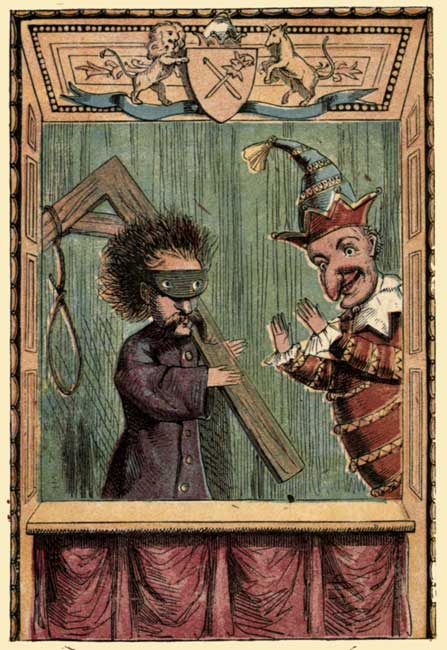
The “Jack Ketch” character from a Punch and Judy puppet show: traditionally, Punch gets the better of their meeting and hangs Jack Ketch.

The Irish immigrant Ketch is the first name in English executioners. Indeed, you can call any of his successors right down to Pierrepoint a “Jack Ketch” and be perfectly understood.

The immediate successor, however, was Ketch’s own assistant — who inherited top billing after Ketch went to jail for “affronting” a sheriff.

Jack Ketch had been trodding the scaffold-boards, hanging, beheading, and drawing-and-quartering for two-plus decades at that point: he’s thought to have been appointed in 1663, and he’d inserted himself into those performances rather more prominently than an executioner ought by botching some of Restoration England’s most high-profile executions.

There’s little reliable information about these early executioners, but it seems Ketch’s reputation for clumsiness had forced him to issue an “Apologie” justifying himself.

But the man unquestionably had longevity in his favor, which is more than Paskah Rose could say.

Within months of becoming the chief London executioner, Rose and another man were chased down in the act of burgling clothes from a house, “the Goods found in Rose’s Breeches.”

Rose and his co-defendant Edward Smith accordingly hanged along with three others at Tyburn this date — by Jack Ketch, now returned from his carceral retirement for one last tour.

Ketch died late that same year of 1686, but has lived on in any number of ballads, doggerels and broadsides immortalizing the name. He was surely aided in this by the less impressive caliber of many who succeeded him: it wasn’t long after Ketch dispatched Pascha Rose that another “Jack Ketch” — an ignoble profession that wouldn’t until centuries hence be drawn from the country’s respectable classes — also met Pascha Rose’s same fate.

There’s a now-public-domain Autobiography of Jack Ketch by 19th century English writer Charles Whitehead.

On this day..