1535: Thomas More, the king’s good servant but God’s first

On this date in 1535, Sir — later Saint — Thomas More kept his conscience at the expense of his head on Tower Hill.

For all More‘s greatness — as intellectual, polemicist, lawyer, statesman, father — none of his many gifts at the end could avail him beside his commitment to Catholicism at the dawn of the English Reformation.

Yet it is for those gifts that he cut such a commanding presence in his times, for those very reasons that his sovereign hounded his first citizen to assent to the divorce and remarriage he was fixed upon.

A devotee and friend of Erasmus from years before, More was in Henry’s more orthodox youth the king’s very scourge of Protestantism. His scatological invective against Martin Luther in Responsio ad Lutherum — much in the impolite tenor of Catholic-Protestant rhetoric continent-wide, it should be noted — is of the sort to crimson the cheeks of the milquetoast modern:

Since he has written that he already has a prior right to bespatter and besmirch the royal crown with shit, will we not have the posterior right to proclaim the beshitted tongue of this practitioner of posterioristics most fit to lick with his anterior the very posterior of a pissing she-mule until he shall have learned more correctly to infer posterior conclusions from prior premises?

Over that hairshirt, he wore the robes of state. But his engagement with the world had a selective bent that must have exasperated his colleague and predecessor as Lord Chancellor, Cardinal Wolsey. Orson Welles and Paul Scofield spar here in the definitive More hagiography A Man for All Seasons over the intellectual’s delicate refusal to dirty his gloves with the great matter of state before them — the annulment the king demanded of his marriage to the Queen (and More’s friend) Catherine of Aragon:

Peas in a pod, these two: Wolsey, the cleric grounded in realpolitik; More, the barrister who trusts to God. (More considered holy orders as a young man.)

Our man’s reputation for honesty in a den of hypocrites has certainly outrun Wolsey’s. Still, all More’s disdain for the deal-making that invests the sovereign majesty and all his foreboding for the relationship he had with his dangerous king were not quite enough to stop him accepting the Chancellorship and the opportunity to stamp out Lutheranism … knowing perfectly well the simultaneous thrust of Henry’s boudoir policy.

It all cuts quite a contrast to More’s (barely) pre-Reformation text, Utopia (available free from Project Gutenberg), which named a literary genre and described an imagined society of tolerant primitive communism that surely would have blanched at its inventor’s coming role in the state’s machinations:

I can have no other notion of all the other governments that I see or know, than that they are a conspiracy of the rich, who, on pretence of managing the public, only pursue their private ends, and devise all the ways and arts they can find out; first, that they may, without danger, preserve all that they have so ill-acquired, and then, that they may engage the poor to toil and labour for them at as low rates as possible, and oppress them as much as they please

…

[E]very man might be of what religion he pleased, and might endeavour to draw others to it by the force of argument and by amicable and modest ways, but without bitterness against those of other opinions; but that he ought to use no other force but that of persuasion, and was neither to mix with it reproaches nor violence* …

It’s not a given that More himself agrees with every (or even any) sentiment expressed in Utopia, but his most famous work’s criticism of the death penalty too liberally applied makes interesting reading.

[E]xtreme justice is an extreme injury: for we ought not to approve of those terrible laws that make the smallest offences capital … God has commanded us not to kill, and shall we kill so easily for a little money [i.e., execute petty thieves]? But if one shall say, that by that law we are only forbid to kill any except when the laws of the land allow of it, upon the same grounds, laws may be made, in some cases, to allow of adultery and perjury: for God having taken from us the right of disposing either of our own or of other people’s lives, if it is pretended that the mutual consent of men in making laws can authorise man-slaughter in cases in which God has given us no example, that it frees people from the obligation of the divine law, and so makes murder a lawful action, what is this, but to give a preference to human laws before the divine? and, if this is once admitted, by the same rule men may, in all other things, put what restrictions they please upon the laws of God.

This insistence on the supremacy of divine law over human institutions forms the basis of his objection to parliament’s overthrowing the papacy — which he expressed openly only after he was convicted by obviously perjured “jailhouse snitch” testimony

[Y]ou have no authority, without the common consent of all Christians, to make a law or Act of Parliament or Council against the union of Christendom.

Paul Scofield bears enjoying in the role in A Man for All Seasons:

More is sometimes suspected of desiring martyrdom since he marched so unerringly into it, but he also made every attempt to survive Henry’s demand the he affirm the royal remarriage and the king’s ecclesiastical supremacy by withdrawing silently from the public sphere rather than openly opposing it. More had by every account an enviable, downright happy life at his own hearth, and a tender and intellectual relationship with his favorite daughter Meg. (Meg corresponded with her father in prison, collected his works, and retrieved his head from London Bridge.)

But by his way of thinking — Meg tried to talk him out of it — he couldn’t swear to the Act of Succession acknowledging the king’s right to divorce Queen Catherine and disinherit her daughter Mary if Henry decided to force the choice. And in the king’s eyes, there was no middle ground for someone of the ex-Chancellor’s stature.

Henry could see to it, though, to cut his old friend a break and commute the sentence from drawing and quartering to “mere” beheading, here depicted in the past season of the Showtime series The Tudors.

More’s last moments as rendered here — the ironic remark at the foot of the scaffold, “See me safe up: for my coming down, I can shift for myself”;** his generous answer to the headsman’s plea for forgiveness — are well-documented. Undoubtedly, his sturdy martyr’s bearing, the extension of a life of joyful piety, helped cement for posterity the fame he held in life.

And that dying address — “I die the King’s good servant, but God’s first” — gathers in one sentiment free of bombast or self-pity the irreconcilable demands of conscience that would lead many thousands besides More to Henry VIII’s scaffolds, and rings equally true to less lethal challenges to the conscience in every land and time since.

Anne Boleyn, who caused More’s fate, shared it less than a year afterwards.

Thomas More was canonized by the Catholic Church in 1935 — the patron saint of politicians. Rather bizarrely, July 6 is also his feast day on the Anglican calendar, a tribute to the nearly universal regard his memory enjoys.
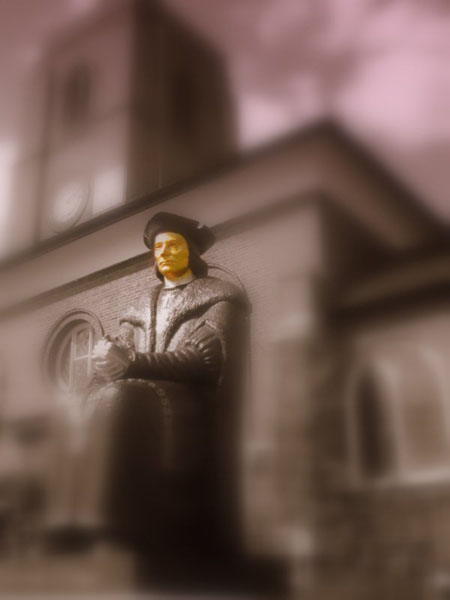
Thomas More's statue at the Chelsea Old Church

Chelsea resident Thomas More’s statue at the (Anglican) Chelsea Old Church.

* Despite its religious tolerance, More’s Utopia — anticipating Dostoyevsky — maintains:

a solemn and severe law against such as should so far degenerate from the dignity of human nature, as to think that our souls died with our bodies, or that the world was governed by chance, without a wise overruling Providence … since a man of such principles must needs, as oft as he dares do it, despise all their laws and customs: for there is no doubt to be made, that a man who is afraid of nothing but the law, and apprehends nothing after death, will not scruple to break through all the laws of his country, either by fraud or force, when by this means he may satisfy his appetites.

** According to the biography published by More’s son-in-law — who married More’s favorite, Margaret — the jest was occasioned by the rickety look of the scaffold. The Mirrour of Vertue in Worldly Greatness; Or, The Life of Sir Thomas More is available free on Google Books.

On this day..

1946: Eleven from the Stutthof concentration camp

On this date in 1946, officials of Soviet-occupied Poland publicly hanged eleven convicted war criminals of the Stutthof concentration camp.

Set up immediately upon Germany’s September 1, 1939 invasion of Poland and not liberated until after official German capitulation in 1945, Stutthoff handled over 100,000 prisoners during its long service.

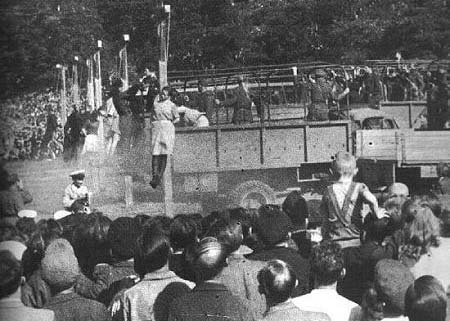
This day’s condemned — camp commandant Johann Pauls, five male kapos, and five female guards — were the product of the first of four Stutthof trials held in 1946-1947. At a hill in Gdansk known as Biskupia Gorka (Bishop Hill), upon a specially-erected row of four T-shaped double gallows centered around a pi-shaped triple gallows, and before a crowd of thousands, the doomed eleven were noosed on the back of military trucks which then drove away to leave them strangling to death with a “short drop” hanging.

The following gut-twisting images are among a number to be found here.

Above: on one end of the gallows row, the truck has just pulled away from Jenny Wanda Barkmann — a modish Hamburg lass in her mid-20’s known to Stutthof prisoners as “the Beautiful Specter” for her cruelty. Down the row, one can see that some of the prisoners are already swinging, while others have not yet been dropped.

Upon hearing her sentence, Jenny Barkmann retorted, “Life is indeed a pleasure, and pleasures are usually short.” (More about Barkmann, including trial photos, here.) In this closer view of her, just as in the first photo, she is still alive and struggling. Next to her, Ewa Paradies, another guard, is prepared for the same fate.

The central triple gallows. Commandant Johann Pauls hangs in the middle with Gerda Steinhoff — one of the senior female guards — in the foreground. The line of five male kapos recedes behind them into the enormous crowd of onlookers.

There’s more about Stutthof’s history at the Holocaust Research Project, and at the current memorial facility’s home page.

On this day..

1570: Aonio Paleario, Italian religious reformer

On this date, Antonio della Pagliara was hanged across the Tiber from the Castel Sant’Angelo in Rome for heresy.

The present-day view from the square where Paleario is thought to have been put to death, over the Ponte Sant’Angelo’s span across the Tiber to the Vatican’s imposing citadel.

Better known as Aonio Paleario (English Wikipedia entry | the considerably deeper Italian), the humanist scholar grew into his intellectual career just as Martin Luther’s doctrine was shaking Christendom.

Paleario’s positions were dangerously — and at length, fatally — close to Protestantism. He counted himself a humanist, a great admirer of Erasmus, who from the Low Countries managed to hold his critical positions without running afoul of the Catholic Church.

This would prove an increasingly difficult trick as the century unfolded … especially in the pope’s back yard.

Paleario’s most particular offenses were to take what amounts to the Lutheran side on the primacy of scriptural text over ecclesiastical tradition, and of salvation through Christ alone without the Church’s intermediation. (He also denied Purgatory.)

Since the Italian academic also cottoned to the Protestant-humanist critique of clerical corruption, he pitched Martin Luther and John Calvin on the notion of convening a Christendom-wide ecclesiastical council to reconcile competing sects. He seems to have wanted to reconcile the reformist current of humanism still within the Catholic tradition, and that of those critics who had broken, perhaps not yet irrevocably, with Rome.

The effort ultimately foundered. Instead, the curia-approved Council of Trent formulated a Roman Catholic doctrine that insured the permanent schism with Protestantism.

The Counter-Reformation was on. Still, with contending theologies — and contending polities — afoot in the Italian quiltwork plus his own towering reputation as the greatest orator in Italy, Paleario was able to find protectors and carry on. He taught in Siena, Lucca and Milan for more than three decades, surviving two bouts with the Inquisition before a Rome in crackdown mode finally pinned a heresy rap on him.

By that time, the septuagenarian didn’t much bother to fight it.

If your Eminences have so many credible witnesses against me, there is no need to give yourselves or me any further trouble … Judge, therefore, and condemn Aonio; satisfy my adversaries, and fulfil your office.

The office was fulfilled consuming the old man in flames, but they did extend the favor of hanging him (and apparently exposing the corpse for several days) first.

A book uncertainly attributed to Paleario, Beneficio di Criso (The Benefit of Christ’s Death) is available free at Google Books.

On this day..

1822: The audacious Denmark Vesey

On this date in 1822, white South Carolinians hanged the most terrifying slave insurrectionary who never rose — and breathed a sigh of relief as they clamped the shackles ever tighter upon their groaning servile class.

Inspired by slave revolts shaking the Caribbean, the Denmark Vesey plot was the South’s worst nightmare: Nat Turner, multiplied by about nine thousand.

That’s the size of the slave and free black network Vesey is said to have recruited — ready to undertake a coordinated uprising to seize Charleston, slaughter the white populace, and possibly then to sail for a Haiti whose own slave revolt had recently established it a black-governed republic. The mind boggles at such a scheme’s bravado … but in an age when horseshoes and mizzenmasts could outrun information, Vesey’s plot could have been past any prospect of obstruction before anyone in a position to obstruct it even knew what happened. Had they not flown but defended Charleston, the event would have ignited a conflagration to outshine every other slave uprising.

The weak point, of course, were those 9,000 — or however many — slaves who had to act ruthlessly and in unison, and keep their peace until they struck. It is incredible enough that such a secret kept among so many for up to four years.

The plot finally leaked mere days before it was to have been attempted when a middling player attempted the unnecessary freelance recruitment of a house slave — a class Vesey had intentionally (and rightly, events would prove) excluded for dangerously excessive personal loyalty to their masters’ families.*

Melancholy Dane

A well-educated and well-traveled man on account of his years as the personal property of a slaver — Joseph Vesey, who bequeathed his purchase both a surname and the given name Telemaque, subsequently corrupted into “Denmark” by Charlestonians — the plot’s signature hero/villain had managed to purchase his freedom and establish himself in the anomalous position of free black artisan/entrepreneur in the slaveholding South.

His successful carpentry business (apt choice, for a martyr) had given him the prestige and the werewithal to start an independent African Methodist Episcopal church where he poured out a hatred of chattel slavery undiminished by his own liberty.

For several years before he disclosed his intentions to any one, he appears to have been constantly and assiduously engaged in endeavoring to imbitter [sic] the minds of the colored population against the whites. He rendered himself perfectly familiar with those parts of the Scriptures which he could use to show that slavery was contrary to the laws of God; that slaves were bound to attempt their emancipation, however shocking and bloody might be the consequences … (Source)

His judges were later incredulous that he’d be so hung up about it:

It is difficult to imagine, what infatuation could have prompted you to attempt an enterprise so wild and visionary. You were a free man, comely, wealthy, and enjoyed every comfort compatible with your situation. You had, therefore, much to risk and little to gain.

An American Spartacus?

Denmark Vesey blurs into myth as he approaches his end, together with lieutenants: among them, Peter Poyas, the organizational maven of the operation who was hanged along with Vesey and four others; and Gullah Jack, an African priest among the 29 more who would die in the weeks ahead.

Most of the principals held their tongues before interrogators; the tribunals were held secretly; their records were censored against the apprehension by other slaves of the potential for such designs as “a bottle with poison to put into my master’s pump & into as many pumps he could about town.”

But there was enough known to shatter forever any illusion of paternal congeniality more liberal masters might have fancied. One planter was incredulous that his agreeable charge might be involved in such nefarious doings until he asked the man directly and was astonished to hear from his trusted coachman’s lips the frank intention “to kill you, rip open your belly and throw your guts in your face.” (Both quotes are from this book review.)

Whites were scared. “I have never heard in my life, of more deep laid plots or plots more likely to succeed,” wrote Anna Haynes Johnson, niece to Gov. Thomas Bennett. (Source) Another concluded that “our NEGROES are truly the Jacobins of the country.” (Source)

But as initial panic (and federal troop deployments) gave way to a more pervasive undertow of security paranoia, the affair was self-consciously downplayed and records intentionally destroyed for fear that too-careful documentation of its particulars could map the way for a revival. An 1861 piece in The Atlantic — an excellent read on the progress of the conspiracy — grapples with what was even then a gaping evidentiary vacuum.

The intense avidity which at first grasped at every incident of the great insurrectionary plot was succeeded by a distaste for the memory of the tale; and the official reports which told what slaves had once planned and dared have now come to be among the rarest of American historical documents. In 1841, a friend of the writer, then visiting South Carolina, heard from her hostess for the first time the events which are recounted here. On asking to see the reports of the trials, she was cautiously told that the only copy in the house, after being carefully kept for years under lock and key, had been burnt at last, lest it should reach the dangerous eyes of the slaves. The same thing had happened, it was added, in many other families. This partially accounts for the great difficulty now to be found in obtaining a single copy of either publication; and this is why, to the readers of American history, Denmark Vesey and Peter Poyas have been heretofore but the shadows of names.

Antebellum September 11

Even as a nonstarter, the insurrection was an antebellum 9/11 that spurred a reactionary crackdown on perceived liberalities in the system — most vividly symbolized by the construction of the fortress that became the still-extant military academy The Citadel, but more systematically impinging blacks’ everyday freedom to assemble and worship, and even requiring (until the Supreme Court overruled the law) free black sailors be detained whenever a northern ship called at port. Pro-slavery southerners blamed open disapprobation for slavery voiced in Congress during the recent Missouri Compromise wrangling, and even similar sentiments expressed in the British parliament, for emboldening the terrorists.

All this yielded a rich political harvest from the fruit of the gallows — like Charleston mayor James “there is nothing they are bad enough to do, that we are not powerful enough to punish” Hamilton, who rode his timely suppression of the plot to Congress later that year.

Such political profiteering, combined with the sketchiness of primary sources, has licensed a revisionist take on the orthodox history — that there was never any conspiracy, but that reactionary white elites concocted the plot from a tissue of loose liberation talk, false confessions, and latent white fear in order to win political power. This contested minority interpretation has been a recent topic of academic dispute, since Michael P. Johnson floated it in 2001 (an account is required to read Johnson’s original essay; here’s a synoptic article that appeared subsequently in The Nation).

Markers of historiography around these competing versions of Vesey, bearing directly on the question current in today’s Charleston of whether and how to memorialize this episode, are ripe with controversial modern-day implications.

Consider: if Vesey is a rebel indeed, the silence of (most of) the plotters is a noble acceptance of torture to protect their confederates; if they’re framed, they’re silent because there’s nothing to confess. Either way, the modern reader’s sympathies are likely to lie with the blacks, but Johnson’s interpretation removes the locus of action from them to white elites. If he’s right, would that derogate an entire narrative of black resistance to slavery, drain the martyrdom from their deaths? Or would it correct an overstated romantic mythology of armed resistance, and color this day’s hanging with a different heroism: refusing to purchase their lives with a false accusation?

* For his timely betrayal, Peter Desverneys received his liberty and a state pension; he later became a slaveholder himself. See Black Slaveowners.

On this day..

1766: Jean-François de la Barre, freethinker martyr

On this date in 1766, a 20-year-old French chevalier’s freethinking proclivities got him beheaded and burned for impiety in one of Bourbon France’s most notorious episodes of religious chauvanism.

Check that date again. This is 69 years after the British Isles’ last execution for blasphemy; Voltaire was alive, and already in his dotage — and the fact that young Chevalier de la Barre was reading him was proclaimed as evidence. Such a benighted proceeding with the French Revolution on the horizon calls Dickens to mind:

it was the epoch of belief, it was the epoch of incredulity,
it was the season of Light, it was the season of Darkness

The luckless youth and a couple of friends had pissed off a local judge, which got ugly for them when the unexplained vandalism of a town crucifix availed the opportunity for the magistrate to wield a sledgehammer against a fly.

De la Barre’s volume of Voltaire was tossed onto the pyre with him. That Enlightenment colossus made a measured posthumous effort at having the boy rehabilitated* — primarily for the benefit of his more judicious friend, who had fled the country and required his death sentence in absentia be lifted in order to inherit the family estate — but the verdict was not set aside until the French Revolution, a few months after the end of the Terror.

France’s overall secular trajectory since has rendered this date a sort of national freethinkers’ holiday, Chevalier de la Barre Day. A statue of its namesake stands in Paris’ Montmarte:

* Voltaire’s writings on the case in the original French are collected by the Association Le Chevalier de la Barre here.

On this day..

2000: Two kidnappers, televised by Guatemala

On this date in 2000, Amilcar Cetino Perez and Tomas Cerrate Hernandez were executed on live television in Guatemala for kidnapping and murdering a liquor heiress.

The televised Perez execution began at 6:05 a.m., with Hernandez (reportedly “shaking badly”) following at 7:15. Both took some minutes; Amnesty International has charged that they were botched and the prisoners suffered prolonged suffering. The macabre spectacle was replayed on Guatemalan TV throughout the day.

So daunting (or puffed-up) was the menace posed by the Los Posaco kidnapping-and-extortion gang they belonged to, the president sent his family to Canada to shield them from reprisals.

Today’s casualties were the second and third persons to die by lethal injection in Guatemala,* and remain to this date the last.

They might not retain that distinction long, however. Legislation earlier this year filled a legal gap that had caused a five-year moratorium on executions — ironically, by restoring the president’s power to pardon and commute death sentences.

* Lethal injection was introduced after a televised execution by firing squad came off most un-telegenically.

On this day..

Unspecified Year: Justine Moritz, Frankenstein family servant

Around this date in the unspecified 18th-century year of Mary Shelley’s Frankenstein, the titular family’s servant is put to death for the murder of their youngest child, William.

In the novel, smarty-pants university student Victor Frankenstein has created (and immediately rejected) his famous monster. Not long after, he receives a letter (dated May 12, “17–“) from his father informing him of the murder of his youngest brother.

About five in the morning I discovered my lovely boy, whom the night before I had seen blooming and active in health, stretched on the grass livid and motionless; the print of the murder’s finger was on his neck.

Covering the 600-plus kilometers home to Geneva, Victor becomes convinced that his creation is the culprit.* But upon reaching his destination, he finds that circumstantial evidence has accused the family’s blameless (and ironically named) servant, Justine.

He’s back just in time to watch, in horror, as she’s convicted — impotent (or at least that’s what he tells himself) to help her with his fantastical truth, and despairingly watching her friends abandon her to her fate.

Justine has grown up with Victor and the others, so the entire Frankenstein family remains convinced of the servant’s innocence, though they’re practically alone in Geneva in that belief.

A woodcut illustration of Justine in prison, by Lynd Ward — as seen here.

Shelley includes an interesting passage in which Justine (having already been convicted) is battered by her priest into falsely confessing to the crime. Though clearly anti-clerical in intent, it’s also a moment with remarkable current resonance given the prevalence of false confessions in modern wrongful conviction scenarios:

“I did confess, but I confessed a lie. I confessed, that I might obtain absolution; but now that falsehood lies heavier at my heart than all my other sins. The God of heaven forgive me! Ever since I was condemned, my confessor has besieged me; he threatened and menaced, until I almost began to think that I was the monster that he said I was. He threatened excommunication and hell fire in my last moments if I continued obdurate. Dear lady, I had none to support me; all looked on me as a wretch doomed to ignominy and perdition. What could I do? In an evil hour I subscribed to a lie; and now only am I truly miserable.”

The poor woman’s fate is sealed either way — and in her parting conversation with Victor and his future wife Elizabeth, we find Justine more at peace than the monster’s creator:

“I do not fear to die,” [Justine] said; “that pang is past. God raises my weakness and gives me courage to endure the worst. I leave a sad and bitter world; and if you remember me and think of me as of one unjustly condemned, I am resigned to the fate awaiting me. Learn from me, dear lady, to submit in patience to the will of heaven!”

During this conversation I [Victor] had retired to a corner of the prison room, where I could conceal the horrid anguish that possessed me. Despair! Who dared talk of that? The poor victim, who on the morrow was to pass the awful boundary between life and death, felt not, as I did, such deep and bitter agony.

…

“In these last moments I feel the sincerest gratitude towards those who think of me with kindness. How sweet is the affection of others to such a wretch as I am! It removes more than half my misfortune, and I feel as if I could die in peace now that my innocence is acknowledged by you, dear lady, and your cousin.”

Thus the poor sufferer tried to comfort others and herself. She indeed gained the resignation she desired. But I, the true murderer, felt the never-dying worm alive in my bosom, which allowed of no hope or consolation. Elizabeth also wept and was unhappy, but hers also was the misery of innocence, which, like a cloud that passes over the fair moon, for a while hides but cannot tarnish its brightness. Anguish and despair had penetrated into the core of my heart; I bore a hell within me which nothing could extinguish. We stayed several hours with Justine, and it was with great difficulty that Elizabeth could tear herself away. “I wish,” cried she, “that I were to die with you; I cannot live in this world of misery.”

Justine assumed an air of cheerfulness, while she with difficulty repressed her bitter tears. She embraced Elizabeth and said in a voice of half-suppressed emotion, “Farewell, sweet lady, dearest Elizabeth, my beloved and only friend; may heaven, in its bounty, bless and preserve you; may this be the last misfortune that you will ever suffer! Live, and be happy, and make others so.”

And on the morrow** Justine died. Elizabeth’s heart-rending eloquence failed to move the judges from their settled conviction in the criminality of the saintly sufferer. My passionate and indignant appeals were lost upon them. And when I received their cold answers and heard the harsh, unfeeling reasoning of these men, my purposed avowal died away on my lips. Thus I might proclaim myself a madman, but not revoke the sentence passed upon my wretched victim. She perished on the scaffold as a murderess!

Shelley gives us quite the gentle picture of the Frankenstein family, in which Victor is practically the only exponent of vengeance after the dreadful crime. Even the father’s initial letter home, written in the immediate shock after discovering the boy’s body, summons his son to come

not brooding thoughts of vengeance against the assassin, but with feelings of peace and gentleness, that will heal, instead of festering, the wounds of our minds.

After the hanging, dad again endeavors to keep Victor from wasting himself on rage … which it seems that Victor would have readily assented to had he not carried his secret burden of guilt:

“Do you think, Victor,” said he, “that I do not suffer also? No one could love a child more than I loved your brother” — tears came into his eyes as he spoke — “but is it not a duty to the survivors that we should refrain from augmenting their unhappiness by an appearance of immoderate grief? It is also a duty owed to yourself, for excessive sorrow prevents improvement or enjoyment, or even the discharge of daily usefulness, without which no man is fit for society.”

This advice, although good, was totally inapplicable to my case; I should have been the first to hide my grief and console my friends if remorse had not mingled its bitterness, and terror its alarm, with my other sensations.

Frankenstein is available free at Project Gutenberg. Of course, it has been adapted many times into other cultural artifacts; these are somewhat famous for their infidelity to the original work, and Justine tends to get short shrift in most (although she’s hanged in quite an over-the-top spectacle in the 1994 Kenneth Branagh vehicle Mary Shelley’s Frankenstein (review here)).

If Justine is usually pulled from the story, Hollywood has found a role for the scaffold elsewhere. Where Shelley has Victor haunting “charnel houses” and the like, the seminal and oft-imitated 1931 Boris Karloff film makes a point to include a hanged criminal for some of the creature’s parts — although “the brain is useless”:

But a criminal brain finds its way into the monster just the same, an explanation of its behavior completely antithetical to Mary Shelley’s:

* He’s right, of course — the creature later admits it — but you could certainly quibble with Victor’s methodology:

Nothing in human shape could have destroyed the fair child. HE was the murderer! I could not doubt it. The mere presence of the idea was an irresistible proof of the fact.

** The precise date is never disclosed, but the events are roughly dated by Victor’s subsequent narration, “it was about the middle of the month of August, nearly two months after the death of Justine, that miserable epoch from which I dated all my woe.”

On this day..

1621: Bohemia’s “Day of Blood”

On this date in 1621, the Habsburg crown took 27 nobles’ heads in Prague’s Old Town Square for attempting to lead Bohemia to independence.

A century into the Protestant Reformation, the many conflicts between the prerogatives of princes and prelates were about to spawn the Thirty Years’ War — a settling of accounts eventually to lay the cornerstone of modern national sovereignty.

And it all got started in the mother of cities.

Predominantly Protestant Bohemia was at loggerheads with the doctrinaire Catholic slated to become the next Holy Roman Emperor, and as rising tensions in Prague between the faiths took on a patriotic tone, a mob chucked a couple of imperial representatives out the window of Prague Castle.

The Defenestration of Prague. It’s a great word for a great political tradition — there are multiple Defenestrations of Prague in Czech history.

The royal retainers survived the plunge, thanks to miraculous angelic intervention [Catholic version], or to fortuitously landing on a dunghill [Protestant version]. (Maybe the truth lies somewhere in between.)

Either way, it was game on. The Protestant nobility refused to recognize the Habsburg heir and offered the crown to a Calvinist toff instead.

This Frederick V, Elector Palatine answers to the nickname “the winter king” — because by the next winter, the Catholics had overrun Bohemia and driven Frederick off to the dissolute life of exiled nobility, where he anonymously knocked around the Low Countries and accidentally sired the modern line of British royalty.

Good choice: the Czech lands soon felt the monarch’s wrath.

J.E. Hutton’s History of the Moravian Church — which treats especially a distinctive strain of local Christianity with roots in the pre-Lutheran Hussite movement, and which although shattered by the failed revolt still persists today — narrates the result for the 27 unluckiest nobles:

There fell the flower of the Bohemian nobility … Among these were various shades of faith — Lutherans, Calvinists, Utraquists, Brethren; but now all differences were laid aside, for all was nearly over …


Detail view (click for the full image) of the Bohemian nobles’ execution. Note the block on the scaffold foreground for chopping off hands.

Swiftly, in order, and without much cruelty the gory work was done. The morning’s programme had all been carefully arranged. At each corner of the square was a squad of soldiers to hold the people in awe, and to prevent an attempt at rescue. One man, named Mydlar, was the executioner; and, being a Protestant, he performed his duties with as much decency and humanity as possible. He used four different swords … The first of these swords is still to be seen at Prague, and has the names of its eleven victims engraven upon it. … In every instance Mydlar seems to have done his duty at one blow. At his side stood an assistant, and six masked men in black. As soon as Mydlar had severed the neck, the assistant placed the dead man’s right hand on the block; the sword fell again; the hand dropped at the wrist; and the men in black, as silent as night, gathered up the bleeding members …

Much more general reprisals were in store, too. One of Europe’s most liberal writs of religious toleration was swiftly revoked. Catholicism was imposed from above, with Marian columns thrown up in every town. German became the official language. Books were burned by the thousand. Protestants fled or were expelled over the years to come in such numbers that (combined with the general devastation of a war that wrought famine on Europe), modern Czechia’s population had dropped by a third by the Peace of Westphalia.

And while the war the Bohemians helped touch off would win recognition for several small polities breaking away from dynastic imperial formations and cement the principle for other such states to follow, Bohemia itself would remain yoked to the Habsburgs until World War I.

Nobody’s nursing any grudges against the headless nobles for all this, however. Now that the Czech Republic has finally got a place to hang its hat in the community of nations, it keeps 27 white crosses in the Old Town Square bricks as homage to the Day of Blood.

On this day..

1864: William Johnson, a bad example

On this date in 1864, the Union army in the American Civil War hanged a black deserter outside Petersburg, Va., for — in the delicate words of the army dispatch — “an attempt to outrage the person of a young lady at the New-Kent Court-house.”

The Union army was just taking up position for the coming monthslong siege of the Confederate capital, Richmond. Johnson, who confessed to deserting another unit, offered savvy blue commanders a win-hearts-and-minds opportunity: a public reassurance that the Old Dominion’s dim view of Negro outrages upon young ladies would be honored by its soon-to-be occupiers.

Not bad in theory. The execution left something to be desired.

The field of public relations being very much in its infancy, the upshot of this salutary demonstration seems not to have been conveyed to its target audience; so, when a defending Confederate battery caught sight of the gallows being thrown up in brazen view of its own lines, it jumped to the not-unreasonable conclusion that the Yanks were about to make an example of a southern spy. Rebel guns promptly made the Union detachment their “target audience.” An artillery shot struck one Sgt. Maj. G. F. Polley (or Polly) and “tore him all to pieces” before

[a] flag of truce was sent out to inform the enemy that a negro was to be hung who had insulted a white woman the day before; they stopped firing. We then marched back and saw the negro hung.

The return on investment for the souls of Johnson and the misfortunate NCO was altogether unsatisfactory:

The incident was cleverly turned to advantage by the Confederates, who had been losing hundreds of Negro laborers by desertion. The Rebels marched Negroes past the spot, pointing out to them the perils of fleeing their lines, saying that the Yankees hanged all ‘Contrabands.’ For weeks nocturnal escapes of Negroes ceased on that front. (Source)

It wasn’t a total loss, however. The Library of Congress ended up with some striking archival photos.

(There’s a better touch-up of this last photograph of Johnson’s body being cut down here.)

On this day..

1975: Prince Faisal ibn Musa’id, royal assassin

On this date in 1975, a Saudi prince knelt in the public square before Riyadh’s Great Mosque, and 10,000 onlookers watched a golden-hilted sword took off his head for regicide.

It is little enough to say that, twelve weeks before, Faisal ibn Musa’id (transliterated several different ways — ibn or bin; Musa’id, Musaid, Musaed, or Musad) had approached his uncle King Faisal and shot him three times at point-blank range.

The reason(s) why a prince of the realm should do such an extraordinary thing are the real issue. They were murky then, and remain so to this day.

Certainly, when the monarch of the world’s leading oil producer is slain shortly after denying his product to the world’s leading oil consumer … well, speculation is bound to happen, even if the oil embargo was wrapped up a year before the murder. The assassin had studied (lackadaisically) in the United States a few years before, fueling hypotheses of a CIA hit, but there’s not even much of a satisfying just-so story to go with that, to say nothing of supporting evidence.

Whatever reasons there were seem to have been internal — a personal vendetta arising ultimately from the kingdom’s uneven confrontation with modernity so sensitively treated in Abdelrahman Munif’s Cities of Salt novels.*

The prince’s brother Khalid (or Khaled) had been slain by Saudi Arabia’s security forces in 1965 after demonstrating against television’s entry into the kingdom, an innovation authorized by King Faisal to the chagrin of strict Wahhabists. Khalid remains a martyr figure to Islamic fundamentalists to this day, and the conventional supposition is that Prince Faisal shot King Faisal in vengeance served 10 years cold; some accounts have him announcing as much at the moment of the murder.

(The conspiratorial palace intrigue version suspects Prince Fahd (or Faud) of using the aggrieved young man as his instrument in a coup; a defector from the Saudi diplomatic corps also inculpated Fahd along these lines. King Faisal’s death made Fahd the de facto ruler of Saudi Arabia upon the accession of a politically disinterested brother; Fahd ascended the throne officially when that brother died in 1982 — the succession was passing brother-to-brother, rather than father-to-son — and had steered the ship of state for 30 years by the time of his own death in 2005.)

The official inquiry concluded, as such things do, that Faisal killed Faisal alone, and though early reports had the shooter mentally unbalanced, authorities eventually figured him sane enough for trial and the full measure of the law’s majesty.

Faisal ibn Musa’id remains the only royal prince judicially executed by the House of Saud.

* An assassination inspired by Faisal’s shows up in the second novel of the cycle, Trench.

On this day..