1941: Karel Treybal, Grand Master

On this date in 1941, chess grand master Karel Treybal was shot in occupied Czechoslovakia as a suspected subversive for illegally stockpiling weapons.
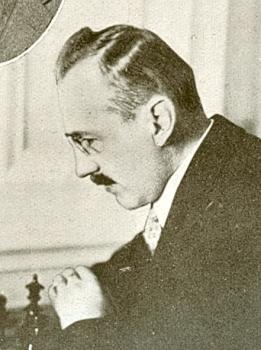
The Bohemia-born Treybal was one of the great Czech players from the turn of the century.

Competing as an amateur — his day job was as a barrister — his attacking play made him one of the world’s best for most of his adult life. (Chess aficionados can browse his big matches here and here, or take in some Treybal chess puzzles. It says here that Treybal once played countryman Franz Kafka.)

Like everyone else standing between the great imperial powers come wartime, grand masters were just so many pawns.

The particulars of Treybal’s death seem murky: whether or not he received a nominal Nazi trial before his execution; whether there was anything to the weapons charges against him. Word, nonetheless, got right around.

According to a UP report datelined this very day that ran in the New York Times on Oct. 3,

German occupation forces have executed nearly 1,000 persons in Europe, in some cases shooting them by the carloads, in reprisal for a mounting tide of violence in the occupied countries, a compilation showed tonight.

German dispatches said eighteen persons were executed in Bohemia-Moravia today [Thursday, Oct. 2 -ed.], and thirty-nine yesterday. Six were executed Sunday, twenty Monday and fifty-eight Tuesday, according to earlier German announcements, making the total so far this week 141.

Those executed today were said to include Josef Benes, manager of the Farmers’ Association at Raudnitz; Anton Kvarda, manager of the trades school at Rakonitz; Karel Treybal, salesman; Josef Smrkovsky, business man, and Manzel Svoboda, former Czech Army lieutenant.

From Norway to Greece the executions have been Germany’s answer to all forms of opposition — sabotage, espionage, armed resistance, murder, treason, arson, aiding the enemy, listening to the foreign radio, operating illegal markets, dynamiting and the ill-inclusive “Communist” activity.

A postwar tournament was played in tribute of Treybal and the great Czech women’s champion Vera Menchik.

On this day..

1942: Bishop Gorazd of Prague

On this date in 1942, the Orthodox Bishop Gorazd — Matej Pavlík is what his parents named him — was shot in Prague along with priests of Sts. Cyril and Methodius Cathedral for sheltering the Czechoslovakian resistance fighters who had lately assassinated Nazi Reichsprotektor Reinhard Heydrich.

After icing Heydrich, the assassins had taken shelter in the Cathedral basement … only to be betrayed by a onetime compatriot.

The Nazis besieged the church — fiercely, but hopelessly defended.

With the Germans already visiting unspeakable collective punishment for the murder, the act of sheltering the assassins had trouble written all over it.

The Serbian-consecrated first bishop of the Czech Orthodox Church, Gorazd sought to limit the potential scope of reprisals by writing the German authorities, directly claiming responsibility — even though, in fact, he hadn’t found out who his sanctuary was concealing until several days after they had already been installed by sympathetic priests.

He enjoyed the characteristic hospitality of the Gestapo, and was shot at Kobylisy along with priests Vaclav Cikl and Jan Sonnevend; theologian Vladimir Petrek followed them the next day.


From left to right (not counting the guards, of course): Jan Sonnevend, Vaclav Cikl, Vladimir Petrek, and the bearded Bishop Gorazd, at their public show trial September 3. From the Czech Ministry of Defense’s slick and well-illustrated publication (pdf) on Operation Anthropoid.

The Czech Orthodox Church was suppressed while the Germans held Czechoslovakia. Bishop Gorazd is recognized in the Orthodox martyrology on August 22nd (the date of his death per the Julian calendar).

On this day..

1942: The village of Lidice, for the assassination of Reinhard Heydrich

On this date in 1942, the Germans visited upon the Czechoslovakian village of Lidice one of the most notorious butcheries of World War II: the physical destruction of the town, and the execution of most of the adult population, in revenge for the assassination of Reichsprotektor Reinhard Heydrich.

Heydrich had power of life and death in Nazi-occupied Bohemia and Moravia, and did not scruple to use it.

“The Hangman of Prague” was no mere functionary, but a Nazi grand wizard from way back, who’d had a hand in the Third Reich’s most terrifying greatest hits — the Night of the Long Knives, Kristallnacht. Just four months before this date, Heydrich had chaired the Wannsee Conference.* (Watch Kenneth Branagh as Heydrich ride herd over a gaggle of bureaucrats to get the Final Solution up and running in Conspiracy.) Hitler called him his “man with the iron heart.”

So he was a natural target for the Czechoslovakian army-in-exile and their British handlers, made more so by his lordly disdain for common-sense security safeguards.

Zipping along a predictable route in an open car, he was a sitting duck for a hit squad, who gave the Nazi bastard a mortal shrapnel wound from a grenade that had him lingering painfully at death’s door for several days before he finally died of blood poisoning.

The 1964 Czechoslovakian film Atentat (“Assassination”) chronicles the plot to kill Heydrich and its aftermath.

For this effrontery, Czechoslovakians would pay a dreadful price.

Naturally, the Nazis mercilessly hunted down and slaughtered those with any connection to the plot.

But the Reich also exacted collective reprisals to make plain that the entire “protectorate” could be considered hostage against such plots in the future.

Special transports of Jews marked “Attentat auf Heydrich” were shipped to the camps, and 152 were executed on the day Heydrich succumbed. But then, the Nazis were brutalizing Jews anyway. Something more headline-grabbing would be needed.

Enter Lidice.

After gaudy funerals for the slain Reichsprotektor, the Reich settled upon the small town of Lidice north of Prague — trumping up a few connections to resistance to “justify” collective punishment.

On this date, German troops stormed it, summarily executed all the men and boys** old enough to bear arms and a fair number of women, deported the others, and then physically destroyed and buried the town.

Lidice was intended as a demonstration — boldly published to the world as proof against a repeat,† it became the byword of Nazi cruelty towards subject nations. Though not by quantitative standards the greatest crime of the occupation, not even the greatest crime in reprisal for Heydrich, its three syllables distill all the evil of Hitler’s conquest for Czechoslovakia.

Lidice did live, and does yet, as an emblem par excellence those terrible years.

Less alive: Heydrich’s right-hand man Karl Hermann Frank, who was hanged in Prague after the war for engineering this monstrous crime. Those survivors of Lidice able to make the trip enjoyed priority seating.

* Heydrich’s aide at the Wannsee Conference, and taker of cleaned-up minutes, was Mr. Banality of Evil himself, Adolf Eichmann.

** Only three men of Lidice survived the destruction: two who were in England at that time, and one who was imprisoned in Prague for killing his son. The sentence for this crime, it turned out, was life.

† An effective proof — the calculated wholesale slaughter apparently did cool both the conquered populace and the enemies of Germany on enthusiasm for further assassinations.

On this day..

1946: Karl Hermann Frank

On this date in 1946, the Sudeten German whose fifth column had paved the way for the Nazi conquest of Czechoslovakia expiated his war crimes at Prague’s Pankrac Prison.

Karl Hermann Frank (English Wikipedia page | German) had been a prewar mover and shaker in the Sudeten German Party, increasingly the Reich’s stalking-horse as it bluffed European rivals into acceding to Czechoslovakia’s dismemberment.

The onetime Czechoslovakian MP did well by the Anschluss, gaining the rank of Obergruppenführer and becoming one of Bohemia and Moravia’s top evildoers.

Notably, he helped orchestrate (though the orders for it came from above) the notorious massacre of Lidice in revenge for the assassination of Reich Protector Reinhard Heydrich.

The Lidice operation formed a war crimes charge against Herr Frank after the war, and Frank’s own lasting badge of infamy: the systematic destruction of the entire male population of an arbitrarily chosen village remains the emblematic crime of the Nazi occupation to this day.

(Source of the video)

Thousands of spectators came to see the former “Protector of Bohemia and Moravia” executed in Prague’s Pankrac Prison by the Austro-Hungarian “pole hanging” method, as depicted in the film above.

Those of Lidice’s widows who were able to come — and widows of some of the 30,000 other Czechs for whose executions Frank had been adjudged indirectly responsible — occupied the second row of seats. …

Not the slightest gleam of compassion could be seen in that long row of unforgiving eyes as Frank, garbed in a ragged Nazi Elite Guard uniform, walked quietly between two guards. …

As the noose was adjusted about his neck, Frank muttered: “Deutschland wird leben auch wenn wir nicht leben” (“Germany will live even if we do not live.”)

The spectators, admitted by special cards, watched quietly in the bright sunshine. (New York Times)

On this day..

1536: Jacob Hutter, Anabaptist leader

On this date in 1536, the namesake of a major Anabaptist strain “gave a great sermon through his death” by fire at Innsbruck.

Jacob (or Jakob) Hutter, a hatmaker from the south Tirol, became the leader of a thriving Anabaptist community in Moravia where he shocked authorities with adult baptism and managed the heretics’ affairs so smoothly that the heirs of those who survived the hard years ahead still call themselves Hutterites.

Hutter pulled multiple fractured and sometimes fractious Anabaptist groups together and instilled structure that arguably saved these communities from extinction. (More about this in Hutterite Society.)

His effective evangelism only heightened the persecution of the Habsburgs, who exasperatedly reported on “more than 700 persons” executed or expelled, adding that the re-baptizers “have no horror of punishment but even report themselves; rarely is one converted nearly all only wish to die for their faith.”

Hutter himself was so pursued that he had to take his leave of his community, by that time expelled en masse and living as vagrants;* he did not long outlive his return to his native Tirol. He was captured there, hauled to Innsbruck, and tortured for three months before suffering public burning at the express directive of Holy Roman Emperor Ferdinand I.

* Hutter’s letter of remonstrance to a governor during this period makes affecting reading; this excerpt is from The Anabaptist Story:

Now we are camping on the heath, without disadvantage to any man. We do not want to wrong or harm any human being, not even our worst enemy. Our walk of life is to live in truth and righteousness of God, in peace and unity. We do not hesitate to give an account of our conduct to anyone. But whoever says that we have camped on a field with so many thousands, as if we wanted war or the like, talks like a liar and a rascal. If all the world were like us there would be no war and no injustice. We can go nowhere; may God in heaven show us where we shall go. We cannot be prohibited from the earth, for the earth is the heavenly Father’s; may He do with us what He will.

Here‘s a German site all about Jakob Hutter.

On this day..

1939: Nine Czech students

Today is International Students’ Day and a public holiday in the Czech Republic and in Slovakia thanks to the martyrdom of nine at the hands of the Nazi occupation forces this day in 1939.

The previous fall, Hitler had cowed the allied powers into ceding the mountainous Czechoslovakian Sudetenland to the Third Reich in order to avert war — leading to Neville Chamberlain‘s famously mistaken “peace in our time” speech.

In March 1939, Germany reneged its part of the bargain and gobbled up Bohemia and Moravia, essentially the modern Czech Republic.

That this would collapse Chamberlain’s vision of peace and set Europe’s powers on the road to war with Berlin was cold comfort to the occupied Czechs. They had their own problems.

On October 28, youth demonstrations in Prague against the occupation resulted in the shooting of Charles University medical student Jan Opletal

Two weeks later he succumbed to the injury, and his funeral turned into an anti-occupation riot forcibly quashed by German arms. According to the London Times account:

On November 17 at 3 a.m., the Gestapo entered all students’ colleges, men’s and women’s, without allowing them to dress, tied the students in groups of three, and dragged them away … Between 3 o’clock and 8 o’clock in the morning the Gestapo visited students’ homes and lodgings. Those opposing arrests and parents who withheld information were immediately shot at, and the wounded were refused attention. The Gestapo broke into high schools as well as into the university …

The prisoners were taken to the Ruzyn barracks and to the Sparta football stadium, where cold water was flung over them and were made to wait until the evening. Then, in the barrack yard, 124 students and teachers* were shot before their fellow-students, the first nine being presidents of students’ associations, including the brilliant young sociologist Dr. Matoushek [English Wikipedia entry | Czech], son of a former Minister of Commerce.

Universities in the cities were declared closed for three years; they would not in fact re-open until after the war.

The day, subsequently memorialized as den boje studentu za svobodu a demokracii (Day of the Students’ Fight for Freedom and Democracy), entered Czech history a second time a half-century later. A student protest at Opletal’s grave on this date in 1989 helped catalyze the Velvet Revolution that toppled Czechoslovakia’s Communist government.

* The larger figure was circulated in the days following by Czech sources. It is not clear to me whether that number proved unfounded, or whether subsequent memorials simply came to focus on the leading nine — whose executions are certain, and were even announced by German communique.

On this day..

1950: Milada Horáková, democrat and feminist

On this date in 1950, Milada Horakova was hanged with three others in Prague’s Pankrac Prison as a spy and traitor to the Communist Czechoslovakian government.

Not (yet) as internationally recognizable as Rudolf Slansky,* the Communist General Secretary in Horakova’s time who would run afoul of Stalin and die on the same gallows two years later, Horakova (English Wikipedia page | Czech | the detailed French) is a potent symbol domestically of her country’s Cold War nightmare.

Lawyer, social democrat, and a prominent feminist in the interwar and postwar periods — her life’s work, rather overshadowed by an end that was memorable for different reasons — Horakova survived Nazi imprisonment and was a member of parliament when the Communists seized power in 1948.

She spurned counsel to flee the country, and found herself the headline attraction at a show trial for a supposed plot to overthrow the government. In a hopeless scenario, she distinguished herself with off-script defiance despite having broken under torture and signed a confession; Albert Einstein, Winston Churchill and Eleanor Roosevelt all pleaded in vain for clemency.

Photo of Milada Horakova defending herself at trial.

Horakova left the world clear in her purpose. In a letter to her teenage daughter awaiting execution, she justified her own dangerous choices:

The reason was not that I loved you little; I love you just as purely and fervently as other mothers love their children. But I understood that my task here in the world was to do you good … by seeing to it that life becomes better, and that all children can live well. … Don’t be frightened and sad because I am not coming back any more. Learn, my child, to look at life early as a serious matter. Life is hard, it does not pamper anybody, and for every time it strokes you it gives you ten blows. Become accustomed to that soon, but don’t let it defeat you. Decide to fight.

Hours before her hanging, she wrote a few last words for her loved ones:

I go with my head held high. One also has to know how to lose. That is no disgrace. An enemy also does not lose honor if he is truthful and honorable. One falls in battle; what is life other than struggle? (Both excerpts cited here)

The only woman among Czechoslovakia’s postwar political executions was abortively rehabilitated during the 1968 Prague Spring. Since the fall of the Iron Curtain, her resistance to both Naziism and Communism — worthy of an opera (topical interview) and a forthcoming film — have elevated her into her country’s official pantheon.

As a result, this date is “Commemoration day for the victims of the Communist regime” in the Czech Republic.

Meanwhile, Horakova’s now-octogenerian prosecutor Ludmila Brozova-Polednova, whose repulsive legal barbs at trial (“Don’t break her neck on the noose. Suffocate the bitch — and the others too.”) were probably the consequence of the foregone conclusion more than the cause, was convicted late last year for her role in the trial. That verdict has kept in the news these past several months — most recently, the Czech Supreme Court returned it for retrial after an appeals court overturned the sentence — a tangible symbol of the challenges inherent to confronting the past. (Brozova-Polednova, for her part, is unapologetic.)

* One of the goons who tortured confessions out of the conspirators in Horakova’s “terrorist center,” Karel Svab, was among those later hanged with Slansky.

On this day..

1621: Bohemia’s “Day of Blood”

On this date in 1621, the Habsburg crown took 27 nobles’ heads in Prague’s Old Town Square for attempting to lead Bohemia to independence.

A century into the Protestant Reformation, the many conflicts between the prerogatives of princes and prelates were about to spawn the Thirty Years’ War — a settling of accounts eventually to lay the cornerstone of modern national sovereignty.

And it all got started in the mother of cities.

Predominantly Protestant Bohemia was at loggerheads with the doctrinaire Catholic slated to become the next Holy Roman Emperor, and as rising tensions in Prague between the faiths took on a patriotic tone, a mob chucked a couple of imperial representatives out the window of Prague Castle.

The Defenestration of Prague. It’s a great word for a great political tradition — there are multiple Defenestrations of Prague in Czech history.

The royal retainers survived the plunge, thanks to miraculous angelic intervention [Catholic version], or to fortuitously landing on a dunghill [Protestant version]. (Maybe the truth lies somewhere in between.)

Either way, it was game on. The Protestant nobility refused to recognize the Habsburg heir and offered the crown to a Calvinist toff instead.

This Frederick V, Elector Palatine answers to the nickname “the winter king” — because by the next winter, the Catholics had overrun Bohemia and driven Frederick off to the dissolute life of exiled nobility, where he anonymously knocked around the Low Countries and accidentally sired the modern line of British royalty.

Good choice: the Czech lands soon felt the monarch’s wrath.

J.E. Hutton’s History of the Moravian Church — which treats especially a distinctive strain of local Christianity with roots in the pre-Lutheran Hussite movement, and which although shattered by the failed revolt still persists today — narrates the result for the 27 unluckiest nobles:

There fell the flower of the Bohemian nobility … Among these were various shades of faith — Lutherans, Calvinists, Utraquists, Brethren; but now all differences were laid aside, for all was nearly over …


Detail view (click for the full image) of the Bohemian nobles’ execution. Note the block on the scaffold foreground for chopping off hands.

Swiftly, in order, and without much cruelty the gory work was done. The morning’s programme had all been carefully arranged. At each corner of the square was a squad of soldiers to hold the people in awe, and to prevent an attempt at rescue. One man, named Mydlar, was the executioner; and, being a Protestant, he performed his duties with as much decency and humanity as possible. He used four different swords … The first of these swords is still to be seen at Prague, and has the names of its eleven victims engraven upon it. … In every instance Mydlar seems to have done his duty at one blow. At his side stood an assistant, and six masked men in black. As soon as Mydlar had severed the neck, the assistant placed the dead man’s right hand on the block; the sword fell again; the hand dropped at the wrist; and the men in black, as silent as night, gathered up the bleeding members …

Much more general reprisals were in store, too. One of Europe’s most liberal writs of religious toleration was swiftly revoked. Catholicism was imposed from above, with Marian columns thrown up in every town. German became the official language. Books were burned by the thousand. Protestants fled or were expelled over the years to come in such numbers that (combined with the general devastation of a war that wrought famine on Europe), modern Czechia’s population had dropped by a third by the Peace of Westphalia.

And while the war the Bohemians helped touch off would win recognition for several small polities breaking away from dynastic imperial formations and cement the principle for other such states to follow, Bohemia itself would remain yoked to the Habsburgs until World War I.

Nobody’s nursing any grudges against the headless nobles for all this, however. Now that the Czech Republic has finally got a place to hang its hat in the community of nations, it keeps 27 white crosses in the Old Town Square bricks as homage to the Day of Blood.

On this day..

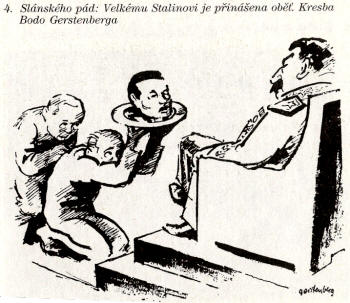
1952: Rudolf Slansky and 10 “conspirators”

On this date in 1952, eleven high-ranking Czechoslovakian politicians were hanged at Prague’s Pankrac Prison two weeks after a show trial purging unreliable elements from the Communist party.

One of the most infamous show trials in Czechoslovakia saw 14 high-ranking Communists — eleven of them Jews — railroaded for a “Trotskyite-Titoist-Zionist activities in the service of American imperialism”. Three received life sentences. The other eleven went to the gallows.

While the roots of the persecution, especially the undertones of anti-Semitism, sink into the id of the Stalinist Eastern bloc, the most evident proximate cause was the USSR’s assertion of control over its satellite states at a time when Josip Tito was successfully charting a course of independent communism. Purges in Poland, Bulgaria and Hungary had taken place in the years before.

The Soviet agents rounding up suspects for Stalin did not trifle with small game. Rudolf Slansky was General Secretary of the Communist Party and therefore the second-most powerful man in the country; by the time he was tried, after a year in prison under torture, he was publicly denouncing himself.

Otto Sling, whose name became synonymous with forbidden heterodoxy, did likewise — “I was a treacherous enemy within the Communist Party … I am justly an object of contempt and deserve the maximum and the hardest punishment.”

And Vladimir Clementis, the Slovak Minister of Foreign Affairs, was erased from a photo taken with the Czechoslovakian President, a circumstance Milan Kundera reflected upon in The Book of Laughter and Forgetting:

In February 1948, the Communist leader Klement Gottwald stepped out on the balcony of a Baroque palace to harangue hundreds of thousands of citizens massed in Old Town Square … Gottwald was flanked by his comrades, with Clementis standing close to him.

The propaganda section made hundreds of thousands of copies of the photograph taken on the balcony where Gottwald, in a fur hat and surrounded by his comrades, spoke to the people. On that balcony the history of Communist Bohemia began. Every child knew that photograph, from seeing it on posters and in schoolbooks and museums.

Four years later, Clementis was charged with treason and hanged. The propaganda section immediately made him vanish from history and, of course, from all photographs. Ever since, Gottwald has been alone on the balcony. Where Clementis stood, there is only the bare palace wall.

The hanged were rehabilitated in 1963.

Artur London, who received a life sentence and was released after rehabilitation, wrote about his experiences in The Confession, subsequently a 1970 Costa-Gavras film. The wife and son of Deputy Minister of Foreign Trade (and Auschwitz survivor) Rudolf Margolius have also both written memoirs covering the trial.

The younger Margolius in particular, who has staunchly defended his father as an essentially apolitical man and not a Communist apparatchik, has been in the thick of present-day disputes in Czechoslovakia’s successor states over whom is due sympathy and recognition for bygone political crimes.

On this day..