1381: John Ball, radical priest

Radical priest John Ball was hanged, drawn, and quartered on this St. Swithin’s Day in 1381 for the edification of the 14-year-old king whom he had very nearly deposed.

The wandering “hedge priest” Ball emerged out of St. Albans in the heart of the calamitous fourteenth centry spitting class leveling to rapt audiences of aggrieved peasants. He paid the price with at least three stints in prison. In 1366, an edict forbade his would-be flock from hearing his seditious theology demanding clerical poverty and (so complained the Archbishop of Canterbury) “putting about scandals concerning our own person, and those of other prelates and clergy.”*

But there was a reason that Ball’s illicit sermons could command such attention, and ordering him to shut up was mere whistling past the graveyard.

Ravaged by war and plague and heavy-handed wage suppression, England’s seething 99% broke into rebellion in June 1381.

Wat Tyler’s rebellion was one of the most spectacular risings England ever saw, and one of the first acts of peasants marching on London was to liberate Ball from ecclesiastical custody in Maidstone.

Ball preached to his rescuers at Blackheath, coining his great egalitarian slogan-couplet, “When Adam delved and Eve span, Who was then the gentleman?”

When Adam delved and Eve span, Who was then the gentleman? From the beginning all men by nature were created alike, and our bondage or servitude came in by the unjust oppression of naughty men. For if God would have had any bondmen from the beginning, he would have appointed who should be bond, and who free. And therefore I exhort you to consider that now the time is come, appointed to us by God, in which ye may (if ye will) cast off the yoke of bondage, and recover liberty.

They came breathtakingly close to accomplishing it.

For a few days that pregnant June the rebels controlled London, even putting to death the Archbishop of Canterbury and mounting his head on London Bridge — and Ball the “mad priest” stood in leadership alongside Wat Tyler and Jack Straw. Peasant rebellions are usually destined to end horribly; maybe this was one always was too, but it achieved very much more — terrifyingly much, to England’s ruling class — than previous other disturbances by the pitchfork crowd. By appearances, Wat Tyler and John Ball and the rest were within an ace of overturning England’s feudal hierarchy. Certainly they had the opportunity to slay young king Richard II, whose courage in command at this moment might have saved the crown to be taken from his descendants. During face-to-face negotiations between Richard and Wat Tyler himself, the rude peasant was murdered — and Richard acted smartly to bluff his villeins into marching away at a moment when they could easily have turned regicidal.

The beheaded movement was soon dislodged from London, and while promises of mercy (not always observed) did for the mass of rebels, those in its leadership could never hope for the same — least of all a career rabble-rouser. Ball was hunted down in hiding, and this time would be indulged no ecclesiastical detention: instead, his head replaced the Archbishop of Canterbury’s on London Bridge.

Wat Tyler’s name attaches to the rebellion, but for posterity it is the words of Ball, few as have survived for us, that describe its aims in something like its own voice.

Those words still make for a powerfully current critique in our own oligarchical age. When in 2015 a marker was unveiled commemorating the peasants’ rebellion, it was done on this anniversary of John Ball’s execution — and with a summons to equality he issued that has never yet been answered.

Things cannot go on well in England nor ever will until everything shall be in common. When there shall be neither Vassal nor Lord and all distinctions levelled.

* Ball’s radicalism also helped turn English elites against the religious reforms sought by John Wycliffe, who was still alive during the 1381 peasants’ rebellion.

** In the early 20th century, socialist priest Conrad Noel had a marker with the same words hung at Thaxted Parish Church, where it can still be seen today.

On this day..

1813: John McDonald and James Black, Edinburgh robbers

From the Edinburgh Annual Register for 1813:

On Wednesday, M’Donald and Black, who were convicted before the High Court of Justiciary of the robbery and murder of Mr. Muirhead, near Coltbridge, were executed upon the spot where the murder was committed. About one o’clock these unfortunate young men were brought out of prison and placed upon a cart, having seats elevated and railed round.

They were escorted along the Lawn Market, Bank-street, the Mound, and Prince’s street, by the magistrates of the city, the high constables, a detachment of the Northampton and Norfolk militias, a party of the 7th dragoons, and the city guard.

Upon reaching the west end of Prince’s street, the procession halted, where the magistrates delivered over the prisoners to the sheriff of the county, and they were then escorted by a strong detachment of the Mid Lothian yeomanry cavalry, and the sheriff and police constables, through the village of Coltbridge to the place of execution.

After some time spent in devotion, the prisoners mounted the platform, and about a quarter before three they were launched into eternity.

On the way to the place of execution the prisoners employed their time in reading, but occasionally looked round on the surrounding multitude. At the place of execution they behaved with seeming fortitude and resignation; in a particular manner, Black, who first mounted the platform, and prayed.

M’Donald was not visited by any catholic [sic] clergymen till after sentence had been passed upon him. On the first visit, he was found not so grossly ignorant as might have been apprehended, seeing that he had never attended any religious duty: and his dispositions seemed to correspond with his awful situation.

On the scaffold, as on the way to it, and indeed during the whole preceding day, he seemed entirely taken up with those exercises of devotion which had been suggested to him as proper for the occasion. In all appearance he died truly penitent and resigned to his fate.

At half past three the bodies were cut down, and conveyed in the same cart, escorted by a body of constables, to the College of Edinburgh, and delivered over to the professors of anatomy.

On this day..

1860: Albert Hicks, the last pirate hanged by the US?

The hanging of Albert Hicks on Bedloe’s Island on this date in 1860 marked perhaps the last execution for piracy in U.S. history.*

This was a century and more past the Golden Age of Piracy. By the mid-19th century, the picaresque buccaneer had long ago hornswaggled his last doubloons and retired from Atlantic sea lanes into literary nostalgia. According to the Espy file, there had been only a single piracy death case, a double execution in Virginia in 1852, over the preceding quarter-century.

Hicks, who alternately went by William Johnson, wasn’t exactly Captain Kidd: think less freebooter, and more hijacker.

Shipping out of New York on the sloop E.A. Johnson, Hicks — urged on by the devil, he later claimed — seized the vessel by murdering two crewmates, Oliver and Smith Watts, and the captain, George Burr. As that was the entirety of his company, that gave him the ship too. He didn’t mean to raise the Jolly Roger and go a-plundering with his prize: he simply stripped his victims of portable valuables, pitched their bodies into the drink 50 miles off Sandy Hook, and abandoned ship. Eventually the creepy hulk of the E.A. Johnson drifted back into New York’s harbor.

Hicks was tracked down in Providence, R.I. and arrested a few days later — the only survivor of a bloodstained mystery ship who happened to have a large quantity of coins he couldn’t quite account for.


1860 ballad, set to the tune of “The Rose Tree”.

As pieces fell into place, it emerged that Hicks had some previous experience as a seaborne desperado. Indeed, he published a confession admitting to quite an extensive career in. The life, trial, confession and execution of Albert W. Hicks, the pirate and murderer, executed on Bedloe’s Island, New York Bay on the 13th of July 1860 for the murder of Capt. Burr, Smith and Oliver Watts on board the oyster sloop E.A. Johnson: containing the history of his life is available free online and details a bloody life’s adventure from Peru to gold rush California that might even qualify as a swashbuckle — if it’s true.

Newsmen meeting him during his incarceration not infrequently express skepticism of Hicks’s veracity and motivations as he attaches himself to new outrages; in particular, Hicks might have been interested to create sensational gallows copy in order to support the family he would soon leave behind. One report shortly after Hicks’s arrest (Boston Courier, March 29, 1860) has his soon-to-be-widow visiting Hick’s cell where “she broke out upon him in the most vituperative language, charging him with being a bloody villain. She held her child up in front of the cell door, and exclaimed, ‘Look at your offspring, you rascal, and think what you have brought on us. If I could get in at you I would pull your bloody heart out.'”


Execution report from the July 14, 1860 New York Herald.

* The U.S. also enforced — loosely — its anti-slaving provisions under piracy statutes, so the 1862 execution of slave trader Nathaniel Gordon occurred under an anti-piracy law. Whether that makes him pirate enough for the milestone, the reader may judge.

On this day..

1995: Boris Dekanidze, the last in Lithuania

Lithuania conducted its last execution on this date in 1995, distinguishing Vilnius crimelord Boris Dekanidze with the milestone.

Dekanidze was born in Georgia, but had no citizenship anywhere. His father Georgy cashed in on the collapse of Soviet rule with businesses that, to survive and thrive in the 1990s, would be mobbed-up practically by definition. “When you have a collapse of government and total incompetence, people appear who can organize themselves and influence the lives of others,” Georgy said in this Newsweek report. “I can’t say if this is good or bad.” Georgy ran the Hotel Vilnius, an apt metaphor for the era.
The dapper son was convicted of ordering the murder of investigative reporter Vitas Lingys, founder of the still-extant Lithuanian newspaper Respublia* — a conviction sustained on the evidence given by the admitted gunman, Igor Akhremov.

“The collapse of government and total incompetence” was a much more nettlesome foe than this or that murderer, however. The single bullet fired into Dekanidze’s head on the morning of July 12, 1995 crippled his own criminal syndicate, the “Vilnius Brigade” — but it was not long before new gangs emerged to replace it.

Lithuania abolished the death penalty in 1998.

* Despite the punishment meted out in this one case, a wave of 1990s journalist assassinations around the former Soviet Union during the 1990s went mostly unsolved.

On this day..

2006: Derrick O’Brien, for murdering Jennifer Ertman and Elizabeth Pena

Ten years ago today, Texas executed Derrick O’Brien for an infamous Houston gangland crime — the rape-murder of Jennifert Ertman and Elizabeth Pena.

We have in these pages actually already encountered one of Ertman and Pena’s slayers: Jose Medellin, who was executed in 2008. That case was notable for the litigation resulting from Texas’s failure to comply with the Vienna Convention by notifying the Mexican consulate of Medellin’s arrest — and the Medellin post focuses on that issue. This post turns instead to the crime itself.

On June 24, 1993, Ertman and Pena — 14- and 16-year-old Waltrip High School students desperate to beat curfew — took a late-night shortcut along a railroad skirting the White Oak Bayou.

At a railroad trestle in T.C. Jester Park, just moments from home, they encountered our man Derrick O’Brien, Jose Medellin, and four other young men toasting a gang initiation. The six fell on the vulnerable girls and raped both, then strangled them with shoelaces.

Even for a city as large as Houston, it was a shattering crime that still haunts the lost girls’ friends and neighbors.


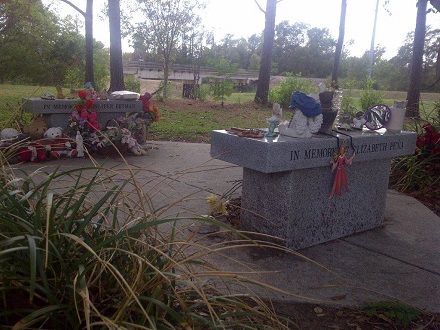
Memorial to Ertman and Pena in T.C. Jester Park. (cc) image by Pepper Hastings.

Politically, it thrust gangs to the front of the agenda for Houston pols. The girls’ kin* also fought successfully to adjust Texas Department of Criminal Justice procedure in order to permit victims’ family members to witness executions, an innovation that is now widely used throughout the U.S.

O’Brien, barely 18 when he took part in the murder, turned up in the crowd gawking at the crime scene when it was first discovered, and some video footage chances to catch him smiling and laughing. He would eventually be the first person put to death for the Ertman-Pena murder.

Besides O’Brien and Medellin, the gang leader Peter Anthony Cantu was also executed for this murder. Efrain Perez and Raul Villareal, both 17 years old at the time of the attack, were condemned to death initially but had their sentences commuted after the U.S. Supreme Court barred the execution of juvenile offenders. Fourteen-year-old Venancio Medellin — Jose’s brother — caught a 40-year sentence that he’s still serving.

* Notably, Jennifer Ertman’s father Randy became an outspoken crime victim advocate until he succumbed to cancer in 2014.

On this day..

1535: Jacob van Campen, Amsterdam Anabaptist

On this date in 1535, the Amsterdam Anabaptist leader Jacob van Campen* was mutilated, beheaded, and consigned to flames.

He’s an oddly little-known figure considering his stature in the movement — an anomaly the Global Anabaptist Mennonite Encyclopedia Online attributes to van Campen’s radical affiliations during the time when Anabaptists’ rebellion at Muenster sent the movement into the wilderness. But in Amsterdam in 1535, the cloth shearer was a leader of some 3,000 adherents to the new heresy.

There had been a price on his head since at least May of 1534, so absent a Joris-esque disappearance his capture was probably just a matter of time.

Once in his enemies’ power, van Campen’s person was used to stage a particularly elaborate execution spectacle. According to Drama, Performance and Debate: Theatre and Public Opinion in the Early Modern Period, van Campen

was sentenced to be publicly exposed on a scaffold on the Dam Square wearing a tin mitre with an imprint of the city’s coat of arms. After having been exposed as a mock bishop for one hour or more, his tongue, which he had used to deceive people, was cut out, and his right hand, which he had used to re-baptise was chopped off. He was decapitated and burnt. His head with mitre and his hand were exhibited on the Haarlemmerpoort.


Seated on a platform, the scorned Jacob van Campen endures his tortures while the flame that will soon consume his remains awaits him. Via the Rijksmuseum.

* Not to be confused with the Dutch painter Jacob van Campen.

On this day..

1858: Isaac Wood

From the Livingston Republican of July 1858, by way of Murderpedia:

On this day..

1617: Eleonora Galigai, Marie de’ Medici favorite

On this date in 1617, Italian noblewoman Eleonora Galigai was beheaded in Paris for witchcraft.

Continuing the French crown’s glorious tradition of importing dubious Italians in the train of a Medici, Eleonora (also known as Leonora or Dianora) shipped over from Tuscany with her mistress Marie de’ Medici when the latter was dynastically married off to Henri IV. Like many in its time it was a marriage of convenience: Henri brought the kingdom — and Marie the money.


Detail view (click for the full panoramic panel) of Peter Paul Rubens‘s Coronation of Marie de’ Medici in [the Basilica of] St. Denis, part of a cycle of Marie de’ Medici paintings Rubens produced on the queen’s commission beginning in 1622.

The coronation depicted above occurred on May 13, 1610 after ten quarrelsome years of marriage, and it was noteworthy timing (some thought suspicious timing) because her husband was assassinated the very next day, leaving Marie to rule France in the stead of her eight-year-old firsborn Louis XIII.

To the boundless irritation of France’s native optimates, the import queen now bestowed an incommensurate favor on her own people, and were the French nobility to draw up their bill of particulars for us the very first name might be Eleonora Galigai’s husband.

This character, Concino Concini by name, was the quick-witted son of a Florentine notary who had hustled his way into that same nuptial entourage. Marrying Eleonora, who was one of Marie’s favorites, put him squarely in the limelight among the regal expats; indeed it was he who had the honor of informing Marie of her late husband’s murder with the cold words “L’hanno ammazzato”: they killed him.

Now (runs an English traveler’s epistle), Marie’s “Countenance came to shine so strongly upon him, that he became her only Confident and Favourite, insomuch that she made him Marquis of Ancre, one of the twelve Mareschals of France, Governor of Normandy; and conferr’d divers other Honours and Offices of Trust upon him.” He lived with his wife in splendor at the Louvre, both of them in the constant orbit of the queen whom they dominated.

Haughty, insolent, low-born, foreign, and possibly complicit in regicide, D’Ancre was widely loathed in France; certainly he had few greater enemies than the growing young king, who would already have been disposed to chafe under his mother’s regency. In Louis’s eyes, this adventurer-marquis was both emblem of his mother’s misrule and (as Marshal of France) a substantive roadblock to his own power.

At last in 1617 — not yet 15 years of age — Louis seized his own realm* by having D’Ancre ambushed crossing in front of the Louvre and murdered by palace guards. Afterwards, a crowd long hostile to the noxious favorite brutally vented its rage on his naked corpse, gleefully shouting at Eleonora those words Concino had made so notorious: l’hanno ammazzato! They were really baying for her blood, too.

And they got it.

With France in hand and public opinion at his back — “I cannot represent to the king one thousandth part of joy of all these people who are exalting him to heaven for having delivered the earth from this miserable burden,” one toady reported; “I can’t tell you in what execration this public pest was held” — Louis’s party began purging the remaining dregs of his mother’s regency.** They soon shut up Eleonora in the Bastille, and had her charged as a sorceress.

* This coup was naturally big news in England as well; there’s evidence of a now-lost play about it within weeks of D’Ancre’s murder.

** The eminence grise himself, Cardinal Richelieu, first attained the summit of the state as a loyal aide to Marie and Concino. Briefly banished from Paris in the wake of Louis’s coup, Richelieu bided his time and won his way back into the confidence of the young king with whom he was to become so closely identified.

On this day..

2010: Wen Qiang, prey of Bo Xilai

On this date in 2010, Chongqing politician Wen Qiang was executed for corruption — but the rival who felled him was on the brink of his own destruction.

Wen, the longtime Public Security Bureau chief in the southwestern city of Chongking, was a big dog to most. To Bo Xilai, Wen looked more like trophy game.

Son of an “immortal” Communist pol Bo Yibo, the aggressive and charismatic Politburo member Bo was then an ascending star on the national stage.

In 2007, Bo won the Communist Party’s appointment as party chief of Chongqing — effectively giving him control of the city. From this platform, Bo launched a high-profile crackdown on graft and organized crime rife in the 30 million-strong megacity.

During a campaign from roughly 2009 to Bo’s own fall in 2012, some 9,000 people were investigated for corruption, and nearly half of them jailed … or in Wen’s case, worse.

“Dare to fight against the devil, never compromise with the gangs”: Bo’s act resonated powerfully in a country fractured by economic development and widely afflicted by beak-wetting. But Bo’s political angle was not merely playing to the peanut gallery: it was also a factional power play, implicitly critical of his similarly powerful predecessor Wang Yang for having tolerated the mobsters’ rise.

And Wen Qiang, a holdover from even before the Wang years, was Bo’s highest-ranking prey.

Xinhua reported that he was found guilty of soliciting USD $1.7 million worth of bribes, of protecting criminals like his sister-in-law who happened to be the “godmother” of crime in Chongqing, and even of raping a university student. Media circulated salacious stories of buried sacks of cash, mistresses collected and discarded, and secret luxury villas.

In these years, Bo went from victory to vctory and destroying Wen was just another stepping-stone towards the top leadership circles in the People’s Republic.

But merely 16 months after Wen faced his executioner, Bo’s own star also dramatically fell to earth.

In November 2011, British businessman and Bo associate Neil Haywood was found suspiciously poisoned in his Chongqing hotel. Practically overnight, Bo Xilai found himself the target instead of the author of the investigation — politically stricken as all his own chickens came home to roost.

An incredible sequence of events ensued: Bo’s chief of police (and Wen’s own Javert) Wang Lijun bizarrely fled to the (temporary) sanctuary of an American consulate the following February, days after Bo demoted him — apparently citing fear that Bo might have him, too, murdered.

Within weeks, Bo had been sacked as Chongqing party boss and dismissed from the Politburo while his wife Gu Kailai arrested for Neil Heywood’s murder. Wang was arrested when he left the American consulate. Politically impotent now, Bo had months to wait before his own divisive case finally came to a courtroom resolution in 2013. As of this writing, Wang and Bo and Gu are all serving long prison sentences. (Gu’s was a suspended death sentence recently commuted to life imprisonment.)

Through Bo’s precipitous fall, Bo’s own patron Zhou Yongkang was also ruined, forced out of national leadership, and eventually sent to prison on corruption charges of his own.

Bo’s disgrace has brought a re-examination of his rough rule in Chongqing — though many targets of his bygone anti-corruption drive still languish in prison, vainly protesting their innocence.

Though he is no longer around to protest on his own behalf, and there appears to be little sentiment that he was clear of corruption in an absolute sense, Wen has also been re-evaluated in light of those events — including indications that the most incendiary allegations against him might have been ginned up for show:

police buried the bundles of cash, carefully wrapped in waterproof paper, in the morning and then dug them up in front of the cameras that afternoon.

Another key piece of evidence used to convict Wen — two luxury villas worth more than 30 million yuan that Wen allegedly owned — has also been questioned.

A former senior police officer in Chongqing who was close to Wen insisted he was the real owner of the villas, where Wen allegedly kept mistresses and which were later turned into destinations for “anti-graft education” tours.

The (possibly apocryphal) story has it than in a prison meeting, the doomed Wen prophesied Danton-like to his persecutor Wang, “You’ll meet the same fate as me.”

There are affecting interviews with Wen’s wife and son, and even a reporter’s conversation with Wen during the very last hours of his life, all here.

On this day..

1962: Roger Degueldre, OAS commando

Thanks to Thomas Kanyak of @ModernConflict for the guest post. -ed.

On this date in 1962, Organisation Armee Secrete (OAS) Delta commando leader Roger Degueldre was executed by firing squad at Fort d’Ivry, near Paris, France.

Degueldre, 37 years old at his death, was one of only three OAS men executed by France for the terrorist excesses in the end game of the Algerian War in 1961 and 1962. Fittingly, that conflict wrenched to a conclusion five days before Degueldre’s death by musketry, with a referendum confirming Algeria’s independence from France. After the January 1960 “Barricades Week” revolt failed, Degueldre swore he “took an oath to keep Algeria French. As far as I’m concerned the oath will be kept. I’ll go to the limit.” He certainly did.

Like many men who joined the French Foreign Legion, Degueldre was the product of a murky past: either a Belgian who joined the SS Wallonie and fought on the Russian front, or a Frenchmen who served in the Resistance in occupied France.

What is known is, he joined the regular Army towards the end of the war, and then enlisted in the Foreign Legion under a nom de guerre. He served in Indochina and was wounded at Dien Bien Phu. In Algeria, he assumed his real name. After being suspected of taking part in the December 1960 riots during President de Gaulle’s visit to Algeria, Degueldre deserted from 1er REP, the French Foreign Legion parachute Regiment, in early 1961. The French Army, after crumpling against Germany, losing in Indochina and being humiliated at Suez, was determined to make a stand in Algeria. But the army’s resolve proved to greatly exceed the nation’s.

As France’s commitment to the fight against the Moslem rebel FLN began to crack, the army’s simmering resentment turned into open revolt, culminating in the failed Generals Putsch of April 1961 and the formation of the Secret Army Organization (Organisation Armee Secrete or OAS) that spring. It was comprised of disaffected soldiers and pieds noirs (black feet, a nickname for the European population of Algeria).

The OAS was structured in early May 1961, and Degueldre was assigned to the Organisation-Renseignement-Operation (ORO) section which was responsible for most of the OAS terrorist violence.

Degueldre’s OAS codename was Delta, and his commandos within the ORO became known as the “Deltas”; they carried out the majority of operation punctuelle (assassinations) from the failed Putsch to Algerian Independence in July 1962.

In Algiers, betrayed, Degueldre was identified slipping away from a OAS meeting in Algiers and arrested by French authorities on 7 April 1962.

“At Caserne des Tagarins, gendarmes toasted Degueldre’s arrest with champagne. They were very relieved. The Captain in charge approached the long, grim, sun baked figure and offered to wager a case of champagne that French Algeria would no longer exist within a few months.

“I won’t be here in a few months to drink it” Degueldre replied simply.

Degueldre went on trial on 27 June at Fort de Vincennes in Paris. After legal maneuvers to unseat a second judge (the first judge resigned, and committed suicide two days after the trial), Degueldre went essentially undefended, refusing to answer questions. After providing no defence witnesses, and hearing the testimony of four prosecution witnesses, Degueldre was convicted by the military court of ten murders and sentenced to death. Upon hearing the verdict, Degueldre smiled.

In Fresnes Prison after the conviction, fellow prisoners discussed going on hunger strike in protest of the death sentence meted out to Degueldre. When Degueldre was informed of the plans for the strike, he curtly replied “there’ll be no strike for me.”

On 6 July 1962, Degueldre was driven to Fort d’Ivry Prison outside of Paris where the sentence would be carried out. An 11-man firing squad delivered a volley of shots, the captain in charge administered the traditional coup de grace, and it was over (there are several versions of the fusille hier matin au Fort d’Ivry; one had it that only one shot of 11 hit Degueldre, and the Captain had to empty his revolver into him). The man described by Jean-Jacques Susini, an OAS leader, as “a magnificent revolutionary” had pour l’honneur de la parole donnee: he kept his oath.

On 23 November 1961, French President Charles de Gaulle delivered a speech to 2,000 assembled military personnel in Strasbourg. This “Lost Soldiers” Speech sought to quell discontent in the Army over the direction of French policy in Algeria after eight years of war.

it’s an illusion to think one can make things be what one desires and the contrary of what they are … at that moment when the state and the nation have chosen the way, military duty is traced out once and for all … outside these limits there can be — there are only — lost soldiers.


Sources:

Wolves in the City, the death of French Algeria by Paul Henissart

A Savage War of Peace: Algeria 1954-1962 by Alistar Horne

Various New York Times articles

@claireparisjazz twitter account

On this day..