1638: The melancholy Dorothy Talby

On this date in 1638, Dorothy Talby was hanged in Boston for breaking the neck of her baby daughter (aptly named “Difficulty”) “in order to save the child from future misery.”

Though not the first execution of a woman in the territory of the future United States, it is the first that is reasonably well-documented … and for a disturbed, possibly insane, woman striking out against her troubled family life, a case that resonated for later Americans like Nathaniel Hawthorne and Oliver Wendell Holmes.

For those of us, post-Andrea Yates, for whom “post-partum depression” has become a sadly familiar term of criminology, it is likely to resonate as well.

Mrs. Talby was esteemed for godliness, etc., but after the birth of the child she became melancholy and possessed of delusions. She sometimes tried to kill herself and her husband by refusing to eat “meat” and not permitting them to eat it, saying it had been so revealed to her. (Source)

Take a break from the Headsman’s noodlings and instead enjoy the thoughtful treatment given Talby’s case by crime blogger extraordinaire Laura James.

On this day..

1939: The 18 corpses of the rebellion

On this date in 1939, 18 junior officers of the Thai military were shot in Bangkok.

Ostensibly condemned for being part of a coup plot to depose the adolescent King Ananda Mahidol in favor of his abdicated predecessor Prajadhipok, they were in reality the casualties of a purge by the Field Marshal-turned-Prime Minister Phibun Songkhram.

It’s alternatively transliterated “Phibun Songkhram” or “Pibunsonggram”, and familiarly abbreviated to “Por”, but by any name he dominated Thai politics for a generation.

One of the military leaders of the bloodless 1932 Siamese Revolution that made the country a constitutional rather than an absolute monarchy, Phibun had in 1938 muscled his way to the Prime Ministership.

Beset by assassination attempts linked to royal revanchists to whose purposes the young turk’s programme was deeply inimical, Phibun determined to break the back of monarchism en route to a modernized, militaristic nationalism (pdf) that would be right at home in the imminent world war.*

As 1939 opens, we join the narrative of Paul Handley’s The King Never Smiles:

Phibun swept the capital and arrested 50 royals, nobles, and soldiers in the clique of his People’s Party rival Colonel Song Suradej for plotting his overthrow …

Whatever the truth behind the cabal, its quashing came to represent the final victory of the 1932 revolutionists and the constitutionalists over the monarchists. To mark it, Phibun commissioned a huge monument to the constitution, later called Democracy Monument, in the middle of the city’s main thoroughfare, Rajadamnoen (“royal progress”) Avenue.


The Democracy Monument in Bangkok.

The eighteen officers who took it in the shorts on this date were not joined by condemned VIPs like royal blood Prince Rangsit, who copped a commutation. It’s widely thought now that the “Songsuradet Rebellion” — or aptly-named “Rebellion of 18 Corpses” — was trumped-up, if not an phantasm altogether.

The Democracy Monument was not the only bulwark of Thai nationalism thrown up by Phibun in the year between the “conspirators'” January arrest and their deaths this day.**

He dropped the old absolutist name “Siam” in favor of the more nationalistic “Thailand” in June of that year; made the date of the 1932 revolution a national holiday; stripped the language of class-distinctive structures; and pressed irredentist claims against neighboring French colonies.

And if the royal house was efficiently marginalized by Phibun, it would yet develop in the latter part of the century into one of the region’s weightiest political entities† … intertwined with the Thai military Phibun helped hoist to pride of place, a formula that has left coups and unstable governments a presistent feature of the political landscape down to the present day.

* And subsequently, too. Despite aligning with the Axis powers during World War II, Phibun was a feted anti-Communist dictator as Washington started counting dominoes in Southeast Asia in the 1950’s.

** The Wikipedia page for the rebellion claims that the executions were carried out in batches of four per day. A New York Times report of December 6, 1939 said that all 18 had been executed the previous day.

† The current King Bhumibol Adulyadej, who coincidentally turns 81 today, is the world’s longest-reigning monarch as of this writing … with no shortage of concern about the conflict his passing may unstop.

On this day..

1859: John Brown’s body starts a-moulderin’ in the grave

That line between “martyr” and “terrorist” is often a matter of historical perspective or even accident.

Were the person’s actions justified?

If not justified, were they at least historically significant?

If not historically significant, did they at least inspire some really great songs?

Or, movies?

John Brown, abolitionist, father of 20 children, advocate of armed insurrection as a direct means of ending slavery, is just such a figure. Before looking at how his actions influenced history, however, it is instructive to consider how history influenced him.

Born into a devout family opposed to slavery on religious and moral grounds, Brown grew up in a vehemently anti-slavery district of Ohio and, as a young man, began training in New England to become a Congregationalist minister.

When money ran out, he returned to Ohio and began a series of variously successful business ventures and married his first wife, with whom he would have seven children. When his businesses failed, he moved to Pennsylvania, buried his wife, married his second, and started a tannery, which began to founder as one of his sons died and Brown fell ill. He moved his family –- now with more than a dozen children –- back to Ohio, where he was hit hard by the economic crisis of 1839 (PDF link). In 1842, he was declared bankrupt; the following year, four more of his children died of dysentery.

In spite of these setbacks, Brown remained dogged in his pursuit of ventures to get himself out of debt, becoming a seasoned expert among small sheep farmers and acting as a self-appointed crusader for their empowerment against the encroaching interests of manufacturers. While this backfired and Brown remained impoverished into the 1850s (thought not as much as when he was declared bankrupt), it solidified his interest in helping the underdog.

Bleeding Kansas

Moral and religious interest in the abolition of slavery had been part of Brown’s upbringing, but it wasn’t until 1855, when five of Brown’s adult sons began sending word of often violent pro-slavery machinations in the Kansas territory, that Brown first became committed to drastic action on behalf of the cause. His strategy wasn’t at first overtly violent, but was rather convinced that the anti-slavery cause could win by the ballot box; over the course of the next year, however, he became convinced that the only sure way of preserve Kansas as a free territory was by “fighting fire with fire” (historical opinion as to the precise extent of the pro-slavery violence in relation to Brown’s later actions is divided).

In 1856, with tensions reaching a boiling point, Brown, four of his sons, and a band of other abolitionists killed five pro-slavery settlers in Franklin County, Kansas in what became known as the Pottawatomie Massacre. No legal retribution was possible or likely; Brown and his party escaped handily (although one of his sons was killed the following August), and Brown spent the next three years using various aliases to travel among abolitionists raising funds to launch an all-out assault on slaveowners back East.

“The crimes of this guilty land will never be purged away but with blood.”

That he chose the federal arsenal in Harpers Ferry, Virginia (now West Virginia) for his historic attack was no accident; it “evinced federal power stained by slavery.”

Brown believed his actions would be the start of a lasting insurrection in which slaves would rise up against their owners in an insurrection that would quickly spread to neighboring counties and throughout the South. While violence was expected, it was to be minimized, and, after the initial raid, used only in self-defense.

Twenty-one men, in total, took part in the raid; Brown’s expected hundreds of recruits never materialized. The slave population never got a chance to rise up against their masters, as townspeople promptly began firing on the raiders; by the morning after the start of the raid, the invaders were surrounded by a company of US Marines.* Brown was captured, along with seven of his men; ten were killed, and four escaped.

Tried in Virginia for murder, treason and conspiracy, Brown was convicted on November 2, just weeks after his failed insurrection, and sentenced to be hanged within a month. His often-cited speech in Court in response to this sentence would become a rallying cry for the abolitionist movement:

This court acknowledges, as I suppose, the validity of the law of God. I see a book kissed here which I suppose to be the Bible, or at least the New Testament. That teaches me that all things whatsoever I would that men should do to me, I should do even so to them. It teaches me, further, to “remember them that are in bonds, as bound with them.” I endeavored to act up to that instruction… Now, if it is deemed necessary that I should forfeit my life for the furtherance of the ends of justice, and mingle my blood further with the blood of my children and with the blood of millions in this slave country whose rights are disregarded by wicked, cruel, and unjust enactments, I submit; so let it be done!

“Make the gallows glorious like the Cross.”

During his last month on Earth, Brown seemed well-aware that he was on his way to be a martyr. Refusing rescue by a supporter who had managed to infiltrate the prison, he wrote letters of valor and conviction which were increasingly picked up by the Northern abolitionst press, and attracted pleas of clemency from sources as removed as Victor Hugo.


Christ-like: The Last Moments of John Brown, by Thomas Hovdenden.

John Brown hanged at Charles Town, Virginia (present-day West Virginia — another thing Virginia lost during the Civil War). This 19th-century drawing is from the Virginia Military Institute archive of the event, which includes eyewitness accounts of soldiers who attended the hanging, including Thomas “Stonewall” Jackson.

Hanged in the mid-morning of December 2, 1859, Brown stated ominously: “I, John Brown, am now quite certain that the crimes of this guilty land will never be purged away but with blood. I had, as I now think, vainly flattered myself that without very much bloodshed it might be done.”

Brown’s dramatic enactment of an attempted armed insurrection –- even an abortive one –- stoked longstanding Southern fears of slave rebellions, leading the South to reorganize and equip its outdated militias, and the Union to increasingly valorize a man who held, with sheer and utter clarity, the very convictions in which they must needs believe to fight and win the coming War Between the States.

Called a “misguided fanatic” by the man who would lead that war, Brown’s actions nonetheless both hastened the inevitable schism already drawn so dramatically across a nation in which one out of every ten human beings was held in legal bondage, as well as gave moral and spiritual courage to those who would ultimately rise to eradicate it.

“His soul goes marching on…”

Or in the words of Frederick Douglass:

Did John Brown draw his sword against slavery and thereby lose his life in vain? And to this I answer ten thousand times, No! No man fails, or can fail, who so grandly gives himself and all he has to a righteous cause. No man, who in his hour of extremest need, when on his way to meet an ignominious death, could so forget himself as to stop and kiss a little child, one of the hated race for whom he was about to die, could by any possibility fail.

Did John Brown fail? Ask Henry A. Wise in whose house less than two years after, a school for the emancipated slaves was taught.

Did John Brown fail? Ask James M. Mason, the author of the inhuman fugitive slave bill, who was cooped up in Fort Warren, as a traitor less than two years from the time that he stood over the prostrate body of John Brown.

Did John Brown fail? Ask Clement C. Vallandingham, one other of the inquisitorial party; for he too went down in the tremendous whirlpool created by the powerful hand of this bold invader. If John Brown did not end the war that ended slavery, he did at least begin the war that ended slavery. If we look over the dates, places and men for which this honor is claimed, we shall find that not Carolina, but Virginia, not Fort Sumter, but Harpers Ferry, and the arsenal, not Col. Anderson, but John Brown, began the war that ended American slavery and made this a free Republic. Until this blow was struck, the prospect for freedom was dim, shadowy and uncertain. The irrepressible conflict was one of words, votes and compromises.

When John Brown stretched forth his arm the sky was cleared. The time for compromises was gone – the armed hosts of freedom stood face to face over the chasm of a broken Union – and the clash of arms was at hand. The South staked all upon getting possession of the Federal Government, and failing to do that, drew the sword of rebellion and thus made her own, and not Brown’s, the lost cause of the century.

For more John Brown:

* Under the command of future Confederate General Robert E. Lee.

On this day..

1517: Torben Oxe

It was November 29, 1517, when the last Roman Catholic king of Denmark, the ambitious and possibly manic-depressive monarch Christian II, enforced the execution of a man whom he trusted for years. Torben Oxe was beheaded at St. Gertrude’s Hospital Cemetery for crimes against the throne.

Oxe was a subsidiary character during the tenure of one of the more intriguing Western European monarchs, and his hasty — and largely unsubstantiated — condemnation was a critical indicator in the governance of King Christian II.

Christian II of Denmark

Christian took the throne during a time of great disquiet in Scandanavia. His father, Hans of Denmark, fought for more than 30 years to restore the union across Norway, Sweden, and Denmark while harshly opposing the Hanseatic League. His efforts bore fruit in 1483 when Norway and Denmark came together to appoint him ruler of those two lands; 14 years later, he conquered Sweden and claimed kingship.

But his dominion over Sweden was short-lived: struggles to regain independent territory in Northern Germany resulted in a resounding defeat, and Sweden gave its new king the pink slip in 1501. Hans was eventually reinstated as an absentee ruler, awarded the title of king in 1509 but not allowed into Stockholm, nor re-crowned. His takeover was exclusively economic.

It was during this time that Christian stepped into his political future.

He took control of Norway as viceroy in 1506, and his rule was less than appreciated by the wealthy. The nobles in Norway maintained a sort of Privy Council called the Rigsraadet, which Christian was unwilling to cede any more power to than he felt was necessary.* Christian was known as a brutal man among the nobles even as he tried to cultivate a connection to the common people.

It was this connection that led to the downfall of Oxe. During his time in Norway, Viceroy Christian took a mistress named Dyveke Sigbritsdatter, a Norweigan peasant of Dutch descent.

At the death of Christian’s father early in 1513, the viceroy became King of Denmark and Norway and immediately set to bringing Sweden under heel. His father had made similar efforts which were supported by Eric Trolle, who was initially appointed regent to Sweden after Sten Sture (the elder) passed away; unfortunately for Christian II, in 1511, Sten Sture (the younger) convinced the high council to rescind its earlier appointment in his favor.

Sture was no friend to Christian II.

It is widely thought that the desires of Christian were eventually played out through Gustav Trolle, Eric’s son, who rose to the post of archbishop early in Christian II’s reign. Trolle threw his lot in with the Danish ruler and gained his ear, earning the promise that Trolle might rule over Sweden in Christian’s name. Trolle did everything he could to secure his place in history, demanding more autonomy for the church and, Sture claimed, attempting a backdoor coup. In 1515, Sture had Trolle imprisoned, the Catholic church condemned the Swedish government, and the Swedes and Danes squared off in a series of battles to decide its fate.

But Christian was obsessed with the expansion of his realm. He worked persistently to expand his power and reach, forming alliances that would help him gain control of what he considered the whole of Denmark. It was around this time that Christian II hitched the horse of the Holy Roman Empire to his team by marrying Isabella (Elizabeth I), granddaughter of Maximilian I.**

Which brings the story back to Torben Oxe.

Oxe was appointed Governor of Copenhagen Castle, a modest nobleman’s post that put him in close contact with the king’s court. Despite Christian’s marriage, he kept his mistress, openly housing her and her mother immediately adjacent to his residence. In summer 1517, Dyveke Sigbritsdatter fell ill and died; her mother pointed the finger at Oxe, who sent the girl a box of cherries two days earlier: apparently, Oxe was also enamored of Dyveke. Sigbrit alleged that Dyveke rebuked Oxe’s advances, and out of spite, he had murdered her.

History is awash with uncertainties, and there are plenty of those in the death of Dyveke. To begin, it’s not even clear that Dyveke was poisoned; she died suddenly and with severe stomach pain, so poisoning was assumed, but never really proven. In addition, it’s not clear whether Oxe was, indeed, courting Dyveke, as Sigbrit insisted. Last but not least, if Dyveke was murdered, there was nothing to suggest that the killer was not a member of the Rigsraad — the Privy Council in Denmark — or just someone seeking revenge on the king for one of his many cruel acts; instead of tracing these possibilities, Christian II condemned his friend Oxe on Sigbrit’s word alone.

But the farce was not complete without an equally farcical trial or two. Oxe’s post gave him a trial by the Council of the State: a dozen noblemen met, conferred, and delivered a rebuke to the king, declaring Oxe innocent of the crime. Christian was incensed at the verdict, allegedly asserting, “If I had as many kinsmen in the Rigsraad as he has, he would never have been acquitted.”

Not content with this form of justice, the king turned to the people, assembling a jury of peasants who were more than obliging in delivering the famed line, “We do not convict him, but his deeds convict him.” So, despite the pleadings of the king’s wife, Torben Oxe lost his head — and his corpse was burned for good measure.


Christian II underskriver Torben Oxes dødsdom, or Christian II Signs Torben Oxe’s Death Warrant (1874-76), by Eilif Peterssen. The queen sits at his side, imploring him not to do it.

In the great tradition of nepotism, Sigbrit was subsequently appointed chief adviser to the king and took over the role of management of the mercantile taxation system, the Sound Tolls; she was remarkably successful in these posts and formed a middle-class council which held far more sway over Christian than its “noble” counterpart, the Rigsraadet.

As he moved away from them, Christian’s rule became more and more unstable, and his desire to have Sweden almost insatiable. After a series of battles, he managed to claim the title of King of Sweden for a brief period around 1520, crowned by his friend Gustav Trolle shortly before putting on the Stockholm Bloodbath. It was this event which earned him the title in Sweden of Christian the Tyrant.

Peder Oxe

As if these connections weren’t enough, Oxe’s nephew, Peder Oxe (born in 1520), who was Steward of the Realm under Frederick II, became one of the players in an attempt to restore Christian II’s daughter, Christina, to the Danish throne — long after Christian himself was out of the picture. The attempt was unsuccessful.†

Dyveke’s story, and her impact on King Christian II, has been cast in a variety of literary formats.

* The Rigsraadet was the Norweigan instantiation of the Scandanavian sort of House of Lords, with members the noblemen of the time. New members could be appointed by kings and queens, or by other members of the council, and, until the Reformation, Roman Catholic bishops also maintained posts.

** This marriage also extended the reach of the Habsburgs into Denmark, a move that would have further consequences several hundred years hence.

† Christina also has the distinction of turning down a marriage proposal by Henry VIII. According to legend, her witty response to the ambassador sent to arrange the marriage was, “If I had two heads, one should be at the King of England’s disposal.”

On this day..

1950: James Corbitt, the hangman’s mate

On this date in 1950, famed British executioner Albert Pierrepoint carried out his most difficult assignment: hanging his friend.

Though not literally the Isles’ last hangman, Pierrepoint is the last one everyone thinks of, the man who defined the hangman’s job for the 20th century.

Discreet, orderly, and as quiet as he was efficient,* he was the brand-name executioner for stiff-upper-lip England of the waning empire, with over 400** hangings to his name from 1932 until he resigned over a fee dispute in 1956.

Despite his proper avoidance of the spotlight, Pierrepoint’s excellence at his craft would make him a celebrity — especially after the press fixated on his role hanging Nazi war criminals after World War II. The ready-made morality play upon the scaffold boards could hardly be resisted: the English grocer, meting out a dignified and precise measure of justice to the likes of the Beast of Belsen.

Hanging Around

Pierrepoint’s characteristic client wasn’t a war criminal, but a humdrum British murderer, only a handful of which attract especial remembrance today.

Still, in the immediate postwar years, the growing reach of the mass media and burgeoning public controversy over the death penalty would frequently put Pierrepoint in the middle of the era’s highest-profile hangings, including:

Tish and Tosh

Like as not, this day’s affair hit the sturdy hangman harder than any of those.

James Henry Corbitt was a regular at “Help the Poor Struggler”, the piquantly named Oldham pub Pierrepoint bought and managed after World War II. Known as “Tish” to Pierrepont’s “Tosh,” the two had sung a duet of “Danny Boy” on the night that Corbitt went out and murdered his girlfriend in a jealous rage.

Corbitt was not exceptional as a criminal, and he was indisputably guilty; we wouldn’t notice him if not for his acquaintance with the man who put him to death.

But Pierrepoint would remember this one well, as he later wrote in his his autobiography:

I thought if any man had a deterrent to murder poised before him, it was this troubadour whom I called Tish. He was not only aware of the rope, he had the man who handled it beside him singing a duet. The deterrent did not work.

Remarkably, the most prolific executioner in British history had come out against the death penalty, or so it seemed. (He later backed away from a strong anti-death penalty position, though without retracting his original reservations. The death penalty had been a decade off the books by this point, in any case.)

It is I who have faced them last, young lads and girls, working men and grandmothers.

I have been amazed to see the courage with which they walk into the unknown.

It did not deter them then and it had not deterred them when they committed what they were convicted for. All the men and women I have faced at that final moment convince me that in what I have done I have not prevented a single murder. And if death does not work to deter one person, it should not be held to deter any … capital punishment, in my view, achieved nothing except revenge.

It’s an open question how much Tish’s hanging this day really contributed to Pierrepoint’s retirement six years later or his apparent change of stance on his trade. But it provides the gut-wrenching dramatic pivot for the film Pierrepoint: The Last Hangman.

Interestingly, while the hangman saw in Corbitt’s fate a troubling indictment of the death penalty, the hanged man’s son to this day still says dad deserved to die.

More on Albert Pierrepoint

For a man so ubiquitously present in the mid-century experience of Great Britain, and who undertook such a dramatic volte-face, it’s no surprise that Pierrepoint has attracted plenty of attention — including this website, and a number of books.

Also of possible interest: Hangmen of England: History of Execution from Jack Ketch to Albert Pierrepoint (we’ve met Jack Ketch here before). More dry factual data about Pierrepoint, the father and uncle who preceded him in the post, and other recent practitioners in Britain’s colorful line of executioners is here.

* The English practice was for Pierrepoint to pinion the prisoner’s arms in the condemned cell, escort him a few steps into a hanging chamber, hood him, and execute the sentence without further ceremony. The whole process took mere seconds — a record fast seven seconds from cell door to trap door in the case of James Inglis — which Pierrepoint seems to have had a gift for dignifying in his (usual) silence with a sort of calming paternal assurance.

Pierrepoint hanged six American soldiers under the auspices of U.S. military forces deployed to England during the Second World War, and confessed to considerable discomfort with that entity’s protracted pre-hanging procedures that had him standing on the scaffold with the condemned man for several minutes.

* And perhaps well over 600 hangings; the figures are disputed.

On this day..

1927: Father Miguel Pro, “Viva Cristo Rey!”

On this date in 1927, the anti-clerical Mexican government made the emblematic martyr of the Cristero War.

This video is in Spanish, but the storyline is pretty easy to follow — young man finds faith, lives faith, dies faith.

Miguel Pro‘s dying cry, “Viva Cristo Rey!” — “Long live Christ the King!” — was a refrain of Cristeros, anti-government guerrillas who in the late 1920’s fought the revolutionary Mexican government’s attempts to forcibly restrict the power of the Catholic Church.

That conflict had been brewing for years, an outgrowth of Mexico’s own complex history of colonization and development — measures to restrict the church’s size, wealth, and social reach had been mooted and sometimes implemented well back to the middle of the 19th century.

Early in the 20th, the confrontation was merely a twist on its classic form: liberal state-builders and the Catholic hierarchy were (or increasingly saw themselves as) diametrically opposed in their vision for Mexico.

That conflict came to a head under president Plutarco Elias Calles, an irreligious northerner with a project of national capital development for whom the church’s intransigence from its agrarian strongholds was most unwelcome … and who seemed to delight in provoking Rome with sport like mandatory physicals for priests, not neglecting to publicize the incidence of venereal disease thereby revealed.

Liberals had already brought about drastically reduced clerical privileges in the Mexican Constitution of 1917; its somewhat draconian measures were neither fully enforced nor fully resisted, but initiated a period where the two hostile institutions rudely grappled for their respective spheres of influence on the ground.

Calles was the rudest grappler of all, and his 1926 Calles Law pushed for anti-clericalism stricter than the letter of the constitution … and sparked armed resistance.

It was an exceptionally dirty war with routine summary executions on both sides and thousands of Catholic refugees — a dangerous environment for any priest with legal sanctions against basically every practice of the vocation. (Photos of Cristeros, some in heroic resistance and others in grisly martyrdom, can be eyeballed here.)

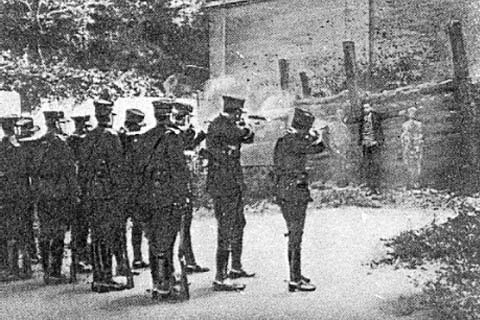
Pro, a Jesuit who like many was forced underground, was under state surveillance and got picked up in the aftermath of an assassination attempt against a prominent politician. He was chosen to make an example of — without an actual trial, possibly because there’s no actual reason to think he was involved in the bombing.

Looking at these pictures of Pro’s last moments, it’s hard to believe that they were taken and circulated at government direction to cow the Cristero movement. Fail.


Led out to execution in a police courtyard. The place of his death today is (bizarrely) Calle Loteria Nacional.


Calmly at prayer before his death, under the eye of the firing squad commander.


Pro himself refused a blindfold. But why state authorities carrying out the execution with an eye towards public relations would allow him to die in this pose is anyone’s guess.


He blessed and forgave the firing squad, of course.


Just beginning to topple at the moment the bullets struck him.


Like many firing squad executions, this one failed to kill its victim with the ceremonial volley. Pro was finished off with a coup de grace.

Calles was simultaneously — the key measures were also enacted in 1926 — involved in a confrontation with the United States over oil rights, a situation that came to the brink of war, with Washington saber-rattling about “Soviet Mexico”. It’s tempting to wonder whether the two situations weren’t related, especially since the new American ambassador* who had arrived only the month before Pro’s execution would ultimately negotiate both situations’ resolutions.

While the natural resource politics went their separate way, the Mexican Revolution’s anti-clerical strain didn’t so much disappear by negotiation as fade away over decades, with regular new outbreaks.

One thinks of Mexico today as such so staunch a Catholic country that it’s hard to imagine that some of these provisions were only officially repealed in 1998.

As for Pro, he’s welcome in Mexico by now — celebrated by Pope John Paul II who ultimately beatified him, and the inspirational source of this hymn whose refrain is his famous last cry.

There’s a faithful site in his honor here, and apparently a shrine to him in Houston, Texas run by a group pushing for his canonization.

* The American ambassador in question, Dwight Morrow, invited Charles Lindbergh on a goodwill tour to Mexico, where the aviator would meet the diplomat’s daughter not long after Miguel Pro’s martyrdom. Little could Lindbergh and Anne Morrow suspect that their love match would set them on the path to their own famous encounter with capital punishment.

On this day..

284: Aper, by Diocletian

On this date* in 284, one of Rome’s greatest emperors claimed the purple by summarily executing his rival before the approving army in Anatolia.

The Emperor Diocletian christened his reign with a bit of scaffold theatricality, but he might have been the real perp.

For half a century, the Roman Empire had waded through crisis. In its political manifestation, a parade of forgettable emperors had marched through the throne room, each to be assassinated, overthrown, or otherwise disposed of by some equally forgettable aspirant en route to a similarly unenviable end.

At length, out of this unpropitious bunch, rose one Diocles, a low-born Dalmatian of classical education whose martial gifts saw him rise through the legions. His opportunity came when the emperor Carus, barely a year on from succeeding his assassinated predecessor, died on campaign against Persia allegedly struck by lightning (quite possibly a euphemism for something more dagger-like), leaving his son Numerian in charge.

As the army meandered back to the friendly confines, Numerian secluded himself in his litter. And after a while, the litter started to stink.

Sometime on the journey, he’d been secretly killed — but by whom?

The principals this day are our leading suspects. (And it’s a little mystifying in either case just what was gained by leaving the body hidden so long.) We turn to Gibbon to narrate what must have been a riveting — not to mention definitive — proceeding adjudicating between them a few kilometers past Nicomedia (moder Izmit, Turkey) towards Chalcedon (now the Kadikoy district of Istanbul).

A general assembly of the army was appointed to be held at Chalcedon, whither Aper was transported in chains, as a prisoner and a criminal. A vacant tribunal was erected in the midst of the camp, and the generals and tribunes formed a great military council. They soon announced to the multitude that their choice had fallen on Diocletian, commander of the domestics or body-guards, as the person the most capable of revenging and succeeding their beloved emperor. The future fortunes of the candidate depended on the chance or conduct of the present hour. Conscious that the station which he had filled exposed him to some suspicions, Diocletian ascended the tribunal, and raising his eyes towards the Sun, made a solemn profession of his own innocence, in the presence of that all-seeing Deity. Then, assuming the tone of a sovereign and a judge, he commanded that Aper should be brought in chains to the foot of the tribunal. “This man,” said he, “is the murderer of Numerian;” and without giving him time to enter on a dangerous justification, drew his sword, and buried it in the breast of the unfortunate praefect.** A charge supported by such decisive proof was admitted without contradiction, and the legions, with repeated acclamations, acknowledged the justice and authority of the emperor Diocletian.

Though there isn’t any direct evidence of it, posterity is entitled to suspect on grounds of means, motive and opportunity, that the eventual beneficiary of Numerian’s demise — the emperor henceforth known as Diocletian — was its true author.

Whether obtained by fair means or foul, Diocletian put the laurels of state to good use, stabilizing government by introducing the “Tetrarchy” — the rule of the empire’s eastern and western halves by two emperors (“Augusti”) each aided by a “Caesar” who was also the heir apparent.

Diocletian’s two decades in power before his anomalous voluntary retirement constitute a watershed in the late history of Rome, and not only because the cycle of imperial assassinations and civil war took a welcome generation-long hiatus.

Although he’s also remembered for initiating the last major persecution of Christians, his administration set the stage for the rise of Constantine the Great, the Galilean’s first imperial champion. Constantine’s father was one of the original tetrarchs, the Caesar of the west.

And in the longer term, Diocletian’s division of the empire between east and west would sow the seed of the later separation of Byzantium and Rome, and the corresponding division in the Christian world. No surprise, then, that the first ruler profiled in Lars Brownworth’s 12 Byzantine Rulers podcast is this date’s executioner:

[audio:http://www.12byzantinerulers.com/audio/02-Diocletian.mp3]

More audiophilia about Diocletian and the tetrarchs in this lecture from Isabelle Pafford’s UC-Berkeley course on Roman history. (The first 6:45 or so consists of class business and carryover from previous lectures.)

[audio:http://webcast.berkeley.edu/media/s2008/hist106b/hist106b_20080425.mp3]

* As with much in the ancient world, sourcing is tenuous, and there is some scholarly debate over whether the events in this post should be ascribed to November 20, or to November 17, or to September 17, or to some other date. Since this blog, notwithstanding its title, embraces the occasional execution whose date is uncertain, I am prepared to wave aside textual uncertainty in the interest of a ripping good story.

** According to the Historia Augusta, Diocletian had a superstitious reason to carry out this bloodthirsty act personally.

This story my grandfather related to me, having heard it from Diocletian himself. “When Diocletian,” he said, “while still serving in a minor post, was stopping at a certain tavern in the land of the Tungri in Gaul, and was making up his daily reckoning with a woman, who was a Druidess, she said to him, ‘Diocletian, you are far too greedy and far too stingy,’ to which Diocletian replied, it is said, not in earnest, but only in jest, ‘I shall be generous enough when I become emperor.’ At this the Druidess said, so he related, ‘Do not jest, Diocletian, for you will become emperor when you have slain a Boar (Latin: Aper).’ ” … It is now well known and a common story that when he had killed Aper, the prefect of the guard, he declared, it is said, “At last I have killed my fated Boar.” My grandfather also used to say that Diocletian himself declared that he had no other reason for killing him with his own hand than to fulfill the Druidess’ prophecy and to ensure his own rule. For he would not have wished to become known for such cruelty, especially in the first few days of his power, if Fate had not impelled him to this brutal act of murder.

Part of the Themed Set: The “Ex” Stands For “Extrajudicial”.

On this day..

1928: Marshall Ratliff lynched for the Santa Claus Bank Robbery

On this date in 1928, the man whose disguise christened one of the most bizarre crimes in Texas’s colorful history was lynched behind a theater … producing “The Noose”.

The Santa Claus Bank Robbery was, in the words of one columnist present for the affair,

the most spectacular crime in the history of the Southwest … surpassing any in which Billy the Kid or the James boys had ever figured.

The story begins on December 23, 1927, in the town of Cisco, where a genial man dressed as Saint Nick strolled down the main drag dandling playful children en route to the First National Bank.

Santa — Marshall Ratliff — and three accomplices then conducted one of the most inept bank robberies in that craft’s ample stock of ineptitude.

A general gun battle erupted during the robbery, owing to the general citizenry being armed, and a standing reward available from the bank association for shooting a bank robber in the act. When the quartet finally fought their way to the getaway car — killing two cops in the process — they realized it was almost out of gas.

After a few days’ dodging a manhunt, everyone was rounded up, one of them in corpse form. Two of the surviving three drew death sentences, and Henry Helms sat in the Lonestar State’s electric chair on September 6, 1929.

But Kris Kringle — er, Ratliff — had his execution delayed by a sanity hearing that brought him back to Eastland County, where he feigned illness and killed a guard in an abortive escape attempt. The good folk decided they’d had about enough of due process.

Quoth a newspaper report of the day (reproduced in A.C. Greene’s book on the case):

All yesterday afternoon they gathered in little groups about the town and muttered about [the guard] Jones’ shooting which physicians said probably would prove fatal. Last night a crowd in front of the jail swelled to nearly a thousand at 8:30 o’clock.

At about 9 o’clock, some 200 men slipped into a side door of the jail and asked for the man. Jailer Gilborn refused to give him up. They overpowered Gilborn, took his keys and got Ratliff.

… He was dragged in the direction of the public square, but the crowd would not wait to go those few blocks.

At 200 yards from the jail a strong telephone cable was pointed out, a rope flung across it. A noose was put around Ratliff’s neck, a dozen men on the other end of the rope bent their weight, and Ratliff was jerked from the ground.

The rope broke. Messengers were sent for another, and again the mob set to its task. Then someone remembered that men about to die are usually given a chance to say a last word. For another moment he was lowered to the ground, but, displeased at his mumbling, the crowd yelled, “String him up!”

Part of the Themed Set: The “Ex” Stands For “Extrajudicial”.

On this day..

2005: Elias Syriani, a family affair

On this date in 2005, North Carolina executed 67-year-old immigrant Elias Syriani at Raleigh’s Central Prison for the murder of his wife — despite the emotional clemency intervention of the couple’s children.

Syriani, an ethnic Assyrian driven from his native Jerusalem by al nakba who moved to the U.S. from Jordan through marriage to a Jordanian immigrant, had a stormy marriage hit the rocks in 1990. Teresa filed for divorce after a few years facing Elias’s violent objections to her westernized behavior.

Syriani responded by jumping her when she drove home one night, and stabbed her to death with a screwdriver in front of their 10-year-old child.

This case meandered forgettably through the bowels of the criminal justice system; the traumatized children moved on (.pdf).

Until the year before Syriani met his fate, when the mysteries of the human heart flipped the script.

The four children visited Syriani and found themselves forgiving their mother’s murderer … and forging an unexpected bond with the father they hadn’t known for a decade. They called it a miracle, a gift from their late mother to go from “hate, absolute hate, to love in a split second.”

The children — by then grown — became Syriani’s advocates for executive clemency, posing an unusual challenge for Gov. Mike Easley: in an environment that (rhetorically, at least) often counts on survivors’ rage and grief as arbiters of punishment, would he spare a father for killing a mother when the children said execution would redouble the family’s injury?

But commutations rarely happen — there’s just no percentage in them for politicians.

“After careful review of the facts and circumstances of this crime and conviction, I find no convincing reason to grant clemency and overturn the unanimous jury verdict affirmed by the state and federal courts.” (Easley)

This startling story became the subject of a 2007 documentary, Love Lived on Death Row

[flv:https://www.executedtoday.com/video/Love_Lived_on_Death_Row_trailer.flv 440 330]

The following are excerpts from an interview with the film’s Producer/Director Linda Booker originally conducted by Sean O’Connell of The Charlotte Weekly.

When did you first hear about/become interested in this story?

Back in July 2005, I was checking the weather on a local news website and scanning the headlines when the article about the Syriani siblings forgiving their father caught my eye. I think at first it interested me because I have been involved with our local domestic violence agency as a volunteer and fundraiser, but as I read the article something about their reconciling with and forgiving their father really touched me. At this point they had begun to share their story with the public and had just appeared at a domestic violence conference in Charlotte called “Hope to Heal.”

At what point did you get the idea to film the story in documentary form? How long did it take to complete the film?

It was an immediate reaction for me upon reading the article that their story might make a compelling documentary film. I printed it out and carried it around with me. But I was still finishing up interviews and editing my first documentary project “Millworker: the Documentary” so I didn’t act on it right away. Then several months later I learned that they would be speaking in Chapel Hill, close to where I live, and I thought, “okay, if I feel this strongly about this, here’s my chance to meet them and film their discussion.” So there I was, a relatively new filmmaker and very nervous about that first step, but I received permission to film that night. That’s also when I first heard about and met Meg Eggleston, who had been writing letters and visiting Elias Syriani on death row for four years and the Syriani sibling’s attorney Russell Sizemore, who was helping them through their father’s clemency appeal pro-bono. I came to learn that Meg’s friendship with Elias was an essential part of their father’s transformation and was such an interesting story in itself.

I started filming in October 2005, edited in the fall of ’06 and started doing preview screenings in early ’07. Since then the film has screened at film festivals and many grassroots screenings with various non-profits and faith groups as sponsors in the U.S. especially in North Carolina.

The Syriani children are open and honest in the film. Did you have trouble accessing them? Were they open to the idea of participating in the film, even though at this point it could not help their father?

I started filming interviews with Meg Eggleston and Russell Sizemore first who trusted that I was not trying to do a sensationalized story, but that I recognized the Syriani’s story of forgiveness was inspirational, regardless of the outcome of the clemency appeal. The Syrianis knew that I was working with Meg & Russ, but out of respect for all they were going through, I did not push the issue of their participation. About six months after the appeal, I wrote them about participating and subsequently we went to California and Chicago in the summer of ’06 to film interviews with them. While they know that a part of the discussion around the film will be capital punishment, the Syriani siblings have expressed that they want their story to live on in hope that their experience of surviving a domestic violence tragedy and the healing that came from forgiveness will touch people’s hearts and help others.

I think it’s because this case is so unique, but I found the film’s stance on the death penalty unclear. Can you, as the filmmaker, clarify your thoughts on the death penalty?

Well, I’ll take that as a compliment, because the documentaries I admire aren’t pounding you over the head with the filmmaker’s opinion. I can tell you that making this film made me face how I felt about the death penalty and I spent a lot of time researching and doing some deep thinking about the issue.

Needless to say it’s very complex, and it is completely understandable that feelings of anger and retribution can occur when you have lost a loved one to violence. We need to do more for those dealing with the aftermath of murder with as much support, assistance and counseling services as possible, especially children. But as I went to restorative justice forums and have met many people who belong to organizations such as Murder Victims Families for Reconciliation, I kept hearing stories about how the death penalty was causing more grief, stress and division in families that had experienced murder. Between making the documentary and doing the research, I came to the conclusion that I couldn’t support a system of justice that can possibly create more pain and victims in its wake and that was also irreversible and arbitrary.

On this day..

1869: Hamiora Pere, Maori “traitor” to the Queen

On this date in 1869, Hamiora Pere became the only New Zealander ever executed for treason.

Maurice Shadbolt’s Season of the Jew is a historical novel of the conflict that doomed Hamiora Pere. It’s told from the standpoint of Te Kooti, who liked to compare the Maori cause to that of the Israelites resisting Egypt, and founded a religious sect that still persists today.

Pere* came by the distinction quite accidentally — even setting aside the queer circumstance of his “betraying” a state on the opposite side of the globe by resisting its claim to his ancestral homeland.

Hamiora Pere was one of five Maori prisoners from the Siege of Ngatapa during Te Kooti’s War — an indigenous resistance against British colonization — to face the fatal charge.

The crown handled these cases carefully.

Though all five men drew death sentences (mandatory for treason), the government was evidently trying to stay out of the martyr-making business — as revealed by a judge’s comment during official deliberations.

I believe the result is the very best that could have been arrived at. I am glad to know that Mr McLean thinks that one execution will be useful as more would have been by way of example and caution.

Unfortunately for Hamiora Pere, the one of those five who was most likely set up to be the “example,” Wi Tamararo, committed suicide in prison shortly after his sentence.

Pere seemingly became the next in line for hanging because he was associated with murders in a noteworthy massacre at Matawhero that slew 33 Europeans and 37 of their Maori allies. Notably, however, the charge of murder actually filed against him was dropped prior to trial since he could be placed at the scene of the attack, but not directly shown to have killed anyone. Even off the indictment, it may have been the thing that doomed him.

Whatever the nature of the deliberations — and this report (pdf) of New Zealand’s Waitangi Tribunal inconclusively attempts to unpack the story with the patchy evidence available — the remaining convicts got clemency. Four years later, they were pardoned outright.

Pere got the noose at Wellington, and the accidental historical footnote. He would seem destined to maintain his unusual distinction indefinitely, since New Zealand has abolished the death penalty altogether.

Fear of Death

It is the circumstantial distinction of his case that earns Pere his place in this blog out of the numberless thousands to meet his same fate.

But in the end, he faced the gallows in that existential nakedness common to all us mortal wretches beholding death. Many in these pages meet their ceremonial end with with bravado; Hamiora Pere, by contrast, suffered all the pitiably human torments of fear, according to the report of the Daily Southern Cross:

He received the notice of his approaching death with calmness, and it was not until the morning before the execution that he gave any outward sign that he realised his terrible position. … [after his last farewell with his family he] became terribly distressed. He evidently fully recognised his position; he knew that he had looked for the last time on those from whom only he had any right to expect sympathy; every incident was reminding him how rapidly his term of life was decreasing, and it was not until his spiritual adviser … had been with him some time, that he became more composed.

…

[on the morning of the execution, Pere’s] responses [to his spiritual advisor] were accompanied by a peculiar moaning, and by convulsive sobbing. … the prisoner, quite a young man, and with nothing in his general appearance worthy of special remark, was sobbing bitterly, and was evidently suffering from intense mental agony; he looked anxiously around, yet stood firm and erect while he was being pinioned, repeating, as well as his trembling voice would allow, the prayers that were being offered on his behalf. … At the foot of the steps [to the gallows] the prisoner halted a moment, but, being led up, was quickly placed in the centre of the platform, under the noose, which was immediately fixed round his neck. From the time the prisoner left his room, until the rope was adjusted, he continued praying in a low moaning tone, interrupted frequently by violent sobbing …

* Also spelled “Peri” and, occasionally, “Pera”.

On this day..