1860: John Moyse, the Private of the Buffs

“Our readers,” intoned the London Times on Nov. 5 of 1860, “will not have overlooked the behavior and fate of Private Moyse, of the Buffs, whose resolution, indeed, was not proof against the allurements of the grog-cart, but who actually faced death in cold blood rather than demean himself by prostration before ‘any Chinaman alive.'”

It was on this date that said Private Moyse, John to call him by his Christian name, died in captivity — allegedly because he refused to kowtow to a Chinese mandarin. “The Sikhs obeyed” this Asiatic command, goes the account. “But Moyse, the English soldier, declaring that he would not prostrate himself before any Chinaman alive, was immediately knocked upon the head and his body thrown on a dunghill.”

Kowtowing — Chinese insistence upon; British rejection of — was a touchy symbolic issue between the rising European hegemon and the ancient Chinese empire. It’s said (likely with more color than accuracy) that the British envoy Earl Macartney‘s 1790s trade mission to the east failed for want of a kowtow.

For the same reasons this legend became current, the Moyse tale made sensational propaganda during Britain’s Second Opium War intervention in China, valorized in this jingoistic tear-jerker.

The Private of the Buffs
by Sir Francis Doyle

Last night, among his fellow roughs,
He jested, quaffed and swore,
A drunken private of the Buffs,
Who never looked before.
Today, beneath the foeman’s frown
He stands in Elgin‘s place,
Ambassador from Britain’s Crown
And type of all her race.

Poor, reckless, rude, low-born, untaught,
Bewildered and alone.
A heart, with English instinct fraught,
He yet can call his own.
Aye, tear his body limb from limb,
Bring cord, or axe, or flame;
He only knows that not through him
Shall England come to shame.

Far Kentish hop fields round him seem’d
Like dreams, to come and go;
Bright leagues of cherry blossom gleam’d,
One sheet of living snow;
The smoke above his father’s door
In grey soft eddyings hung.
Must he then watch it rise no more,
Doomed by himself so young?

Yes, honour calls! With strength like steel
He puts the vision by.
Let dusky Indians whine and kneel;
An English lad must die.
And thus, with eyes that would not shrink,
With knee to man unbent,
Unfaltering on its dreadful brink
To his red grave he went.

Vain, mightiest fleets of iron framed;
Vain, those all-shattering guns;
Unless proud England keep, untamed
The strong heart of her sons.
So, let his name through England ring –
A man of mean estate,
Who died, as firm as Sparta’s King
Because his soul was great.

Moyse’s defiance and death make an appearance in this Flashman novel.

Aye, Moyse liked to get into the drink and had a discipline problem, but no matter. This fact was easily appropriated further to his bluff and earnest character in national martyrdom.

Getting a bit carried away with itself, the Times editorialized on Nov. 16,

We have no such visions of human perfectibility as to believe that all the young men of this country will be “respectable youth” looking for “honourable service.” … The English are a people endowed with superabundant energy, and energy must sometimes take an irregular and even a criminal form. The best use that can be made of a young man who will settle down to nothing is to get him to enlist as a soldier. He is kept under strict discipline at the same time that his love of activity and adventure is gratified. He becomes a first-rate fighting man, and fulfils splendidly the only duty which society can ever hope to obtain from him. There is no reason to wonder, with Colonel McMurdo, that acts of heroism have been performed by such men, for they have performed them in all ages and all countries. The “obstinate intemperate hero” is of all time, whether in the shape of Alexander or Lord Clive, or Private Moyse of the Buffs. There are two kinds of valour, belonging to two different classes of men, and a citizen-force may very usefully be employed side by side with the wildest lads who ever rioted in Tipperary or gambled in a London pothouse.

Basically forgotten now, this story can be fleetingly encountered among Anglophiles as an arcane indicator that the national character of Britain, or the West, or what have you, is not now what it once was, given all the kowtowing to mandarins going on in these debased times.

(Although this post amusingly juxtaposes the “commonsense prudence and practicality” of Wellington taking an expedient knee so that a military strategem would not be lost on account of bullheaded pride. Maybe it helped that Wellington was kneeling to a European.)

On this day..

1914: Rudolf Duala Manga Bell, in German Kamerun

On this date in 1914, the Germans hanged D(o)uala king Rudolf Duala Manga Bell for treason in German Kamerun.

European-educated and on retainer by the colonial German government, Bell was hardly the subversive type: rather, as the head of the largest clan of the important Duala tribe, he was the guy that Berlin looked to to uphold its authority.

This mutually satisfactory relationship began unraveling in 1910, with the Reich’s plan to abnegate the 1884 treaty under whose auspices it intruded into Kamerun (Cameroon) in the first place.

Seeking to confine the Duala to a few coastal villages — and subsequently, to push those Duala to less desirable inland territory — Berlin managed the rare feat of uniting the tribe’s various families, and pushing Rudolf Manga Bell himself into (surprising, to Germany) resistance.

When petitions to the Reichstag were ignored, the Duala began (Bell’s own degree of involvement in this seems to be a disputed point) making noises about holding Berlin in breach of the colonial treaty and finding itself a new European patron, like France or England.

Azanwi Nchami’s Footprints of Destiny (“the historical Cameroonian novel par excellence”) tells the story of Rudolf Manga Bell, Martin Paul Samba, and emergent Kamerunian nationalism.

And one notes the year in this post’s title, which would become momentous to Germany for other reasons. “The coming war,” notes Victor T. LeVine, “made it appear that Manga Bell had been plotting with Germany’s enemies.”

Bell was arrested for treason in the first half of 1914, as the Germans seized prime Bell land along the Wouri River.

In the conflict that became remembered as World War I, the first declarations of war were made in the very first days of August; Axis and Ententethe Central Powers and Triple Entente lined up against one another in the colonial territories, too, and German administrators in Kamerun realized that they were about to face an invasion from neighboring British and French colonies.

So it was in an atmosphere of panic and a view towards desperate internal repression that Bell was tried for treason on August 7, 1914, along with his friend and fellow-traveler Martin Paul Samba — and put to death the very next day.

Postscript

The Allied invasion had taken Duala and the other principal cities of Kamerun from the Germans by the end of September; over an 18-month campaign, the Germans were totally defeated in the territory, which France and England claimed as victors’ spoils after the war. (Also inheriting the tense relationship with the Duala; France was still trying to sort out the 1914 German expropriations that started the whole mess decades later.)

As a result, Rudolf Duala Manga Bell’s son, Alexander Ndoumbe Duala Manga Bell, not only inherited his father’s royal position among the Duala — he became Cameroon’s first elected representative to the French National Assembly.* There’s more about that guy here.

It is here that the Germans part ways with Cameroon’s national story, but there was almost a “peace in our time” diplomatic reconquista.

Although Hitler originally held the colonial movement in great disdain, in the late 1930s his regime ‘adopted’ and coordinated this movement. After 1936 the renewed campaign for the recuperation of German colonies had its desired results among the Allied powers. In discussions between the French Foreign Minister, Yvon Delbos, and the American Ambassador, William Bullitt, proposals were considered for the appeasement of Germany including tariff reductions, the involvement of the Third Reich in the development of Africa, and finally the granting of a colony to Germany, probably the Cameroons. In November 1937, during talks between Premier Chautemps, Prime Minister Chamberlain, Eden and Delbos, the suggestion was allegedly made by Chamberlain that France should ‘hand the Cameroons to Germany at once without any quid pro quo’.**

* Ralph A. Austen, “The Metamorphoses of Middlemen: The Duala, Europeans, and the Cameroon Hinterland, ca. 1800 – ca. 1960”, The International Journal of African Historical Studies, Vol. 16, No. 1 (1983).

** Richard A. Joseph, “The German Question in French Cameroun,” Comparative Studies in Society and History, Vol. 17, No. 1 (1975)

On this day..

1936: Aboune Petros, Ethiopian bishop

On this date in 1936, the Italian forces occupying Ethiopia executed anti-occupation cleric Aboune Petros.

War on Ethiopia had been Benito Mussolini‘s monument to muscular Italian nationalism.

By May of 1936, it had forced Haile Selassie into exile and established control of the country. Mission accomplished!

At last Italy has her empire.

-Mussolini

As is often the case, the war of conquest instead transmogrified into a war against continuing resistance to foreign military occupation, and the colony of Italian East Africa was a short-lived and bloody affair.

The Duce will have Ethiopia, with or without the Ethiopians.

-Italian Gen. Rodolfo Graziani

(Though the progressive counterpart to Italy’s iron-fisted approach to troublemakers was monumental construction, and 1930s-era fascist architecture is still to be seen in Addis Ababa today.)

Ethiopian Orthodox patriarch Aboune — it’s a title that can also be rendered Abuna or Abune — Petros cut a public profile a little too sympathetic to the native subversives. When the Italians demanded that he tone it down, he replied (according to a hagiography that appears several places online),

The cry of my countrymen who died due to your nerve-gas and terror machinery will never allow my conscious to accept your ultimatum. How can I see my God if I give a blind eye to such a crime?

On July 28, Italians repelled a large* Abyssinian insurgent attack by the sons of Ras Kassa between Addis Ababa and Petros’s stomping-grounds of Dessie; the next day, Petros was escorted to an abrupt martyrdom to the mirroring causes of national self-determination and anti-insurgency realpolitik.

His sacrifice is commemorated in statuary as well as a couple of notable theatrical pieces, Yedam Dems (The Voice of Blood) by Makonnen Endalkachew** and Petros Yachin Saat (Petros At That Hour) by Tsegaye Gebre-Medhin.

* On the scale of thousands. It “showed a certain tenacity,” according to the London Times‘ droll Rome correspondent in a July 30 story.

** Not the same guy as the post-colonial Prime Minister who was executed in a 1974 purge.

On this day..

1998: David Wilson

Just after dawn this date in 1998, David Wilson was hanged for murdering a security guard in St. Kitts and Nevis.

Wilson was only the second person executed by the tiny Caribbean nation since it achieved independence in 1983, and he would be the last hanged there until 2008.

The execution of this run-of-the-mill criminal attracted particular attention as a hempen protest against death penalty skeptics on the bench of the British Privy Council. Especially in the 1990s (and since) the exercise by this high court of the commonwealth of an excessively persnickety supervision of Caribbean death sentences attracted regional backlash against colonial meddling for hampering local response to violent crime. (See also the contemporaneous Trinidad and Tobago case of Dole Chadee.)

Wilson was controversially hanged before he submitted his appeal to the Privy Council.

In a bid to shore up national sovereignty, Caribbean countries were even then hammering out a Caribbean Court of Justice to replace these distant and unaccountable magistrates. However, official adoption of the CCJ has been halting.

On this day..

1916: Cesare Battisti and Fabio Filzi

On this date in 1916, the Austro-Hungarian empire executed Cesare Battisti and Fabio Filzi for treasonous Italian nationalism.

It was the multiethnic Habsburg state that was itself dying of its constituents’ national aspirations; in little more than two years, the state entity that carried out this day’s sentences would no longer exist at all.

Pre-World War I, Battisti (English Wikipedia entry | Italian) was actually a Socialist representative in the Austrian parliament.

When the unpleasantness broke out, though, he made a break for the peninsula where he agitated* (successfully) for Italian entry into the fray against Austria-Hungary. Irredentists had long coveted Habsburg properties with a heavy Italian population, like the Adriatic port of Trieste and Battisti’s own native Trento; the war offered an opportunity to swipe those territories, notwithstanding Italy’s putative prewar alliance with the Austrians.

Although already 40 years of age when Italy entered the war, the intrepid Battisti enlisted to fight. He was captured along with an otherwise obscure subaltern, Fabio Filzi, on the Alpine slope of Monte Corno (now known as Monte Corno Battisti) repelling the Austrian Strafexpedition.**

Austria did not stand on ceremony with these men; their capture took place on July 10, their trial on July 12, and their executions at the Castello del Buon Consiglio — an ironic Calvary, for a parliamentarian — later that same day. (To complete the scene, the strangulation-hanging was botched when Battisti’s first rope broke.)

The Austrian writer Karl Kraus would observe that “they thought they were hanging Italy, but it was really Austria on the gallows.”

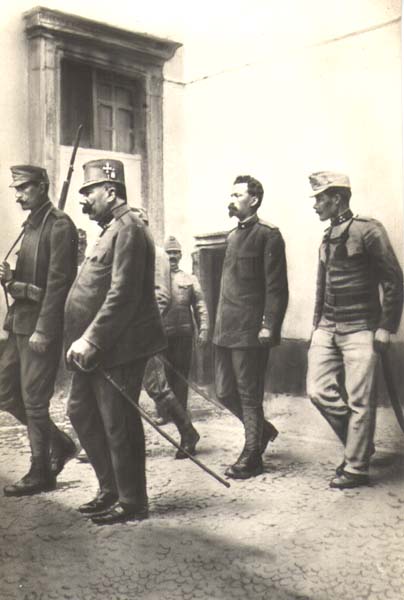
Whichever one it was, they took a lot of pictures.


Battisti and Filzi as prisoners.


Battisti leaving the courtroom en route to his execution.


Battisti approaches the scaffold.


Battisti waiting at the scaffold as the sentence is read.


The Austrian army offers a prayer and salute to the shrouded body of Cesare Battisti.

* As a socialist who broke against the internationalist position and in favor of violent nationalism, Battisti was an ally of Benito Mussolini. It was Battisti, actually, who pioneered the socialist-nationalist-newspaperman act upon which Mussolini would later raise is own star, to such an extent that Battisti’s paper, Il Popolo — the apparent inspiration behind Mussolini’s own subsequent paper, Il Popolo d’Italia — gave the still-obscure future Duce some of his earliest gigs.

A martyr’s death during World War I fortuitously spares Battisti’s legacy the unpleasant association with his friend’s postwar turn towards fascism, so there are many streets and plazas named for Battisti, as well as a memorial in Trento. He’s also honored by name in the 1918 patriotic tune La Leggenda del Piave (lyrics).

** “Punitive expedition”.

On this day..

1395: Ivan Shishman, falling to the Turks

On this date in 1395, Bulgarian tsar Ivan Shishman was beheaded in Nikopol by the Ottoman Empire then engaged in absorbing his crumbling empire.

Ivan is the little guy in the middle; the towering figures are his parents.

The mythical (though not quite literal) last emperor of Bulgaria, Shishman is ungenerously judged by Wikipedia “a vacillating politician whose inopportune choices speedily guided him to his violent end and the subjugation of the country by the enemy.”

The guy ruled a waning state under the shadow of a neighboring expansionist superpower. Only inopportune choices were available.

Shishman’s sister, Maria Thamara Hatun, had been married off to the Ottoman Sultan Murad I in a token of Bulgaria’s vassalage.

In 1389, said Murad smashed the Serbians at the Battle of Kosovo. Even though Murad died in combat, the Turks left the Field of Blackbirds with the Balkans by the throat and the Bulgarian Empire (or rather, Empires: Shishman and his brother had split the kingdom) nicely encircled.

Murad’s son Bayezid “the Thunderbolt” struck soon enough.

At the Siege of Tarnovo in 1393, the Turks essentially destroyed Shishman’s realm, while Shishman bugged out to be captured at a later mop-up operation.

The Ottomans took his head, but left Bulgaria a martyr whose iconography is still good for the nationalist metal audience.

The clips in this video are from the 1969 Bulgarian flick Tzar Ivan Shishman.

On this day..

1597: Severyn Nalyvaiko

On this date in 1597, Cossack Severyn Nalyvaiko was publicly quartered in Warsaw.

Nalyvaiko organized “unregistered” Cossacks in Poland’s eastern realms, modern-day Belarus and Ukraine, into what became a significant rebellion. (Poland’s efforts to “register” and thereby control Cossacks would continue to cause tension in the years ahead.)

The Poles outmuscled him, and here he is.

However, because longer-term historical trends were not so favorable to the Polish-Lithuanian Commonwealth, Nalyvaiko rates a place as an early independence martyr for (east) Slavic resistance to Warsaw’s Polish imperialism.

Not only does he get a spot on present-day Ukrainian coinage (as pictured); 19th century Russian poet Kondraty Ryleyev, who would himself be executed for his part in the Decembrist plot, lyricized Nalyvaiko’s death as heroic national sacrifice … and simultaneously elevated the poet’s own prophesied fate for himself.

“In Ryleyev’s poetry, fate — romantic fate — is not simply personal and individual,” writes Lauren Leighton. “The fate of his heroes, and so his own fate, is raised to the level of national-historical tragedy. By welcoming his fate and dying for his land, Nalivayko ennobles his people.”


“Nalyvaiko”

Say not, thou holy man, again
That this is sin, thy words are vain,
Be it a fearful mortal sin
Worse than all crimes that e’er have been,
I care not — for could I but see
My native land at liberty,
Could I but see my race restored
To freedom from the foreign horde,
All sins would I upon me take
Without one sigh for Russia’s sake. —
The crimes of all the Tartar race,
The apostates Uniates‘ treason base,
The sins of every Jew and Pole —
All would I take upon my soul.
Try not with threats my mind to shake,
Persuasive words no change can make,
For hell to me is to have viewed
My loved Ukraine in servitude;
To see my fatherland set free,
This, this alone, is heaven for me!

E’en from the cradle was my breast
With love of liberty possessed;
My mother sang me glorious lays
Of those long-past historic days,
Whose memory yet lives ‘mongst men,
For no fear seized on Russians then,
None cringed before the haughty Pole;
The iron of a foreign yoke
Weighed upon no free Russian’s soul,
None cowered beneath a stranger’s stroke;
Cossacks were then the Pole’s allies,
Bound each to each in equal ties,
Such as free men would well beseem —
Now all is vanished like a dream.
Cossacks long since had learned to know
How into tyrants friends may grow;
The Lithuanian, and the Jew,
The Pole, and all the Uniate crew,
Like ravening crows around their prey
Seize us, and tear our limbs away.
The voice of law no more is heard
In Warsaw’s city, none are stirred
At hearing all a nation’s wail,
Our mourning voices nought avail,
And now within me burns a flame
Of hatred for the Polish name —
A fierce hot flame of raging fire —
My look is wild with passion dire
And frenzied wrath; the soul in me
Sickens for love of liberty.
One thought have I by night and day,
Which like a shadow haunts my way,
E’en where the steppes lie silent, bare,
Unresting it pursues me there;
E’en in the soldier’s camp, and when
The battle’s whirl, and tramp of men,
Around me roar with maddening rush,
I hear it still, and in the hush
Of the still church’s vaulted gloom,
Sound in my ears the words of doom
“‘Tis time,” the holy accents say,
“‘Tis time to sweep the foes away,
“O’er the Ukraine who bear their sway.”
I know full well the direful fate
Which must upon the patriot wait
Who first dare rise against the foe
And at the tyrant aim the blow.
This is my destined fate — but say
When, when has freedom won her way
Without the blood of martyrs shed,
When none for liberty have bled?
My coming doom I feel and know
And bless the stroke which lays me low
And, father, now with joy I meet
My death, to me such end is sweet.

On this day..

1919: Mehmed Kemal, for the Armenian genocide

Ninety-one years ago today,* the tottering Ottoman Empire hanged one of its officials in Istanbul for his role in the mass slaughter of its Armenian minority during the First World War.

Kemal Bey’s hanging in Bayezid Square occurred in the immediate aftermath of the Great War. Here, on its last legs, the remains of a sultanate splintered apart in the war instituted tribunals for wartime offenses by the Young Turks who had run the government during the war — a sop to the British occupying forces making worrying noises about international trials for much bigger fish.

Much testimony at the trial pointed to the governor’s fervor for massacres; an Armenian priest who survived the slaughter later wrote that a Turkish officer had told him that Kemal “made a vow on the honor of the Prophet: I shall not leave a single Armenian alive in the sanjak of Yozgat.”

A response to the New York Timesreport of the hanging noted that “his part was that of an executioner. The originators of the plan to exterminate the Armenians were primarily Enver, Tallat, and Djemal.”

These “Three Pashas” who had driven Ottoman policy during the war had fled abroad. They would be condemned to death in absentia, and though none would hang, neither would they outlive Mehmed Kemal by as much as four years.

They were among the many unpunished perpetrators of the slaughter hunted down by Armenian assassins. The latter two were avenged by Operation Nemesis; Enver Pasha died in battle in Tajikistan during the Russian Civil War.

Though overshadowed in historical import by those three, our day’s principal is distinguished as the first person executed for “crimes against humanity.”

This novelty, combined with the trial’s victor’s-justice character, were immediately controversial, and remain so in the fraught politicking around the genocide. (This genocide-denialist paper describes, on page 13, the rowdy funeral scene that erupted the next day, also attested** by annoyed British officials.)

Events would soon outstrip these tribunals and lay waste to all parties’ plans for the Ottoman carcass, incidentally leaving the Armenian issue permanently unresolved.

The month after Mehmed Kemal swung, western allies went one dismemberment too far by backing the irredentist Greek state’s landing at Smyrna — an intervention that was to backfire catastrophically for the Greeks, and help birth the Turkish Republic.

* A few secondary sources say April 12 rather than April 10, but the earlier date appears much better attested.

** e.g., a diplomatic note cited in The Burning Tigris, p. 337: “Not one Turk in a thousand will think that any other Turk deserves to be hanged for massacring Christians.”

On this day..

1910: Ahn Jung-geun, Korean nationalist

A century go today, Korean independence martyr Ahn Jung-geun (or An Jung-geun) hanged at Port Arthur for assassinating Japanese statesman Ito Hirobumi.

Ahn Jung-geun, who was also a skilled calligrapher (his epigram, “Unless reading everyday, thorns grow in the mouth” is well-known in Korea), actually had a more visionary pan-Asianist agenda than his nationalist byline might initially suggest.

But he militantly opposed Japan’s annexation of the peninsula, and won his hero stature for gunning down Ito in Manchuria.

Ito, for his part, is a national hero in Japan for establishing that country’s parliamentary government and serving as its first Prime Minister.

So, yeah. Still a spot of tension over this incident.

Because the Japanese worried that “if Ahn Jung-geun’s body is handed over to the surviving family or impudent Koreans … it will not be good in the future,” its ultimate deposition has become an enduring historical mystery, with China the current likely suspect. Koreans’ intensified hunt for records pointing to Ahn’s grave has been much in the news during the centennial run-up.

Wherever his bones rest, the Korean patriot (as the saying has it) lives on. He’s even been posthumously promoted by the South Korean army to the rank of “General”.

The recent Korean film 2009 Lost Memories is premised on an radically different alternate timeline starting when Ahn is prevented from killing Ito. Here’s its aesthetically appealing climax, when history is righted.

Scrabbel put the Ahn Jung-geun story to music.

On this day..

1689: Karposh, Macedonian rebel

On an uncertain date in early December (or possibly late November), the Macedonian* rebel Karposh was executed at Skopje.

The Great Turkish War had seen the Ottomans advance to the gates of Vienna, but an alliance of European powers pushed the Mohammedan back.

Their crisscrossing armies roiled the Balkans, creating the opportunity for a bit of ill-fated separatism.

Arambasha [a title, not a name] Karposh raised a native Macedonian rebellion (detailed account of it here) that waxed and waned with the fortunes of the Austrian army. In his brief heyday, he was acclaimed “Prince of Kumanovo“.

But a November 1689 counteroffensive seriously harshed that vibe; the Turks overran his force and drug Karposh back to Skopje where he and a couple hundred fellow Macedonian captives are said to have been put to death by impalement on the lovely Stone Bridge over the Vardar. (Other versions of this story cite, less picturesquely, hanging.)

You can still see this landmark today in Skopje … capital of the now-independent Macedonia.

* Lest I wade carelessly into the Balkan ethnic crossfire, I hasten to declaim that “Macedonian” here refers to the geographic environs roughly coincident with the present-day Republic of Macedonia. No representation as to the man’s ethnicity or his project is intended, or attempted.

On this day..