1788: Thomas Barrett, the first hanged in Australia

On this date in 1788, Thomas Barrett became the first person legally executed in Great Britain’s Australian colonies when he hanged at Sydney Cove for stealing from government stores. It was barely a month after the First Fleet had arrived from England to found the penal colony.

More than just a milestone, Barrett packed an amazing criminal career into the few years he surfaces for us in the documentary record.

Our man was condemned to death in 1782 for stealing a silver watch, the first of three death sentences he would hear. That sentence was reprieved in favor of convict transportation, a system which had ground to a halt with the American Revolution and still awaited the creation of the Australian pipeline.

In 1783, a convict hulk that had been rejected by the now-independent North American colonies, the Swift, mutinied. Barrett would meet survivors of that mutiny who were stashed away with him on the Censor, one of the earliest of the Thames’ frightful stationary convict hulks where reprieved felons awaited their deportation.

In 1784, Barrett and one of the Swift mutineers, Charles Kellan, rebelled once again on their next convict transport ship, the Mercury — earning Barrett his second death sentence, and his second reprieve. Three more years on the fetid hulks ensued while legislators* and cartographers stroked their beards over Britain’s next move in the convict transportation game.

And this is when Australia the prison was invented. That First Fleet Barrett arrived on was a flotilla of eleven ships carrying 700 or so prisoners was it, the literal first European colony Down Under.

Besides being a man of spirit and enterprise, as his mutiny showed, Barrett was a skilled craftsman who enlivened the tiresome trip around the world by fashioning little metallic mementos. The journal of the ship’s surgeon John White narrates with more admiration than censure an escapade off the coast of Brazil that revealed Barret’s talent for counterfeiting.

This morning a boat came alongside, in which were three Portugueze and six slaves; from whom we purchased some oranges, plantains, and bread. In trafficking with these people, we discovered, that one Thomas Barret, a convict, had, with great ingenuity and address, passed some quarter dollars which he, assisted by two others, had coined out of old buckles, buttons belonging to the marines, and pewter spoons, during their passage from Teneriffe. The impression, milling, character, in a word, the whole was so inimitably executed, that had their metal been a little better, the fraud, I am convinced, would have passed undetected. A strict and careful search was made for the apparatus wherewith this was done, but in vain; not the smallest trace or vestige of any thing of the kind was to be found among them. How they managed this business without discovery, or how they could effect it at all, is a matter of inexpressible surprise to me; as they never were suffered to come near a fire; and a centinel was constantly placed over their hatchway, which, one would imagine, rendered it impossible for either fire or fused metal to be conveyed into their apartments. Besides, hardly ten minutes ever elapsed, without an officer of some degree or other going down among them. The adroitness, therefore, with which they must have managed, in order to complete a business that required so complicated a process, gave me a high opinion of their ingenuity, cunning, caution, and address; and I could not help wishing that these qualities had been employed to more laudable purposes.

Duly impressed, White found that more laudable purpose by commissioning Barrett to create a medallion celebrating the arrival of their vessel to Australian soil. This Charlotte Medal from Barrett’s hand is one of the most celebrated artifacts of Australian colonization; it depicts the Charlotte at anchor in Botany Bay with a narration on the reverse of its long journey from home:

Sailed the Charlotte of London from Spit head the 13 of May 1787. Bound for Botany Bay in th Island of new holland arriv,d at Teneriff th4 of June in Lat 28 13 N Long 16 23 W depart,d it 10 D’, arriv,d at rio janeiro 6 of Aug in Lat 22,54 S Long 42,38 W, depart,d it the 5 of Sep’ arriv,d at the Cape of good hope the 14 Oct’ in Lat 34 29 S Long 18 29 E depart,d it th13 of Nov’ and made the South Cape of New Holland the 8 of Jan 4 1788 in Lat 43,32 S Long 146,56 E arrivd at Botany Bay the 20 of Jun’ the Charlotte in Co in Lat 34.00 South Long 151.00 East distance from great Britan Miles 13106

But Barrett’s legitimate artistic career was as brief as it was scintillating.

The colony had a tight supply situation and its isolation and heavy convict population seemed to Governor Arthur Phillip to demand the strictest discipline, like that of a ship upon the sea: any significant failure of order could imperil the entire project. He assembled the little colony in early February to impress upon all that stealing rations would be harshly punished.

White, again, in his entry of February 27, 1788:

Thomas Barrett, Henry Lovel, and Joseph Hall, were brought before the criminal court, and tried for feloniously and fraudulently taking away from the public store beef and pease, the property of the crown. They were convicted on the clearest evidence; and sentence of death being passed on them, they were, about six o’clock the same evening, taken to the fatal tree; where Barrett was launched into eternity, after having confessed to the Rev. Mr. Johnson who attended him, that he was guilty of the crime, and had long merited the ignominious death which he was about to suffer, and to which he said he had been brought by bad company and evil company. Lovel and Hall were respited until six o’clock the next evening. When that awful hour arrived, they were led to the place of execution, and just as they were on the point of ascending the ladder, the judge advocate arrived with the governor’s pardon, on condition of their being banished to some uninhabited place.

As the infant colony had scarcely prioritized establishing an executioner right off the boat, one of Barrett’s fellows was pressed into the disreputable role. Another narrative underscores the tension this incident must have created among the convicts, half-starved and under the lash on the empire’s most distant moon. “The unhappy wretches were conducted wt. a party of Marines walking before them … with a large party of Marines drawn up opposite the Gallows … in case an insurrection should take place … & all the Convicts were summoned to see the deserved end of their Companions.” Hall and Lovel’s pardons should probably be read in this light; Phillip had a job to enforce obedience without triggering rebellion and once he had established the firmest precedent wisely reflected that the quality of mercy blesseth him that gives and him that takes. Two other thieves (of wine, in their case) named Daniel Gordon and John Williams were likewise condemned on the 29th of February only to be spared for banishment instead.


A small marker at Sydney’s Circular Quay commemorates Barrett’s execution. (cc) image by mazzle278.

Barrett is an important character in the BBC drama Banished.

* The Home Secretary who orchestrated the pivot to Australia was the Viscount Sydney: hence, the Australian city of Sydney.

On this day..

1858: Maniram Dewan, tea infuser

On this date in 1858, the British hanged Assamese grandee Maniram Dewan for joining the 1857 Indian Rebellion.

Maniram was a young man going on 20 when the British wrested control from Burma of the eastern province Assam, and he carved himself a successful career in the empire.

But without doubt his lasting service to the Union Jack and the world was discovering to the British the existence of a theretofore unknown varietal of the tea plant, cultivated in Assam’s monsoon-drenched jungles by the Singhpo people* — a fact of geopolitical significance since it augured a means to crack the Chinese stranglehold on tea supply so taxing to the current accounts.** Today, rich Assam tea is one of the world’s largest tea crops, yielding 1.5 million pounds annually.

Maniram himself was among its earliest commercial cultivators (in fact, the first native Indian cultivator), setting up with an estate at the village of Chenimora in the 1840s, but the next decade found him increasingly irritated by the injuries British avarice to the extent that he began intriguing to restore the lately dispossessed kings.

With the outbreak of rebellion in 1857, Maniram and the like-minded made their move to restore the Ahom heir Kandarpeswar Singha but the plot was betrayed and landed its authors in irons.

Although he suffered the law’s last extremity for his plot, Maniram’s name lives on in honor in modern India. A trade center in Assam’s largest city bears his name, for instance; and, when India declared tea its official drink in 2013, it timed the announcement to fall on Maniram’s birthday (April 17, 1806).

* It goes without saying that imperial recognition of their secret produce did not redound to the benefit of the Singhpo. Although Singhpo assembled the very first export crop, much of their land was soon gobbled up by tea plantations, and when they rebelled in 1843 the East India Company annexed it outright. “Now it is said that where the tea grows, that is yours, but when we make sacrifices we require tea for our funerals,” a Singhpo chief wrote the Company, mournfully. “We therefore perceive that you have taken all the country, and we, the old and respectable, cannot get tea to drink.” (Source)

** China required payments in specie for tea, an imbalance which London tried to redress by foisting an undesirable import upon China — resulting in the Opium War.

On this day..

1984: Ten members of the Tudeh party

On this date in 1984, the Islamic Republic of Iran completed its destruction of the Tudeh party with ten executions.

In the 1940s, the Tudeh was Iran’s largest mass party and a fair bet to take power in the near future but state repression after Mossadegh was overthrown in 1953 had largely driven the Communist movement to the skulking margins.

Its fragments hung on underground, preparing and organizing for the proletarian revolution — an orientation that would leave the Tudeh entirely unprepared for the Iranian Revolution that really occurred. In fairness, few from Tehran to Moscow to Washington could read those tea leaves: who in the winter of the Cold War anticipated a great regional prize like Iran being captured by … the mullahs?

The Revolution released the once-banned party onto terra incognita as a minor outlet for leftward sentiment and perhaps a show of democratic good faith. But from the start it awkwardly existed on sufferance of an entirely incompatible regime. The venerable English journalist Robert Fisk, who covered the Iranian Revolution, filed a wry dispatch for the Times (Nov. 26, 1979) from the Tehran offices of Tudeh leader Nouredin Kianouri — unconvincingly trying to position his own movement within the events sweeping everyone along.

Tudeh is involved in “the radical struggle against imperialism”, and “the struggle for the reorganization of social life, especially for the oppressed strata of society” … and in so far as it is possible, Tudeh — Iran’s oldest political party — stands for the same things as Ayatollah Khomeini.

That, at least, is the theory: and Mr Kianouri holds to it bravely.

…

Tudeh demands a “popular front” government in Iran and Mr Kianouri professes to see little difference between this and Ayatollah Khomeini’s desire for national unity. “Popular Front”, however, is not an expression that has ever crossed the Imam’s lips and it is difficult to see how Iran’s new fundamentalist religious administration could form any cohesion with the materialist aims of Mr Kianouri’s scientific Marxism.

The article’s headline was “Ayatollah tolerates Communists until they become too popular,” but Tudeh never fulfilled its clause: it was blown out in the 1980 election, failing to win even a single seat, and maneuvered ineffectually for two years until a crackdown shattered its remnants with over 1,000 arrests early in 1983,* heavily targeting Tudeh-sympathizing army officers.** (The aforesaid Mr. Kianouri was forced to make a humiliating televised self-denunciation in 1983, although he surprisingly avoided execution.)

Those arrests culminated in a large show trial of 101 Tudeh principals in December 1983-January 1984, followed by smaller trials of lesser Tudeh figures in several cities over the months to come.

Eighty-seven Tudeh officials caught prison sentences ranging from eight months to life; these “lucky” ones, along with hundreds of other Tudeh adherents arrested in the years to come, would later be well-represented among the victims of Iran’s 1988 slaughter of political prisoners.

That left ten† reserved for execution on February 25 on charges compassing espionage, treason, and the weapons they had once naively stockpiled to fight against a monarchist coup. Notable among them were four high-ranking military officers: Col. Houshang Attarian, Col. Bezhan Kabiri, Col. Hassan Azarfar, and the chief catch, former Navy Commander Admiral Bahram Afzali.

Formally banned in Iran, the Tudeh party does still exists to this day, an exile shadow of its former glory.

* The U.S., officially abhorred of Iran, was in this period covertly aiding Tehran to raise funds to illegally bankroll Central American death squads — the Iran-Contra scandal. According to the American Tower Commission investigation of those events, the Tudeh were one of the lesser casualties this foreign policy misadventure when U.S. intelligence about the Tudeh network, largely obtained via a KGB defector, was passed to Tehran as a pot-sweetener: “In 1983, the United States helped bring to the attention of Tehran the threat inherent in the extensive infiltration of the government by the communist Tudeh Party and Soviet or pro-Soviet cadres in the country. Using this information, the Khomeini government took measures, including mass executions, that virtually eliminated the pro-Soviet infrastructure in Iran.” (See Appendix B here.)

** Iran at this moment was two years deep into its war with Saddam Hussein‘s Iraq, having in 1982 stalled out with a bloody and ineffectual offensive.

Other background of note: a different, Maoist party had in early 1982 launched a failed rising against the Islamic Republic.

† This doesn’t add up to 101. According to Tortured Confessions: Prisons and Public Recantations in Modern Iran, “when a Japanese correspondent asked why the numbers of those sentenced did not tally with those originally brought to trial, he [Mohammed Reyshahri] hedged, it was rumoured some had died during their interrogation.”

On this day..

1902: Joe Higginbotham, criminal assailant

On this date in 1902, Joe Higginbotham was hanged for raping and slashing the throat of a Mrs. Ralph Webber.

The State (Columbia, S.C.), Jan. 24, 1902

This headline-making outrage occurred in Lynchburg, Virginia, and the town was on the verge of living up to its name before officers spirited the black janitor away to Roanoke for safekeeping; in Roanoke, military guardsmen were scrambled for security against a rumor that Higginbotham’s life would be attempted even there.

One might well wonder why the bother, as the formal proceedings against the culprit blessed by the law entailed very little deliberation beyond Judge Lynch. Mrs. Webber survived her injury and once her condition stabilized, she was brought to the jail on January 21 to make an identification. “She at once identified him as the man who assaulted her. The negro broke down and confessed to the crime with which he is charged, and further stated that he had attempted some months ago to assault a white girl who was a patient in a Lynchburg hospital.” (Charlotte Observer, Jan. 22, 1902)

Two days after that meeting, Higginbotham pleaded guilty at a short trial under heavy guard back in Lynchburg. The sentence was imposed for exactly one month out — plus one more day so as not to fall on a Sunday — and it went off as scheduled, undisturbed by any appeal or reprieve.

The Higginbotham name will be distinctive to students of 20th century American law, as it was borne by Judge A. Leon Higginbotham, one of the greatest jurists never to reach the Supreme Court.* (Higginbotham was reportedly considered for the seat Thurgood Marshall eventually received.) Since it appears from this message board that Higginbotham descendants in the Lynchburg and Amherst County part of Virginia count the judge among their kin, we couldn’t help but wonder whether, like radio host Tom Joyner discovered, there might be an execution hidden in the family tree.

Resident genealogist and occasional guest poster Golde Singer did some research on this proposition.

Judge Higginbotham grew up in New Jersey but census records confirm that his father Aloysius was in fact born in Virginia to a family with deep roots in Amherst County. Aloysius’s move to the Trenton, N.J. area in the first decade of the 20th century would have put him on the leading edge of the Great Migration of southern blacks to northern industrial cities.

Suggestive as that might be, Golde’s search through Aloysius’s family did not appear to turn up any clear link to a Joseph Higginbotham; indeed, Higginbotham the criminal assailant was reportedly himself an adopted or foster child whose lineage appears obscure. The trail from this point dissipates in history’s marshes. The Higginbotham name is quite widespread in the Lynchburg area; family ancestries for the African-American Higginbothams appear to trace back to slavery among the white family of Captain John Higginbotham, a Revolutionary War officer whose own father relocated to Amherst, Va. from Barbados. (Different English Higginbothams made good in India.)

A generalist site such as ours leaves off short of the close reading of archival records or research into family lore that would required here. (Perhaps there are some readers prepared to shed some light?) In the end, of course, any hypothetical family connection between these two very different men would count as little more than historical curiosity.

* Full disclosure: this author never had the privilege of meeting Judge Higginbotham, but counts as a mentor to his death penalty interest one of the judge’s proteges.

On this day..

1828: Uriah Sligh

From the Charleston Courier, March 29, 1827.

PENDLETON, MARCH 21. — We regret to announce that Captain Jehu Orr, who was stabbed on the 12th of February by Uriah Sligh, died on Sunday morning last of the wound.

Captain Orr has been long an inhabitant of the district, and has been very generally esteemed as an upright man and respectable citizen. His sufferings from the period of the infliction of the wound to that of his death, are represented to have been severe, and to have been borne with the most Christian fortitude.

Sligh, who was some time since admitted to bail, has been recommitted, and will probably be tried at the ensuing Court, which will commence on Monday next.

From Poulson’s American Daily Advertiser (Philadelphia, Pa.), March 13, 1828:

Pendleton, (S.C.) February 27, 1828.

On Friday last pursuant to the sentence of the law, Uriah Sligh was executed at this place for the murder of Jehu Orr.

As usual on such occasions, a large concourse of people assembled to witness the last pangs of a suffering fellow creature. It is certainly a strange curiosity which prompts people to attend the execution of a criminal, but it has so happened that the three occurrences of the kind which have unfortunately taken place here within two years, have severally collected together a more numerous assemblage than we have observed on any other occasion.

The following has been handed us by a gentleman who was present; the address being as nearly as can be remembered in the words uttered by the criminal on the eve of execution: —

After some religious exercises, he rose and addressed the crowd as follows.

Fellow-Citizens of Pendleton District — You see me in this situation. It is intemperance has brought me here. I was an honest and industrious man and strove to maintain my family in honesty and comfort.

I have no recollection of the action for which I am now suffering. I never had any ill-will or intention of killing that man.

And I now warn all of the danger of a habit of intemperance; particularly the poorer class who have it not always in their power. When they have an opportunity they will go to great excess.

I would exhort all to seek religion as the only sure guard against such awful practices. If you were always in the discharge of your duty and serving your God, you would be in no danger of coming to an end like mine.

He then knelt down and prayed with much earnestness that the Lord would pardon his sins and receive him to happiness; expressing a strong hope that as the blessed Saviour had promised that none who came to him should be cast out, he would also receive his spirit, and cleanse him by his blood.

On this day..

1944: Missak Manouchian and 21 French Resistance members, l’Affiche Rouge

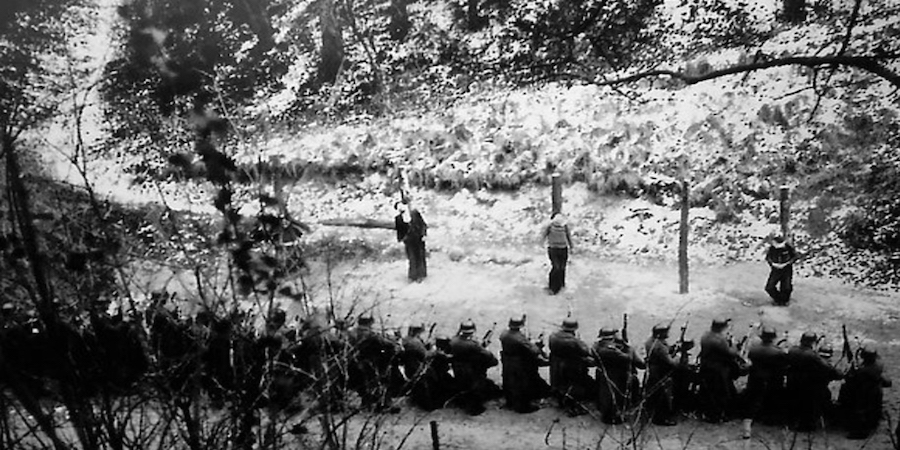
On this date in 1944, 22 members of the anti-Nazi French Resistance’s “immigrant movement” Francs-tireurs et partisans – main-d’œuvre immigrée (FTP-MOI) were executed by firing squad on the outskirts of Paris.

Comprised of foreign communists whose backgrounds amply motivated them to desperate resistance, FTP-MOI was a notably aggressive partisan unit; a few months before this date’s executions, it had stunningly assassinated SS Col. Julius Ritter on the streets of Paris. Risky tactics, including larger-scale operations like the one that claimed Ritter (these required more partisans to know each other) entailed greater risk of penetration, and the November 1943 arrest of the Armenian commander Missak Manouchian and his group devastated FTP-MOI. After the customary interlude of torture, these were subjected to a show trial with 23 condemned to execution.*

As a gaggle of foreign terrorists, heavily Semitic, this clique looked to the occupation like a marvelous tar with which to blacken the Resistance. To that end the Germans produced a scarlet poster denouncing the Resistance as an “Army of Crime,” its soldiery labeled with strange names and alien nationalities converging on the swarthy Manouchian.**

Soon known as l’Affiche Rouge, the poster instead apotheosized its subjects. In the postwar period it became an emblem of the best of the Resistance — its multinational unity, France as an idea powerful enough that men and women of distant birth would give their lives for her. (Not to mention the postwar French Communists’ claim on le parti des fusillés.)

To this day in France, the backfiring propaganda sheet is one of the best-recognized artifacts of the Resistance.

The executions were naturally conducted quietly; the Germans strictly forbade public access to or photography of Resistance heroes in their martyrdoms for obvious reasons.

That made it especially surprising when a few pictures of this execution surfaced recently, surreptitiously snapped from an overlooking vantage by German motorbike officer Clemens Rüter, who kept them hidden for decades. They are to date the only known World War II photos of French Resistance members being executed.

* The 23rd, and the only woman in the group, was Romanian Olga Bancic, also known by the nom de guerre Pierrette; she was not shot on this date but deported to Stuttgart and beheaded there on May 10, 1944. There was also a 24th, a man named Migatulski, who was initially part of the same trial; he was instead remanded to French custody. (See coverage in the collaborationist La Matin from Feb. 19, 1944 and Feb. 22, 1944.)

** We’ve noted before that a Polish Jew named Joseph Epstein who was part of the same cell (and a prime candidate for racist demagoguing) avoided a place on l’Affiche Rouge thanks to his preternatural talent for remaining mum under interrogation.

On this day..

1592: Thomas Pormort, prey of Richard Topcliffe

Thomas Pormort (or Pormant) was hanged on this date in 1592 on a gibbet erected adjacent to a Paul’s Churchyard haberdashery whose proprietor had once entrusted the condemned Catholic priest with his confession.

Pormort was a priest trained on the continent who returned to native soil about the beginning of 1591 to brave the Elizabethan persecution, but managed only a few months in the field before his arrest.

He had the misfortune to face the personal interrogation of the vindictive inquisitor Richard Topcliffe, notorious even in his own day for his gleeful sadism. Topcliffe seems not to have even feigned a politic distaste for the breaking of bones and and of men and made a point to attend the executions his offices effected, including Pormort’s.

Now, back in the day such grim ministers of state could be empowered to toy with their prey in their very own lairs. Even the sainted Thomas More had kept a personal torture chamber at his own home.

So it was with Topcliffe, who inflicted his hospitality on Pormort in the intimacy of his own place, where he apparently had the facilities necessary to put a prisoner to the rack. According to Portmort, the torturer had another intimacy besides during their pain-wracked discourse, taunting or boasting to his victim of carnal indulgences he enjoyed from the queen herself. Pormort would allege at the bar that

Topcliffe told [Pormort] that he was so familiar with her Majesty that he many times putteth [his hands] between her breasts and paps and in her neck.

That he hath not only seen her legs and knees [but feeleth them] with his hands above her knees.

That he hath felt her belly, and said unto her Majesty that she had the softest belly of any woman kind.

That she said unto him, ‘be not these the arms, legs and body of King Henry?’ To which he answered: ‘Yea.’

That she gave him for a favour a white linen hose wrought with white silk, etc.

That he is so familiar with her that, when he pleaseth to speak with her, he may take her away from any company; and that she is as pleasant with everyone that she doth love.

This Penthouse letter for the queen has no factual plausibility, and nobody thought so in 1592. Whether the priest’s report of its utterance is an actual glimpse into a seditious perversion of the torturer, or a desperate attempt by a doomed man to smear his persecutor, Topcliffe took the matter seriously enough that he made Pormort stand on the ladder under his noose in freezing cold for two hours on execution day while Topcliffe browbeat him to withdraw the allegation. (Pormort didn’t budge.)

On this day..

1329: The effigy of Pope John XXII, by Antipope Nicholas V

On this date in 1329, as Wikipedia puts it, Antipope Nicholas V “presided at a bizarre ceremony in the Duomo of Pisa, at which a straw puppet representing Pope John XXII and dressed in pontifical robes was formally condemned, degraded, and handed over to the secular arm (to be ‘executed’).”

Despite the show of force, Nicholas V was on his last legs at this moment as antipope.

He’d been elevated to the putative papacy by Holy Roman Emperor Louis IV. In this, Nicholas was a throwback to an old rivalry between popes and emperors compassing both authority within the church, and authority on the Italian peninsula, a conflict which had generated several German-backed antipopes in centuries previous. Though not the last antipope in history, Nicholas has the distinction of being the last imperial antipope.

Louis (or Ludwig) had a pique of long standing with Pope John XXII dating back to John’s unwelcome intervention in his, Louis’s, disputed accession as emperor: back in 1314, a divided imperial electorate had wrought a “double election” of the Wittelsbach Louis and the Habsburg Frederick the Fair, a circumstance that resulted in civil war within the empire.

While officially neutral in the fight, the pontiff exploited the opportunity to claw back ecclesiastical authority by asserting that the imperial throne was vacant and its edicts null until the papacy had blessed the claimant. Louis told John to pound sand.

Certain persons, blinded by avarice and ambition, and totally ignorant of the Scriptures, have distorted the meanings of certain passages by false and wicked interpretations, and on this basis have attacked the imperial authority and the rights of the emperors, electors, and other princes and subjects of the empire. For they wrongfully assert that the emperor derives his position and authority from the Pope, and that the emperor elect is not the real emperor until his election is confirmed and approved, and he is crowned by the pope … We now declare … that the emperor holds his authority and position from God alone … he has full power … without the approval, confirmation, authorisation or consent of the pope or any other person.

-Sachsenhausen Appellation, 1324 (as translated here)

John excommunicated Louis, and Louis, well, he did the same to John — seizing on the pope’s hostility towards the movements for clerical poverty as excuse to declare put a Spiritual Franciscan into St. Peter’s Throne on his own say-so as imperial armies smashed through Italy.* If a pope was going to crown Louis, it was going to be his pope.


Antipope Nicholas V crowns Louis IV in May 1328.

Peter of Corbara (Pietro Rainalducci) had barely two years to deny himself the emoluments of antioffice before Louis’s withdrawal required his own submission to the man he had executed in effigy. John XXII didn’t go nearly that hard on the former “Nicholas V”: merely absolved him after confession and kept him comfortably imprisoned at the papal palace in Avignon until the would-be usurper’s peaceful death in 1333.

* This conflict forms the backdrop for Umberto Eco’s The Name of the Rose, set in late 1327. The narrator-monk Adso refers in his epilogue to having heard of the antipope’s elevation soon after leaving the monastery where the bulk of the novel’s action occurs.

On this day..

1836: Felipe Santiago Salaverry, President of Peru

On this date in 1836,* the deposed President of Peru was shot with his comrades by the new Bolivian boss.

The youngest ever to head his country, Felipe Santiago Salaverry (English Wikipedia entry | the much more detailed Spanish) abandoned his studies in 1820 for the romance of soldiery.

He was all of 15.

By age 28, he was a brigadier general, fresh off crushing a bunch of rebels in the 1834 civil war.

He must have decided he could build a better mousetrap, because by 1835 Salaverry was rebelling himself. He chased off President Luis Orbegoso and was cock of the walk in Peru from the spring of 1835 until the first days of 1836.

By then, his exiled predecessor had made common cause with their Andean neighbor, Bolivian strongman Andres de Santa Cruz — who now proceeded to invade into southern Peru, where Orbegoso remained more popular than his usurper.

Salaverry answered with panache, pronouncing “Guerra a Muerte” and going on the offensive by crossing the border to raid Cobija where he pulled down the Bolivian flag and dragged it around. He was cocksure in victory after defeating his enemies at the Battle of Uchumayo (there’s a Salaverry Hill at the location, where a crumbling bust of our man stands trapezoidal sentinel).


The march “El ataque de Uchumayo” was originally dubbed “La Salaverrina”

But three days later, he was routed at Socabaya; his escapes cut off, Salaverry had to surrender his presidency and his person to the discretion of his foes. This outcome merged both states into the short-lived Peru-Bolivian Confederation under Santa Cruz, who now bore the Cromwellian title Supreme Protector. (Orbegoso was relegated to the tributary presidency of North Peru.)

But Salaverry was not around to see all that play out because Santa Cruz had he and eight chief officers condemned to death by a drumhead tribunal. Not a one of them had so many as 35 years; Salaverry was still just 29. They were shot together in Arequipa’s Plaza de Armas before a massive, and hostile, crowd: Arequipa was a stronghold for Orbegoso’s forces, and Salaverry in better times had openly relished the prospect of rewarding his own soldiers by putting it to the sack.

My dear Juana,

Within two hours I will be assassinated by Santa Cruz, and I address to you my final vows. I have loved you as you have loved me, and I carry into eternity the profound sorrow that I have made you so unhappy. I preferred my country’s good to my family’s, and I have been permitted neither. Educate my children, care for them; I put my trust in your wisdom and your talents. Do not lose heart that misfortune is the inseparable companion of mortals. Be as happy as you can, and never forget your dear husband.

-Salaverry’s last letter to his wife

* There are some cites out there for February 19. I have had a surprisingly difficult time finding a definitive date for so public and recent an event, but the more numerous and stronger sources — e.g., this very specific narration — prefer the 18th.

On this day..

2014: A.R. and N.J., a double hanging caught on video

The initials of the two men in the double hanging are all the identification I have found — but the spectacle of this February 15, 2014 public double hanging in Karaj amid fulsome praise for both God and the state security forces is a riveting horror.

Warning: Mature Content. Two men die in this video.

On this day..