1890: William Kemmler, only in America

On this date in 1890 the iconic symbol of the American death penalty made its grisly debut upon the person of William Kemmler at New York’s Auburn Prison.

The long New World tradition of hanging condemned prisoners came under fire as a barbarism in the late 19th century, leading reformers to look for killing procedures less likely to result in a horrendously protracted strangulation or a midair decapitation. As Empire State Governor David Hill put it,

The present mode of executing criminals by hanging has come down to us from the dark ages, and it may well be questioned whether the science of the present day cannot provide a means for taking the life of such as are condemned to die in a less barbarous manner.

On this stage, Executed Today presents a rogues’ gallery of homo Americanus, the salesmen and swindlers who would help the U.S.A. ride the lightning.

The Dentist

A true renaissance man, Buffalo dentist Dr. Alfred Southwick, applied his active mind to the need to better kill a fellow, and soon hit upon an inspiration — that is to say, a town drunk hit upon an electrical generator and died instantaneously, and the observant Southwick said “eureka!”

Without the subsequent industry of this neglected gentleman, who added to his repertoire scientifically-minded electrical butchery of animals alongside political gladhandings to bring a flutter to a busybody’s heart, the Chair’s entire oeuvre of machismo-sadism might have missed the country altogether. Just imagine living in a world where New York had pioneered its other leading reform alternative: lethal injection.

(This, incidentally, is why the chair is a chair, and not a bed or a stake or a St. Andrew’s Cross: because the guy who thought of it spent all day administering his own tender mercies to seated penitents.)

The Plutocrats

As Southwick nagged his senator and shocked stray cats into the great hereafter, the gears of commerce strove relentlessly ever-onward. The business of America was ever business, and never more so than the Gilded Age.

And the business of killing people was about to become the biggest business there was.

The age of electricity was buzzing into incandescence, and two rival standards were at currents amped over eventual dominance of this stupendous industry. Thomas Edison’s earlier Direct Current (DC) standard was being challenged by Nikolai Tesla’s Alternating Current (AC), backed by the financial muscle of George Westinghouse.

Cheaper and more efficient, AC tilted the playing field against Edison. Seeing his days numbered, the Wizard of Menlo Park fought back the way any dinosaur industry would: dirty.

AC, Edison said, was too dangerous for consumer use — a lurking killer. “Is this what your wife should be cooking with?” And he started taking up traveling road shows zapping large animals with AC to demonstrate the rival product’s deadliness. (This press coined the term “electrocution” from these spectacles.)

This clip of the electric demise of a circus elephant — don’t hit “play” if you’re not up for animal cruelty — is from some years later (Edison kept tilting at windmills and megafauna carcasses as his DC empire disappeared), but it’ll give a sense of the horrifying spectacle.

(Topsy, it should be noted, was being put down as a danger and not strictly for kicks.)

Elephants? Horses? Dogs?

How about a human?

With the New York legislature’s embrace of Southwick’s seated voltage people-eater, Edison turned his PR gears on the state, demanding they adopt his competitor’s “deadlier” current for the contraption. And they did, reflecting a widespread belief inculcated by Edison’s experiments — as this New York Times article on an Edison crony’s public livestock-killing show in the days leading up to the advent of the electrocution law indicates:

The experiments proved the alternating current to be the most deadly force known to science, and that less than half the pressure used in this city for electric lighting by this system is sufficient to cause instant death.

After Jan. 1 the alternating current will undoubtedly drive the hangmen out of business in this State.

Too bad for Edison that the business he was really trying to kill was made of sturdier stuff.

The Alcoholic Vegetable Merchant

As the 1880’s wane, we come at last to our subject — in several senses of the term — an illiterate nobody of German stock who chanced to kill his common-law wife with just the right timing to join in a new kind of experiment.

William Kemmler mounted a “cruel and unusual punishment” appeal against his sentence funded by Westinghouse himself: no dice. Perhaps appreciating the odd foothold on history he was about to attain, he showed little worry as he entered the execution room and sat himself — “undoubtedly the coolest man in the room,” a journalist present reported.

The End of the Beginning

That reporter’s description for the New York Herald graphically captures humanity’s first horrible encounter with this “humanitarian” machine, beginning with the prisoner’s parting remarks.*

Doubtless he knew that his words will go down in history and he had his lesson well learned. He addressed his audience [in] a commonplace way and without hesitation.

“Well, gentleman, I wish everyone good luck in this world, and I think I am going to a good place, and the papers have been sa[yi]ng a lot of stuff that isn’t so. That’s all I have to say.”

And so with a parting shot at what he was good enough to refer to not long ago as “those d—d reporters,” William Kemmler took his leave of earth. The quiet demeanor of the man as he entered had made a strong impression on those in the room. His self-possession after his oratorical effort simply amazed them. He got up out of his chair as though he were anxious to try the experiment, not as though he courted death, but as though he was thoroughly prepared for it. …

There was no delay. Kemmler constantly encouraged the workers at the straps with “Take your time; don’t be in a hurry; do it well; be sure everything is all right.” He did not speak with any nervous apprehension.

Warden Durston leaned over, drawing the buckle of the straps about the arm. “It won’t hurt you, Bill,” he said, “I’ll be with you all the time.”

A minute later Kemmler said, “There’s plenty of time.” He said it as calmly as the conductor of a streetcar might have encouraged a passenger not to hurry.

Kemmler was pinioned so close that he could hardly have moved a muscle except those of his mouth.

The Warden took a last look at the straps. “This is all right,” he said.

“All right,” said Dr. Spitzka, and then bent over and said, “God bless you, Kemmler.”

“Thank you,” said the little man, quietly.

“Ready?” Said the Warden.

“Ready,” answered the doctors.

“Goodbye,” said the Warden to Kemmler. There was no response.

GAVE THE SIGNAL.

The Warden stepped to the door leading into the next room. It was then forty-three and one-half minutes past six o’clock by the prison clock. “Everything is ready,” said the Warden to some one hidden from view in the next room.

The answer came like a flash in the sudden convulsion that went over the frame of the chair. If it seemed rigid before under the influence of the straps, [it] was doubly so now has it strained against them.

The seconds ticked off. Dr. McDonald, who was holding the stopwatch, said “Stop.”

Two voices near him echoed, “Stop.”

The Warden stepped to the door of the next room and repeated the word “Stop.”

As the syllable [passed] his lips the forehead of the man in the chair [grew] dark [in] color, while his nose, or so much of it as was exposed, appeared a dark red.

There was very little apparent relaxation of the body, however. [A] fly lighted on the nose and walked about unconcernedly. The witnesses drew nearer to the chair.

“He’s dead,” said Spitzka, authoritatively.

“Oh, yes, he’s dead,” said McDonald.

“You’ll notice,” said Spitzka, “the post-mortem appearance of the nose immediately. There is that remarkable change that cannot be mistaken for anything else, that remarkable appearance of the nose.”

The other doctors nodded [assent]. They looked at the body critically for a minute and then Spitzka said, [“]oh, undo that now. The body can be taken to the hospital.”

“Well, I can’t let you gentlemen out of here until I have your certificates,” said the Warden.

FOUND SIGNS OF LIFE.

It was while this businesslike conversation was going on that Dr. Balch made a discovery.

“McDonald,” he cried, “McDonald, look at that rupture,” he pointed at the abrasion of the skin on Kemmler’s right thumb. In the contraction of the muscles the figurehead[?] scraped against it and removed the skin, and from that little [wound] blood was flowing-[an] almost certain indication of life.

A low cry of horror went through the assemblage.

“[Turn] on the current,” excitedly cried Dr. Spitzka. “This man is not dead.”

The crowd fell back from the chair, as though they were in danger. The Warden sprang into the closed door and pounded on it with his hand.

“Start the current!” he cried. As he spoke of fluid began to drop from Kemmler’s mouth and to run down his beard; a groaning sound came from his lips, repeated and growing louder each time.

It seemed [an] age before the card was again turned on. In fact it was just seventy-three seconds from the end of the first contact when the first sound was heard to issue from Kemmler’s lips, and it was not more than a half [minute] before the card was again turned on.

RECOVERING CONSCIOUSNESS.

But every second to that time the horrible sound from those groaning lips was becoming more distinct, [a straining] of the chest against the leather harness stronger and more evident.

The man was coming to life. The spectators grew faint and sick. [Men] who had stood over dead and dying [men] and had cut [men] to pieces without an emotion [grew] pale and turned their heads away.

One witness was forced to lie down while one of the doctors fanned him.

But [the end] came at last. There was another convulsion of the body, and … it became rigid with the rigidity of iron.

“That man wasn’t dead,” cried Spitzka excitedly. As he spoke the body twitched again. The electrician had given the current gain new alternation and now 2,000 volts [were] playing in short, successive shocks down Kemmler spine. The sound ceased with the first convulsion, but the fluid continued to trip from the mouth and down the beard, making the body a sickening spectacle.

“Keep it on now until he’s killed,” said one of the doctors. …

“Keep it on! Keep it on!” Cried Warden Durston through the door.

Silence reigned for a moment. A bell without began to [toll] solemnly. …

BURNED BY THE CURRENT.

Then from the chair came a sizzling sound, as of [meat] cooking on hand. Following it immediately a billow of smoke came from the body and filled the air of the room with the odor of burning hair.

There was a cry from all the members of the little group, and Warden Durston cried through the door leading to the next room to [turn] the current off.

(Also of interest: the New York Times‘ (non-eyewitness) report on the affair.)

More shocking — so to speak — papers ran the next day’s headline “Kemmler Westinghoused,” the verb “to Westinghouse” being another shameless Edisonian bid to stamp his marketing project onto the Queen’s English. This fine, rounded, archaic neologism the right sports anchor could resuscitate as a fresh synonym for thrashing, horsewhipping, poleaxing, or else (in greater justice) for moderation and decency as the only principal in the sordid affair that rejected death-dealing by electricity.

(Officially, Edison also opposed the death penalty. Like Dr. Guillotin, he was doing his part for humanity in the meantime … just with a little skin in the game. Did we mention the business of America is business?)

Westinghouse, for his own part, thought the Kemmler debacle would nip the electric chair in the bud, and he was scarcely the only one.

Official reviews for the “art of killing by electricity” were, ahem, mixed.

“They could have done better with an axe.”**
-George Westinghouse

“Strong men fainted and fell like logs on the floor.”
-New York Herald

“Revolting … a disgrace to civilization.”
-New York Times

“We live in a higher civilization from this day on.”
-Alfred Southwick

Books (remarkably numerous!) about the creation of the electric chair

It should, in fairness, be noted that the U.S. was not the only country (pdf) to mull an electrocution chair in the 19th century … but it was (and for a long time remained) the only one to actually use one.

* The Herald excerpt, along with several other articles from the same paper about the Kemmler execution, is here, but the text has obviously been generated from a scan with uneven results. As I do not have access to the originals, [bracketed] remarks in the excerpt indicate this author’s own interpretations or interpolations of seemingly mistaken transcriptions.

** Some sources make it “would have done better with an axe.”

On this day..

1918: Tsar Nicholas II and his family

In the small hours after midnight on the night of July 16-17 90 years ago, the former Tsar Nicholas II, his wife, children, and four family retainers, were shot in a Yekaterinburg basement by their Bolshevik jailers.

Doting family man, vacillating dictator, as weak and rich as Croesus … the doomed Emperor and Autocrat of All the Russias was a man small of stature. His reign emerged under a bad star when 1,300 Muscovites were trampled to death in the crush for his coronation largesse; 18 years later, Nicholas‘s support for Serbia against Austria-Hungary was instrumental in pitching Europe into World War I, a blunder for which he reaped a whirlwind long in the making.

When an anti-Bolshevik force approached Yekaterinburg (or Ekaterinburg), where the deposed royals had been stashed in a commandeered private residence,* Yakov Sverdlov (for whom the city was subsequently renamed) ordered the prisoners shot — not only the tsar, but his beloved wife, their hemophiliac heir, and those four daughters who had to be bayoneted because the state jewels secreted in their corsets shielded them from the gunfire.

The executioners (here’s the account of their leader; here’s another guard’s version) did their best to destroy and conceal the remains, helping fuel subsequent rumors that one of the children had survived and escaped.

Those rumors are only now, with post-Soviet investigation and DNA forensics, being debunked, and not yet to the satisfaction of all comers. This very week, Moscow affirmed (though the Orthodox church has not accepted) that the last of Nicholas’s family had been accounted for:

Modern nostalgia for this unimpressive sovereign is making a minor comeback, with Nicholas absurdly contending in a current poll for the title of “greatest Russian” … supported not only by the miseries of the state that succeeded his, but by the family’s decent and accessible private life.

Even a monarchist — especially a monarchist! — shouldn’t reason that the greatest monarch is the one who drove the bus over the cliff. But much is forgiven a martyr. Indeed, like Charles I of England, the last Romanov monarch has been posthumously saddled with divine sanction; he and all the family are certified “passion bearers”. (Update: And possible future relics!)

A handful of the many books about the Romanovs and their fall

* The Ipatiev House where the tsar was held (and shot) no longer stands. On its spot is a church consecrated five years ago yesterday to the Romanov canonization.

Update: The Romanovs were officially rehabilitated by the Russian Supreme Court on October 1, 2008.

On this day..

1685: James Scott, Duke of Monmouth

On this date in 1685, the haughty Duke of Monmouth mounted the scaffold at London’s Tower Hill to suffer beheading for treason, and tipped the headsman with the words, “Here are six guineas for you and do not hack me as you did my Lord Russell. I have heard you struck him four or five times; If you strike me twice, I cannot promise you not to stir.”*

Upon this tart public reminder of his recent and infamous failure of craft, the eponymous executioner Jack Ketch quite came apart.

Monmouth, certainly, would have appreciated the advance that would bring the guillotine. Beheading by a free-swinging axe was a ghoulishly inexact procedure: bad aim, insufficient force, an untimely flinch, or the tough neck muscles of a grizzled campaigner regularly complicated the process, often to the fury of spectators. Jack Ketch is sometimes reported a sadist, and sometimes a professional hangman so rarely summoned to give a nobleman the chop that he simply lacked proficiency. Either way, he’d been on the job for a generation by this time: his reputation for infelicity with the blade preceded him.

Historical fiction from the perspective of the Duke of Monmouth.

Monmouth, an illegitimate son of King Charles II, had cause to dread Ketch’s offices for the rebellious culmination of a long power struggle with his uncle, the future King James II.

The personal contest between these men for the throne of England was the echo of the decades-old struggles straining the English polity — the Reformation and the reach of royal authority.

As it became known that the king’s brother James had gone from Catholic sympathizer to Catholic convert, Protestants began maneuvering to keep him from inheriting the crown. For three years, Parliament pushed the Exclusion Bill, which would have excluded James from succession.**

Favor among the bill’s supporters settled on the Protestant playboy Monmouth — politically convenient rumors that he was actually a legitimate child began circulating. “Weak, bad, and beautiful,” this unfriendly-to-Monmouth free book has him; whatever he was, his allies in the House of Commons were handily outmaneuvered. The Exclusion measures failed, and in 1685, James II began his reign as England’s last Roman Catholic monarch.

Monmouth’s hopes had been raised, however, and he proceeded to invade England at Dorset with a somewhat ragtag army that was routed by the Protestant royal troops who remained loyal to James at the Battle of Sedgemoor — not quite the last battle fought on English soil, but the last consequential one (the last fought with pitchforks makes a livelier distinction). Monmouth was caught trying to get away in a shepherd’s disguise. Other fugitives of his cause were hunted mercilessly.

The defeated duke was reputedly not above begging the sovereign for his life; obviously, that didn’t work out. But his cause was a popular one, nearing reverence among some commoners. Jack Ketch may have had a case of the butterflies even before the duke undressed him … and as it turns out, Ketch almost left the scaffold worse than his victim.

Here is the scene in Macaulay’s words:

The hangman addressed himself to his office. But he had been disconcerted by what the Duke had said. The first blow inflicted only a slight wound. The Duke struggled, rose from the block, and looked reproachfully at the executioner. The head sank down once more. The stroke was repeated again and again; but still the neck was not severed, and the body continued to move. Yells of rage and horror rose from the crowd. Ketch flung down the axe with a curse. ‘I cannot do it,’ he said; ‘my heart fails me.’ ‘Take up the axe, man,’ cried the sheriff. ‘Fling him over the rails,’ roared the mob. At length the axe was taken up. Two more blows extinguished the last remains of life; but a knife was used to separate the head from the shoulders. The crowd was wrought up to such an ecstasy of rage that the executioner was in danger of being torn in pieces, and was conveyed away under a strong guard.

In the meantime many handkerchiefs were dipped in the Duke’s blood; for, by a large part of the multitude he was regarded as a martyr who had died for the Protestant religion.

Just the sort of soil for posthumous tall tales — that his execution was bogus and he was in hiding to return again, or had been packed off to France to become the Man in the Iron Mask. One possibly better-founded legend is that his head was set back upon its stump to sit him for what must have been a pungent portrait.

Protestant opponents of James were much thicker on the ground than the Duke’s own person, of course. They soon succeeded where Monmouth had failed.

* Slightly different versions of this address from the Duke to the executioner are recorded. Macaulay omits the “if you strike me twice” clause but adds “My servant will give you some more gold if you do the work well”; a more polite (barely) construction suggests “Do not serve me as you did my Lord Russell.”

** The factions in this dispute — the “Petitioners” (supporting the bill) and the “Abhorrers” (supporting the king) — evolved into the Whig and Tory political parties.

Part of the Themed Set: Embarrassed Executioners.

On this day..

1989: Horace Franklin Dunkins, Jr., “just hope that he was not conscious”

Minutes after midnight this date in 1989, Alabama’s executioners electrocuted a developmentally disabled murderer. Nine minutes later, after rewiring the chair, they finally managed to kill him.

Alabama’s fifth execution of the “modern” era initially made the headlines as the nation’s first execution of a mentally impaired prisoner after the Supreme Court’s controversial Penry v. Lynaugh decision (since overturned) green-lighted the death penalty for developmentally disabled defendants.

Horace Franklin Dunkins, Jr. and an accomplice had raped a mother of four, tied her to a tree, and stabbed her to death, an unquestionably horrific crime. A black man with a white victim deep in Dixie … well, his IQ in the high sixties wasn’t going to help him do anything but waive his right to remain silent. The jury at his trial didn’t hear about his borderline mental retardation — Penry would require that juries get that information in the future — and at least one juror later said that little tidbit would have made the difference in Dunkins’s case.

At any rate, the buzz in this morning’s papers wasn’t about the circumstances of Dunkins’s entry into the criminal justice system, but his clumsy exit from it into the great hereafter.

According to the account of a Dr. John Vanlandingham:*

I saw Dunkins in the electric chair and I heard the generator start…. After a short period of time the other doctor … and I were called into the execution chamber. I could see that Dunkins was breathing…. I checked his peripheral pulse, in his wrist, and it was normal. I listened to his heart and his heartbeat was strong with little irregularity…. I told an official that Dunkins was not dead. Dr. – and I returned to the witness room…. I again heard the generator begin.

“I believe we’ve got the jacks on wrong,” the prison guard captain called out. It was flatly not enough current to kill, although it apparently did the killer the favor of knocking him out.

From 12:08 to 12:17, Dunkins sat motionless and seemingly unconscious while the execution team went all MacGyver on Yellow Mama. Once they’d fit Tab A into Slot B into Lethal Electrode C, they were finally able to try again. The doctors pronounced death 19 minutes after the switch had first been thrown.

”I regret very very much what happened,” the Alabama Prison Commissioner, Morris Thigpen, said at a news conference after the execution. ”It was human error. I just hope that he was not conscious and did not suffer.” (The New York Times)

* Dr. Vanlandingham was participating in the execution despite an injunction by the American Medical Association, which considers it a violation of the Hippocratic Oath. Physicians’ involvement (or not) in executions is a thorny ethical issue of its own; Vanlandingham, however, is not the only doctor to break the taboo.

Part of the Themed Set: Embarrassed Executioners.

On this day..

1882: Thomas Egan: 3 tries, 2 ropes, 1 innocent man

On this date in 1882, Thomas Egan was hanged in Sioux Falls in the Dakota Territories (present-day South Dakota) for strangling his wife, Mary.

It took three tries to get the hanging right … and it still turned out they got it wrong: years later, Egan’s stepdaughter copped to the crime on her deathbed.

Egan was the first man hanged (.doc) by state officers in the Dakota Territory; earlier, Jack McCall had been executed there by the feds.

Let’s start with the twice-botched hanging, whose can’t-look-away horror can hardly be improved from its original coverage by The Chicago Tribune (picked up elsewhere as well — such as The Alexandria Post of Douglas County, Minnesota):

A HORRIBLE AFFAIR.

The Execution of Thomas Egan, the Wife Murderer, at Sioux Falls, Dak — The Drop Fails Three Times Before the Culprit is Deprived of Life, Owing to Rotten Ropes.

On Thursday, July 13, occurred at Sioux Falls the first judicial hanging ever done in the territory of Dakota. Nearly two years ago Thomas Egan, who suffered the death penalty, most foully and cruelly murdered his wife, with whom he had lived for nearly a quarter of a century. From evidence produced at the trial it would appear that they had frequent quarrels which at length culminated on this fatal morning in her death. He deliberately sent the children away, and while she was washing dishes at the table came behind her, and after throwing a rope around her neck and strangling her, pounded the life out of her with a club. The body was then thrown through a trap door into the cellar, where it was found three days after, horribly mutilated. The skull was fractured and the head was covered with frightful gashes made by the club. It appeared also as if she were not dead when thrown down, as she was discovered partly reclining against the call [sic] of the cellar, which added to the horribleness of the crime. Eagen [sic] was arrested and tried, and although there was every effort made by his attorneys to save him; he was convicted and sentenced to be hanged at Sioux Falls by Judge Kidder of the Fourth judicial district of the territory.

On Thursday, 13th, after eating a hearty breakfast, hearing the sentence read, and some religious exercises by a Catholic priest, Eagan [sic] was taken to the gallows. All eyes were intently fixed on the prisoner. His face was somewhat pale, but his lips were firm and he seemed to exhibit no sign of fear. He was a straight, heavy-set man, weighing 180 lbs., with a retreating forehead, heavy projecting eyebrows and an ugly looking eye. His general appearance was far from prepossessing. He was dressed in a plain black suit, with clean white shirt, collar and tie, and low shoes. He walked straight up to the platform to the scaffold, taking his place on the fatal trap, turned around and faced the crowd below. The sheriff now asked him if he had any thing to day [sic], but his lips still were kept sealed to his secret, and he shook his head and answered in a low voice, “No.” His legs were now tied, he himself assisting the officer by placing his feet close together. The black cap was put on his head, but not a limb quivered. The noose was adjusted and the fatal moment had come. While the priests were chanting their solemn service, and while the attending officers and crowd were holding their breath in silence, the sheriff touched the trigger which alone kept Thomas Egan from his death. There was a crash as the door flew back against the boards and body, deprived of its footing, shot through the door, and now, horror or horrors!

The rope snaps like a piece of thread, the body drops to the earth with a dull thud, partly on its back, and rebounding rolls over on its face. The crowd are paralyzed with astonishment and fear. An unearthly gurgling sound now breaks forth from the prisoner. His neck is not broken, but the cord is wound tightly about it and he is strangling. A half a dozen men now rush forward, one seizes him by the arm, another by the leg, another by the waist, another by the head. It is seventy-five feet from the ground, where he has fallen, back to the jail-door, and around to the platform of the scaffold he is hurriedly conveyed through the crowd, the broken rope in the meanwhile dangling from his neck, while his horrible groaning strikes terror to the bystanders. Once more on the scaffold, another rope is adjusted and the sickening details once more gone through with, the trap falls again and the half dead man drops once more; but worse. The rope was not fully adjusted before the excited sheriff again touched the trigger and down the body goes a second time but not with sufficient force to accomplish the desired result.

His neck is still unbroken, and the slow process of suffocation is all this time going on. The attendants seize him by the arms and again pull him on the scaffold while the death struggle continues. The first rope is flopping from his neck and he still has life enough, so one says who was on the scaffold, to brace his feet for the third and last fall. If at this juncture some one had mercifully stepped up and put a bullet through his head, it would have been an act which would have certainly been appreciated by the crowd. The rope is finally fixed, the door drops once again, the man shoots down, and there is a snap which is heard all around the yard and outside. There is a shrugging of the shoulders, a twitching of the legs a convulsive shudder and all is still. The body swings slowly around. There is no motion of leg or arm or muscle, and in eight and one half minutes the doctors pronounced him dead, and shortly after the body was taken down. Yes, he is dead at last, and the sightseers heave a genuine sigh of relief. The corpse is now cut down and the pinioned arms and legs released. The dirt was brushed from the clothing and body laid in a coffin, where it was afterwards viewed by the crowd, both outside and inside the jail. The effects of the strangulation were fearfully evidence about the neck. The first cord had embedded itself, but the action of the heart had forced the blood under it and the flesh was swollen, purpled and discolored. There was a sightless stare to the eyes and blood was flowing out of the corners of his mouth. After all those desiring had seen the corpse it was boxed up, and early in the afternoon it was taken to the Catholic burying-ground where it was buried, and with it the club and cord with which he killed his wife.

Nobody in a position to help Egan knew he hadn’t “most foully and cruelly murdered his wife” or that “the horribleness of the crime” stained some other’s soul, of course … but one wonders how the writer thinks he did know it. The obscure considerations of jurymen might well be the most virtuous structural safeguard of the Republic, but as a dependable compass of fact, one might as well scry the entrails of a sacred ox.

It has always seemed misfortunate to the Headsman that journalists prone to the most tedious wheedling over the use of the qualifier “allegedly” to uphold the principle of innocent before proven guilty consider the epistemological certitude of a juridical conviction sufficient to abandon full stop the (admittedly inelegant) qualifier and speak of Revealed Truth. The New York Times would hardly think to make apology for flatly calling Egan — who did keep his peace about the verdict — “the wife murderer”:


… any more than the San Antonio Express-News would regret the assertive headline “Father who killed 3 is executed” mounted atop an article reporting the executed man’s continued insistence upon his innocence. Any good scribe frets more readily about column-inches and legal ass-covering than bickering and arguing over who killed who. But shame if not stylistics merits less awe before the particular sausage-making of the judiciary when such modern cases too turn out to have been cock-ups from start to finish.

In 1993, South Dakota Governor Walter Miller apologized (.pdf) for Egan’s execution. A descendant of Egan’s has written a book about the case, Drop Him Till He Dies: The Twisted Tragedy of Immigrant Homesteader Thomas Egan.

Part of the Themed Set: Embarrassed Executioners.

On this day..

1850: The Bab, Prophet of Baha’i

On this date in 1850, a Persian merchant who claimed to be the Islamic messiah was shot in Tabriz for apostasy.

The Bab — the handle means “Gate”; he was born Siyyid `Alí Muhammad — started preaching as a young man in 1844 and attracted a following unwelcome to the orthodox Shi’a clergy and the powers that were.

The Bab would claim to be “that person you have been awaiting for one thousand years”: the Mahdi. And in a John the Baptist-like pose, he would also pledge to be preparing the way for another, “He whom God shall make manifest,” to follow his footsteps.

Authorities cracked down on this subversive faith and its heretical claim to have a divine messenger, hailing the Bab before a clerical tribunal that found him a blasphemer and an apostate. After dawdling a couple of years, the government finally ordered him shot … to which punishment a young disciplie submitted himself voluntarily as well.

Reputedly, the public execution by firing squad was quite a fiasco for the government, and/or a miracle for the Bab. It is said that the entire sizable regiment deployed to volley at the Bab and his devotee managed to miss everything, but to shoot through the rope that was holding the prophet suspended a few meters above the ground. In the Baha’i version, he miraculously disappears from the first execution attempt and is found later calmly conversing with a secretary in his prison cell, at which point he’s (successfully) executed a second time.

A less pious version of the story commencing from the same starting point of unmarksmanlike executioners has the Bab shot out of his rope and availing the smoke of the discharge to scramble out of the courtyard, only to be detained before he could make good an escape.

Inevitable disputes about the succession to this charismatic figure ensued his death, and several claimed to be the Bab’s Promised One. The main current of the tradition evolved into the Baha’i faith, accepting the claim of Baha’u’llah to this position. (A tiny remnant of Babism still persists who dispute Baha’u’llah’s legitimacy and still await the Promised One.)

July 9 is a major holiday for Baha’i, for whom the Bab is a revered figure.

On this day..

1999: Allen Lee “Tiny” Davis, the end of the road for Old Sparky

On this date in 1999, America’s obesity epidemic met Florida’s death penalty politics in the ugly electrocution of Allen Lee “Tiny” Davis.

The reader will discern that Tiny earned his nickname ironically. Reportedly 159 kg (350 pounds) at his death, he’d put his ample heft to work bludgeoning a pregnant mother of two beyond recognition with a revolver handle back in 1982 … and then shooting to death the now-motherless two.

As his appeals meandered through the courts, Davis got fatter — and got high blood pressure, arthritis, hypertension and a wheelchair. Meanwhile, the death penalty was meandering its own way across the weird political chessboard of the Sunshine State.

For the American death penalty nowadays, it’s Texas and then everyone else … but time was that Florida was the capital of capital punishment.

It conducted the first “modern” involuntary execution in 1979. It had carried out three executions before anyone else had more than one. And when the the drip-drip-drip pace of one or two execution nationwide per year in the early 1980’s finally burst into a torrent, Florida led the way with eight of the 21 executions in 1984.

Not until late in 1986 did Texas overtake Florida in the body count sweepstakes.

All that time, Florida was happily using its vintage electric chair, Old Sparky (one of several electric chairs with that moniker), built in 1923 of 100% oak wood and prison labor. And the more the chair’s quasi-medieval ickiness drove other states to lethal injection, the more Floridians cherished electrocution.

Law-and-order Tampa mayor Bob Martinez won the governorship in 1986 on the promise that “Florida’s electric bill will go up.” There was a high-profile botch in 1990, and another in 1997 — flames shooting from the inmates’ heads. What was the state’s Attorney General going to do about it? “People who wish to commit murder, they’d better not do it in the state of Florida because we may have a problem with the electric chair.” Under pressure to move to lethal injection — the chair’s unsightly malfunctions were spawning legal and public relations nightmares that were gumming up the gears — the legislature voted nearly unanimously to keep Old Sparky.

And then along came a giant.

After three-quarters of a century and 266 jobs, Old Sparky was “falling apart” … and that was going to be a problem for a man of Davis’ carriage.

The killer’s lawyers argued that Davis was so fat he couldn’t conduct electricity efficiently and would be slowly cooked to death. According to Slate, Florida authorities were nervous that he’d break the chair during his electrocution and send a disconnected live cable scything into someone else in the room.

It was time for the unthinkable: Florida retired Old Sparky and built a new chair … and supersized it. (Image, from the Florida Department of Corrections)

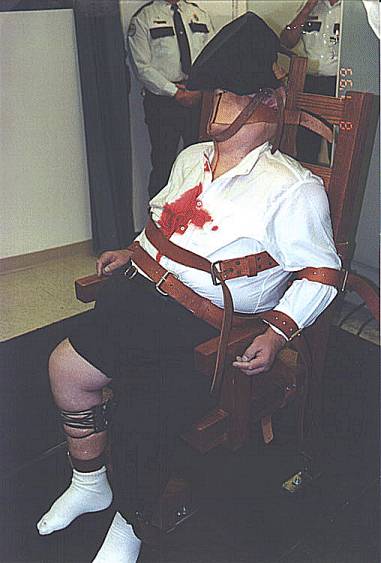
And it worked, in that it killed Tiny. But what a mess — especially when an ensuing Florida Supreme Court opinion once again upheld the constitutionality of electrocution, and a dissenting judge attached the photos on this page to his opinions. Naturally, they became a grisly Internet sensation.

Old Sparky’s custom-built successor would only manage this single execution before Florida finally got on the lethal injection bandgurney.

Or at least, it’s only managed one so far. Old electric chairs don’t die, they just fade away … and in Florida, Tiny Davis’s chair remains available for condemned prisoners who choose it. Since this date in 1999, none have.

On this day..

1953: Julius and Ethel Rosenberg, “the first victims of American fascism”

On this date in 1953, Julius and Ethel Rosenberg were put to death in Sing Sing’s electric chair as Soviet spies.

Divisive since it was handed down — or more precisely, since a famous article in London’s Guardian challenged the verdict and helped elevate it into a latter-day Dreyfus case — the Rosenbergs‘ sentence has inspired so much acrimony over several generations that merely to observe the date is to invite a debate capable of eminently more heat than light.

Where to begin with a case so towering in the recent cultural milieu?

A textbook might say that Julius and Ethel were convicted of passing atomic secrets to the Russians, that they maintained their innocence and their defenders carried that flame years after their deaths, and that intelligence files opened after the Cold War — notably the Venona project — apparently confirmed that Julius was a spy after all, though Ethel seems to have been little more than an approving bystander and Julius, come to think of it, never had anything so worthwhile as atomic secrets to share with Moscow. This information (which does have its own skeptics, albeit a small minority) undermines the maximal “absolute innocence” position that this day’s victims always asserted, but it’s a curious leap to take it as vindicating the legal outcome.

“My husband and I must be vindicated by history; we are the first victims of American fascism.”

Half a century on, juridical guilt or innocence seems distinctly secondary in the lasting importance of the Rosenberg trial, the two-year battle to save them, and their potent symbolic afterlives.

The Rosenbergs are the only stateside judicial executions for espionage since the Civil War.* That is a remarkable distinction, after all; so, how comes it that it is held by — to state the case against them in its strongest imaginable terms — two enthusiastic but bush-league players, and not by the likes of Aldrich Ames? How was it that a judge with a largely center-liberal career on the bench would read them a sentence of death hysterically accusing these Lower East Siders of causing the Korean War?

[Y]our conduct in putting into the hands of the Russians the A-bomb years before our best scientists predicted Russia would perfect the bomb has already caused, in my opinion, the Communist aggression in Korea, with the resultant casualties exceeding 50,000 and who knows but that millions more of innocent people may pay the price of your treason.

I feel that I must pass such sentence upon the principals in this diabolical conspiracy to destroy a God-fearing nation, which will demonstrate with finality that this nation’s security must remain inviolate; that traffic in military secrets, whether promoted by slavish devotion to a foreign ideology or by a desire for monetary gains must cease.

It is here in the age of McCarthyism, in the shadow of the USSR’s balance-altering A-bomb test in 1949, that the Rosenbergs stand in sharpest relief — not because of “guilt” or “innocence”, but as the ne plus ultra of that era’s range of social discipline.

A few years before, the United States and the Soviet Union had made common cause against Hitler in World War II, the United States pumping war materiel to Russians bearing the brunt of the fighting.

No longer operative.

The Communist Party USA enjoyed membership rolls pushing six figures; other socialist parties and movements had found niches in American life in the interwar years.

As the Great War gave way to the Cold War, the great powers remained nominal allies (that’s the reason the Rosenbergs weren’t tried for treason), but shifted rapidly into conflict. The American polity organized to expel the red menace by rendering it foreign and criminal — ideological rigging for the forty years’ imperial contest ahead. Loyalty oaths, blacklists, the House Un-American Activities Committee … in the whole of the self-conscious construction of communism as “contagion”, the power and willingness of the state to kill Julius and Ethel Rosenberg formed the tip of the spear, and an ugly contrast to that same state’s solicitous handling of Nazi scientists then developing the vehicles to deliver atomic technology to Moscow in mushroom cloud form.

Though different in many particulars, the thrust will be familiar to any sentient denizen of post-9/11 America: the extreme penalty enforces a wall between the suspect and abject (but tolerated) loyal liberal and the enemy left. Depend upon Ann Coulter for the most brutal articulation:

We need to execute people like John Walker [the American-born soldier captured fighting for the Taliban in 2001] in order to physically intimidate liberals, by making them realize that they can be killed, too. Otherwise, they will turn out to be outright traitors.

Like most symbols, the Rosenbergs came by their exaltation by accident; at the strictly personal level, their deaths are nearly operatic performances of human stubbornness and bureaucratic inertia. Investigators rolling up a spy ring** were looking for confessions and names to keep the indictments coming.

Julius refused to provide either, so his wife was arrested for leverage against him on the reasoning that he would confess to protect her. The gambit failed: both prisoner and hostage remained obstinate. The government’s bluff had been called, and it ruthlessly executed its threat.

Had the two really been responsible for starting a war, execution would hardly begin to cover the bill — yet to the very foot of the chair, the condemned, and Julius especially for the sake of his wife, were pressed with offers of mercy for confessing and “naming names”.

Abjure or expire: show trial logic.

[audio:Julius_and_Ethel_Rosenberg.mp3]

An Execution in the Family

Given names to name, the personal mystery of their silence — the ultimate heroism or folly or tragedy or transcendence — only deepens the resonance of their fate both for contemporaries and posterity, the poignance of their orphaned children’s subsequent path, the contrast with Ethel’s brother David Greenglass who has since admitted to perjuring testimony against Ethel in order to shield his own wife. (Greenglass says the Rosenbergs died from the “stupidity” of not copping a deal of their own.)

Even before Julius and Ethel went to the chair this date,† they had become the emblem of a paranoid age. In the days following, Sartre savaged the United States for trying “to stop scientific progress by a human sacrifice”:

Your country is sick with fear. You’re afraid of everything: the Russians, the Chinese, the Europeans. You’re afraid of each other. You’re afraid of the shadow of your own bomb.

Decades later, the shadows haven’t faded altogether. In playwright Tony Kushner’s imagination, the spirit of Ethel stalks her real-life prosecutor, closeted McCarthy henchman Roy Cohn, as he succumbs to AIDS in the 1980’s.‡

Rosenberg resources — and vitriol — are in plentiful supply online and off. A good starting point on the case is this page at the University of Missouri – Kansas City. Be sure to check the tale of a last-ditch legal maneuver that almost succeeded.

* There is one partial exception in the unusual case of six German saboteurs electrocuted in Washington, D.C., during World War II on a charge sheet that included espionage. The hearing was held by a military commission and only one of the six was an American citizen, so it was far from the regular judicial process — if one can call it that — the Rosenbergs faced.

** Originating in the investigation of Klaus Fuchs, the man who actually did what Julius and Ethel Rosenberg were accused of doing — passing atomic secrets to Moscow — although with debatable ultimate effect for the Soviets’ research. Fuchs served nine-plus years in a British prison and was released to East Germany; more than a few were galled at the difference between his sentence and the Rosenbergs’.

Stateside, George Koval was another spy far more valuable to Moscow in the nuclear race than were the Rosenbergs. Koval got away clean and died in Moscow in 2006.

† Julius first, then Ethel. Her execution was botched; repeated shocks were required to kill her.

‡ Cohn’s posthumous autobiography did acknowledge illegally rigging the Rosenberg trial, as his Kushner character does.

On this day..

1569: Dirk Willems, for loving his enemy

On this date in 1569, Dirk Willems paid the penalty for a famous act of charity.

Willems was condemned by the still-ascendant Catholic church as an Anabaptist, but escaped prison.

Fleeing a pursuer across a frozen pond, Willems had an opportunity to make good his escape when his persecutor crashed through the ice. But he turned back to save the drowning man:

One good turn did not deserve another: the man arrested Willems, and the compassionate Protestant found himself burned to death* this day at Asperen.

Hundreds of Anabaptists suffered similar fates, many of them registered in the Martyrs Mirror (available online here). But Dirk Willems’ story has always been one of the most affecting and popular with the Mennonite communities who trace their lineage to the Anabaptists:

[W]hen he fled he was hotly pursued by a thief-catcher, and as there had been some frost, said Dirk Willems ran before over the ice, getting across with considerable peril. The thief-catcher following him broke through, when Dirk Willems, perceiving that the former was in danger of his life, quickly returned and aided him in getting out, and thus saved his life. The thiefcatcher wanted to let him go, but the burgomaster, very sternly called to him to consider his oath, and thus he was again seized by the thief-catcher, and, at said place, after severe imprisonment and great trials proceeding from the deceitful papists, put to death at a lingering fire by these bloodthirsty, ravening wolves, enduring it with great steadfastness, and confirming the genuine faith of the truth with his death and blood, as an instructive example to all pious Christians of this time, and to the everlasting disgrace of the tyrannous papists.

(Bygones, tyrannous papists: last year, a Mennonite delegation to the Vatican gave Pope Benedict XVI a framed picture of Willems saving his romish persecutor.)

Few are the faiths that lack a martyrology, but notwithstanding the incendiary language of our 17th-century source, the place of martyrs (“Dirk Willems warns Mennonites not to expect to be rewarded for good works — a sharp contradiction to the American gospel of success”) and the right way to commemorate them without stoking confessional hostility occupy unusually nuanced places in Mennonite thought.

* The burning came off badly, the Martyrs Mirror records:

[A] strong east wind blowing that day, the kindled fire was much driven away from the upper part of his body, as he stood at the stake; in consequence of which this good man suffered a lingering death, insomuch that in the town of Leerdam, towards which the wind was blowing, he was heard to exclaim over seventy times, “O my Lord; my God,” etc., for which cause the judge or bailiff, who was present on horseback, filled with sorrow and regret at the man’s sufferings, wheeled about his horse, turning his back toward the place of execution, and said to the executioner, “Dispatch the man with a quick death.” But how or in what manner the executioner then dealt with this pious witness of Jesus, I have not been able to learn, except only, that his life was consumed by the fire.

On this day..

1763: Hannah Dagoe, violently

On this date in 1763, Hannah Dagoe did it her way in “an extraordinary and unprecedented scene” at Tyburn.

A “strong, lusty”* Irish woman, her crime of theft does not much enthrall us, but her behavior on the way to the gallows would have done many a condemned wretch proud:

On the road to Tyburn she showed little concern at her miserable state, and paid no attention to the exhortations of the Romish priest who attended her. When the cart, in which she was bound, was drawn under the gallows, she got her hands and arms loose, seized the executioner, struggled with him, and gave him so violent a blow on the breast that she nearly knocked him down. She dared him to hang her; and in order to revenge herself upon him, and cheat him of his dues,** she took off her hat, cloak and other parts of her dress, and disposed of them among the crowd. After much resistance he got the rope about her neck, which she had no sooner found accomplished than, pulling out a hand kerchief, she bound it round her head and over her face, and threw herself out of the cart, before the signal was given, with such violence that she broke her neck and died instantly.

(Updated with a fortuitous connection not noted in first passing.)

Somewhere amid that ample throng cheering on the unexpected fisticuffs under the scaffold was notable scribbler James Boswell, he of The Life of Johnson.

Boswell had come along to the spectacle to see another, less pugilistic victim of the hanging party, Paul Lewis, a respectable clergyman’s son and former Navy officer taken to highway robbery. (The third member of the doomed party was stockbroker and forger John Rice.) Boswell’s diary records the happenstance encounter with Lewis and Hannah “Deigo” that led him to Tyburn’s shadow.

TUESDAY 3 MAY.

I walked up to the Tower in order to see Mr. Wilkes† come out. But he was gone. I then thought I should see prisoners of one kind or other, so went to Newgate. I stepped into a sort of court before the cells. They are surely most dismal places. There are three rows of ’em, four in a row, all above each other. They have double iron windows, and within these, strong iron rails; and in these dark mansions are the unhappy criminals confined. I did not go in, but stood in the court, where were a number of strange blackguard beings with sad countenances, most of them being friends and acquaintances of those under sentence of death. Mr. Rice the broker was confined in another part of the house. In the cells were Paul Lewis for robbery and Hannah Diego for theft. I saw them pass by to chapel. The woman was a big unconcerned being. Paul, who had been in the sea-service and was called Captain, was a genteel, spirited young fellow. He was just a Macheath. He was dressed in a white coat and blue silk vest and silver, with his hair neatly queued and a silver-laced hat, smartly cocked. An acquaintance asked him how he was. He said, “Very well”; quite resigned. Poor fellow! I really took a great concern for him, and wished to relieve him. He walked firmly and with a good air, with his chains rattling upon him, to the chapel.

Erskine and I dined at the renowned Donaldson’s, where we were heartily entertained. All this afternoon I felt myself still more melancholy, Newgate being upon my mind like a black cloud. Poor Lewis was always coming across me. I felt myself dreary at night, and made my barber try to read me asleep with Hume’s History, of which he made very sad work. I lay in sad concern.

WEDNESDAY 4 MAY.

My curiosity to see the melancholy spectacle of the executions was so strong that I could not resist it, although I was sensible that I would suffer much from it. In my younger years I had read in the Lives of the Convicts so much about Tyburn that I had a sort of horrid eagerness to be there. I also wished to see the last behaviour of Paul Lewis, the handsome fellow whom I had seen the day before. Accordingly I took Captain Temple with me, and he and I got upon a scaffold very near the fatal tree, so that we could clearly see all the dismal scene. There was a most prodigious crowd of spectators. I was most terribly shocked, and thrown into a very deep melancholy.

The Macheath imagery, if not the melancholy, evidently stuck with the dutiful scribe, who found himself still minded of the Beggar’s Opera hero two weeks later while out on the pull.

I then sallied forth to the Piazzas in rich flow of animal spirits and burning with fierce desire. I met two very pretty little girls who asked me to take them with me. “My dear girls,” said I, “I am a poor fellow. I can give you no money. But if you choose to have a glass of wine and my company and let us be gay and obliging to each other without money, I am your man.” They agreed with great good humour. … We were shown into a good room and had a bottle of sherry before us in a minute. I surveyed my seraglio and found them both good subjects for amorous play. I toyed with them and drank about and sung “Youth’s the Season” and thought myself Captain Macheath; and then I solaced my existence with them, one after the other, according to their seniority. I was quite raised, as the phrase is: thought I was in a London tavern, the Shakespeare’s Head, enjoying high debauchery after my sober winter. I parted with my ladies politely and came home in a glow of spirits.

* London Evening Post, May 3-5 1763.

** The executioner was entitled to claim his clients’ clothing.

† Distantly related to namesake and Lincoln assassin John Wilkes Booth.

On this day..