1780: Five for the Gordon Riots

This date in 1780 saw three men and two women hanged at various spots around London for the previous month’s Gordon Riots. They were the first five souls among 19 who would suffer the last extremity of the law for that disturbance.

The eponymous Protestant Lord George Gordon, had inflamed a mob against the 1778 Papists Act, which disencumbered British Catholics of some of their legal disabilities. (In part to pad out the redcoat ranks as the army found itself stretched thin by the American Revolution.)

The Gordon Riots started from Lord Gordon’s march on Parliament to serve it an anti-Catholic petition, and turned into five days of anti-Catholic mayhem before the troops were finally called out to quell it. (The want of a standing professional police force was among the deficiencies London encountered.)


This did not help Britain’s diplomatic overtures towards Habsburg Austria.

But the matter metastasized well beyond a merely sectarian event: a mass rally originating in the working-class Moorfields took an unmistakable class dynamic — assailing Newgate Prison and The Clink, liberating convicts in the process. The latter dungeon would never resume operations. “Crimping houses” for impressed sailors and “sponging houses” imprisoning debtors were also liberated.

Alongside white sailors and day laborers, London’s emerging black population would feature prominently in this affair. A “copper coloured person,” a former slave named John Glover, was observed at the front rank of those torching Newgate. Peter Linebaugh attributes to Glover the incendiary (and, as it turned out, credible) threat, “Damn you, Open the Gate or we will Burn you down and have Everybody out.” (Glover was condemned to death, but reprieved for likely-fatal servitude on the African coast.)

Three of the five executed in London on this date were hanged at Tower Hill, including both women, Mary Roberts and Charlotte Gardiner. Gardiner, like Glover, was an African; she and Roberts had helped sack the house of an Italian Catholic innkeeper.

Although nineteen folks put to death within a month and a half hardly constitutes giving the rioters a pass, it’s somewhat striking in view of the unabashedly anti-authority conflagration in hemp-happy 18th-century England that the death toll wasn’t greater. And it could have been: in a treatment in the December 1997 History Today, Marika Sherwood reports that fully 326 people were tried for some role in the Gordon Riots. But elites’ sense of the situation may well be captured by Edmund Burke’s remark,

If I understand the temper of the publick at this moment a very great part of the lower, and some of the middling people of this city, are in a very critical disposition, and such as ought to be managed with firmness and delicacy.

Less than two score were actually condemned to death for all this mess, and barely half of them were actually executed.


The 19th century writer Charles Dickens set his very first historical novel,* Barnaby Rudge, during the riots, and has his fictitious lead characters among the crops doomed to the scaffold.

(As we have seen several times, Dickens abhorred public executions, a circumstance also apparent in this passage.)

Barnaby would have mounted the steps at the same time — indeed he would have gone before them, but in both attempts he was restrained, as he was to undergo the sentence elsewhere. In a few minutes the sheriffs reappeared, the same procession was again formed, and they passed through various rooms and passages to another door — that at which the cart was waiting. He held down his head to avoid seeing what he knew his eyes must otherwise encounter, and took his seat sorrowfully, — and yet with something of a childish pride and pleasure, — in the vehicle. The officers fell into their places at the sides, in front and in the rear; the sheriffs’ carriages rolled on; a guard of soldiers surrounded the whole; and they moved slowly forward through the throng and pressure toward Lord Mansfield‘s** ruined house.

It was a sad sight — all the show, and strength, and glitter, assembled round one helpless creature — and sadder yet to note, as he rode along, how his wandering thoughts found strange encouragement in the crowded windows and the concourse in the streets; and how, even then, he felt the influence of the bright sky, and looked up, smiling, into its deep unfathomable blue. But there had been many such sights since the riots were over — some so moving in their nature, and so repulsive too, that they were far more calculated to awaken pity for the sufferers, than respect for that law whose strong arm seemed in more than one case to be as wantonly stretched forth now that all was safe, as it had been basely paralysed in time of danger.

Two cripples — both mere boys — one with a leg of wood, one who dragged his twisted limbs along by the help of a crutch, were hanged in this same Bloomsbury Square. As the cart was about to glide from under them, it was observed that they stood with their faces from, not to, the house they had assisted to despoil; and their misery was protracted that this omission might be remedied. Another boy was hanged in Bow Street; other young lads in various quarters of the town. Four wretched women,† too, were put to death. In a word, those who suffered as rioters were, for the most part, the weakest, meanest, and most miserable among them. It was a most exquisite satire upon the false religious cry which had led to so much misery, that some of these people owned themselves to be Catholics, and begged to be attended by their own priests.

One young man was hanged in Bishopsgate Street, whose aged grey-headed father waited for him at the gallows, kissed him at its foot when he arrived, and sat there, on the ground, till they took him down. They would have given him the body of his child; but he had no hearse, no coffin, nothing to remove it in, being too poor — and walked meekly away beside the cart that took it back to prison, trying, as he went, to touch its lifeless hand.


Gordon himself, an odd duck, had better resources than these poor saps, and repelled a treason prosecution.

However, fate still ordained him a death in Newgate Prison — by illness many years later, after being convicted of defaming Marie Antoinette. By that time, the former Anglican rabble-rouser had converted to Orthodox Judaism, circumcision and all.

* The first of just two historical novels for Dickens; the second, of course, was A Tale of Two Cities.

** We’ve met Lord Mansfield before, articulating the jurisprudence of a slave society. His home was also targeted by Moorsfield rioters.

† Dickens is wrong about “four wretched women” being hanged: Gardiner and Roberts, our day’s pair, were the only two. Evidently, though, these two were arresting enough in the public conscience to forge “memories” of entire cartloads of ladies gone to Tyburn. (n.b.: none of the Gordon Rioters were hanged at Tyburn, either.)

On this day..

1899: Ologbosere, of the Benin Empire

On this date in 1899, British forces occupying Benin City hanged a local tribal leader for the massacre whose perpetration had justified London’s, er, “humanitarian” intervention.

The locale of today’s post is “Benin”, but it’s important to note that this is not the modern country of Benin but rather the land just to the east currently situated in southern Nigeria — which was then the Benin Empire, at the tail end of a very long run.

Ruled from Benin City (also presently in Nigeria), this great African state had been in direct contact with European countries since the 15th century.

By the 19th, of course, it had waned with colonial incursions — but Benin itself had sagely declined to extend “free trade” to the powers that meant to dominate it, nor to cede sovereignty by signing a “protectorate” arrangement.

It was only a matter of time before Britain (or someone else) made an offer Benin couldn’t refuse.

In January 1897, a British expedition attempting to enter Benin during a religious festival against the orders of its oba (king) was slaughtered by a Benin force led by the oba‘s son-in-law, Ologbosere (alternatively, Ologbosheri). Britain claimed it was a diplomatic mission; Benin apparently believed the deputation meant to attack.

Regardless, the tactical victory would prove a strategic debacle.


New York Times, Jan. 21, 1897. The last paragraph of this article innocently observes that “the country is said to be very rich, and it would not be surprising to find that one result of the punitive expedition would be the annexation of the whole territory to the British possessions in West Africa.”

The circumstances of this encounter remain murky and hotly disputed to this day. (Here’s a Benin-sympathetic take.) We at Executed Today are confident that a global superpower would never misrepresent its intentions nor engineer a provocation in order to unseat a resource-rich dictator.

As we learn from the London Times (June 12, 1897),

The object of the mission is described as peaceful, and one version even asserts that the party were unarmed … it was intended to send a party to Benin city to ask the King to remove the obstacles which he places in the way of trade …

The King and his capital have a bad reputation. He is a “Ju Ju” follower and addicted to human sacrifices, the gruesome remains of which are to be found in abundance in his capital. He is said recently to have threatened death to the next white man who attempted to visit him, and there is but too good reason to fear that he has kept his word. A military expedition against him probably would have been necessary in any event sooner or later.


Why, less than a teaspoon of Ju-Ju is enough to …

Dispatched within days, the retaliatory Benin punitive expedition sacked Benin City by the end of February, sending its reigning oba into exile. The Benin Empire had fallen; as the journalist had predicted, it was folded into Britain’s colonial administration.

Punitive force personnel reported a veritable bloodbath perpetrated within Benin City by its outgoing administration, including that trump taboo, human sacrifice.

Naval intelligence officer R.H. Bacon wrote,

The one lasting remembrance of Benin in my mind is its smells. Crucifixions, human sacrifices, and every horror the eye could get accustomed to, to a large extent, but the smells no white man’s internal economy could stand. …

Blood was everywhere; smeared over bronzes, ivory, and even the walls, and spoke the history of that awful city in a clearer way than writing ever could. And this had been going on for centuries! Not the lust of one king, not the climax of a bloody reign, but the religion (save the word!) of the race …

the atrocities of Benin, originating in blood lust and desire to terrorise the neighbouring states, the brutal love of mutilation and torture, and the wholesale manner in which the caprices of the King and Juju were satisfied, could only have been the result of stagnant brutality …

[I saw] a crucifixion tree with a double crucifixion on it, the two poor wretches stretched out facing the west, with their arms bound together in the middle. The construction of this tree was peculiar, being absolutely built for the purpose of crucifixion. At the base were skulls and bones, literally strewn about; the debris of former sacrifices … and down every main road were two or more human sacrifices.

The synoptic reports of two other officers are excerpted in this tome; e.g.,

Seven large sacrifice compounds were found inclosed by walls … [containing earthen] altars [that] were covered with streams of dried human blood … [and] open pits filled with human bodies giving forth the most trying odours.

Whilst Britain set about making Benin safe for the olfactory nerves of long-barred merchandisers, Ologbosere persisted in the bush for more than two years. He was finally snared with the connivance of some local tribal chiefs keen to do business with the new boss.


Ologbosere, captured.

Tried on June 27 — just one day before his actual execution; the verdict, of course, foreordained — Ologbosere was damned by those chiefs’ testimony that the strike force he had led back in 1897 to precipitate the intervention “was not sent to kill white men — and we therefore decide that according to native law his life is forfeited.”
Ologbosere said otherwise, to no avail.

The king told me that he had heard that the white men were coming to fight with him, and that I must get ready to go and fight the white men … when all the people called the mass meeting at Benin City and selected me to go and fight the white men, I went. I had no palaver with the white men before.

The day I was selected to go from Benin City to meet the white men all the chiefs here present were in the meeting, and now they want to put the whole thing on my shoulders.


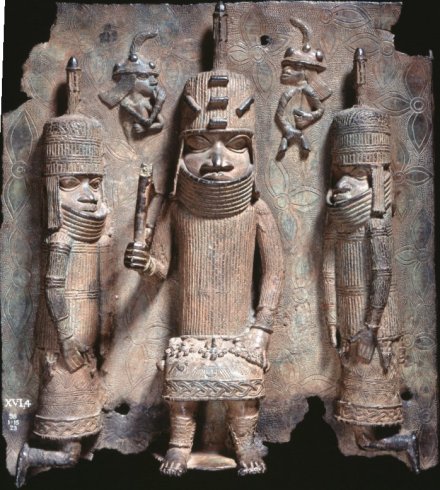
Great Britain’s punitive expedition also resulted in the capture of many hundreds of metal objects scattered to European museums and collections — collectively known as the Benin Bronzes. (It’s a misnomer: they’re actually brass.)

Hocked to defray the expense of their plundering, their diffusion around the empires’ continent helped broaden European appreciation for African art, and influenced modernist art movements. (Notably (pdf) German expressionism: tons of the bronzes ended up in Germany, and many can still be seen at Berlin’s Ethnological Museum.)

Nigeria, and the successor obas of Benin, have for decades besought their return in vain.


Cultural encounter: this Benin “bronze” shows the oba with two attendants, and the smaller floating heads of two European (Portuguese) traders.

More on this object, and its place in the story of Benin and Europe, in this episode of the BBC’s History of the World in 100 Objects; or, at the “bronze’s” page at the British Museum website.

On this day..

1790: Thomas Bird, the first federal execution under the U.S. constitution

This date in 1790 saw the first federal execution under the auspices of the recently ratified U.S. Constitution, when English mariner Thomas Bird hanged in Portland, Maine. (At the time, still part of Massachusetts.)

This book is also available here, and via the author’s Portland, Me., History Blog, or on order from any bookstore.

Today, we’re pleased to interview author Jerry Genesio, whose Portland Neck: The Hanging of Thomas Bird compellingly reconstructs this once-forgotten story — a small British slave ship making landfall in a North American city only recently torched by the British, where it is found that its violent captain has been murdered at sea in unclear circumstances.

In the aftermath of the American Revolution, the one man to pay life for John Connor’s life was the one British sailor aboard the ship.

Besides a captivating account of an 18th century American capital trial, Portland Neck features biographies of all the principal characters. Portlanders will also especially enjoy a 25-page appendix on the topography of the town at the dawn of the American Republic.

This was a British subject who killed a British victim on a British ship in international waters. Was there any question of whether a U.S. court had jurisdiction?

The people who were on the vessel when it was captured — one was British, one was Norwegian, one was American, and there was a 12- or 14-year-old African boy named Cuffey.

They came under U.S. jurisdiction because in the constitutional convention (article 3, section 2), the federal courts were given jurisdiction of admiralty and maritime cases.

The Supreme judicial court in Massachusetts — Maine was part of Massachusetts then — apparently considered bringing the case before its judges, but then the constitution overruled that when it was ratified.

And then they had to wait for the federal courts to be organized, because they didn’t exist yet. They languished in jail for almost a year while the courts were being organized.

In Chapter II, you describe Thomas Bird’s ship, the Mary, operating on the Guinea coast. It’s a small ship basically working the coast and rivers, making small sales of one or two slaves to the large slavers waiting to cross the Atlantic. There must have been whole niches of the slavery industry occupied by these sorts of small-timers.

Oh, yes. The large slave ships that carried several hundred, three, four hundred in their hold — they were too large to get too close to the coast of Africa. So they would anchor perhaps a mile offshore, and they would wait for these smaller ships, like the sloop Mary — Captain Connor was in business with people in London who sent him down there just to go up the rivers to various villages where they knew there were wars going on, and when there were wars, the captives would be sold to slavers. (They also traded ivory and gold.)

When they got slaves, crews like the Mary‘s would go to the ships who had been there the longest, because they knew they would get the best price. They were known to have been there as long as a year trying to fill their cargo, and the slaves they held were liable to die while they waited. Slave ships couldn’t even allow the slaves topside because they would jump overboard if they could and try to swim for shore.

Incidentally, the Google book project has many slave captain logs online. I was able to read about the ports that Captain Connor and Thomas Bird actually visited, and it gave me such a wealth of information, and I could practically see where they were.

Ed. note: here are a few from Genesio’s bibliography, all free at Google books:

You’ve compiled this book despite a paucity of primary trial data, and there are some spots where you’re clearly reading between the lines. How difficult was the historiography on Portland Neck?

There’s not a complete trial record. Even the examination before the court — the scribe tried, apparently, to write down all of their answers, but he did not write down the questions.

My concern is more around the scribe. Was the scribe hearing these answers properly? Was the scribe hard of hearing? One of them was replaced in the process. Was the scribe able to keep up? He was writing with a quill pen, after all.

And then, on top of all of that, they did not indicate on the court record who was the scribe, who did the questioning, and who wrote the answers down. And the prisoner never signed it!

And you felt that at some level, they targeted the Englishman out of this multinational crew.

I believe that people are so influenced by the events of their times — look at World War II and how we viewed the Japanese and the Germans, or the people involved in the war in Vietnam.

These people on the jury, the foreman on the grand jury, many of them were Portland residents whose homes had been burned by the British just 14 years earlier. The war had just ended seven years earlier.

Every one of the court officials on the prosecutors’ side were all officers in the Revolutionary War. [Notably, the U.S. marshal who actually carried out Bird’s hanging, Henry Dearborn. He took part in the decisive Battle of Yorktown and would go on to become Thomas Jefferson’s Secretary of War, as well as the namesake of the city of Dearborn, Michigan. -ed.]

All of these things influence what was going on. And the fact that they acquitted the Norwegian kid and executed the Englishman makes me feel, certainly, that there was a strong influence there that was hostile to Thomas Bird. But what actually happened and how people felt, we’re just too far away — but I suspect that played a role.

Thomas Bird claimed in his dying statement, knowing that he was to be hung in a couple of hours, that he did not kill John Connor. The lawyers desperately tried to get then-President Washington to give him a commutation, and Washington refused to do it.


Information wants to be free, y’all. The newspaper editor tried to sell a broadside with the condemned man’s final narrative, but public pressure eventually forced him to put it in the July 26, 1790 Cumberland Gazette.

How did you come by this story?

When I was working at Portland Public Library and I ran into a couple of lines referring to a Thomas Bird in books by William Willis and William Goold.

In Goold’s book, Portland in the Past, he actually interviewed a fellow named Charles Motley who was in his 90s, and this interview took place in the 1880s. Motley was the youngest child of the jailer who held Thomas Bird, and Charles Motley, and he describes being five years old and being allowed into the cell where Thomas Bird would carve them little toy boats. With a knife! Then when Thomas Bird was executed, there was a note about the jailer’s wife, Emma Motley, taking all seven children away, to the other side of the land from Portland, so that they wouldn’t know what was going on. They were probably playing with Thomas’s boats as he was being hanged. So it was obvious that the Motley family held this Thomas Bird in high regard, and I got to thinking, I want to know more about this guy.

He (Motley) was five years old at the time, and, with his older brother Edward, at the request of Bird, was often admitted by his father to the cell and spent much time there. The prisoner made them toy ships and boats … At the time of the execution, Mrs. Motley, the mother of the boys, took them over back of the Neck to be out of sight of the gallows, as the whole family had become interested in the fate of Bird.

–Goold

For a couple of years, I couldn’t find much of anything. Finally, I took the time to go down to the federal archives in Waltham, Mass., I found a little manila folder that was like a bar of gold. It had 12 little sheets written in quill, and it’s as much of a record of the trial as exists.

The other question in my mind is, why has nobody written about this before? I think maybe it’s because it’s something of an embarrassment, which reinforces my belief that maybe this hanging should not have taken place.

Thomas Bird, if they really suspected he was a participant, should have been punished, but probably shouldn’t have been hung. Unfortunately in those days, captains were like gods on their little wooden worlds. Even though, based on the testimony, [the victim] John Connor was a brutal drunk who beat his men mercilessly. Connor murdered his first mate on that voyage.

It’s sad because Bird probably saw America as some sort of refuge — he probably didn’t expect that he might be hanged for this crime. He’d been at sea since age eight, and all through the [American] Revolution he had been on both American and British ships. The British navy kept impressing him and making him serve on British warships, and he kept deserting and signing up for American ships instead.

One other interesting aspect of this story is that when Thomas Bird was looking for a ship to sign on with and signed on with the Mary, he might just have signed up on the HMS Bounty, because the Bounty was tied up at Wapping before its voyage to Tahiti. Had he signed on with the Bounty, he wouldn’t have fallen into American hands, but he might not have fared any better.

How thick on the ground were slaves and slavers in New England at this time?

There were a lot of slave captains, a lot of owners. Their home ports were in Boston or in Portland. Normally, when they came back to their home port, the product they were carrying was rum and molasses. Slaves would be delivered in the South or in the West Indies, separate legs in the triangle trade.

What’s your next project?

I’m working on a family genealogy.

After that, maybe something about Captain John Lovewell. He was a bounty hunter who went hunting for Indian scalps. In 1725 he was living in Massachusetts, and he got the court to authorize 10 pounds per scalp, and he recruited a small army and took off looking for Indians and found the Pequawket here in Fryeburg, Maine. They were not warriors, they were farmers.

Lovewell and a Scaticook named Paugus ended up killing each other at a battle at a pond now called Lovewell’s Pond.

Lovewell is the namesake of the town of Lovell. A couple of people have written Lovewell’s story, but I wanted to write it from the perspective of the Indians. And not only the Indians, but the true perspective — because John Lovewell was a bounty hunter, not a hero. He was willing to kill farmers who hadn’t killed anyone for their scalps.

On this day..

1535: Cardinal John Fisher

On this date in 1535, Catholic prelate John Fisher was beheaded on Tower Hill for refusing to endorse Henry VIII as the head of the Church of England.

The longtime Bishop of Rochester had only been elevated to the cardinalate weeks before by the new Pope Paul III, in the vain hope that the sublimity of the position would induce King Henry to ease the prelate’s imprisonment.

Henry eased it, all right. Permanently.*

Forbidding the official hat to be delivered to Albion, Henry declared he would dispatch its owner’s head to Rome instead.

A jury including the father of the usurping queen who had occasioned all this trouble — Anne Boleyn, of course, bound for the block herself in less than a year — condemned the aged ecclesiastic to death for treason.

He was hustled to the scaffold on this date to beat the June 24 feast day of his patron and namesake Saint John the Baptist, Christ‘s Biblical precursor who was … beheaded by a ruthless king whose marriage the Baptist had denounced. Struck a little too close to home, that.

Fisher’s friend and fellow-traveler both spiritual and temporal, Sir Thomas More, followed the cardinal’s footsteps to Calvary a fortnight later.

Both men are considered saints not only by Catholics (for obvious reasons) but also by Anglicans. June 22 is their feast day on the Catholic calendar of saints.

* It’s possible Henry had been out for Fisher’s blood for some time. As a foe of the king in his so-called Great Matter of many years’ standing, Fisher was the presumed target of a 1531 assassination-by-poison attempt that resulted in a horrific execution by boiling alive.

On this day..

1648: Margaret Jones, the first witch executed in Boston

We expediently cadge today’s entry from the public-domain Memorial History of Boston, in a section penned by Chicago public librarian William F. Poole.

(The illustrations, their captions, and the footnotes are interpositions from ExecutedToday.com.)


In Boston, the earliest execution for witchcraft was that of Margaret Jones, of Charlestown, on June 15, 1648.* There seems to be no evidence that any earlier case of witchcraft was under investigation in the colony.

Her husband, Thomas Jones, was arrested at the same time on the same charge, but he was not convicted. The little we know of Margaret Jones we find in Governor Winthrop’s Journal. She was evidently a strong-minded woman, and a skilful practitioner of medicine … There was no charge that she had bewitched any one, and the usual phenomena of spectres, fits, spasms, etc. were wanting. The main evidence on which she was convicted was her imps, which were detected by “watching” her …

The Court Records and the Deputies’ Records … for May 18, give an order concerning Margaret Jones and her husband, without the mention of their names, as follows: —

This court, desirous that the same course which hath been taken in England for the discovery of witches, by watching [them a certain time] may also be taken here with the witch now in question: [It is ordered that the best and surest way may forthwith be put in practice, to begin tis night, if it may be, being the 18th of the 3d month] that a strict watch be set about her every night, and that her husband be confined to a private room and watched also” (Deputies’ Records, with the words in brackets inserted from the Court records).

The theory of the English law books was that every witch had familiars or imps, which were sent out by the witch to work deeds of darkness, and that they returned to the witch once a day, at least, for sustenance, and usually in the night. By watching the witch these imps might be detected, and thus furnish certain proof of guilt in the accused.


1647 frontispiece of English witch hunter Matthew Hopkins‘s tract The Discovery of Witches shows witches and their various named familiars.

Michael Dalton’s Country Justice, containing the Practice, Duty, and Power of Justices of the Peace, was a common book in the colonies, and was quoted in the witch trials at Salem. In the chapter on “Witchcraft” it has the following directions: —

Now against these witches, being the most cruel, revengeful, and bloody of all the rest, the justices of the Peace may not always expect direct evidence, seeing all their works are the works of darkness, and no witnesses present with them to accuse them; and, therefore, for the better discovery, I thought good here to insert certain observations, partly out of the ‘Book of Discovery of the Witches that were arraigned at Lancaster, Anno 1612, before Sir James Altham and Sir Edward Bromley, Judges of Assize there,’ and partly out of Mr. [Richard] Bernard’s ‘Guide to Grand Jurymen.’

These witches have ordinarily a familiar, or spirit, which appeareth to them, sometimes in one shape and sometimes in another; as in the shape of a man, woman, boy, dog, cat, foal, hare, rat, toad etc.


A 1579 English image of a witch feeding her familiars. (But not from secret teats.)

And to these their spirits they give names, and they meet together to christen them (as they speak). Their said familiar hath some big or little teat upon their body, and in some secret place, where he sucketh them. And besides their sucking the Devil leaveth other marks upon their body, sometimes like a blue or red spot, like a flea-biting, sometimes the flesh sunk in and hollow (all which for a time may be covered, yea, taken away, but will come out again in their old form). And these Devil’s marks be insensible, and being pricked will not bleed, and be often in their secretest parts, and therefore require diligent and careful search. These first two are main points to discover and convict those witches; for they fully prove that those witches have a familiar, and made a league with the Devil. So, likewise, if the suspected be proved to have been heard to call upon their spirits, or to talk to them, or of them, or have offered them to others. So if they have been seen with their spirit, or to feed something secretly; these are proofs that they have a familiar. They have often pictures [images] of clay or wax, like a man, etc., made of such as they would bewitch, found in their house, or which they may roast or bury in the earth, that as the picture consumes, so may the parties bewitched consume (Edition of 1727, p. 514.)

Mr. John Gaule, in his Select Cases of Conscience touching Witches and Witchcraft, 1646, p. 77, condemning the barbarous methods of discovering witches, thus describes the mode of “watching a witch” in use at the time: —

Having taken the suspected witch, she is placed in the middle of a room upon a stool or table, cross-legged, or in some uneasy posture, to which if she submits not, she is bound with cords. She is there watched, and kept without meat or sleep for the space of four-and-twenty hours. — for they say within that time they shall see her imp come and suck. A little hole is likewise made in the door for the imps to come in at.

…

Margaret Jones was “searched” and “watched;” the fatal witch-marks were discovered, and her imp was seen in “the clear day-light,” as appears in the record of the case which Governor Winthrop made in his Journal at the time: —

[June 15, 1648].** At this court, one Margaret Jones, of Chalrestown, was indicted and found guilty of witchcraft, and hanged for it. The evidence against her was —

  1. That she was found to have such a malignant touch, as many persons, men, women, and children,, whom she stroked or touched with any affection or displeasure, or etc. [sic], were taken with deafness, or vomiting, or other violent pains or sickness.
  2. She practising physic, and her medicines being such things as, by her own confession, were harmless, — as anise-seed, liquors, etc., — yet had extraordinary violent effects.
  3. She would use to tell such as would not make use of her physic, that they would never be healed; and accordingly their diseases and hurts continued, with relapse against the ordinary course, and beyond he apprehension of all physicians and surgeons.
  4. Some things which she foretold came to pass accordingly; other things she would tell of, as secret speeches, etc., which she had no ordinary means to come to the knowledge of.
  5. She had, upon search, an apparent teat … as fresh as if it had been newly sucked; and after it had been scanned, upon a forced search, that was withered, and another began on the opposite side.
  6. In the prison, in the clear day-light, there was seen in her arms, she sitting on the floor, and her clothes up, etc., a little child, which ran from her into another room, and the officer following it, it was vanished. the like child was seen in two other places to which she had relation; and one maid that saw it, fell sick upon it, and was cured by the said Margaret who used means to be employed to that end. Her behavior at her trial was very intemperate, lying notoriously, and railing upon the jury and witnesses, etc., and in the like distemper she died. The same day and hour she was executed, there was a very great tempest at Connecticut, which blew down many trees, etc. (ii. 397, ed. of 1853).

Mr. John Hale,† in his Modest Inquiry, p. 17, mentions the case, but none of the incidents recorded by Winthrop. He was born in Charlestown, was twelve years old at the time, and with some neighbors visited the condemned woman in prison the day she was executed. He says: —

… She was suspected, partly because that, after some angry words passing between her and her neighbors, some msichief befell such neighbors in their creatures [cattle] or the like; partly because some things supposed to be bewitched, or have a charm upon them, being burned, she came to the fire and seemed concerned.

The day of her execution I went, in company of some neighbors, who took great pains to bring her to confession and repentance; but she constantly professed herself innocent of that crime. Then one prayed her to consider if God did not bring this punishment upon her for some other crime; and asked if she had not been guilty of stealing many years ago. She answered, she had stolen something; but it was long since, and she had repented of it, and there was grace enough in Christ to pardno that long ago; but as for witchcraft she was wholly free from it, — and so she said unto her death.

There is no other contemporary mention of the case. It is a horrible record; and if downright, stolid superstition and inhumanity was not surpassed, if, indeed, it was equalled, at Salem forty-four years later. That it was an incident characteristic of the time, and that similar atrocities were being committed in every nation in Europe without shocking the sensibilities of the most refined and cultivated men of that day, are the only mitigating circumstances which can be suggested.

Thomas Jones, the husband of the woman executed, found, on his release from prison, that his troubles had only begun. He resolved to leave the country, and took passage in the Boston ship “Welcome,” riding at anchor before Charlestown … The weather was calm, yet the ship fell to rolling, and so deep it was feared she would founder … hearing that te husband of the executed witch was on board, between whom and the captain a dispute had arisen as to his passage-money, [the County Court of Boston] sent officers to arrest him, one of them saying “the ship would stand still as soon as he was in prison.” No sooner was the warrant shown, tan the rolling of the ship began to stop, and after the man was in prison it moved no more.‡

* Not to be confused with the first witchcraft execution in all of New England, witchwhich distinction belongs, so far as can be documented, to Alse Young in Connecticut the previous year.

** Winthrop does not date this entry himself. The author of this piece observes in a footnote here that “the date next preceding is June 4, 1648. The true date of the execution was doubtless June 15, as appears in Danforth‘s Almanac for that year.

† John Hale is of particular interest as one of the ministers later involved in the Salem witch trials — proceedings he initially supported, but turned against as they unfolded. He appears in that capacity as a character in Arthur Miller’s The Crucible; there’s a short YouTube video series exploring his character in that play: Part 1 | Part 2

The work cited here, A Modest Enquiry into the Nature of Witchcraft, was Hale’s post-Salem critique of witchcraft theology and jurisprudence.

‡ Suggestive evidence indeed. Montague Summers might encourage us to consider the possibility that the Joneses really were witches.

On this day..

1381: Simon of Sudbury and Robert Hales during Wat Tyler’s peasant rebellion

On this date in 1381, a mob’s summary execution on Tower Hill of some nobby English lords marked the acme of that country’s most noteworthy peasant revolt.

The trigger for the revolt was an onerous poll tax levied to finance the realm’s escapades in the Hundred Years’ War, but as Barbara Tuchman notes,

the fundamental grievance was the bonds of villeinage and the lack of legal and political rights. Villeins could not plead in court against their lord, no one spoke for them in Parliament, they were bound by duties of servitude which they had no way to break except by forcibly obtaining a change of the rules. That was the object of the insurrection, and of the march on the capital that began from Canterbury.

Late medieval England was in the throes of economic, and therefore social transformation.

Manorial lords’ traditional power over their peasants had become untenable for a labor pool depleted by the Black Death, survivors of which found themselves consequently in-demand and suddenly blessed with leverage. As one chronicler recorded,

There was so marked a shortage of labourers and workmen of every kind in that period that more than a third of the land in the whole realm was left idle. All the labourers, skilled or unskilled, were so carried away by the spirit of revolt that neither King, nor law, nor justice, could restrain them. … The entire population, or the greater part of it, has become even more depraved… more ready to indulge in evil and sinfulness.

Rentiers put a forceful kibosh on “sinfulness” like rising wages and labor mobility, legislating backwards feudal rights and pre-plague wage levels.

Who Then Was The Gentleman?

It was a ground fertile for insurrectionary sentiment, like the class-warfare sermon of subversive Lollard preacher John Ball:

When Adam delved and Eve span, Who was then the gentleman? From the beginning all men by nature were created alike, and our bondage or servitude came in by the unjust oppression of naughty men. For if God would have had any bondmen from the beginning, he would have appointed who should be bond, and who free. And therefore I exhort you to consider that now the time is come, appointed to us by God, in which ye may (if ye will) cast off the yoke of bondage, and recover liberty.

This cry for justice anticipated the Levellers by almost three centuries.

Poll Position

But these 14th century downtrodden had some rough levelling of their own in mind, and when the poll tax set spark to tinder, the conflagration spread with terrifying rapidity.

[T]here were some that desired nothing but riches and the utter destruction of the noblemen and to have London robbed and pilled; that was the principal matter of their beginning, the which they well shewed; for as soon as the Tower gate opened and that the king was issued out with his two brethren and the earl of Salisbury, the earl of Warwick, the earl of Oxford, sir Robert of Namur, the lord of Vertaing, the lord Gommegnies and divers other, then Wat Tyler, Jack Straw and John Ball and more than four hundred entered into the Tower and brake up chamber after chamber …

These guys were after, above all, John of Gaunt,* the Dick Cheney of 14th century England right down to the malevolent name and underwhelming military achievements: the throne at this time held the posterior of 14-year-old (in 1381) Richard II, and the widely reviled uncle John ran (and freely looted) the realm with a council of loathsome optimates.

London Calling

Luckily for John, he happened to be off at the Scottish frontier when the Peasants’ Revolt rolled into London; the mob settled for destroying his opulent Savoy Palace on June 13.

The next day, it rampaged through the Tower of London

… and at last found the archbishop of Canterbury, called Simon, a valiant man and a wise, and chief chancellor of England, and a little before he had said mass before the king. These gluttons took him and strake off his head, and also they beheaded the lord of Saint John’s and a friar minor, master in medicine, pertaining to the duke of Lancaster, they slew him in despite of his master, and a sergeant at arms called John Leg; and these four heads were set on four long spears and they made them to be borne before them through the streets of London and at last set them a-high on London bridge, as though they had been traitors to the king and to the realm.

Simon’s severed, and incredibly well-preserved, skull has been resident in a cubby at St. Gregory’s Church of Sudbury for lo these six hundred years. It made news recently when it was retrieved for a CT scan to (among other things) reconstruct Simon’s real-life appearance.

Right, these executed-today guys.

Simon of Sudbury, Archbishop of Canterbury and Lord Chancellor of England, and Robert Hailes, Lord High Treasurer, neatly concentrated in their persons the political, financial, and religious power exercised by “the unjust oppression of naughty men.”

Still better, they were the advisors most directly connected to the poll tax. As a reward, they got their polls axed.

This was no mere provincial riot. A lower-class revolt had massed an overwhelming force in the very capital of the kingdom, with most of the main government ministers trapped therein — holed up and inconclusively debating one another about how to get out of this jam. And the movement aimed itself at the conquest of power: Tuchman (citing Benedictine chronicler Thomas Walsingham) says that rebel leader Wat Tyler was anticipated that “in four days’ time all the laws of England would be issuing from his mouth.”


Hey, it’s Baldrick!

In the end, the last thing between history and King Wat — and, if you’re willing to dream an anachronistic dream, a Commune of London — was the peasantry’s foolhardy reverence for the person of the pimply king.

Foreshadowing a later era’s “if only the tsar knew” naivete, the rebels who thirsted for the blood of Richard’s advisors fancied the king their champion. Young and handsome; regal; charismatic; and plausibly not implicated in the villeins’ grievances … you can understand why they thought that. But disarmed thereby of the ruthlessness necessary to strike him, Wat Tyler’s band instead went the way of the typical peasant rising.

Richard the Lionheart

The king’s own nerves were steel in this moment, when a lesser adolescent would have quailed from the perilous task of safeguarding the divinely ordained oligarchy with his own person. Richard was, at this point, still in his minority: other men took the country’s decisions in their own hands. Richard would one day have to fight them for his own kingly rights; but, on the evidence of this crisis, he had already grown up, and fast.

Perhaps reasoning that royalty is the best shroud, Richard invited the rebels out to Smithfield the very next day, June 15. When the royal teenager was in personal parley with Tyler, the king’s buddy William Walworth got into a scrape with the peasant and

gave him a deep cut on the neck, and then a great cut on the head. And during this scuffle one of the King’s household drew his sword, and ran Watt two or three times through the body, mortally wounding him. And he spurred his horse, crying to the commons to avenge him, and the horse carried him some four score paces, and then he fell to the ground half dead. …

when the commons saw that their chieftain, Watt Tyler, was dead in such a manner, they fell to the ground there among the wheat, like beaten men, imploring the King for mercy for their misdeeds.

(This source says that Tyler was retrieved from hospital for a summary execution of his own that same day. Others, such as Froissart, indicate that he died straightway from the wounds he suffered in the fray.)

Brazenly wielding the dread sovereign power over the minds of his subjects, Richard braved death by riding unprotected towards their lines, styling himself their “captain,” commanding their obedience. Peasant archers and pikemen who on that day might have turned English history on its head instead lowered their weapons and submitted themselves.

Though the ensuing bloodbath was a bit less wholesale than the one attending France’s recent Jacquerie, it went rough for the leaders, and concessions the king had made the rank and file vanished along with the danger to his crown. “Villeins ye are,” he would later tell a delegation of petitioners imploring him to effect his pledge to abolish serfdom, “and villeins ye shall remain.”

* John of Gaunt also kind of got the last laugh out of those tumultuous years: though John brokered compromises between the king and his rival nobles, John’s son was one of those rival nobles. After dad’s death, that young man overthrew Richard and established the Lancastrian dynasty as King Henry IV.

On this day..

1857: Twelve blown from cannons in British Punjab

An account from the February 15, 1862 Harper’s Weekly of a very messy spectacle orchestrated to maintain British control of Punjab.

Another execution of a similar nature took place on the 13th of June, at Ferozepore. All the available troops and public establishments were convened to witness the scene. Some of the mutineers were to be hung, and around the gallows, erected during the night previous, the soldiers were drawn up. The mutineers were then brought into the centre, and the proceedings of the general Court-Martial was read. Upon being informed that if they would become Queen’s evidence they would be reprieved, twelve of the criminals accepted the offer and were marched to the rear. Two were taken to the gallows. They ascended the ladder with firm steps, and to the last moment betrayed no emotion of fear.

The remaining ten were now led away to the artillery guns, and while their irons were being struck off some cried, “Do not sacrifice the innocent for the guilty!” Two others rejoined, “Hold your sniveling: die men and not cowards — you defended your religion, why then do you crave your lives? Sahibs! they are not Sahibs, they are dogs!” Others then began to upbraid their commanding officer. The wretched beings were quickly fastened to the muzzles of ten guns, charged with blank cartridge.

The commanding officer directed port-fires to be lit. “Ready!” “Fire!” and the drama was played out. An eye-witness says: “The scene and stench were overpowering. I felt myself terribly convulsed, and could observe that the numerous native spectators were awe-stricken — that they not only trembled like aspen-leaves, but also changed into unnatural hues. Precaution was not taken to remove the sponge-and-load men from the muzzles of the guns; the consequence was that they were greatly bespattered with blood, and one man in particular received a stunning blow from a shivered arm!“


A lengthier account, no less riveting and we suppose more accurate on account of its primary sourcing, is to be found in this memoir or the British campaign against the Sepoy rebellion.

June 13 The morning of June 13 was fixed upon for the execution. A gallows was erected on the plain to the north side of the fort, facing the native bazaars, and at a distance of some 300 yards. On this two sepoys were to be hanged, and at the same time their comrades in mutiny were to be blown away from guns.

We paraded at daylight every man off duty, and, with the band playing, marched to the place of execution, and drew up in line near the gallows and opposite the native quarter.

Shortly after our arrival the European Light Field Battery, of six guns, appeared on the scene, forming up on our left flank, and about twenty yards in front of the Light Company.

The morning was close and sultry, not a cloud in the sky, and not a breath of wind stirring; and I confess I felt sick with a suffocating sense of horror when I reflected on the terrible sight I was about to witness.

Soon the fourteen mutineers, under a strong escort of our men with fixed bayonets, were seen moving from the fort. They advanced over the plain at our rear, and drew up to the left front of, and at right angles to, the battery of artillery.

I was standing at the extreme right of the line with the Grenadier Company, and some distance from the guns; but I had provided myself with a pair of strong glasses, and therefore saw all that followed clearly and distinctly.

There was no unnecessary delay in the accomplishment of the tragedy. Two of the wretched creatures were marched off to the gallows, and placed with ropes round their necks on a raised platform under the beam.

The order was given for the guns to be loaded, and quick as thought the European artillerymen placed a quarter charge of powder in each piece. The guns were 9-pounders, the muzzles standing about 3 feet from the ground.

During these awful preparations, I watched at intervals the faces of the condemned men, but could detect no traces of fear or agitation in their demeanour. The twelve stood two deep, six in front and six in the rear, calm and undismayed, without uttering a word.

An officer came forward, and, by the Brigadier’s order, read the sentence of the court-martial, and at its conclusion the six men in front, under escort, walked towards the battery.

There was a death-like silence over the scene at this time, and, overcome with horror, my heart seemed almost to cease beating.

Arrived at the guns, the culprits were handed over to the artillerymen, who, ready prepared with strong ropes in their hands, seized their victims. Each of these, standing erect, was bound to a cannon and tightly secured, with the small of the back covering the muzzle. And then all at once the silence which reigned around was broken by the oaths and yells of those about to die. These sounds were not uttered by men afraid of death, for they showed the most stoical indifference, but were the long-suppressed utterances of dying souls, who, in the bitterness of their hearts, cursed those who had been instrumental in condemning them to this shameful end. They one and all poured out maledictions on our heads; and in their language, one most rich in expletives, they exhausted the whole vocabulary.

Meanwhile the gunners stood with lighted port-fires, waiting for the
word of command to fire the guns and launch the sepoys into eternity.

These were still yelling and raining abuse, some even looking over their shoulders and watching without emotion the port-fires, about to be applied to the touch-holes, when the word “Fire!” sounded from the officer in command, and part of the tragedy was at an end.

A thick cloud of smoke issued from the muzzles of the cannons, through which were distinctly seen by several of us the black heads of the victims, thrown many feet into the air.

While this tragic drama was enacting, the two sepoys to be hanged were turned off the platform.

The artillerymen again loaded the guns, the six remaining prisoners, cursing like their comrades, were bound to them, another discharge, and then an execution, the like of which I hope never to see again, was completed.

All this time a sickening, offensive smell pervaded the air, a stench which only those who have been present at scenes such as these can realize — the pungent odour of burnt human flesh.

The artillerymen had neglected putting up back-boards to their guns, so that, horrible to relate, at each discharge the recoil threw back pieces of burning flesh, bespattering the men and covering them with blood and calcined remains.

A large concourse of natives from the bazaars and city had assembled in front of the houses, facing the guns at a distance, as I said before, of some 300 yards, to watch the execution. At the second discharge of the cannon, and on looking before me, I noticed the ground torn up and earth thrown a slight distance into the air more than 200 paces away. Almost at the same time there was a commotion among the throng in front, some running to and fro, while others ran off in the direction of the houses. I called the attention of an officer who was standing by my side to this strange and unaccountable phenomenon, and said, half joking: “Surely the scattered limbs of the sepoys have not been carried so far?”

He agreed with me that such was impossible; but how to account for the sight we had seen was quite beyond our comprehension.

The drama came to an end about six o’clock, and as is usual, even after a funeral or a military execution, the band struck up an air, and we marched back to barracks, hoping soon to drive from our minds the recollection of the awful scenes we had witnessed.

Two or three hours after our return news arrived that one native had been killed and two wounded among the crowd which had stood in our front, spectators of the recent execution. How this happened has never been explained. At this time a “cantonment guard” was mounted, consisting of a company of European infantry, half a troop of the 10th Light Cavalry, and four guns, and two of these guns loaded with grape were kept ready during the night, the horses being harnessed, etc. Half the cavalry also was held in readiness, saddled; in fact, every precaution was taken to meet an attack.

As far as I can recollect, there were but two executions by blowing away from guns on any large scale by us during the Mutiny; one of them that at Ferozepore.

On this day..

1675: The murderers of John Sassamon, precipitating King Philip’s War

On this date in 1675, Puritan colonists’ hanging of three Wampanoag Indians helped trigger a brutal bout of ethnic cleansing, King Philip’s War.

The condemned men’s victim, Wassausmon — known by his Christian, Anglicized name of John Sassamon — was a converted Massachuseuk, briefly a Harvard attendee (1653)*, and eventually a translator for several tribes when dealing with the early settlers. Sassamon fought on the colonists’ side during the Pequot War, which has graced these pages before, and was generally seen as very sympathetic to the colonial cause, at one point becoming a schoolmaster at the inception of the towns of Natick and Ponkapoag.

After his work as a translator, Sassamon returned to the Puritan fold to become a minister in the Plymouth Colony.

Because of his high position in both the white and native worlds, though, he drew some resentment from both sides. It was Sassamon’s sense of loyalty to both sides of the growing tension between the natives and colonists that led to his demise.

King Philip (natively known as Metacomet) became head (Sachem) of the Wampanoag Confederacy in 1662 after his brother’s death.

Though initially trade-friendly with the burgeoning colonies to the north and east, the Wampanoag were also feeling the squeeze from the Iroqouis Confederation gaining power to the west. In 1671, the colonies presented the Wampanoag with an ultimatum: give up their arms and submit to English law, or be forced out.

The colonists had tried this tactic before with the Pequot (hence the Pequot War), Narragansett, and other native tribes with great success. As expected, Philip blinked, and the English moved in.

But the Sachem was predictably unhappy with the relationship. Three years later, he had assembled a band of warriors and was ready to, er, renegotiate.

Sassamon got wind of Philip’s planned attack on Plymouth Colony and warned its governor Josiah Winslow. Two months later, Sassamon was fished out from under the ice of Assawompset Pond.

With one witness claiming that a trio of King Philip’s men had knocked off the translator and dumped the corpse, the Puritans became convinced that Philip was already getting involved in their affairs.

In June 1675, four months after Sassamon’s body was found, a mixed jury of Indians and colonists convicted three Pokanoket Indians of murdering Sassamon, and on June 8, they were hanged.**

The executions helped bring tensions to the breaking point, and Philip decided it was his time.

On June 18, he launched an attack on homesteads in Swansea, and the war was on. The colonists struck back, laying siege to Mount Hope with the thought of gutting the insurgency by capturing its leader. That move failed, and King Philip escaped to recruit more tribes to his cause. Eventually, the forces included five major native tribes fighting colonists and two other major tribes.

Things got ugly fast: the conflict would become one of North America’s bloodiest colonial wars, and touch everyone who lived in the region. In September, the New England Confederation officially declared war on the Native Americans of the area.

After suffering months of casualties, the colonists finally gained a foothold in the conflict in December. By spring, King Philip’s War was in full swing, with atrocities happening on both sides. But the native forces were being worn down, and the colonists began clawing back. Despite rampant destruction of towns across the colonies (including complete abandonment of a dozen or more), the colonists had fortresses to retreat to and boats to resupply them; the natives needed to trade with the colonists to get their arms. The situation was unsustainable, and when Canadian supply lines fell through, King Philip’s adventure was over.

Persistent enemies of many of the raiding tribes, the Plymouth-allied Mohegans took the offensive and broke up Philip’s warrior bands, scattering them across the Northeast. By the following summer, the Narragansett were defeated and dispersed, and the colonists were granting amnesty to natives who surrendered and could document non-participation. (Others were not so lucky.) In July, King Philip himself was isolated and on the run, taking refuge in Mount Hope. It was there that John Alderman, a Native American, shot him on August 12, 1676.

Philip’s body was mutilated: he was quartered and beheaded, and his head was displayed in Plymouth Colony Fort for years to come.

After the war, Mary Rowlandson, who was taken captive by Philip’s men, wrote a memoir about her experience. Philip’s escapades were also later made into a play.

* Harvard, founded in 1636, started its “Indian Harvard” in 1655 which saw a total of five students: Caleb Cheeshahteamuck (Aquinnah Wampanoag) took a degree in 1665 and died of tuberculosis a year later; classmate Joel Iacoombs (Aquinnah Wampanoag) disappeared in a shipwreck off Nantucket before walking; John Wampus (Aquinnah Wampanoag) bailed after a year and went to sea; and Benjamin Larnell and an otherwise unnamed “Eleazer” caught smallpox and died the year they enrolled.

** One account reports that only two of the Indians died on the first drop; the third was spared by his rope breaking, and after confessing the guilt of all three, he was re-executed.

On this day..

1572: Thomas Howard, Ridolfi plotter

On this date in 1572, the Duke of Norfolk lost his head for a conspiracy to overthrow Queen Elizabeth.

Thomas Howard was a born plotter. Literally.

The fourth Duke of Norfolk, he inherited the title from the third Duke of Norfolk — his eponymous grandfather, the scheming courtier who had maneuvered nieces Anne Boleyn and Catherine Howard into disastrous matrimony with Henry VIII.

Having run afoul of his ruthless sovereign, this elder Howard then had the distinction of dodging execution only because the king himself dropped dead the very day before Howard was to have been beheaded.

The Norfolk title, however, did skip a generation, because grandpa Howard’s son Henry Howard was not so lucky, and abdicated his birthright at the block.*

That left our day’s principal, a mere boy of 10 when his father got axed, as his lucky grandfather’s heir apparent — to carry on the Howard scheming against his second cousin, Anne Boleyn’s lucky daughter Queen Elizabeth.

And young Thomas Howard would prove to be a chop off the old block.

Howard’s sympathies for Catholicism and for swinging an ever-bigger dick led him into a machination to wed Elizabeth’s northern rival Mary, Queen of Scots.

Lucky to get off with just a slap on the codpiece, Howard went right back at it with an unabashed Spanish-supported conspiracy to depose Elizabeth, again in favor of Mary — the Ridolfi Plot.

This chicanery was sniffed out by Elizabeth’s pervasive spy network, and while Mary’s royal status enabled her to survive the revelation, Norfolk had already got down to his last chance.

The conflict between Elizabeth and Norfolk, heavily fictionalized and climaxing in the Ridolfi Plot, is essentially the plot of of the 1998 movie Elizabeth.

Having endured so much trouble from these nettlesome Howards, the crown left the Duke of Norfolk title vacant for nearly a century after this date’s beheading. It was finally restored to a mentally deficient Howard descendant with the post-Cromwell Stuart restoration.

* And that’s just on the dad’s side. His maternal grandfather and great-grandfather from the Stafford family also met their ends on the scaffold.

On this day..

1673: Thomas Cornell, on spectral evidence

(Thanks to Meaghan Good of the Charley Project for the guest post. -ed.)

On this day in 1673, alleged mother-slayer and arsonist Thomas Cornell was hanged in Portsmouth in the colony of Rhode Island.

The death of his elderly mother, Rebecca, and the subsequent homicide investigation have got to be one of the strangest murder stories in American colonial history.

The Cornells were a respectable and prosperous Quaker family, the ancestors of the man who founded Cornell University. (Their descendants also included Lizzie Borden of the “forty whacks” fame, but that’s another story.)

Rebecca, a 73-year-old widow, was the legal owner of the family’s hundred-acre spread by Narragansett Bay. Her oldest son, Thomas, and his wife and six children lived there with her, along with one lodger and one male servant, a Narragansett Indian named Wickopash.

Crowded as the house was, Rebecca had the master bedroom all to herself. It was well known that Rebecca and Thomas didn’t get along. For some time, both parties had been complaining bitterly about each other to anyone who would listen. Thomas resented the fact that, at 46, he was still financially dependent on his mother, who had made generous gifts from her late husband’s estate to her other children but not to him. Rebecca, for her part, said Thomas was “a Terror to her” and that she was neglected and had to fetch her own firewood.

None of her complaints were taken seriously until after her mysterious death, which is chronicled in Elaine Forman Crane’s 2002 book Killed Strangely: The Death of Rebecca Cornell.

Rebecca died on the evening of February 8, 1673.

That night, she refused to join the family for dinner because she didn’t like what was being served. After the meal was over, her grandson came to her room to check on her and found her charred body lying on the floor by the fireplace, burnt “to a cole.” She was recognizable only by her shoes.

Her death was originally ruled “an unhappie accident.”

It could have been spontaneous human combustion, but a more likely explanation is that embers from the fireplace or from the pipe Rebecca smoked landed on her dress.


An alleged victim of spontaneous human combustion.

No one heard her scream, no one smelled smoke, and somehow the fire didn’t spread to the rest of the house. No one seems to have suspected foul play at that time.

Two nights later, however, Rebecca’s younger brother, John Briggs, received a spiritual visitation from his sister as she slept. “See how I was burned with fire,” she said. He inferred that someone had intentionally burned her.

Briggs didn’t report his experience for a week, but when he did his account was taken seriously by the superstitious colonials. Rebecca’s body was exhumed and given a thorough inspection, and this time a wound was found on her upper abdomen. The authorities decided she had been stabbed by something like “the iron spyndell of a spinning whelle.” No murder weapon was ever produced, however.

Thomas quickly became the prime suspect: he was the last person to see Rebecca alive, and the whole town knew of the enmity between them. After Rebecca’s death, Thomas and his wife Sarah reportedly made some incredibly crass remarks; Sarah said her mother-in-law’s demise was “a wonderfull thing,” and Thomas said that his mother had always liked a good fire, and “God had answered her ends, for now shee had it.”

This hearsay was presented as evidence at Thomas’s trial, along with John Briggs’s dream.

Thomas was convicted and, although many of the townspeople had doubts about the verdict and death sentence, he chose not to appeal. He was hung before a crowd of over one thousand people.

Did Thomas Cornell murder his mother?

Certainly he wasn’t the only one who had the opportunity to do so; the house was full of people that night. In fact, a year after Thomas’s death, the servant Wickopash was tried as an accomplice to the murder. Nothing is known about the case against him, but he was acquitted.

In 1675, Rebecca’s son William tried to make a case against Thomas’s wife for the murder, but he failed to produce any witnesses or evidence against her.

Was this even a murder at all?

The fire, as noted above, could have been accidental; as for the “suspicious wound” the authorities found after they dug up the body, Rebecca could have stabbed herself in her struggles after her dress caught fire, or perhaps those who performed the exhumation saw only what they expected to see.

And there is yet a third possibility: prior to her death, Rebecca told her daughter she had contemplated suicide on several occasions, but her religious beliefs prohibited such action.

One final note: Thomas’s wife, Sarah, was pregnant at the time of his execution and later gave birth to a daughter.

She named the baby Innocent.

On this day..